This guide is independent and contains no paid placement. It gives general safety information only and is not a substitute for veterinary advice. If you suspect heatstroke, contact a vet promptly.
A heatwave week is a timetable problem, not a toughness test. Move every walk, game and journey into the cool hours, keep the middle of the day for shade, water and sleep, never leave a dog in a parked car, and treat heavy panting that will not settle as a reason to cool the dog and call a vet. The dogs most at risk are flat-faced breeds, overweight dogs, older dogs, puppies and dogs with thick coats or breathing problems, but any dog can overheat on a hot day.
Reading the forecast and the 5-second pavement test
A heatwave rarely arrives as a single scorching afternoon. It builds over several days, and the danger grows with it: night-time temperatures stay high, so the dog starts each morning already warm, pavements and buildings hold heat long after sunset, and a dog that coped on day one may struggle by day three. That is why the first job on a hot-weather holiday is not packing a new toy or planning a long walk. It is reading the forecast properly, every morning, and letting it set the day.
Start with the daytime high, but do not stop there. The overnight low matters just as much, because a warm night means the house, caravan or tent never fully cools and the ground is still warm at dawn. Humidity matters too: dogs cool themselves mainly by panting, and humid air makes panting less effective, so a muggy 26 degrees can be harder on a dog than a dry 30. Wind, cloud cover and the timing of the peak all change the picture, and local conditions can differ sharply from the regional headline — a sheltered south-facing garden, a sun-trap courtyard or a beach with no shade can be several degrees hotter than the forecast for the nearest town. If a detail of the forecast is unclear, or if local heat-health advice differs from what you expected, check the official guidance before you travel rather than guessing from a single number on a phone screen.
Next, translate the forecast into a personal risk check for the dog in front of you. Flat-faced breeds such as bulldogs, pugs and French bulldogs have shorter airways and struggle to lose heat by panting, so they are at higher risk even at temperatures other dogs tolerate. Overweight dogs carry extra insulation and work harder to move, older dogs and puppies regulate temperature less well, and dogs with heart or breathing conditions, thick double coats or dark coats that absorb sunlight all need extra caution. A dog that has overheated before, or that pants heavily after only gentle exercise in normal weather, should be treated as high risk for the whole week. Write that assessment down at the start of the holiday and share it with everyone who will walk or watch the dog, so a well-meaning relative does not undo a careful plan with one long midday walk.
Then comes the simplest and most useful test of the week: the 5-second pavement test. Press the back of your hand firmly onto the surface your dog will walk on, or stand on it with your own bare foot, and hold it there for a full five seconds. If it feels uncomfortably hot to you, it is too hot for your dog. Pavements, tarmac roads, stone patios, decking and sand all store heat, and they stay hot long after the air begins to feel pleasant in the evening. Test every surface, not just the first one: a shaded lane can be cool while the sunny stretch beyond the corner burns, and a beach path that was fine at breakfast can be painful by late afternoon. Repeat the test whenever the sun moves, after a change in cloud, and before the evening walk, because ground temperature lags behind air temperature in both directions.
If the test fails, change the route rather than pushing through. Grass, shaded woodland paths, damp earth and streamside tracks are kinder on paws, but check them too, because dry grass over baked soil can still be warm and a woodland path in full sun is no different from a road. Keep the dog on a lead across hot surfaces on the way to somewhere cooler, carry the dog over short stretches of unavoidable hot ground if the dog is small enough to lift safely, and consider protective boots only if the dog is already used to wearing them — a heatwave is a poor time to introduce unfamiliar kit. Watch the paws during and after the walk: limping, licking, reluctance to keep walking, or redness and blisters between the toes are signs the surface was too hot, and the dog should be moved to a cool surface and checked carefully.
Finally, build a daily forecast habit that takes two minutes and prevents most heatwave mistakes. Each morning, check the high, the overnight low and the humidity, note the hottest hours, and write the day's walking windows on paper or in a phone note: an early window and a late window, with the middle of the day blocked out for rest. Check again in the early evening, because forecasts shift and a cooler evening than expected is a gift, while a hotter one means the late walk should be shorter or skipped. Save the number of the nearest vet and the out-of-hours service before the first hot day, not during an emergency, and keep a printed note of the holiday address, because a stressed caller trying to direct a vet or a taxi will forget details that seemed obvious at breakfast. For help finding that number on an unfamiliar trip, see the guide to finding an emergency vet on holiday.
The cool hours: early morning and late evening
In a heatwave, the day belongs to the hours at its edges. The early morning walk, taken before the sun has real strength, and the late evening walk, taken once the ground has genuinely cooled, are not lesser versions of a normal walk. They are the whole walk, and everything else in the day should be arranged around them. Dogs that get their exercise, sniffing, toileting and social time in these two windows are calmer, sleep better through the hot hours, and are far less likely to be pushed into the dangerous middle of the day by a restless afternoon.
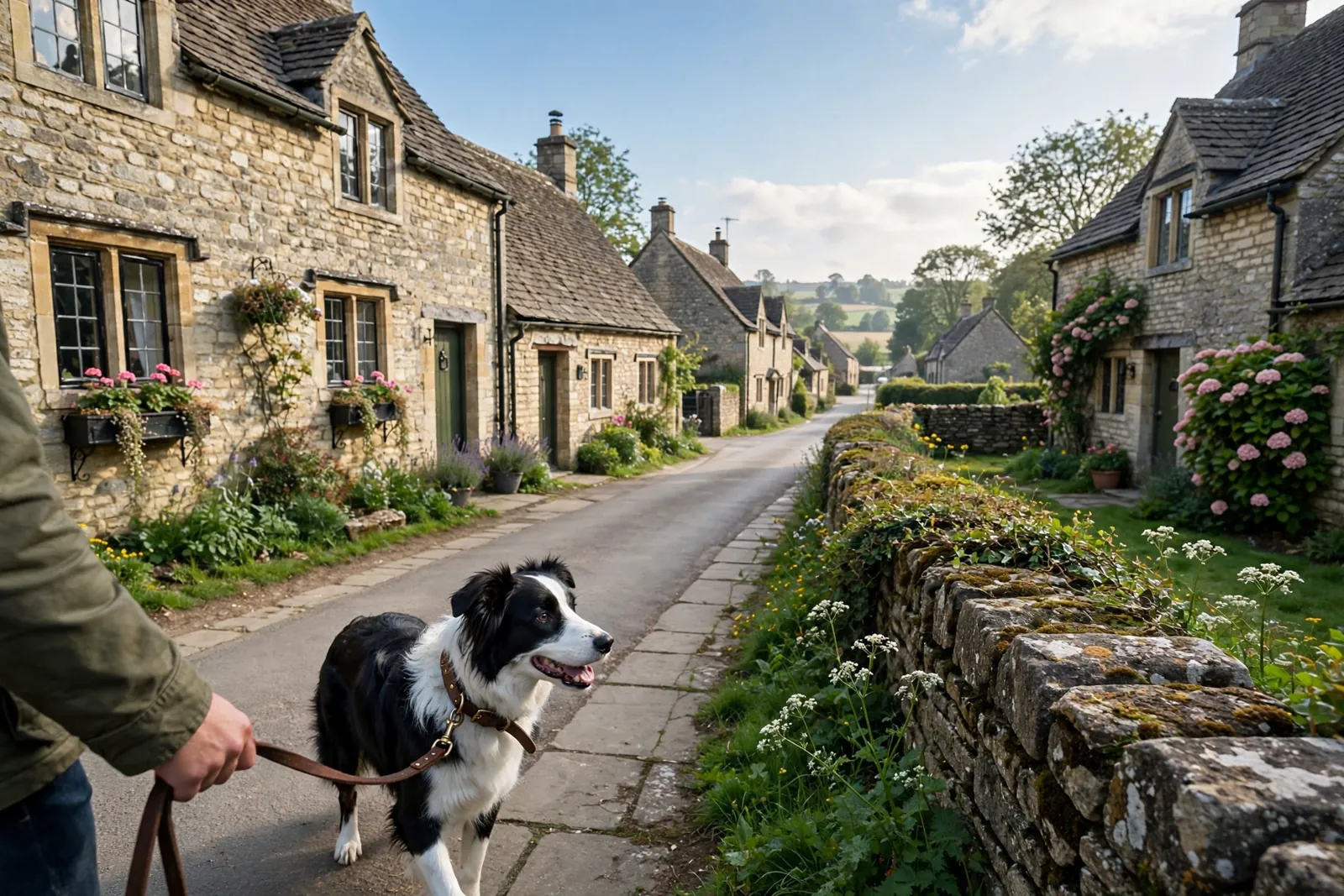
The morning window is usually the better of the two. Aim to be out before the heat builds, which in a British heatwave often means setting an alarm earlier than feels like holiday. The air is at its coolest, the ground has had the night to lose heat, and the dog can move freely without the sun on its back. Keep the pace gentle even in the morning: a sniff-heavy wander with plenty of pauses suits a hot week far better than a run, a long game of fetch or a steep climb, because exercise generates heat inside the dog and that heat has to go somewhere. Bring water even for a short morning walk, offer it at pauses rather than waiting for the dog to look desperate, and watch for the first signs of effort — panting that stays heavy after a rest, a slowing pace, or a dog that seeks every patch of shade is telling you the walk is already long enough.
Water deserves its own routine in the cool hours. Offer fresh water before the walk, carry a bottle and a collapsible bowl on the walk, and offer water again as soon as you return. At home, keep several bowls in different rooms so the dog never has to cross a hot conservatory or a sunlit kitchen to drink, and refresh them through the day rather than leaving one large bowl to grow warm and stale. Some dogs drink less when they are hot or unsettled, so add water to dry food, offer ice cubes or frozen treats made from diluted stock or plain water with a few treats frozen inside, and keep an eye on intake without forcing it. A dog that refuses water entirely, or that drinks far more than usual, is worth a call to a vet for advice.
The evening window needs more judgement than the morning one, because the air can feel cooler while the ground is still dangerously hot. Always repeat the 5-second pavement test before the evening walk, even if the breeze feels pleasant, and be ready to delay the walk by an hour or to shorten it if the ground has not cooled. Evening light also brings its own hazards on a holiday: busier roads as people return from days out, barbecues and food scraps on beaches and in parks, and midges near water in some areas. Keep the dog on a lead where food, traffic or other dogs could turn a calm evening into a chase, and carry a torch or a light on the collar if the walk runs into dusk.
Between the two windows, the dog still needs toileting, and that is where many heatwave plans quietly fail. A short, shaded garden break on grass is enough: out, toilet, a drink, and back inside before the heat builds. Do not turn a toilet break into a play session, do not throw a ball in a sunny garden at noon because the dog looks bored, and do not assume that a dog lying in the sun is comfortable — dogs will lie in sunshine out of habit and overheat while doing it. Move beds, bowls and resting spots into the shade as the sun moves, and check sun patches through the day, because a favourite bed that was shaded at breakfast can be in full sun by lunch.
Feeding fits the cool hours as well. Many dogs eat less in heat, and a large meal in the middle of a hot day can leave a dog lethargic and uncomfortable. Offer the main meals in the morning and evening, keep portions normal unless a vet advises otherwise, and avoid feeding immediately before exercise or immediately after a hot walk, when the dog is still panting hard. Store food somewhere cool, discard wet food left uneaten in a warm room, and remember that a dog that skips one meal in heat is usually fine, while a dog that skips meals and water together, vomits, or has diarrhoea needs veterinary advice promptly.
The dangerous middle of the day
The middle of the day in a heatwave is not a time to be managed with a bit more water and a bit more shade. It is a time to be avoided for anything active. Roughly from late morning to late afternoon, the combination of direct sun, hot air, radiant heat from walls and pavements, and humidity leaves a dog very little room to cool down. A dog at rest in shade can cope; a dog walking, playing, travelling or even standing in a sun-trap conservatory can tip over into overheating surprisingly quickly. The rule for the whole week is simple: when the sun is high, the dog rests.
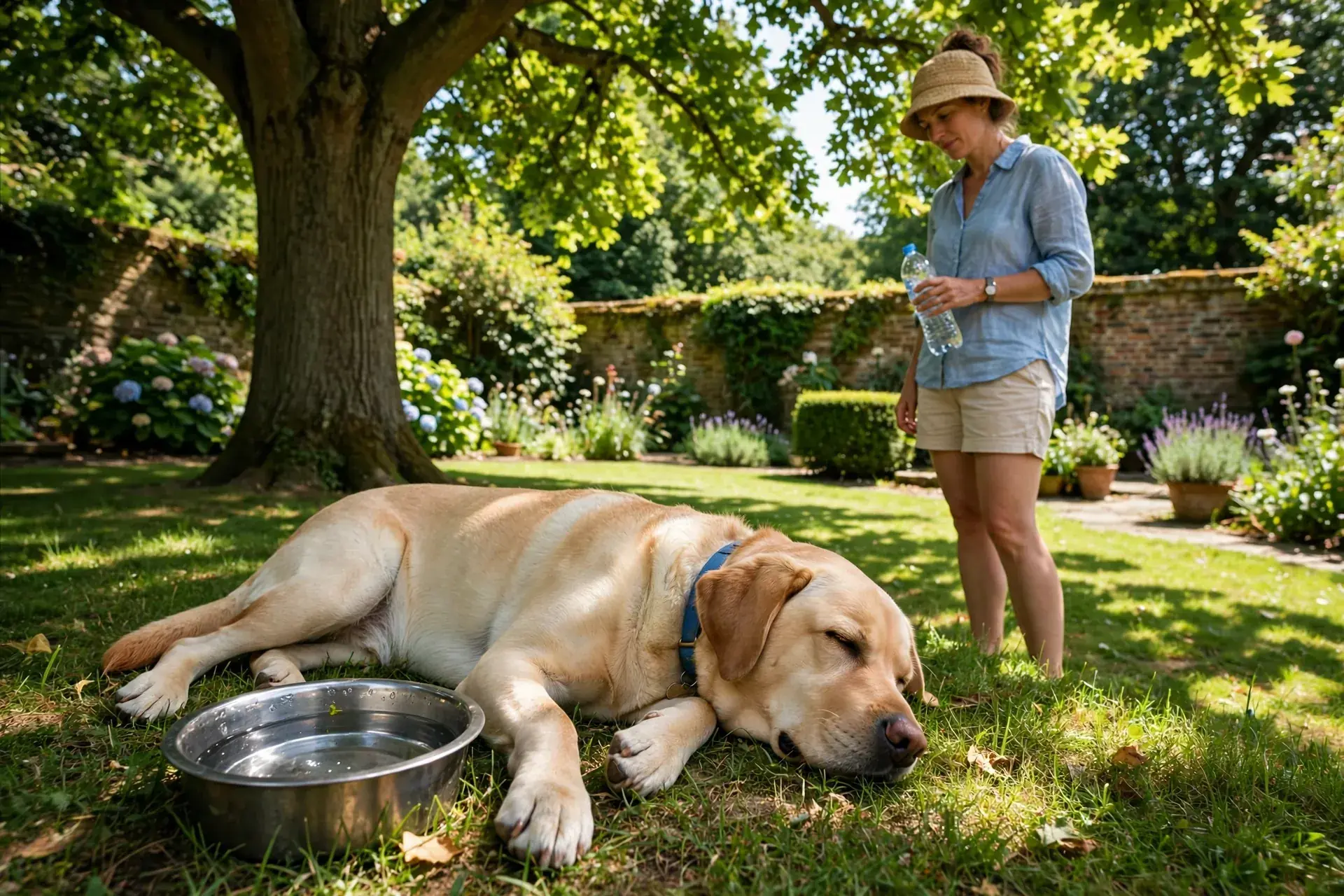
Shade is the first requirement, and it has to be real shade, not a token strip beside a wall. A tree canopy, a parasol that actually covers the dog and its bed, an awning, or a cool room indoors all count; a narrow shadow that moves every twenty minutes does not, because the dog will end up in full sun while everyone is looking the other way. Check the shade at midday itself, not at breakfast, and move the dog's bed, water and resting area as the sun tracks across the garden or campsite. Indoors, the coolest room is usually on the shaded side of the building, away from south-facing windows and glass doors, and a room with a tiled or stone floor will stay cooler than a carpeted room above a heated space. Close curtains on the sunny side, open windows on the shaded side for airflow where it is safe to do so, and keep internal doors open so air moves rather than pooling in a hot room.
Water and airflow complete the midday setup. Keep fresh, cool water within a few steps of the resting spot and top it up regularly, because a bowl in a warm room heats up and dogs drink less from warm water. A fan aimed near, but not directly and constantly at, the dog helps moving air carry heat away, and a damp towel on a tiled floor gives the dog a cool surface to lie on — as long as the towel is refreshed when it warms up. Cooling mats can help, but they are not a substitute for shade and rest, and a dog that lies on a cooling mat in full sun is still a dog in full sun. In a caravan, motorhome or tent, the midday problem is sharper: these spaces heat fast, ventilate poorly, and can become hotter than outside, so the dog should rest in the shade outside under an awning, or in a properly ventilated building, rather than shut inside a vehicle or tent.
Enrichment in the middle of the day should be calm and indoors. Scatter feeding, a stuffed food toy kept in the fridge, a gentle training game with the dog lying down, or a frozen lick mat will tire a dog's brain without heating its body. Avoid the activities that feel like harmless holiday fun but add heat: fetch in a sunny garden, running beside a bicycle, agility-style play, long games of tug that leave the dog panting hard, and swimming in warm shallow water that offers no real cooling. Even a paddling pool needs care — it should be in shade, filled with cool water, and used for short paddles with the dog free to step out, not as a place to leave a dog unsupervised. Never use a muzzle that prevents the dog from panting fully, and never cover a dog with a heavy coat or blanket in heat, however smart it looks.
There is also a short list of things that must never happen in a heatwave, and it is worth stating plainly because each one still happens every summer. Never leave a dog in a parked car, a conservatory, a glass-fronted porch, a tent or a caravan in the sun. Never exercise a dog in the heat of the day to tire it out. Never tie a dog outside a shop, cafe or attraction in full sun while you go inside. Never leave a dog in a garden with no shade and no water, even for a short errand, because shade moves and water spills. And never assume that because a dog has managed heat before, it will manage it again — age, weight, fitness, illness and sheer cumulative tiredness over a hot week all change the risk, and yesterday's easy afternoon is no guarantee for today.
Finally, watch the dog, not the clock. The official hottest hours are a guide, but a humid, still afternoon at a lower temperature can be worse than a breezy, dry day at a higher one. If the dog is panting heavily at rest, seeking cool floors, drooling, or lying flat and reluctant to move, the day is already too hot for anything but rest, however early it seems. Bring the dog inside, offer water, improve the airflow, and let the dog sleep. A boring afternoon is a successful afternoon in a heatwave, and the evening walk will be all the better for it.
Cooling a dog safely, step by step
Knowing how to cool a dog matters most in the minutes before a vet is involved, and the method matters as much as the intention. The goal is steady, gentle cooling: bring the body temperature down without shocking the system, keep the dog calm, and get veterinary help on the way. Cooling that is too aggressive can cause shivering, which generates heat again, or can constrict blood vessels near the skin and trap heat inside. Slow and steady, with airflow, is the right approach, and it should start the moment you realise the dog is too hot, not after a wait to see if things improve.
Step one is to move the dog out of the heat. Bring the dog into shade or, better, into a cool room, and stop all exercise at once. Do not carry on walking to the car, the house or a nicer spot if a shaded place is already close — every extra minute of effort adds heat. Lay the dog on a cool surface such as tiles, stone or damp grass, loosen any harness, coat or tight collar, and keep other dogs and excited people away so the dog can settle. If the dog is in a car, get it out into the shade immediately and do not wait for the air conditioning to cool the vehicle around it.
Step two is to wet the dog with cool, not ice-cold, water. Pour or sponge cool water over the body, paying attention to the belly, the inner thighs, the paws and the ears, where blood vessels run close to the surface. A wet towel laid over the body works, but it should be kept damp and cool — a towel that warms up against a hot dog becomes insulation, so re-wet it frequently. A fan, an open window or a breeze across the wet coat will speed cooling considerably, and a gentle spray from a bottle can help for a dog that dislikes being soaked. Do not plunge the dog into ice-cold water, do not pack ice around the body, and do not cover the dog with wet towels and then leave it, because trapped damp heat helps nobody.
Step three is to offer water in small amounts. A dog that is alert enough to drink should be offered small sips of cool water at intervals, not a huge bowl all at once, which can cause vomiting. Do not force water into the mouth of a dog that cannot swallow properly, is distressed, or is losing consciousness, because of the risk of inhaling it. Ice cubes to lick can be useful for a dog that is alert but reluctant to drink, and a small amount of water over the tongue and gums is safer than a forced gulp. Keep offering, keep watching, and keep the cooling going while you arrange the next step.
Step four is to contact a vet promptly and keep cooling on the way. Call ahead so the practice can prepare, describe what happened — how long the dog was in the heat, what it was doing, and what signs you have seen — and follow the practice's instructions about whether to continue cooling during transport. Travel with the windows open or the air conditioning on, keep wet towels available, and keep the dog as calm and still as possible. Even if the dog seems to recover, with panting easing and energy returning, the dog still needs veterinary assessment, because overheating can cause damage that is not obvious at first and can develop over the following hours.
There are a few common mistakes worth naming, because they come from good intentions. Do not wait until the dog collapses before acting: heavy, unrelenting panting, drooling and restlessness are already the moment to cool and call. Do not give the dog a cold bath and then wrap it in blankets. Do not try to cool the dog with alcohol, which can be absorbed through the skin and is harmful. Do not offer food while the dog is overheated. And do not assume that because the dog has been cooled, the incident is over — a vet needs to check the dog, and the rest of the week needs a stricter plan, with shorter walks, earlier hours and a lower threshold for calling for help.
Prevention, as always, beats cooling. Pack a heat kit before the holiday and keep it where you can reach it: a bottle of water, a collapsible bowl, a small towel, a spray bottle, and the vet's number on paper as well as in a phone. Practise the routine once on a normal day so that nobody is working it out for the first time in a panic. Cooling a dog is a skill like any other, and the dogs that come through hot weeks best are usually the ones whose owners rehearsed the boring parts — shade, water, timing and a phone call — long before the temperature rose.
Recognising heatstroke and calling a vet urgently
Heatstroke is what happens when a dog's body temperature rises faster than panting and other cooling mechanisms can bring it down, and it can develop with frightening speed. It is not simply being hot and tired. It is a medical emergency in which the dog's internal temperature climbs to a level that can damage organs, and the difference between a scare and a serious outcome is often measured in minutes. That is why this section comes before any travel or holiday planning: if you can recognise the early signs and act at once, you may never need the rest of it.
The early warning signs are worth learning by heart. Heavy panting that does not ease after rest, rapid or noisy breathing, and drooling thicker than usual are the first signals most owners notice. The gums may look bright red or, as the situation worsens, pale, grey or blue-tinged. The dog may seem restless and unable to settle, then suddenly lethargic, wobbly on its feet, or unwilling to move at all. Vomiting or diarrhoea, sometimes with blood, can follow, and in severe cases the dog may collapse, tremble, have a seizure, or lose consciousness. Any one of the later signs — collapse, vomiting, disorientation, seizures or unconsciousness — means the situation is already urgent, and the dog needs a vet immediately, not after a cooling attempt at home has run its course.
Some dogs will show subtler signs first, and on a holiday these are easy to miss. A dog that normally charges after a ball but now trots and stops, a dog that lies flat on a cool floor and refuses a favourite treat, a dog that pants while lying still in shade long after a walk has ended, or a dog whose ears and paws feel unusually hot are all signalling that cooling is not keeping up. Brachycephalic dogs may make louder breathing noises than usual, and their distress can escalate faster than a longer-nosed dog's, so noisy breathing in a flat-faced breed in heat should be treated as a warning, not as normal summer noise. When in doubt, cool the dog and call a vet for advice — a phone call that turns out to be unnecessary is always better than a delay that turns out to matter.
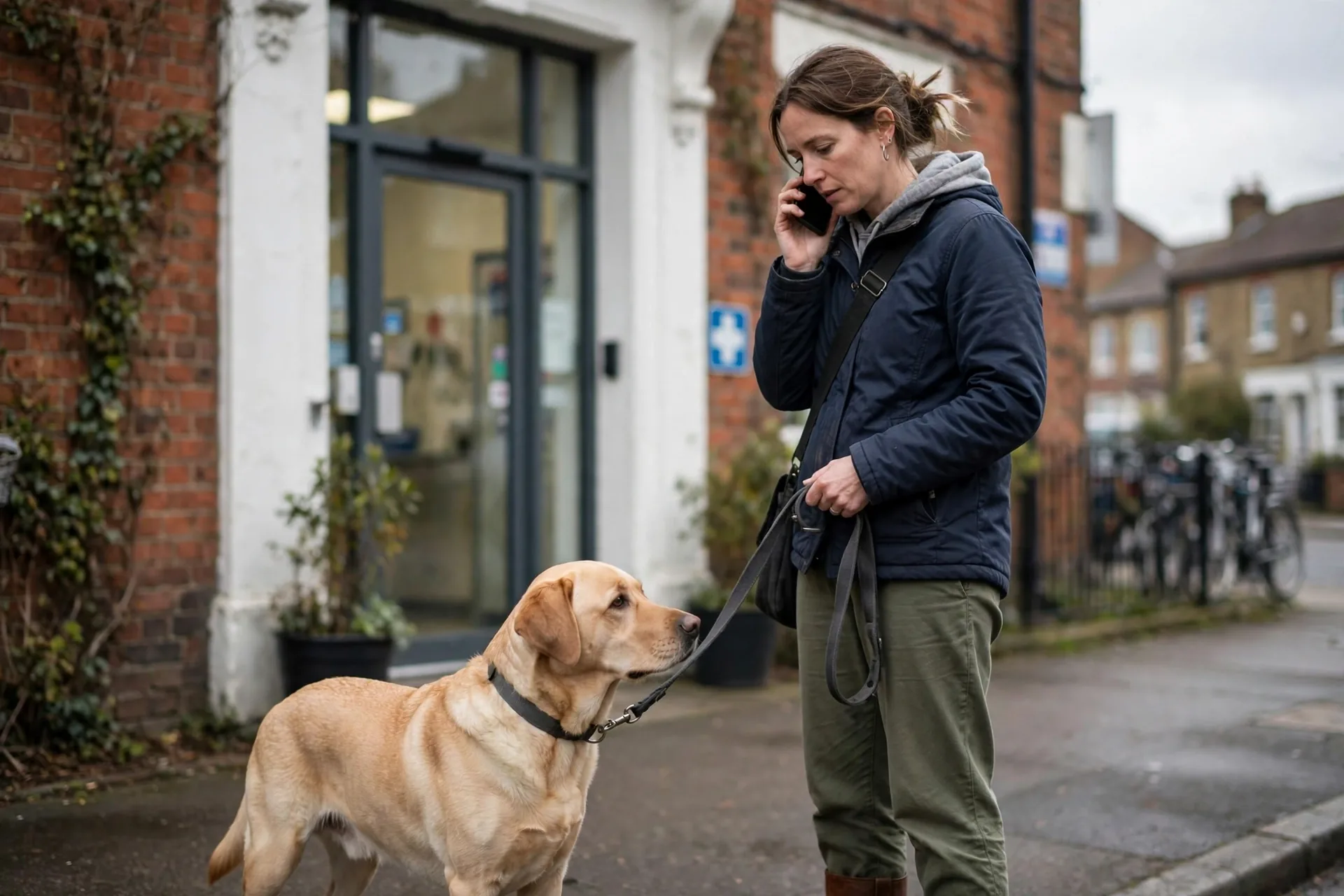
When you call, be ready with the facts a vet needs. Say where you are staying and how long it will take to reach the practice, what the dog was doing and for how long, how long the signs have been present, and what cooling you have already started. If the practice is closed, use the out-of-hours number, and if you are staying somewhere remote, ask at booking time — before the holiday — which practice covers emergencies and how far away it is. Keep the dog's details to hand: age, breed, weight if known, any medication, and any previous overheating episode. A clear, calm summary helps the practice judge urgency and prepare, and it stops a stressed caller from forgetting the one detail that matters.
What happens next is for the vet to direct, and this guide deliberately keeps medical detail general. Expect the practice to want to see the dog even if cooling seems to have worked, because the effects of overheating can continue inside the body after the outside looks better. Follow the vet's instructions about continued cooling, transport and monitoring, and do not try to treat the dog at home with medicines intended for people. After any suspected heatstroke episode, the rest of the holiday changes: walks get shorter and earlier, the dog rests more, and the threshold for calling the vet again drops to almost nothing. A dog that has overheated once is a dog to watch closely for the rest of the week.
Finally, make sure everyone travelling with the dog knows this section, not just the person who read the guide. Children, grandparents, friends and kennel staff should all know the signs and the rule: cool gently, call the vet, do not wait. Print the warning signs and the vet's number and put them on the fridge, the caravan door or the kennel noticeboard. On a hot week, the most valuable thing in the holiday home is not the barbecue or the beach bag. It is a phone number everyone can find, and a group of people who know when to use it.
Travelling and cars in heat
Cars and heat are a dangerous combination for dogs, and the danger starts before the journey does. A parked car in sunshine heats up far faster than most people expect, and opening a window a crack makes very little difference. On a warm day, the inside of a car can reach dangerous temperatures within minutes, and a dog left inside — even with water, even in the shade of a tree that will move, even for what was meant to be a five-minute errand — can overheat before the owner returns. The rule is absolute and non-negotiable: never leave a dog alone in a parked car in hot weather. If the dog cannot come with you, the plan changes, not the rule.
That rule shapes the whole journey, starting with timing. Travel in the cool hours wherever possible: an early morning departure or a late evening drive is kinder than a midday motorway run, and it also means less traffic, fewer queues and fewer unexpected delays in the sun. Before setting off, check the car properly: air conditioning that actually blows cold, windows and ventilation that work, and a shaded, secure place for the dog that is not in direct sun through a rear window. A sunshade on the rear window, a light-coloured cover over a crate, and a cool mat under the dog's bed all help, but none of them replaces airflow and a reasonable cabin temperature. For the restraint itself — harness or crate, boot or back seat — the choice should be made and fitted before the hot week, not improvised on departure morning; see the guide to choosing a dog car harness or crate for the fitting and safety details.
On the road, build the journey around breaks and water. Stop every couple of hours at most, and more often in real heat, choosing shaded service areas or lay-bys where the dog can toilet on grass, drink, and cool down before the next leg. Never exercise the dog hard at a motorway stop in the heat of the day — a short shaded toilet break is enough — and never leave the dog in the car while the rest of the party goes inside for lunch. If the party splits, the dog goes with a person into the shade, or the stop is rearranged. Keep water and a bowl within reach throughout the journey, offer small drinks at every stop, and watch for panting that stays heavy after the car has cooled: that is a sign to extend the break, improve the airflow, and consider whether the journey should pause until the evening.
Breakdowns and delays deserve a plan of their own, because they are when the parked-car rule gets tested. If the car breaks down in heat, get the dog out into the shade at once, with water, and keep the dog out of the vehicle while help is arranged. Pack a small breakdown kit for the dog alongside the human one: water, a bowl, a towel that can be dampened, a lead, and a shade source such as a large umbrella or a reflective blanket that can be rigged as a sunshade. If you are travelling with a dog that cannot safely wait by a busy road, agree in advance who stays with the dog and who deals with the vehicle, and keep the vet's number and the breakdown service number together.
At the destination, the car does not stop being a risk. A car parked in a sunny holiday-park space, a beach car park or a campsite field heats up just as fast as it did on the motorway, and dogs are sometimes left in cars while owners unload, check in, or queue for an attraction. Unload the dog first, into shade, with water, and only then deal with luggage and paperwork. The same applies at beaches and attractions: if dogs are not allowed inside, and there is no shaded, safe place for the dog with a person, the outing is not suitable for a heatwave day. Check the official guidance before you travel where beach or attraction rules are unclear, because seasonal dog restrictions and heat combine to close options that look open on a map. For the wider picture on seasonal beach rules, see the guide to UK beach dog rules and bans.
Finally, remember that heat affects the driver as well. A hot car makes for a tired, irritable driver, and a dog panting loudly in the back adds distraction. Keep the cabin comfortable for everyone, take the breaks you planned, and do not let a tight arrival time push a journey into the hottest hours. Arriving an hour later, with a calm dog and a cool car, is a better start to a holiday than arriving on time with a dog that has spent the afternoon struggling to cool down.
A seven-day heatwave routine for holiday bases, kennels and campsites
A single hot day can be improvised around. A whole heatwave week cannot. By day three or four, small daily stresses accumulate: the dog sleeps less well in a warm room, walks get slightly too long because everyone is bored, water bowls are topped up slightly less often, and a dog that was coping starts to flag. A written seven-day routine prevents that slow slide. It does not need to be elaborate. It needs to say, for each day, when the dog walks, where the dog rests, who is responsible, and what happens if the forecast worsens.
Day one is the setup day, and it is the most important day of the week. Arrive, if possible, in the cool hours, and before unpacking properly, walk the base: find the shaded resting spots at midday, the grass toilet area, the nearest tap, and the coolest room. Save the vet's number, check the shade at midday rather than assuming it, and set up the dog's bed, bowls and cooling mat in the place that will stay shaded all afternoon. Keep day one deliberately quiet — a short morning or evening walk, a calm settle, an early night — because a tired, overstimulated dog starts a heatwave week at a disadvantage. If you are staying at a holiday park or campsite, ask the staff on day one about the heat plan: where dogs can rest in extreme heat, whether there is a shaded communal area, and what the site does on its hottest days.
Days two and three are when the routine should settle into its shape. Morning walk, breakfast, rest through the middle of the day with calm enrichment, late walk, evening meal, and a final shaded toilet break. Keep a simple daily log, even just a few lines: how the dog coped on the walks, how much it drank, whether panting settled quickly, and anything unusual such as a skipped meal or loose stools. The log sounds fussy, but on day four, when someone asks whether the dog is coping worse than on day two, the log gives an answer instead of a guess. If the forecast peaks on one of these days, treat it as a rest day in advance: cancel the longer walk, plan an indoor day, and tell everyone the plan has changed before boredom invents a midday outing.
The middle of the week is where kennels and campsites need specific attention. In kennels, ask before booking — not on arrival — how the kennels are ventilated, whether each kennel has shade for the whole afternoon, how often water is refreshed, and what the staff do on the hottest day: extra checks, damp towels, fans, or moving dogs to a cooler block. A good kennels will have ready answers; vague answers are a reason to choose elsewhere. Ask also how exercise is timed: kennel dogs should not be run in the midday heat, and play sessions should move to the cool hours just as holiday walks do. Leave written instructions for the dog — risk factors, normal drinking and eating, warning signs, and the vet's number — and make sure the kennels have a contact who can make decisions if you are unreachable.
Campsites bring a different set of problems, because tents and awnings are heat traps. Pitch, if you have a choice, where afternoon shade falls, not where the morning sun looks prettiest, and rig a shade cloth or tarpaulin that covers the dog's resting area for the whole afternoon, checking it as the sun moves. Never leave a dog shut in a tent in the sun, and never assume a tent with the door open is cool — on a still day it can still be hotter inside than out. The dog's bed should be on grass or a cool mat in the shade outside the tent, with water beside it, and the tent itself should be ventilated at night so the dog does not start the next day already warm. If the campsite has a shaded communal area, a stream, or a woodland edge, learn its location on day one and use it as the midday base. If the site offers no genuine shade at all, that is a reason to move, not a problem to endure for a week.
Holiday cottages, lodges and caravans sit between the two. In a cottage, identify the coolest room and keep it as the dog's base, with curtains drawn on the sunny side and airflow through the shaded side. In a lodge or caravan, watch the decking: south-facing decking can become too hot for paws by mid-morning, and a dog that toilets on decking needs a grass alternative. Check where the dog can rest if the accommodation itself heats up — a shaded garden, a nearby woodland walk in the cool hours, or a dog-friendly cafe with a cool interior for a short visit. Wherever you stay, keep the same daily rhythm: the dog should be able to predict when walks happen and when rest happens, because predictability lowers stress and stress raises body temperature.
Days six and seven are for winding down, not cramming in missed adventures. Dogs that have spent a week in heat are tired, even if they look enthusiastic, and a long final walk in the hottest part of the last day undoes a careful week. Keep the last full day to the established routine, pack the car in the cool hours, and travel home early or late rather than at midday. When you get home, keep the routine for another day or two: cool-hour walks, plenty of water, and a watchful eye for delayed effects such as lethargy, reduced appetite or loose stools. If anything seems off, call your own vet and mention the heatwave week, because a dog's history over the previous seven days is part of the picture.
Above all, a heatwave week rewards the owners who change the plan early. The best holiday in hot weather is rarely the one with the most miles walked or the most attractions ticked off. It is the one where the dog slept well, drank well, walked in the cool hours, and came home as healthy as it left. That is a lower bar than most holiday plans set, and on a hot week it is exactly the right one. If the forecast, the accommodation or the dog itself says the week is too hot for the plan you made, change the plan. The dog will not mind a quieter week. It will only mind a week that was too hot.
Practical questions
Before you go
Can I walk my dog at midday during a heatwave if we stay in the shade?
No. Shade helps, but it does not remove the risk on a very hot day. Air temperature, humidity and heat radiating from pavements and walls can still push a dog toward overheating, and exercise adds heat the dog then has to lose. Keep midday for rest, water and shade, and save walks for the early morning or late evening.
How do I check whether the pavement is too hot for my dog's paws?
Press the back of your hand, or your own bare foot, firmly on the pavement for five seconds. If it feels uncomfortably hot for you, it is too hot for your dog. Choose grass, shaded paths or a cooler time of day instead, and check again after the sun has moved, because a path that was safe in the morning may be dangerously hot by afternoon.
What should I do first if I think my dog has heatstroke?
Move the dog to shade or a cool room at once, start gentle cooling with cool water and airflow, and contact a vet urgently. Do not wait to see whether the dog recovers on its own, and do not use ice-cold water or force the dog to drink. A dog that has overheated needs veterinary assessment even if it starts to look better.
Is it ever safe to leave a dog in a parked car with the windows open?
No. A parked car heats up very fast in sunshine, even with a window cracked open and even on a day that does not feel extreme to you. Never leave a dog alone in a parked car in hot weather. If you cannot take the dog with you, change the plan so the dog stays somewhere cool and safe instead.
How should I plan a week at a campsite or kennels during a heatwave?
Build the week around the cool hours, confirm shade, water and ventilation before you arrive, and agree a heat plan with the site or kennels in advance. Ask where the dog will rest at midday, how air moves through the sleeping area, and what happens on the hottest day. If the site cannot offer genuine shade and cool rest, change the dates or the accommodation rather than hoping the weather relents.