This guide is independent and contains no paid placement. If affiliate links are added later, they will be clearly marked and will not change our editorial checks.
Clean legs and belly at the door every time, let plain mud dry before brushing when you can, rinse only what is actually dirty, and dry the coat fully before the dog settles on bedding. Full shampoo baths are the exception on a muddy holiday, not the daily routine — and mats are dealt with slowly, from the outside in, never by yanking or by cutting close to the skin.
The first muddy paw print
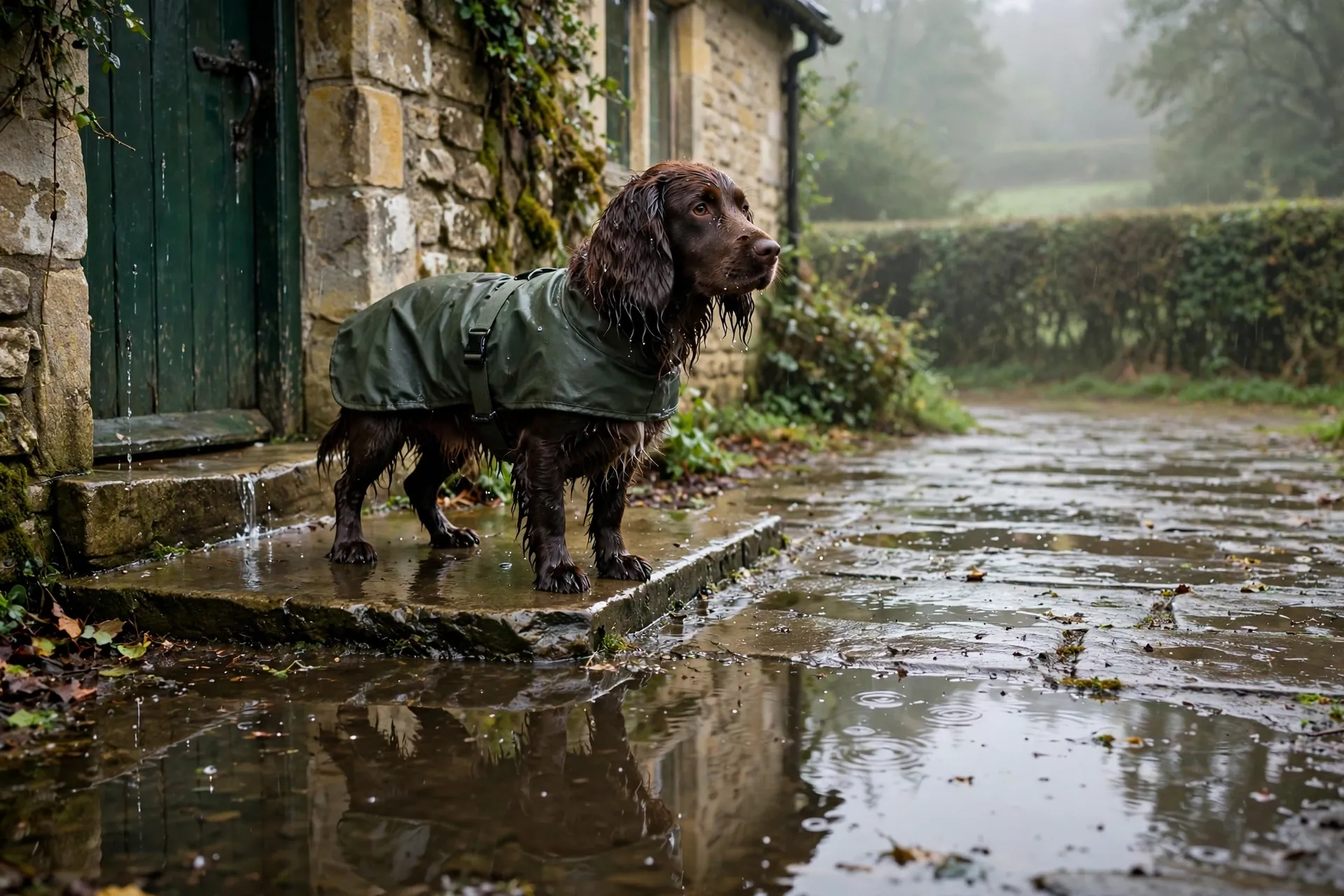
The holiday does not go wrong when the dog gets muddy. It goes wrong at the moment the first muddy paw print crosses the doormat and nobody has a plan for the second, third and twentieth print that will follow it. On a British walking holiday, mud is not an accident or a single bad day. It is the normal condition of field edges in November, woodland paths after rain, riverbanks in spring, farm tracks in February and coastal paths where the cliff-top grass has turned to slurry. A dog that walks properly will get muddy, and a holiday that pretends otherwise ends with gritty bedding, a damp smell in the living room and a coat that mats a little more each evening.
So start at the doormat, literally. Before the first proper walk, stand in the doorway with the dog and look at what you actually have to work with. Is there a porch, a boot room, a tiled kitchen floor or only a carpeted hallway? Is there an outside tap, a drain, a shower with a handheld head, or just a bath the dog will hate? Where will wet towels go so they do not sit in a damp heap? Where will the dog wait while you clean its legs — and will it wait, or will it bolt for the sofa the second the lead comes off? The answers to those five questions shape the whole week far more than the brand of shampoo in your bag.
The useful mindset is a small, boring routine repeated without drama. The dog comes in, stops in the same place, gets legs and belly dealt with, gets a drying coat or a towel, and only then gets access to the rest of the house. Dogs learn routines quickly when the routine is consistent, short and followed by something good: a drink, a chew, a settle on their own bed. What dogs do not learn is a different panic routine every evening, with one person chasing them with a towel while another person shouts about the rug. Calm, predictable and quick beats thorough, stressful and late. If the full clean takes twenty minutes and the dog hates it, you will skip it on the wettest night, which is exactly when you need it most.
This guide follows that logic. It works by coat length, because a smooth-coated terrier and a long-coated collie do not have the same mud problem at all. It separates dry cleaning from wet washing, because drying mud off is often kinder and more effective than washing it straight away. It deals with mats as a daily prevention job, not a weekend emergency. And it treats the room — the porch, the car boot, the bedding — as part of coat care, because a clean dog put straight onto a muddy blanket is a muddy dog again within an hour.
Map the coat before the mud
Before you pack a single brush, spend ten minutes at home mapping your dog's coat. Run your hands over the whole dog, slowly, and note where the coat is longest, thickest, thinnest and most likely to tangle. The usual trouble spots are behind the ears, under the armpits, between the back legs, around the feathering on the legs and tail, and on the belly where wet grass brushes all day. Those are also the spots most owners miss, because they are not visible when the dog is standing nicely for a photograph. On a muddy holiday, those hidden spots collect mud, hold dampness longest and mat first.
Coat length is the simplest sorting tool, but density and texture matter just as much. A short, dense double coat can hold an astonishing amount of muddy water close to the skin while looking almost clean on top. A single, silky long coat may look dramatic when wet but dries faster and brushes out more easily than a thick, cottony coat that felts at the slightest provocation. A curly coat does not shed mud the way a smooth coat does; it traps it in the curls. A wiry coat repels light rain but collects burrs, seeds and sticky clay in the beard and eyebrows. If you are unsure what kind of coat your dog has, ask your groomer before the holiday and write down the answer. A groomer's two-minute description — brush type, problem areas, whether the undercoat should be thinned — is worth more than a drawer full of generic tools.
Also note the dog's skin and habits. Does the belly get red after wet grass? Do the paws crack in winter? Does the dog chew at its feet after walks? Is there a scar, a lump or a sore patch you need to avoid pressing? Dogs with sensitive skin, allergies or a history of hot spots need a gentler holiday routine and a lower threshold for seeking advice. The same applies to puppies, older dogs and dogs recovering from surgery: their coats may look ordinary, but their tolerance for long baths, cold rinses and vigorous towelling is lower. Check the official guidance before you travel if you are unsure whether a particular product, wash or grooming step is suitable for your dog's age or condition.
Finally, be realistic about time. A long-coated dog on a muddy week needs ten to fifteen minutes of coat care after a wet walk, plus a longer brush once the coat is dry. A short-coated dog may need five minutes. If your holiday plan involves two long walks a day, a pub lunch and a drive to a beach, that coat-care time has to come from somewhere. Building it into the return routine — porch, clean, dry, settle — stops it becoming a chore squeezed in at bedtime, when both dog and owner are tired and patience is thin.
Short coats: fast, but not foolproof
Short-coated dogs — think Labradors, Staffies, beagles, French bulldogs, smooth terriers and short-coated mixed breeds — are the easiest muddy-holiday dogs in one sense and the most underestimated in another. Mud does not tangle in a short coat, and a good towel often removes most of it. But short coats also offer very little protection. Muddy water reaches the skin quickly, grit sits directly against the belly and inner thighs, and a short coat that looks clean can still be damp underneath for hours if the dog lies down straight after a walk.
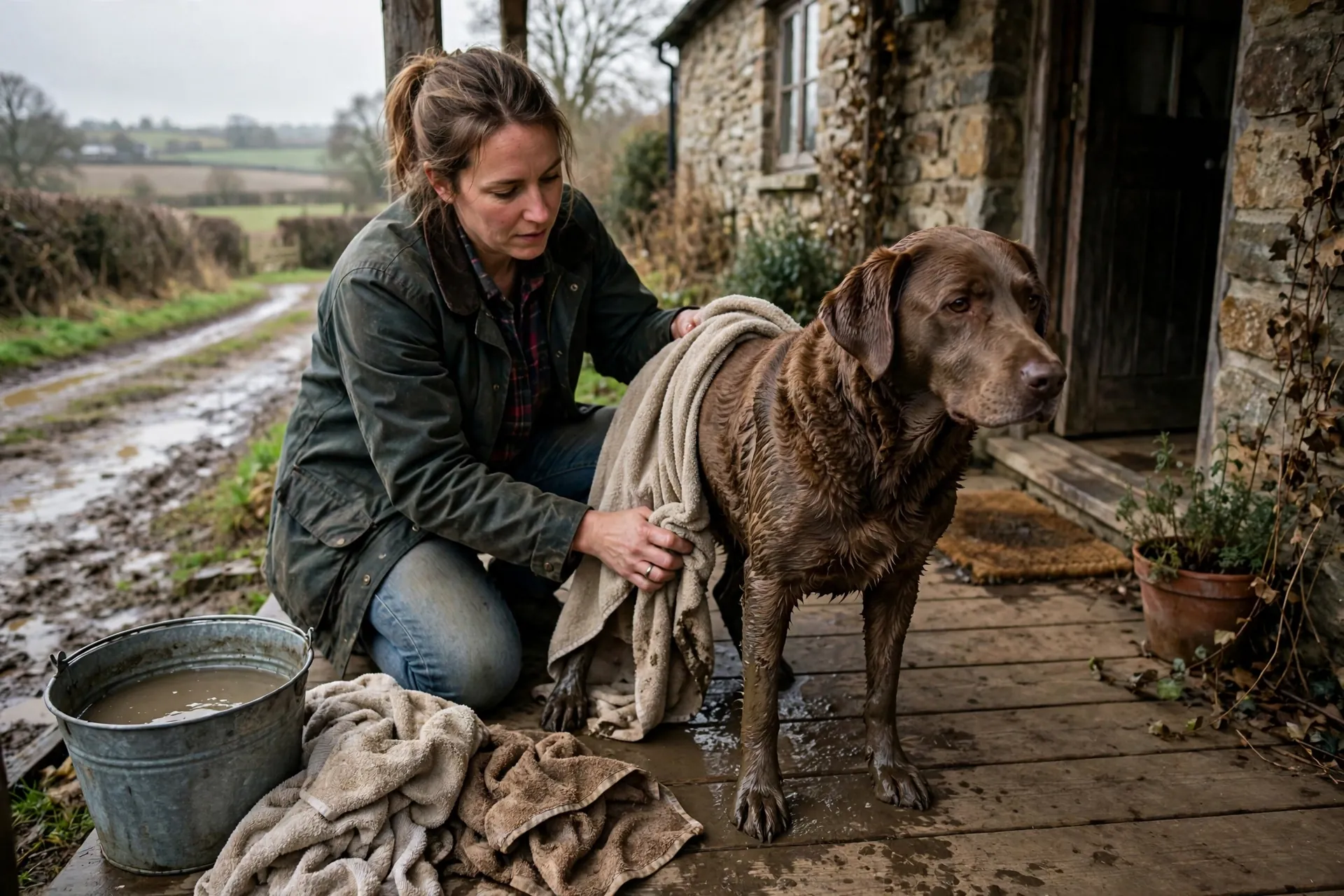
The routine for a short coat is simple, and simplicity is the point. At the door, wipe or rinse legs, belly and chest first, because those are the areas that touched mud, puddles and wet grass. Use lukewarm water for a rinse, not cold water from an outside tap in winter, and not hot water either. Dry with a large, absorbent towel using a pressing and rubbing motion that follows the direction of the coat, then check the skin as you go. Pay attention to the groin, the armpits and the folds of skin on breeds with wrinkles or loose skin, where dampness and grit can irritate quickly. A microfibre towel or a dedicated dog towel absorbs far more than a thin hand towel, and two towels — one for the worst mud, one for the final dry — work better than one towel used twice.
Do not assume a short coat needs no brushing. A rubber grooming mitt or a short bristle brush, used for two minutes once the coat is dry, removes loose hair, dried mud dust and dead skin, and gives you a chance to feel for cuts, ticks and sore spots. In shedding season, that two-minute brush also keeps loose hair off holiday bedding, which matters more in a small cottage than it does at home. Bathing a short-coated dog on holiday is rarely needed more than once, if at all, unless the dog has rolled in something foul, been in salt water, or walked through a substance you would not want on your own skin. Plain water, thorough drying and a brush will handle ordinary field mud.
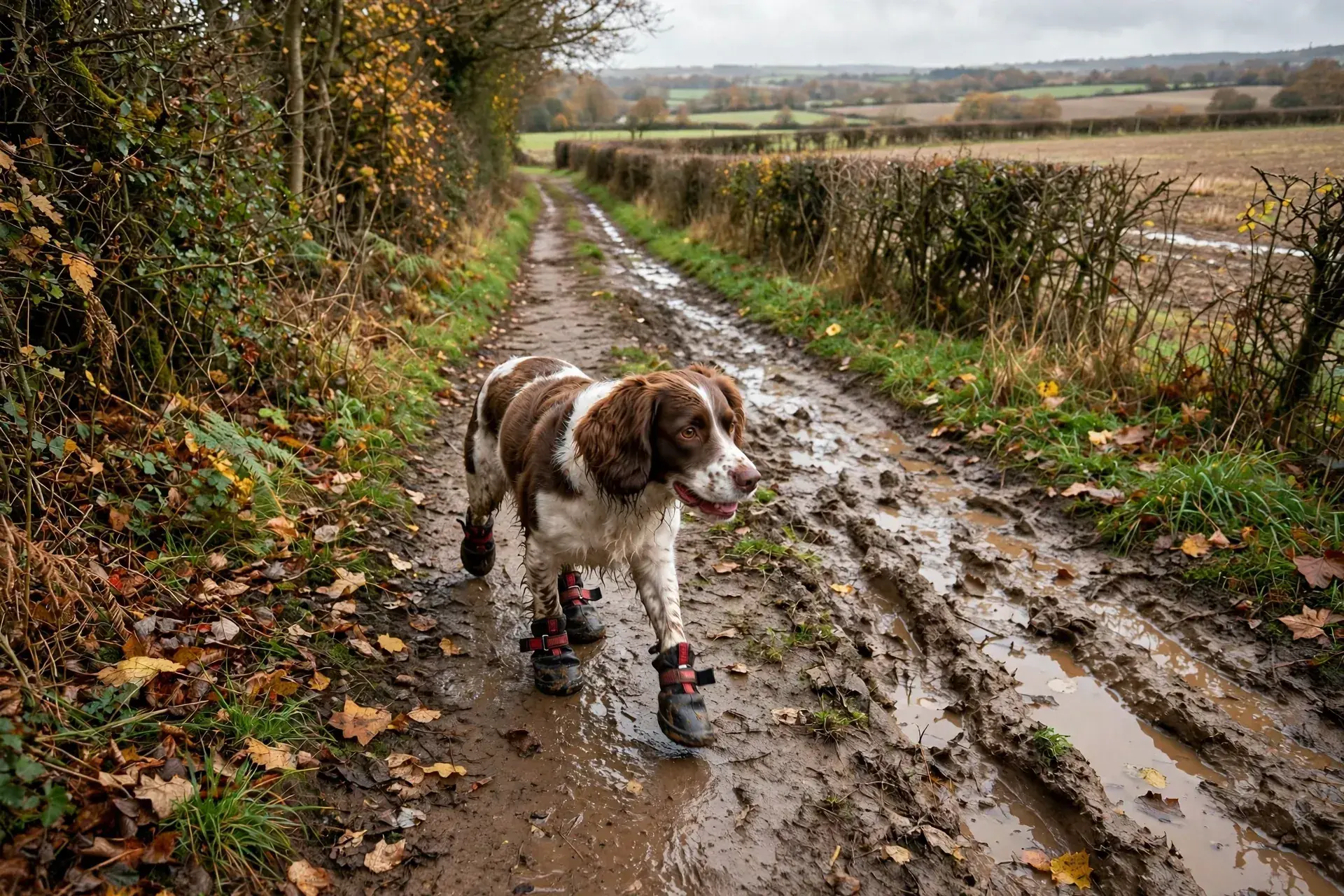
Watch the paws in particular. Short-coated dogs often have less feathering to protect the feet, so mud, grit, road salt in winter and small stones sit directly between the toes. After a walk, spread each paw gently, rinse out grit, and check for cracks, cuts or redness between the toes. If your dog licks its feet persistently after walks, the cause may be irritation from grit or salt rather than habit, and a rinse followed by a proper dry often helps. Boots can help some dogs on gritty or salty ground, and our guide to best dog boots for muddy walks explains measuring, fit and when boots do more harm than good.
Medium coats: the feathering trap
Medium-coated dogs — spaniels, setters in pet trim, border collies, many retrievers and a large share of mixed breeds — are where muddy holidays get interesting. The main body coat may be manageable, but the feathering on the ears, chest, legs, belly and tail is longer, softer and far more absorbent. Feathering acts like a fringe of small towels dragging through every puddle, ditch and wet field. It soaks up muddy water, picks up leaves, twigs and burrs, and then, as it dries, it tangles. Owners often focus on the back, which looks fine, while the feathering quietly forms mats behind the ears and between the back legs.
The door routine for a medium coat therefore has two stages. First, deal with the worst mud: rinse legs, belly and feathering with lukewarm water, working from the paws upwards so dirty water runs down and away rather than being pushed further into the coat. A jug, a watering can with a rose head, or a low-pressure shower head is often easier to control than a powerful hose, which can drive grit into the coat and frighten a nervous dog. Second, towel dry in sections: paws, then lower legs, then feathering, then belly. Squeeze feathering gently in the towel rather than rubbing it vigorously in all directions, because rubbing wet feathering is one of the fastest ways to create tangles.
Once the dog is dry — and this is the crucial part — brush the feathering with a slicker brush or a pin brush, working in small sections from the ends towards the skin. A comb should glide through feathering without catching. If it catches, there is a tangle, and the tangle should be dealt with that evening, not left for the end of the week. A light leave-in conditioning spray made for dogs can help the brush glide, but use it sparingly on holiday and avoid heavy, scented products that may irritate skin or attract the dog to lick the coat. Trimming is a separate decision: a small tidy of straggly feathering before the holiday, done by a groomer, can reduce mud collection dramatically, but do not clip a medium or double coat short at home on the eve of a trip without advice, because you may remove insulation the dog needs.
Ear care deserves a special note for spaniels and similar breeds. Long, heavy ears drag in mud and water, and the ear leather itself can stay damp long after the body is dry. After a wet walk, lift each ear gently, wipe the outer ear with a clean damp cloth, and check for redness, smell or discharge. Do not poke cotton buds or fingers deep into the ear canal. If the ears smell strongly, look sore, or the dog shakes its head repeatedly, that is a reason to seek veterinary advice rather than to keep cleaning at home.
Long and double coats: mud hides deep
Long-coated and double-coated dogs — Old English sheepdogs, long-coated collies, Samoyeds, huskies, chows, Afghan hounds in full coat and many long-coated crossbreeds — present a different problem altogether. Mud does not just sit on the surface. It works its way through the outer coat into the dense undercoat, where it holds water against the skin for hours. The dog may look only slightly damp on top while the undercoat is soaked, and a quick towel over the back does almost nothing for the layers underneath.
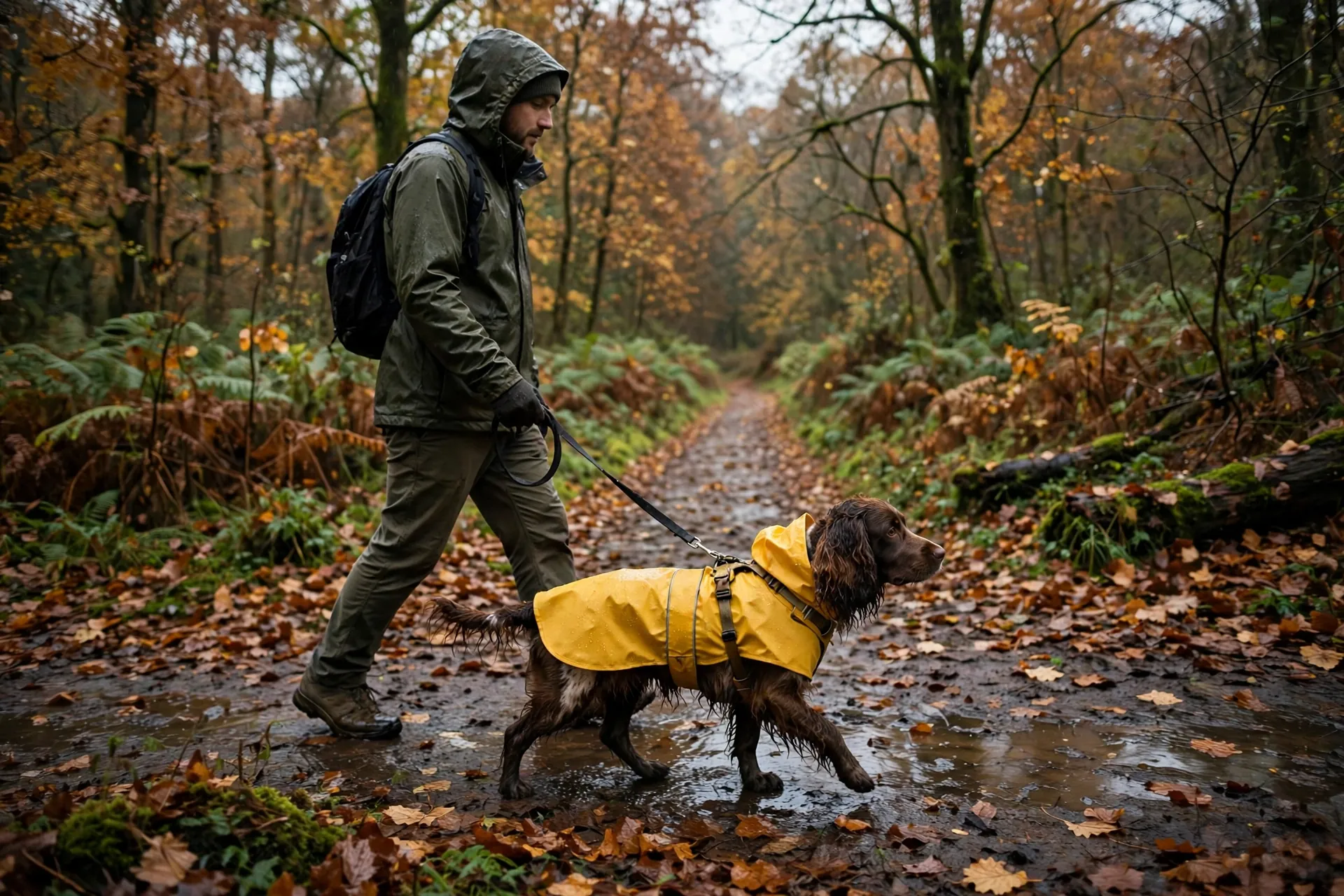
Patience is the main tool here. At the door, rinse the lower coat thoroughly, section by section, and then towel dry in layers: press a towel into the coat, lift, move to the next section, and repeat. A drying coat is particularly valuable for long and double coats, because it continues to draw moisture out of the undercoat while the dog settles, rather than relying on a single towelling session. Our guide to dog drying coats compares fabrics, belly coverage and fit, and is worth reading before you buy one for a muddy week. Whichever drying method you use, the coat is not dry just because the top layer feels dry. Part the coat with your fingers in several places and check the undercoat near the skin, especially on the belly, chest and behind the front legs.
Brushing a long or double coat must wait until it is dry, or nearly dry. Brushing a soaking wet long coat stretches and breaks hair, pulls painfully and can felt the undercoat into a solid layer. When the coat is dry, use a pin brush or a slicker brush first, then a wide-toothed comb, working in layers: lift the top coat, brush the undercoat beneath it, and move on only when the comb passes through cleanly. This is slow work — twenty to thirty minutes for a large long-coated dog after a very muddy day is normal — and it is far better done in two calm ten-minute sessions, with breaks and treats, than in one frustrated half-hour. A dematting comb or an undercoat rake can help, but use them lightly and evenly; aggressive raking can thin the coat, irritate the skin and create bald patches that take months to recover.
Water temperature and draughts matter more for these dogs, too. A long, wet coat loses heat slowly but steadily, and a dog left damp in a draughty cottage or a cold car boot will chill. Dry the dog in a warm room, out of a direct draught, and do not put a wet long-coated dog straight into a cold car for a long drive. Equally, do not be tempted to solve the problem by clipping the coat very short before the holiday. A double coat provides insulation against cold and wet as well as heat, and clipping it can damage the coat's texture and regrowth. If the coat has become unmanageable, talk to a groomer about a bath, a high-velocity dry and a tidy, rather than reaching for clippers at home.
Curly and wiry coats: mud locks in
Curly coats — poodles, cockapoos, labradoodles, Portuguese water dogs and similar crosses — and wiry coats — terriers, schnauzers, wirehaired pointers and griffons — trap mud in opposite ways, and both need a specific approach. A curly coat absorbs mud into the curl, where it dries into small, hard clumps that tighten as they dry. A wiry coat sheds light rain well, but mud, clay and burrs cling to the beard, eyebrows, leg furnishings and belly, and the harsh outer coat can hide a softer, tangle-prone underlayer.
For curly coats, the key rule is: do not let mud dry into tight clumps and then try to brush them out dry. If the curls are muddy, rinse with lukewarm water, gently squeeze — never wring — the curls in a towel, and then use a slicker brush and a comb while the coat is damp but not dripping, followed by a final comb when dry. Many curly-coated dogs benefit from a light dog conditioner or detangling spray during the holiday brush, because dry curly hair snaps and frizzes when brushed without lubrication. Keep the coat at a practical holiday length if you can: a shorter, even trim before the trip, done by a groomer, makes a week of mud dramatically easier than a long, show-length coat that mats by day two.
For wiry coats, focus on the furnishings. The beard will collect mud, food, water and whatever the dog has investigated on the walk, so rinse and towel the beard and eyebrows after muddy walks, and comb them out with a small comb once dry. Check the leg furnishings for burrs and seeds, which can work into the skin and cause sores if left. Hand-stripping is a specialist grooming technique for many wiry breeds and is not a holiday job; do not attempt to strip a coat in a cottage, and do not clip a hand-stripped coat without advice from your groomer, because clipping changes the texture and colour of the regrowth. A simple bath, a dry and a comb will see a wiry coat through a muddy week.
Both coat types benefit from a short, regular comb-through every evening, even on days when the dog does not look very dirty. Five minutes with a comb through the ears, armpits, belly and leg feathering catches the small tangles that become mats by the weekend. Make it part of the settle-down routine — dog on its bed, owner with a comb, a few treats — rather than a separate grooming event. Dogs that accept a nightly comb at home will accept one on holiday; dogs that are only combed in a crisis will resist exactly when you need cooperation most.
Dry clean or wet wash? Decide at the door
The most useful question at the door is not "how do I clean this dog?" but "does this mud need water at all?" The answer depends on the mud, the coat and the weather, and getting it right saves skin, time and temper. Plain field mud — the ordinary brown, gritty kind from paths, fields and woodland — is often best left to dry. Wet mud smears and pushes grit into the coat when you rub it. Dry mud brushes and crumbles out. That sounds counterintuitive after a filthy walk, but it is the reason experienced dog owners towel off the worst wetness, put a drying coat on the dog, and brush properly an hour later when the coat is dry.
Use dry cleaning when the mud is ordinary soil, the dog is not smelly, and the skin underneath is healthy. The method is: remove loose mud with a towel or a rubber mitt, let the coat dry in a warm room, then brush or comb out the dried mud, working section by section. A dry shampoo made for dogs can freshen a coat between baths, but it does not remove grit, and it should be brushed out fully so it does not build up on the skin. Never use human dry shampoo, talcum powder or household cleaning products on a dog. If the dog has rolled in something that smells strongly, the dry method will not help — smell means the coat needs washing, not perfuming.
Use a wet rinse when the mud is heavy, clay-like or caked on the legs and belly, when the coat is soaked through, or when grit is trapped against the skin. A rinse means lukewarm water and no shampoo, unless the coat is also greasy or smelly. Work from the paws upwards, rinse until the water runs reasonably clear, and then towel dry thoroughly. A rinse is much kinder to skin than a shampoo bath, and it can be repeated daily on a muddy holiday without the drying effect of repeated shampooing. For dogs that hate baths, a leg and belly rinse in a shallow tray, a large bucket or a shower tray is often far less stressful than a full bath, and it cleans the parts that actually got dirty.
Use a full shampoo bath only when the coat is dirty beyond rinsing, smells even when dry, feels greasy or sticky, or has been in salt water, slurry, road run-off or any substance you would not want left on skin. Choose a gentle, unscented or lightly scented dog shampoo, dilute it if the label says to, lather the dirty areas rather than the whole dog if only part of the coat is dirty, and rinse for longer than you think necessary — shampoo left in a coat causes itching, flaking and dullness, and in a long coat it can take several minutes of rinsing to clear. Dry the dog fully afterwards, in a warm room, and brush once dry. One thorough bath with a complete rinse beats three rushed baths that leave residue behind.
Salt water, sand and seaweed deserve a rinse every time, even if the dog looks clean. Salt dries the coat and irritates skin, sand works into the coat and between the toes, and seaweed can hide sharp shells and fishing debris. A plain-water rinse after a beach walk, followed by a paw check and a full dry, prevents most beach-related coat problems. The same logic applies after walks through farmyards, slurry, standing water near roads or any water that may be contaminated: rinse, check the skin, and if the dog has drunk from or swum in water you are worried about, check the official guidance before you travel and seek veterinary advice if the dog becomes unwell. For blue-green algae risks in particular, do not let the dog swim in or drink from water you suspect is affected.
Mats and tangles: slow work wins
Mats form quietly. A small tangle behind an ear on Monday becomes a tight, felted mat by Friday if the coat stays damp and is brushed only on the surface. Mats are not just untidy: they pull on the skin, trap moisture, hide sores and parasites, and can become painful enough that the dog snaps when touched. Preventing mats on a muddy holiday is therefore a daily job, and removing them is a slow job. There is no quick, painless way to rip a mat out, and any method that promises one should be avoided.
Start with your fingers. For a small, loose tangle, hold the base of the tangle between thumb and finger so you are not pulling the skin, and gently tease the outer fibres apart, working from the outside of the tangle towards the skin. A little dog-safe detangling spray or conditioner can help the fibres separate. Once the tangle loosens, a wide-toothed comb should pass through it. If the comb still catches, go back to fingers. This sounds slow because it is slow, and that is why it works: the dog stays relaxed, the skin is not pulled, and you can feel exactly where the tangle is tightest.
For a firmer mat, a dematting tool or a mat splitter can help, but use it with care. Work on the outer edge of the mat only, in small strokes away from the skin, and keep one hand holding the base of the mat to protect the skin. Stop frequently to check the skin underneath: if it is pink, hot or sore, stop and leave the mat for a groomer. Never slide scissors flat against the skin to cut a mat out. Skin folds up inside a tight mat in ways that are invisible from outside, and a scissor cut to that skin is a common and entirely avoidable grooming injury. If a mat is hard, close to the skin, larger than a coin, or the dog is clearly in pain, the right move is to leave it alone and book a groomer or vet, not to force it at home in a holiday cottage.
Prevention is mostly about drying and combing. A coat that is brushed only when wet, or brushed only on the top layer, will mat underneath. A coat that is dried fully and combed through to the skin every evening will rarely mat, even on a muddy week. Pay special attention after swimming, after rain, and after the dog has worn a harness or coat all day, because friction under straps and coats is a major cause of mats behind the front legs and across the chest. If the dog wears a harness on every walk, lift the harness each evening and comb the coat underneath it. The same applies to drying coats and raincoats: they are useful tools, but they press the coat flat and can create tangles if the coat underneath is never combed.
Talk to children and other holiday guests about mats, too. A well-meaning relative brushing a long-coated dog vigorously with the wrong brush, or pulling at a tangle to "help", can turn a small tangle into a painful mat and a frightened dog in minutes. One person, one brush, one calm session is the holiday rule. If the dog is already stressed by a mat, give it a break, a treat and a walk, and come back to the mat later or leave it for a professional. A mat that waits one more day is a minor problem; a dog that learns grooming means pain is a problem that lasts far beyond the holiday.
Drying and brushing tools that earn their space
Holiday packing space is limited, so every grooming tool has to earn its place. The core kit for a muddy week is small: two large absorbent towels or one towel plus a drying coat, a slicker brush or pin brush suited to the coat, a wide-toothed comb, a rubber mitt for short coats, a jug or portable shower for rinses, and a small bottle of gentle dog shampoo. Everything else — detangling spray, a dematting tool, paw balm, a portable dryer — is useful only if you know how to use it and your dog tolerates it.
Towels deserve more thought than they usually get. A thin hotel towel, or the single towel a cottage provides, will not dry a wet spaniel, let alone a wet collie. Microfibre dog towels absorb several times their weight in water, wring out easily and dry quickly between uses, which matters when you need the same towel again the next morning. A drying coat works differently: it wraps the dog, draws moisture from the coat over twenty to thirty minutes, and keeps the dog warm while it dries. Many owners use both — a towel for the worst water at the door, then a drying coat while the dog settles. Whichever you use, wash towels and drying coats during a wet week. A towel that smells damp is not drying anything; it is spreading dampness and bacteria back onto the coat.
Brushes are coat-specific, and the wrong brush is worse than no brush. A slicker brush suits medium and long coats and curly coats, but used too hard it scratches skin. A pin brush suits long, silky coats. A bristle brush suits short, smooth coats. A rubber mitt suits short coats and dogs that dislike brushes. A wide-toothed comb is the final test for every coat type: if the comb passes through, the coat is tangle-free; if it does not, there is work still to do. An undercoat rake helps double coats in shedding season, but use it lightly and evenly. A Furminator-style de-shedding tool, if you use one, should be used sparingly and never on a wet, matted or sore coat, and never pressed hard against the skin. When in doubt, ask your groomer which single brush and comb they would pack for your dog.
Dryers divide opinion, and the answer depends on the dog. A low-heat, low-noise pet dryer or a household hairdryer on a cool or warm setting, held at a distance and moved constantly, can dry a long coat far faster than towels alone and helps prevent the damp undercoat that causes mats and smells. But many dogs hate dryers, and a frightened dog that will not stand still is not being dried effectively anyway. Never use a dryer on its hottest setting, never hold it in one place, never point it at the face or ears, and never leave a dog unattended with a dryer running. If your dog has never met a dryer, a holiday is not the time to introduce one. Towels, a drying coat and a warm room will do the job more slowly and with far less stress.
Paw care tools are small and worth packing: a shallow tray or bucket for paw rinses, a soft cloth for between the toes, and paw balm for cracked pads in winter or after gritty ground. Check paw balm ingredients and use a product made for dogs, not a human moisturiser. Boot care matters too: if the dog wears boots, rinse them, remove grit from inside, and dry them overnight, because a boot full of yesterday's grit will rub a paw raw today. The same principle applies to harnesses, leads and collars: rinse muddy gear, dry it, and check it for grit and wear before the next walk.
Mud-proof the room, not just the dog
A clean dog in a muddy room does not stay clean, and a holiday cottage is not your house: the deposit, the next guests and the owner's rules all depend on you leaving it as you found it. The most effective mud-proofing is done before the first walk, not after the first disaster. Lay a washable doormat outside the door and a second, larger mat inside. Put a boot tray or a shallow lidded box by the door for muddy leads, harnesses and boots. Hang towels at dog height, not on a high rail the dog will shake against. Put the dog's bed on a washable blanket or a waterproof mat, not directly on a light-coloured sofa or a pale rug.
Zone the house for the first hour after a walk. The porch, boot room or kitchen is the dog's zone until legs and belly are clean and the coat is reasonably dry. The living room and bedrooms are the reward for a clean dog, not a right of entry. This is not punishment; it is the same logic as taking muddy boots off at the door, and dogs understand it quickly when it is consistent. If the cottage has no porch, create one: a large washable mat, a baby gate or a furniture arrangement that keeps the dog in the kitchen for ten minutes is enough. Ask the owner before the trip what floor protection is acceptable — most owners would far rather you lay down an old sheet or a washable throw than scrub mud out of a cream carpet at checkout.
Bedding is the hidden mud trap. A dog that sleeps on the bed, or on a blanket that is never washed, will carry yesterday's mud into today's clean coat. Bring the dog's own bed or blanket from home, because familiar bedding settles the dog and is washable, and wash it halfway through a wet week if the cottage has a washing machine. Check whether the machine accepts pet bedding — some owners prefer pet items washed separately or not at all — and use a short, warm cycle with a gentle detergent, then dry the bedding fully before the dog sleeps on it again. A damp bed is worse than a slightly muddy one, because damp bedding keeps the coat damp all night and encourages smells and skin irritation.
Ventilation matters as much as cleaning. A wet dog in a sealed, heated cottage produces condensation on windows, a damp smell in soft furnishings and, over a week, a clammy feeling that no amount of air freshener fixes. Open a window briefly after drying the dog, run an extractor fan, and hang towels where air circulates rather than draped over a radiator in a heap. In caravans and small lodges, this matters even more: a wet dog, closed windows and heating is a fast route to condensation, mould on soft furnishings and a deposit dispute. A few minutes of ventilation after every drying session is a small habit with a large payoff.
Finally, plan the checkout clean. On the last day, wash the mats, shake out the dog's bedding outside, wipe paw prints from hard floors, and check under furniture where muddy paws may have left prints nobody noticed. Photograph the room as you leave it, as you would for any rental. Leaving a cottage clean is not just polite; it protects your deposit and keeps the property genuinely dog-friendly for the next guests. Owners who have a bad experience with mud restrict the next dog, and every dog owner on a muddy holiday benefits when the previous guests left the place clean.
The car, the boot and the journey home
Coat care does not end at the cottage door, because the car is where a clean dog often gets muddy again — or where a muddy dog makes the journey home miserable. Before a muddy walk, line the boot or back seat with a washable cover, an old blanket or a waterproof sheet, and keep a towel, a water bottle and a bag for muddy gear in the car. After the walk, do the door routine at the car, not at the cottage: rinse or towel legs and belly, put on a drying coat if you have one, and only then load the dog. A dog loaded wet and muddy will shake, drip and spread mud over every surface it touches, and will then sit in that dampness for the whole drive.
On the drive itself, ventilation and temperature matter. A wet dog in a cold boot will chill, and a wet dog in a hot, sealed car will steam. Keep the car at a comfortable temperature, allow some airflow, and stop on a long journey to check the dog, offer water and, if needed, re-towel the legs. Do not leave a wet dog in a parked car while you stop for lunch, even briefly, and never leave any dog in a hot car. If the journey home is long, plan a stop where the dog can toilet, stretch and be checked over, and pack a spare towel for the final leg — a dog that was dry at the cottage can be damp again after a rainy service-station stop.
At home, the muddy holiday is not quite over. Unpack the dog's gear first, not last: wash the drying coat, towels, harness and leads, check boots for grit, and give the dog a full brush once the coat is completely dry. This is also the moment to check the whole dog properly, in good light, for cuts, ticks, burrs and mats you may have missed in a dim cottage. If the coat has matted despite your best efforts, book a groomer promptly rather than leaving mats to tighten further. A post-holiday groom — bath, dry, brush and tidy — resets the coat and is often the kindest end to a muddy week, especially for long, curly and double coats.
Skin, paws and ears: the daily check
The daily check takes two minutes and catches most problems before they become vet visits. Once the coat is dry, run your hands over the dog from nose to tail, feeling for heat, swelling, cuts, lumps, sore spots and anything stuck in the coat. Check between the toes, under the armpits, behind the ears, around the tail base and in the groin — the places mud and moisture hide. Check the ears for smell, redness or discharge, and the eyes for redness or discharge after dusty or muddy walks. Note anything unusual, even if it seems minor, because a small sore on Monday is easier to deal with than an infected sore on Friday.
Paws need their own check after every muddy walk. Spread each toe gently, look between the toes for grit, stones, burrs, cuts and redness, and check the pads for cracks, splits or worn patches. In winter, road salt and grit can irritate pads, and a paw rinse followed by a dry and, if needed, a dog paw balm helps. In summer, check for grass seeds, which can work into the skin between toes and cause painful swelling. If the dog limps, licks one paw persistently, or you find a grass seed, a thorn or a deep cut, seek veterinary advice promptly rather than trying to dig the object out at home. The same applies to ticks: remove them correctly with a tick remover, or ask a vet to show you how, and check the official guidance before you travel if you are unsure about tick-borne disease in the area you are visiting.
Skin problems on a muddy holiday usually announce themselves as redness, itching, a smell that does not wash out, or a patch where the dog keeps licking or chewing. Common causes include dampness trapped under a matted coat, irritation from grit or salt, an allergic reaction to a new shampoo or a plant encountered on a walk, and hot spots that develop quickly in thick, damp coats. If the skin is red, broken, hot, swollen or discharging, or if the dog is clearly uncomfortable, stop home treatment beyond a gentle plain-water rinse, keep the area clean and dry, and seek veterinary advice. Do not apply human creams, antiseptics or leftover medication from another dog, and do not keep bathing a sore patch in the hope that one more wash will fix it.
Keep a simple record during the week: which walks caused the worst mud, which rinse or brush worked, any sore spots you found and whether they improved. That record is useful if you need to speak to a vet, useful for the groomer after the holiday, and useful for your next muddy trip, because the same dog on the same kind of ground will usually have the same trouble spots. Over several holidays, that record becomes a personal coat-care plan that no generic guide can replace — which walks to avoid in wet weather, which brush works, how long drying really takes, and where mats always form first.
The holiday coat-care kit
Pack the kit the night before, not on the morning of departure, and pack it as a single bag or box that lives by the door. The essentials are: two large absorbent towels or a towel plus a drying coat; a slicker or pin brush and a wide-toothed comb suited to the coat; a rubber mitt for short coats; a jug, watering can or portable shower for rinses; a small bottle of gentle dog shampoo; a dog detangling spray if your dog's coat needs one; a tick remover; a soft cloth for paws and ears; paw balm if your dog needs it; and bags for muddy towels and gear. Add a washable doormat and a boot tray if the cottage does not provide them, and a spare blanket for the dog's bed.
What not to pack matters too. Do not pack human shampoo, human dry shampoo, scented sprays, baby wipes with fragrance or alcohol, or household cleaning products for use on the dog. Do not pack a brush you have never used, a dryer your dog has never met, or a dematting tool you do not know how to use safely. Do not pack a single thin towel and hope the cottage provides more. And do not pack coat-care tools at the bottom of a suitcase under clothes; if the tools are hard to reach on arrival, the first muddy walk will happen before you have unpacked them, and the first paw print will already be on the rug.
Finally, remember the point of all this work. A muddy holiday is not a failed holiday. Some of the best British dog walks — woodland after rain, a river path in spring, a moor in mist, a beach in a storm — are muddy by nature, and a dog that is allowed to enjoy them, then cleaned calmly at the door, dried properly and brushed once dry, will sleep better, smell better and stay healthier than a dog kept on pavements to protect the carpet. Coat care on a muddy holiday is not about keeping the dog pristine. It is about a small, repeatable routine that lets the dog get gloriously muddy and still come home clean, dry and comfortable, day after day, without mats, sore skin or a ruined cottage. Start at the doormat, work by coat length, dry before you brush, deal with tangles early, and let the mud stay where it belongs: outside, on the path, and in the stories you tell when you get home.
Practical questions
Before you go
How often should I wash my dog on a muddy holiday?
Usually far less often than you wash the mud off. Rinse or towel off mud after most walks, but save a full shampoo bath for when the coat still smells, feels greasy or gritty after rinsing, or when mud has reached the skin. Over-bathing strips natural oils, dries the skin and can make a coat tangle more easily, so plain water and thorough drying are the default holiday routine.
Is dry shampoo safe for dogs on holiday?
A product made specifically for dogs can help between baths, especially for a light freshening of the back or chest, but it is not a substitute for removing mud, grit or salt. Use it sparingly, brush it out fully, and never use human dry shampoo, baby powder or scented sprays on a dog. If the skin is sore, broken or itchy, skip dry products and use plain water instead, and check the official guidance before you travel if you are unsure.
How do I remove a mat without hurting my dog?
Work slowly from the outer edge of the mat towards the skin, holding the base of the mat so you are not pulling the skin. Use your fingers first, then a wide-toothed comb or a dematting tool, and stop for a treat and a break if the dog flinches or the skin looks pink. Never cut a mat with scissors held flat against the skin, because skin can fold up inside a tight mat. If a mat is hard, close to the skin or painful, leave it for a groomer or vet.
Should I bath my dog every day after a muddy walk?
No, not as a routine. Daily shampooing is usually too much for skin and coat, even on a wet holiday. A daily leg and belly rinse with lukewarm water, a good towel dry, and a brush once the coat is dry will handle most British mud. Keep full baths for genuinely dirty, smelly or contaminated coats, and use a gentle dog shampoo and a thorough rinse when you do bath.
What stops mud spreading through a holiday cottage?
A fixed porch routine stops more mud than any cleaning product. Use a washable doormat and a second mat inside the door, a lidded bucket or a boot tray for muddy leads, a towel station at dog height, and a drying coat on the dog before it steps onto carpet. Keep the dog in the porch or kitchen until legs and belly are clean, and wash the mats halfway through a wet week rather than waiting until checkout.
When should muddy coat care become a vet visit?
Seek veterinary advice promptly if you find a cut, swelling, discharge, a hot or painful patch of skin, persistent licking or chewing, limping, or a smell that does not go after washing. Also seek advice if mud, grit or a foreign object is stuck in a wound, between toes or in an ear. Do not wait until the end of the holiday if the dog is in pain, and check the official guidance before you travel for local emergency vet details.