No boot maker paid for a mention in this guide and we have no commission arrangements with any brand named below. Brand names appear only as examples of a boot style, and prices are whatever the retailer's page shows at the time you look.
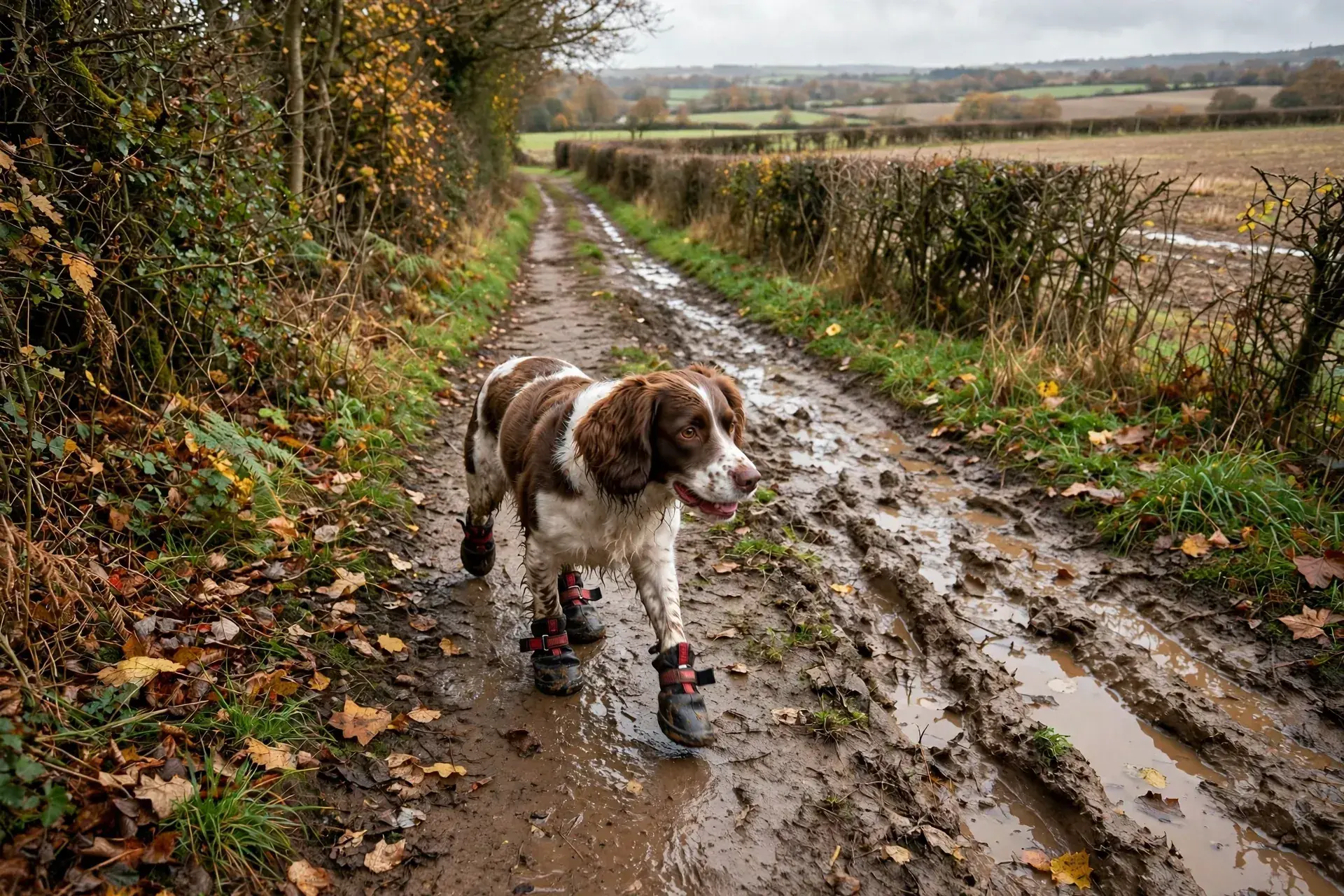
Most healthy dogs walk mud perfectly well barefoot, but boots earn their keep when paws are splitting, sore, recovering, or constantly packed with grit; when ground is sharp with ice crystals or grit; or when cleanup after every walk has become the walk's second job. For muddy British trails, choose a full-wrap boot with a grippy textured sole, a secure two-point closure and a cuff high enough to shed slurry — and only after a proper paw measurement and a gradual introduction period.
The back-door test: does your dog need boots at all
Stand at your back door after a typical wet-season walk and take an honest look at what comes in. If the answer is four paws that are muddy but intact, a dog that trots off unconcerned, and five minutes of towelling before everyone is dry — you probably do not need boots. Dog feet are not delicate ornaments. A healthy pad is thick, self-moisturising to a point, and built for exactly this terrain. Most of the mud-season suffering in Britain is suffered by floors and car boots, not by paws.
Boots stop being optional and start being sensible in a narrower set of circumstances. First, when the pads themselves are failing: dogs whose paws split in winter, whose pads stay soft and sore after long wet walks, or who chew their feet raw in a cycle that restarts every rainy week. Second, when a vet has given you a reason — a healing cut, a bandage that must stay dry, post-surgical pads, or a chronic condition like interdigital cysts that mud keeps re-infecting. Third, when the walk itself changes: frozen mud with sharp ice edges in a cold snap, gravel forestry tracks that grate pads over distance, or gritting salt on lanes after a freeze, which dries and cracks pads badly. Fourth, and this one is quietly legitimate, when the after-walk ritual has become the obstacle to walking at all — the dog that needs a full paw bath and a floor-mop every time, especially a reactive dog that hates the cleaning, can genuinely get more exercise because boots make the return civilised.
There is also a clear list of times to say no. Boots do not fix bad ground choice — if a particular field is a bog in February, the answer is a different route, not footwear. They are a poor answer to general mud phobia (yours or the dog's); a dog that is fine in mud does not need protection from being a dog. Puppies under about six months rarely need them unless a vet advises, because growing paws change size monthly and young dogs need the sensory feedback of ground contact for proprioception. And on very hot days they are counterproductive — but muddy British trails are not where heat is the problem, so the seasonal window this guide covers is roughly October to April, plus the odd boggy summer after weeks of rain.
Run this test before you shop: three recent walks, honest notes on paw condition afterwards. Cracked, split, bleeding, limping or obsessively licked — that is a yes. Muddy, intact and unbothered — that is a no, and your money is better spent elsewhere, perhaps on a better drying setup in the hall. The rest of this guide assumes the test said yes, or close enough that you want to be prepared.
Two kinds of paw protection and what each is for
Everything sold as a dog boot belongs to one of two families, and they solve different problems. The first family is the full-wrap boot: a structured shoe with a proper sole, an upper that wraps the whole foot and ankle, and a closure system of straps or cinch cords. These are what you want for mud. They keep slurry out, protect the pad from sharp edges, and give grip through a textured rubber sole. Names you will see as examples of this style include the Ruffwear-type rugged boot, the Hurtta-type trail boot and similar structured designs from outdoor pet brands — mentioned here only as illustrations of the category, not recommendations.
The second family is the paw cover or sock: a thin, flexible sleeve — sometimes rubber-dipped fabric, sometimes silicone — that slides over the paw and fastens with a simple band. These are lighter, easier for a fussy dog to tolerate, and fine for keeping a healing paw clean or keeping road salt off for short distances. But in real mud they have two weaknesses: the shallow sole fills and packs with mud, turning the cover into a slick mud paddle, and the low cuff lets slurry pour in from the top. For the muddy-walk problem this guide targets, they are a compromise — acceptable as a spare pair or for a dog that refuses structured boots, not the first choice.
Between the two sits a middle design worth knowing about: the fabric trail sock with a reinforced sole but no rigid structure. Lighter than a full boot and more tolerable for picky dogs, it handles firm damp ground well but struggles in deep slurry where water comes over the low cuff. If your muddiest walks are lanes and park paths rather than ploughed fields, this middle design can be the practical pick. Match the family to the worst ground you actually walk, not the average — boots are bought for the bad days.
One more distinction matters at purchase time: whether boots are sold in sets of four identical sizes or as separate front and hind pairs. Front paws are usually noticeably larger and broader than hind paws in most breeds, so a single-size set of four often leaves the hind boots sloppy. Sets that offer two sizes, or brands sold in pairs, solve this properly. Buying four of the front-paw size "to be safe" guarantees two boots that will spin and slide — which brings us to measurement.
How to read a boot before you buy it
Ignore the marketing copy and read the construction instead. Five features decide whether a boot survives a British winter, and you can assess every one of them from product photos and the specification list before it arrives.
First, the closure. A single ankle strap holds a boot on dry ground and loses it in mud. Suction from wet ground is the great boot thief — every step in deep slurry tries to pull the boot off, and a one-point closure acts like a pivot the boot rotates around. What you want is two separate fastening points: typically one strap around the paw itself and a second around the ankle or leg above the joint. This locks the boot against both twisting and sliding down. Cinch-cord closures with a locking toggle work too, provided the cord path is genuinely separate from the paw strap. Velcro-style hook-and-loop straps are fine but check they are wide; narrow straps migrate and loosen, and mud clogs short hook strips fast.
Second, the sole. For mud you want soft, flexible rubber with a defined lug pattern — raised tread blocks that bite into soft ground. Hard plastic soles look durable but skate on wet clay. A sole that flexes in your hand like a trainer outsole is the right stiffness; if it bends only with real effort, it will act like a ski on slippery descents. Sole depth matters less than pattern: shallow, dense tread packs with mud and becomes a smooth disc, while wider spaced lugs self-clear as the paw lifts. Some boots add a slight heel flare for grip on slopes, which helps on chalk downs and woodland banks after rain.
Third, cuff height and the mud-shedding cut. In slurry, water and liquid mud enter boots from the top, so a low-cut boot on a deep-mud walk is a bucket. Look for a cuff that sits well above the wrist joint with a drawcord or elasticised top that closes gently against the leg. The ideal shape widens slightly above the joint so the boot does not chafe where the leg moves, then narrows again at the closure. Mesh uppers dry faster after the walk but leak sooner during it; solid nylon or softshell uppers keep slurry out longer but need airing afterwards. There is no perfect answer — pick the trade-off that matches your walk length, because a two-hour ramble in saturated fields punishes a leaky boot far more than a forty-minute lane loop does.
Fourth, the interior. A lined boot is warmer and kinder to sore pads, but lining holds moisture against the skin between toes, which is exactly where mud dermatitis starts. For the mud-season job, an unlined or thinly lined interior that dries fast usually beats a plush one, especially for dogs walked daily. Check the toe box is genuinely rounded and deep — a boot that crams toes against the front changes the dog's gait and causes nail-pressure sores within a single long walk. Turn the boot inside out if you can: flat seams are good, raised welts inside the toe box are a blister machine.
Fifth, and least glamorous, is the washability of the whole thing. Boots for muddy walks get filthy every single outing, so machine-washable construction at 30 degrees (or at least fully hose-down-able with no cardboard-style stiffeners inside) is not a luxury, it is the difference between boots you use and boots you abandon by November. Fastenings should be operable with cold wet hands — if a strap buckle needs fine finger dexterity, you will dread every walk. Test this in the shop, or read reviews specifically about winter handling, not summer.
Measuring paws: the tracing method
Sizing charts lie, but paws do not. Almost every failed boot purchase traces back to measuring wrongly — usually measuring one paw once, on carpet, while the dog sits. Do it properly and the boots fit the first time.
Wait until after a walk, not before. Paws spread under load, and a measurement taken on a dog standing relaxed on a hard floor is meaningfully different from one taken on a paw lifted and dangling, which shrinks and narrows. Stand the dog on a piece of paper on a hard floor — kitchen tiles are perfect — and have someone hold a treat so the dog stands square with weight on all four feet. Mark the outline of the widest part of the paw, including the claws if they touch the ground when standing, because they do count inside the boot. Do all four paws. In most breeds the front paws are a full size larger than the hind ones, and ignoring this is the single most common reason hind boots spin off.
Measure the tracings in millimetres, both width and length, then compare against the brand's chart — noting that one brand's medium can be another's small, which is why charts beat labels. If a paw falls between sizes, size up for winter use: paws swell slightly with exercise, and a boot that is snug in the hall becomes a tourniquet on the third mile. The correct fit leaves the dog able to spread its toes inside; when you press the toe of the empty boot, there should be roughly a thumb's width of room ahead of the longest claw. A boot that fits "neatly" in the kitchen will be a boot that rubs at mile four.
Two edge cases deserve mention. Dogs with dew claws need a cuff cut that clears them — a straight low cuff can press directly on the dew claw and cause soreness within one walk, so look for boots with a notched or shaped cuff if your dog has them. And sighthounds, with their long narrow feet, rarely fit standard round-toe charts; they usually need the narrow-specific lines that a few brands make, or they size down in length and accept a narrower fit. If a breed-specific line exists for your dog's foot shape, prefer it over the generic chart.
Keep the tracings. Paws change: weight gain over winter, nail length, and pad condition all shift the fit, and having the original paper means you can re-check against a new pair without repeating the whole ritual. Write the date on the paper and keep it with the boots.
Teaching a dog to accept boots without a wrestling match
The classic first-boot video — dog high-stepping like a dressage horse — is funny because the dog has never been taught the skill. Boots change proprioception: the paw sends back different signals, and the dog's first response is to lift each foot higher to figure out what is going on. This is normal and temporary, but only if you introduce the change gradually instead of fitting all four boots and marching out for an hour.
Day one is one boot, one paw, inside the house. Fit a single front boot, give a treat for standing still, and let the dog walk to the kitchen and back. Treat calm standing and any four-step walk that looks normal. Most dogs sort themselves out within five to ten minutes; the high-stepping usually fades in the first session. Remove the boot, play, done. Day two is two boots on the front paws, same routine. Day three adds the hind pair but stays indoors. Only on day four or five do you go outside, and the first outdoor walk should be a familiar, boring, short loop — not the muddiest trail in the county. The goal of week one is that boots predict treats and normal walks, nothing more.
Three mistakes undo this work. The first is leaving boots on too long in the early days — twenty minutes is plenty for the first outdoor sessions, because a tired dog that starts chewing at the boots teaches itself that boots are removable by force. The second is fitting them in a rush before a walk the dog is already excited about; arousal plus novelty equals chaos, so fit boots while the dog is calm, before the lead comes out. The third is ignoring the dog's vote: a dog that keeps stopping to mouth one specific boot is usually telling you about a fit problem on that paw, not being stubborn. Check that paw's fit before you blame the attitude.
For dogs that genuinely resist — seniors set in their ways, anxious rescues, dogs that panic at paw handling — slow the programme down rather than abandoning it. One boot per day for a week beats a fight that poisons the whole project. And some dogs simply will not tolerate structured boots; for them, the lighter sock-style covers from the second family are a worthwhile fallback, because a tolerated compromise beats a refused ideal. A dog that walks happily in covers gets more exercise than a dog that fights full boots at the door.
Waterproofing and grip: what actually matters in mud
Marketing departments love the word waterproof. In the context of a dog boot in British mud, it means something specific and limited: how long before the inside of the boot is wet. No boot stays dry forever in slurry, because water enters from the cuff as well as through the material. So evaluate waterproofing as a duration question tied to your walk length, not as a yes-or-no badge.
The practical test is seam construction. Taped or welded seams on the upper keep water out far longer than stitched seams, which wick moisture along the thread — in the first hour you will not notice the difference, in the third you will. Softshell and neoprene-style uppers shed light rain and splashes well but saturate under immersion; coated nylon keeps slurry out longest but stays wet longest afterwards, which matters for the dog walked twice a day. A useful middle ground many winter walkers settle on is the coated upper for the outward walk, then boots off at the car and paws dried — because the truth is that boots are not meant to keep feet dry all day, they are meant to keep the worst of the mud, sharp edges and salt off the pads while the walk happens.
Grip is the other half of the equation and it interacts with mud type. British mud is not one substance: chalk downland slurry is slick and greasy, clay woodland mud is heavy and suctioning, peaty moorland is springy but slippery on the surface, and frozen rutted mud is basically broken glass for pads. A lug pattern that grips clay — deeper, wider-spaced lugs that self-clear — also performs on peat. On greasy chalk, the compound matters more than the pattern: softer rubber grips better on slick surfaces, which is why the hard-plastic "durable" sole is the wrong choice for most southern English winter walks. If you walk one terrain type most of the time, buy for that; if you roam, buy for clay, because clay is where grip failures actually cause falls.
One waterproofing-adjacent detail is often missed: drainage. Some boots include small drainage vents near the sole, which sounds like a leak but is actually a feature — a boot that takes in a little water through the cuff and holds it is worse than one that lets it out again. For walks that regularly cross streams or floodwater, a boot that drains beats a boot that seals, because sealed boots become ankle-deep puddles that soften pads exactly the way you were trying to avoid. Match the design to your water exposure, not to the word on the box.
Walking muddy trails in boots: technique and judgment
Boots change the walk in small ways that add up, and the first few outings go better if you expect them. The most common surprise is pace: most dogs walk slightly slower in boots for the first mile, then settle into their normal rhythm. Plan the first booted walks shorter than usual — not because the dog cannot manage the distance, but because the gait change uses different muscles and fatigue arrives earlier. A dog that normally does six miles should do three or four for the first fortnight, then build back up.
Mud technique matters more than boot choice once you are out. On deep slurry, keep the dog moving steadily rather than standing about — a stationary booted paw sinks and the suction on lift-off is what pulls boots off. This is also the moment to think about your lead setup: on churned bridleways and narrow farm tracks, a long line used properly gives the dog room to pick the firmer line through a boggy section while you stay on the driest footing, which means fewer deep-sink moments for booted paws. On slopes, let the dog zigzag rather than plunge straight down; the lugged soles grip well on angled descents, but no boot defeats gravity on greasy chalk.
Know when to take them off. Boots are for the muddy sections, not a uniform for the whole outing. River crossings deeper than the cuff will flood the boots — better to remove them, cross, and refit on the far bank than to walk the next mile in puddles. Stiles are the other classic boot casualty: dogs that scramble stiles in boots catch the toe box on the woodwork and tear the upper, so unclip and carry the dog over (or fit boots after the stile section if your route allows). The same applies to long dry tarmac stretches at the start or end of a walk: the soft mud-gripping compound wears fast on hard surfaces, so save the soles for where they earn their keep.
Mid-walk checks take thirty seconds and prevent most problems. At each natural stop — a gate, a water break, a view — run a finger under each closure strap to confirm nothing has loosened, and glance at the gait for the first steps after standing: a dog that walks off square and then develops a limp on one paw has usually got a boot that has rotated or a stone trapped inside. Carry one spare boot if you have it; losing a single boot two miles from the car is a solved problem if the spare is in your pocket and a walk-ruiner if it is not. A cheap zip bag for the removed or spare boots keeps the mud out of the rest of your kit.
Winter adds two special cases. In a hard freeze, the mud ridges you walked on soft in November become sharp-edged in January, and this is when boots move from comfort to genuine paw protection — ice-edged ruts cut pads that mud only dirtied. After gritting, lane walks expose paws to salt, which dries pads and stings small cracks; boots earn their place on every salted lane, and a paw rinse at home finishes the job. Both are reasons to keep the boots in the car from December to March even on days that look fine from the kitchen window.
After the walk: boots off, paws checked
The walk is not over when the lead comes off. Boots trap moisture between the toes, and mud pressed against skin for hours is how interdigital irritation starts. Make the removal part of the routine: boots off at the door or the car, paws rinsed or wiped, then a proper check before the dog settles. Spread each toe and look between them for redness, small cuts, or grit packed against the webbing. Check the pads for cracks or swelling and the nails for splits — a nail caught inside a boot can split days later, so knowing it happened lets you watch for it.
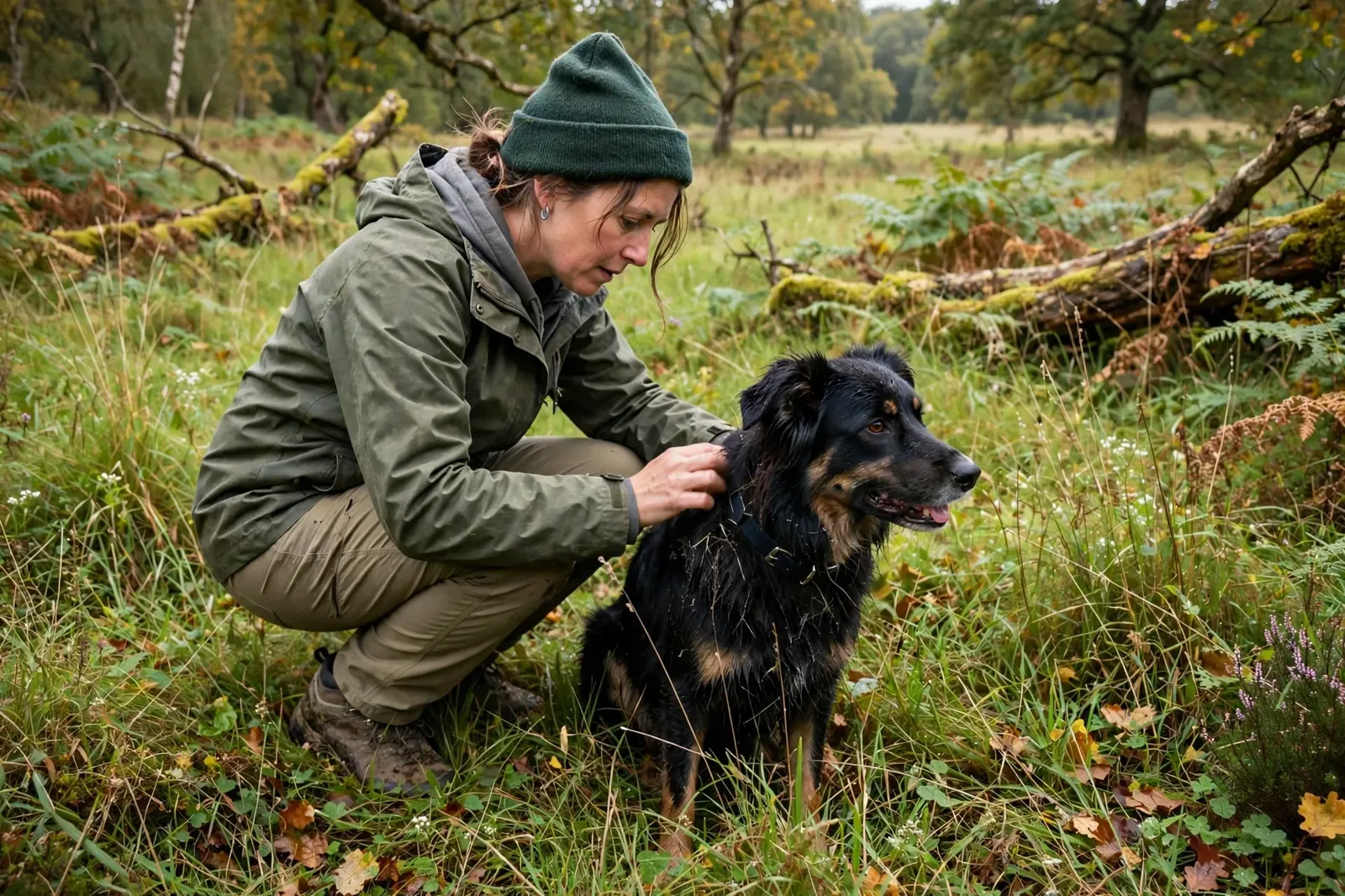
This is also the moment for the tick check, because muddy winter walks still cross the rough grass and bracken edges where ticks wait. Run your hands against the lie of the coat over the legs, belly and ears, feeling for anything the size of a pinhead or larger. Our guide to ticks on dogs in the UK covers safe removal and the signs worth watching for afterwards, which is worth a read before tick season proper rather than during a panic. If the walk crossed standing water or slow ditches — common on flooded winter footpaths — remember that still water carries its own risks for dogs that drink from it, covered in our blue-green algae guide.
Boots themselves need a routine too, or they become a smell. Knock off the worst mud outside, then rinse or machine-wash according to the care label — most mud boots tolerate a 30-degree wash with the straps done up, which stops the hook-and-loop clogging. Air-dry them stuffed loosely with newspaper away from direct radiator heat, which hardens rubber soles and shrinks some uppers. A boot that still smells damp after drying has lining that is holding moisture; for daily-walked dogs, two sets in rotation solve this completely and double the life of each pair, which is worth factoring into the budget from the start.
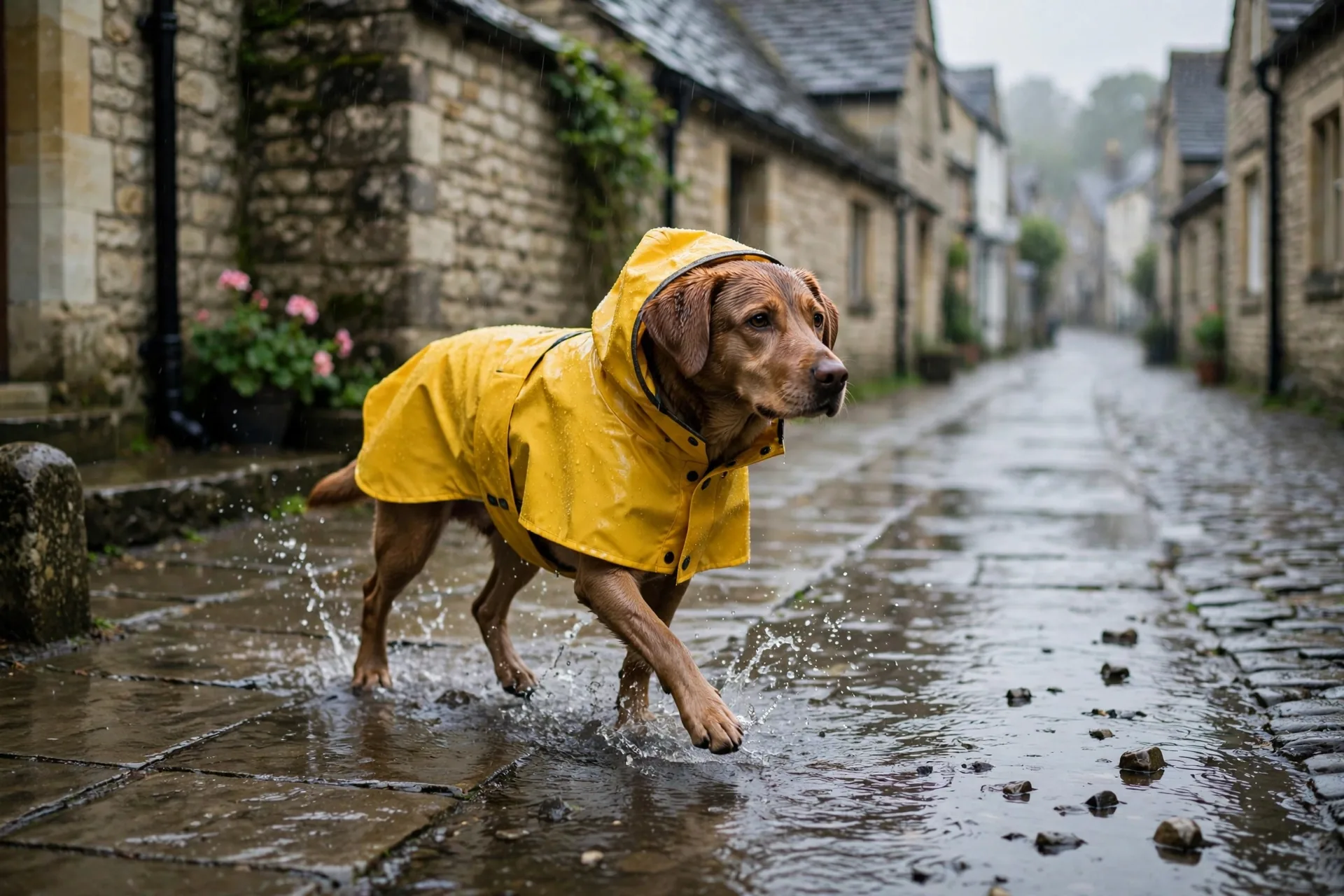
Finally, log what worked. Note which boots stayed on, which paw needed re-fastening, and how the pads looked — this record is what turns the second winter's purchase from a guess into a decision. And if boots have become part of your daily kit, the rest of the wet-weather system matters just as much: a proper rain coat and drying routine alongside the boots means the dog comes home genuinely clean rather than merely less muddy, which is the whole point of the exercise.
Practical questions
Before you buy
Which boot goes on which paw?
Most dog boots are ambidextrous, so there is no left/right pairing as with human shoes. What matters instead is matching the right size to the right foot, because front paws are usually wider and larger than hind paws. Measure all four paws separately and check whether the boot set you are buying offers a narrower hind-boot size, or simply buy the size each paw needs.
Can my dog wear mud boots on pavements as well as trails?
Yes, but expect faster wear. Boots built for mud use soft, grippy soles that wear down quickly on rough tarmac, so treat them as trail footwear and change out of them for long pavement stretches where possible. If your routine mixes both, look for models with a thicker replaceable-style sole, and keep a separate cheaper set for road work.
Will boots overheat my dog's paws?
Paws play only a small part in a dog's cooling system, which happens mainly through panting, so boots do not cause dangerous overheating in cool British weather. The real warmth concern is friction: a boot that rubs creates hot spots and blisters regardless of season. If the dog's paws feel warm inside a well-fitted boot after a walk, that is normal; warmth with a sore spot is a fit problem, not a weather problem.
How snug should the fastening be?
Snug enough that the boot does not rotate or slide off when the dog turns sharply in mud, but loose enough to slide one finger under the closure strap comfortably. Mud is the great boot thief: suction from wet ground pulls boots off, so fastenings should be checked mid-walk, not just at the car. If you have to re-fasten more than once per hour, the size is probably wrong rather than the strap.
Are boots a sensible option for a senior dog or one recovering from injury?
Often yes, with one condition: the dog must still have the balance to cope with slightly changed proprioception, and any injury use should be cleared with your vet first. For older dogs, a grippy sole can genuinely help on wet, slippery ground where a bare paw skids. Start on familiar level paths before taking an older dog onto rutted trails in boots, and watch for fatigue — booted walking uses slightly different muscles and tiring starts sooner. Our senior dog travel guide covers the wider comfort picture for older dogs on the move.