This guide is independent and contains no paid placement. If affiliate links are added later, they will be clearly marked and will not change our editorial checks.
Buy for the flat space your dog will actually lie on, not for the largest size on the packet. A pressure-activated gel mat suits most car journeys, a water-filled mat suits a longer stay where you can refill and dry it, and neither replaces shade, ventilation, water and rest. Check the mat before every trip, and plan breaks for the moment its cooling effect starts to fade.
When the mat stops working
Picture the third stop on a warm journey. The car has been parked in a lay-by, the dog has had a drink and a short walk, and everyone is ready to move on. The cooling mat in the boot, which felt pleasantly cool at the start of the day, now feels barely different from the blanket underneath it. Nothing has broken. The mat has simply done the only job it was designed to do, and then run out of room to do it again.
That moment is the right place to start, because it explains almost every disappointment people have with cooling mats. A mat does not generate cold. It absorbs heat from the dog lying on it and moves that heat somewhere else, or stores it for a while. Once the absorbing material has warmed up to roughly the temperature of the dog, there is nowhere left for the heat to go. The surface stops feeling cool, the dog may shift off it, and an owner who expected hours of relief can feel misled. The product has not necessarily failed; the expectation was wrong.
Understanding saturation changes how you shop. Instead of asking which mat is coldest in the shop, ask how long it stays useful, how it recovers, and what you will do when it stops. A gel mat that reactivates after a period away from the dog is useful on a journey with stops. A mat that must be soaked, chilled or refilled is useful at a holiday cottage, but awkward in a service station car park. A mat that folds into a tiny parcel is tempting for packing, but useless if it creases, leaks or slides around the boot. The best mat for your trip is the one whose recovery method matches your timetable.
Saturation also changes how you judge your dog. Dogs do not always lie neatly in the centre of a mat. Some sprawl half on and half off, some circle and settle on the edge, and some prefer a cool floor tile to any mat at all. A dog that moves off a warm mat may be making a sensible choice, not rejecting the product. Watch the whole dog rather than the mat: panting, restlessness, seeking shade and drinking behaviour tell you far more than whether a surface still feels cool to your hand. If the dog is settled, drinking normally and not panting hard, a warm mat is not an emergency. If the dog is restless, panting heavily or seeking out every cool surface, the answer is shade, air and a vet check if needed, not a second mat.
This guide therefore treats a cooling mat as one layer in a wider hot-weather system. Shade, moving air, water, rest and timing do most of the work. The mat adds comfort during the periods when the dog is lying still, in the car or at the accommodation, and it works best when it is flat, clean, correctly sized and given time to recover. The sections below compare the main types, explain sizing and weight for car and holiday use, and set out the limits that matter most, including the signs of heatstroke that should never be left to a mat to fix.
How gel and water mats work
Most travel cooling mats fall into two broad families: pressure-activated gel mats and water-filled mats. A smaller group uses evaporative fabric, phase-change inserts or a simple raised mesh, and those are worth understanding too, because they solve different problems. The differences are not about which technology sounds most advanced. They are about weight, recovery time, cleaning, leak risk and what happens when the dog chews the edge.
A pressure-activated gel mat contains a gel that absorbs heat when weight is applied. In practice, the dog lies down, the gel under the chest and belly warms slowly, and the surface feels cooler than the surrounding bedding for a period. There is usually nothing to freeze, soak or plug in, which is why this type dominates car travel. The trade-off is saturation: after one to three hours of continuous contact, depending on the dog, the air temperature and the thickness of the mat, the gel approaches body temperature and the cooling effect fades. Removing the dog, or moving the mat to a cooler spot, lets the gel release heat and recover, but recovery is not instant. On a long drive, that means the mat is best for a leg of the journey, not for the whole day without a break.
A water-filled mat works differently. The dog lies on a sealed chamber of water, sometimes with a gel layer or a foam core, and the water absorbs heat more slowly and more evenly. Some designs can be topped up, drained for packing, or chilled before use. A water mat can feel cool for longer, and it often suits a larger dog better, because the weight is spread across a wider area. The trade-offs are weight and handling. A filled mat is heavy to carry, awkward to fold, and a leak is messier than a gel leak. Draining and refilling at a holiday cottage is straightforward; doing it in a car park, with a wet dog and a queue for the tap, is not. Water mats also need thorough drying, because a damp mat stored in a closed bag can develop an unpleasant smell and, over time, mould in the fabric cover.
Evaporative mats are soaked in water and cooled by evaporation as air passes over them. They can feel refreshing in a breeze, and they are light when dry, but they depend on airflow and dry air. In a closed car, or on a humid British summer day, evaporation slows and the benefit falls. They also leave the dog and the bedding damp, which some dogs dislike and which can chill a small or elderly dog if the evening turns cool. Phase-change mats, which use inserts that melt at a set temperature and then need recharging in a fridge or freezer, can stay cool for a defined period and then need a proper recharge. They are precise, but they add a second object to remember, charge and carry, and a forgotten insert is just extra weight.
Raised mesh beds are sometimes confused with cooling mats, but they work by a different principle. Raising the dog off a hot floor allows air to circulate underneath, which helps on a warm patio or in a tent. They do not absorb heat in the same way, and they are bulkier to pack. They can, however, be a good partner to a mat: a mesh bed for daytime lounging in the shade, and a gel mat inside a crate or on a bed for rest periods. Combining two simple tools often beats searching for one perfect product.
When comparing products, read the care label and the filling description before the marketing claims. Look for the weight when filled, the folded or rolled size, whether the cover is removable and washable, and what the manufacturer says about supervision and chewing. Claims such as “stays cool all day” should be treated with caution unless the manufacturer explains the test conditions, the dog size and the air temperature used. If that information is missing, check the official guidance before you travel, and plan as if the mat will need a recovery break during the day. A mat that is honestly described as lasting a couple of hours is more useful than a mat that promises a full day and disappoints at the third stop.
Safety deserves the same attention as cooling power. No mat is chew-proof, and gel or water fillings are not food. A dog that mouths bedding, digs at seams or chews when bored should use a mat only under supervision, ideally inside a cover that makes the edge harder to reach. Check seams, corners and valves before every trip. If a mat is punctured, remove it, clean up any leaked material without letting the dog lick it, and seek veterinary advice if any filling has been swallowed. Puppies, dogs that chew when anxious in the car, and dogs left unsupervised in a crate with a new mat are the highest-risk combinations, and for those dogs a tougher fabric, a mat placed under a crate liner, or no mat at all may be the safer choice.
Size, weight and shape
Size is where most cooling-mat purchases go wrong, and the error is usually buying too large rather than too small. A mat that curls up the sides of a crate, folds over a boot lip or bunches under a dog does not cool evenly. The folded edge creates a ridge the dog avoids, the gel pools in the crease, and repeated folding along the same line weakens the seam. A mat that fits the flat area, with a small margin around it, stays flatter, wears more slowly and is far more likely to be used.
Start by measuring, not by guessing from breed labels. Measure the flat floor of the crate, the boot area with the seats in their normal travel position, and the floor space beside the bed at your accommodation. Measure in centimetres, write the numbers down, and compare them with the mat dimensions, not with a size name such as large or extra-large. Size names vary between brands, and a large mat from one maker can be smaller than a medium mat from another. If the mat will be used in two places, measure both and buy for the smaller space, or buy two mats in different sizes rather than forcing one mat to do both jobs badly.
As a rough guide, many small dogs settle well on a mat around 50 by 40 centimetres, many medium dogs need around 90 by 60 centimetres, and many large dogs need around 110 by 70 centimetres or more. Those figures are starting points only. A long, lean dog that stretches out needs length more than width. A stocky dog that curls up needs a square area more than a long rectangle. A dog that lies with its belly flat needs the chest and belly in contact with the mat; a dog that sleeps curled on its side needs the full body length covered. Watch how your dog actually sleeps at home for a few nights before you buy. The sleeping position is a better sizing guide than any chart.
Weight matters as much as size on a travelling holiday. A pressure-activated gel mat for a medium dog often weighs between one and three kilograms, which is manageable in a car but noticeable in a rucksack or a train bag. A water-filled mat of the same size can weigh considerably more once filled, and the weight changes as water is added or drained. If you travel by train, on foot to a campsite, or with limited luggage space, weigh the mat filled, not empty, and test carrying it in its bag for a realistic distance. A mat left at home because it is too heavy helps no dog.
Shape and thickness also affect comfort. A thin mat conforms to a crate floor and packs flat, but it may saturate faster and offer little cushioning for an older dog with stiff joints. A thicker mat insulates better and can feel softer, but it takes up more boot height, may raise the dog closer to a crate roof, and can be harder to fold. Some mats have a non-slip base, which is valuable in a car boot on a smooth liner, and some have a wipe-clean top, which is valuable after a muddy walk. A removable cover is useful for washing, but a cover that slips, bunches or adds a warm layer over the gel can reduce the cooling effect. If you use a cover, choose a thin, breathable one and check that the dog still settles on it.
For multi-dog households, resist the temptation to buy one giant mat for two dogs. Dogs often want their own space, and a shared mat saturates faster because two bodies are warming the same gel. Two correctly sized mats, each with its own recovery time, usually work better than one oversized mat. If space is tight, one mat rotated between dogs during breaks can work, provided each dog also has shade, water and a comfortable place to lie without it.
Finally, consider the dog in front of you, not an ideal dog. An elderly dog with arthritis may benefit more from a mat placed on top of a supportive bed than from a thin mat on a hard floor. A brachycephalic breed, such as a pug or a bulldog, overheats more easily and needs a wider safety margin: earlier breaks, cooler timings and a vet-aware plan, not simply a larger mat. A puppy that is still learning to settle may chew, dig or toilet on a new mat, so a cheaper, tougher first mat is often wiser than an expensive one. A dog that hates new textures may need a gradual introduction at home, with treats and short lying-down sessions, before the mat ever goes in the car. A mat that the dog avoids is not a cooling aid, however good its specification looks on paper.
Using a mat in the car
The car is the most demanding place for a cooling mat, because temperature, space and safety all interact. A mat in the boot must stay flat while the car moves, must not slide under braking, must not block ventilation, and must not interfere with the restraint that keeps the dog safe. Get the restraint right first, then fit the mat around it. Our guide to dog car safety covers harness and crate choices in detail, and the same principle applies here: a mat is never a substitute for a proper restraint, and a loose mat sliding around the boot is a distraction and a hazard.
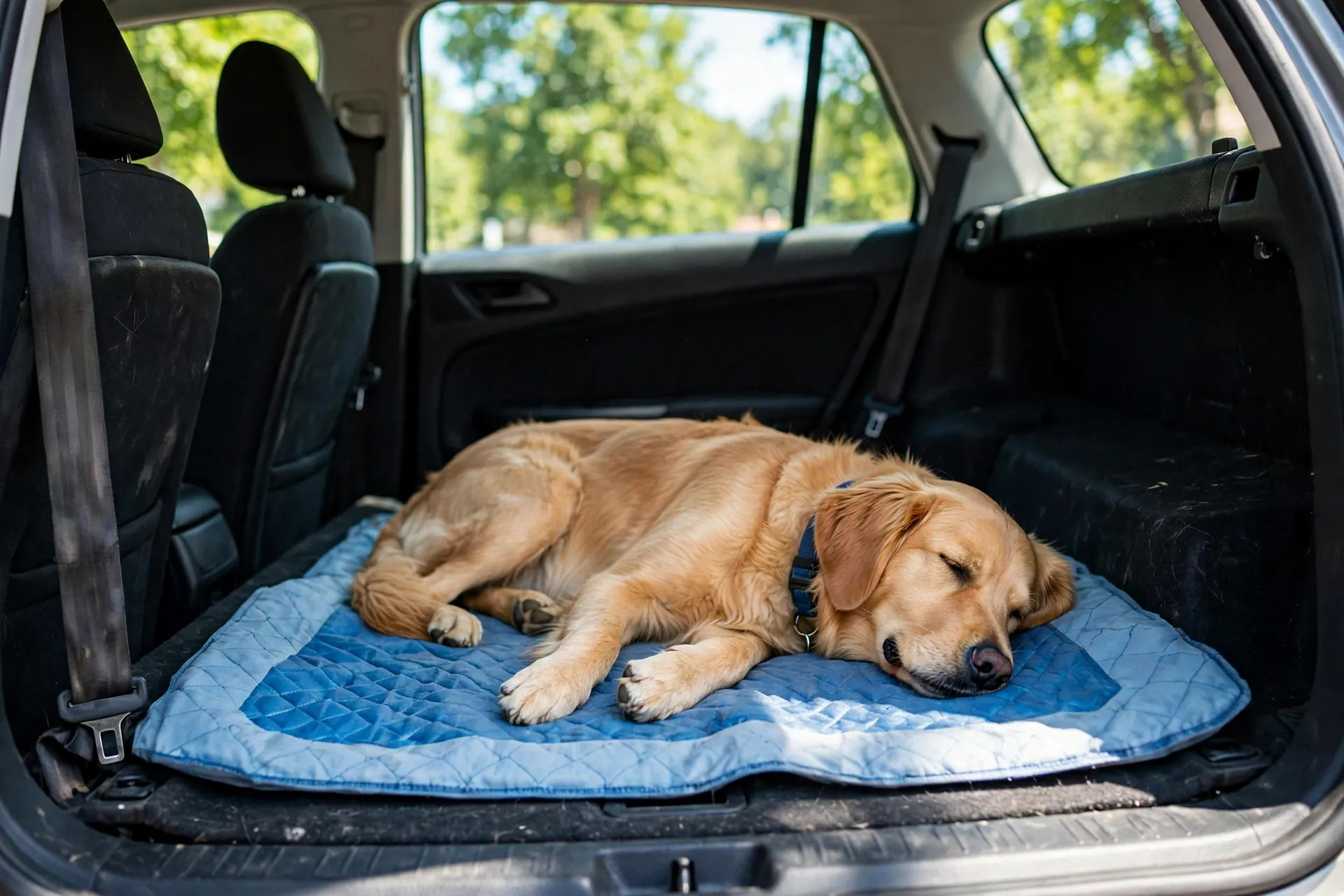
Before a warm journey, place the mat flat in the boot or crate and let the dog step onto it at home, without the engine running. Check that the dog can turn around, lie down and stand up without stepping off the mat onto a hot surface, and that the mat does not cover air vents or block the crate door. A non-slip base, a crate liner underneath, or a mat sized to the crate floor all help. Avoid stacking a thick mat, a blanket and a bed in a way that raises the dog or reduces headroom. In a crate, headroom matters for panting and for comfort on a long journey.
On the road, use the mat as part of a timetable, not as a reason to extend a journey. Plan stops every two hours or so, sooner in hot weather, and use each stop to check the dog, offer water, and let the mat recover in shade or in moving air. If the mat feels warm to your hand, move it to a shaded spot during the stop, or swap it for a second mat if you carry one. Do not leave the mat in a parked car in direct sun while you eat lunch, because it will absorb heat from the car itself and start the next leg already warm. Take it with you into the shade, or store it in the coolest part of the car.
Never leave a dog alone in a parked car on a warm day, even with a cooling mat, the windows cracked and a bowl of water. A car heats up far faster than most people expect, and a mat cannot offset that rise. If you must stop, take the dog with you, or plan the stop around a dog-friendly place where the dog can wait in shade with you. The mat is for a moving car with ventilation or air conditioning, and for rest stops in shade, not for a parked car.
Air conditioning and ventilation still matter more than the mat. Direct a vent towards the boot or crate area if the car allows it, without blowing cold air straight into the dog's face for the whole journey. Keep the car at a comfortable temperature before the dog gets in, rather than loading a hot car and hoping the mat compensates. On arrival, check the mat for damp patches, slipped edges or chew marks before the next leg. A quick check takes a minute and prevents a leak spreading across the boot liner.
For train, bus and ferry travel, the same sizing and recovery rules apply, with one extra consideration: other passengers and staff. A mat that smells damp, sheds gel or slides across the floor will cause problems in a shared space. Pack a clean, dry mat in a bag, place it only where the dog is allowed to lie, and keep a spare towel for muddy paws. If the journey involves a long wait on a platform in sun, find shade first and use the mat second. The mat does not make a sunny platform comfortable, and a dog that is already hot will not settle on it.
Using a mat at your stay
At a holiday cottage, caravan, campsite or hotel, a cooling mat has more time and more space to work, and that changes the best choice. A water-filled mat that would be heavy in the car becomes practical when it stays in one room for a week. A gel mat that saturated during the drive can recover overnight in a cool room, ready for the next day. The key is to give the mat a proper place, rather than leaving it folded in the car or draped over a radiator.
On arrival, choose a spot that is already cool: a tiled floor, a shaded corner, or a room that does not face the afternoon sun. Lay the mat flat, ideally on top of or beside the dog's usual bed, so the dog has a familiar scent and a clear choice. Some dogs move between a mat and a bed during the day, cooling down on the mat and then settling on the bed. That movement is normal and healthy. Do not fence the dog onto the mat or remove the bed in the hope of forcing use. A dog that can choose will use the mat when it helps.
In a caravan or a small lodge, floor space is limited and heat builds up quickly in strong sun. Keep curtains or blinds closed on the sunny side during the middle of the day, ventilate in the cooler morning and evening, and place the mat where air moves, not in a stuffy corner behind furniture. A mat on a bed that is itself in direct sun will warm up with the bedding, so move the mat with the shade during the day if you can. The same applies to a tent: a mat inside a tent that has been closed all day will be warm before the dog lies on it. Open the tent, air it, and let the mat cool in shade before the evening rest.
For dogs that sleep in a crate at the accommodation, check the same fit as in the car: flat, no curling edges, door unobstructed, and enough headroom. For dogs that sleep on a bed, a mat placed on top of a travel dog bed can combine cushioning and cooling, provided the mat does not slip. A non-slip base or a bed with a raised edge helps. If the dog is elderly or has joint problems, prioritise support first and cooling second: a supportive bed with a thin mat on top is usually better than a cooling mat alone on a hard floor.
Cleaning at the accommodation is easier if you plan for it. Bring a damp cloth, a small bottle of dog-safe cleaner and a spare towel, and wipe the mat after muddy walks rather than letting mud dry into the surface. If the mat has a removable cover, wash it mid-stay if needed, and dry it fully before putting it back. A damp cover left on a mat in a warm room can smell quickly, and a dog that associates the mat with a damp smell may avoid it. At the end of the stay, dry the mat completely before packing, because a mat packed damp will be unpleasant to unpack at the next stop.
Also check the accommodation rules. Some places ask that dogs stay off beds and sofas, and a mat on the floor respects that rule while still giving the dog a cool place. Others provide a dog bed, in which case your mat can go on top of it or beside it. If the accommodation has a tiled utility room or a cool hallway, that can be an excellent mat location during the hottest part of the day, provided the dog is not isolated or distressed by being separated from the family. The mat should follow the dog's social place in the household, not exile the dog to the coolest room alone.
A realistic hot-day routine
A cooling mat works best inside a timetable that already respects heat. The most effective hot-day routine is simple, and it does not depend on buying more gear. Walk early, rest in the middle of the day, walk again when the air cools, and use the mat during the rest periods, not as a way to push through the hottest hours.
Start with an early walk, before the sun strengthens. Choose shade, grass or woodland paths over tarmac, which holds heat and can burn paws. Carry water, offer it regularly, and watch for the dog slowing down, seeking shade or panting more than usual. A short, sniff-rich walk that leaves the dog content is better than a long walk that leaves the dog overheated. After the walk, offer water, let the dog cool down in shade, and only then settle the dog on the mat. A dog that lies on a mat immediately after hard exercise, while still panting heavily, will warm the mat quickly and may not settle.
During the middle of the day, keep the dog in shade with water available and air moving. This is the mat's main window: a rest period of an hour or two, in a cool room or a shaded car boot during a stop, with the mat flat and the dog settled. Check the mat after the first hour. If it feels warm, give the dog a break from it, move to a cooler surface, or swap mats. Do not wake a settled dog to check the mat, but do check when the dog naturally moves, drinks or changes position.
In the afternoon, repeat the pattern in reverse. A short, shaded walk or a gentle play session in a cool garden, followed by water and a rest on a recovered mat, is more sustainable than one long outing. If the day is exceptionally hot, skip the afternoon walk altogether and use indoor play, training games or a calm chew in shade. For a fuller hot-weather timetable, including walk timings, shade and water planning, see our heatwave week guide, which sets out how a whole week of hot days should be structured.
Evening is often when a mat is most appreciated, because the dog is tired and the air is cooling. Place the mat in the sleeping area, check it is clean and dry, and let the dog choose between the mat and the bed. If the evening is still warm, ventilate the room, keep water nearby, and avoid a late, vigorous walk that reheats the dog just before bed. A calm last outing, a drink and a settled rest usually lead to a better night than a final burst of exercise.
Two cautions belong in every hot-day routine. First, never rely on a mat to judge whether a dog is too hot. Panting, drooling, restlessness, a rapid heartbeat, vomiting, confusion or collapse are signs to act on immediately, not signs to watch while waiting for a mat to work. Second, never use a mat as a reason to leave a dog in a situation that is already too hot. If the room, car or garden is too hot for a person to sit comfortably in, it is too hot for a dog to rest in, mat or no mat. Move the dog, cool the space, and seek veterinary help if you are worried.
Cleaning, drying and storage
Cleaning a cooling mat is straightforward, but it is also where many mats fail early, because damp storage and sharp folding damage the filling and the seams. A simple routine, done after every trip, extends the life of the mat far more than any special product.
Start by checking the care label. Most gel mats can be wiped with a damp cloth and a mild, dog-safe cleaner, while water mats may need the outer fabric cleaned separately from the inner chamber. Avoid harsh disinfectants, bleach or abrasive pads unless the manufacturer specifically allows them, because they can damage the surface and leave residues a dog may lick. After muddy walks, wipe the mat promptly rather than letting mud dry and crack into the surface. For a removable cover, machine-wash it according to the label, and dry it fully before refitting.
Drying matters as much as washing. Lay the mat flat in a ventilated room, away from direct sun and radiators, until both sides feel completely dry. A mat that feels dry on top can still be damp underneath, especially on a thick gel mat. If you must pack quickly, wrap the mat in a dry towel for the journey, then unpack and dry it properly at the next stop. Never pack a damp mat in a sealed plastic bag for days, and never store a mat on top of a radiator or in a hot loft, because heat accelerates gel breakdown and fabric ageing.
For storage between trips, keep the mat flat if you have the space, or roll it loosely rather than folding it sharply. Repeated folding along the same line is a common cause of seam failure in gel mats, because the gel is forced into the crease and the fabric weakens. If the mat must be folded to fit a bag, vary the fold lines, avoid placing heavy objects on top of it, and unfold it a day before travel so it can lie flat again. Store it in a cool, dry place, out of reach of a dog that might chew it in storage, and check it before every trip: seams, corners, valves, non-slip base and any sign of swelling, leaking or smell.
Water mats need one extra step. Drain them fully if they will not be used for a while, following the manufacturer's instructions, and dry the chamber and cover before storage. Stagnant water left in a mat can smell, and a mat stored full is heavy and more likely to leak if knocked. When refilling, use clean water, check the valve seal, and test the mat on a towel for a few hours before putting it in the car or on a bed. A slow leak discovered at home is an inconvenience; a slow leak discovered in a car boot is a mess.
Finally, know when to retire a mat. A mat with a patched leak, a persistent smell, a swollen section, a damaged valve or a cover that no longer stays in place should be replaced, not patched repeatedly. A mat that has served several summers and now saturates in under an hour has probably lost much of its gel effectiveness. Replacing it is cheaper than a vet visit, and a new mat with intact seams is safer for a dog that chews or digs. Keep the old mat out of reach until it is disposed of, so a dog cannot chew the damaged filling.
Limits and heatstroke signs
The most important section of this guide is also the shortest to state: a cooling mat has clear limits, and heatstroke is a veterinary emergency that no mat can treat. Understanding those limits protects the dog far more than choosing between brands.
A mat cannot lower the temperature of a room or a car. It can only absorb heat from the part of the dog in contact with it, for a limited time. It cannot provide drinking water, moving air or shade. It cannot undo heat built up during exercise, and it cannot help a dog that is already overheating as quickly as shade, cool water on the body, moving air and veterinary care can. If a dog is showing signs of heatstroke, the mat is not the treatment; it is, at most, one cool surface among others while you seek help.
Heatstroke signs vary, but the pattern to watch for includes heavy or rapid panting that does not settle with rest, excessive drooling, a bright red or pale tongue and gums, restlessness or confusion, vomiting or diarrhoea, a rapid heartbeat, weakness, staggering and, in severe cases, collapse or seizures. Brachycephalic dogs, elderly dogs, overweight dogs, dogs with heart or breathing conditions and puppies are at higher risk, and they can deteriorate faster. If you see several of these signs together, move the dog to shade or a cool room immediately, offer small amounts of cool water if the dog can drink safely, cool the body gradually with cool, not ice-cold, water and moving air, and contact a vet urgently. Do not use ice baths or very cold water, do not force water into a dog that cannot swallow safely, and do not delay veterinary advice while trying home cooling alone. If you are unsure about any aspect of first aid or local rules, check the official guidance before you travel, and save the number of a vet near your destination before you need it.
Prevention is more reliable than any cooling product. Avoid the hottest part of the day for walks, test pavements with your hand, carry water, never leave a dog in a parked car, and build rest into every journey. A mat fits inside that prevention plan; it does not replace it. If a journey or a day out cannot be made safe without relying on a mat to fix overheating, change the plan. An earlier start, a shorter walk, a shaded route or a day at the accommodation is a better decision than a longer outing with a mat in the boot.
There are also dogs and situations where a mat is not the right tool at all. A dog with a skin condition, an open wound or a recent operation should not lie on a mat unless a vet advises it, because dampness and pressure can irritate the area. A dog that is shivering, elderly and thin, or recovering from illness may be chilled by a cooling mat in the evening, when the air cools. A dog that is anxious in the car may chew, dig or pace on a mat, creating a hazard rather than comfort. In each case, ask a vet or a qualified behaviour professional for advice specific to that dog, rather than assuming a product marketed for all dogs suits every dog.
Finally, be honest about marketing. A mat described as veterinary approved, clinically proven or guaranteed to prevent heatstroke should be read carefully. Ask what was tested, on which dogs, and under what conditions. A product that helps a resting dog feel more comfortable in warm weather is genuinely useful. A product that claims to make hot cars, long midday walks or unsupervised parking safe is not telling the whole story. The safest guide is the dog in front of you, the shade and water you can provide, and the timetable you choose.
Packing checklist
Packing for a cooling mat is less about the mat itself and more about the system around it. Use this checklist the night before a warm trip, and adapt it to your dog, car and destination.
- Mat, checked: seams, corners and valves inspected, surface clean and fully dry, lying flat overnight so it is not creased on departure.
- Second mat or spare towel: useful for a long journey, so one mat can recover while the other is in use, or a towel can cover a damp surface.
- Non-slip base or crate liner: prevents sliding in the boot or crate, especially on a smooth liner after a wet walk.
- Water and bowl: a filled bottle, a collapsible bowl and a spare bottle for the dog, not just for the humans.
- Shade and ventilation plan: a parasol, a car shade or a known shaded stop, plus a plan for air conditioning and vent direction.
- Cleaning kit: a damp cloth, dog-safe cleaner, a dry towel and a bag for a dirty cover, so mud does not dry into the mat.
- Vet details: the number of a vet near your destination, saved in your phone, plus your own vet's number for advice on the road.
- Restraint check: harness or crate fitted correctly, mat placed without blocking the door, vents or headroom.
- Timetable: planned stops every couple of hours, an early walk, a midday rest and a cooler evening walk, with a fallback if the day turns hotter than forecast.
- Dog's own bed or blanket: a familiar scent helps the dog settle on or beside the mat, in the car and at the accommodation.
On the morning of departure, do a final check that takes less than two minutes. Lay the mat flat, run a hand over the surface for damp patches or swelling, confirm it has not been chewed in storage, and place it where the dog will actually lie. If it fails any check, leave it at home and rely on shade, water and rest. A trip without a mat, well planned, is far safer than a trip with a damaged mat and a false sense of security.
When you return home, the same routine closes the loop. Wipe the mat, dry it fully, roll it loosely, store it flat or loosely rolled in a cool, dry place, and note anything that needs replacing before the next warm trip. A mat cared for in this way will last longer, stay safer and be ready when the next warm journey arrives, rather than being discovered, damp and creased, on the morning you need it most.
Practical questions
Before you go
How long does a dog cooling mat stay cool on a journey?
Most pressure-activated gel mats feel noticeably cool for about one to three hours, depending on the dog's size, the air temperature and how much of the dog's body is in contact with the mat. After that the gel warms towards the dog's body temperature and the benefit fades, so plan a break, shade and fresh air rather than expecting one mat to cover a whole day.
Are gel cooling mats safe if my dog chews them?
No cooling mat should be treated as chew-proof. Most gel mats are designed to be used under supervision, and a punctured mat can leak gel that a dog should not eat. Choose a tougher outer fabric for a keen chewer, keep the mat inside a cover or crate liner where possible, remove it at the first sign of damage, and seek veterinary advice promptly if your dog swallows gel or filling.
Can a cooling mat replace shade, water and air conditioning?
No. A cooling mat is only a supporting layer. Shade, moving air, drinking water, rest and a sensible timetable do most of the work of keeping a dog comfortable. A mat cannot make a hot car safe, cannot replace ventilation, and cannot undo the heat built up during a long walk in strong sun.
What size cooling mat should I buy for the car boot?
Measure the flat area your dog will actually lie on, then choose a mat that covers the chest and belly without curling up the sides or blocking the crate door. For many medium dogs that means a mat around 90 by 60 centimetres, but the boot measurement matters more than the breed label. If the mat is too large it will fold, crease and wear faster; if it is too small the dog will simply lie beside it.
How do I clean and store a cooling mat between trips?
Wipe the surface with a damp cloth and a mild, dog-safe cleaner, dry it fully before folding, and store it flat or loosely rolled in a cool, dry place away from radiators and direct sun. Check seams and corners before every trip, and do not fold a gel mat sharply along the same line each time, because repeated creasing is a common cause of leaks.