This guide is independent and contains no paid placement. If affiliate links are added later, they will be clearly marked and will not change our editorial checks.
Dorset rewards dog owners who plan by beach, not by county. Knoll Beach at Studland has a year-round dog area, Weymouth's main beach bans dogs from 1 May to 30 September but keeps a dog area at the Pavilion end, and Chesil Beach, Ringstead Bay and Shell Bay welcome dogs all year. Swanage, Lyme Regis and Charmouth run seasonal bans on their main sands, while Durdle Door and Lulworth Cove allow dogs but demand a lead on the cliffs and a careful eye on the tide. Check the signs at each beach entrance before you let your dog off the lead, because boundaries and dates are set beach by beach.
How Dorset beach rules work
Dorset does not have one county-wide dog rule. Each beach is managed separately, usually by Dorset Council, by the National Trust at Studland, or by the Lulworth Estate around Durdle Door, and each one sets its own seasonal dates, its own dog zone and its own lead rules. That is why a beach that welcomes dogs in February can ban them in July, and why two beaches a mile apart can have completely different signs. The practical habit is simple: read the notice board at the entrance to the beach you are actually standing on, and treat the sign in front of you as the rule for that day, even if a website or a guidebook says something different. If the sign and the website disagree, follow the sign and check the official guidance before you travel next time.
Most of the busy resort beaches use the same seasonal pattern. Dogs are banned from the main bathing beach from 1 May to 30 September, which covers the school summer holidays and the busiest weekends, and are welcome again from 1 October to 30 April. Weymouth Beach, Swanage main beach, Lyme Regis main beach and Charmouth Beach all follow a version of this pattern, although the exact stretch of sand covered by the ban differs at each one. At Weymouth the ban covers the main beach but leaves a dog area at the Pavilion end. At Swanage the ban covers the main beach in front of the town, while the quieter stretches beyond it are treated differently. At Lyme Regis the main beach in front of the town is restricted in summer, and at Charmouth the ban applies to the main beach near the car park and the Heritage Coast Centre. In every case, the restricted stretch is marked on the beach itself, and the dog area, where one exists, is usually at one end of the bay rather than in the middle.
The quieter beaches work the other way round. Knoll Beach at Studland, Shell Bay at the far end of Studland, Ringstead Bay, much of Chesil Beach and the shingle at West Bay welcome dogs all year, with no summer ban to remember. That does not mean anything goes. Dogs must still be under control, owners must clear up after them, and leads are required on paths, near roads, near livestock and on cliff tops. At Studland the year-round dog area is a defined stretch at the southern end of Knoll Beach, not the whole four miles of Studland Bay, and the National Trust asks owners to keep dogs on a lead through the car park, the dunes and the heathland paths where ground-nesting birds and grazing animals are present. At Chesil Beach there is no summer ban, but the beach is a long, exposed shingle bank with a steep shelf into the sea, so the risk is not a fine but a dog in difficulty in the water or cut paws on the stones.
Enforcement in Dorset is through Public Spaces Protection Orders, known as PSPOs, which Dorset Council uses to set the seasonal bans and the lead rules on its beaches. A PSPO can carry a fine, so the seasonal dates are worth taking seriously rather than treating as a suggestion. The council publishes the current PSPO maps for each beach, and the signs on the beach summarise them, but the maps are the authoritative version if you want to check a boundary before you set off. National Trust land at Studland has its own byelaws and its own wardens, and the Lulworth Estate sets the rules at Durdle Door and Lulworth Cove. If you are planning a multi-beach day, check each beach separately rather than assuming that a rule at one applies at the next. A good routine is to check the tide times and the dog rules for each beach the night before, then confirm them again on the notice board when you arrive, because a landslip, a nesting season or a change in estate management can close a stretch of sand with little warning.
Winter is the easy season in Dorset. From October to April almost every beach in the county welcomes dogs, the car parks are quieter, the cafes are less crowded, and the long sands at Studland, Weymouth and Swanage give a dog room to run without the summer crowds. The trade-off is weather and light. Winter storms can throw shingle and debris onto the beaches, the South West Coast Path can be muddy and slippery on the cliff sections, and some beach cafes and kiosks close or shorten their hours outside the summer season. Summer is the season that needs planning: arrive early for parking, use the year-round beaches such as Knoll Beach and Chesil Beach if you want a full day on the sand, and use the dog areas at Weymouth and Swanage if you want to be in town. Spring and autumn are often the best compromise, with the seasonal bans lifted or not yet in force, the heathland at Studland in flower, and the coastal path firm underfoot.
Studland: Knoll, Middle and Shell Bay
Studland Bay is the most important dog beach in Dorset, and it is also the one where the rules most often confuse first-time visitors, because the bay is four miles long and the three beaches along it are managed as separate places. The bay runs from South Haven Point at the southern end, near the mouth of Poole Harbour, north-east to Old Harry Rocks, and the sand is soft, pale and gently shelving, which makes it one of the best swimming beaches in the county for dogs that like the water. The National Trust owns and manages the beach, the dunes, the heathland behind it and the car parks at Knoll Beach, Middle Beach and Shell Bay, and it is the Trust's signs that set the dog rules here. The headline to remember is that Knoll Beach has a year-round dog area at its southern end, while the rest of the bay has seasonal and lead restrictions that change with the stretch of sand.
Knoll Beach is the main Studland beach, reached from the National Trust car park at the end of Ferry Road, and it is the beach most dog owners head for first. The car park is large but fills quickly on summer weekends and school holidays, and it is a pay-and-display car park with National Trust member parking. From the car park, a short walk through the dunes leads to the beach, and the dog area is at the southern end of Knoll Beach, marked by signs on the sand. In the dog area, dogs can be off the lead all year round, provided they are under control and their owners clear up after them. The rest of Knoll Beach, towards the middle and northern end, is a family bathing beach in the summer months, and dogs are restricted there during the seasonal period, so keep your dog in the marked dog area if you visit between May and September. Outside the summer season, the whole of Knoll Beach is quieter and dogs are welcome more widely, but the dog area remains the reliable place to let a dog run off the lead without worrying about the boundary.
Middle Beach is the middle of the three Studland beaches, reached from its own smaller National Trust car park off the B3351, and it is a shorter, narrower stretch of sand backed by dunes and heathland. Middle Beach is quieter than Knoll Beach and is a good choice for owners who want a calmer walk, but it is also more exposed to the wind and has fewer facilities. There is no cafe on Middle Beach itself, and the nearest toilets and refreshments are at Knoll Beach, so bring water for your dog and plan accordingly. Dogs are welcome on Middle Beach, but the seasonal restrictions that apply to the bathing area at Knoll Beach also affect how far you can walk along the sand in summer, so check the signs at the Middle Beach car park and at the beach entrance before you let your dog off the lead. The walk between Middle Beach and Knoll Beach along the sand is one of the best dog walks in Dorset at low tide, but it is a long walk on soft sand, so older dogs and small dogs will tire quickly.
Shell Bay is at the far southern end of Studland Bay, at the mouth of Poole Harbour, and it is reached from the Shell Bay car park near the Sandbanks ferry terminal, or on foot from Knoll Beach along the sand at low tide. Shell Bay is a wilder, more open beach than Knoll Beach, with views across the harbour entrance to Sandbanks and Poole, and it welcomes dogs all year. It is a good beach for dogs that like a long, empty run, but it is also the most exposed to the harbour current and to the ferry traffic, so keep dogs out of the deep water near the harbour mouth and on a lead near the ferry road and the car park. The Sandbanks ferry, which runs between Shell Bay and Sandbanks, is a useful crossing if you are walking the coast path from Poole, but check the ferry times before you rely on it, because the ferry can be suspended in bad weather or at very low tide.
Behind the beaches, Studland Heath is a large area of lowland heathland managed by the National Trust, with waymarked trails through heather, gorse and pine woodland, and it is one of the best inland dog walks in Dorset. Dogs must be kept on a lead on the heathland, because the heath is home to ground-nesting birds, including the Dartford warbler and the nightjar, and to grazing ponies and cattle. The heathland trails are also used by horse riders and cyclists, so a lead keeps your dog safe as well as protecting the wildlife. The walk from Knoll Beach car park through the heath to the village of Studland is a good circular route, and the village itself has a pub and a shop, but the heath can be very hot and dry in summer, with adders present in the gorse and heather, so keep your dog on the path, carry water, and check the official guidance before you travel if you are unsure about the current grazing or nesting restrictions.
Weymouth, Bowleaze Cove and Ringstead
Weymouth Beach is the classic Dorset seaside beach: a long, gently curving bay of fine sand in front of the town, with the Esplanade behind it, donkey rides and Punch and Judy in summer, and a shallow, sheltered bay that is popular with families. For dog owners, the key fact is the seasonal ban. Dogs are banned from the main Weymouth Beach from 1 May to 30 September, and the ban covers the main bathing beach in front of the Esplanade. During those months, dogs are welcome on the dog area at the Pavilion end of the beach, at the northern end near the Pavilion Theatre, where the sand is still good and the water is shallow. The Pavilion end dog area is a defined stretch, marked by signs, and it is the place to head for if you want to be on Weymouth Beach with a dog in summer. Outside the summer season, from 1 October to 30 April, dogs can use the whole of Weymouth Beach, and the long, flat sand is one of the best winter dog walks in Dorset.
Weymouth is a good town for a dog day out beyond the beach itself. The Esplanade is a level, paved promenade that runs the length of the bay, and dogs on a lead are welcome along it, with benches, cafes and ice-cream kiosks along the way. The harbour, at the southern end of the bay, is a working fishing harbour with boats, fish stalls and a bridge, and dogs on a lead are welcome on the quayside, although the harbour is busy and the quayside is narrow in places. The Nothe Gardens, on the headland above the harbour, are a good place for a dog walk with views across the bay, and the Rodwell Trail, a former railway line that runs from Weymouth towards Portland, is a level, traffic-free walk that is popular with dog owners. Parking in Weymouth is in council car parks, including the Melcombe Regis car park near the beach and the Swannery car park, and charges apply, with the beach car parks filling quickly on summer weekends. Arrive early, or use the park-and-ride, if you are visiting in July or August.
Bowleaze Cove is a smaller beach to the east of Weymouth, beyond the River Wey and the Lodmoor Nature Reserve, and it is reached from the Bowleaze Cove car park on the coast road towards Osmington. Bowleaze Cove is a shingle and sand beach backed by cliffs, with a holiday park and a cafe nearby, and it is a good alternative to Weymouth Beach in summer because it is quieter and less crowded. Dogs are welcome at Bowleaze Cove, but the beach is more exposed than Weymouth Beach, the sea shelves more steeply, and the cliffs at the eastern end are prone to falls, so keep your dog on a lead near the cliff base and check the signs at the car park for the current dog rules. The walk from Bowleaze Cove eastwards along the South West Coast Path towards Osmington Mills and Ringstead is a fine cliff walk, but it is steep in places and the path can be narrow, so it suits fit dogs and owners who are comfortable with heights.
Ringstead Bay is one of the quietest and most attractive beaches in Dorset, a small, sheltered bay of sand and shingle between Weymouth and Lulworth, reached from the Ringstead car park at the end of a narrow lane. Ringstead Bay welcomes dogs all year, and it is a favourite with local dog owners because it is rarely crowded, even in summer. The beach is backed by low cliffs and grassy slopes, with a small cafe and toilets near the car park, and the water is clear and shallow at low tide. The eastern end of the bay, towards White Nothe, is a good place for a dog to explore the rock pools, but the cliffs are unstable and the tide can cut off the walk along the shore towards Lulworth, so check the tide times before you walk east from Ringstead and keep your dog on a lead near the cliff base. The walk from Ringstead to Lulworth Cove along the coast path is a beautiful but strenuous route, with steep climbs and descents, and it is best done as a one-way walk with a bus or a lift back, rather than as a return walk with a tired dog.
Between Weymouth and Ringstead, the coast road passes through Osmington Mills, a small village with a pub and a beach of its own, and the coast path here is one of the most scenic stretches in Dorset, with views across the bay to Weymouth and Portland. Osmington Mills beach is a shingle beach with rock pools, and dogs are welcome, but the beach is small and the car park is limited, so it is best visited outside the summer peak. If you are staying in Weymouth for a few days, a good routine is to use the Pavilion end dog area in the morning, when the beach is quiet, then walk the Rodwell Trail or the Nothe Gardens in the afternoon, and save Ringstead Bay and Bowleaze Cove for a quieter day when you want a longer drive and a wilder beach.
Swanage and the Purbeck bays
Swanage is a small seaside town on the Isle of Purbeck, at the eastern end of the Jurassic Coast, and its main beach is a gently shelving bay of sand in front of the town, with a pier, a promenade and a row of beach huts. The main Swanage beach has a seasonal dog ban, and dogs are banned from the main beach during the summer months, in line with the pattern at Weymouth and Lyme Regis. The exact dates follow the Dorset Council seasonal ban, usually from 1 May to 30 September, and the ban covers the main bathing beach in front of the town. During the ban, dogs are welcome on the quieter stretches of sand beyond the main beach, towards the northern end near the pier and the southern end towards the coast path, but the boundary is marked on the beach and it is worth checking the signs at the beach entrance before you let your dog off the lead. Outside the summer season, dogs can use the whole of Swanage Beach, and the long, flat sand is a good winter walk.
Swanage is a good base for a dog holiday in Purbeck, because the town is compact and walkable, with a good range of cafes, pubs and shops, and because the coast path runs in both directions from the town. To the north, the coast path runs from Swanage towards Studland, passing through the chalk downland of Ballard Down and the village of Studland, and this is a fine, if steep, walk with views across Poole Harbour. To the south, the coast path runs from Swanage towards Durlston Country Park and then onwards to Dancing Ledge, St Aldhelm's Head and Chapman's Pool, and this is a wilder, more exposed walk with steep cliffs and few facilities. Dogs must be kept on a lead on the coast path near the cliff edge and near livestock, and the path can be muddy and slippery after rain, so wear good boots and keep your dog close on the narrow sections.
Durlston Country Park, at the southern end of Swanage, is a good place for a dog walk that is not on the beach. The park is a large area of downland and woodland above the cliffs, with waymarked trails, a visitor centre in Durlston Castle, and views across the bay to the Isle of Wight. Dogs are welcome in Durlston Country Park, but must be kept on a lead in some areas, particularly near the cliff edge and where ground-nesting birds are present, and the park is home to grazing animals. The walk from Durlston to the lighthouse at Anvil Point is a short, level walk that is suitable for older dogs, while the longer walk to Dancing Ledge is a more strenuous route with steps down to the ledge itself. Check the official guidance before you travel if you plan to walk the Purbeck coast path in summer, because the path can be closed after heavy rain or a cliff fall.
Parking in Swanage is in council car parks, including the main car park near the beach and the car park at Durlston Country Park, and charges apply, with the beach car park filling quickly on summer weekends. The town also has a steam railway, the Swanage Railway, which runs from Swanage to Corfe Castle and Norden, and dogs are welcome on the railway, which is a useful way to reach the coast path at Corfe Castle without driving. Corfe Castle itself is a National Trust property, and dogs on a lead are welcome in the castle grounds, although the castle ruins are steep and uneven. A good day out from Swanage is to take the steam train to Corfe Castle, walk the Purbeck Hills back to Swanage, and finish with a walk on Swanage Beach in the evening, when the seasonal ban does not apply or the beach is quiet.
North of Swanage, the small bays of the Purbeck coast, including Dancing Ledge, Chapman's Pool and Kimmeridge Bay, are wild, rocky places that are not resort beaches and do not have the same facilities as Swanage. Kimmeridge Bay is a rocky bay with rock pools and a small car park, and dogs are welcome, but the bay is part of a marine reserve and the rock pools are protected, so keep dogs out of the pools and on a lead near the cliff base. Dancing Ledge is a flat rock ledge at the base of the cliffs, reached by a steep path with steps, and it is not a beach for dogs that are unsteady on their feet. Chapman's Pool is a remote cove reached by a long walk from the coast path, with no facilities and no car park nearby, and it is best visited by experienced walkers with fit dogs. These bays are worth visiting for their wildness, but they are not places to take a dog for a first beach day.
Lyme Regis, Charmouth and West Bay
Lyme Regis is a small town on the Dorset-Devon border, at the western end of the Jurassic Coast, and its main beach is a shingle and sand beach in front of the town, sheltered by the Cobb, the famous stone harbour wall. The main Lyme Regis beach has a seasonal dog ban, and dogs are banned from the main beach during the summer months, usually from 1 May to 30 September, in line with the Dorset Council pattern. During the ban, dogs are welcome on the beaches beyond the main beach, including the stretch towards Charmouth and the quieter sand at the eastern end of the bay, but the boundary is marked on the beach and it is worth checking the signs at the beach entrance and at the Cobb. Outside the summer season, dogs can use the whole of Lyme Regis Beach, and the long, flat sand at low tide is a good winter walk, with views across the bay to the cliffs of the Jurassic Coast.
Lyme Regis is also a town where the cliff risk is real and visible. The cliffs to the east of Lyme Regis, towards Charmouth, are made of soft, crumbling clay and shale, and landslips are frequent, particularly after heavy rain. The beach below the cliffs is a good place to look for fossils, but it is also a place where a cliff fall can happen without warning, so keep your dog on a lead near the cliff base, do not let your dog dig at the base of the cliff, and do not walk directly below an overhang or a recent slip. The town council and Dorset Council put up warning signs at the beach entrances when a landslip has occurred, and the coast path above the cliffs can be closed or diverted after a slip, so check the signs before you walk. Fossil hunting is popular at Lyme Regis and Charmouth, but the best fossils are found on the beach after the tide has gone out, not by digging into the cliff, and the Charmouth Heritage Coast Centre runs guided fossil walks that are a good way to learn the safe places to look.
Charmouth Beach is a shingle and sand beach at the mouth of the River Char, to the east of Lyme Regis, and it is the main fossil-hunting beach in Dorset. Charmouth Beach has a seasonal dog ban on the main beach near the car park and the Heritage Coast Centre, usually from 1 May to 30 September, and dogs are welcome on the beach outside the summer season and on the quieter stretches beyond the main beach during the summer. The beach is backed by cliffs that are prone to landslips, and the river mouth can be deep and fast-flowing after rain, so keep your dog on a lead near the cliff base and near the river, and check the tide times before you walk east from Charmouth towards Lyme Regis, because the tide can cut off the walk along the shore. The Heritage Coast Centre at Charmouth is a good place to start a visit, with information about the tides, the cliffs and the fossils, and dogs on a lead are welcome outside the centre, although the centre itself is a small building and it is worth checking the current access rules before you visit.
West Bay, also known as Bridport Harbour, is a small harbour town at the mouth of the River Brit, with a shingle beach, a harbour wall, and the tall, golden cliffs of East Cliff and West Cliff at either end of the bay. West Bay Beach welcomes dogs all year, and it is a good beach for dogs that like a long, open run on shingle, although the shingle is hard on paws and the sea shelves steeply. The harbour itself is a working fishing harbour, and dogs on a lead are welcome on the quayside, with fish stalls, cafes and a pub nearby. The cliffs at West Bay are among the tallest and most unstable on the Dorset coast, and the beach below East Cliff is closed after landslips, so keep your dog on a lead near the cliff base and do not walk directly below the cliffs. The walk from West Bay eastwards along the coast path towards Burton Bradstock and Abbotsbury is a fine cliff walk, but it is steep and exposed, and the path can be closed after a cliff fall, so check the official guidance before you travel.
A good way to explore this western end of Dorset with a dog is to base yourself in Lyme Regis or Charmouth for a few days and walk the coast path between the two towns, which is a short, level walk along the beach at low tide or along the cliff top at high tide. The walk from Lyme Regis to Charmouth takes about an hour on foot, and it passes the fossil-rich cliffs and the rock pools that make this stretch famous. In summer, use the dog areas beyond the main beaches, and in winter use the whole beach. If you are staying in West Bay, the walk to Burton Bradstock is a good half-day walk, with a beach cafe at Burton Bradstock and a quieter beach than West Bay itself. In all three towns, the car parks are council car parks with charges, and they fill quickly on summer weekends, so arrive early or use the bus from Bridport or Axminster.
Durdle Door and Lulworth Cove
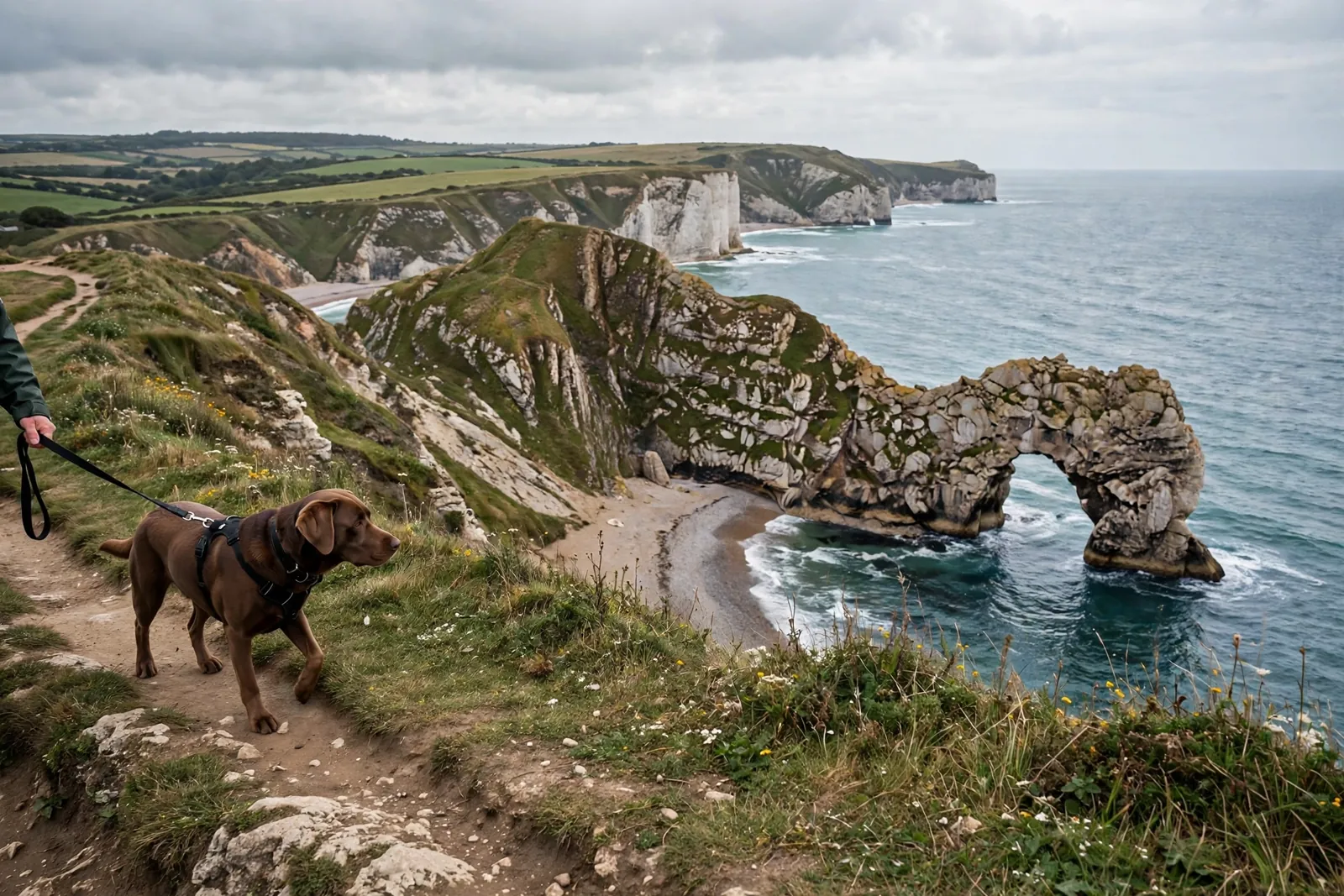
Durdle Door is the most photographed place in Dorset: a natural limestone arch in the sea, with a shingle beach below it and a steep, stepped path down from the car park. Dogs can visit Durdle Door and the beach below it, but this is not a soft-sand beach for a dog to run on, and it is not a place to take a dog that struggles with steps or steep slopes. The walk from the Durdle Door car park down to the beach is steep, with steps and a loose, chalky path, and the climb back up is hard work in summer, particularly for older dogs and for owners carrying a dog. The beach itself is shingle, with a steep shelf into the sea, and the water is deep close to the shore, so keep dogs out of the water if they are not strong swimmers, and keep them on a lead on the clifftop path and near the cliff edge, where the drop is sheer and the ground can be slippery.
Lulworth Cove is a small, almost circular bay a short walk from Durdle Door, with a shingle beach, a village, and a Heritage Centre. Dogs are welcome at Lulworth Cove, but the beach is small and crowded in summer, and the cove is a popular swimming and kayaking spot, so it is not the best place for a dog that needs space. The walk from Lulworth Cove to Durdle Door along the coast path takes about thirty minutes and is a steep, stepped route with fine views, but it is busy in summer and the path is narrow in places, so keep your dog on a lead. The Lulworth Estate manages the car parks at Durdle Door and Lulworth Cove, and charges apply, with the car parks filling quickly on summer weekends and bank holidays. Arrive early, or visit in the evening, if you want a quieter visit, and check the official guidance before you travel, because access and rules at Lulworth can change with cliff conditions and estate management.
The coast path between Lulworth Cove and Durdle Door continues westwards to Man O' War Beach, a small shingle cove below the cliffs, and then onwards to the Lulworth Ranges, a large area of downland and coast that is used by the army for live firing. The Lulworth Ranges are open to the public only when firing is not taking place, usually at weekends and during school holidays, and the coast path through the ranges is closed when the red flags are flying. This is a critical safety point for dog owners: do not enter the ranges when the flags are up, do not let your dog off the lead near the range boundary, and check the firing times on the Lulworth Ranges website or on the notice boards at the range entrances before you walk. The walk through the ranges to Tyneham Village, a village evacuated during the Second World War and never reoccupied, is one of the most atmospheric walks in Dorset, but it is only open when firing is not taking place, and the village itself is a quiet, respectful place where dogs on a lead are welcome.
Facilities at Durdle Door and Lulworth Cove are limited compared with Weymouth or Swanage. There is a cafe and toilets at the Durdle Door car park and in Lulworth village, but there is no cafe on the beach at Durdle Door itself, and the nearest water tap for dogs is at the car park. Bring water for your dog, particularly in summer, because the walk down to the beach and back up is hot and exposed, and there is no shade on the beach. The shingle at Durdle Door is hard on paws, and the beach is steep, so dogs that are used to soft sand may find it uncomfortable. A good routine is to visit Durdle Door early in the morning, walk down to the beach for a short visit, then walk back up and drive to Ringstead Bay or Weymouth for a longer, softer beach walk in the afternoon. That way your dog gets the famous view without a long, hot day on shingle.
Portland and Chesil Beach
Chesil Beach is one of the most distinctive beaches in Britain: an 18-mile bank of shingle that runs from West Bay in the west to Portland in the east, separating the sea from the Fleet, a shallow, brackish lagoon that is a haven for wildlife. Dogs are generally welcome on Chesil Beach, including the long stretch from Abbotsbury towards Portland, and there is no summer dog ban on most of Chesil, which makes it one of the most reliable year-round dog beaches in Dorset. The beach is accessed from several car parks, including the car park at Abbotsbury, the car park at the Fleet, and the car park at Portland Bill, and each access point gives a different walk. The Abbotsbury end is the most popular with dog owners, because the car park is large, the beach is wide, and the walk along the shingle towards West Bay is long and open.
Chesil Beach is not a soft-sand beach, and it is not a beach for every dog. The shingle is made of smooth, rounded pebbles that are hard on paws, particularly for dogs that are not used to walking on stones, and the beach shelves steeply into the sea, with a strong undertow and deep water close to the shore. Swimming at Chesil Beach is not recommended for dogs, and the sea can be rough even on a calm day, with waves breaking directly onto the shingle. The Fleet lagoon, on the landward side of the beach, is shallow and calmer, but it is a protected wildlife site, and dogs should be kept on a lead near the lagoon and kept out of the water where birds are nesting or feeding. Carry drinking water for your dog, because there is no fresh water on the beach itself, and the shingle reflects the sun in summer, making the beach hot underfoot.
Portland, at the eastern end of Chesil Beach, is a tied island connected to the mainland by the Chesil causeway, and it is a windswept, open place with cliffs, quarries and a lighthouse. Portland Bill, at the southern tip of the island, is a good place for a dog walk, with a level path around the lighthouse, views across the sea to the Isle of Wight, and a cafe and toilets nearby. Dogs on a lead are welcome at Portland Bill, but the cliffs are sheer and the wind can be strong, so keep your dog on a lead near the cliff edge and do not let your dog run off the lead near the quarries, where the ground is uneven and the drops are hidden. The walk from Portland Bill northwards along the coast path to Church Ope Cove, a small, sheltered cove below the cliffs, is a good walk for fit dogs, but the path is steep and the cove is reached by steps, so it is not suitable for older dogs.
The Chesil Beach Centre, at the Portland end of the beach, is a visitor centre with information about the beach, the Fleet and the wildlife, and dogs on a lead are welcome outside the centre. The centre is a good place to start a visit to Chesil Beach, because it explains the tides, the currents and the wildlife, and it has toilets and a small cafe. The car park at the Chesil Beach Centre is a council car park with charges, and it fills quickly on summer weekends, particularly when the weather is good. A good routine for a Chesil Beach day is to park at Abbotsbury, walk the beach for an hour, then drive to Portland Bill for a shorter, level walk and a cafe stop, rather than trying to walk the whole 18 miles of Chesil in one day, which is a long, hard walk on shingle even for a fit dog.
For a wider Dorset trip, the Chesil Beach and Portland area pairs well with Weymouth, which is a short drive across the causeway, and with the Fleet and Abbotsbury, which are good places for a quieter walk. The Abbotsbury Swannery and the Abbotsbury Subtropical Gardens are nearby, but dogs are not allowed in the gardens, so plan a separate visit if you want to go there. The village of Abbotsbury itself is a pretty, stone village with a pub and a shop, and dogs on a lead are welcome in the village. If you are staying in Weymouth, a day out to Chesil Beach and Portland Bill is a good change from the town beach, and it gives a dog a wilder, more open walk than the resort beach.
Tides, cliffs and fossil-hunting risks
Tides are the most important safety factor on a Dorset beach, and they catch out more dog owners than any other hazard. Dorset has a complex tidal pattern, with a double high tide at some beaches and a fast-rising tide at others, and the tide can cut off the return walk along the shore at coves such as Lulworth Cove, Ringstead Bay and the beach between Lyme Regis and Charmouth. The rule is to check the tide times for the exact beach you plan to visit, not for Dorset in general, and to arrive with enough time before high tide to walk back the way you came. A good routine is to check the tide times the night before, then check them again on the notice board at the beach entrance, and to plan your walk so that you are back at the car park at least an hour before high tide. If you are walking along the shore between two beaches, such as from Lyme Regis to Charmouth or from Ringstead to Lulworth, check the tide times for both ends of the walk, because the tide can rise faster at one end than the other.
Cliffs are the second major risk, and Dorset's cliffs are among the most unstable in Britain. The cliffs at Lyme Regis, Charmouth and West Bay are made of soft clay and shale that crumble and slip after heavy rain, and the cliffs at Durdle Door, Lulworth Cove and Portland are made of limestone and chalk that can shed large blocks without warning. The beach below a cliff is not a safe place to stand directly under an overhang, and a dog that digs at the base of a cliff or runs along the cliff base can be caught by a fall. Keep your dog on a lead near the cliff base, do not let your dog dig at the cliff, and do not walk directly below a recent slip or an overhang. The warning signs at the beach entrances are there for a reason, and the coast path above the cliffs can be closed or diverted after a slip, so check the signs before you walk and check the official guidance before you travel if you are unsure about the current cliff conditions.
Fossil hunting is a popular activity at Lyme Regis and Charmouth, and it is a good way to spend a day with a dog, provided you do it safely. The best fossils are found on the beach after the tide has gone out, in the loose shingle and clay, not by digging into the cliff, and the Charmouth Heritage Coast Centre runs guided fossil walks that are a good way to learn the safe places to look. Dogs can come on a fossil walk, but they must be kept on a lead, and they should not be allowed to dig at the cliff base or to chase the fossils that other people are looking for. The river mouth at Charmouth can be deep and fast-flowing after rain, and the beach at Lyme Regis can be slippery with seaweed and clay, so wear good boots and keep your dog close. If you find a fossil, leave it where it is if it is in the cliff, and take only loose fossils from the beach, because digging into the cliff is dangerous and can cause a landslip.
Swimming is a third risk, and it is worth thinking about before you let your dog into the sea. The sea at Dorset's beaches is generally clean and safe for swimming, but the currents can be strong, particularly at Chesil Beach, where the sea shelves steeply and the undertow is powerful, and at Durdle Door, where the water is deep close to the shore. The sea at Studland Bay and Weymouth Beach is shallower and gentler, and it is a better place for a dog that likes to swim, but even there the tide can carry a dog out to sea if the dog swims too far from the shore. Keep your dog in shallow water, do not let your dog swim near the harbour mouth at Poole or Weymouth, where boats are moving, and do not let your dog drink seawater, because it can cause vomiting and diarrhoea. Carry fresh drinking water for your dog, and rinse your dog with fresh water after a swim, because salt water can irritate a dog's skin and paws.
Other risks are less obvious but still worth knowing. Adders are present on the heathland at Studland and on the downland above the cliffs, particularly in summer, and a dog that runs through gorse or heather can be bitten. Keep your dog on the path on the heathland, and check the official guidance before you travel if you are unsure about the current adder warnings. The sun can be strong on the Dorset coast, even on a cloudy day, and a dog with a light coat or a pink nose can sunburn, so provide shade and water, and do not leave your dog in a car on a warm day. The shingle at Chesil Beach and Durdle Door can be hot underfoot in summer, and the sand at Studland and Weymouth can be hot too, so check the ground temperature with your hand before you let your dog walk on it, and carry your dog or use dog boots if the ground is too hot. If your dog is stung by a jellyfish or cut by a sharp shell, rinse the wound with seawater, not fresh water, and seek veterinary advice if the wound is deep or the dog is in pain.
Parking, bins, water and cafes
Parking is the practical detail that shapes a Dorset beach day more than any other, because the car parks at the popular beaches fill quickly in summer and the charges vary by location. The National Trust car parks at Studland, at Knoll Beach, Middle Beach and Shell Bay, are pay-and-display car parks, with National Trust members parking free on production of a membership card, and non-members paying a daily charge that varies by season. The car parks at Studland are large, but they fill by mid-morning on summer weekends and school holidays, so arrive early, or visit in the evening, if you want a space. The car park at Durdle Door and Lulworth Cove is managed by the Lulworth Estate, and charges apply, with the car parks filling quickly on summer weekends and bank holidays. The council car parks at Weymouth, Swanage, Lyme Regis, Charmouth and West Bay are pay-and-display car parks, with charges that vary by location and season, and the beach car parks fill quickly on summer weekends.
A good parking routine is to check the car park charges and the opening times before you set off, and to have coins or a card ready for the pay-and-display machine, because some car parks do not accept contactless payment or have a poor mobile signal for app payment. Some car parks, such as the National Trust car parks at Studland, accept payment by app, but the signal on the heathland can be patchy, so have a backup payment method. If you are staying in Weymouth or Swanage for a few days, consider using the park-and-ride or the bus, rather than driving to the beach every day, because the town car parks are busy and the bus is a good way to reach the beach without worrying about parking. The Ringstead car park is smaller and quieter than the Weymouth car parks, and it is a good choice if you want a quieter beach, but the lane to Ringstead is narrow and the car park can fill on a sunny weekend, so arrive early.
Bins, water taps and toilets are the facilities that dog owners notice most, and they vary by beach. Studland Knoll Beach has toilets, a cafe and a shop near the car park, with dog waste bins on the beach and in the car park, and a water tap for dogs near the cafe. Middle Beach has fewer facilities, with toilets near the car park but no cafe on the beach itself, and Shell Bay has a small car park with no cafe or toilets on the beach, so bring water for your dog if you visit Shell Bay or Middle Beach. Weymouth Beach has toilets, cafes and kiosks along the Esplanade, with dog waste bins on the beach and along the promenade, and a water tap for dogs near the beach. Swanage Beach has toilets and cafes near the beach, with dog waste bins on the promenade, and Lyme Regis Beach has toilets and cafes in the town, with dog waste bins on the beach and along the seafront. Charmouth Beach has toilets and a cafe near the car park, with dog waste bins on the beach, and West Bay has toilets and cafes on the quayside, with dog waste bins on the beach and in the car park.
Cafes and pubs are an important part of a Dorset beach day, and many of them welcome dogs. The cafe at Knoll Beach, the cafe at Lulworth Cove, the cafes along Weymouth Esplanade, the pubs in Swanage and Lyme Regis, and the cafe at Ringstead Bay all welcome dogs in their outdoor seating areas, and some welcome dogs indoors as well, although the rules vary by venue and by season. A good routine is to check the cafe's dog policy before you sit down, and to keep your dog on a lead and under the table, rather than letting your dog wander between tables. The pubs in the villages along the coast, such as the pub at Osmington Mills, the pub at Abbotsbury and the pub at Burton Bradstock, are good places for a dog-friendly lunch after a beach walk, and they often have a dog-friendly garden or terrace. If you are planning to eat in a cafe or pub, bring a blanket or a mat for your dog to lie on, and bring water for your dog, because the cafe may not have a dog bowl.
For a longer stay, the facilities that matter most are the ones that help you manage a wet or sandy dog. The National Trust car parks at Studland have an outdoor tap for washing down a sandy dog, and the cafes at Weymouth and Swanage have outdoor seating where you can dry a dog before you drive home. Bring a towel and a drying coat for your dog, and a bag for wet leads and collars, because the sand at Studland and Weymouth gets everywhere, and the shingle at Chesil Beach and Durdle Door can cut a dog's paws if the dog runs on it for too long. A good packing list for a Dorset beach day includes fresh drinking water, a collapsible bowl, a towel, a drying coat, a lead and a long line, poo bags, a first-aid kit, and a copy of the tide times and the dog rules for the beach you are visiting. Check the official guidance before you travel if you are unsure about the facilities at a particular beach, because cafes and toilets can close in winter or after a storm.
Linked walks on the South West Coast Path
The South West Coast Path runs the whole length of the Dorset coast, from Lyme Regis in the west to Studland in the east, and it is one of the best long-distance walks in Britain for dog owners, provided you plan it in sections rather than trying to walk it all in one go. The path is 630 miles long in total, but the Dorset section is about 70 miles, and it can be broken into day walks that start and finish at a beach, a village or a bus stop. Dogs are welcome on the coast path, but they must be kept on a lead near the cliff edge, near livestock, and where the path passes through farmland or a nature reserve. The path can be steep, muddy and slippery after rain, particularly on the cliff sections between Lyme Regis and Charmouth, between Ringstead and Lulworth, and between Swanage and Studland, so wear good boots, carry water for your dog, and check the official guidance before you travel if you are unsure about the current path conditions.
A good first coast path walk for a dog is the walk from Studland to Swanage, which takes about two hours and passes through the chalk downland of Ballard Down, with views across Poole Harbour and the Isle of Wight. The walk starts at the Knoll Beach car park at Studland, follows the coast path north-east to Old Harry Rocks, then south-west to Swanage, and it is a steep walk with a long climb up Ballard Down, so it suits fit dogs and owners who are comfortable with heights. The walk from Swanage to Durlston Country Park is a shorter, easier walk, with a level path around the park and views across the bay, and it is a good walk for older dogs. The walk from Weymouth to Ringstead Bay, along the coast path through Osmington Mills, is a fine cliff walk with views across the bay, and it takes about two hours, with a steep climb at the eastern end. The walk from Ringstead to Lulworth Cove is a longer, more strenuous walk, with steep climbs and descents, and it is best done as a one-way walk with a bus or a lift back.
At the western end of Dorset, the walk from Lyme Regis to Charmouth is a short, level walk along the beach at low tide or along the cliff top at high tide, and it takes about an hour. The walk from Charmouth to West Bay, along the coast path through the cliffs, is a longer walk with steep sections and views across the bay, and it takes about three hours. The walk from West Bay to Burton Bradstock and Abbotsbury is a fine cliff walk with a beach cafe at Burton Bradstock, and it takes about two hours. In all of these walks, the tide times matter, because the beach walks are only possible at low tide, and the cliff-top walks can be closed after a landslip. Check the tide times and the path conditions before you set off, and carry a map, because the coast path is waymarked but the signs can be hard to follow in fog or after a storm.
Studland Heath is a good inland walk that links to the beach walks, and it is a large area of lowland heathland with waymarked trails through heather, gorse and pine woodland. The heathland trails are a good alternative to the coast path on a windy day, because the heath is sheltered, and the trails are level and easy to follow. Dogs must be kept on a lead on the heathland, because the heath is home to ground-nesting birds and grazing animals, and the heath can be very hot and dry in summer, with adders present in the gorse and heather. The walk from Knoll Beach car park through the heath to the village of Studland is a good circular route, and the village itself has a pub and a shop. The walk from Lulworth Cove to Durdle Door, along the coast path, is a short, steep walk with fine views, and it is a good walk for a dog that is fit and steady on steps.
For a multi-day Dorset trip with a dog, our wider Dorset with a dog guide covers the Jurassic Coast beaches and walks in more detail, including Durdle Door, Lulworth, Studland and Swanage, and our Sussex beaches guide is a useful comparison if you are planning a longer south-coast trip and want to see how Dorset's seasonal rules differ from the pebble beaches further east. A good Dorset itinerary is to spend a day at Studland, a day at Weymouth and Ringstead, a day at Lyme Regis and Charmouth, and a day at Durdle Door and Lulworth Cove, with a rest day in between for a quieter walk on the heath or the Rodwell Trail. That way your dog gets a mix of soft sand, shingle, cliff walks and heathland, without a long, hot day on any one beach. Check the tide times, the dog rules and the firing times for the Lulworth Ranges before each day, and you will have a Dorset beach trip that is safe, varied and enjoyable for both you and your dog.
Practical questions
Before you go
Which Dorset beaches allow dogs all year round?
Knoll Beach at Studland has a year-round dog area, and several quieter Dorset beaches, including parts of Charmouth outside the seasonal zone, Shell Bay, Ringstead Bay and much of Chesil Beach, welcome dogs all year. Always check the signs at the beach entrance, because the exact boundary of a year-round area can change and seasonal zones are marked on the sand or on notice boards.
When is the seasonal dog ban on Weymouth Beach?
Dogs are banned from the main Weymouth Beach from 1 May to 30 September each year. During the ban, dogs are welcome on the dog area at the Pavilion end of the beach, towards the northern end near the Pavilion Theatre. Outside the summer season, from 1 October to 30 April, dogs can use the main beach as well, but keep them under control and clear up after them.
Is Studland Knoll Beach dog friendly all year?
Yes, Knoll Beach at Studland has a designated dog area that welcomes dogs all year round. The dog area is at the southern end of Knoll Beach, and dogs can be off the lead there if they are under control. Other parts of Studland Bay, including Middle Beach and Shell Bay, have their own rules, so check the National Trust signs at each car park before you let your dog off the lead.
Can dogs go to Durdle Door beach?
Dogs can visit Durdle Door and the beach below it, but the walk down from the car park is steep, with steps, and the beach is shingle rather than soft sand. Keep your dog on a lead on the clifftop path and near the cliff edge, and check the official guidance before you travel, because access and rules at Lulworth can change with cliff conditions and estate management.
Are dogs allowed on Chesil Beach?
Yes, dogs are generally welcome on Chesil Beach, including the long shingle stretch from Abbotsbury towards Portland, and there is no summer dog ban on most of Chesil. The shingle is hard on paws and the sea shelves steeply, so keep dogs out of deep water, carry drinking water, and use a lead near the road and the Fleet lagoon, where wildlife is protected.
What should I check about tides before visiting a Dorset beach with my dog?
Check the tide times for the exact beach you plan to visit, because Dorset has coves such as Lulworth Cove and Ringstead Bay where the tide can cut off the return walk along the shore. Arrive with enough time before high tide, keep your dog on a lead near cliff bases and rock pools, and never let your dog swim in strong currents off Chesil Beach or near Durdle Door.