This guide is independent and contains no paid placement. If affiliate links are added later, they will be clearly marked and will not change our editorial checks.
Kent gives you a choice that no other county offers: sandy bays at Thanet, level shingle at Deal, and the white cliffs at Dover. Deal and Dungeness are the easiest all-year dog beaches, the Thanet bays need a careful read of the seasonal signs, and Dover is a clifftop walk rather than a beach day. Check the tide times every morning and check the official guidance before you travel.
Kent's two coasts
Kent is the only county in England with two genuinely different coastlines, and the difference shapes every dog walk you plan here. The north coast, from Whitstable to Margate, faces the Thames Estuary and the North Sea: it is low, flat and sheltered, with sandy bays at low tide, oyster beds, and towns that have been seaside resorts for two hundred years. The south coast, from Folkestone to Dungeness, faces the Channel: it is wilder and more exposed, with white chalk cliffs, long shingle beaches and a vast flat marsh that feels like the edge of the world. A dog that loves to swim will prefer the north coast, where the water is shallow and the sand is firm. A dog that loves to run will prefer the south, where the shingle stretches for miles and the crowds thin out fast.
The practical consequence is that you should pick your base to match your dog. A base in Canterbury puts you within half an hour of both coasts, which is ideal for a short break when you want to try a bit of everything. A base in Deal or Broadstairs suits a longer stay focused on one coast, with a village or town that has everything you need within walking distance. The county is small enough that you can drive from one coast to the other in under an hour, but the two coasts feel like different countries, and the best trips are the ones that pick a side and explore it properly rather than rushing between the two.
Kent's summer rules are set beach by beach by the district councils, so the picture shifts every few miles along the coast. Deal, Walmer and Dungeness carry no summer ban on their main stretches, the sands at the edges of the Thanet bays are mostly open too, and the marked restrictions sit on the short fronts at Margate, Broadstairs, Ramsgate and Folkestone. Each zone is spelled out on the boards at the car parks and slipways, and the board in front of you is the one that counts on the day, because the councils change the boundaries from time to time. Our guide to UK beach rules, bans and fines explains how these orders are made and what a breach can cost.
Thanet: Margate, Broadstairs and Ramsgate
Thanet is the sandy end of Kent, a peninsula at the north-eastern corner of the county with a string of bays that are among the best in the south-east for dogs. Margate is the biggest of them, with a wide sandy beach, a promenade, a harbour arm and a town that has reinvented itself in recent years as an arts destination. The main beach carries a seasonal restriction on a defined section in summer, but the sand at the edges of the bay and at the neighbouring beaches of Westbrook and Palm Bay is open to dogs, and the promenade is level and easy for older dogs. The town has plenty of dog-friendly cafes and pubs, and the harbour arm is a good place for a slow evening walk with the dog on a lead.
Broadstairs is smaller and prettier, a town of seven bays that are among the most photographed in England. Viking Bay, the main beach, is a curve of golden sand below the town, with a promenade, cafes and a seasonal restriction on a defined section in summer. The smaller bays — Botany Bay, Joss Bay and Kingsgate Bay — are quieter and more open to dogs, with chalk stacks, rock pools and a wilder feel. Access to the smaller bays is down steep steps in places, so they are not ideal for an older dog, but the sand is firm and the walking is flat once you are down there. Joss Bay is also a popular surfing beach, so keep the dog on a lead near the water when the surf is up, and watch for the strong currents that run along the shore at high tide.
Ramsgate, at the southern end of Thanet, has a large harbour, a marina and a beach that is a mix of sand and shingle. The main beach carries a seasonal restriction in summer, but the sand at the edges and the neighbouring beach at Pegwell Bay, a nature reserve with mudflats and wading birds, are open to dogs. Pegwell Bay is best visited as a walking destination rather than a beach destination: the mudflats are dangerous for a dog that runs in after birds, so keep the dog on the path and out of the mud. The harbour at Ramsgate is worth a slow wander, with fishing boats, a lighthouse and several dog-friendly cafes, and the cliff walk north from the town towards Broadstairs is a good half-hour stroll with wide views.
The chalk edge: Dover and Folkestone
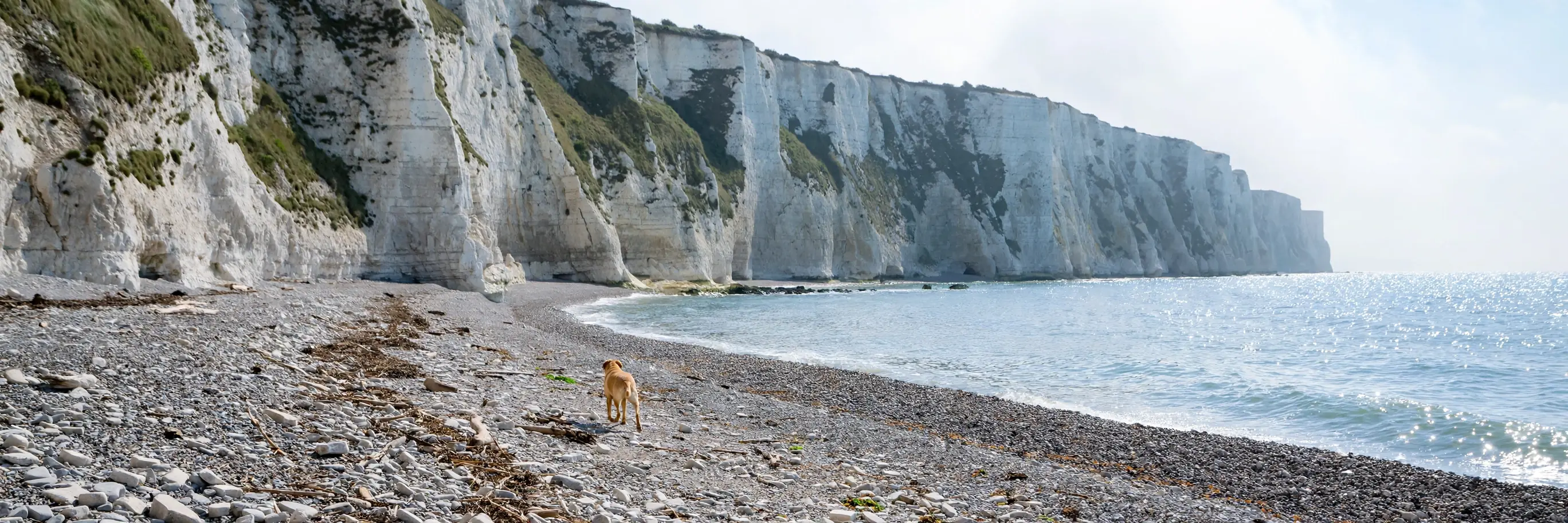
Dover is the most famous sight on the Kent coast, and it is also the least like a beach day. The White Cliffs rise sheer from the sea, and the beaches below them are narrow, rocky and hard to reach on foot. The clifftop paths, managed by the National Trust, are the real attraction: a network of well-surfaced paths with views across the Channel to France on a clear day, and a landscape of grassland, wildflowers and seabirds. Dogs are welcome on the paths but must stay on a lead near the cliff edge and around livestock, and the edge has no fence in places, so keep the dog on a short lead and a good distance from the drop. The visitor centre has a cafe and a car park, and the paths are level enough for most dogs, though the wind can be strong and there is no shade.
Folkestone, a few miles west, is a town that has changed a lot in recent years, with a harbour arm, a creative quarter and a beach that is a mix of shingle and sand. The main beach, Sunny Sands, is a small sandy bay below the harbour, and it carries a seasonal restriction in summer, but the long shingle beach at the western end of the town, towards Sandgate, is open to dogs all year and is a good place for a long, quiet walk. The harbour arm is a level, paved walk that welcomes dogs on leads, with food stalls and views across the Channel, and the town has several dog-friendly cafes and pubs. The cliff walk east from Folkestone towards Dover runs along the top of the cliffs and is one of the best walks on the coast, but it is exposed and narrow in places, so keep the dog on a lead and watch for the strong wind.
Both towns are best treated as walking destinations rather than beach destinations. The cliffs are the attraction, and the beaches below them are a bonus rather than the main event. If your dog needs a long run on sand, drive to Deal or Greatstone, and use Dover and Folkestone for the slower part of the day: a clifftop walk, a harbour lunch, and a quiet hour watching the ships in the Channel. The ferries at Dover are a reminder that this is a working coast, and the harbour area can be busy with lorries and traffic, so keep the dog on a lead around the port and let it run only on the clifftop paths or the open beaches further along the coast.
Deal and Walmer: the quiet shingle
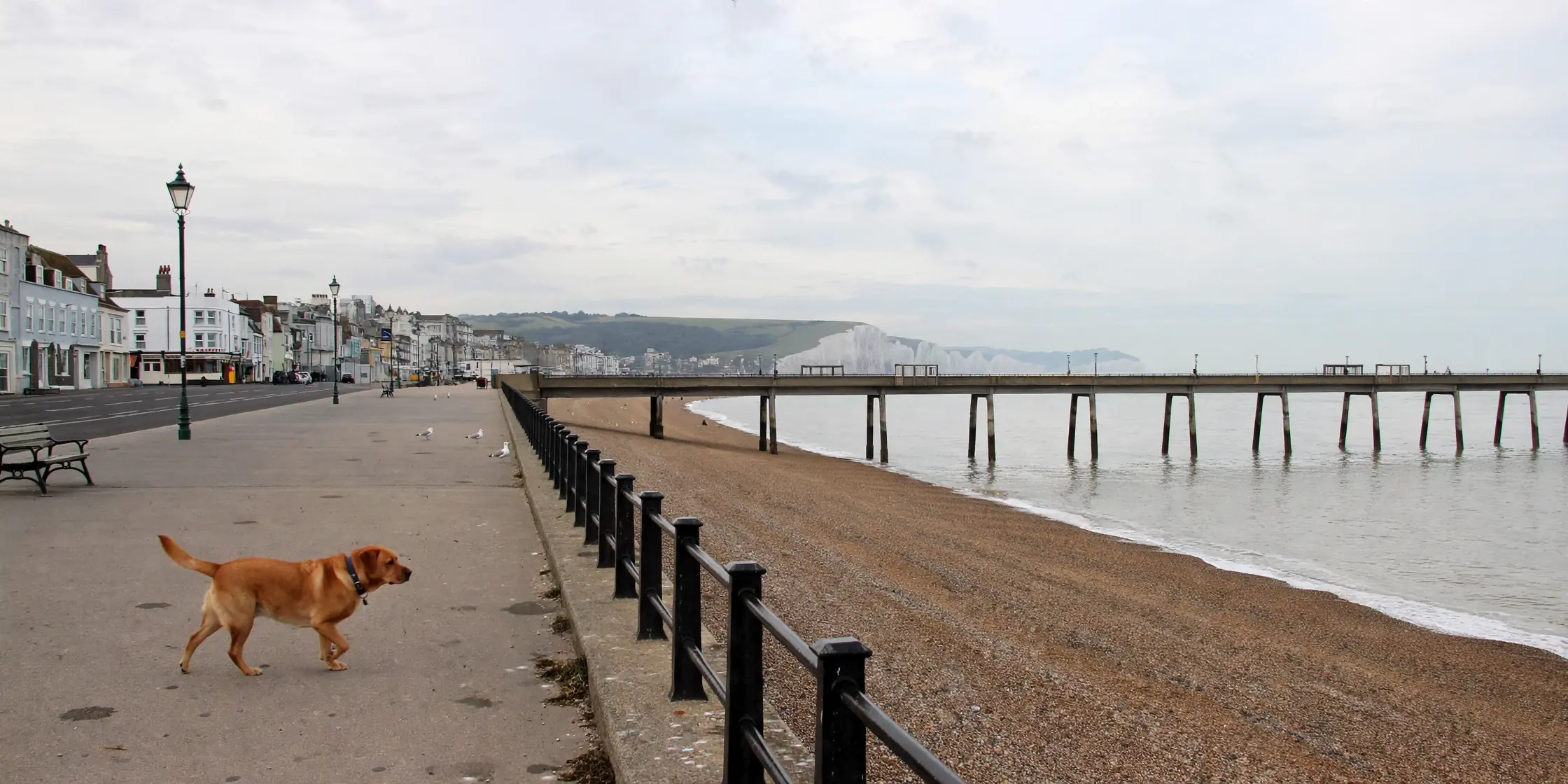
Deal is the easiest beach in Kent for a dog owner, and it is also one of the most pleasant. The town has a long, level promenade, a pier, a castle, and a beach of shingle that runs for miles in both directions, and dogs are welcome on the beach all year. There are no steps, no steep climbs and no seasonal restrictions on the main stretch, which makes it a good choice for an older dog, a puppy in training, or a nervous rescue that needs space. The promenade is paved and level, the car parks are close to the sea, and the town has several dog-friendly cafes and pubs, including a couple that welcome dogs inside as well as out. The pier is a good place for a slow walk with the dog on a lead, with views along the coast to the white cliffs in the distance.
Walmer, just south of Deal, is a smaller and quieter version of the same idea, with a beach of shingle, a castle with gardens, and a promenade that runs south towards Kingsdown. The castle gardens have their own dog rules, so check before you assume the dog can follow you inside, but the beach and the promenade are open to dogs all year, and the walk from Deal to Walmer along the seafront is flat, paved and easy, and suits dogs of any age. Kingsdown, further south, is a small village with a shingle beach and a pub, and the coast path from here runs to St Margaret's Bay, a small cove below the white cliffs that is one of the prettiest spots on the coast. The path is narrow and steep in places, so keep the dog on a lead, but the bay itself is a lovely place for a quiet hour at low tide.
Deal also makes a good base for a longer stay, with the town's high street, its market, and its easy access to Canterbury and Dover. The beach here is not sandy, and that matters: shingle is hard underfoot and tiring on a long walk, so keep shingle walks brief and stick to the promenade for the longer stretches. If your dog struggles on shingle, the sandy bays at Broadstairs or Greatstone are a better choice. But for a level, easy, all-year dog beach with everything you need within a short walk, Deal is hard to beat. Our guide to Deal with a dog covers the seafront, the castle, the pier and the town in more detail.
Romney Marsh: Dungeness and Greatstone
Romney Marsh is the wildest part of the Kent coast, a vast flat landscape of shingle, salt marsh and drainage ditches that feels like the edge of the world. Dungeness, at the southern tip, is one of the most distinctive places in England: a huge shingle headland with a lighthouse, a power station, a miniature railway and a scattering of fishermen's cottages, all set against a big, empty sky. The beach is open to dogs all year, and the shingle stretches for miles in both directions, with the sea on one side and the marsh on the other. There are no facilities on the beach itself, so bring water, poo bags and a windproof layer, and keep the dog on a lead near the power station and the railway, where the ground is uneven and the trains are close.
Greatstone, just west of Dungeness, is the sandy end of the marsh, with a long, flat beach that is open to dogs all year and is one of the best in the county for a long run. The sand is firm and level at low water, the dunes behind the beach give shelter from the wind, and the village has a pub and a small shop. The beach is at its best in the morning, when the light is soft and the village is still quiet, and the walk south from here towards Dungeness is a good hour along the shingle with wide views. The marsh behind the beach is a nature reserve, with grazing sheep and a network of ditches, so keep the dog on a lead near livestock and out of the deep water, and watch for the birds that feed on the mudflats at low tide.
The marsh is a place that rewards a slow, careful approach. The landscape is flat and open, with no shade and no shelter, and the wind can be strong even on a sunny day. Dress for the wind as well as the rain, carry water for the dog, and time your walk by the tide table rather than the clock. The shingle is hard underfoot, so keep walks short if your dog struggles on loose stones, and use the sandy beach at Greatstone for the longer stretches. In return, you get one of the emptiest and most distinctive coastlines in England, with a feeling of openness that is rare anywhere else in the south-east.
The Medway and Swale edge
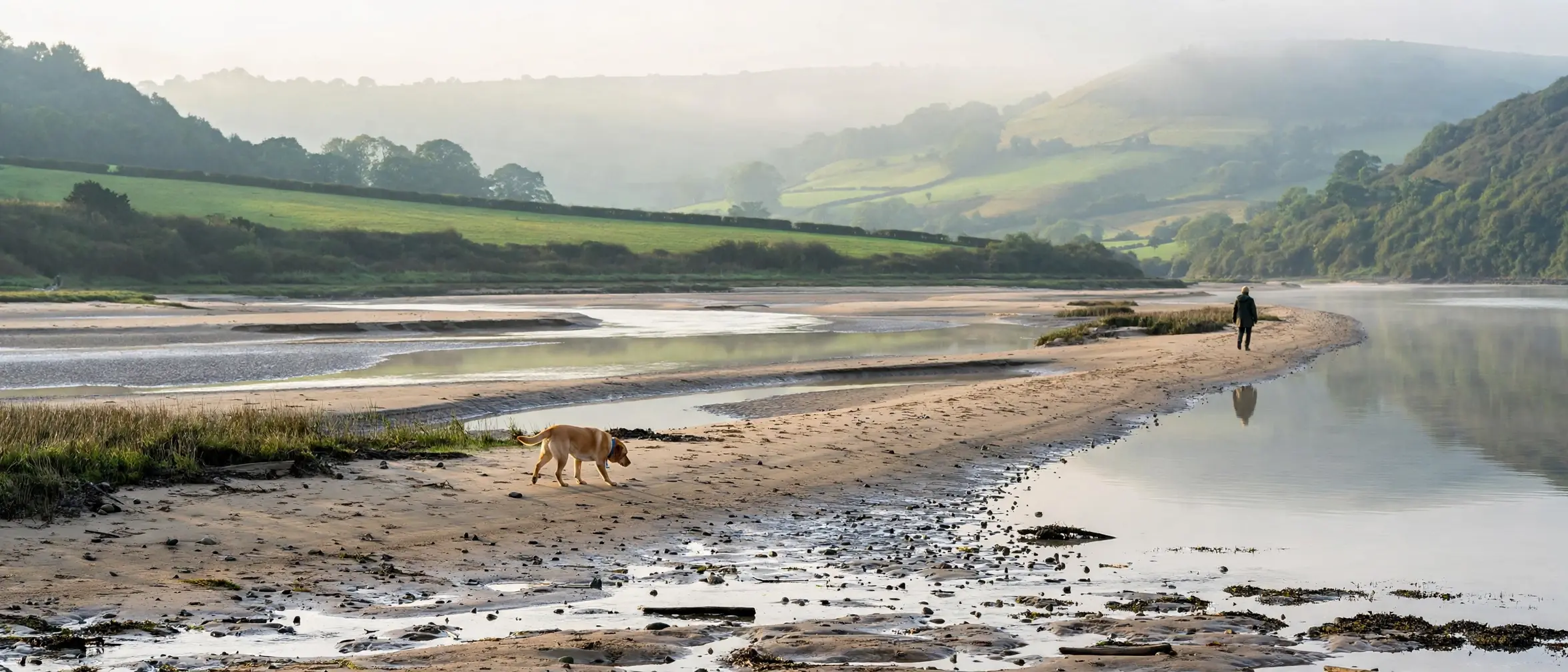
The north coast of Kent, from Whitstable to the Isle of Sheppey, is a quieter and less visited part of the county, and it has a feel all of its own. Whitstable is the best known of these towns, a fishing harbour with oyster beds, a shingle beach and a high street full of independent shops and dog-friendly cafes. The beach is a mix of shingle and sand, with firm sand at low tide, and dogs are welcome on much of it all year, with seasonal restrictions on a defined section in front of the town in summer. The harbour is a working place, with boats, ropes and fish boxes on the ground, so keep the dog on a lead on the quayside and let it run once you are out on the beach. The walk east from Whitstable towards Herne Bay runs along the sea wall and is a level, easy stroll with wide views across the estuary.
Herne Bay, a few miles east, is a classic seaside town with a pier, a promenade and a beach of shingle that gives way to sand at low water. The beach is open to dogs on much of its length, with seasonal restrictions on the central section in summer, and the flat, paved promenade makes it a good option for older dogs. The town has several dog-friendly cafes and pubs, and the pier is a good place for a slow walk with the dog on a lead. The Isle of Sheppey, further west, has long, empty beaches at Warden and Minster, with sand and shingle and very few facilities, and it suits a dog that needs space and an owner who is happy to carry everything. The island is reached by a bridge, and the beaches are at their best at low tide, when the sand firms up and the walking is level and easy.
These towns suit a wet day or a short visit, when a cafe and a dry car matter more than a dramatic view, and they are the best beaches in the county for a dog that likes to paddle, because the estuary is shallow and the sand is firm. The town fronts are the places most likely to carry a marked summer zone, so look at the board at the slipway before letting the dog off the lead.
Access: steps, slopes and level routes
Access decides whether a Kent beach works for your dog, and it varies more here than anywhere else in this series. Some beaches are level from the car park to the sea, some are reached down a steep flight of steps, and some are only visited from the clifftop path above. The table below sets out the access for each beach so you can match it to your dog's legs. Treat it as a guide rather than gospel: the boards at each access point show the current rules, and the board wins wherever it disagrees with a web page.
| Beach | Access | Surface | Summer rule |
|---|---|---|---|
| Deal | Level, no steps | Shingle | Open all year |
| Walmer | Level from promenade | Shingle | Open all year |
| Greatstone | Level from car park | Firm sand | Open all year |
| Dungeness | Level, long shingle walk | Loose shingle | Open all year |
| Margate main beach | Level from promenade | Sand | Seasonal restriction on a signed section |
| Broadstairs Viking Bay | Steps from the town | Sand | Seasonal restriction on a signed section |
| Joss Bay | Steep steps down | Sand and rock pools | Open, check signs |
| Ramsgate main beach | Level from promenade | Sand and shingle | Seasonal restriction on a signed section |
| Dover clifftops | Level paths, unfenced edge | Grass paths | Lead required near edge |
| Folkestone Sunny Sands | Steps from the harbour | Sand | Seasonal restriction on a signed section |
| Whitstable | Level from the harbour | Shingle and sand | Seasonal restriction near the town |
| Herne Bay | Level from promenade | Shingle, sand at low tide | Seasonal restriction on the central section |
Seasonal zones are only half the story. The other half is behaviour: keep the dog close enough to call back at once, and put the lead on before the dog reaches the cliff edge, the nesting ground or the harbour quayside, not after. The bins are another practical point: they stand by the car parks and the promenade entrances, not out on the shingle, so the bag comes back to the car with you. Both fouling and entering a marked restriction carry fines, and the wardens do patrol the town beaches in summer. How these orders work in full is explained in our guide to UK beach rules, bans and fines.
A weekend from Canterbury
Canterbury is the natural base for a Kent beach weekend, and it is one of the most dog-friendly cities in England. The cathedral precincts have their own rules, but the medieval lanes, the river walks and the parks are all good for dogs, and the city has plenty of dog-friendly cafes, pubs and shops. Our guide to Canterbury with a dog covers the precinct rules, the river walks and the practical details in depth. From Canterbury, the coast is a short drive in every direction, which makes it easy to try a different beach each day without packing up and moving on.
Day one is the north coast: Whitstable in the morning, with the harbour walk and the shingle beach at low tide, then Broadstairs in the afternoon, with the bays and the chalk stacks. Stay overnight in Canterbury or in Broadstairs itself, and eat in a pub that welcomes dogs, of which both towns have several. Day two is the south coast: Deal in the morning, with the level promenade and the long shingle beach, then Dover in the afternoon, with the clifftop walk and the views across the Channel. The drive between the two is short, and the contrast between the sandy bays of the north and the white cliffs of the south will teach you more about the county than any list of beach names.
Leave slack in the plan on purpose. Two hours on shingle tires a dog far more than two hours on pavement, so keep the second day gentle and the driving short. Take a bottle and a bowl on every walk: the shingle beaches have no taps, and the nearest shop can be a long way back. Keep a towel and a drying coat by the back seat for the journey home. If the weather turns, Canterbury has plenty to offer on its own, with its lanes, its river and its dog-friendly cafes, and the promenades stay walkable when the beach itself is being blown sideways. Take Kent one coast at a time: a whole day on one stretch of shingle beats a morning spent hopping between three beaches.
Practical questions
Before you go
Which Kent beaches allow dogs in summer?
Deal, Walmer and Dungeness stay open to dogs through the year, and the quieter sands at the edges of Thanet are largely unrestricted too. Margate, Broadstairs, Ramsgate and Folkestone carry marked summer zones on the stretches in front of the towns, so look at the board at the slipway and carry on a little further along the beach if the dog needs to run free.
Is shingle hard on a dog's paws?
It can be. Loose shingle is tiring and can sore a dog's pads on a long walk, especially when the sun has warmed the stones. Keep a shingle walk brief, stick to the firm sand at low water wherever you can find it, and look at your dog's paws when you get back to the car. If shingle clearly bothers your dog, the sandy bays at Broadstairs, Margate or Greatstone are the better choice.
Can dogs walk on the White Cliffs at Dover?
Dogs are welcome on the clifftop paths at Dover, which are managed by the National Trust, but they must stay on a lead near the cliff edge and around livestock. The cliff edge has no fence in places and the drops are sheer, so keep the dog on a short lead and a good distance from the edge. The beaches below the cliffs are not easily reached on foot, so treat Dover as a clifftop walk rather than a beach day.
Where is the easiest Kent beach for an older dog?
Deal suits an older dog best: a level promenade, a flat shingle beach and parking beside the sea, with no steps anywhere. Whitstable and Herne Bay are level and easy too, with firm sand at low tide. Skip the steep steps down to the Broadstairs bays and the Dover clifftop paths if stairs are a problem for your dog.
What should I know about tides on the Kent coast?
The Channel tide rises a long way, and the shingle narrows fast as the water comes in, while the Thanet bays are cut off altogether at high water. Look up the tide times each morning and leave two hours of margin, and keep the dog out of the water near harbour mouths and piers, where the current runs hard.