This guide is independent and contains no paid placement. If affiliate links are added later, they will be clearly marked and will not change our editorial checks.
Lincolnshire's dog-friendly beaches are wide, flat and wonderfully empty once you step away from the resort centres. In summer, dogs are kept off the main central beaches at Skegness and Cleethorpes, but dog-friendly sand is available just to the north and south, and the whole coast opens up again when the seasonal bans lift. Mablethorpe, Anderby Creek, Huttoft, Saltfleet and Theddlethorpe are the best choices for long off-lead runs, while Donna Nook is a lead-only visit during the grey seal pupping season from November to January. Arrive with a tide timetable, a windproof coat and drinking water for the dog, and check the official guidance before you travel.
What makes Lincolnshire different: flat sands, big skies and real wind
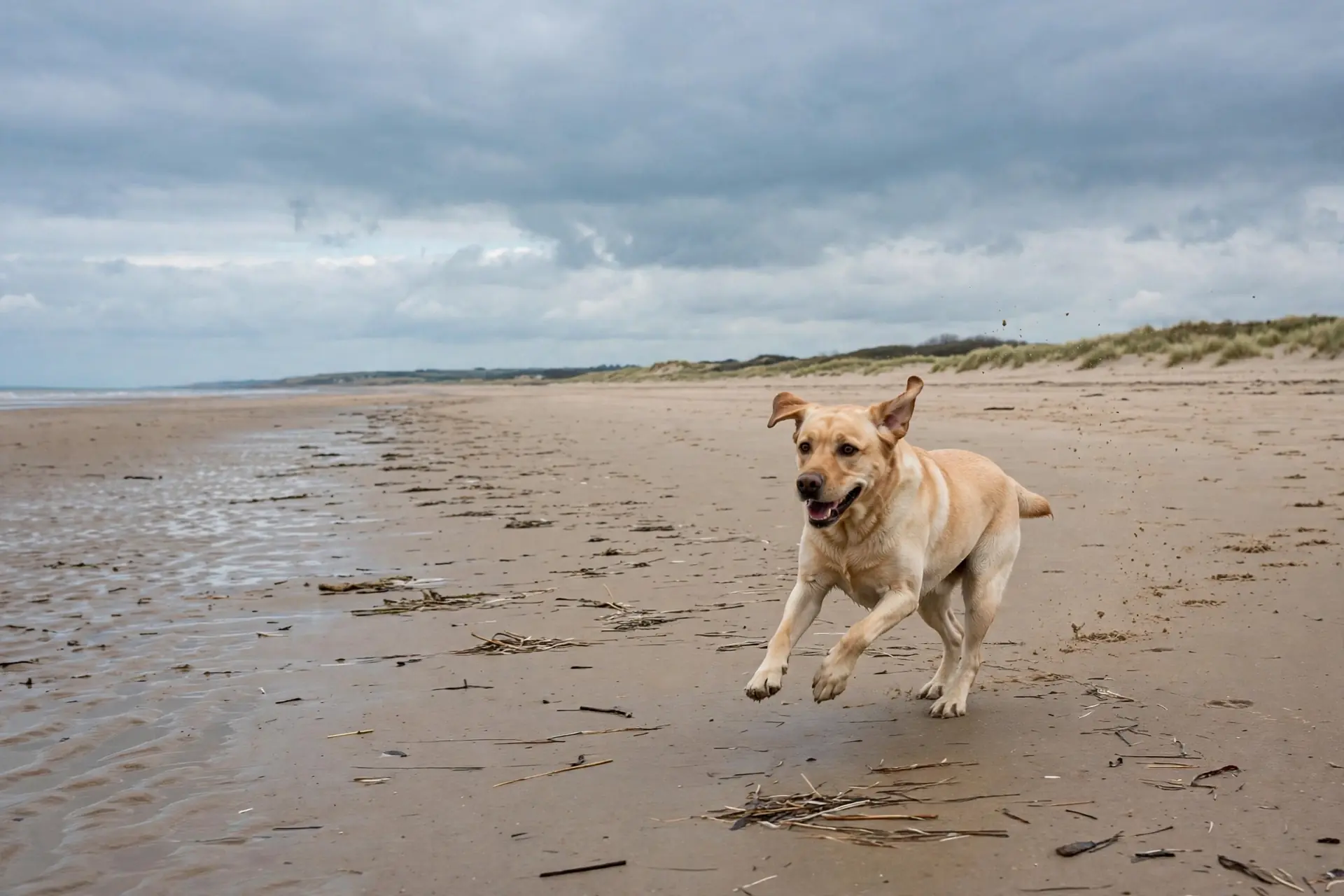
Lincolnshire does not do dramatic cliffs or secret coves. What it does, better than almost anywhere else in England, is space. From Cleethorpes in the north to Gibraltar Point in the south, the coast is a long, low, gently curving line of sand, and at low tide the sea pulls back so far that the beach can be hundreds of metres wide. A dog that loves to run can sprint in a straight line until it is a speck, and a dog that loves to sniff can work its way along the tide line for an hour without meeting another soul. That flatness is the whole character of a Lincolnshire beach day, and it shapes everything else in this guide: the tides matter more here than on a steeply shelving beach, the wind has nothing to stop it, and the sky really does feel bigger, because there is so little land in the way of it.
The wind is the first thing to plan around. Lincolnshire faces east and north-east into the North Sea, and there is no high ground between the beach and the weather. On a calm summer morning the sand is warm, the air is still and the coast feels almost Mediterranean in its openness. On a blustery day the same beach can be genuinely cold, with sand blowing ankle-high and a wind chill that catches out owners who dressed for the temperature on the car dashboard. Bring a windproof layer even on a sunny forecast, and pack a windbreak or a beach shelter if your dog likes to curl up out of the draught after a swim. Small dogs and short-coated breeds feel the wind first, so a drying coat earns its place in the bag on this coast more than it does on a sheltered south-coast beach.
The second thing to understand is the tide. Because the sand is so flat, the incoming tide covers ground fast, and channels and sandbanks can cut off a route back to the access point faster than expected. The classic Lincolnshire mistake is walking a long way out at low tide, letting the dog chase a ball further and further, and then realising the sea has come in behind you. Check a tide timetable before you set off, note the time of high tide, and start heading back well before it. Keep your dog within sight and within recall range, because a dog that runs half a mile down an empty beach is a dog you may have to run half a mile to retrieve while the water is rising. The same flat sands that make Lincolnshire so good for dogs also mean there is very little to climb onto if you do get caught out, so treat the tide with respect every single visit.
The coast also changes character along its length, which is why this guide goes beach by beach instead of treating Lincolnshire as one long strip. The southern end around Skegness, Ingoldmells and Chapel St Leonards is resort Lincolnshire: arcades, fairgrounds, caravan parks and busy summer crowds. The middle stretch from Mablethorpe through Sutton-on-Sea, Anderby Creek and Huttoft is quieter, with sand dunes, a sand train and wide empty beaches. The northern end around Saltfleet, Theddlethorpe and Donna Nook is wild Lincolnshire: salt marsh, a seal colony, a nature reserve and the vast mudflats of the Wash. A single day can cover two or three of these moods, but a dog will have a very different day at each of them, so pick the stretch that fits the dog you have, not just the resort with the nearest car park.
Skegness: the resort beach, the restricted centre and the dog sand to the north and south
Skegness is the beach most people picture when they think of Lincolnshire: a wide sweep of golden sand in front of a classic seafront of arcades, fish and chip shops, the pier and the clock tower. It is also the beach where the rules matter most, because the central stretch in front of the main seafront is subject to seasonal dog restrictions in the summer months. During the restricted season dogs are not allowed on the main beach between the signed boundary points, and the restriction is enforced, so arriving with a dog and heading straight for the sand in front of the pier in July is the one reliable way to start a Skegness day badly. Check the official guidance before you travel, because the exact dates and the exact boundary markers are set each year and the signs on the beach are the final word.
The good news is that the restricted zone is only a portion of a very long beach. To the north of the central beach, past the pier and towards the North Shore and the start of the Gibraltar Point dunes, the sand opens out and dogs are welcome. To the south, past the main seafront and towards the southern end of the resort and the road towards Ingoldmells, there is more dog-friendly sand again. Both directions give a dog the same flat, firm, golden beach that makes Skegness famous, just without the crowds, the donkey rides and the busiest part of the seafront. Walk five or ten minutes in either direction from the centre and the beach changes completely: the crowds thin, the sand widens and there is room for a proper game of fetch.
Parking at Skegness is plentiful but worth planning, because the seafront car parks fill early on sunny summer weekends. The main seafront car parks along the front and around the pier put you right by the beach, but they are the busiest and the most expensive, and on a hot day the walk from the car to the dog-friendly sand can be a long one across hot tarmac. The car parks a little further back from the front, and the larger car parks towards the north and south ends of the resort, are often easier, cheaper and closer to the stretches where dogs are allowed. Arrive early, park once, and walk along the promenade to the dog area rather than circling the seafront looking for the closest space. On a hot day, remember that the promenade and the car park surfaces can burn paws, so carry your dog across the worst of it if you can, or use the sand access points and keep to the cooler sand as soon as possible.
Facilities around Skegness are the best on the Lincolnshire coast, which is one reason the resort suits a full family day. There are cafes and takeaways along the front, public toilets, bins along the promenade, and shops selling everything from buckets and spades to dog treats. But the best facilities for a dog are the simplest ones: fresh drinking water, shade and a place to rinse off sand. Bring your own water and a bowl, because a dog that has been running on a hot Skegness beach will drink a lot, and the sea is not a substitute. A quick rinse matters too, because Skegness sand is fine and gets everywhere, and a dog that shakes itself dry in the car on the way home will leave a beach behind. Outside the summer season, when the restrictions lift, Skegness becomes a different and much quieter beach, and a winter walk from the pier to Gibraltar Point with a dog is one of the best low-season walks on the east coast.
Mablethorpe and Sutton-on-Sea: the sand train, the beach huts and the long dog-friendly stretches
Mablethorpe is the beach to choose if Skegness feels too busy and you still want a proper resort with facilities. The sand here is wide, flat and pale, the promenade is calmer, and the dog-friendly stretches are generous. Unlike Skegness, Mablethorpe does not squeeze dogs into a small corner: much of the beach outside the central restricted area is open to dogs, and the long walk south towards Sutton-on-Sea is one of the finest dog walks on the Lincolnshire coast. The beach shelves so gently that at low tide the sea seems to retreat to the horizon, leaving a vast expanse of firm, rippled sand that is perfect for running, and the dunes behind the beach give shelter from the wind on a blustery day.
The sand train is Mablethorpe's most distinctive feature, and it is worth knowing about before you arrive with a dog. The land train runs along the beach itself, carrying passengers between the town centre and the quieter stretches of sand, and it is a familiar sight trundling across the flat beach in summer. Dogs are not the train's main passengers, and a nervous dog may find the vehicle and its noise unsettling, so keep your dog on a lead and at a sensible distance when the train passes, and do not let an off-lead dog chase it. The train's route is also a useful landmark: the sand it crosses is the same wide, open beach that dogs love, and following the line of the beach south from the town centre takes you steadily away from the crowds and towards the quieter sand near Sutton-on-Sea.
Sutton-on-Sea, just south of Mablethorpe, is the quieter sibling and in many ways the better dog beach. The village has a small parade of shops and cafes, a paddling pool and a more old-fashioned seaside feel, and the beach in front of it is wide, clean and notably less crowded than Mablethorpe's central stretch. The beach huts that line parts of the Sutton-on-Sea and Mablethorpe frontage are a local institution: rows of colourful wooden huts that families rent for the day or the season, and they give the beach a cheerful, orderly look that photographs beautifully against the big sky. Dogs should be kept clear of the huts themselves and on a lead around them, because the narrow gaps between huts are full of children, picnics and dropped food, but the open sand in front of the huts is ideal for a long, straight walk.
Parking at Mablethorpe is straightforward, with car parks along the seafront and near the town centre, and the walk from car to sand is short and flat, which suits older dogs and owners carrying a lot of gear. Sutton-on-Sea has smaller car parks closer to the village, and they fill on sunny weekends, so an early start pays off. Both towns have cafes where dogs are welcome outside, public toilets, and bins along the promenade, and both are good bases for a longer stay because the beach walk between them is so easy. The walk from Mablethorpe to Sutton-on-Sea along the sand takes about an hour at a comfortable pace with a dog that keeps stopping to sniff, and it is the kind of walk that shows off Lincolnshire at its best: flat sand, a huge sky, the sound of the sea a long way off at low tide, and almost nobody else around once you leave the town centre behind.
Chapel St Leonards and Ingoldmells: caravan country and long quiet sands
South of Skegness, the coast becomes caravan country. Chapel St Leonards and Ingoldmells sit close together on a long, straight stretch of beach, and both are surrounded by large caravan parks that fill with families through the summer. For a dog owner this has two consequences: the beaches here are busy in high season around the caravan park access points, but they are also very long, and a short walk in either direction takes you to sand that is almost empty. The beach at Chapel St Leonards is wide and flat, with a village centre that has shops, cafes and a pub, and the sand in front of the village is the natural place to start. Ingoldmells, just to the north, is livelier, with the Fantasy Island market and fairground drawing crowds, and the beach there is best enjoyed early in the morning or in the evening, when the day visitors have gone and the sand belongs to dog walkers again.
The practical appeal of Chapel St Leonards for dog owners is its scale. The beach is not a pocket of sand between cliffs; it is a vast, open expanse that runs for miles in both directions, and at low tide the firm sand is excellent for dogs that like to run in straight lines. There are no rocks to cut paws on and no steep drops to worry about, which makes it a good choice for puppies, older dogs and dogs that are still building recall. Keep the dog in sight, though, because the flatness works both ways: a dog can be a long way away before you notice, and the caravan parks behind the dunes all look alike from the beach, so note which access point you came down before you let the dog off the lead.
Ingoldmells needs a little more care. The beach is dog-friendly outside the central restricted areas, and the same seasonal rules that apply at Skegness apply here in spirit: the busiest sand in front of the main attractions is the least suitable for dogs in summer, and the quieter stretches to the north and south are the place to be. The fairground noise, the crowds and the smell of food from the market can overstimulate a nervous dog, so if your dog is sound-sensitive or reactive, Chapel St Leonards is the calmer choice. If your dog is bombproof and you want a lively day with plenty to look at, Ingoldmells delivers, and the evening walk along the sand as the fairground lights come on is genuinely atmospheric.
Parking at both villages is mainly in the caravan park car parks and the village car parks near the beach, and in high season they can be busy by late morning. Arrive early, or come later in the afternoon when the day crowds thin. Facilities are good: shops, cafes, toilets and bins are all within a short walk of the beach, and many of the cafes have outdoor seating where a well-behaved dog is welcome. The one thing to bring anyway is water, because the walk back from the far end of the beach to the car can be a long one in the sun, and a dog that has been running on the sand will need a drink before the drive home. Rinse the worst of the sand off before you load the dog into the car, because Chapel St Leonards sand is fine and persistent, and it will find its way into every seam of the upholstery.
Cleethorpes: seasonal bans, the beach huts and the boating lake
Cleethorpes, at the northern end of the Lincolnshire coast, is a proper old-fashioned resort with a pier, a promenade, a miniature railway and a long sandy beach that looks across the Humber towards the Yorkshire coast. It is also the second resort beach in the county, after Skegness, where seasonal dog restrictions matter. During the summer season dogs are banned from the central beach in front of the main resort area, and the restriction is clearly signed at the access points. Outside the restricted season the ban lifts and dogs can use the central beach again, which makes Cleethorpes a very different proposition in October than it is in August. Check the official guidance before you travel, because the dates and the boundary signs are the authority, and a dog on the wrong stretch in July can earn its owner a fine.
The dog-friendly sand at Cleethorpes is found by walking away from the centre in either direction. To the south, the beach runs towards the quieter stretches near the Humber mouth and the start of the long, wild coast towards Donna Nook, and the sand there is wide, flat and much less crowded. To the north, the beach continues towards the resort's quieter end and the start of the Humber bank. Both directions reward a ten-minute walk: the crowds fall away, the beach widens, and there is room for a proper off-lead run. The beach huts that line parts of the Cleethorpes frontage are worth a mention too, because they are a distinctive part of the resort's character. The huts are privately owned and rented, and dogs should be kept on a lead around them and not allowed to sniff at doors or investigate the gaps between huts, where children and picnics are concentrated.
The boating lake is one of Cleethorpes' best features for a dog day, and it is easy to miss if you only think of the resort as a beach. The lake sits just back from the seafront, surrounded by gardens and paths, and it gives a dog a completely different kind of walk: flat, surfaced paths, ducks and swans to watch from a distance, and shade from the trees on a hot day. Dogs should be kept on a lead around the lake, because the waterfowl are the attraction and a dog that plunges in after a swan will not be popular. The lake area is also a good place to cool a dog down after a run on the beach, because the paths are shaded and there is usually a breeze coming off the water. Combine the lake with the beach and you have a full day that suits dogs that like variety: a run on the sand in the morning, a gentle lead walk around the lake at midday, and another beach session in the cooler evening.
Parking at Cleethorpes is plentiful, with large car parks along the seafront and around the resort centre, and the promenade is flat and easy for older dogs. The seafront car parks are the most convenient but also the busiest on summer weekends, and the walk from the car to the dog-friendly sand can be a long one if you park in the centre. Parking a little further south, towards the quieter end of the beach, often puts you closer to the sand where dogs are welcome and further from the crowds. Facilities are excellent: cafes, toilets, bins and shops line the front, and the resort has a good range of dog-friendly outdoor seating. Cleethorpes is also the easiest Lincolnshire beach to reach by train, which matters if you are travelling without a car, and the walk from the station to the seafront is flat and straightforward. For a longer coastal perspective, the same wide, open character continues south towards the wilder beaches, and if you enjoy Cleethorpes' space, the dog-friendly beaches of Norfolk to the south offer a similar sense of scale with a very different coastline to explore.
Anderby Creek and Huttoft: the Cloud Bar, bathing water and the quiet middle coast
Between Mablethorpe and Sutton-on-Sea lies one of the quietest and most rewarding stretches of the Lincolnshire coast, and Anderby Creek is its centrepiece. There is no resort here, no arcade and no crowds: just a car park, a path through the dunes, a wide beach and a remarkable piece of public art. The Cloud Bar is a small, open, cloud-shaped shelter that sits in the dunes above the beach, designed as a place to sit and watch the sky, and it has become a landmark for walkers on the Lincolnshire Coastal Country Park. For a dog owner it is a useful meeting point and a sheltered spot to sit with a flask while the dog rests after a run, and it sums up what this part of the coast is about: sky, sand, wind and quiet.
Anderby Creek's bathing water quality is officially monitored and has been rated highly, which matters for dogs that swim. The beach shelves gently, the water is clean by the standards of the east coast, and at low tide the sand is firm and flat for a long way out. That said, the North Sea is cold even in summer, and a dog that swims here should be watched for tiredness and cold, especially smaller dogs and puppies. Rinse the dog off with fresh water after a swim, because salt water dries the coat and the sand sticks to wet fur, and check the dog's ears afterwards, because sand and salt water are a classic combination for ear irritation. The creek itself, a small watercourse that runs down to the beach, can be a hazard after heavy rain, when it runs fast and deep, so keep dogs clear of it in wet weather.
Huttoft, a short walk south of Anderby Creek, is even quieter. The village is set back from the coast, the car park is small, and the beach is reached by a path through the dunes that feels like a proper walk in itself. The reward is a beach that is often completely empty, with the same wide, flat sand and the same enormous sky, and with the added bonus of the Huttoft Bank and the sea bank path that runs along the top of the dunes. The bank is a good place for a lead walk with a view, because it gives a panorama of the coast in both directions, and on a clear day you can see a long way north towards Mablethorpe and south towards Chapel St Leonards. Dogs should stay on the path on the bank and not be allowed to run through the dunes, because the dune grass holds the sand together and the dunes are a sensitive habitat.
The practicalities of Anderby Creek and Huttoft are simple, and that is part of their charm. Parking is in the small car parks at the end of the access lanes, and they are free or cheap, but they fill quickly on sunny weekends because they are small, so arrive early or come on a weekday. There are no cafes or shops on the beach itself, so bring everything you need: water, a bowl, a towel, a lead and a bag for waste. There are bins at the car parks, but not along the beach, so take everything home with you. The nearest facilities are in the villages inland, and the nearest proper shops are in Mablethorpe or Sutton-on-Sea. That lack of facilities is exactly why these beaches stay quiet, and for a dog that loves space it is a fair trade. The same quiet, open quality makes this stretch a good introduction to the longer, wilder coast to the north, and the contrast with the busier resort beaches shows why Lincolnshire rewards drivers who are willing to go a few miles past the obvious car park.
Saltfleet and Theddlethorpe: salt marsh, sea banks and the wild north
North of Mablethorpe, the coast changes again. Saltfleet and Theddlethorpe are not resort beaches at all: they are wild, flat, marshy places where the land meets the sea across a wide band of salt marsh and mudflat, and they are some of the most atmospheric dog-walking country in England. The beach at Saltfleet is reached by a lane from the village, and the last stretch is a path across the marsh to the sea bank, with the beach beyond. The sand here is firmer and narrower than at Mablethorpe, and the tide comes in across the marsh in a way that can surprise visitors, so check the tide times and stay on the marked paths across the marsh. Dogs should be kept on a lead on the marsh itself, because the channels and creeks are deep, the mud is soft, and the marsh is an important habitat for birds.
Theddlethorpe, just north of Saltfleet, is similar in character but even quieter. The village has a small beach access and a car park, and the walk to the sea is across open fields and marsh, with the sea bank giving a long, flat walk with views in both directions. The beach itself is a mix of sand and shingle, and at low tide the sand stretches a long way out. Theddlethorpe is also notable for the Theddlethorpe dunes and the salt marsh that runs behind the beach, which is part of the larger Lincolnshire coastal habitat that stretches from the Humber to the Wash. Dogs that are used to resort beaches may find the marshy ground and the lack of facilities a surprise, so come prepared: bring water, a towel and a lead, and wear boots yourself, because the paths can be muddy after rain.
The wildlife is the point of Saltfleet and Theddlethorpe, and it is also the reason to keep a dog under close control. The salt marsh and the mudflats are feeding grounds for wading birds, and the dunes and the marsh are home to ground-nesting birds in the spring and summer. A dog that runs through the marsh will flush birds and disturb nests, so keep the dog on a lead on the marsh and on the dunes, and only let it off on the open sand where it will not disturb wildlife. The same rule applies to the sea bank: it is a good walking route, but it runs through sensitive habitat, and a dog that chases birds along the bank is a problem. The reward for that discipline is a walk of real quality: a long, flat, empty beach, the sound of waders calling over the marsh, and a sense of space that is hard to find on a busier coast.
Facilities at Saltfleet and Theddlethorpe are minimal, and that is part of the deal. There are small car parks, a pub in Saltfleet village and a few local shops, but no beach cafes, no toilets on the sand and no bins along the beach, so take everything you need and take everything home. The villages themselves are worth a look: Saltfleet has a historic church and a quiet, old-fashioned feel, and the lanes around both villages are good for a short lead walk if the tide is wrong for the beach. These are beaches for dog owners who want wildness rather than convenience, and they are a good halfway point on a longer exploration of the north Lincolnshire coast, between the resort beaches of the south and the seal colony at Donna Nook. If you enjoy this kind of open, undeveloped coast, the dog-friendly beaches of Yorkshire to the north offer a different but equally rewarding version of it, with cliffs and coves where Lincolnshire has marsh and mudflat.
Donna Nook and the grey seals: a lead-only visit, pupping season and keeping your distance
Donna Nook is the most famous wildlife site on the Lincolnshire coast, and it is the one place in this guide where the rules are not negotiable. Every autumn, grey seals come ashore on the beach and the dunes at Donna Nook to give birth, and the colony is one of the largest and most accessible grey seal breeding sites in Britain. The pupping season runs from November to January, and during those months the beach is home to hundreds of seal mothers and their white-coated pups, lying on the sand and in the dunes behind the beach. It is a remarkable sight, and it is also a fragile one: a seal mother that is disturbed can abandon her pup, and a pup that is separated from its mother is unlikely to survive. Dogs are the single biggest avoidable disturbance, which is why the rules at Donna Nook are strict and why they matter.
The rules are simple and absolute. Dogs must be kept on a lead at Donna Nook, at all times and in all seasons, and they must be kept at a distance from the seals. During the pupping season, visitors are asked to stay behind the marked viewing areas and the fencing that is put up to protect the colony, and dogs must stay behind those lines too. Never let your dog approach a seal, never let it bark at the colony, and never let it off the lead in the hope of a photograph. Seals may look slow and placid on the sand, but they can move fast when threatened, they have a powerful bite, and a dog that gets too close risks a serious injury as well as causing a disturbance. The viewing areas are designed to give a good view without getting close, and a pair of binoculars will show you far more than walking up to a seal ever will.
Outside the pupping season, Donna Nook is still a special place, and dogs on leads are welcome to walk the beach and the dunes. The beach is wide and flat, the sand is firm, and the walk along the coast towards the Humber is long and empty. But the lead rule still applies, because seals can be present outside the main pupping season, and because the dunes and the beach are a sensitive habitat for birds and other wildlife. The car park at Donna Nook is well signed from the village, and there is a visitor information point during the pupping season with wardens who can tell you where the seals are and where the best viewing points are. Listen to them: they know the colony, they know where the mothers are most sensitive, and they will tell you if a particular area is closed on a given day.
Planning a Donna Nook visit with a dog takes a little thought. Go early in the day, when the light is best for viewing and the crowds are thinner, and dress warmly, because the beach is exposed and the wind off the North Sea is cold in November and December. Bring water for the dog, a short lead rather than a long line, and a towel, because the sand is fine and the walk back to the car can be muddy. Do not bring a dog that barks at wildlife, and do not bring a dog that cannot be kept on a lead for an hour or two, because this is not a beach for an off-lead run. If your dog needs a run, give it one at Saltfleet or Mablethorpe first, and treat Donna Nook as a separate, lead-only visit. Done properly, it is one of the most memorable dog days in Britain: a walk on a huge empty beach, the sound of seals calling, and the sight of white pups on the sand under a vast Lincolnshire sky.
Gibraltar Point and the Wash: a nature reserve, dune trails and the southern end of the coast
Gibraltar Point sits at the southern end of the Skegness beach, where the resort gives way to a nature reserve and the coast turns towards the vast, tidal expanse of the Wash. It is one of the most important coastal nature reserves in England, a mix of sand dunes, salt marsh, freshwater ponds and open beach, and it is a wonderful place for a dog walk if you understand and respect its rules. Dogs are welcome on parts of Gibraltar Point, but the reserve has its own dog rules, and some areas are sensitive for ground-nesting birds and other wildlife, so dogs must be kept on a lead in the reserve areas where signs require it. Check the official guidance before you travel, and check the signs at the visitor centre when you arrive, because the rules can vary by season and by area.
The beach at Gibraltar Point is the most rewarding part for a dog. South of the Skegness seafront, the sand widens and the crowds thin, and the beach runs for miles along the edge of the reserve towards the Wash. At low tide the sand is vast and flat, and the walk from the visitor centre to the southern end of the beach is a proper half-day outing. The dunes behind the beach are a different world: a maze of grassy ridges and hollows that shelter skylarks and other birds, and dogs should be kept on a lead through the dunes, both to protect the wildlife and because the dune grass can hide rabbit holes and sharp debris. The reserve's trails are well marked, with boardwalks across the marsh and paths through the dunes, and they give a dog a varied walk that a straight beach walk does not: sand, grass, marsh and woodland in a single loop.
The Wash itself is the backdrop to the whole reserve, and it is worth understanding what you are looking at. The Wash is a huge, shallow bay where the tide comes in across miles of mudflat and sandbank, and at low tide the sea can be a distant silver line on the horizon. It is one of the most important estuaries in Britain for wading birds, and the mudflats are a feeding ground for tens of thousands of birds in winter. That is why the reserve asks dogs to be kept under control: a dog running across the mudflats will flush birds that have flown thousands of miles to feed there, and the disturbance can cost them the energy they need to survive the winter. Keep the dog on the beach and on the marked trails, and enjoy the birds from a distance.
Facilities at Gibraltar Point are good by nature reserve standards. There is a visitor centre with toilets, a cafe, information about the reserve and the current dog rules, and a car park that is a short walk from the beach. The car park is the natural starting point for a visit, and the walk from the car park to the beach through the dunes is one of the prettiest approaches on the Lincolnshire coast. Parking charges apply, and the car park can fill on sunny weekends, so arrive early. The reserve is also a good place to combine a beach walk with a longer trail: the paths through the dunes and around the ponds make a loop of an hour or two, and the beach walk back along the sand makes a satisfying circuit. For a dog that likes variety, Gibraltar Point is the best single destination on the Lincolnshire coast, because it offers beach, dunes, marsh and woodland in one visit, and it does so under a sky that seems to go on forever.
Seasonal bans, parking, tides and wind: planning a Lincolnshire beach day
Seasonal dog bans are the single most important planning fact on the Lincolnshire coast, and they are easy to get wrong if you assume one beach's rules apply to another. The main resort beaches at Skegness and Cleethorpes have seasonal restrictions in the summer months, when dogs are kept off the central beach in front of the seafront. The restricted zones are signed at the beach access points, and the dates are set by the local council each year, so they can shift slightly from one year to the next. The bans normally lift in the autumn, after which dogs can use the central beaches again, and the winter beach at Skegness or Cleethorpes is a very different and much quieter place than the summer one. Mablethorpe, Sutton-on-Sea, Chapel St Leonards and Ingoldmells have their own local arrangements, with dog-friendly sand available outside the busiest central stretches, and the quieter beaches at Anderby Creek, Huttoft, Saltfleet and Theddlethorpe have no resort-style bans at all. The rule of thumb is simple: the busier the beach, the more likely a summer restriction applies, and the quieter the beach, the more likely your dog is welcome all year. Check the official guidance before you travel, and read the signs at the access point when you arrive, because the signs are the final authority.
Parking deserves the same attention as the bans, because the wrong car park can add a long, hot walk to the start of the day. Skegness seafront car parks are the most convenient and the most expensive, and they fill early on sunny summer weekends. Mablethorpe's seafront car parks are easier and the walk to the sand is short, while Sutton-on-Sea's smaller car parks are closer to the village and fill quickly. Cleethorpes has large seafront car parks, but the ones at the southern end of the resort are closer to the dog-friendly sand. Anderby Creek and Huttoft have small, cheap car parks that fill by mid-morning on a sunny day. Gibraltar Point has a reserve car park with a charge, and Donna Nook has a well-signed car park that is busy during the pupping season. Wherever you park, note the car park name and the access point you used, because the Lincolnshire coast is so flat and so uniform that it is easy to walk a mile along the beach and then struggle to find your way back to the right car park. Take a photograph of the car park sign and the access point as you arrive, and keep your car keys in a zipped pocket, because a dog that shakes itself dry on the beach will soak anything in an open pocket.
Tides are the other planning essential, and on the Lincolnshire coast they matter more than on most English beaches. The sand is so flat that the sea can come in a long way in a short time, and the channels that form on the beach can cut off a route back to the shore. Before you set off, check a tide timetable for the specific beach you are visiting, note the time of low tide and the time of high tide, and plan your walk so that you are heading back well before high tide. Avoid walking out to sandbanks at low tide, because the tide can come in behind you and the sandbanks can become islands. Keep your dog within recall range, and be especially careful with dogs that chase the water: a dog that runs after a receding wave can be a long way out before you realise, and a dog that is caught by the incoming tide can panic. If you are unsure, ask at the visitor centre at Gibraltar Point or at the tourist information points in Skegness and Mablethorpe, where staff give tide advice every day.
Wind, facilities and the practical kit list complete the planning picture. The wind off the North Sea is the defining feature of the Lincolnshire coast, and it can be cold even on a sunny day, so bring a windproof layer for yourself and a drying coat for the dog. Facilities vary enormously: Skegness, Mablethorpe and Cleethorpes have cafes, toilets and bins, while Anderby Creek, Huttoft, Saltfleet and Theddlethorpe have almost nothing, so bring water, a bowl, a towel, a lead and waste bags everywhere. A first-aid kit for the dog is worth carrying, because the nearest vet can be a long drive from the quieter beaches, and a cut paw on a shell or a piece of debris is the most common beach injury. Sun protection matters too: the flat sand reflects the sun, and a pale-nosed dog can burn on a bright day, so bring shade or a beach shelter and limit the time in the midday sun. Finally, remember that the Lincolnshire coast is a working coast as well as a holiday coast: fishing boats, sea defences and farm traffic are all part of the landscape, and a dog that is used to a quiet beach should be kept on a lead near roads, car parks and sea walls.
Linked walks and day plans: the Coastal Country Park, the Viking Way and Gibraltar Point trails
The Lincolnshire coast is at its best when a beach is not a destination in itself but part of a longer walk, and the county has three linked walking systems that suit dogs particularly well. The first is the Lincolnshire Coastal Country Park, a long, linear park that runs along the coast from Sandilands in the south to Mablethorpe and beyond, linking beaches, dunes, marsh and villages with a network of paths. The Coastal Country Park is not a single trail but a landscape, and its paths give a dog a varied day: a stretch of open sand, a path through the dunes, a walk along the sea bank, and a lane back through a village. Anderby Creek and the Cloud Bar sit at the heart of the park, and the walk from Anderby Creek south to Huttoft or north to Sutton-on-Sea is a classic Coastal Country Park outing. Dogs should be kept on a lead on the dune paths and the sea bank, where the habitat is sensitive, and can be let off on the open sand where the signs allow it.
The second linked walk is the Viking Way, the long-distance trail that runs the length of Lincolnshire from the Humber to Rutland, and its northern end is on this coast. The Viking Way starts at Barton-upon-Humber on the Humber bank and runs south through the Lincolnshire Wolds, and the coastal section near the Humber gives a dog a completely different kind of walk from a beach: a riverbank path, open fields and views across the Humber to the Yorkshire coast. The start of the Viking Way is a good place for a lead walk with a dog that likes a long, steady outing, and it connects with the coastal paths around Cleethorpes and the Humber bank. The full Viking Way is a multi-day walk, but the first few miles from the Humber are an easy day walk, and they show a side of Lincolnshire that the beach alone does not: the flat, open farmland, the big skies and the sense of a county that is built for long, straight walks.
The third system is the trail network at Gibraltar Point, which is the most varied single walking area on the coast. The reserve has marked trails through the dunes, around the freshwater ponds and across the salt marsh, with boardwalks over the wettest ground and viewpoints over the Wash. A typical Gibraltar Point circuit takes an hour or two and gives a dog sand, grass, marsh and woodland in a single walk, and the beach walk back along the sand makes a satisfying loop. Dogs must be kept on a lead on the reserve trails where signs require it, and the trails are shared with birdwatchers and families, so keep the dog close and under control. The visitor centre is the natural start and finish, and it is a good place to ask about the current trail conditions, because the marsh paths can be wet after rain and some routes are closed during the bird breeding season.
Putting it together, a good Lincolnshire dog day has a simple shape. Start early, park once, and walk the beach before the crowds arrive. Use the morning for the long off-lead run on the open sand at Mablethorpe, Anderby Creek or Huttoft, when the tide is low and the sand is firm. Use the middle of the day for a lead walk: the Coastal Country Park paths, the Gibraltar Point trails, or a gentle walk around the boating lake at Cleethorpes. Use the evening for a second beach session, when the light is low, the wind drops and the sand is cooler underfoot. If you are staying for a weekend, use one day for the resort beaches and one day for the wild north: Skegness and Mablethorpe on the first day, Saltfleet, Theddlethorpe and Donna Nook on the second, with Gibraltar Point as a half-day in between. And if you want to extend the trip, the coast to the south continues into Norfolk, where the dog-friendly beaches of Norfolk offer a different coastline with the same big skies, and the coast to the north continues into Yorkshire, where the cliffs and coves are a complete change from Lincolnshire's flat sands.
Practical questions
Before you go
Can dogs go on Skegness beach all year round?
Not on the main central beach. Seasonal dog restrictions apply there in the summer months, so dogs are kept off the stretch in front of the seafront and the main attractions. Dog-friendly sand is available to the north and south of the restricted zone, and the restrictions lift outside the summer season, so the whole beach opens up again in the quieter months. Check the official guidance before you travel, because the exact dates and boundary signs can change.
Where is the best dog-friendly beach in Lincolnshire for a long off-lead run?
Mablethorpe and the long flat sands around Anderby Creek and Huttoft suit long runs best, because the beach is wide, firm and open for miles at low tide. Skegness and Cleethorpes work well too once you are outside the seasonal restricted zones. Pick a quieter stretch, watch the tide, and keep your dog in sight: the flatness that makes these beaches so good for running also makes it easy for a dog to cover a surprising distance very quickly.
Can I take my dog to see the seals at Donna Nook?
Yes, but only on a lead and only at a respectful distance. Donna Nook is a grey seal breeding colony, and the pupping season runs from November to January, when mothers and newborn pups are at their most vulnerable. Keep your dog on a short lead, stay behind the marked viewing areas and fencing, never let your dog approach a seal, and do not let it bark at the colony. A stressed seal can abandon a pup, so this is one beach where the lead stays on for the whole visit.
Are dogs allowed at Gibraltar Point nature reserve?
Dogs are welcome on parts of Gibraltar Point, but the nature reserve has its own rules and some areas are sensitive for ground-nesting birds and other wildlife, so dogs must be kept on a lead in the reserve areas where signs require it. The beach and the dunes at the southern end of the Skegness coast are the most rewarding part for a dog walk, and the visitor centre is a good place to check the current rules before you set off. Check the official guidance before you travel.
When do the seasonal dog bans on Lincolnshire beaches end?
The seasonal bans on the main resort beaches at Skegness and Cleethorpes normally run through the summer season and lift in the autumn, after which dogs can use the central beaches again. The exact start and end dates are set by the local council each year and can vary, so do not rely on last year's dates. Check the official guidance before you travel, and look for the restriction signs at the beach access points when you arrive.