This guide is independent and contains no paid placement. If affiliate links are added later, they will be clearly marked and will not change our editorial checks.
Northumberland is one of the most forgiving beach counties in England for dogs: huge open sands, few seasonal bans, and long stretches where you can walk for miles. Start at Bamburgh or Beadnell Bay for the easiest first visit, check the tide table every morning, and treat every seasonal restriction as a local rule that must be confirmed on the day — check the official guidance before you travel.
The shape of the coast
Northumberland runs for roughly sixty miles from the Scottish border to the Tyne, and for most of that distance the beach is the same generous thing: a wide band of pale sand backed by dunes, with a castle, a fishing village or a stretch of nothing at all on the horizon. There are no big resorts here in the southern English sense. The towns are small, the car parks are modest, and the crowds that fill other counties in August thin out fast once you walk ten minutes from the nearest access point. That is the whole appeal for a dog owner. A spaniel that needs an hour of open running and a nervous rescue that needs space from other dogs can both find what they need on the same stretch of sand, often on the same morning.
The coast divides naturally into three characters. The north, from Berwick down to Holy Island and Bamburgh, is dramatic and exposed, with castles on headlands and long views across to the Farne Islands. The middle, from Beadnell through Alnmouth to Amble, mixes fishing harbours, river mouths and dune systems, and it holds some of the easiest family-friendly access in the county. The south, from Druridge Bay to Blyth, is wilder and emptier, with reclaimed mining country behind the dunes and beaches that can feel entirely yours on a weekday. Knowing which character suits your dog matters more than any single beach name: a dog that chases birds will be happier away from the estuaries, a dog that hates wind will prefer the sheltered bays, and a dog that swims will want the gentle shelves of the middle coast rather than the steeper drops further north.
Northumberland keeps its beach rules simpler than the southern counties, and the council sets them beach by beach rather than county-wide. Walk out onto Bamburgh or Druridge Bay in July and you will find no ban at all; walk the short stretch in front of Spittal or Alnmouth village and a summer order may apply to that one marked section only. Boards at every car park and path entrance spell out where the line falls, and those boards override anything you read beforehand, because the council revises the zones from time to time. Our separate guide to UK beach rules, bans and fines explains how these orders are made, what a breach can cost, and how to read a sign when the wording is unclear.
Berwick and Spittal
Berwick-upon-Tweed sits at the very top of the county, and its beaches set the tone for everything south of them: wide, firm at low tide, and shaped by the River Tweed. Spittal Beach, just south of the river mouth, is the long sweep most visitors use. At low water it is a vast flat expanse where a dog can run in straight lines for a kilometre, and the sand is firm enough for older dogs that struggle on soft ground. The promenade behind it gives you a paved, level walk for the days when the beach itself is too windy, and the car park at the southern end keeps the walk from car to sand short. Seasonal restrictions apply to a defined section here in summer, so read the boards before you let the dog off the lead; the restricted stretch is clearly signed, and the open sand beyond it is usually only a few minutes further on.
On the Berwick side of the river, the beach below the town walls is smaller and rockier, and it suits a different kind of visit. The town walls walk itself is one of the best short dog walks in the county, a level circuit with views over the Tweed and the harbour, and it pairs naturally with a beach stop afterwards. Parking in Berwick is spread across several small car parks, so arrive before mid-morning in summer if you want a space near the river. The town has several dog-friendly cafes on the high street, which matters on a wet day when the beach is no fun at all. If you are staying overnight, Berwick also makes a practical base for the north of the county, with Holy Island, Bamburgh and the Cheviot foothills all within an easy drive. Our guide to Berwick-upon-Tweed with a dog covers the walls, the quay and the town in more detail.
One warning that applies to the whole northern coast: the wind here is a real factor, not a footnote. A north-easterly straight off the North Sea can drop the temperature by several degrees and drive sand into a dog's eyes, so carry a windproof layer for yourself and watch for a dog that starts squinting or shaking its head. On the plus side, that same wind keeps the beaches empty, and a weekday in October can feel like a private coastline. Bring water for the dog even on cool days, because there are long stretches with no shop, no tap and no shade.
Holy Island and the causeway
Holy Island, or Lindisfarne, is the one Northumberland beach visit that needs a timetable rather than a whim. The causeway floods twice a day, and the safe crossing windows are published by the council and posted at both ends of the road. Check them the night before, arrive early, and leave with a generous margin, because the tide here moves faster than it looks and cars are caught out every year. Dogs are welcome on the island, but the visit works best as a short, controlled outing rather than a long beach run: the village is small, the priory grounds have their own rules, and sheep graze the open land, so a lead is essential outside the beach itself.
The beach on the island's north side is a quiet sweep of sand and rock pools that rewards a slow wander at low tide. Rock pools hold crabs and small fish that many dogs find irresistible, so keep an eye on a dog that tries to eat everything it finds, and rinse paws afterwards if your dog has been digging in the mud. The island has very few facilities, no large car park with shade, and limited fresh water for dogs in summer, so bring your own and plan to leave before the afternoon crossing window closes. If the crossing times do not fit your day, skip the island entirely and drive to Bamburgh instead; the view of the castle from the mainland beach is just as good, and you will not spend the afternoon watching the clock.
For photographers and early risers, the island at dawn is one of the great sights of the English coast, but it is not a place to rush a dog. The causeway walk itself is not suitable for dogs: the road is narrow, traffic moves fast when the window opens, and there is no pavement. Drive across, park in the village car park, and keep the visit short and calm. If your dog is nervous around crowds, visit on a weekday outside school holidays, when the island returns to its quieter self and the beach feels like a private shore again.
Bamburgh, Beadnell and Embleton
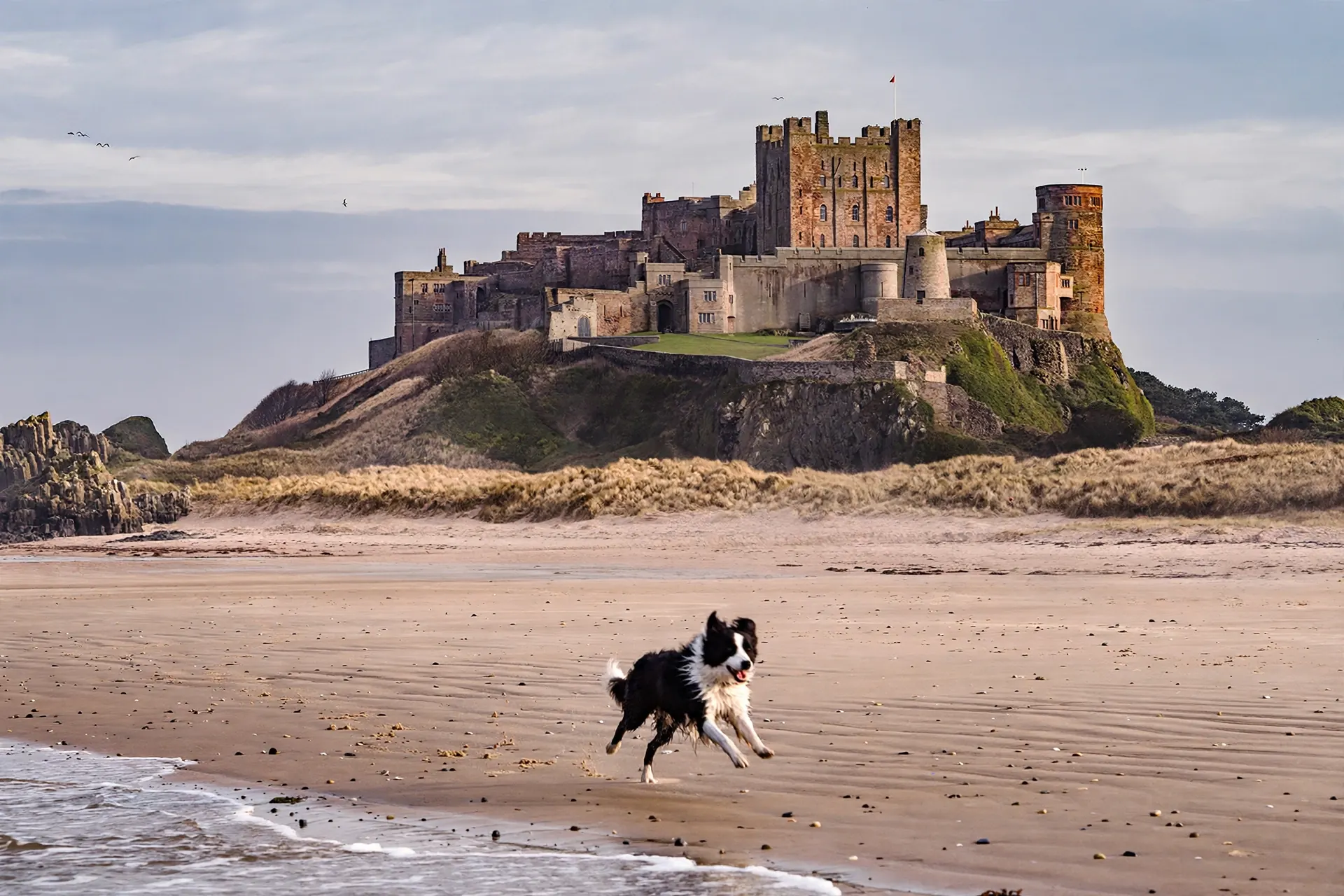
Bamburgh is the postcard beach of the county and, unusually, the postcard is accurate. The castle stands on a basalt outcrop above a beach that runs for miles in both directions, and the sand at low tide is wide, flat and firm. Dogs are welcome on the beach all year, and the sheer scale of the place means that even on a busy August afternoon you can walk ten minutes north or south and find empty sand. Parking is in the village car park and at the castle, both a short walk from the beach, and the dunes behind the beach hold a network of paths that make a good sheltered loop when the wind is up. The village has pubs and cafes that welcome dogs, and the castle grounds themselves have their own visiting rules, so check before you assume the dog can follow you everywhere.
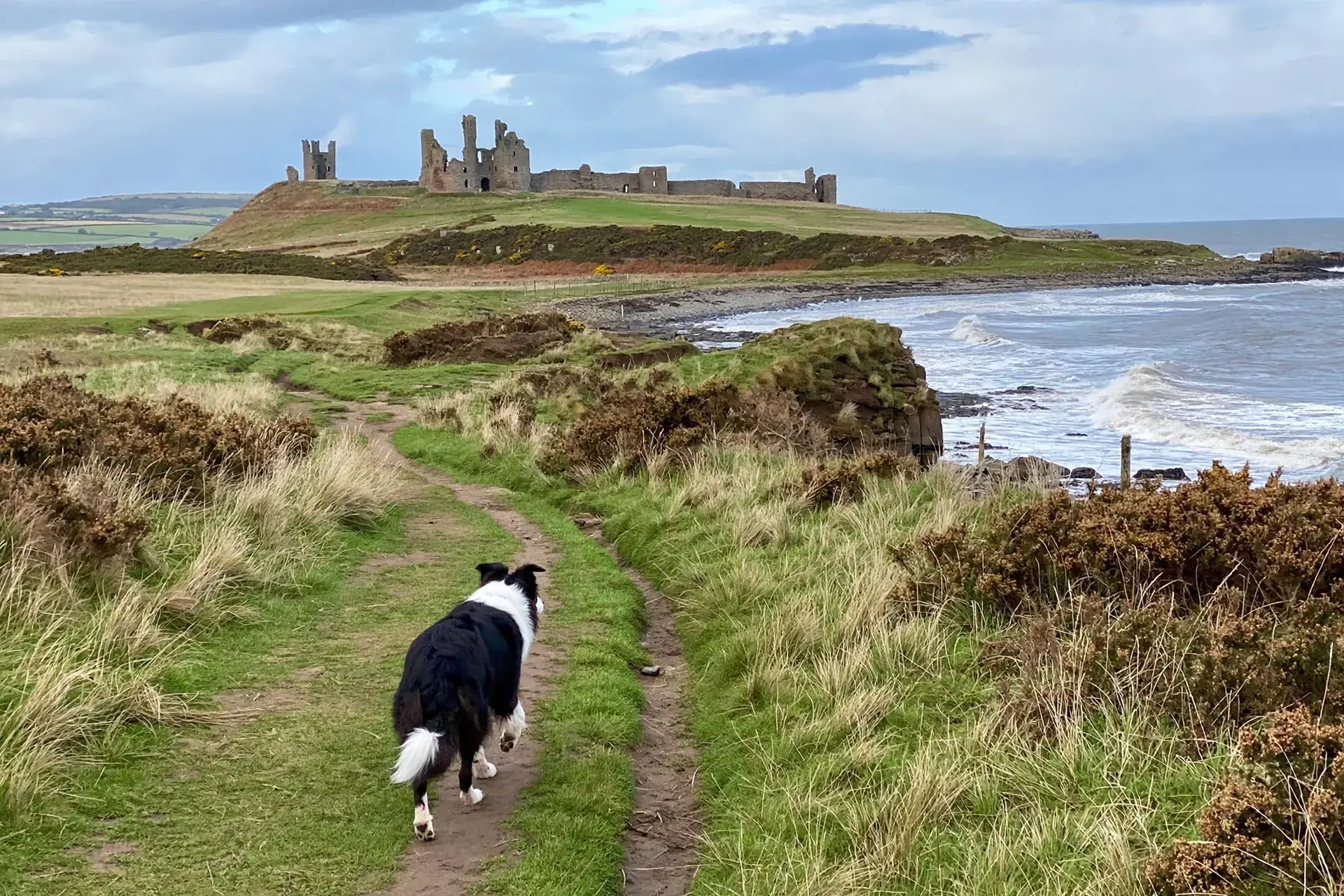
Beadnell Bay, a few miles south, is the county's other great open sand, and in some ways it is the better dog beach. The bay curves gently for nearly two miles, the car park at the southern end sits almost on the sand, and the dunes at the back give shelter from the worst of the wind. At low tide the beach is enormous, with firm sand and shallow pools that suit paddling dogs. Beadnell village has a harbour, a couple of pubs and a small shop, and the coast path south from here runs to the ruins of Dunstanburgh Castle, a walk of about ninety minutes that is one of the finest dog walks in England. Keep the dog on a lead on the clifftop sections and watch for nesting birds in spring, but the beach itself is open and forgiving.
Embleton Bay sits between the two, reached from the village of Embleton or from the coast path, and it is the quietest of the three. There is no big car park and no cafe, just a path through the dunes to a beach that can feel entirely empty on a weekday. That is exactly its charm for a dog that needs space, but it also means you should carry everything you need and not expect facilities. The sand here is softer than at Bamburgh, so older dogs may find the dune crossing tiring; if that is a concern, use the Beadnell end of the bay instead, where the access is flatter. Together these three beaches form the heart of a Northumberland beach holiday, and most visitors never need to go further. Our guide to Bamburgh with a dog covers the castle, the dunes and the village in more depth.
Alnmouth and Warkworth
Alnmouth is where the coast turns gentler. The River Aln meets the sea here, and the beach is a long curve of sand that changes character with the tide: at low water it is a firm, flat expanse that runs south towards Warkworth, and at high water it narrows to a strip below the dunes. The village itself is one of the prettiest on the coast, with pastel-painted houses, a small harbour and several dog-friendly pubs, and the walk from the village green to the beach takes only a few minutes. Seasonal restrictions apply to a defined section near the village in summer, so check the signs and walk a little further south if the dog needs to be off the lead. The estuary side of the village is worth a slow wander too, but keep the dog out of the soft mud at low tide, where the ground can be deceptively deep.
Warkworth, a mile inland, pairs with Alnmouth as a single day out. The castle ruins stand above the river, the village has a good bakery and a dog-friendly pub, and the riverside path between the two settlements is an easy, level walk that suits older dogs. The beach walk from Alnmouth to Warkworth's own stretch of sand is one of the best low-tide routes in the county: firm sand, few other walkers, and the castle appearing on the horizon as you approach. Allow an hour each way at a dog's pace, and time it so that you are walking on a falling tide with at least two hours before high water. If the tide turns while you are out, the dunes behind the beach give you a dry route back, though the sand there is soft and slow going.
Parking in Alnmouth is limited and the village streets are narrow, so arrive early in summer or park at the golf course end of the beach and walk in. The beach here is also a good place to watch for wading birds, especially in autumn, when the estuary fills with curlew and redshank. A dog that chases birds should stay on a lead near the river mouth, where the birds feed at low tide and are easily disturbed. The same rule applies along the whole coast, but it matters most at estuaries, where the birds are concentrated and the mud is treacherous for a dog that runs in after them.
Amble and the Coquet
Amble is the county's working harbour town, and its beach has a different feel from the castle bays further north. The town has been redeveloped around the marina in recent years, with seafood shacks, a Sunday market and a harbour walk that is level, paved and easy for dogs of any age. The beach itself lies south of the harbour, a long sweep of sand that runs towards Warkworth, and it is at its best at low tide, when the sand firms up and the rock pools appear. The Coquet estuary at the north end of the beach is a bird reserve, so keep the dog on a lead near the river mouth and out of the mud, and watch for the terns that nest on Coquet Island just offshore in summer.
The coast path north from Amble runs to Warkworth and beyond, and the section through the dunes is one of the quieter stretches of the whole route. It is also one of the best places in the county to see the coast as the locals see it: dog walkers, fishermen and the occasional horse rider, with no crowds and no queues. Parking in Amble is easier than in the smaller villages, with a large car park near the harbour and another at the beach end, and the town has several cafes that welcome dogs inside as well as out. If you are staying in the middle of the county, Amble makes a good base, with Alnmouth, Warkworth and Druridge Bay all within a short drive. Our guide to Amble with a dog covers the harbour, the beach and the coastal walks in detail.
One practical point about Amble: the harbour area can be busy with boats, ropes and fish boxes, so keep a close eye on a curious dog around the quayside. The beach is the place to let the dog run, not the working harbour. Once you are past the river mouth, the sand opens up and the crowds thin out within minutes, which is the pattern all along this coast. The best dog beaches in Northumberland are rarely the ones with the biggest car parks; they are the ones a short walk beyond them.
Druridge Bay
Druridge Bay is the wild card of the county: seven miles of almost unbroken sand from Amble to Cresswell, backed by dunes and a string of small lakes, with no town and no resort anywhere along it. The beach is owned and managed in sections by the National Trust and the county council, and dogs are welcome along most of it all year. Access is from a handful of small car parks — Druridge Bay Country Park, Cresswell and the National Trust car park at Low Hauxley — and each one leads through the dunes to a beach that can feel entirely yours. The country park has a lake, a visitor centre and a cafe, and it makes a good wet-day alternative when the beach is too exposed, with surfaced paths that stay usable after rain.
The scale of Druridge Bay is its main challenge. The dune crossing from car park to beach can be a few hundred metres of soft sand, which is tiring for small or older dogs, and the beach itself is so long that it is easy to walk further than you meant to. Plan a there-and-back walk rather than a loop, carry water, and keep an eye on the time, because the tide comes in across a very flat shore and can cut off the route back along the sand faster than you expect. The dunes also hold ground-nesting birds in spring and summer, so keep the dog on the paths and out of the fenced areas, where wardens work to protect the nests. In return, you get one of the emptiest beaches in England, with views across to the Cheviots on a clear day and a feeling of openness that is rare anywhere on the English coast.
Wildlife is the other reason to visit Druridge Bay with care. The lakes behind the dunes attract wildfowl all year, and the beach itself is a feeding ground for waders. A dog that runs into the shallows after birds will disturb them and may get into trouble in the soft mud at the lake edges, so keep the dog on the beach side of the dunes and on a lead near the lakes. The country park has a dog-wash tap near the car park in summer, which is worth knowing after a muddy walk, and the cafe welcomes dogs outside. For a long, quiet walk with a fit dog, there is nowhere better in the county; for a short, easy outing, Bamburgh or Beadnell will serve you better.
Blyth and the southern edge
Blyth marks the southern end of the Northumberland coast, and its beach is a reminder that this county was once an industrial coastline. The harbour is still working, the town has a long promenade, and the beach south of the harbour runs for miles towards Seaton Sluice and Whitley Bay. The sand here is firm and flat at low tide, the promenade gives a level paved walk for older dogs, and the car parks are large and close to the beach. Cambois, just north of Blyth, is another long open sand that stays quiet even in summer, with dunes behind it and views back up the coast towards the castle country. Both beaches are good choices for a first visit if you are driving up from Newcastle, because they are the easiest to reach and the simplest to navigate.
Seaton Sluice, a small village at the southern edge of the county, has a harbour cut into the rock and a beach that appears at low tide between the cliffs. It is a pretty stop rather than a long walk, and it pairs well with a visit to the National Trust property at Seaton Delaval Hall, where the grounds have their own dog rules. The coast path south from here continues into Tyne and Wear, and the whole southern section of the county is flatter and more built-up than the north, with more facilities and more people. That makes it a good choice for a wet day or a short visit, when you want a cafe and a dry car within easy reach, but it lacks the empty drama of the beaches further north.
For a longer stay, the southern edge doubles as a launch pad for the county's inland side: Morpeth market town one day, the Roman wall country the next, with a beach walk fitted in at either end. Nobody drives to Northumberland for Blyth beach alone, but as part of a week it earns its place, flat and easy to reach and open to dogs on most stretches through the year. The town fronts are where a marked summer zone is most likely to appear, so read the board where you park before letting the dog off the lead.
Rules at a glance
Use the table below as a first filter when you are choosing a beach for the day, and then confirm the detail on the ground. The council publishes the current orders, and the boards at each access point show the zone that applies right now; where the two disagree, the board wins. Dates and boundaries shift from year to year, so a beach that was unrestricted last summer may carry a marked section this year, and the only reliable check is the sign in front of you.
| Beach | Summer rule | Surface | Best for |
|---|---|---|---|
| Spittal | Seasonal restriction on a signed section | Firm flat sand | Long straight runs at low tide |
| Holy Island | Open, but causeway times rule the day | Sand and rock pools | Short quiet wanders |
| Bamburgh | Open all year | Wide firm sand | First visits and older dogs |
| Beadnell Bay | Open all year | Firm sand, shallow pools | Paddling and long walks |
| Embleton Bay | Open all year | Softer sand, dunes | Space and quiet |
| Alnmouth | Seasonal restriction near the village | Firm sand at low tide | Village walks and pubs |
| Amble | Open, lead near the estuary | Sand and rock pools | Harbour days and level walks |
| Druridge Bay | Open all year | Long flat sand | Fit dogs and long walks |
| Blyth and Cambois | Open, signed town sections may vary | Firm flat sand | Easy access from Newcastle |
Beyond the seasonal orders, two habits keep you on the right side of the wardens here. Keep the dog close enough to recall on the first call, because the dunes hide nesting birds and grazing sheep that a loose dog can reach in seconds, and a lead is the only honest answer when recall is uncertain. And take the mess home with you: the bins stand by the car parks and the path entrances, never out on the sand, so a bag carried back to the car is part of the walk. Fouling and breaching a marked restriction both carry fines, and the wardens do patrol the busy beaches in summer. The full picture of how these orders work is in our guide to UK beach rules, bans and fines.
A four-day north-to-south plan
Four days is enough to walk the whole county at a dog's pace without rushing, and the plan below keeps each day to one area so that the dog is never in the car for long. Day one starts at Berwick: the walls walk in the morning, Spittal Beach at low tide in the afternoon, and a pub supper in the town. Day two is the castle day: Holy Island in the morning if the causeway times allow, then Bamburgh in the afternoon, with the dunes walk as a sheltered fallback if the wind rises. Day three covers the middle coast: Beadnell Bay in the morning, the coast path to Dunstanburgh in the afternoon, and Alnmouth for the evening, when the light on the estuary is at its best. Day four is the wild south: Druridge Bay in the morning, the country park lake walk in the afternoon, and Blyth for a last easy beach before the drive home.
Leave slack in the plan on purpose. Two hours on soft sand tires a dog far more than two hours on pavement, so follow a big beach morning with a slow afternoon in a village or a pub garden, and keep one whole day spare for bad weather. Take a bottle and a bowl on every walk: the long beaches have no taps, and the villages are often a mile behind you. Keep a spare towel and a drying coat in the car. If the wind turns foul, Alnwick and Morpeth both have covered arcades, dog-friendly cafes and bookshops that make a decent wet-day outing, and the dune paths behind the beaches stay passable when the sand itself is being blown sideways. The best moments here come from pressing on past the last other walker, not from adding another beach name to the list.
Sleeping arrangements are straightforward along this coast. The villages hold a mix of self-catering cottages, pubs with rooms above the bar and small campsites, and nearly all of them take dogs as a matter of course. The castle villages book up first in July and August, so reserve early and ask the host directly whether the garden is properly fenced and whether the dog is allowed to stay alone indoors. A cottage around Alnmouth or Amble keeps both ends of the county within a short drive, while Bamburgh suits a short break that never leaves the north. On arrival, walk the garden boundary yourself before letting the dog off the lead, and keep the first evening deliberately dull so the dog learns that the new house is a safe place to sleep.
Tides, weather and safety
If you remember one safety fact from this guide, make it the tide. The North Sea rises a long way here, and across the flat sands at Beadnell or Druridge Bay the water can cover ground quicker than a person can walk it. Look up the day's tide times before breakfast, aim to be walking while the tide is going out, and turn back with two hours still in hand. River mouths and tidal channels hide the strongest currents on this coast, so keep the dog out of them even when the surface looks still, and if a dog does get into difficulty, stay on dry land and dial 999 for the coastguard rather than going in after it.
Northumberland weather rewards a packed bag and a flexible plan. Sunshine at breakfast can become driving rain by lunch, and the breeze on the sand is usually a good deal stronger than the breeze a mile inland. Pack a windproof for yourself and watch the dog as you walk: a dog that starts shivering, tucks its tail or keeps stopping to look back at the car is telling you it is cold. Summer flips the problem round, because the pale sand reflects the sun, there is almost no shade on the open beaches, and a dog running hard can overheat in under an hour, so walk at dawn or dusk and rest in the dunes at midday. Adders bask on the dune edges in warm weather, so keep the dog out of thick bracken and long grass; a sudden yelp, a swollen muzzle and a dog that goes quiet afterwards all mean a vet, straight away.
The wildlife here is the reason many of these beaches have rules at all. The Farne Islands and the Coquet estuary support seabird colonies that matter far beyond the county, and the open sand itself is a nesting ground for terns and ringed plovers through spring and summer. Give the fenced nesting areas a wide berth, keep the dog on a lead wherever you see the warning signs, and leave any seal hauled out on the rocks well alone, because a close approach can stress it badly and a cornered seal can bite. Chasing is not mischief; it is instinct, which is why the lead has to come out before the chase starts, not after. Cut a walk short when the birds or the weather ask for it, and the beach will still be waiting tomorrow.
Practical questions
Before you go
Which Northumberland beaches allow dogs all year round?
Bamburgh, Beadnell Bay, Embleton Bay, Druridge Bay and Cambois all stay open to dogs through the year, with no summer ban on the main sands. Spittal and Alnmouth are the exceptions, with marked summer zones on the stretches nearest the villages. The zones move from year to year, so read the board where you park and treat that as the rule for the day.
How do tides affect a dog walk on the Northumberland coast?
The sea rises a long way here, so a beach that is a mile wide at low water can shrink to a narrow strip at high water, and the water crosses flat sand faster than most people expect. Walk while the tide is falling, watch the clock, and keep the dog out of the channels and the causeway waters. A printed tide table for the day is worth carrying.
Can I walk the Northumberland Coast Path with my dog?
Yes, dogs can walk most of the coast path, and it joins the beaches in this guide into a single long route. Use a lead beside livestock, nesting birds and cliff edges, and obey the notices where the path crosses farmland or a reserve. A few short stretches ask dogs to stay on the path itself rather than roaming the fields beside it.
Is Holy Island safe to visit with a dog?
It can be, if you respect the causeway timetable. The road floods twice a day and the crossing window is short, so check the official safe crossing times, arrive early and leave with plenty of margin. Dogs must be kept under control around the village, the priory grounds and grazing sheep, and there is very little shade or water on the island in summer.
Where is the easiest Northumberland beach for an older dog?
Bamburgh and Beadnell Bay suit an older dog best: the car parks sit beside level sand, the walking is flat, and there are no steps at all. Alnmouth is a good second choice at low tide, when the sand is firm and the village is a short stroll away. Skip Druridge Bay if soft sand tires your dog, because the dune crossing there is long and heavy going.