This guide is independent and contains no paid placement. If affiliate links are added later, they will be clearly marked and will not change our editorial checks.
Norfolk gives dogs more room than almost anywhere in England: Holkham and Wells for huge open sands, Cley for quiet shingle, Cromer and Sheringham for a classic seaside day, and Blakeney for seal-watching from a respectful distance. Seasonal restrictions are light outside the town fronts, but they are set beach by beach, so read the signs at each access point and check the official guidance before you travel.
A flat coast, and why that matters
Norfolk is flat in a way that changes the whole feeling of a beach day. There are no cliffs to climb, no steep paths down to the sand, and almost nothing between you and the horizon except sky. The sea retreats a long way at low tide on the north coast, leaving a mile or more of firm sand at places like Holkham and Brancaster, and the light has a pale, wide quality that photographers travel a long way to find. For a dog owner, the flatness is practical as well as pretty: an older dog can walk for an hour without a single step, a puppy can practise recall with a clear view in every direction, and a nervous dog can see other dogs coming from far away instead of meeting them suddenly around a headland.
The coast is also a patchwork of very different beach characters, which is why this guide is organised by type rather than by town. The north coast runs from Hunstanton in the west to Cromer in the east, and along it you will find vast sands, shingle ridges, salt marsh, tidal creeks and classic seaside fronts, sometimes within a few miles of each other. A dog that loves to swim wants a different beach from a dog that loves to chase a ball on firm sand, and a dog that is frightened of other dogs wants a different beach again. The sections below describe each character honestly, including the drawbacks, so you can match the beach to the dog you actually have rather than to the photograph you saw online.
Norfolk's beach rules are drawn up by the district councils, and they follow the shape of the coast rather than a single county-wide order. The great sands at Holkham and Wells stay open to dogs through the summer, the shingle ridges at Cley and Salthouse are largely unrestricted too, and it is only the short fronts at Cromer, Sheringham and Great Yarmouth where a marked summer zone appears. The boundary of that zone is painted on the boards at the slipways and car parks, and the board is the authority on the day, not a web page. For the background on how these orders are made and what a breach can cost, see our guide to the UK beach rules.
Holkham and Wells: the great open sands
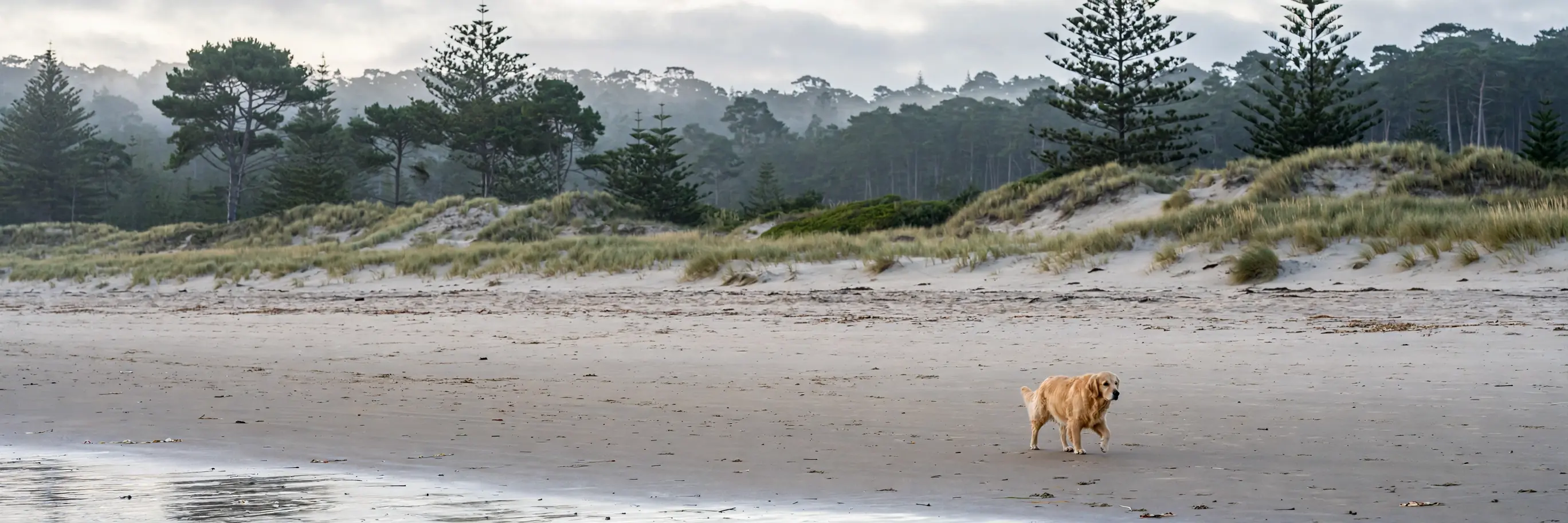
Holkham is the beach that makes people fall in love with the Norfolk coast. At low tide the sand stretches for what feels like forever, a vast pale expanse backed by pine woods and dunes, with the sea a thin silver line on the horizon. Dogs are welcome all year, and the sheer scale means that even on a busy summer day you can walk for ten minutes and be alone. The walk from the car park through the pines to the beach takes about ten minutes on a level path, which is a pleasant approach for most dogs, though it can be tiring for a very small or very old dog in hot weather. Once you reach the sand, the walking is flat and firm near the waterline, and the shallow pools left by the tide are ideal for a dog that likes to paddle without swimming.
Wells-next-the-Sea, a few miles east, offers a different version of the same idea. The beach here is reached from the harbour by a walk of about a mile along the sea wall or across the sand at low tide, and the town itself is one of the most dog-friendly on the coast, with cafes, a small harbour and a beach cafe that welcomes dogs. The walk from the harbour to the beach is level and easy, and the pine woods behind the beach give shade on a hot day. Wells is also a good base for a longer stay: the town has several dog-friendly cottages and pubs, the coast path runs east towards Stiffkey and Blakeney, and the marshes behind the town are full of birds in every season. Keep the dog on a lead near the harbour, where the quayside is busy with boats and ropes, and let the dog run once you are out on the open sand.
Both beaches share one important safety point: the tide. On this flat coast the sea comes in fast across a very gentle slope, and it is easy to walk out further than you meant to and find the water behind you. Check the tide times before you set out, walk on a falling tide, and leave at least two hours of margin before high water. The sand at Holkham is also soft in places away from the waterline, so a dog that struggles on soft ground will do better near the firm wet sand at the edge of the sea. Bring water for the dog, because there is no fresh water on the beach itself, and bring a windproof layer for yourself, because the Norfolk wind is a constant companion even on a sunny day.
Cley and Salthouse: the shingle ridges
Cley-next-the-Sea is the quiet, bird-watching end of the Norfolk coast, and its beach is unlike any other in the county. A long ridge of shingle separates the village from the sea, and behind it lies a network of marshes, reed beds and shallow pools that attract birdwatchers from all over Europe. The beach itself is a broad bank of pebbles and shingle, not sand, which makes it a poor choice for a dog that likes to dig or roll, but a good choice for a dog that needs space and quiet. The shingle is hard underfoot, so dogs with sore paws or arthritis may find it uncomfortable, and there is no shade at all, so a summer visit needs water and a short stay. What Cley offers instead is stillness: the sound of the sea on the stones, the wind in the reeds, and a village with a windmill, a good pub and a cafe that welcomes dogs.
Salthouse, the next village east, has a similar shingle beach with easier access from a small car park, and the coast path between the two villages runs along the top of the ridge with wide views across the marshes. The path is level and well surfaced, and it makes a good walk for a dog that prefers a path to a beach. Keep the dog on a lead on the marsh side, where the ground is soft and the birds are easily disturbed, and watch for adders in the warm months, when they bask on the edges of the paths. The marshes are also a working landscape, with grazing cattle and sheep, so a lead is essential near livestock, and the reed beds hold deep water that a dog should not be allowed to enter.
For a dog owner, the Cley area is best treated as a walking destination rather than a beach destination. The village, the marshes and the coast path are the attraction, and the beach is a place to stand and look at the sea rather than to run on. If your dog needs a long run on sand, drive west to Holkham or east to Cromer, and use Cley for the slower part of the day: a pub lunch, a marsh walk, and a quiet hour watching the birds. Our guide to Cley-next-the-Sea with a dog covers the marsh boardwalks, the village and the practical details in more depth.
Cromer and Sheringham: the family seaside
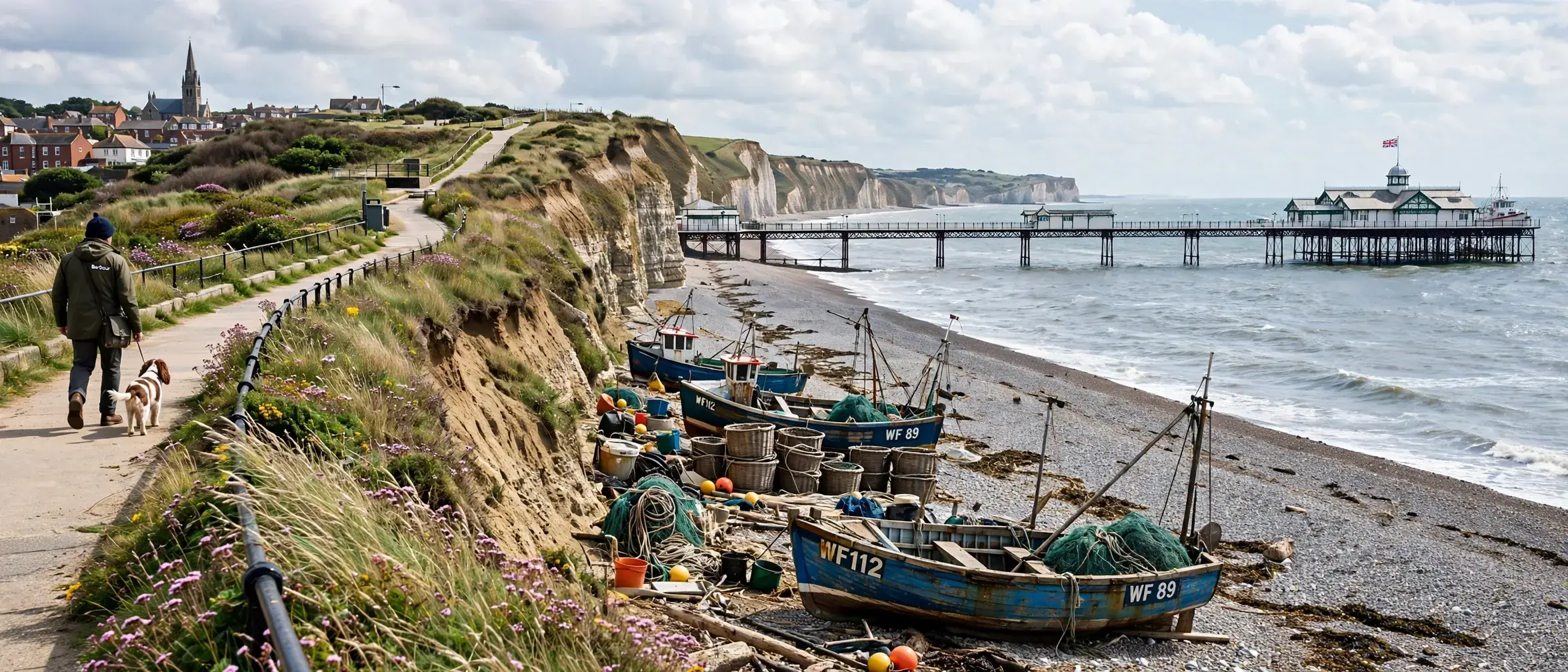
Cromer is the classic Norfolk seaside town, with a pier, a promenade, crab boats on the beach and a clifftop walk to Overstrand that is one of the best short dog walks on the coast. The beach below the town is a mix of sand and shingle, and seasonal restrictions apply to a defined section in front of the town in summer, so check the signs and walk a little further east or west if the dog needs to be off the lead. The promenade itself is level and paved, which makes it a good option for older dogs and for wet days when the beach is too rough, and the town has cafes and pubs that welcome dogs on every corner. The pier is not suitable for dogs, but the beach below it is, and the crab boats that land their catch on the sand in the morning are a lively sight for a dog that likes to watch the world go by.
Sheringham, a few miles west, is a smaller and quieter version of the same idea. The town has a railway station, a promenade and a beach that is mostly shingle with sand at low tide, and the clifftop walk east towards Weybourne is a gentle, grassy path with wide views. Sheringham is also the start of the North Norfolk Railway, and the steam trains are a popular sight for visitors, though dogs should be kept well back from the platform edge and the tracks. The town has several dog-friendly pubs and a good fish and chip shop, and the beach is at its best at low tide, when the sand appears and the rock pools are full of small crabs. Seasonal restrictions apply to the central section in summer, so read the boards before you let the dog off the lead.
Cromer and Sheringham suit a first Norfolk trip well, because everything a dog owner needs sits within a short walk: somewhere to park, somewhere to eat, a promenade and a beach. They are also the busiest beaches in the county in summer, so visit early in the morning or late in the afternoon if your dog is nervous around crowds, and use the clifftop paths for the quieter part of the day. The coast path between Cromer and Sheringham runs along the cliff tops and through the woods, and it is a good walk for a dog that prefers grass underfoot to sand. Our guide to Cromer with a dog covers the pier, the beach zones and the clifftop walks in detail.
Blakeney, Horsey and the seal coast
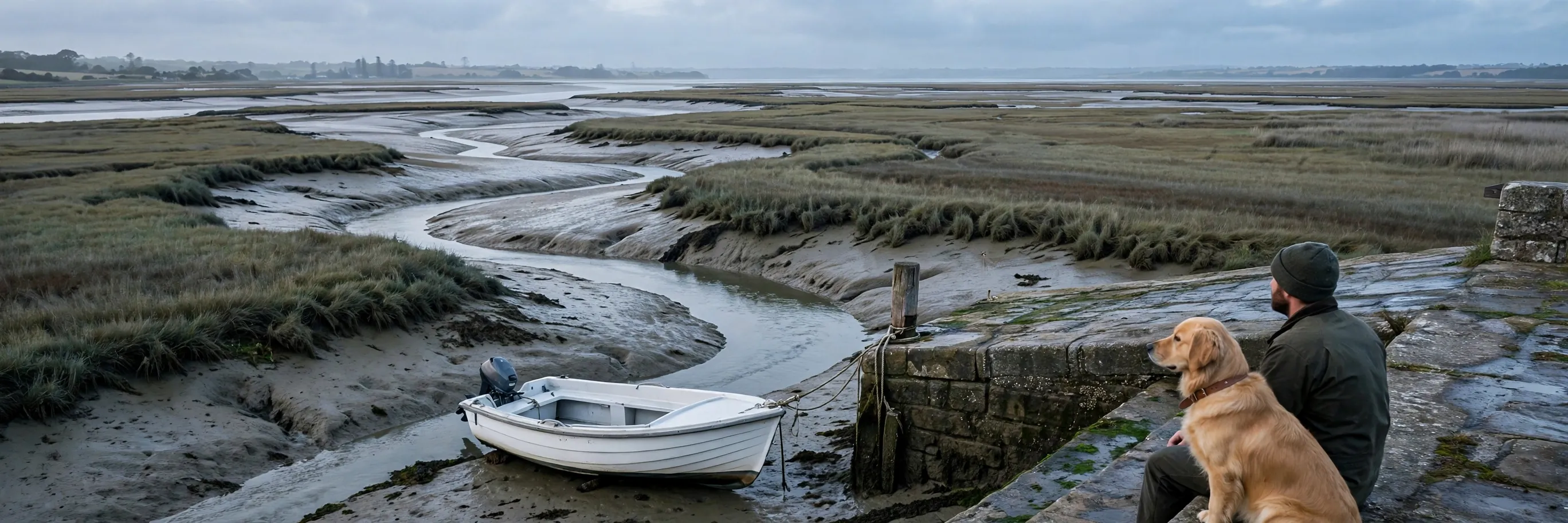
Norfolk is famous for its seals, and the two main places to see them with a dog are Blakeney and Horsey. At Blakeney, the seals live on the far end of the point, and the usual way to see them is by boat from the harbour, which is not a dog outing: the boats are small, the trips are long, and the seals are best left undisturbed. What Blakeney does offer a dog owner is a lovely harbour walk, a quay with cafes and pubs, and a marsh walk towards Cley that is flat, quiet and full of birds. Keep the dog on a lead on the quay, where the ground is uneven and the boats are close, and on the marsh paths, where the birds feed at low tide. The harbour at low water is a maze of mud and creeks, and a dog that runs in after a bird can get stuck, so keep to the paths and the firm ground.
Horsey, on the east coast, is where the grey seals come ashore to pup in winter, and it is one of the most popular wildlife spectacles in England. The viewing area is managed by wardens, and dogs are welcome on the beach walk to the viewing point, but they must stay on a lead and well back from the seals. A seal on the sand is often resting, not stranded, and a dog that approaches it can cause serious stress and can also be bitten. The beach at Horsey is a wide sweep of sand and dunes, and it is a good dog beach outside the pupping season, when the seals are fewer and the beach is quieter. Visit on a weekday if you can, because the pupping season brings crowds, and the car park fills early.
The seal coast is a reminder that Norfolk's beaches are shared with wildlife in a way that few other counties match. The grey seals, the terns, the wading birds and the marsh harriers all use the same beaches that dogs love, and the rules that protect them are there for a reason. Keep the dog on a lead near any signed wildlife area, stay out of fenced-off sections, and keep a good distance from any seal you see on the sand. The experience of watching seals from a respectful distance is far better than a close encounter that ends with a stressed animal and a frightened dog.
Brancaster and Titchwell: estuary and creek beaches
Brancaster is one of the great tidal beaches of England, a vast expanse of sand that appears at low tide and disappears almost entirely at high water. The beach is reached from the village by a walk across the marshes, and the car park at Brancaster Staithe sits close to the harbour. Dogs are welcome on the beach all year, and the sand is firm and flat near the waterline, which makes it a good choice for a long run. The tidal creeks that cross the beach are the main hazard: they fill quickly as the tide comes in, and a dog that crosses one on the way out may not be able to cross it on the way back. Walk on a falling tide, keep to the main sand, and never let the dog swim in a creek or channel, where the current is strong even when the surface looks calm.
Titchwell, a few miles east, is a nature reserve rather than a beach resort, and it is best visited as a walking destination. The reserve has a visitor centre, a cafe and a network of paths through the reed beds and lagoons, and the beach at the end of the path is a quiet sweep of sand and shingle. Dogs are welcome on the beach and on some of the paths, but not in the hides or on the main reserve trails, so check the signs at the visitor centre before you set out. Waders feed along the shore here, and the dunes behind the beach are nesting ground in spring, so keep the dog on a lead near the signs and out of the fenced areas.
Both beaches reward a slow, careful approach. The estuary landscape is beautiful, but it is also a working landscape of mud, creeks and tides, and a dog that runs free in it can get into trouble quickly. Bring water, bring a towel, and plan your walk around the tide table rather than the clock. If the tide is rising, turn back early; the beach will still be there tomorrow, and the creeks will be just as dangerous in an hour as they are now.
Which beach suits which dog
The right Norfolk beach depends on the dog, not on the photograph. A young spaniel that needs an hour of running wants firm sand and open space, which means Holkham, Wells or Brancaster at low tide. An older dog that struggles on soft ground wants a level promenade and a short walk from the car, which means Cromer, Sheringham or the sea wall at Wells. A nervous rescue that needs space from other dogs wants the quieter stretches: the far end of Holkham, the shingle at Cley, or the beach at Horsey outside the pupping season. A dog that swims wants the gentle shelves at Wells or Brancaster, not the steep shingle at Cley or the tidal creeks at Blakeney.
| Dog type | Best beaches | Watch out for |
|---|---|---|
| High-energy runner | Holkham, Wells, Brancaster | Soft sand away from the waterline |
| Older or stiff dog | Cromer promenade, Sheringham, Wells sea wall | Shingle at Cley, long dune walks |
| Nervous or reactive dog | Far end of Holkham, Horsey, Salthouse | Busy town fronts in summer |
| Swimmer | Wells, Brancaster at low tide | Tidal creeks and channels |
| Bird chaser | Cromer, Sheringham town beaches | Estuaries and marshes at low tide |
| Puppy in training | Holkham, Wells, quiet end of Cromer | Crowds, other dogs off lead |
Whichever beach you pick, the kit list barely changes. A bottle and a bowl matter more than anything else, because the long beaches have no taps and no shops, and a bag for the mess is essential, since the bins stand by the car parks rather than out on the sand. A lead is non-negotiable around livestock, ground-nesting birds and seals, and the tide table deserves a look every single morning. Norfolk rewards that kind of preparation: the beaches are so long that a quieter stretch is always a few minutes further along the sand.
A slow week along the coast
Norfolk rewards a slow pace, and a week here is better spent in one place than in five. Base yourself in Wells or Blakeney for the west, or in Cromer or Sheringham for the east, and let each day be a single beach and a single village. Day one is Holkham: the pine woods, the vast sand, and a pub supper in Wells. Day two is the marsh walk from Blakeney to Cley, with the beach at Salthouse as a quiet end to the day. Day three is Cromer: the pier, the promenade and the clifftop walk to Overstrand. Day four is a rest day, with a village walk and a long lunch, because a dog that runs on sand for three days needs a day off. Day five is Brancaster at low tide, with the tidal creeks and the wide sand. Day six is Horsey and the seal coast, with a respectful distance and a long dune walk. Day seven is a return to the favourite beach of the week, because by then you will know which one it is.
Sleeping here is easy. Cottages, pubs with rooms and campsites line the coast, and the villages of Blakeney, Cley and Burnham Market make the nicest bases, with pubs that take dogs, cafes that leave a water bowl by the door, and the coast path starting at the end of the lane. Summer cottages that welcome dogs go first, so book months ahead and ask the owner directly about the garden fence and the alone-time rules. Wells puts you in the middle of the coast with short drives either way, while Cromer suits a short break that never leaves the east. On arrival, inspect the garden fence yourself before the dog goes out, and give the dog a calm first evening so the new house becomes home.
Rain need not end the day. Holt and Fakenham both have covered markets, dog-friendly cafes and bookshops, the steam trains of the North Norfolk Railway carry dogs, and the seal boats from Blakeney give the humans an outing while the dog sleeps it off at the cottage. The wooded stretches of the coast path and the sea wall at Wells stay passable when the open sand is being blown sideways, and the pubs along this coast are among the friendliest in England for a wet dog. Patience pays here: walk ten minutes beyond the last other person and the beach becomes yours.
Wind, weather and the Norfolk sky
The sky over Norfolk is famously big, and the weather moves across it quickly. Sunshine at ten can be a cold shower by noon, and the breeze on the sand runs a good deal harder than the breeze in the village behind the dunes. Bring a windproof layer and keep an eye on the dog: a shivering dog, a tucked tail or a dog that keeps turning for the car is asking to go home. Heat is the summer problem instead, because the pale sand throws the sun back up, there is almost no shade on the open beaches, and a hard-running dog can overheat fast, so walk at dawn or dusk and rest in the pines or the dunes at midday.
Tides deserve the same respect as the weather. At Holkham, Wells and Brancaster the sea pulls back for a mile and then returns across that whole flat distance in a few hours, and the creeks that cut the sand fill without warning. Look up the tide times before you leave the cottage, walk while the water is going out, and turn back with two hours to spare. A creek or a river mouth can run hard even when it looks calm, so keep the dog out of them, and if a dog gets into trouble, stay ashore and dial 999 for the coastguard rather than wading in after it.
Wildlife is the third thing to plan around. The marshes and the open sand support birds of international importance, and the grey seals at Horsey and Blakeney are protected, so a lead near any signed area is not optional, and the fenced sections are there for a reason. A seal resting on the sand deserves a wide berth, and a dog that rushes it can be bitten as well as cause serious stress. Adders sun themselves on the dune edges in warm weather, so keep the dog out of thick bracken and long grass; a sudden yelp, a swollen face and a dog that goes quiet all mean a vet, straight away. A walk cut short today is a beach still there tomorrow.
Practical questions
Before you go
Which Norfolk beaches are best for dogs in summer?
Holkham and the sands west of Wells stay open to dogs through the year, and the shingle at Cley and Salthouse is largely unrestricted too. It is the town fronts at Cromer and Sheringham that carry marked summer zones, so check the board at the car park and head a little further along the sand if the dog needs room to run.
Can dogs visit the seals at Blakeney and Horsey?
You can watch seals from a distance, but dogs must stay on a lead and well back from the colonies, especially during the grey seal pupping season in winter. Never let a dog approach a seal on the beach, and keep to the marked viewing areas. A seal on the sand is often resting, not stranded, so give it space and check the official guidance before you travel.
Why does the tide matter so much on the Norfolk coast?
Because the shore is so flat, the sea can pull back a mile at low water and cover that whole distance again within a few hours, which makes it easy to walk out too far. Look up the tide times each morning, walk while the tide is falling, and treat the creeks at Blakeney and Brancaster as no-go areas once the water starts coming back in.
Are the Norfolk beaches good for older dogs?
Yes, the county is one of the flattest in England, so most beach walks involve no steps and no steep climbs. Cromer, Sheringham and Wells have level access from the promenade or the car park, and the sand at Holkham is firm enough at low tide for a dog that struggles on soft ground. Avoid the shingle ridges at Cley if your dog finds loose stones painful underfoot.
What should I pack for a Norfolk beach day with a dog?
Start with water and a bowl, since the long beaches have no taps, then a long line for the estuary stretches, poo bags, a towel and a windproof layer. Sun and wind both bite here in every season, so pack for both, and look up the current seasonal rules for each beach before you set out.