This guide is independent and contains no paid placement. If affiliate links are added later, they will be clearly marked and will not change our editorial checks.
Northern Ireland gives dogs long, dramatic beaches and generally generous access, but the rules are set beach by beach. Check the council signs, keep dogs on leads near cliffs and livestock, respect Atlantic tides, and pick the quiet end of a resort beach when the centre fills up.
Arriving: Belfast, Derry and the ferry
Most dog beach trips in Northern Ireland start in one of three places: Belfast, Derry, or a ferry port. Belfast is the natural base for County Down and the Causeway Coast, with good roads north and south, vets, pet shops and a wide choice of dog-friendly stays. Derry suits the north-west coast, with shorter drives to quiet strands and to the Donegal border country beyond. Ferries from Cairnryan, Liverpool and Heysham bring dogs by car, and the crossing itself needs a little planning: check whether your dog stays in the vehicle, travels in a kennel area, or can stay with you, and plan a toilet break before boarding and a calm walk after landing. A dog that arrives unsettled will not enjoy a beach, however beautiful it is, so build recovery time into the first day.
Roads in Northern Ireland are generally good, but the last miles to a beach can be narrow, single-track, or shared with farm traffic. Drive slowly near beaches in summer, when walkers, cyclists and dogs cross the road without warning, and never park in a passing place or across a farm gateway. If you are staying in Belfast first, use the city as a settling day: a short park walk, a familiar meal, and a quiet night will do more for a beach holiday than a rushed drive to the coast on arrival day. The same principle applies in reverse: on departure day, choose a short beach walk near your route home rather than a long cliff walk that leaves a tired, sandy dog facing a ferry queue.
Accommodation choices shape the beach plan. A cottage near the Causeway Coast puts long beaches within easy reach, but it also means livestock, narrow lanes and limited evening facilities. A town base in Portrush, Portstewart, Newcastle or Bangor gives cafes, shops and a vet nearby, at the cost of busier beaches. Ask the same questions wherever you stay: where is the nearest practical toilet walk after dark, is there a secure garden or a drying area, and how far is the beach on foot? A stay that answers those three questions well will usually beat a prettier stay that does not.
How Northern Ireland beach rules work
Beach dog controls in Northern Ireland are made locally, usually by the council that manages the beach, and they can differ between neighbouring beaches. Some beaches are open to dogs all year with no restrictions beyond the usual duty to clean up and keep control. Others have a seasonal zone in which dogs are excluded from a marked stretch during summer months, a lead requirement on a promenade, or a restriction that applies only to a particular access point. There is no single national list that replaces checking the beach itself, so treat every new beach as a fresh question. Look for council beach pages before you travel, read the signs at the car park and the beach entrance on arrival, and check the official guidance before you travel if a rule is unclear or if the beach is a protected wildlife site.
Enforcement is usually practical rather than punitive, but fines and fixed penalty notices do exist for fouling, for entering a restricted zone, and for dogs out of control. The most common problems are not deliberate rule-breaking but misunderstandings: an owner who did not see a small sign, who assumed a zone ended earlier than it did, or who let a dog off the lead in a lead-only area because the beach looked empty. Walk the first few minutes on a lead, look for zone markers, bins and other dog owners, and ask a warden, lifeguard or local walker if you are unsure. A two-minute question can save a fine and a spoiled day.
Our wider guide to UK beach dog rules, bans and fines explains the enforcement picture across Britain, including how seasonal zones and lead orders work in practice. It is worth reading before a Northern Ireland trip because the habits it teaches, checking before you go, reading signs on the day, cleaning up, and keeping a dog under control, are exactly the habits that keep Northern Ireland beaches welcoming to dogs. If a beach is restricted, do not argue with a sign or a warden; walk to the unrestricted stretch, or choose a neighbouring beach. The coast is long enough that a restriction rarely means a ruined day.
The Causeway Coast in detail
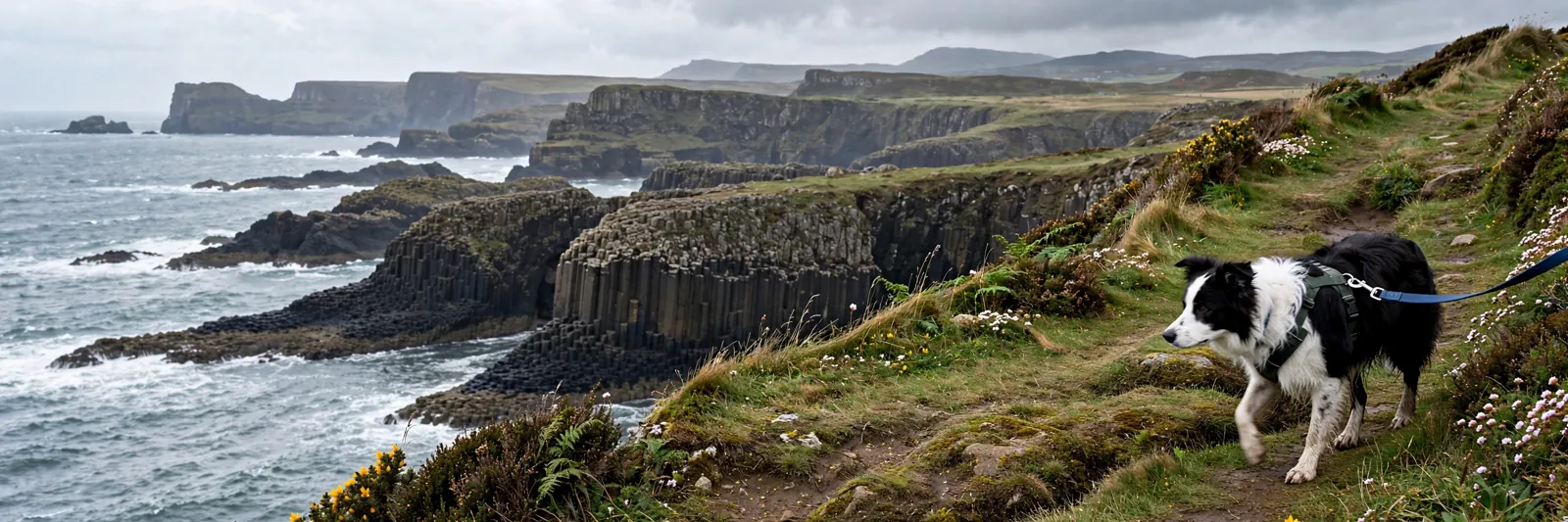
The Causeway Coast is the headline dog coast of Northern Ireland, and it earns that reputation. From Portrush eastwards past Dunluce, Portballintrae and the Giant's Causeway area, and westwards towards Castlerock and Downhill, the coast mixes long sandy beaches, basalt cliffs, dune systems and harbour villages. Our Causeway Coast guide covers beaches, towns and walks in detail, and it is the best companion to this article if you are planning a multi-day Causeway trip. The key point for dog owners is variety: a dog can have a long sand run in the morning, a cliff-top walk in the afternoon, and a harbour stroll in the evening, without ever needing to repeat the same stretch.
That variety brings different risks on different stretches. Sandy beaches suit running and swimming, but they also bring tides, currents and crowds at the main access points. Cliff paths suit views and steady walking, but they demand leads, short leads on narrow sections, and a dog that will not lunge at seabirds or other walkers. Dune systems suit sniffing and exploring, but they hold nesting birds in spring and summer and fragile vegetation that is easily damaged. Harbour areas suit cafes and people-watching, but they bring traffic, fishing gear, ropes and food dropped on the ground. A good Causeway day uses each landscape for what it does best, and does not ask a sandy beach to be a cliff path or a harbour to be a dog park.
Timing transforms the Causeway Coast. Early morning, before the tour coaches and beach crowds arrive, is the calmest time for a dog that needs space. Late afternoon, after the main beach rush has thinned, is often calmer than midday, although light and tide need checking. Midday in a school holiday, at the main access point of a resort beach, is the hardest combination for a reactive, nervous or young dog. If you must visit at midday, walk to the far end of the beach, keep the dog on a lead through the busy zone, and plan a shorter walk. The coast rewards early risers and patient walkers more than it rewards anyone who insists on the busiest hour at the busiest point.
Portrush and Portstewart
Portrush and Portstewart are the two resort towns that most visitors meet first, and they illustrate how seasonal rules work in practice. Portrush has West Strand and East Strand, with different characters and different local arrangements, while Portstewart Strand is a long, National Trust-managed beach with dunes behind it. Our Portrush guide explains West and East Strand rules, Whiterocks, harbour eating, Dunluce Castle planning and golf-path safety in detail. The short version is this: check which strand you are on, check whether a seasonal zone applies on the day, and do not assume that a rule for one strand applies to the other. A dog that is welcome on one stretch may need to be on a lead, or excluded, on the next.
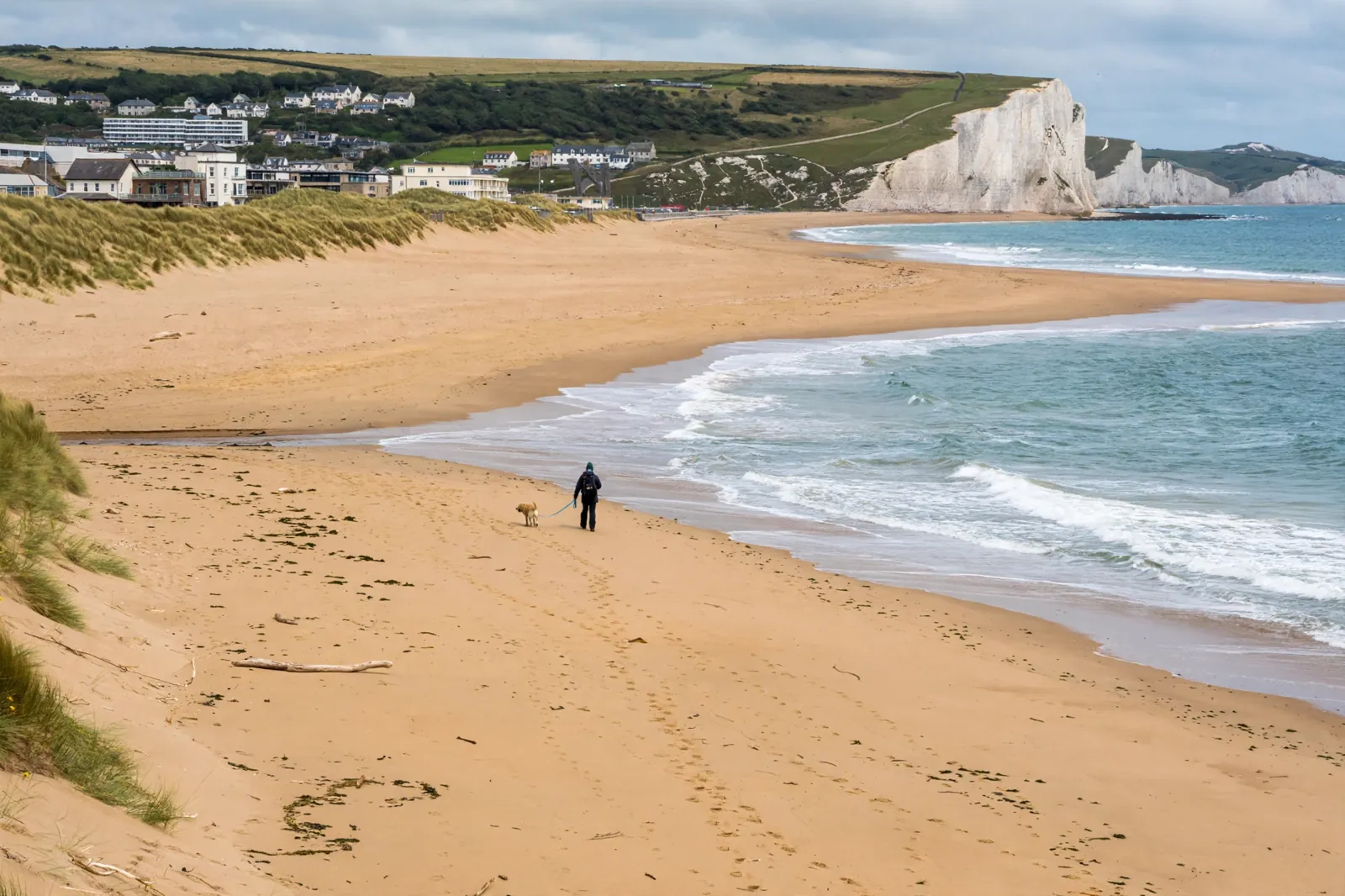
Both towns suit family beach days because they combine sand with facilities: car parks, toilets, cafes, shops and a promenade. That combination also means crowds, children, ice-cream wrappers, dropped food and other dogs, all of which test a dog's training. Keep a dog on a short lead through the promenade and the busiest sand, use a long line only on the quieter stretches, and carry extra poo bags, because resort bins fill fast on a sunny day. If your dog is reactive, visit early, walk the far end of the beach, and avoid the main access point at midday. If your dog is social and well-trained, a resort beach can still be a joy, provided you watch for tiredness, overheating and over-excitement as the day goes on.
Whiterocks and the coast towards Dunluce Castle offer a quieter alternative when Portrush centre is busy. The cliffs, caves and rock formations are spectacular, but they also demand care: keep dogs on leads near cliff edges, do not let a dog scramble on rocks that are wet or unstable, and watch the tide, which can cut off sections of shore. Golf courses border parts of the coast, and dogs must be kept off greens and fairways, on leads near golfers, and away from golf balls in flight. A walk that combines a beach, a cliff path and a harbour stop is a classic Portrush day, but it works best when each part is kept short and the dog gets water, shade and rest between sections.
County Down and Strangford
County Down gives Northern Ireland a second beach character, quite different from the Causeway Coast. Newcastle, at the foot of the Mourne Mountains, offers a long beach, a promenade and mountain views, while the coast south towards Dundrum Bay and north towards Bangor, Donaghadee and the Ards Peninsula offers sandy bays, rocky shores and harbour villages. Strangford Lough, with its tidal narrows, islands and birdlife, is a special landscape for dog walkers, but it is also a sensitive one: wading birds, seals and tidal currents all demand respect. Keep dogs on leads near feeding birds and seal haul-outs, do not let a dog swim in the fast tidal narrows, and check tide times carefully, because Strangford tides are strong and fast.
Newcastle beach suits dogs that like a long, flat walk with a town nearby. The Mournes provide a dramatic backdrop, and the promenade gives an easy, surfaced option for older dogs, pushchairs and wet days. In summer, the town is busy, so the same early-morning and late-afternoon advice applies. Further north, Bangor and the Ards coast offer a mix of sandy beaches, marinas and coastal paths that suit a touring holiday: a different beach each day, a harbour cafe for lunch, and a quiet evening walk. The Ards Peninsula, in particular, rewards slow touring, because its beaches are smaller, its villages are quieter, and its coastal roads invite stopping rather than rushing.
Across County Down, the same local-rule principle applies. A beach that is open in one town may have a seasonal zone in the next, and a harbour beach may have different rules from a bay beach a mile away. Check the council pages for the specific beach, read the entrance signs, and ask locally if you are unsure. County Down also offers a useful lesson for dog owners: a beach does not have to be famous to be excellent. A small bay with firm sand, a car park, a bin and a view of the Mournes or Strangford Lough can be a better dog beach than a famous resort beach on a busy day, because the dog gets space, the owner gets calm, and the walk ends with a settled dog rather than an over-stimulated one.
The north-west and Donegal border country
The north-west coast, around Derry, Magilligan, Benone and Downhill, is quieter than the Causeway Coast and, for many dogs, better for it. Benone Strand is a long, wide beach backed by dunes, with room to walk for miles, while Magilligan and the coast towards Lough Foyle offer estuary walks, birdlife and big skies. Derry itself gives a city base with walls, cafes and a riverfront, and a short drive puts a dog on a beach that may be almost empty outside peak weekends. The north-west suits dogs that need space to decompress, dogs that are reactive to crowds, and owners who prefer a long, steady walk to a social beach scene.
The border with County Donegal adds another dimension, because many visitors cross into the Republic of Ireland for a day trip. Dog rules, beach management and veterinary arrangements differ across the border, so check the specific beach and the official guidance before you travel if you plan to cross. Keep the dog's identification, vaccination record and any travel documents with you, and do not assume that a rule in Northern Ireland applies in Donegal, or vice versa. A day trip that stays on one side of the border is simpler, and a cross-border trip needs a little extra paperwork and planning, but both are entirely possible with a dog.
Remote north-west beaches share the same practical needs as remote beaches anywhere: carry fresh water, poo bags, a towel and a spare lead, download maps and tide times before you leave, and tell someone your route if you are walking alone. Phone signal can be patchy on remote stretches, and the nearest vet may be a drive away. The reward for that preparation is a beach walk that feels private, with a dog that can run, sniff and swim without the pressures of a resort beach. For many owners, that is the best version of a Northern Ireland beach holiday, and it is worth the extra drive.
Cliffs, tides and Atlantic water
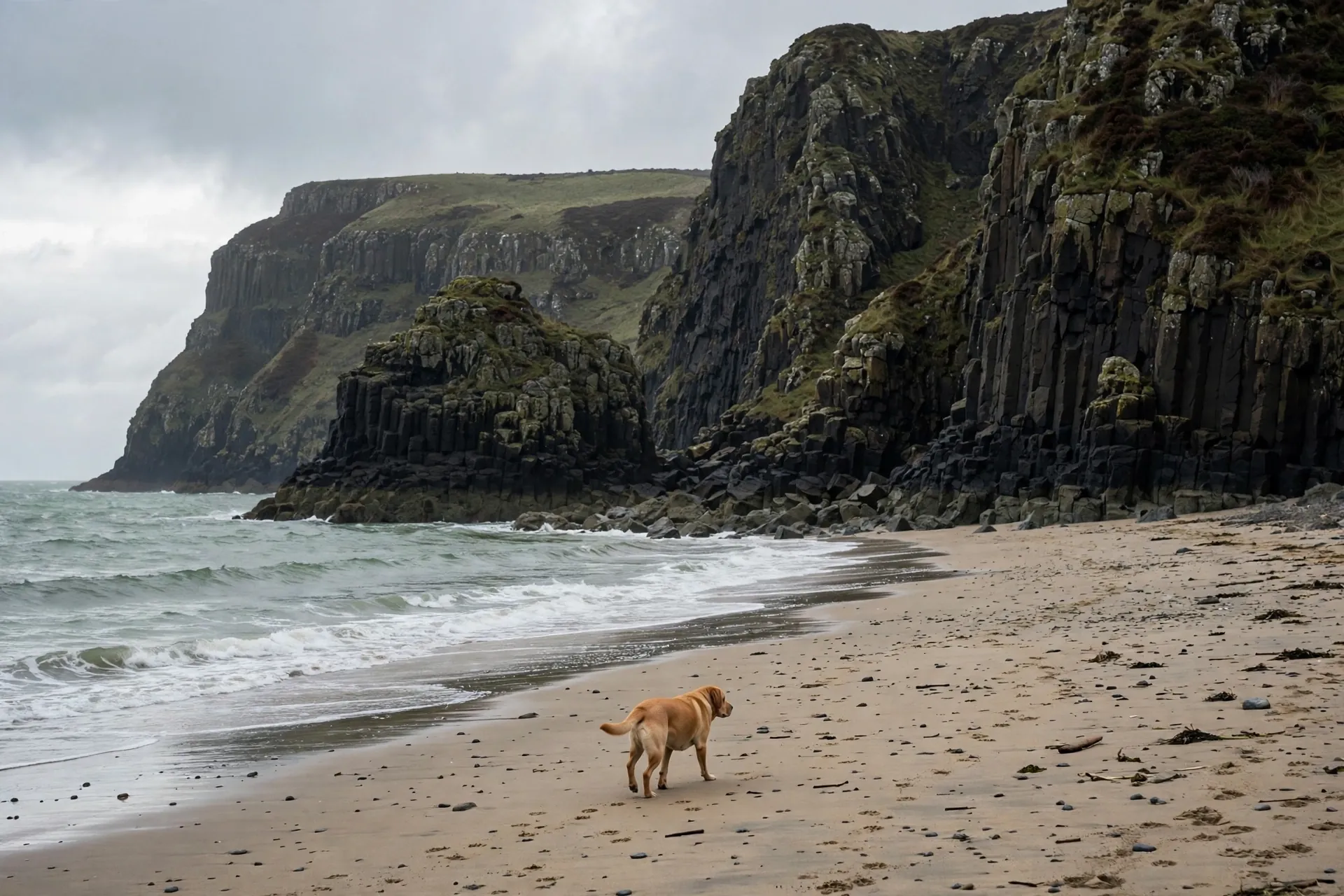
The drama of this coast is geological, and it changes how a dog walk works. Along the Causeway Coast, basalt columns stack into headlands, chalk cliffs glow white at the White Rocks east of Portrush, and Fair Head rises sheer above the sea near Ballycastle. None of these edges behaves like a fenced park boundary: grass runs right up to a drop, gusts arrive without warning, and a dog that bolts after a gull has no second chance. Before a cliff-top stretch, clip the lead short, pocket the long line, and decide in advance where the dog walks — on the inland side of the path, away from the edge, with you between the dog and the drop. Where a path is barred or a landslip fence has gone up, treat that as final: the ground beyond it may already be hollow underneath.
Tide timing matters most on the wide, flat strands. Whitepark Bay, Benone and Portstewart Strand all look endless at low water, then narrow fast as the tide returns, pushing walkers against dunes or cliff bases. Look up the tide table for the named beach on the morning of the visit, not for the nearest town, and aim to be back at your exit a full hour before high water. Caves and rock platforms at the White Rocks and around Ballintoy Harbour are for low tide only, and a rising tide can close the way back while you are still photographing rock pools. Harbour mouths at Portstewart and Ballycastle deserve the same respect: the current there runs hard even when the beach itself looks calm.
Swimming here is an Atlantic affair, not a paddling-pool one. Portrush surf draws surfers for a reason, and the same waves that excite them can tumble a dog, while rip currents along the open north coast pull sideways with surprising force. Pick a sheltered corner for a first swim — a harbour-side bay or the lee of a headland — keep the first dip to a few minutes, and watch for the dog slowing, shivering or turning away from the water. Offer drinking water before and after, because a thirsty dog will gulp seawater and feel sick later, and rinse the coat at the car if a tap is handy. A short splash that ends with a warm, dry, settled dog beats a long battle with surf every time.
Wind is the fourth factor, and on exposed headlands it can matter more than rain. An onshore gale at Benone drives sand into eyes and ears, drowns recall calls and chills a wet dog quickly, while a headland walk above Fair Head can feel twice as cold as the beach below. Check the wind forecast as well as the rain forecast, carry a drying coat for short-coated or older dogs, and be ready to swap a cliff-top route for a sheltered dune walk. Shortening the outing when the weather turns is not a failed day; it is the habit that keeps the next beach day possible.
Farms, wildlife and other beach users
Many Northern Ireland beaches are working landscapes, not just leisure ones, and the clearest example is Whitepark Bay, where cattle graze the dunes and sometimes wander onto the sand itself. Sheep graze the coastal grass above the Antrim road, horses exercise on the open strands at Benone and Portstewart, and farm lanes double as beach approaches. The rule that covers all of it is simple: whenever animals could be nearby, the dog goes back on the lead before you reach them, not after. Walk the dog around a flock at a wide distance, never through it, shut every gate you open, and if cattle block the path, wait or retrace rather than pushing past. A dog that has never chased anything can still scatter a flock by running at it in play, and the consequences for the farmer, the animals and the dog's future beach access are all serious.
The wild residents need a different kind of attention. Rathlin Island, just offshore, hosts puffins and guillemots on its cliffs in summer, Strangford Lough fills with waders and wildfowl through the colder months, and the dunes at Murlough shelter birds that nest on open ground where a running dog can destroy a nest without anyone noticing. Grey seals haul out around the Copeland Islands and parts of Strangford Lough, and a pup resting alone on a beach is almost certainly waiting for its mother, not in need of rescue. Give every seal a wide berth, keep the dog leashed and quiet, and move on rather than stopping for a closer look. The pattern is the same in each case: spot the wildlife first, change your route or your dog's freedom first, and let the dog enjoy the beach within those limits.
Then there are the other people, and on a Northern Ireland beach they arrive in more varieties than on most. Surfers carry boards across the sand at Portrush, riders gallop the firm sand at Benone, anglers cast from rocks at Ballycastle, golfers cross the links behind Portstewart Strand, and families spread picnics at Newcastle and Helen's Bay. A dog that races up to a stranger, snatches food or chases a kite can ruin someone's afternoon and, near a horse or a surfboard, cause a real accident. Recall the dog before it reaches anyone, use the lead wherever the beach is busy, and save off-lead freedom for the quieter end of the strand. Beaches stay dog-friendly when every group can use them at once, and dog owners set that tone.
Access, parking and facilities
Getting from the car to the sand in Northern Ireland takes five different shapes, and knowing which one you are heading for avoids most bad starts. Resort beaches are the easiest: Portrush, Newcastle and Ballycastle offer large car parks, promenades, toilets, cafes and lifeguards in season, with flat or gently sloping routes to the sand. National Trust beaches come next: Whitepark Bay and Murlough have proper car parks and waymarked paths, but the walk down to Whitepark Bay is steep and the return climb is a real test for an older dog or a tired toddler. Country parks such as Crawfordsburn offer surfaced paths, toilets and a cafe, plus a woodland walk before the shore, while rural strands — Ballintoy, Whitehead's back bays, the quieter corners of the north-west — may offer only a layby, a farm track and a stile. Rathlin Island is the fifth shape: a ferry from Ballycastle, then a walk or a bus, with no car at all unless you book one across.
Match the arrival to the dog in front of you before you set off. Ask how far the car sits from the sand, whether the route involves steps, a road crossing or a stile, whether there is a tap for drinking water and a bin for waste, and whether Blue Badge bays exist near the entrance. A beach with a short, level approach is worth more than a spectacular one with a long descent when the party includes a stiff older dog, a puppy still building stamina, or someone carrying a picnic and a dog bag. On sunny weekends and in school holidays, resort car parks fill before mid-morning, so arrive early, carry a card for machines, and never block a gateway, a passing place or dune grass; if the car park is full, pick another beach rather than inventing a space.
Facilities thin out fast once you leave the resorts, so plan as though the beach provides nothing. Carry drinking water and a bowl even when a tap is marked on a map, because taps run dry, freeze or sit locked behind a closed cafe, and a dog that has run in salt water needs a drink before the drive home. Carry more waste bags than the walk seems to need, bag everything even on an empty beach, and take it to a bin or home in a sealed container in the boot — remote beaches have the fewest bins and the least cleaning, so what you leave behind stays visible. The same goes for litter: a torn wrapper or a broken ball can harm wildlife and spoil the strand. Northern Ireland's beaches look cared for because most visitors leave them that way, and dog owners who do the same keep the welcome intact.
Planning a calm family beach day
Think of a family beach day as three acts on one beach, not a single long march, and pick the beach to fit the youngest and the oldest in the party. Crawfordsburn and Helen's Bay suit families who want woodland, a cafe and a short walk to the shore; Newcastle suits those who want a promenade, amusements and an easy retreat when the weather turns; Benone suits families whose dog needs a long, open run and whose children want space rather than crowds. Whatever the choice, agree the plan before the car doors open: who holds the lead at each stage, where the dog may run, what happens when another dog approaches, and what time the walk ends. That five-minute conversation prevents most beach arguments.
Act one is a scouting walk, all on lead, along the waterline and back. It tells you where the tide sits, where other dogs are playing, where the seaweed and the litter have gathered, and which stretch is quiet enough for off-lead time. Act two is the main play: a swim or a run on the quiet stretch if the rules allow and recall holds, with fresh water offered little and often and shade or a windbreak for the rest between bursts. Feed lightly before swimming and wait a while after a big swim before the main meal, and keep any medication in the car in its original packaging rather than in a beach bag that could soak. Act three is the wind-down: a slow lead walk back to the car, a rinse at a tap if one exists, and a calm drive home with the dog settled on a blanket.
The evening tells you whether the day was pitched right. A dog that sleeps soundly, eats normally and wakes keen the next morning had the right amount of beach; a dog that paces, pants, refuses food or limps had too much, and the next outing should shrink, not grow. Check paws for sand, grit and small cuts, ears for trapped sand or water, and the coat for tangles before the dog settles, and brush sand out while it is still dry and loose. A quiet evening — no second long walk, no busy cafe, no extra car journey — rounds the day off. Distance walked and photographs taken are poor measures of a good family beach day; a relaxed dog and a relaxed family are the real ones.
Practical questions
Before you go
Are dogs allowed on Northern Ireland beaches all year?
Dogs are welcome on many Northern Ireland beaches throughout the year, yet each council sets its own seasonal conditions. A resort strand may mark off a summer zone or require leads in peak months, so read the notice board where you arrive and confirm the current position before setting out, above all during school holidays.
Which Northern Ireland beaches restrict dogs in summer?
Restrictions are local, not national, and they usually apply to a marked stretch of a busy beach rather than the whole coast. Portrush, Portstewart and other resort beaches are the most likely to have seasonal zones, so check the specific beach page and the signs on arrival before letting a dog off the lead.
Is the Causeway Coast good for dogs?
Yes, the Causeway Coast is one of the best dog coasts in Britain, with long beaches, cliff paths and harbour towns. Keep dogs on leads near cliff edges, livestock and busy attractions, watch tides and wind, and choose the quieter end of a beach when crowds gather at the main access point.
Should dogs stay on leads near cliffs on the north coast?
Yes, keep dogs on leads on cliff paths, near unfenced edges, and anywhere the path runs close to a drop. Coastal wind, seabirds and other dogs can distract even a well-trained dog, and a cliff edge leaves no margin for a mistake. Use a short lead, not a long line, on narrow cliff paths.
Can dogs swim at Northern Ireland beaches?
Swimming is fine wherever it is permitted and the water looks manageable: pick a sheltered spot, stay clear of fast flows and harbour entrances, and keep dips brief in the cold Atlantic. Wash the salt off when you finish, give the dog a drink, and towel it dry before heading home by car.
What should I do if my dog meets farm animals near a beach?
Clip the lead on straight away, steer a wide arc around the animals, and keep moving without stopping to watch them. A dog must never be allowed to run at sheep, cattle or horses, or to cut across a grazed field on the way to the shore. Calm, early action protects the animals, the farmer's livelihood and your dog, and it is what keeps these beaches welcoming dogs.