This guide is independent and contains no paid placement. Beach rules, castle policies and venue dog policies change, so check the latest official guidance before you travel.
Base yourself near West Strand for the longest, most forgiving dog walks, use East Strand and Whiterocks with seasonal restrictions in mind, eat around the harbour and Ramore with a phone-ahead check, stay on signed paths near Royal Portrush, and treat Dunluce Castle as a verify-before-you-go visit where one person may need to wait outside with the dog.
Choose your strand first — the decision that shapes the whole trip
Most visitors arrive in Portrush, see sand, and head for whichever beach is closest to where they parked. With a dog, that shortcut is where trips go wrong. Portrush is a narrow peninsula town in County Antrim with water on both sides, and its three main beaches behave very differently. West Strand runs south-west from the harbour along the Atlantic-facing side. East Strand runs east from the town towards Portstewart, backed in part by dunes and the Royal Portrush links. Whiterocks sits further east again, below pale limestone cliffs, reached from the coast road towards Dunluce and the Giant's Causeway. Same town, same day, three sets of rules, crowds and hazards.
Start, therefore, not with a list of attractions but with three questions. First, what season are you travelling in, and does any seasonal dog restriction apply to the section of beach you want? Second, what does your dog actually need today — a long, open run, a short sniffy plod on firm sand, or a quiet walk away from other dogs? Third, what else is in the day: a harbour meal, a castle visit, a coastal path section? The answers point to a strand. West Strand usually wins for distance and space. East Strand wins for a classic promenade-and-town walk when its rules allow. Whiterocks wins for scenery and a sense of escape, provided you have planned parking, tides and the walk back.
This guide works through each beach in turn, then the practical layers that sit between them: eating around the harbour and the Ramore complex, staying safe on paths around a championship golf course, planning Dunluce Castle without assuming your dog will be admitted, choosing a base that makes early walks easy, and handling tides, surf and Atlantic weather. For the wider coastline, pair this guide with our Causeway Coast with a dog route planner, which puts Portrush in context between Portstewart, Bushmills and the Causeway itself.
West Strand in detail: the default dog beach
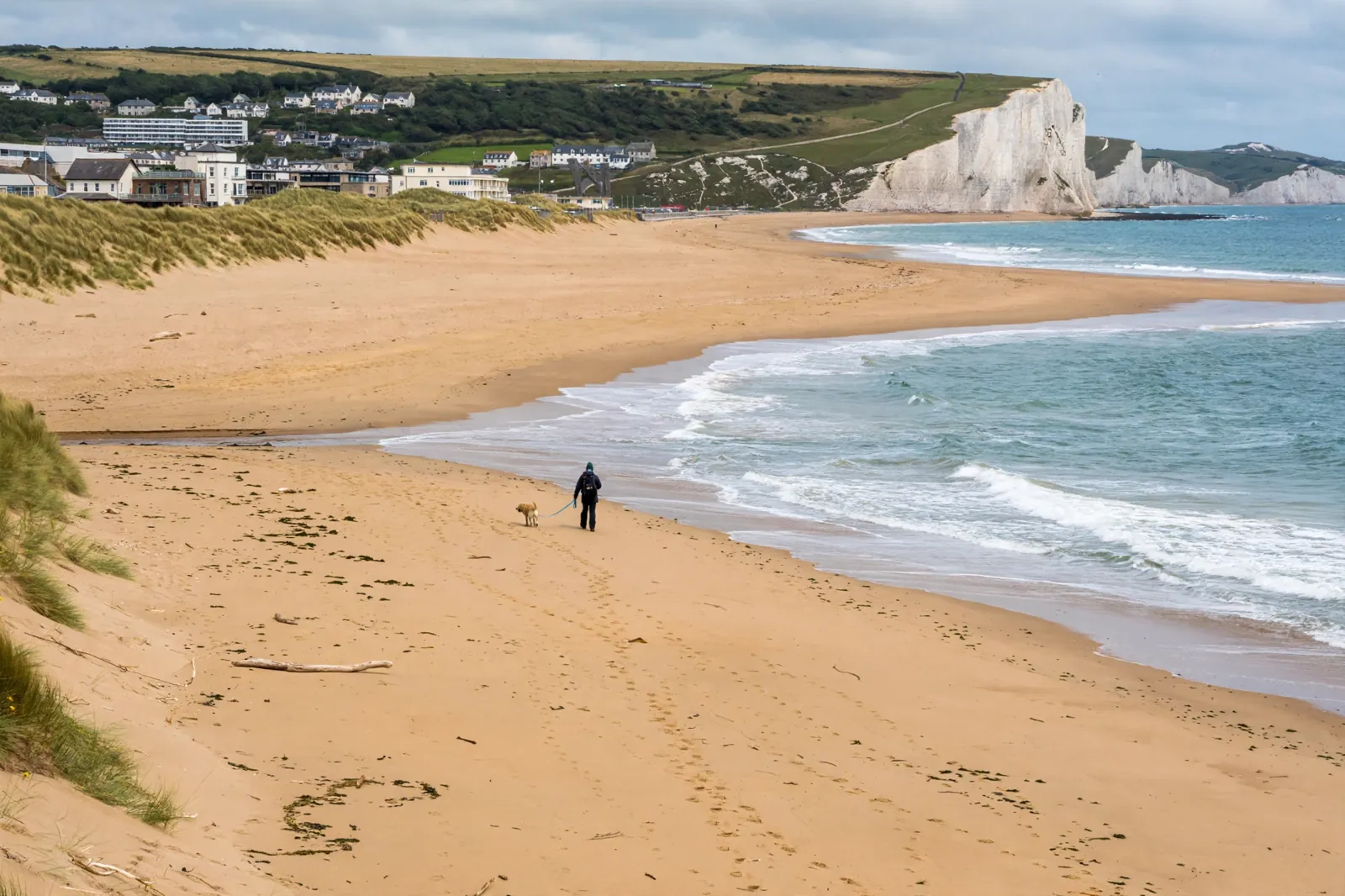
West Strand — also signed locally as Portrush West Strand beach — is the long sweep of sand running from near the harbour and the old lifeboat slipway side of town south-west towards Portstewart direction along the peninsula's Atlantic edge. It is backed by a promenade for much of its length, which matters more than visitors expect: you can combine a firm, step-free promenade walk with spells on the sand, turning back at any point rather than committing to a single out-and-back on soft ground. For older dogs, puppies building stamina, and anyone pushing a buggy alongside a lead, that promenade-plus-sand combination is the most flexible walking in town.
Space is West Strand's second advantage. At low and mid tide the beach opens out considerably, and it is usually possible to find room away from family groups, surf schools and games of football simply by walking further from the main access points. Dogs that need distance from other dogs do better here than on a narrow cove, provided you go early or walk beyond the busiest central section. Keep recall honest, though: gulls, other dogs, washed-up seaweed and the occasional horse rider or runner can all test it, and a long line is a sensible compromise on a wide beach where a loose dog can cover a lot of ground before you react. If your dog swims, read the sea before you let them in. This is a surf beach. Rip currents, shorebreak and cold water are real hazards on this coast even on apparently calm days, and a dog chasing a ball into surf can get into difficulty faster than an owner on the sand can respond. Follow lifeguard flags and local advice where patrols operate, keep dogs out of the water when conditions look rough, and never enter the water yourself to attempt a rescue — raise the alarm instead.
Seasonal rules still apply here. In previous years, defined sections of Portrush beaches have carried seasonal dog restrictions, typically covering the busiest summer period and the most central, lifeguarded areas, while other sections remained available. The exact zones, dates and whether a restriction means no dogs, dogs on leads, or a zoned dog area can change from year to year. Do not rely on a blog post, a photograph of an old sign, or what another dog owner tells you in the car park. Check the latest official guidance before you travel — Causeway Coast and Glens Borough Council publishes beach information for this area — and then read the signs at the specific access point you use, because zoned rules only make sense on the ground. Our national explainer on UK dog-friendly beach rules sets out how these seasonal and zoned systems usually work and what the common sign wording means.
Practical details for West Strand: arrive early in summer for both parking and space; expect the promenade to be busy with runners, mobility scooters and children on scooters around midday; carry water even on cool days because there is little shade on the sand; and plan a drying routine, because a dog that has been in Atlantic surf will bring a surprising amount of sand and salt back to any car or holiday rental. A towel and a bottle of fresh water for paws at the car saves the interior and makes the dog more comfortable on the drive back to your base.
East Strand and seasonal rules: beautiful, central — and the one to check twice
East Strand is the postcard beach: a long curve of sand heading east from the town, with views towards the Skerries islands offshore and Dunluce in the distance, backed by dunes and, behind them, the famous links. It is also the beach most closely tied to the town centre, the East Strand car park and the main summer crowds, which is precisely why its dog rules deserve the most careful checking. Central, lifeguarded, family-focused beaches are the ones most likely to carry seasonal dog restrictions, designated zones or lead requirements during the peak season.
Treat East Strand as a two-mode beach. In quieter months and outside any restricted period, it offers a superb long walk: promenade or firm sand near the water's edge, dune paths set back from the beach, and the option to continue on the coastal route towards Whiterocks and beyond. In peak summer, plan on the basis that at least part of the beach may be restricted, that the remaining dog-accessible sections will be busier than you expect, and that an early start is not a preference but a strategy. If you arrive at midday in August to find your intended section is not available to dogs, West Strand is your fallback — it is a short hop across town, and knowing that in advance turns a frustration into a simple change of plan.
The dune system behind East Strand needs specific care. Dunes are fragile habitats and, around Royal Portrush, they are also working golf landscape. Keep to established paths through dunes, keep dogs under close control where paths pass near fairways, and do not let a dog dig in dune faces or chase wildlife in the longer grass. Adders are not a common headline risk on this coast, but long dune grass in warm weather is exactly the habitat where caution is sensible anywhere in Britain: stay on the path, keep the dog close, and you remove most of the risk. Sand can also get hot enough at midday in a heatwave to hurt paws — test it with the back of your hand, and walk on wet sand near the water or stick to the promenade in the hottest hours.
Facilities cluster at the town end: parking, toilets and food are easiest there and thin out as you walk east. That gradient is useful. Walk east for space and quiet, but carry water, poo bags and anything else you need with you, and keep an eye on the tide and the time for the return leg. A dog that was fresh on the way out has to walk the same distance back, often into the wind on this coast.
Whiterocks beach: white cliffs, fewer facilities, better planning required
Whiterocks, east of Portrush below the coast road, is the beach people remember. Pale limestone cliffs, rock arches and stacks at the water's edge, and a long strand running towards Dunluce make it feel wilder than either of the town beaches, even though it is only a short drive away. For dogs, it offers the same Atlantic cautions as West Strand — surf, currents, cold water — plus a few of its own: rockier sections where paws can be cut on sharp stone or barnacles, areas that narrow considerably as the tide comes in, and cliffs above the beach where staying on signed paths matters.
The tide check is not optional at Whiterocks. Sections of beach that feel spacious at low water can be cut off or squeezed against rocks at high water, and a dog walker absorbed in the view can miss how quickly the usable sand is shrinking. Check tide times before you set out, build your walk around the falling or low tide rather than the rising one, identify your exit points early, and turn back with time in hand. The same discipline applies under the cliffs: avoid lingering directly below cliff faces, especially after wet weather, and keep dogs on a lead on the clifftop and coast road sections rather than on the open sand only.
Access and parking at Whiterocks fill quickly on good days, and facilities are more limited than in town. Go early, take everything you need down to the beach with you, and expect less phone signal in the lee of the cliffs. Seasonal dog restrictions have applied to parts of Whiterocks in previous years in line with the borough's other managed beaches, so the same rule holds: check the latest official guidance before you travel and obey the signs at the car park and beach entrance on the day. If Whiterocks is restricted or simply too busy when you arrive, do not improvise by climbing into an unsigned section — return to West Strand, where space is more forgiving.
Photographers love Whiterocks at low sun, and evening walks here can be the highlight of a trip. Just plan the logistics in reverse: know where you parked, how long the walk back to the car takes in fading light, and whether your dog is comfortable on rockier ground at dusk. A headtorch for the human and a light on the dog's collar or harness are small items that make an evening walk feel relaxed rather than rushed.
Harbour and Ramore eating: how to eat well without leaving the dog outside
Portrush's food scene concentrates in two walkable clusters: the harbour itself, with its boats, slipway and waterfront bustle, and the Ramore area at the harbour end of town, long known for its group of restaurants and bars in a compact strip. For a dog owner, that concentration is good news — you can check several venues in a few minutes on foot — but it comes with a peak-time problem. On a sunny summer evening, every dog-friendly terrace table in the Ramore area can be taken by six o'clock, and formal dining rooms in the same buildings may not accept dogs at all.
Use a simple system. First, decide what kind of meal you actually need: a full restaurant dinner, a bar meal, a cafe lunch, or fish and chips eaten on the harbour wall. Dogs are most commonly welcome for the middle two — bar areas, terraces and cafes — and a harbour-wall takeaway is the zero-risk option that often turns into the most enjoyable meal of the trip, provided you manage gulls, dropped food and a dog that believes chips are a shared resource. Second, phone ahead and ask a precise question: not “are you dog-friendly?” but “where exactly can my dog sit with us for dinner tonight, and do we need to book that area?” Third, arrive with a settled, toileted, exercised dog. A dog that has had a proper West Strand walk, water and a chance to settle under the table is welcome in far more places than a frustrated dog straight out of a car.
Harbour-specific manners matter. Working harbours have moving vehicles, fishing gear, wet surfaces and strong food smells. Keep the lead short on the quayside, keep the dog out of doorways and service routes, and do not tie a lead to a chair on a busy terrace where waiting staff are carrying hot plates. If a venue says dogs are welcome outside only, respect it without negotiation — and if the weather turns, have a backup plan that does not involve leaving the dog alone in a hot or unfamiliar car. Never leave a dog in a parked car in warm weather, even briefly, and never assume a holiday rental allows a dog to be left alone inside either; check both rules in advance.
For daytime, cafes around the town centre and near both strands make good walk-end stops, but policies vary and change with refurbishments and ownership. A venue that welcomed dogs last summer may have changed its layout. A quick call on the morning of your visit is the most reliable check, and keeping a shortlist of three options — one restaurant or bar, one cafe, one takeaway — means a single “sorry, not tonight” never derails the evening.
Royal Portrush and path safety: walking beside a championship course
Royal Portrush is one of the world's great links courses, host to The Open Championship, and its Dunluce Links occupies the dunes between East Strand and the town's eastern edge. For dog walkers, the key point is simple and non-negotiable: the course is private sporting ground, not a walking route, a shortcut or an exercise area. Fairways, greens, tees, bunkers and practice areas are out of bounds for walkers and dogs at all times, whether or not play looks quiet.
The safe pattern is to use the designated public routes — the promenade, the beach itself where its rules allow, and signed coastal path sections — and to treat every boundary between path and course as a hard line. Keep your dog on a lead wherever a path runs close to the course, because a dog that slips a collar or pulls a lead from a hand can be onto a fairway in seconds, in front of players about to hit. Golf balls travel fast and far, including sideways on a mishit shot. If you hear a shout of “fore!”, do not look around for the ball — cover your head, turn away and gather your dog in close. If play is under way across a path crossing point, stop well clear and wait for a clear gap and, where relevant, a signal from players or marshals, rather than hurrying across in front of a tee.
Tournament time changes everything. When a major event is on at Royal Portrush, expect road closures, path diversions, security fencing, large crowds and parking pressure across the whole town, not just near the course. A dog that copes with normal Portrush may not cope with championship-week Portrush, and a beach walk that is normally straightforward may involve diverted routes. If your trip coincides with a big tournament, plan walks at West Strand and Whiterocks, book accommodation and meals well ahead, and check the latest official guidance before you travel for closures and diversions. At quieter times, early morning is still the most pleasant window for the East Strand side: fewer golfers' movements around the course edges, fewer other walkers on narrow path sections, and softer light over the dunes.
One more courtesy costs nothing: if your dog fouls on any path, verge or dune track near the course — or anywhere else in Portrush — pick it up and take it to a bin. Links landscapes and beaches are shared with ground staff, players and other walkers, and dog fouling is the complaint most likely to lead to tighter restrictions for everyone. Carry more bags than you think you need; coastal wind has a talent for removing the last one from a pocket.
Dunluce Castle with a dog: plan for two versions of the visit
Dunluce Castle, a few miles east of Portrush along the coast road, is the ruin that defines this coastline: a medieval castle on a basalt outcrop, separated from the mainland by a narrow bridge, above sea caves and Atlantic swell. It is an essential Causeway Coast stop, and it is also the part of a Portrush dog trip that needs the most honest planning, because historic sites are rarely straightforward with dogs.
The policy position must be verified, not assumed. Access rules for dogs at Dunluce — whether they are permitted in the grounds, whether any areas are excluded, whether there is a charge or a lead requirement — are set by the site operator and can change. Check the latest official guidance before you travel, ideally before you fix the day's itinerary, and treat any older guide (including the detail in general listings) as a prompt to verify rather than as a promise. Our guide to visiting the Giant's Causeway with a dog covers the same verify-and-have-a-plan-B discipline for the other headline site on this coast, and the two visits pair naturally in one day if the policies and the tides line up.
Plan two versions of the visit. Version A: dogs are permitted in at least the grounds on the day. In that case, go early or late to avoid the narrowest crowding, keep the dog on a short lead throughout — this is a clifftop site with drops, uneven historic surfaces, a bridge crossing and many other visitors, including children — carry water, and be ready to skip any interior, exhibition or confined area where dogs are not allowed or where your dog is unsettled. Keep well back from edges in wind; gusts on an exposed headland can unbalance a person holding a pulling dog. Version B: dogs are not admitted, or not admitted to the parts you want to see. Then the visit becomes a tag-team: one adult visits while the other walks the dog on an agreed route nearby, then you swap, with a clear meeting point and phone contact. What you must not do is leave the dog tied up unattended outside an entrance or alone in the car while everyone goes in — neither is safe, kind or acceptable at a busy heritage site.
Even in Version B, the Dunluce stop is not wasted for the dog holder. The clifftop setting, the views back towards Portrush and Whiterocks, and a short, lead-on walk in the immediate area (staying on permitted paths and away from cliff edges and private land) can be a pleasant half hour while the other half of the party explores the ruin. Allow more time than you expect for the whole stop: parking, tickets, the bridge, uneven ground and other visitors all slow a castle visit down, and a rushed swap helps nobody. If you are travelling solo with a dog, be realistic — a solo visit inside Dunluce may simply not be possible on a given day, and the clifftop exterior, Whiterocks and a good beach walk are a strong day without it.
Walks beyond the beaches: promenades, harbour loops and the coastal path
Not every dog walk in Portrush needs sand. The town's peninsula shape creates a natural harbour-and-headland loop: around the harbour, past the lifeboat station area, and along the western shore paths, with views across to County Donegal on a clear day. Surfaces and access arrangements on headland paths can change with weather and maintenance, so follow local signs, keep dogs on leads near cliff edges, roads and any livestock, and turn back if a path looks eroded or closed rather than finding your own way round a barrier.
The Causeway Coast Way and its local sections link Portrush eastwards towards Dunluce, Bushmills and the Giant's Causeway, and westwards towards Portstewart. With a dog, walk it in sections rather than as a single heroic day. The Portrush-to-Dunluce stretch is the obvious first section from this base, but plan transport honestly: walking there and back doubles the distance, the coast road is not a pleasant or safe walking route for long stretches, and bus or taxi options should be checked in advance if you intend to walk one way. Carry water — there are long exposed sections with no supply — and remember that a coastal path that was easy in morning calm can be hard work into an afternoon headwind with a tired dog.
For a low-effort evening walk, the West Strand promenade at sunset is hard to beat and suits almost every dog: firm surface, clear sightlines, benches, and an easy turn-back at any point. For a rainy-day leg-stretch, short harbour loops between showers, followed by a cafe stop you have already confirmed welcomes dogs, will serve most dogs better than a determined expedition in horizontal Atlantic rain. Portrush weather changes quickly; build the day in layers, with a good morning walk banked early, so a wet afternoon is a disappointment rather than a dog that has had no exercise at all.
Where to stay: choosing a base that makes dog life easy
Portrush and neighbouring Portstewart offer the full range: hotels, guest houses, self-catering apartments and houses, caravan and holiday parks on the outskirts, and smaller stays in villages inland from the coast road. “Dog-friendly” in a listing can mean anything from a genuinely welcoming hotel with no pet fee to a single ground-floor room where a small dog is tolerated for a charge. As with any stay, confirm the specifics before you book: how many dogs, any size or breed conditions, the per-dog or per-stay fee, whether the dog can join you for breakfast or in the bar, whether the dog may be left alone in the room, and where the nearest patch of ground for a late-night toilet walk actually is.
Location matters more than star rating for a dog trip here. A base near West Strand makes the best dog walk in town your default start to the day, with no car needed. A base in the centre or near the harbour puts eating options on the doorstep but adds town noise, seagulls at dawn and busier pavements. A base on the eastern side suits Dunluce and Causeway days and early starts at East Strand or Whiterocks, but check the walk from the door: a property that looks close to the beach on a map may be separated from it by the golf course or a busy road with no direct path. Self-catering suits many dog owners best — space for a wet dog, a door you control, no dining-room negotiations — provided the garden, if any, is genuinely enclosed for your dog, not merely described as private.
Ask two Portrush-specific questions. First, parking: in peak season and during golf events, town-centre parking is pressured, so confirm whether your stay includes a space and whether you can unload a dog safely away from moving traffic. Second, drying: is there somewhere to rinse and dry a sandy, salt-water dog that is not the bathroom of a white-carpeted apartment? A utility area, an outside tap or even a garage transforms a beach week with a dog. Finally, if you are arriving by ferry into Belfast or Larne with a dog, or by train to Portrush station, build in decompression time on arrival day — a gentle promenade walk and an early night will set up the whole trip better than heading straight for the busiest beach at the busiest hour.
Tides, safety and practicalities: the Atlantic checklist
Portrush rewards a small amount of daily planning. Each morning, check four things: the tide times for the beach you intend to use, the weather and wind forecast, any lifeguard patrol information for the season, and whether anything — a surf event, a golf tournament, a road race — is changing parking or access that day. That two-minute habit prevents most of the problems dog owners meet here: cut off by a tide at Whiterocks, blown off an exposed path, or circling a full car park with an overheating dog.
Pack for a surf coast, not a paddling beach. Fresh water and a bowl, because dogs should not drink sea water and can become unwell if they drink a lot of it. A lead plus a long line if you use one, and a spare lead in the car. More poo bags than the walk needs. A towel and a drying coat. Sun protection for pale or thin-coated dogs in summer, and awareness that even in Northern Ireland a bright, windy day can burn. In winter, a coat for older or fine-coated dogs, paw checks for sand, grit and small cuts after every beach walk, and a fresh-water paw rinse to remove salt. If your dog cuts a paw on rock or shell, or seems unwell after swallowing sea water, contact a local vet promptly rather than waiting — save the number of a Portrush-area practice and the out-of-hours arrangement in your phone before you need them.
Wildlife and livestock rules are straightforward. Keep dogs under close control around seabirds, seals hauled out on rocks (keep a generous distance and never let a dog approach a seal, for both animals' safety), and any livestock on inland or clifftop grazing. A dog that is reliable on an empty beach may not be reliable around a seal pup or a flock of gulls lifting at once, so judge each situation rather than trusting a general reputation. Finally, leave every beach and path as you found it: take litter and full poo bags to a bin, even if that means carrying them for a while. Portrush's beaches stay dog-welcoming only while dog owners are visibly the most considerate users on the sand — which, on a good morning on West Strand with the surf rolling in and the town waking up behind you, is an easy standard to want to keep.
Practical questions
Before you go
Are dogs allowed on Portrush beaches all year?
Not on every section at every time of year. West Strand, East Strand and Whiterocks have all had seasonal restrictions on parts of the beach in previous years, with rules, dates and zoned areas that can change. Outside any restricted zone or season, dogs are generally welcome under close control, but you should check the latest official guidance before you travel and read the signs at the access point you actually use on the day.
Can dogs go into the grounds at Dunluce Castle?
Policies for historic sites change and can differ between the exterior grounds, any visitor centre and the castle interior. Do not assume dogs are admitted everywhere at Dunluce. Check the latest official guidance before you travel, plan for one person to wait outside with the dog if needed, and keep the dog on a short lead around walls, drops and other visitors if dogs are permitted in the grounds on your visit date.
Where can I eat in Portrush with a dog?
The harbour and Ramore area is the most practical starting point, with a concentration of restaurants, bars and cafes in a small area. Dog access is usually strongest on terraces and in designated bar areas and weakest in formal dining rooms, and it varies by venue and by season. Ring ahead, ask specifically where the dog can sit, and have a takeaway or picnic backup for busy summer evenings when dog-friendly tables fill first.
Can I walk my dog around Royal Portrush golf course?
No. A championship golf course is not a dog-walking area. Stay on designated public paths and beach access routes around the course, keep your dog on a lead near fairways, greens, tees and practice areas, and never cross a fairway to shorten a walk. If a ball is in play, stop and wait well clear. Use the signed coastal and beach routes instead of entering the course itself.
Is Portrush good for a reactive or nervous dog?
It can be, with timing. Choose early mornings, weekdays outside school holidays and the wider, quieter ends of West Strand or Whiterocks rather than the harbour at peak dinner time or East Strand on a hot Saturday. Keep distance on narrow promenade sections, avoid crowding at beach access points, and build the day around one good walk and a quiet base rather than a full circuit of busy attractions.