This guide is independent and contains no paid placement. Site rules, opening times and dog policies can change from year to year, so check the official guidance before you travel.
Bluebell season is short, usually late April to May, and the best dog-friendly visit is a short, on-lead walk on a marked path. Do not let your dog run through the flowers, dig, or pose among the bulbs: the display you see this year depends on leaves and bulbs left undisturbed last year.
The flowering window: late April to May, and why it moves
Most British bluebell woods flower for only a few weeks, and the often-quoted window of late April to May is a useful starting point rather than a promise. In a mild spring in the south, the first flowers may open in mid-April, while a cold, shaded wood further north can still be building to its peak in mid-May. Canopy matters as much as latitude: bluebells flower before the tree leaves fully close overhead, so a wood with a dense canopy can look spectacular for a shorter time than a lighter, more open wood where light reaches the ground for longer. That is why two woods twenty miles apart can be at quite different stages on the same weekend, and why a photograph posted online last week is not a guarantee for this week.
Think of the season in three stages rather than one peak day. First comes the green stage, when leaves are up and buds are forming but colour is thin; this is still a pleasant woodland walk, but anyone travelling a long way for a carpet of purple will feel short-changed. Then comes the main flowering stage, when most stems are open, the scent is noticeable on a still day, and the colour reads as a continuous wash from the path. Finally comes the fading stage, when flowers begin to set seed, petals drop, and the wood turns green again. All three stages have something to offer a dog walker, but only the middle stage rewards a special journey, an early start, or a busy car park. If your main aim is a calm walk with your dog, the early and late stages are often better: fewer people, more space on narrow paths, and less pressure to stop for photographs in a crowd.
Weather moves the window in both directions. A warm, settled April can bring flowers forward and compress the display, so a wood that looked perfect on a Tuesday may be past its best by the following weekend. A cold snap can slow opening without necessarily ruining the season, while a wet, windy spell can batter tall stems and flatten patches that were upright the day before. Rain also changes the walking surface: woodland paths on clay can become slippery, and a dog that is happy on a dry track may need a shorter route after heavy rain. Check a local forecast as well as a flowering report, and treat both as guidance rather than certainty. If you are planning around a particular weekend, look for several recent local reports rather than one headline, and be ready to switch woods if the nearest display is already fading.
Timing within the day matters almost as much as timing within the season. Early morning light suits both photography and dogs: paths are quieter, the air is cooler, and a dog that gets overexcited by crowds has fewer triggers to manage. Late afternoon can be just as calm, but check closing times for managed sites, because estate woods, gardens and nature reserves may lock gates earlier than an open-access wood. Midday on a sunny bank-holiday weekend is the hardest combination: full car parks, narrow paths crowded with families, dogs on long lines tangling around trees, and little shade for a dog waiting while owners take photographs. A shorter walk at a quieter hour will almost always be a better experience for the dog than a longer walk at the busiest hour, even if the flowers are identical.
Finally, plan the season, not just the day. If bluebells are the main reason for a spring break, build in flexibility: choose accommodation near several woods rather than one famous site, keep one weekday free, and have a non-bluebell woodland walk as a fallback. That way a cold spring, a closed car park or a dog that is tired after travel does not turn the whole trip into a disappointment. The woods will still be there for a walk, and the flowers, if you miss them, are a reason to return next year rather than a reason to push a tired dog through a crowded wood this year.
Why bluebell woods are fragile, and what a dog can damage without meaning to
A bluebell carpet looks robust because it covers so much ground, but the plant behind it is surprisingly delicate. The native British bluebell grows from a bulb buried in the soil, and after flowering it needs its leaves to stay intact for weeks so the bulb can store enough energy for the following year. When leaves are crushed, snapped or repeatedly trodden, the bulb weakens; a patch that is walked through year after year may thin out, flower less densely, or disappear from that spot altogether. The damage is rarely obvious on the day, which is part of the problem: a flattened patch in May looks like a minor scuff, but its effect shows up the next spring, when fewer stems return.
Dogs add a particular kind of pressure, not because they are careless but because they move differently from people. A person on a path puts weight on a narrow strip of ground; a dog running off the path, circling for a scent, digging at a root, or cutting corners across a bend can disturb a much wider area in a few seconds. Paws churn the leaf litter, expose shallow bulbs, and break stems at ground level. Digging is the most serious behaviour, because it can directly damage or remove bulbs, but even enthusiastic sniffing at ground level, repeated in the same spot by many dogs, can wear a bare patch into a flower bed. None of this requires a badly behaved dog: a happy, curious dog off the lead in a bluebell wood is simply doing what dogs do, in a place where the plants cannot easily recover from it.
That fragility is also why wild bluebells have legal protection in the United Kingdom. Picking wild bluebells, and damaging or destroying them, can be an offence, and the rules are there because bulbs are slow to recover and because commercial-scale picking in the past damaged whole woods. Visitors do not need to know the statute by heart, but they do need the practical message: leave every flower, leaf and bulb where it grows, and do not dig, pick or move plants, even a single stem for a photograph. Children need the same rule in simple language before the walk starts, because a well-meaning bunch picked for a vase does far more harm than a photograph taken from the path. If you see damage, report it to the site manager or warden rather than trying to replant anything yourself, since disturbed bulbs need expert handling and the wrong intervention can make things worse.
There is also a safety angle that reinforces the same behaviour. Bluebells are generally treated as toxic to dogs if eaten, with the bulbs presenting the greatest concern, so a dog that digs and mouths bulbs is at risk as well as causing damage. The sensible rule therefore serves both purposes: keep the dog on the path, discourage digging and plant-mouthing, and carry water and a small first-aid awareness of what to do if ingestion is suspected. If you think your dog has eaten any part of a bluebell, contact a vet promptly and describe what was eaten and roughly how much; do not wait for symptoms, and do not try home remedies first. Most visits pass without any incident at all, but a clear plan makes a rare incident far less frightening.
Understanding fragility changes how you judge a wood. A site with roped-off areas, one-way paths or a request to stay on surfaced tracks is not being unwelcoming; it is protecting the reason people visit. Similarly, a wood that looks less spectacular because part of it is resting, fenced or left undisturbed is often a wood that will still be spectacular in five years. Choose sites that manage their flowers openly, respect temporary closures, and remember that the best proof of a good visit is a wood that looks just as good when you return next spring.
Leads, paths and other visitors: the rules that make bluebell walks work
Lead rules in bluebell woods vary, and the variation itself is worth understanding before you arrive. Some woods are open-access land where dogs may legally be off the lead, some are managed nature reserves with a strict on-lead rule all year, and some change their rule for the flowering season only. Estate woods and garden woodlands often have their own conditions, which may be stricter than the surrounding countryside. The only reliable approach is to read the signs at the entrance, check the site's own page before you set out, and follow the rule for that wood on that day, even if a different wood last week allowed something else. Our guide to dog on lead law in the UK explains the wider legal picture, including roads, livestock and local orders, but a site rule during flowering can be stricter than the general law, and the site rule is the one that applies on its paths.
During flowering, a short lead is usually the kindest choice even where a longer lead would be allowed. Narrow woodland paths leave little room to pass, and a dog on a long line can easily sweep across a flower bed when it turns, lunges towards another dog, or circles a tree. A short lead keeps the dog on the path surface, gives you control when a child, a pushchair or another dog comes around a bend, and reduces the chance of a tangle that pulls both dogs into the flowers. If your dog normally walks on a long line for enrichment, bluebell season is a good time to practise a different kind of enrichment: a slower pace, plenty of sniffing stops on the path edge, and a longer walk afterwards in a more robust area where off-lead running is appropriate. The dog still gets a satisfying outing, and the flowers stay intact.
Other visitors shape the walk too. Bluebell woods attract photographers, families, school groups and people who have travelled a long way for a quiet moment, and a dog that bounds up to strangers, barks at a tripod, or blocks a narrow path can spoil that moment quickly. Recall matters here, but so does positioning: step to the side on a wider section, shorten the lead before a blind bend, and wait for a clear stretch before moving on, rather than squeezing past on a muddy verge that is itself planted. If your dog is nervous around crowds, choose a less famous wood, an early start, or a weekday, and keep the walk short. A calm fifteen-minute loop that ends well is better than a tense hour in a crowd, for the dog, for you, and for everyone else on the path.
Livestock, wildlife and other dogs add further reasons for a lead. Spring is nesting season for ground-nesting birds and a sensitive time for deer with young, and a dog running through undergrowth can disturb nests and fawns that are invisible from the path. Some woods border farmland, where sheep with lambs may be in adjacent fields, and a dog that slips through a gap in a fence can cause serious harm in seconds. Even a friendly dog can be a problem for a reactive dog on a lead, so keep greetings brief, ask before allowing dogs to meet, and move on if the other owner signals that their dog needs space. A lead is not a punishment in this setting; it is the tool that lets many different people, dogs and wild animals share a small, fragile wood at the same time.
Choosing a wood by region: what changes from south to north
Regional choice is less about finding one famous wood and more about matching a wood type to your dog, your journey and the stage of the season. In southern England, bluebells often flower earliest, and the woods are frequently ancient woodland on gentle ground, with well-worn paths and nearby villages where dogs may be welcome in a pub garden afterwards. The trade-off is popularity: southern woods near large towns can be busy on spring weekends, car parks can fill early, and a famous site may need a timed entry or a booking system in peak weeks. If you are travelling in the south, favour a smaller, less publicised wood on a busy weekend, and save the better-known sites for a weekday or an early start, when the light is better and the paths are quieter.
The Midlands and the Welsh borders offer a useful middle ground. Flowering often follows the south by a week or so, depending on altitude and shade, and the landscape mixes estate woodland, nature reserves and farm woods with public paths. Estate woods can be excellent for dogs because paths are usually clear and waymarked, but they may also have stricter dog rules, seasonal closures or charges for parking, so check the estate's own guidance rather than assuming a public right of way means dogs are welcome everywhere on the site. Nature reserves, meanwhile, may prioritise wildlife over recreation, with dogs on leads throughout, no dogs in certain compartments, or a request to avoid the wood at dawn and dusk during sensitive periods. Those restrictions are worth respecting even when they shorten a walk, because reserves often hold the densest and oldest bluebell populations.
In the south-west, bluebells grow in a different landscape again: steep-sided valleys, coastal woods and former estate plantings where the flowers can be spectacular but the paths can be steep, muddy or narrow. A dog that is happy on a flat southern wood may struggle on a valley-side path with steps, exposed roots and a stream crossing, so read the route description for gradients and surfaces, not just for distance. The reward is often a quieter wood: coastal and valley woods are harder to reach in large numbers, and a weekday walk can feel private even in peak season. Pack for mud, carry water for the climb back up, and plan a shorter loop if the descent is steep, because a dog that runs downhill happily may still need help, or at least a slower pace, on the way back.
Northern England and Scotland extend the season and change its character. Flowering is generally later, the woods can be cooler and wetter, and the mix of species shifts: in parts of Scotland, the native bluebell shares woods with other spring flowers, and the overall display may be less of a single-species carpet and more of a varied spring floor. That is not a lesser experience, but it does mean expectations need adjusting if you have only seen photographs of southern carpets. Northern and Scottish woods also tend to have longer, rougher paths, more open access, and fewer facilities, so self-sufficiency matters more: carry water, a map or a charged phone, and a plan for getting back to the car if the weather turns. Check the official guidance before you travel for any local access rules, seasonal restrictions or forestry operations, because a working forest can close a path at short notice for safety.
Wales and Northern Ireland add further variety, from valley woodlands and country-park woods to forest-park trails where waymarked routes make planning easier for dog owners. Forest parks can be a good choice for a first bluebell walk with a dog, because routes are graded, car parks and toilets are usually available, and the trail surface is more predictable than a remote ancient wood. The bluebell display in a forest park may be patchier than in an ancient wood, because plantation forestry and recreation shape the ground flora, but the trade-off in ease, safety and facilities can be worthwhile, especially with a puppy, an older dog, or a family group. Whatever region you choose, the same questions apply: is the site dog-friendly in flowering season, what is the lead rule, where is the path, and is there a quieter alternative nearby if the first choice is full?
When you compare regions, also compare journeys. A two-hour drive to a famous wood, followed by a crowded hour on a narrow path, is rarely better for a dog than a twenty-minute drive to a modest local wood with a calm loop, a stream to splash in afterwards, and a pub garden for lunch. Dogs do not rank woods by fame; they rank walks by smells, space, shade, water and calm. If you do travel further, break the journey, let the dog stretch its legs in a robust area before the bluebell wood, and keep the bluebell section itself short and on the lead. That structure gives the dog a full outing without asking it to be perfectly behaved for an hour in the most fragile and crowded part of the day.
Photography without leaving the path: better pictures, undamaged flowers
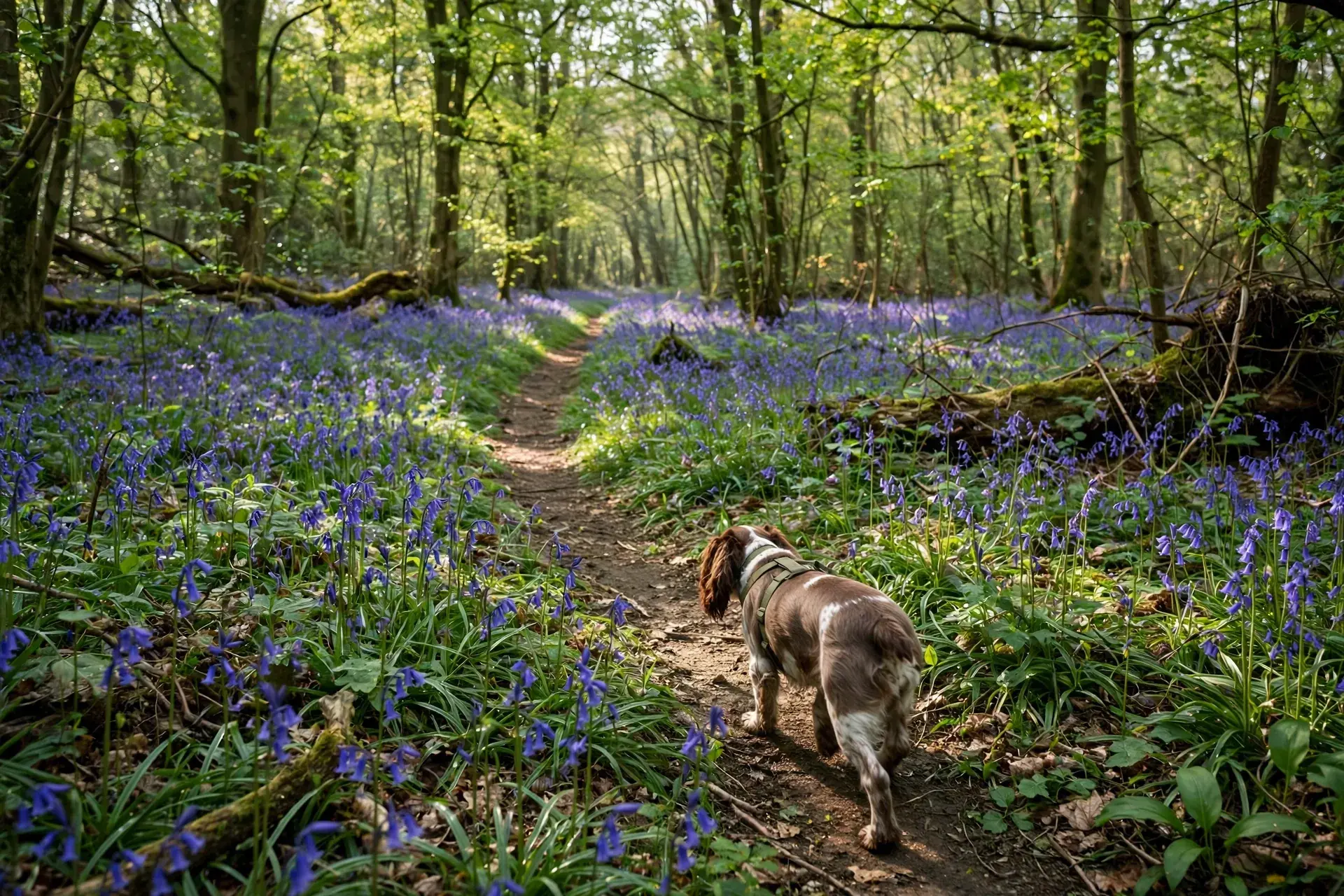
Bluebell photography with a dog is entirely possible without stepping off the path, and the results are often better than a posed photograph in the middle of the flowers. The key is to use the path as a foreground and the flowers as a backdrop: sit or stand the dog on the path surface, get low so the camera is near the dog's eye level, and let the bluebells fill the frame behind and beside the dog. A low angle makes the flowers look taller and denser, while a high angle looking down tends to flatten the display and show more bare ground. If the path curves, use the curve to lead the eye into the picture, with the dog placed where the path bends rather than in the centre of a straight stretch, which usually looks more natural and less staged.
Light matters more than equipment. Dappled light through a spring canopy can be beautiful, but it can also create harsh bright spots on a dog's coat and deep shadows on its face. Overcast light is often kinder: colours read more richly, the dog's face is evenly lit, and you do not have to fight contrast between sunlit flowers and shaded fur. Early morning and late afternoon give softer, warmer light and longer shadows, but they also mean lower light levels under trees, so a phone camera may need a steadier hand or a brief pause while the dog settles. Whatever camera you use, take a few test shots first, check the dog's eyes for catchlights, and move a step or two along the path if a bright patch is falling across the dog's face, rather than moving the dog into the flowers to chase better light.
Keep the dog's comfort at the centre of the session. A photograph that takes thirty seconds, with the dog sitting on the path and looking towards you, is a success; a session that takes ten minutes, with repeated repositioning, treats held overhead, and other walkers waiting behind you, is not. Bring a small number of high-value treats, reward calm sitting rather than constant attention, and stop while the dog is still happy. If the dog will not settle, accept a walking shot instead: a dog trotting towards you along a flower-lined path, taken from a low angle, can be more lively and honest than a stiff sit. Avoid flash, which startles dogs and flattens the woodland light, and avoid calling the dog repeatedly across a path where other people are trying to pass.
There are a few practical details that make the difference between a good photograph and a frustrating one. Clean the lens before you start, because woodland humidity and a dog's nose can fog it quickly. Keep the lead out of the frame by holding it low behind the dog or asking a companion to hold it just out of shot, and never tie a lead to a tree or a fence in a way that could damage bark or block the path. If you want a close-up of the flowers themselves, photograph them from the path edge without leaning over a large area, and do not pick, bend or move stems to improve the composition. A single stem photographed well from the path tells the story of the wood just as clearly as a wide shot, and it leaves the plant intact for the next visitor and the next spring.
Finally, think about sharing responsibly. When you post a bluebell photograph, avoid naming a small, fragile wood in a way that could send a sudden crowd to it, and do not post a photograph that appears to show a dog among the flowers, even if the dog was in fact on a bare patch or a path, because other people will copy what they think they see. A caption that mentions staying on the path, keeping dogs on leads, and visiting at a quiet time does more good than a location tag. The most admired bluebell photographs are often the ones that make the wood look inviting without inviting damage, and that balance is worth keeping in mind before you press share.
Planning a calm spring walk: crowds, parking and timing
A calm bluebell walk starts before you leave home, with a check of the site's own information. Look for the dog policy in flowering season, the lead rule, opening and closing times, parking charges and capacity, toilet facilities, and whether dogs are allowed in any café or visitor centre. Managed sites often update their pages in spring with specific bluebell guidance, including one-way systems, roped areas, or a request to book parking in advance. Open-access woods may have less formal information, in which case a local walking group, a parish noticeboard or a recent local report can fill the gap. If you cannot find a clear dog policy, treat the visit as on-lead and on-path, and have an alternative walk ready in case the site is unsuitable on arrival.
Parking is often the first practical test. Famous woods can fill by mid-morning on a fine weekend, and a full car park is a useful signal: if the car park is full, the paths are probably crowded too. Arrive early, choose a weekday if you can, or pick a second-choice wood with a larger or less pressured car park. Avoid parking on verges, in gateways or on narrow lanes, because blocked access can prevent emergency vehicles and farm traffic from passing, and a dog left in a car while you queue for a space is at risk in warm spring weather. Never leave a dog alone in a car on a warm day, even with a window open, and plan the journey so the dog is not waiting in a hot vehicle while you check a visitor centre or buy tickets.
Crowd management on the path is mostly about pacing and politeness. Walk at a speed that suits the dog, pull in to a wider section to let faster walkers pass, and avoid stopping in the narrowest part of a path for photographs. If a group is photographing a particular view, wait for a gap rather than pushing through with the dog, and if your dog is reactive, cross to the widest available space, shorten the lead, and keep moving calmly past the trigger. A walk that includes a quieter loop away from the main display can help: let the dog enjoy a robust woodland section first, visit the densest bluebells briefly on the lead, and then return to a quieter area for a longer sniffing walk. That structure respects both the dog's needs and the other visitors' experience.
Weather and ground conditions should shape the plan on the day, not just the week before. After rain, woodland paths can be muddy, slippery and deeper than expected, and a dog that is happy on a dry track may need a shorter route, a drying coat afterwards, and a towel in the car. In warm spring sunshine, carry water for the dog, offer it regularly, and watch for panting, slowing or seeking shade, especially in brachycephalic breeds, older dogs and dogs with thick coats. Spring sunshine under trees can be deceptive: the air feels cool in the shade, but a dog working hard on a climb can still overheat. Build in shade breaks, keep the walk shorter than the dog's summer maximum, and remember that a bluebell walk is not the place to test a new distance record.
Reading the route before you go: distance, surface and escape routes
Distance on a map tells only part of the story in a bluebell wood. A two-mile loop on a flat, surfaced path is a different walk from a two-mile loop with steps, exposed roots, a stream crossing and a steep climb, especially for a puppy, an older dog, or a dog recovering from an injury. Before you go, look for the route's surface, gradient, steps, gates and stiles, and whether the path is suitable for the dog's mobility and for any pushchair or wheelchair in your group. A route that requires lifting a large dog over a stile, or squeezing through a narrow kissing gate with a reactive dog, is a poor choice even if the flowers are excellent. Choose a route where the dog can walk comfortably for its whole length, and where you can shorten the walk if the dog tires.
Escape routes matter in a wood more than on an open walk, because paths can be narrow, one-way or hard to leave once you are committed. Identify at least one point where you can turn back, cut across to a wider track, or leave the wood to a road or car park without crossing a flower bed. This is particularly important with a reactive dog, a dog that becomes overexcited by crowds, or a family group where a child may need the toilet urgently. A loop with several junctions gives you options; a single out-and-back path through a dense display gives you fewer, and may mean retracing your steps through the busiest section. If the route description mentions a one-way system during flowering, respect it, because one-way paths are designed to prevent the bottlenecks that damage verges and frustrate dogs and walkers alike.
Waymarking and navigation deserve a brief check too. Ancient woods can be a maze of informal paths, and a bluebell display can tempt walkers off the waymarked route onto a tempting side path that leads nowhere or crosses a sensitive area. Download or screenshot the route before you lose signal under trees, note the car park location and the direction of the return leg, and keep a charged phone for navigation and for emergencies. If you are walking with children, agree a simple meeting point in case the group splits, and keep dogs on leads in areas where paths cross, so a dog does not follow a scent down an unmarked track while you are reading a sign.
Finally, think about what happens after the wood. A good bluebell walk often ends with a muddy dog, a car that needs protecting, and a hungry group looking for lunch. Plan the end of the walk as carefully as the start: a towel and a drying coat in the car, a boot liner or old blanket for the journey home, water for the dog before the drive, and a dog-friendly café or pub garden nearby if you want to eat out. Sites managed by large conservation organisations often have clear dog policies for their cafés and gardens, and our guide to National Trust dogs explains how pawprint ratings and property-by-property rules work, which is useful if you are combining a bluebell wood with a garden or estate visit. Ending the walk calmly, with the dog settled and dry, is part of what makes the whole outing feel successful rather than rushed.
Kit, paws and spring hazards: what to pack for a bluebell walk
Bluebell walks do not need specialist equipment, but a small, well-chosen kit makes a spring woodland walk smoother. Start with the lead: a short, comfortable lead that you can hold securely on narrow paths, plus a harness that fits well and does not rub under the arms on a longer walk. A long line has its place in open country, but in a bluebell wood it is more likely to sweep flowers, tangle around trees, or trip other walkers, so leave it in the car for a later, more robust walk. Add a collapsible bowl and water, because woodland streams are not always safe or accessible, and a dog that has been walking in spring sunshine needs regular drinks even if it does not ask for them.
Paw care deserves attention after a wet spring. Muddy paths, exposed roots and leaf litter can pack between toes, and a dog that licks its paws excessively after a walk may have grit, a thorn or a small cut that needs checking. Pack a towel, check paws at the car, and rinse muddy paws with clean water before the drive home, especially if the dog will then lie on car seats or bedding. A drying coat helps on a cool day, and a spare towel in a sealed bag keeps the car clean without leaving muddy towels in a woodland bin. If your dog wears boots for medical reasons, check the fit before a woodland walk, because roots and mud can loosen a boot that felt secure on a pavement, and a lost boot in leaf litter is hard to find among bluebells without disturbing them.
Spring hazards go beyond mud. Ticks become more active in spring, especially in woodland and long grass, so check your dog after the walk, paying attention to ears, armpits, groin and between toes, and remove any tick promptly with a proper tick remover. Adders also emerge in spring and can be found basking on sunny woodland edges and paths, so keep dogs on paths and on leads in areas where adders are known, and know the signs of a bite and the location of the nearest vet. Neither hazard should stop a bluebell walk, but both reward a calm, observant approach: a dog that is kept on the path is less likely to encounter either, and a post-walk check takes only a few minutes. If your dog is bitten or shows sudden swelling, pain or distress, contact a vet immediately and keep the dog as still and calm as possible on the way there.
Allergies and sensitivities are another spring consideration. Pollen, mould in leaf litter and certain plants can irritate some dogs, and a dog that sneezes, rubs its face or licks its paws after woodland walks may need a vet's advice rather than a longer walk. Rinsing paws and wiping a coat after a walk can reduce pollen carried into the car and home, and a short walk in a less dense wood may suit a sensitive dog better than a long walk in a closed-canopy wood where pollen and humidity are concentrated. As always, check the official guidance before you travel if you are unsure about a site's hazards, seasonal closures or dog rules, because local conditions change faster than general guides can track.
Bluebell etiquette in full: a checklist for dogs, children and photographers
Good bluebell etiquette can be summarised in a few clear rules, but it helps to spell them out for everyone in the group before the walk starts. Stay on marked paths, keep dogs on the path and on a lead where asked, do not pick, dig or move any plant, do not trample flowers for a photograph, and leave no litter, including dog waste bags, in the wood. Dog waste should be bagged and binned, or taken home if there is no bin, because waste left in a woodland is both unpleasant and harmful to wildlife and watercourses. If there is no bin at the car park, carry a sealed bag to the next bin rather than leaving it beside a path or hanging it from a tree, a habit that damages the very wood people came to enjoy.
Children need the rules in their own language, and they often follow them better than adults when they understand why. Explain that bluebells need their leaves to make food for next year, that stepping on them is like breaking the plant's kitchen, and that the best way to love the flowers is to look, smell and photograph them from the path. Give children a job, such as counting colours, listening for birdsong, or spotting the first open flower, so they are engaged without needing to run into the display. If a child does step off the path by accident, guide them back calmly and use it as a teaching moment rather than a scolding, because a frightened child is more likely to run further into the flowers than a child who understands the reason for the path.
Photographers and dog owners sometimes pull in opposite directions, and a little courtesy solves most friction. Photographers should avoid blocking a path for a long session, keep tripods close to the path edge, and accept that a dog passing on a lead is part of a shared wood, not an interruption to be complained about. Dog owners should avoid letting a dog sniff a tripod, bark at a photographer crouched low, or block a viewpoint for an extended period. A brief, friendly exchange, such as asking whether a photographer would like a moment without a dog in frame, or whether a dog owner can pass quickly, usually resolves the situation in seconds. Shared woods work when everyone assumes the other person also has a good reason to be there.
Finally, remember that etiquette extends beyond the wood itself. Do not share a precise location for a small, fragile wood on social media in a way that could overwhelm it, do not park inconsiderately in a nearby village, and do not leave a woodland car park in a worse state than you found it. Villages near famous bluebell woods often deal with spring congestion, blocked lanes and litter, and a considerate visit includes parking properly, using local facilities where welcome, and leaving promptly when the walk is done. A bluebell wood is part of a living community, not just a backdrop, and the way visitors behave in spring affects whether local people and land managers welcome dogs and walkers the following year.
If you are early, late or rained off: still a good spring walk
Missing the peak is not the same as missing spring. An early visit, when leaves are up and buds are forming, still offers a beautiful woodland walk, with birdsong, fresh green canopy, wild garlic in some woods, and other spring flowers that flower before or alongside bluebells. A late visit, when bluebells are setting seed, still offers shade, structure and the satisfaction of a quiet wood without crowds. In both cases, the dog's experience is barely affected: the smells, the shade, the paths and the chance to walk are the same, and a calmer wood often means a happier dog. Adjust expectations, enjoy the wood for what it is that day, and treat the bluebells as a bonus rather than the only measure of success.
Rain need not cancel a bluebell walk either, provided the route and the dog suit wet conditions. A surfaced or well-drained path, a shorter loop, waterproof clothing for people and a drying coat for the dog can turn a rainy walk into a peaceful one, with fewer visitors and richer colours under a grey sky. Heavy rain on clay paths, however, is a different matter: slippery descents, deep mud and flooded stream crossings can make a walk unsafe or unpleasant, especially for an older dog or a puppy. In that case, shorten the walk, choose a forest-park trail with a better surface, or postpone to a drier day. There is no prize for completing a planned route in conditions that leave the dog cold, muddy and stressed, and a wood that is churned by many wet-weather walkers will recover more slowly.
If a site is closed, full or past its peak, have a fallback that does not involve pushing into a closed area. A general spring woodland walk, a riverside path, a country park with waymarked trails, or a garden woodland where dogs are welcome can all provide a satisfying outing, and many of them have their own spring displays, from primroses and wood anemones to blossom and fresh fern growth. The fallback should be chosen in advance, not improvised in a full car park with a restless dog in the back, so note one alternative wood near your first choice before you set out. That single habit, more than any other, turns a potentially disappointing day into a good one, because the dog still gets its walk and you still get spring woodland, even if the bluebells themselves are not at their best.
Looking ahead, the best way to enjoy bluebells next year is to protect them this year. Note which woods were quiet, well managed and dog-friendly, which paths suited your dog, and which times of day worked best, and use those notes to plan next spring's visit. Support the organisations that manage bluebell woods, follow their guidance, and share your experience in a way that encourages path-based, on-lead visits rather than off-path photographs. Bluebell season is short, but the woods themselves are there all year, and a dog that learns to walk calmly on woodland paths in spring will enjoy summer shade, autumn leaves and winter quiet in the same woods for the rest of the year.
Practical questions
Before you go
When is the best time to see bluebells with a dog?
Late April to May is the usual window in much of Britain, but the peak moves with weather, shade and latitude. Check recent local reports and the site's own guidance before you travel, and plan an early or weekday visit if you want a quieter path.
Do dogs have to be on a lead in a bluebell wood?
Often yes, and even where off-lead walking is normally allowed, many bluebell sites ask for leads during flowering to protect the plants and other visitors. Read the signs at the entrance and keep the lead short on narrow paths, whatever the general rule elsewhere.
Are bluebells poisonous to dogs?
Bluebells are generally treated as toxic to dogs if eaten, and the bulbs are the greatest concern. Keep your dog on the path, discourage digging and mouthing plants, and contact a vet promptly if you think your dog has eaten any part of a bluebell.
Can my dog walk among the bluebells for a photo?
No. Stay on marked paths and keep your dog on the path too. Crushed leaves and bulbs may not flower the following year, so the best photographs are taken from the path, with the flowers in front of the dog rather than underneath it.
What should I do if the wood I planned to visit is closed or past its peak?
Have a second, lower-profile wood in mind, or switch to a general spring woodland walk and enjoy the canopy, birdsong and other spring flowers. Do not push into a closed area or a roped-off section to chase the last flowers; check the official guidance before you travel.
Is it illegal to pick bluebells?
Wild bluebells are protected in the UK, and picking them can be an offence. Leave every flower where it grows, teach children the same rule, and report damage to the site manager rather than trying to move plants yourself.