This guide is independent and contains no paid placement. If affiliate links are added later, they will be clearly marked and will not change our editorial checks.
A Tollymore Forest Park dog walk is best chosen by conditions: the River Trail for classic bridges and cascades, the Arboretum for a shorter, steadier loop, and the Mountain Trail for a longer leg-stretcher with Mourne views. Keep dogs on a lead or under tight control as park guidance directs, well away from the Shimna in spate, and arrive early — the main car park fills fast on fine weekends and the forest is deservedly popular.
Choose by the river: how Tollymore organises itself
Some walks are chosen by distance and some by mood, but Tollymore, at the foot of the Mourne Mountains near Newcastle in County Down, is chosen by water. The River Shimna threads the whole forest park, tumbling over rock steps, sliding under a procession of bridges and follies, and dictating — by its height after rain — which banks are pleasant, which stepping places are unwise, and how loud the forest will be. Stand at the first bridge, look at the river honestly, and let that glance shape your day before any trail leaflet does.
The park itself is a designed landscape with wild edges: one of Northern Ireland's oldest forest parks, laid out around the former Clermont estate, famous for its arboretum, its avenue of Himalayan cedars, its Gothic and mock-Gothic gates, bridges and grottos, and — for a newer generation — its life as a filming location for screen fantasy set in haunted northern forests. For a dog, the design means variety in a compact area: gravelled drives, riverside paths, woodland tracks and open parkland, all within a walk that can last forty minutes or most of a day.
Start at the main car park and visitor facilities, pick up the current trail information, and check the latest official guidance before you travel for opening, parking charges and any path closures, because forestry work and storm damage close Tollymore paths from time to time. Arriving before mid-morning on weekends buys you the quietest forest and the easiest parking; arriving after lunch on a fine Sunday buys you neither, though the forest is large enough to absorb crowds once you leave the honeypot bridges behind.
The River Trail: bridges, cascades and close lead work
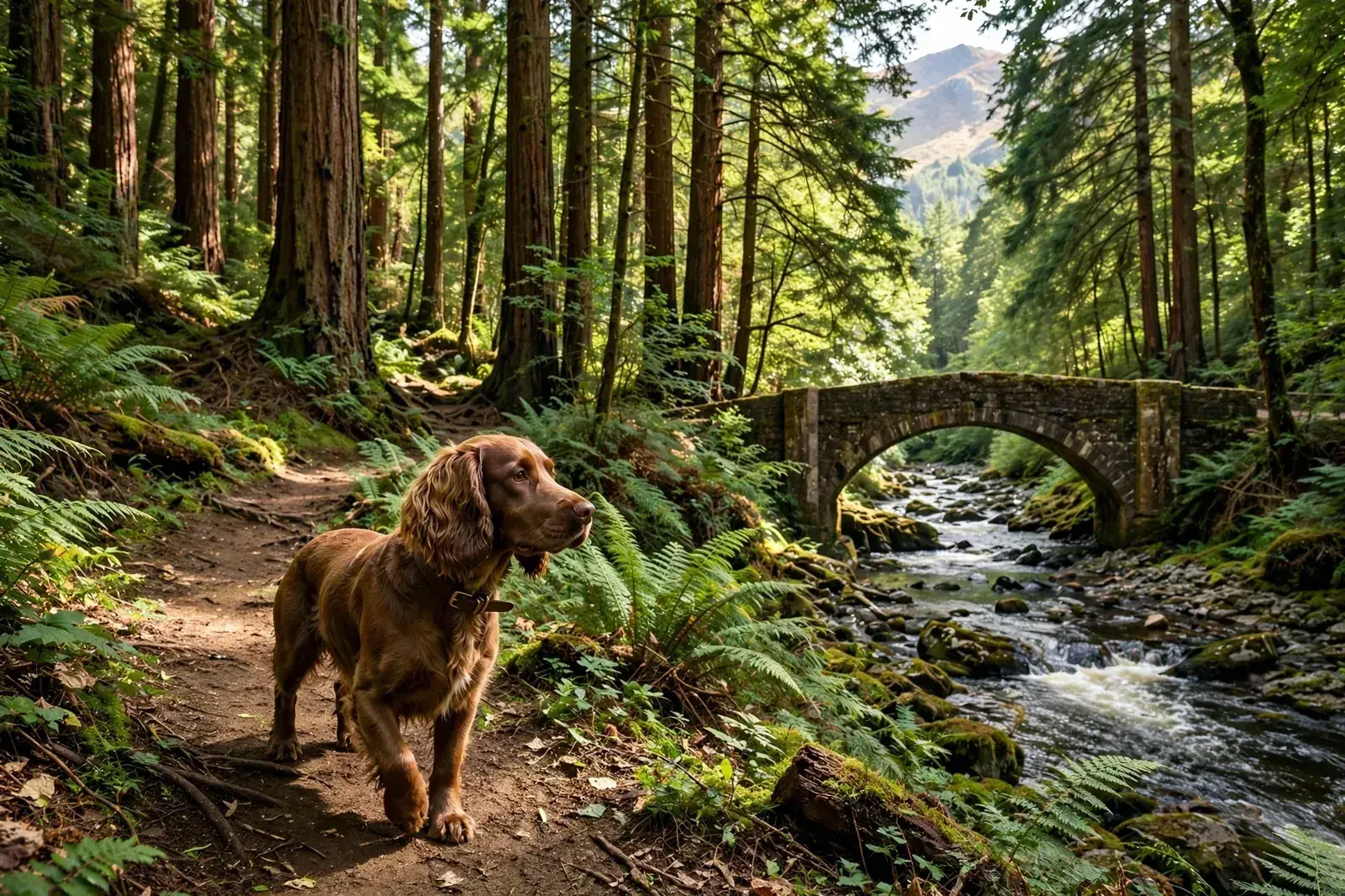
The River Trail is the walk most people mean by Tollymore: a waymarked circuit of roughly three miles that follows the Shimna down one bank and back along the other, crossing and recrossing on bridges that range from sturdy stone to the kind of picturesque structure estate owners built to impress guests. You will pass cascades, deep pools, the Hermitage — a stone retreat built into the riverbank — and groves where the light falls green through beech and conifer. It is beautiful in every season and at its most dramatic after rain, which is exactly when it demands the most care.
That care is mostly about the dog and the water. The Shimna is a spate river: it rises quickly, runs tea-brown and powerful, and its rocks are slippery with algae even at normal levels. Keep your dog on a short lead on bridges, beside cascades and anywhere the bank shelves towards the current, and do not encourage paddling except at obviously shallow, slow margins in settled low water — and not at all when the river is up. A dog swept even a short distance here faces rocks, strainers and cold shock; no photograph is worth it.
For everyone else the trail is friendly: waymarked, well surfaced in most stretches, with steps and muddy patches after wet weather. Reactive dogs will find the bridges and narrow riverside sections sociable, so time this trail for quieter hours or choose the Mountain Trail instead. Photographers should linger at the bridges in soft morning light, but keep tripods and long pauses off the narrowest spans at busy times. Our Causeway Coast with a dog guide pairs naturally with Tollymore for a County Down and Antrim combination trip.
The Arboretum and the drives: Tollymore at walking pace
If the River Trail is Tollymore's drama, the Arboretum Path is its library: a shorter, steadier circuit through one of Ireland's oldest arboreta, where specimen trees — giant redwoods, Himalayan cedars, monkey puzzles and exotic conifers planted when plant-hunting was an imperial hobby — stand labelled in open lawns. For an older dog, a puppy building up distances, a nervous dog that needs space, or anyone walking in the hour before closing, this is often the best walk in the park: firm paths, gentle gradients, room to step aside, and a new tree biography every fifty metres.
The forest drives — the long gravelled avenues that carry walkers, and in places authorised vehicles, through the park — extend the same easy logic. They make Tollymore unusually workable in wet weather, because you can walk for an hour on surfaces that drain, beneath canopy that breaks the worst of the rain, and turn any drive into an out-and-back of exactly the length your dog needs. After storms, though, check for closures and give forestry machinery a wide, obedient berth; a closed drive is closed for reasons a walker cannot see from the barrier.
Children and dogs together change the calculation again, mostly for the better. The arboretum lawns suit a picnic with the dog settled on a blanket, the play areas give children their turn, and the shorter loops mean nobody is carried home. Keep dogs out of play equipment areas as signed, keep leads on around picnics that are not yours, and remember that a forest full of families is a forest full of dropped sandwiches — a reliable leave-it is the most useful command your dog will use all day.
The Mountain Trail: the long leg-stretcher
Walkers who want Tollymore to feel like exercise rather than a stroll should take the Mountain Trail, the park's longest waymarked route at roughly five and a half miles, climbing through forest towards the Mourne foothills and the boundary wall country with views opening to the high peaks — Slieve Donard among them — and down to Dundrum Bay and the sea. It is a different register of walk: quieter, more rural, with rougher tracks, gates and a sense of leaving the estate landscape for the mountain fringe.
Fitness and footwear should match the ambition. The distance is manageable for a healthy adult dog used to two-hour walks, but it is too much for puppies, whose joints are still developing, and a serious outing for a senior dog; build up to it across a holiday rather than attempting it on day one. Carry water for both of you — the trail leaves the river behind — and expect weather at the top of the forest to be windier and colder than the car park suggested. The Mournes generate their own weather, and Tollymore sits in their front garden.
Livestock and ground rules return on the upper sections: fields adjoin the forest, sheep may be present near boundaries, and dogs should be on a lead around any stock and under close control everywhere, following park guidance on the day. If your Mourne ambitions extend beyond the forest, treat this trail as your audition and read up separately on mountain safety before taking a dog onto the high Mournes themselves. Our Giant's Causeway dog guide covers the other great Northern Ireland day out, where cliff edges replace rivers as the hazard to plan around.
Follies, gates and filming fame: walking the story
Tollymore's ornaments are not decoration on the walk; for many visitors they are the walk. The Barbican Gate guards the main entrance like a miniature castle, the Horn Bridge and Ivy Bridge pose over the river, the Hermitage broods by the water, and the Clanbrassil Barn and various grottos and follies reward a slow circuit with a camera. Screen fame has layered new meaning over the old: the forest stood in for haunted woodland in a certain globally famous television saga filmed across Northern Ireland, and fans still seek out particular clearings and bridges. Expect company at the famous spots and solitude a hundred metres beyond them.
With a dog, the follies make excellent training scenery: arched gateways to walk through calmly, bridges to cross without lunging at the view, other visitors to pass politely on narrow paths. What they should not become is a climbing frame — for dogs or children — and the stonework, some of it two and a half centuries old, deserves paws kept off as much as boots do. Keep leads short at the busiest bridges, step aside to let groups pass rather than squeezing, and the whole choreography stays good-humoured.
Take the story home properly by timing a second visit in different light. Tollymore in autumn, when the arboretum turns and the river runs full, is arguably its finest season; in bluebell time the woodland floor changes the walk entirely; after frost the cascades edge with ice and the cedars hold the cold like a cathedral. A forest park rewards repeat visits more honestly than almost any other landscape, because it is the same place becoming itself again in another season — and a dog, who reads a wood by scent, knows that better than any of us.
Rules, parking and the practical Tollymore checklist
Run the practicalities before the poetry. Tollymore is a paying car park with seasonal opening hours for the park gates — arrive inside the hours and note closing time, because a locked-out car is a miserable end to a good walk; check the latest official guidance before you travel for current charges and times. Toilets and visitor facilities cluster at the main car park, and a café operates seasonally nearby; carry water and a bowl regardless, since a forest walk of two hours needs a dog drink whatever the map promises.
On rules, follow the park's current signage as your authority: dogs are welcome in the forest park, must be kept under control, and should be on a lead in busy areas, around livestock and wherever signs direct — and cleaning up is non-negotiable everywhere, including deep in the woods, because Tollymore's paths are walked by thousands of boots and paws. Bag it and take it to a bin at the car park if no bin stands nearby; the forest floor is not a waste system, whatever older habits suggest.
- Before you set off: check gate closing time and path closure notices.
- River rule: short lead on bridges and banks, no paddling when the Shimna is in spate.
- Kit: towel for the car, water and bowl, waste bags beyond what you expect to need.
- Timing: before mid-morning for quiet paths and easy parking on fine weekends.
- After the walk: tick check — bracken and rough ground here hold ticks in season.
Newcastle, five minutes away, completes the day: a promenade, beaches with their own seasonal dog rules on the promenade and shore to verify locally, cafés and fish and chips that taste better after forest air. Combine the two and a dog gets the full County Down pairing — forest shade in the morning, sea breeze in the afternoon — which is as good a summary of this corner of Northern Ireland as any guide can offer.
Beyond the forest: Newcastle, the Mournes and onward
Tollymore is usually one chapter of a longer Northern Ireland story. Newcastle's beach and the walk towards Murlough National Nature Reserve — a fragile, beautiful dune system where dog rules protect nesting birds and seals and must be checked before visiting — extend the coastal theme. The Mourne Mountains themselves rise directly behind the town, and their lower paths and reservoir roads offer a next step for dogs and owners who passed the Mountain Trail audition comfortably, subject to proper mountain preparation and livestock discipline.
Further north and east, the Ards Peninsula, Strangford Lough and the Antrim coast build a natural touring loop from a Newcastle base, and our Causeway Coast guide covers the northern arc of that loop in detail. Ferries across Strangford Lough and the short crossing considerations for dogs are part of the region's charm; keep car waits comfortable, walk dogs before boarding any ferry, and never leave a dog in a hot car in a ferry queue.
However you extend the trip, Tollymore tends to be the memory that anchors it — the river noise, the cedar avenue, the dog trotting over a stone bridge built for an earl's guests and now used by everyone. Return visits in other seasons are the locals' secret, and they can be yours too: put Tollymore in the diary twice, in different months, and watch a good forest become a familiar friend.
Tollymore through the seasons: timing a return visit
Tollymore changes its character more completely between seasons than most forests, because the Shimna changes with it. In spring the river runs full and bright, the woodland floor fills with wild garlic and bluebells in succession, and the arboretum's flowering specimens take their turn like soloists. Dogs notice spring differently — in scent layers, in longer evenings that stretch the last walk, in lambs in the fields beyond the forest boundary that put leads on and keep them on. Spring is also nesting season in the woods, so stick to paths and keep dogs from ranging through undergrowth where ground-nesting birds are raising young.
Summer brings the fullest canopy, the coolest shade on a hot day — Tollymore is the walk County Down chooses when the beach is too warm for paws — and the busiest car parks of the year. Autumn is many locals' favourite: the arboretum turns copper and gold, fungi appear along the drives, the river rises with the first storms and the cascades perform at full volume, and a dog comes home with beech mast in its coat and the deep tiredness of a full forest day. Winter strips the beech woods to architecture, reveals the follies and bridges most clearly, edges the cascades with ice after frost and empties the trails to a peaceful few.
Plan a return in a different season deliberately rather than someday, and walk the same trail again on purpose. The River Trail in autumn flood and in summer low water are two different walks wearing the same waymarks, and watching a dog re-read a familiar route in a new season — checking the same bridge parapets, the same hollow trees — is a quiet argument for depth over novelty in all dog travel. Tollymore, of all places, rewards the repeater.
Practical questions
Before you go
Do dogs have to be on a lead in Tollymore Forest Park?
Follow the park's current signage: dogs must be under control throughout, and a lead is expected in busy areas, on bridges, around livestock and wherever signs direct. Beside the River Shimna a short lead is strongly advised at all times, because banks are slippery and the current is powerful after rain. Check the latest official guidance before you travel.
How long are the main trails at Tollymore?
The River Trail is roughly three miles, the Arboretum Path is a shorter circuit of around a mile, and the Mountain Trail is the longest at about five and a half miles. Waymarked drives and linking paths let you build in-between distances. Allow longer than the mileage suggests — the bridges, cascades and arboretum invite stopping.
Can my dog paddle or swim in the River Shimna?
Only with great caution at shallow, slow margins in settled low water — and never when the river is in spate after rain. The Shimna rises quickly, runs fast over slippery rock and can sweep a dog into hazards. Keep dogs on a short lead beside cascades, pools and bridges, and provide drinking water from a bowl instead.
Is Tollymore suitable for older dogs and puppies?
Yes, if you choose the right trail. The Arboretum Path and the forest drives offer short, firm, gently graded walking that suits older dogs and puppies building distance. The Mountain Trail is too long for puppies and a serious outing for seniors. Shorten any loop without hesitation — the park's layout makes turning back easy.
When is Tollymore busiest, and when should we arrive?
Fine weekends and holiday periods fill the main car park by late morning, and the River Trail bridges get busy at midday. Arrive before mid-morning for the quietest forest, or visit on a weekday. Note the park's gate closing time on arrival and check the latest official guidance before you travel for charges and closures.