This guide is independent and contains no paid placement. Facilities at individual service areas change, so check the official guidance before you travel if a particular stop matters to your plans.
Stop about every two hours, choose a site with grass away from lorry parking, keep your dog on a lead unless an enclosed area is clearly signed, offer water at every stop, and never leave a dog alone in a parked car on a warm day.
The two-hour rule that shapes the journey
Long motorway journeys are hard on dogs in ways that are easy to underestimate from the driving seat. A dog cannot open a window properly, ask for a toilet break, stretch cramped legs or explain that the vibration, engine noise and passing lorries have left it feeling sick. The most useful habit on a long drive is therefore a simple one: plan a proper stop about every two hours, and treat that interval as a maximum rather than a target to beat. Shorter gaps make sense for puppies, older dogs, dogs with medical conditions, dogs that travel anxiously and any dog that has just eaten or drunk a large amount of water. If your dog is panting heavily, restless, drooling or repeatedly shifting position in the car, that is information, not misbehaviour, and the kindest response is the next safe exit rather than another twenty miles of persuasion.
A useful break is longer than most drivers allow. Ten minutes is usually enough for a toilet stop and a drink, but a dog that has been still for two hours benefits far more from twenty to thirty minutes that include sniffing, walking at its own pace and a few calm minutes sitting beside you. Sniffing is not wasted time. For many dogs it is the main way they gather information and settle their nervous system after confinement, and a slow sniffing walk around a grass area often produces a calmer passenger than a brisk march around a car park. Build the stop into the timetable before you leave, rather than treating it as a delay. A journey planned with breaks is still a journey; a journey planned without them tends to acquire breaks anyway, usually in worse places and under more pressure.
Timing also matters around meals. Most dogs travel more comfortably if a large meal is given at least two to three hours before a long drive, with a small snack available during breaks if needed. A dog fed immediately before a motorway run is more likely to feel sick, and a dog that has not drunk for hours may gulp water at the first stop and then need another toilet break almost immediately. Offer small amounts of water often, rather than a huge bowl once, and watch how your individual dog responds. Dogs with kidney problems, diabetes, bladder conditions or medication schedules need a plan agreed with their vet, and that plan should decide the stopping pattern, not a generic rule on a web page. If you are unsure about any medical point, check the official guidance before you travel and ask your vet for advice specific to your dog.
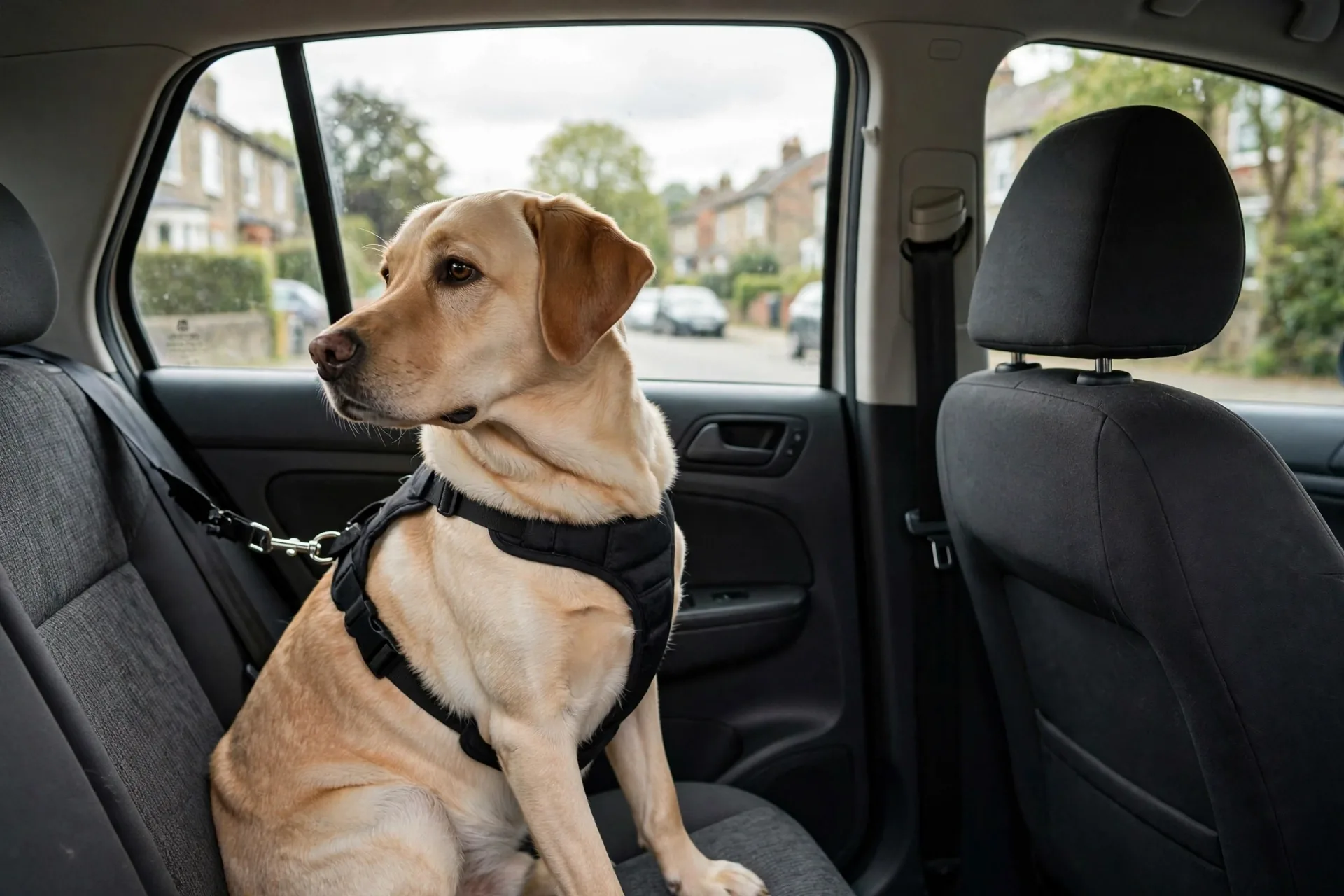
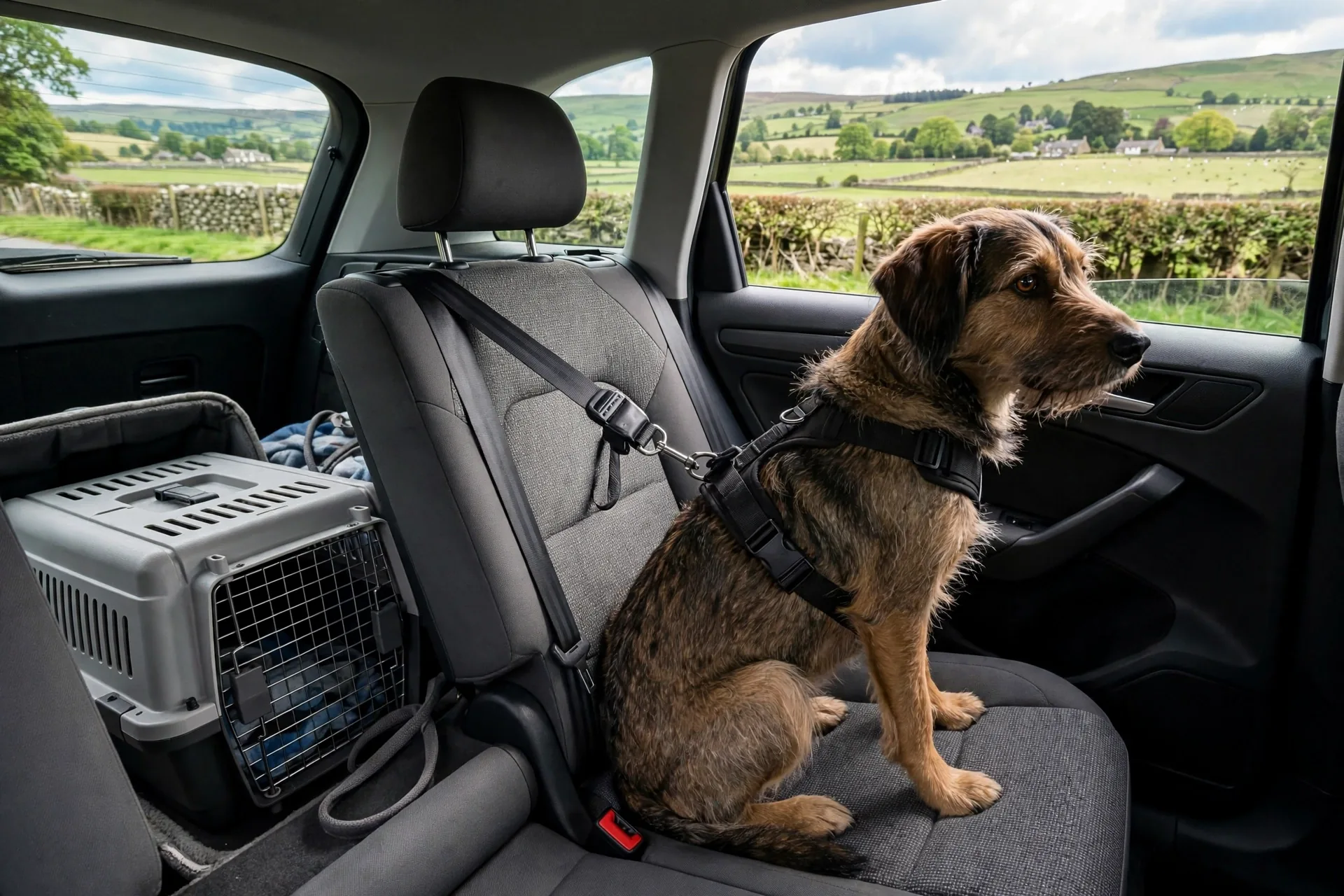
The two-hour pattern also protects the driver. Tired drivers make poorer decisions, and a break that includes walking, fresh air and a drink is one of the simplest fatigue measures available. Use the stop properly: walk the dog, use the facilities yourself, eat or drink something, and check the car, the restraint and the dog before setting off again. A dog that has been checked, watered and settled is far less likely to distract you in the next stretch, which matters because an unrestrained or unsettled dog can become a serious hazard in sudden braking. Our guide to dog car law in the UK explains the restraint duty in plain terms, and it is worth reading before a long trip rather than after a difficult one.
Finally, keep the plan flexible. Roadworks, queues and closures change the best stopping point, and a rigid plan that forces you past a good site towards a favourite one can easily backfire. Choose a preferred stop and a backup roughly half an hour beyond it, and be willing to swap them. If the preferred site is full, noisy or has no usable grass, the backup is not a failure of planning; it is the plan working as intended. Children, passengers and dogs all travel better when the adults in the car are not silently resenting the timetable, so agree the stopping pattern with everyone before departure and write the stops down where the driver can see them without handling a phone.
Exercise areas and grass: what you will actually find
Motorway service areas vary enormously in what they offer a dog, and the phrase dog exercise area can mean several different things. At some sites it is a fenced pen with a gate, waste bins and a clear sign. At others it is a stretch of grass beside the car park, a marked walking loop around the edge of the site, or simply an area where dogs are tolerated on a lead. At a few sites there is effectively no dedicated provision at all, and the only green space is a narrow verge beside a busy road or a landscaped strip that is not meant for walking. Knowing which kind you are heading for changes what you pack, how long you allow and whether the site is suitable for a reactive or easily distracted dog.
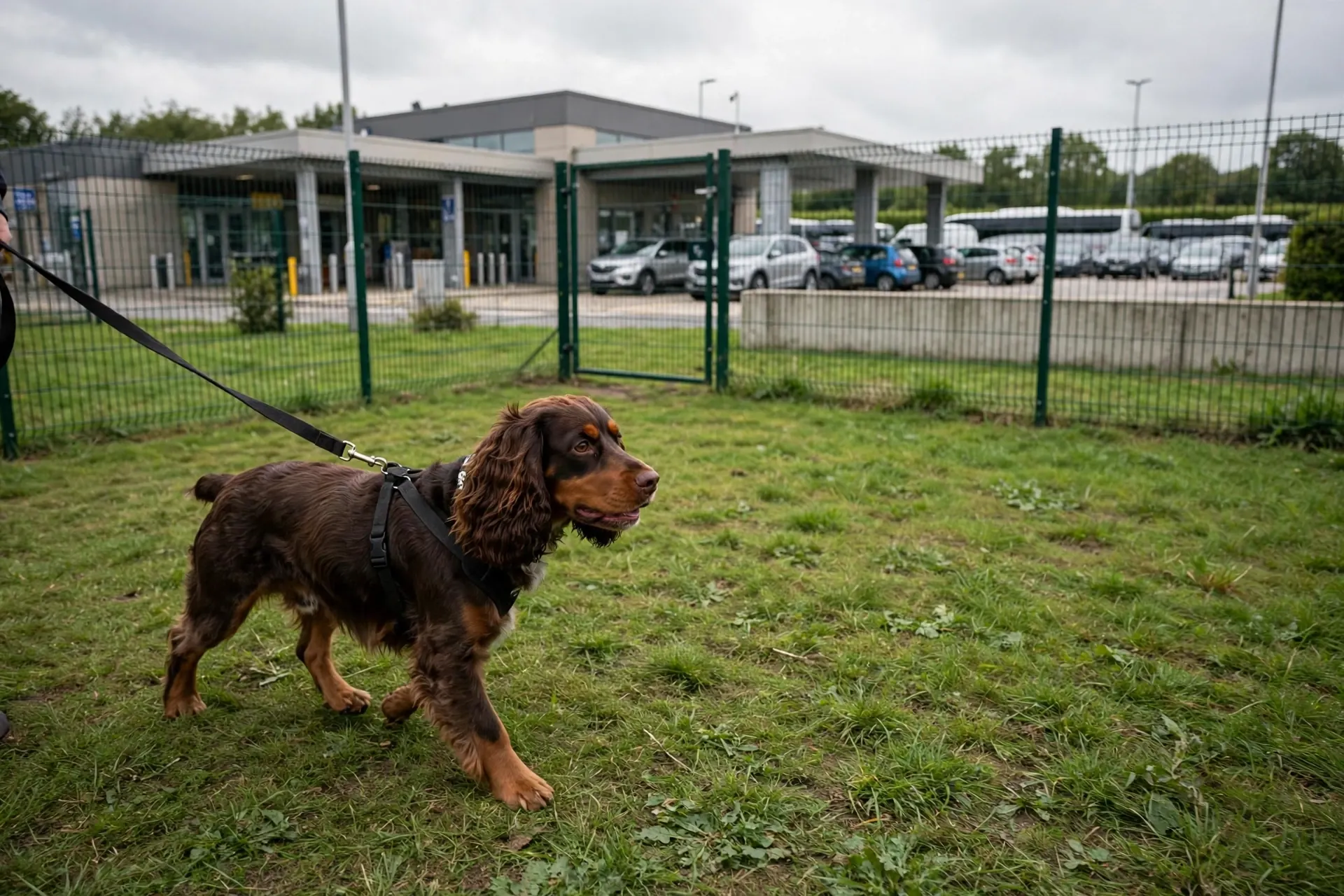
Fenced pens, where they exist, are useful but not automatically safe. Check the gate latch, look for gaps under or between fence panels, and scan the ground for litter, broken glass, discarded food and other dogs before you unclip the lead. A small dog can slip through a surprising gap, and a large dog can jump a low fence if something exciting passes on the other side. Keep the first visit on a lead even inside a pen, walk the boundary yourself, and only let the dog off if the enclosure is genuinely secure and no other dog is already using it in a way that could cause conflict. Two unfamiliar dogs in a small pen at a service station, both tired and overstimulated from travel, is not a good introduction, and there is no benefit in forcing one. If the pen is occupied, wait or use the grass walk instead.
Open grass areas are the most common provision, and they work well if you treat them as lead walks rather than free runs. Choose grass away from the lorry park, the fuel station and the main pedestrian flow, because exhaust fumes, dropped food, hot tarmac and constant foot traffic all make a dog less settled. A quiet corner with shade and a bin nearby is worth more than a large field beside a slip road. Walk a loop rather than standing still: movement helps a dog toilet, stretch and settle, and it gives you a chance to notice hazards such as anti-freeze spills, sharp stones, rabbit holes or areas recently treated with chemicals. If the grass is waterlogged, muddy or covered in litter, a shorter walk on a surfaced path may be kinder than insisting on grass for its own sake.
Some larger sites offer a marked dog walk or a nature trail around the perimeter. These can be excellent, especially for dogs that need more than a toilet stop, but they also need a realistic time allowance. A ten-minute loop is a different proposition from a forty-minute trail when you still have three hours of driving ahead, and a trail that crosses a car park entrance or runs beside a fast road needs a short lead and full attention. Read the site map at the entrance if one is displayed, and do not assume a trail shown online still exists in the same form. Seasonal changes, building work and changes of operator can all alter the layout, so check the official guidance before you travel when a particular walk is the reason you chose that site.
For dogs that cannot cope with busy sites, the quality of the grass matters less than the distance from stimulation. A reactive dog may do far better at a small, quiet site with a modest patch of grass than at a large, popular site with a fenced pen beside a playground and a constant stream of other dogs. Plan for this honestly. If your dog lunges, barks or freezes around other dogs, choose quieter times and quieter corners, keep the lead short, and do not use a service stop as a training exercise. The goal of the stop is recovery, not socialisation, and a calm twenty minutes in a dull corner is a success. Dogs that are deaf, blind or recovering from injury need the same thinking in a different form: a flat, predictable surface, no unexpected steps or grates, and a route you have walked first without the dog.
Water, dog toilets and cleaning up properly
Water provision at motorway services is inconsistent, so never assume a bowl or a tap will be waiting. Some sites provide a dog water point, an outdoor tap or a bowl near an outdoor seating area, while others offer nothing beyond the water you can buy or request inside. Carry your own water and a collapsible bowl as a matter of routine, and refill at every opportunity. Offer water at each stop even if your dog does not seem thirsty, because dogs in cars can become dehydrated quietly, especially in warm weather, on long journeys or after excitement. Small, frequent drinks are usually better than one large drink, and a dog that refuses water at a noisy site may drink happily once moved to a quieter corner away from passing people.
Toilet provision is similarly varied. Some sites have a dedicated dog toilet area with bins and bags, while others simply expect owners to use grass areas and clean up. Always carry more poo bags than you think you need, including a spare roll, and take a small sealable bag for used bags if the nearest bin is full or distant. Clean up immediately, even on grass that looks unused, because service sites are shared spaces and the next dog owner will judge the whole community by what is left behind. If your dog toilets on a surfaced area, a path or a landscaped bed, clean it thoroughly and rinse if water is available. For dogs with diarrhoea or an upset stomach, be extra careful, keep the dog away from other dogs, and consider whether the journey should continue at all.
Think about the practicalities of toilet stops for different dogs. Puppies and older dogs may need to go more often and more urgently, so park close to the grass rather than at the far end of a large car park. Female dogs in season, dogs that mark frequently and dogs that are anxious in new places may need more time and a quieter spot. A long-line lead can help on open grass, but it is a poor choice near roads, car park entrances, cycle routes and other dogs, where a standard short lead gives you control. Avoid retractable leads in busy service areas altogether: they offer little control, tangle easily, and can allow a dog to reach a road or another dog before you can react.
Hygiene extends beyond poo bags. Carry a towel for muddy paws, wet wipes for a quick clean, and a spare blanket or mat for the car so a wet or muddy dog does not soak the seat or crate. If your dog has rolled in something unpleasant, a full wash is rarely practical at a service station, but a towel, water and a change of bedding will get you home comfortably. Keep cleaning supplies in a bag you can grab without opening the whole boot in a busy car park. The same bag can hold a small first-aid kit, any medication, and a spare lead, because a broken clip or a lost bag at a service station is a problem best solved from a kit you already own rather than from a shop that may not stock what you need.
Heat, shade and choosing where to park
Heat is the most serious risk in this whole guide, and it deserves blunt treatment. A parked car can become dangerously hot surprisingly quickly, even on a day that feels mild, and dogs cannot cool themselves by sweating the way people do. They rely mainly on panting, and a dog in a hot, still car can overheat in minutes. Never leave a dog alone in a parked car on a warm day, and do not rely on a slightly open window, a sunshade or a light-coloured car to make it safe. The safe rule is simple: if you stop, the dog comes with you on a lead, or another adult stays with the dog in a shaded, ventilated spot while you go inside. If no adult can stay, plan your stop around outdoor seating, takeaway food or a drive-through option rather than leaving the dog behind.
Parking choice matters before you even open the door. Look for shade from trees or buildings, and remember that shade moves. A space shaded at noon may be in full sun by the time you return from a twenty-minute break, so think about where the sun will be and how long you will be away. Avoid parking beside idling lorries, over hot tarmac with no grass nearby, or in a spot where the dog must cross a busy traffic flow to reach grass. If the car park is full and the only spaces are in direct sun, consider moving on to the next site rather than accepting a poor space for a long break. A few extra miles in an air-conditioned car are safer than a long stop in a baking car park.
On the move, keep the car cool and ventilated, and never put a dog in a boot without airflow. Air conditioning should reach the dog, not just the front seats, so check vents and consider a fan or a vent extender if your car has poor rear airflow. A damp towel on the floor of a crate, a cooling mat and access to water all help, but none of them replaces shade and ventilation. Watch for signs of heat stress: heavy panting that does not settle, drooling, restlessness, vomiting, wobbliness or a glazed expression. If you see these signs, move the dog to shade immediately, offer small amounts of cool water, wet the coat with cool water, and seek veterinary advice urgently. Do not plunge an overheated dog into ice-cold water, and do not delay seeking help while trying home remedies.
Cold weather brings the opposite set of problems, though they are less dramatic. A wet dog left in a cold car cools quickly, and an older or arthritic dog may stiffen after a long, still journey. Dry the dog after a wet walk, offer a blanket or coat if your dog normally wears one, and keep breaks shorter in driving rain or freezing wind. Icy car parks and gritted paths need care too: grit can irritate paws, and a dog that has been still for hours may slip on a smooth surface. A quick paw check, a wipe and a few minutes of gentle walking before returning to the car will usually be enough, but a dog with sore paws, a limp or a cut should not be pushed through a long walk for the sake of routine.
Choosing a parking space is also a safety decision for people. Park where you can open doors fully without stepping into traffic, where children and dogs can get out on the pavement side, and where you can load and unload without rushing. Lock the car, keep valuables out of sight, and keep the dog's restraint ready for the return journey. A dog that is allowed to wander loose around a car park while bags are unpacked is at risk from moving vehicles, and a dog that jumps out of an open door into traffic is a risk to everyone. Clip the lead on before opening the door, every time, even for a supposedly quick stop. Routine is what prevents the one accident that ruins a journey.
How the big operators compare for dogs
The main UK motorway service operators run dozens of sites between them, and their dog provision differs more by individual site than by brand. That said, a few general patterns help when choosing between two sites at a similar distance. Larger, newer sites are more likely to have a marked dog area, outdoor seating where dogs are welcome, bins and water points, simply because they have more space and more recent landscaping. Smaller, older sites may have only a patch of grass and a bin, but they are often quieter, easier to navigate and quicker to get in and out of, which can matter more for a nervous dog than a fenced pen. Judge the site, not the logo, and check the operator's latest site information before you rely on a particular facility.
One useful distinction is between full service areas and smaller rest areas or lay-bys. Full service areas offer fuel, food, toilets and usually some grass, while rest areas may offer little more than parking and a toilet block. A rest area can still work for a quick toilet stop, but it is a poor choice for a proper twenty-minute break, especially in bad weather or at night. Conversely, a very large service area with multiple food outlets, a hotel and a busy forecourt can feel overwhelming for a sensitive dog, even if its facilities look better on paper. The best choice is often a medium-sized site with a clear, short route from the car park to grass, a quiet corner and no need to cross a fuel forecourt to reach it.
Facilities also change with ownership, refurbishment and seasonal demand. A dog area shown on a map two years ago may have been moved during building work, a water point may be out of order, or a previously quiet grass bank may now sit beside a new coach park. Treat online lists as a starting point and confirm the details that matter: is there grass, is there shade, is there a bin, and how far is the grass from the car park? Operator websites, site maps and customer service teams can answer these questions, and a quick check before departure costs far less than a wasted detour. If a facility matters enough to choose a site for it, check the official guidance before you travel rather than trusting a third-party list that may be out of date.
It is also worth knowing that assistance dogs are treated differently from pet dogs. An assistance dog should be allowed into indoor areas where a pet dog is not, and staff should be aware of this distinction. If you travel with an assistance dog and are refused entry or challenged, ask calmly for the site manager and keep a record of what happened. For pet dogs, the indoor rule is usually clear: dogs stay outside, except in specifically designated outdoor seating areas. Do not argue the point at the door or try to carry a small dog inside a bag to bypass the rule; it creates a difficult situation for staff and a stressful one for the dog. Plan to eat outside, order takeaway, or take turns with another adult if the weather or the dog makes indoor eating necessary.
Finally, remember that individual staff attitudes and local management decisions can matter as much as written policy. A site that is officially dog-friendly can feel unwelcoming if the outdoor seating is full of smokers or the grass is beside a noisy generator, while a site with modest facilities can feel excellent because staff point you to a quiet corner and a tap. Be polite, clean up thoroughly, keep the dog under control, and you will usually find staff helpful. If a site works well for your dog, note it down for the return journey and for future trips. Over time, most regular motorway travellers build a personal list of reliable stops, and that list is worth more than any published ranking because it is based on your dog, your car and your route.
Petrol stations, food halls and lead rules
The fuel forecourt is the most dangerous part of a service area for a dog, and it deserves its own rule: dogs stay in the car, with a window open for ventilation and an adult present, while fuel is being bought, or they wait in a safe grass area with another adult. Never walk a dog across a forecourt, past fuel pumps or between moving vehicles, and never tie a lead to a pump, a bin or a post near traffic while you pay. Fuel spills, hot surfaces, moving cars and the smell of petrol all make forecourts stressful and hazardous for dogs, and a loose dog in that environment is a risk to itself and to other drivers. Plan fuel stops and dog stops as separate actions: fuel first with the dog secure in the car, then park properly and walk the dog, or walk the dog first and fuel afterwards with the dog safely back in the car.
Food halls and indoor seating are, as a rule, not for pet dogs. Most operators restrict dogs to outdoor seating areas, terraces and grass, and some sites have a specific dog-friendly outdoor zone with tables and shade. If you need to eat inside, take turns: one adult stays outside with the dog while the other orders and eats, or choose takeaway food that can be eaten outside or in the car with the doors open and the dog settled. Check the signs at each entrance, because rules can differ between the main building, a coffee shop and a fast-food outlet on the same site. When in doubt, ask a member of staff rather than assuming a small or quiet dog will be overlooked; a polite question takes seconds and avoids an awkward removal halfway through a meal.
Outdoor seating areas have their own etiquette. Keep the dog on a short lead, under the table or beside your chair, and do not let it approach other tables, beg for food or wander between chairs. Bring a mat or blanket for the dog to settle on, and a chew or a stuffed food toy to keep it occupied while you eat. Offer water before your own food arrives, and keep the lead where you can feel it, not looped loosely around a chair leg that a startled dog could drag. If the outdoor area is crowded, noisy or full of other dogs, consider eating in the car instead. A calm meal in a parked car with the dog settled beside you is better than a stressful meal on a terrace where the dog is overstimulated and you cannot relax.
Shops and toilets follow the same pattern. Dogs are generally not allowed inside shops, and they cannot be taken into toilet blocks, so plan accordingly. One adult can shop or use the facilities while the other stays with the dog, and many sites have accessible toilets and baby-changing facilities that make a quick turn easier for families. If you are travelling alone with a dog, use drive-through options, outdoor seating and takeaway where possible, and keep toilet breaks short. Never tie a dog up outside a building and leave it unattended while you go inside for a long period. An unattended dog at a service station can become distressed, can be stolen, and can cause problems for other visitors, and the risk is not worth the convenience.
Lead rules inside the site are straightforward in principle and worth stating plainly: keep the dog on a lead everywhere on a service area unless a sign clearly says an enclosed area is provided and you have checked that it is secure. This applies to car parks, grass areas, paths, outdoor seating and the walk to and from the building. A long lead or an extendable lead is a poor choice in these places, because it allows the dog to reach traffic, other dogs or food dropped on the ground before you can intervene. A standard lead of about one to two metres, held properly, gives you control without restricting the dog unreasonably. For dogs that pull strongly, a well-fitted harness and a lead with a secure clip matter more than any particular brand of equipment, and our guide to dog car safety covers restraint and fitting in detail, including harnesses and crates.
Night stops: light, noise and tired drivers
Night stops need a different plan from daytime ones. The grass that looked inviting at noon can be dark, uneven and hard to read at midnight, and a dog that toilets happily in daylight may refuse, hesitate or become anxious in a poorly lit area. Choose a well-lit site, park close to a lit path and a lit grass area, and carry a torch or a head torch so you can see the ground, the dog and any hazards. A light on the dog's collar or harness helps you keep track of it, and it also helps other drivers and pedestrians see that a dog is present. Keep the lead short at night, walk a familiar loop rather than exploring, and do not let the dog off the lead in the dark, even in a fenced area you used earlier in the day.
Noise changes at night too. Lorries arrive and depart through the night, refrigeration units hum, and the site may be quieter overall but with sudden loud events. A dog that copes well with daytime bustle may startle at a reversing alarm or an air brake in the dark, so keep the dog close, move slowly and give it time to settle before expecting it to toilet. If your dog is noise-sensitive, choose a parking area away from the lorry park and away from the main entrance, even if that means a slightly longer walk to the building. A few extra minutes of walking in a quiet corner is better than a short walk beside idling engines.
Driver fatigue is the hidden risk at night. A driver who is tired after hours of motorway driving is less able to judge a dog's behaviour, to notice hazards in a car park or to react to a sudden movement on a lead. If you are stopping because you are tired, treat the stop as a rest, not just a dog break. Walk the dog, drink water or coffee, eat something, and consider a short nap in a safe, well-lit area before continuing. If you feel too tired to drive safely, the right decision is to stop properly, use a hotel or a designated overnight parking area, and continue in the morning. No timetable justifies driving while dangerously tired with a dog in the car, and a service area at night is a place to recover, not a place to push through.
Security also deserves attention. Keep valuables out of sight, lock the car when you leave it, and stay aware of your surroundings, particularly if you are travelling alone. Park in a lit area near other cars and near the main building rather than in a dark corner of a large car park, and keep your phone and keys with you rather than in the car. If a site feels unsafe, trust that feeling and move on to the next one; there is always another service area, and a slightly longer drive in a locked car is safer than a stop that makes you uneasy. Keep children close, keep the dog on a lead, and avoid leaving bags or equipment visible in the car while you walk the dog.
Overnight stays at service areas raise separate questions. Some sites have hotels where dogs may be welcome in specific rooms, while others do not allow dogs in the hotel at all. If you plan to sleep at a service area, check the hotel's dog policy in advance, confirm any fee and the rooms that accept dogs, and plan for the dog's overnight toilet needs. A dog that has travelled all day will need a last walk before bed and an early walk in the morning, and a hotel room is not a kennel. If the hotel does not accept dogs, do not be tempted to leave the dog in the car overnight. Instead, choose a different stop, a dog-friendly hotel nearby, or a shorter driving day that ends at proper accommodation.
Planning by route: M1, M6, M25 and M5
Route planning is where the general advice becomes a usable timetable. Instead of choosing stops at random, work along your route in two-hour blocks and assign each block a preferred site and a backup. The examples below follow the main north-south and orbital routes that carry most long dog journeys in England, but the method works on any motorway. Distances and journey times change with traffic, so treat the stop names as a pattern to adapt rather than a list to follow blindly, and check the official guidance before you travel for current facilities and any closures.
The M1: London to Yorkshire and beyond
The M1 runs from London through the Midlands to Leeds, and it is a route where stops are frequent enough to plan properly. From London, a first stop after roughly two hours puts you in the East Midlands, where larger sites offer grass and outdoor seating, and a second stop after another two hours brings you towards South Yorkshire. The key decision on the M1 is whether to use a large, busy site with good facilities or a smaller, quieter one a little further along. For a nervous dog, the quieter site is usually the better choice, even if it means a shorter walk and fewer food options. For a dog that needs a long run and a proper break, the larger site may be worth the extra stimulation, provided you choose a quiet corner and keep the lead short. Watch for the sections where services are spaced further apart, particularly in the northern part of the route, and do not pass a good site hoping for a better one that may be an hour away. If your dog has already had two hours in the car, the site in front of you is the right one.
The M6: the long western spine
The M6 is the longest motorway in the country and the route where planning matters most. It runs from the Midlands through Cheshire, Lancashire and Cumbria to the Scottish border, and the gaps between services grow noticeably in the north. A dog travelling from Birmingham to Carlisle needs at least two proper stops, and a dog travelling on to Scotland needs more. The southern section offers frequent, larger sites, while the northern section has fewer, more spaced-out services and long stretches where the next stop is a real commitment. Plan these northern stops carefully: choose a preferred site and a backup, keep water and food within reach, and do not let the fuel gauge dictate the dog's breaks. In Cumbria and the border country, weather changes quickly, and a site that is pleasant in sunshine can be exposed and windswept in rain, so carry a coat for the dog if it normally wears one and allow extra time for a wet walk. The M6 also carries heavy lorry traffic, so choose grass away from the lorry park and keep the dog well away from the fuel area at every stop.
The M25: the orbital problem
The M25 is a different challenge because it is often slow, congested and unpredictable, and a journey that should take an hour can take three. Dogs feel this as much as drivers do: stop-start traffic, constant braking and long periods of sitting still are tiring and stressful, even without a long distance. Plan M25 journeys with stops before and after the orbital section rather than relying on a stop on the M25 itself, because services on the M25 are limited and the junctions are busy. A useful pattern is a proper break before joining the M25, a slow transit with the dog settled and watered, and a proper break after leaving it, even if the total distance seems short. If the M25 is closed or heavily delayed, do not hesitate to leave at a junction and find a quieter road or a nearby green space for a break. A dog does not care whether a stop is a motorway service area or a quiet lay-by with grass, provided it is safe, legal and away from fast traffic. The priority is the dog's welfare, not the neatness of the route.
The M5: the south-west holiday route
The M5 carries huge numbers of dogs to Devon, Cornwall and the south-west, particularly on Friday evenings and Saturday mornings in summer. Services on this route can be extremely busy at peak times, with full car parks, queues for food and limited grass. The best advice for the M5 is to travel outside peak hours where possible, to stop early rather than late, and to accept that a popular site at a peak time may not be the best site for your dog. A smaller site a little earlier or later on the route, or a stop on the A-road network before joining the motorway, can be far calmer. In summer, heat is the main concern on the M5: south-facing car parks bake in the afternoon, and a dog that has been in a hot car for hours needs shade, water and a slow reintroduction to exercise rather than an immediate run. Plan a shaded stop, offer water in small amounts, and do not expect a dog to settle quickly after a long, hot, noisy journey. On the return journey, the same sites are busy on Sunday afternoons, so the same advice applies in reverse.
Whatever the route, the same planning habits apply. Write down the stops, share them with passengers, keep the kit within reach, and build in more time than you think you need. A journey that allows an extra hour for dog breaks is a journey that arrives with a calm dog and a calm driver, while a journey planned to the minute arrives late, tired and stressed, with a dog that has not had a proper break. The motorway network is built for cars, not for dogs, and the driver's job is to bridge that gap with planning, patience and a willingness to stop when the dog needs it, not only when the fuel gauge demands it.
A stop kit that stays within reach
Good stops are easier when the kit is already packed and within reach. Keep a small bag in the footwell or on the back seat, not buried in the boot under suitcases, because a stop beside a busy car park is the wrong moment to unpack. The bag should contain a lead and a spare, a collapsible bowl and a bottle of water, poo bags, a towel, a chew or a long-lasting treat, any medication, and a small first-aid kit. Add a torch for night stops, a spare blanket or mat, and a plastic bag for muddy items. Check the bag before every long journey, refill the water bottle, replace used poo bags, and make sure the spare lead is actually in the bag rather than in a drawer at home.
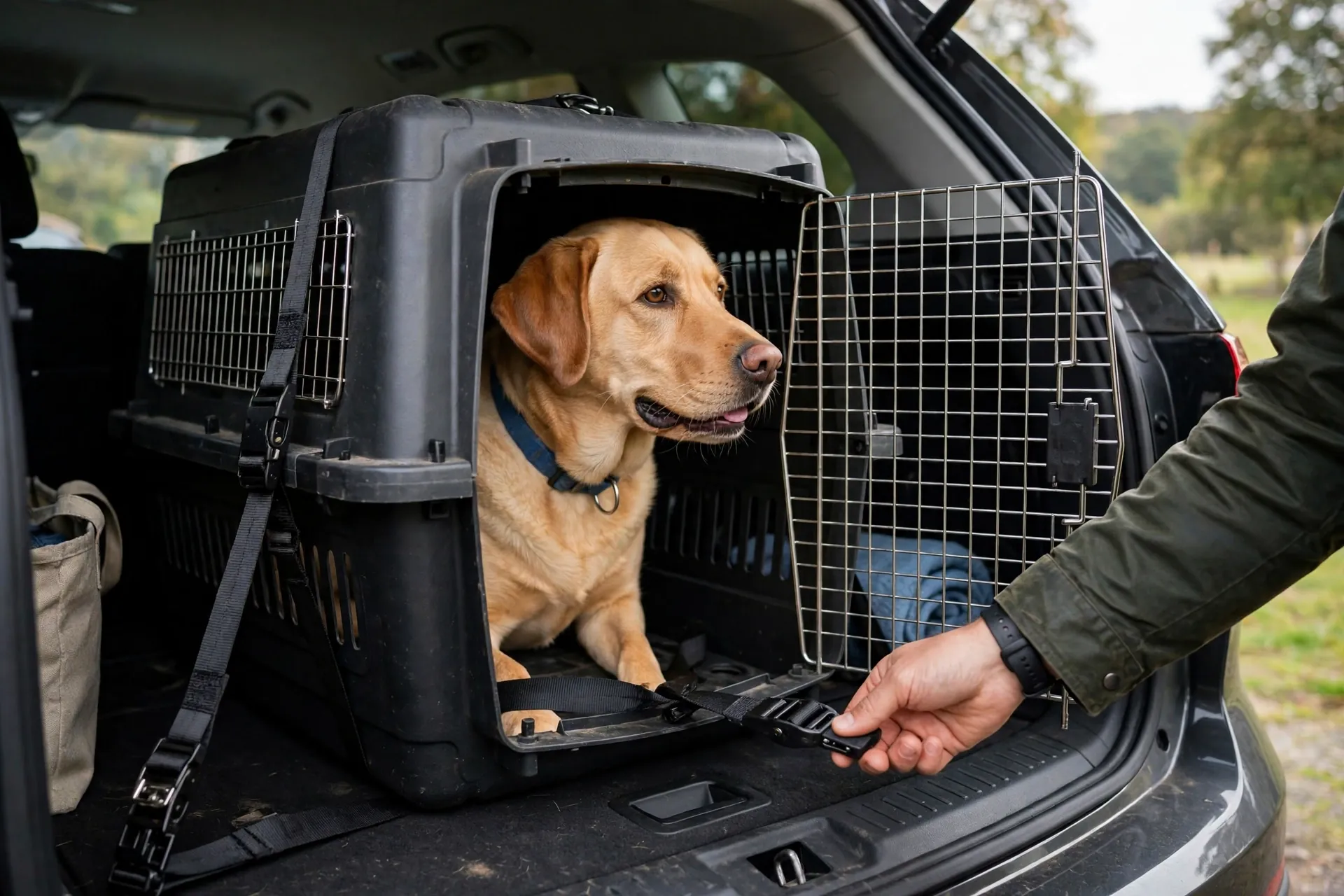
The car itself needs a quick check before a long journey. Confirm that the dog's restraint fits properly and that the harness, crate or guard is secure, because a restraint that has loosened since the last trip will not protect a dog in sudden braking. Check that air conditioning reaches the back of the car, that windows and locks work, and that the dog has a comfortable, non-slip surface to lie on. A dog that slides around on a smooth boot floor for hours will arrive stiff and sore, so a rubber mat, a vet bed or a non-slip blanket makes a real difference. Keep the dog's food, medication and vaccination record accessible, particularly if you are travelling to a holiday let or a vet may need to be consulted on the way. A printed copy of the dog's details, including your phone number, is a useful backup if your phone battery dies.
Finally, plan for the return journey as carefully as the outward one. Dogs are often more tired, more excited or more unsettled on the way home, and drivers are often more tired too. Allow the same two-hour stopping pattern, keep the same kit within reach, and do not be tempted to skip the last stop because home is only an hour away. That last hour is often the hardest for a dog that has had a long day, and a short break with water and grass can make the difference between a calm arrival and a distressed one. When you arrive home, give the dog water, a toilet break and a quiet place to rest before unpacking the car. The journey is not over when the car stops; it is over when the dog has settled, drunk and rested, and that last step is part of the plan, not an afterthought.
Practical questions
Before you go
Are dogs allowed inside UK motorway service buildings?
Usually not, except for assistance dogs. Most operators allow dogs in outdoor seating areas and on grass, but keep them out of indoor food halls, shops and toilets. Check the signs at the entrance and ask staff if you are unsure, because rules can differ between buildings on the same site.
How often should I stop for my dog on a motorway journey?
Plan a proper break at least every two hours, and sooner for puppies, older dogs, anxious dogs and dogs that need regular toilet stops. A useful break means a toilet stop, water, a sniffing walk and a few calm minutes, not just a quick dash on a slip road.
Do motorway services have fenced dog exercise areas?
Some do, but most do not. Many sites offer an open grass area or a marked dog walking route rather than a fully enclosed pen, so keep your dog on a lead unless a sign clearly says an enclosed area is provided and the gate is secure. Always check the fence and gate before letting go of the lead.
Is it safe to leave my dog in the car at a motorway service station?
No, not on a warm day, and it is risky even when the weather feels mild. Cars heat up quickly, and a dog left alone can also become distressed or attract attention. Take the dog with you on a lead, use shaded parking, and never rely on a cracked window to keep a car cool.
What should I pack for a dog stop at motorway services?
Pack a lead and a spare, a collapsible bowl and water, poo bags, a towel, a chew or long-lasting treat for settling, and any medication your dog needs. Keep the kit in the footwell or door pocket so you are not unpacking the boot beside a busy car park.
Which motorway services are best for dogs?
The best sites for your dog are the ones with a quiet grass area away from lorry parking, drinking water or a tap, bins, shade and a short, safe walk from the car park. Facilities change over time, so check the operator's latest information before you travel and have a backup stop in mind.