This guide is independent and contains no paid placement. Farm rules change from season to season, so always check the farm's own website or booking page before you travel.
Choose a farm where dogs are welcome in the picking field itself, not only in the car park. Arrive early on a weekday, keep your dog on a lead on the wheelbarrow route, give farm animals a wide berth, and leave time for a proper towel-down or wash before the drive home.
Before you book: read the dog policy properly
A pumpkin patch is not one place with one rule. It is a working farm that, for a few weeks each autumn, adds visitor routes, ticket gates, food stalls, play areas and a car park full of excited children to its ordinary working life. A farm can therefore be genuinely welcoming to dogs in one part of the site and closed to dogs in another, and the distinction matters more here than at a beach or a woodland walk, where the boundary is usually a single line on a map. Before you book, look for the farm's dog policy in its own words, not in a review or a social media comment. Reviews describe one visit on one day; the farm's current page describes the rule it intends to enforce this season. If the page says dogs are welcome on leads throughout, that is a strong start. If it says dogs are welcome in outdoor areas only, ask what that includes: the picking field, the cafe terrace, the play barn, the maize maze and the farm shop are often treated differently.
Pay attention to four details that are easy to miss. First, lead rules: some farms require a short lead at all times, some allow a long line in the field, and some ask for dogs to stay on leads only near animals and food areas. Second, numbers: a farm may welcome one or two dogs per group but not a larger party with four dogs, because the picking rows get congested. Third, indoor rules: many farms keep dogs out of covered play barns, indoor cafes and farm shops for hygiene and safety reasons, even when the outdoor field is fully dog-friendly. Fourth, seasonal changes: a farm that welcomes dogs quietly in early October may restrict dogs during its busiest Halloween weekend, or may move to timed entry that changes how long you can stay in the field. When any of these points is unclear, send a short message before you book and keep the reply. A written answer protects you if a different member of staff gives a different answer on the day.
Booking type also changes the dog experience. Timed-entry tickets usually mean a set arrival window rather than a set departure time, but they still shape the crowd around you. A farm with timed entry and a capped number of visitors per hour will feel calmer than an open-gate farm on a sunny Saturday, even if both call themselves dog-friendly. Check whether tickets are refundable or transferable if the weather turns, whether dogs need to be declared at booking, and whether there is a separate charge for dogs. Most farms do not charge for dogs, but some charge for parking, for a wheelbarrow hire deposit, or for activities such as a maze or a tractor ride, and those charges add up for a family group. Finally, check the cancellation and weather policy in the same pass. October weather in Britain can change a firm field into a mud bath overnight, and a farm may close a field, move picking to a firmer area, or cancel a day entirely after heavy rain. Knowing that before you travel saves a disappointed dog in a car park.
It also helps to think about the farm as a business with animals, machinery and food production, rather than as a theme park with a pumpkin theme. Tractors move between fields, forklifts may operate near storage areas, and staff may be harvesting, grading or moving pumpkins while visitors are present. A dog that is calm on a village pavement can still be startled by a reversing tractor, a flapping tarpaulin or a sudden burst of music from a food stall. None of this means you should avoid pumpkin patches. It means the best preparation is specific: read the map if one is published, note where vehicles travel, where animals are kept, and where the quieter picking rows are, and plan a route that keeps your dog away from the busiest working areas. If the farm publishes no map, ask for one at the entrance and spend two minutes studying it before you head into the field. Those two minutes often decide whether the day feels relaxed or frantic.
Arrival: car park, entrance and first toilet stop
The first ten minutes at a pumpkin patch set the tone for the whole visit, and they are also the minutes when dogs are most likely to become overexcited. A car park in October is full of new smells: other dogs, food stalls, straw, wet earth, diesel and children carrying pumpkins. If your dog travels in a crate or behind a guard, let them settle for a moment after you park rather than opening the door straight into the crowd. Put the lead on before the door opens, check that the harness or collar is secure, and walk calmly to the edge of the car park for a toilet stop before you join the entrance queue. Many farms provide a grass verge or a field margin for this purpose, but not all do, so do not assume there is a designated dog toilet area. If in doubt, use the quietest grassy edge away from the entrance path and clean up immediately.
At the entrance, keep your dog close and to one side while tickets are checked. Queues at pumpkin patches often narrow to a single gate, a turnstile or a ticket desk, and a dog on a long lead in a queue is a tripping hazard for other visitors. A short lead, a dog standing beside you rather than in front of you, and a treat or a calm word for waiting patiently all help. If the farm uses a timed-entry system, arrive inside your window rather than far ahead of it, because arriving early often means waiting in a car park queue with a dog that is already eager to explore. If you arrive late, check whether your ticket is still valid rather than rushing through the gate with a stressed dog. Staff are usually more flexible when you explain calmly and ask, rather than when you hurry past them.
Once inside, pause again before the picking field. Look for signs about dogs, livestock, wheelbarrows and one-way routes. Many farms run a one-way system in October to keep families moving through the field in the same direction, and a dog that tries to walk back against the flow will meet a stream of wheelbarrows, pushchairs and children. Follow the signed direction even if it feels longer, because the route is usually designed to keep vehicles and pedestrians apart and to spread visitors across the field. Find the nearest water point, bin and exit at this stage, too. A farm may have a single tap near the cafe and none in the far field, which changes how much water you need to carry. Knowing where the bins are matters as well, because pumpkin patches generate a surprising amount of waste: stems, damaged pumpkins, food wrappers and dog waste bags all need a proper bin, and a full bin near the entrance is not an excuse to leave waste in the field.
Finally, agree on a simple plan for the group before anyone picks a pumpkin. Decide who holds the dog, who pushes the wheelbarrow, and who carries the pumpkins back to the car. A common mistake is for everyone to drift off in different directions while one person is left holding both a dog and a wheelbarrow. A clearer plan is for the dog handler to stay with the dog at all times, while another adult manages the wheelbarrow. If you are visiting alone with a dog, choose a smaller pumpkin, use a bag or a small trolley you can manage with one hand, or ask staff whether wheelbarrows can be left at a collection point. Solo visitors with dogs often have the best visits when they keep the plan simple: one row, one pumpkin, one calm walk back, rather than a grand tour of the whole farm.
The picking field and the wheelbarrow route
The picking field is the heart of the visit, and it is also where the farm route matters most. Most farms grow pumpkins in long rows with bare soil or short grass between them. The rows are wide enough for a wheelbarrow and a person, but not always wide enough for a wheelbarrow, a person, a dog and another family coming the other way. Walk in the middle of the row when it is empty, move to the edge when someone needs to pass, and keep your dog on the side away from the pumpkins if your dog is tempted to mouth, paw or mark them. Pumpkins left in the field are the farm's crop, and a dog that chews, scratches or urinates on saleable pumpkins creates waste for the farm and embarrassment for the owner. A short lead and a habit of redirecting the dog back to the path with a calm word usually prevents this, but a dog that cannot resist mouthing pumpkins may be happier walking on the headland path around the field while the rest of the group picks.
Wheelbarrows deserve special attention, because they change how dogs behave. A wheelbarrow is noisy on rough ground, it moves at walking pace but stops suddenly, and it carries a heavy, wobbling load. Some dogs try to chase it, some try to walk underneath it, and some are frightened by the rattling. Introduce your dog to the wheelbarrow gradually: let them sniff it while it is still, walk beside it slowly on a firm path, and only then take it into the rows. Keep the dog on the opposite side from the wheelbarrow wheel, and never tie a lead to a wheelbarrow handle. A tied lead can pull the barrow over, spill pumpkins, or drag the dog if the barrow tips. If your dog is nervous around wheels, leave the wheelbarrow at the field entrance and carry pumpkins back in a bag, or take turns: one person picks while the other waits with the dog on a quiet path. The farm will not mind a slower, calmer visit, and your dog will thank you for it.
Choosing pumpkins with a dog in tow is best done slowly. Look for a firm pumpkin with an intact stem, no soft spots, no cuts and no mould around the base, because a damaged pumpkin rots quickly at home and a mouldy pumpkin should not be handled by children or chewed by dogs. Lift pumpkins with two hands rather than pulling them by the stem, because a broken stem shortens storage life. If you are buying pumpkins for carving, for cooking or for decoration, check the farm's guidance on varieties, because a large carving pumpkin, a small decorative squash and a cooking pumpkin are different products with different storage needs. Ask staff if you are unsure; they can usually tell you which rows hold which varieties and which pumpkins will keep longest. For dogs, the practical point is simpler: pick your pumpkins, load them carefully, and move on. Lingering in a busy row with a dog that is growing restless helps nobody, and the best photographs are usually taken at the edge of the field, where there is space to stand without blocking the route.
Think about the route back as well as the route in. The return path is often the same wheelbarrow route, now busier, with visitors carrying pumpkins in both directions. Keep to the signed route, keep the dog close, and watch for children running between rows, for wheelbarrows parked across paths, and for wet patches where the soil has been churned into a slippery rut. If the farm has a separate exit lane for wheelbarrows, use it. If it has a pumpkin weighing or payment point, queue with your dog to one side and keep the lead short while you pay. A dog that has walked calmly through the field can easily become restless in a payment queue, so a small treat, a familiar command and a quick exit to the car or cafe help. When you reach the car, load pumpkins first, secure them so they cannot roll, and then settle the dog, rather than trying to do both at once with an open boot and an excited dog.
Farm animals: fences, distance and arousal
Many pumpkin patches sit on farms that also keep animals, and some farms add a small animal area for visitors in October. Sheep, goats, pigs, poultry, rabbits and occasionally alpacas or donkeys may be visible from visitor routes, and the way your dog reacts to them will shape the whole visit. The rule is simple and non-negotiable: never let a dog approach, bark at, chase or worry farm animals, even through a fence. Fences are not a guarantee of calm. A dog barking and lunging at a fence line can stress animals, disturb other visitors and, in the worst case, cause an animal to panic and injure itself. Some farms therefore keep dogs out of animal areas entirely, while others allow dogs on leads on a path that passes at a distance. Both approaches are reasonable, and both deserve respect. Read the signs, follow the marked route, and do not take a shortcut through a field or yard to get closer to the animals.
Distance is your best tool. If your dog notices animals and stiffens, stares, pulls or vocalises, increase the distance immediately by walking away calmly, turning onto a quieter path, or leaving the animal area altogether. Do not try to train through the reaction in the middle of a busy farm visit. A pumpkin patch is a poor classroom for livestock desensitisation, because the environment is already full of noise, smells and movement, and the animals have no choice about being there. A dog that is calm at twenty metres may be over-aroused at five metres, so judge by your dog's body language rather than by a fixed rule. Loose body, soft eyes, willingness to turn away and take a treat are signs of a dog coping well. Fixated staring, raised hackles, whining, lunging or an inability to respond to a known cue are signs to move away. If you are unsure, skip the animal area. Your dog will not miss it, and the rest of the visit will be calmer for everyone.
Children complicate the animal area, because they often want to feed or stroke animals while a dog is present. Keep your dog well back from feeding stations, petting areas and low fences where small hands reach through. Even a friendly dog can be overwhelmed by a crowd of children, food smells and animals in a small space, and a dog that jumps up at a fence can knock a child or startle an animal. If the animal area is enclosed and busy, it is often better for one adult to take children inside while the other waits outside with the dog on a quiet path. That is not a lesser visit; it is a sensible division of labour that keeps both children and animals safe. Also watch for feed scattered on paths, because dogs will scavenge grain, pellets or vegetables dropped by visitors. Some animal feeds are unsuitable for dogs, and eating from the ground in an animal area also risks contact with droppings. Keep the dog's head up, keep the lead short, and move on promptly.
Biosecurity is a less obvious but important part of farm visits. Farms may ask visitors to use foot dips, to stay out of certain yards, or to avoid touching animals if they have recently visited another farm. These measures protect animal health, and they apply to dogs as well as people. If a farm asks you to keep your dog out of a particular area for biosecurity reasons, comply without argument. Similarly, if your dog is unwell, has diarrhoea, or has recently been in contact with other unwell animals, postpone the visit. A farm is not the place to test whether a dog is well enough for a day out. Finally, remember that farm animals are working animals, not pets for visitors to handle at will. Admire them from the visitor route, take photographs from a respectful distance, and move on. A calm, brief encounter is better than a long, tense one, and it leaves the animals undisturbed for the next visitors as well.
Play areas, mazes and cafes
Beyond the picking field, many pumpkin patches offer a cluster of attractions: a straw bale play area, a small maze, a tractor ride, a face-painting stall, a food court and a cafe. Dogs are often welcome in some of these and excluded from others, and the pattern is rarely obvious until you read the signs. Play barns and indoor soft-play areas usually exclude dogs for hygiene reasons. Outdoor play areas may allow dogs on leads around the edge but not inside the play equipment itself, because a dog running through a play area is a risk to small children. Maize mazes vary most of all: some welcome dogs on leads, some allow dogs only in quieter periods, and some exclude dogs because the narrow paths, blind corners and high stalks make it impossible to see other visitors coming. If a maze is on your list, check its dog rule before you queue, because a maze is a poor place to discover that dogs are not allowed.
Food areas need a similar check. An outdoor cafe terrace is often the most dog-friendly part of a pumpkin patch, with water bowls, space under tables and a relaxed atmosphere. An indoor cafe may welcome dogs in a designated area, may allow dogs only at certain times, or may exclude them entirely. Food stalls in the open air are usually easier: you can order, step to one side with your dog, and eat at a picnic table or on a grass bank. Whatever the arrangement, keep your dog away from food preparation areas, do not feed your dog from your plate at a shared table if other visitors are nearby, and clean up any dropped food promptly. A dog begging at a food stall is not just a nuisance; it can create a hygiene problem for the stall and a safety problem if the dog pulls towards hot food, sharp utensils or other people's meals.
Noise and movement in play areas deserve planning, especially for sensitive dogs. Music, tannoy announcements, generators, inflatables, shouting children and the sudden movement of a tractor ride can all raise arousal quickly. If your dog is noise-sensitive, plan the play area as a brief pass-through rather than a long stay, or skip it and return to the picking field, where the space is open and the noise is lower. If your dog is sociable and confident, a play area can still be tiring, because the dog must cope with constant novelty without a break. Build in rest: a quiet sit on a bench, a drink of water, a few minutes on a grass verge away from the crowd. Dogs do not need to be entertained every minute. A short rest often restores a dog's ability to cope far better than another activity.
Cafe and shop visits also raise a practical question: what do you do with the dog while you go inside? If dogs are not allowed in the farm shop, do not leave a dog tied up outside alone, especially at a busy farm where theft, teasing or escape are real risks. Instead, take turns going inside, or choose a farm with an outdoor shop stall or a terrace where the dog can wait with a person. The same applies to toilets, ticket offices and indoor attractions. A dog left alone at a farm entrance, even for a few minutes, can become distressed, bark continuously and disturb other visitors, and a tied dog can slip a collar or chew through a lead. Plan for togetherness: if the group cannot stay together, split the group rather than leaving the dog alone. It is a small adjustment that prevents most of the incidents farms report in October.
Mud, paws and washing before the car
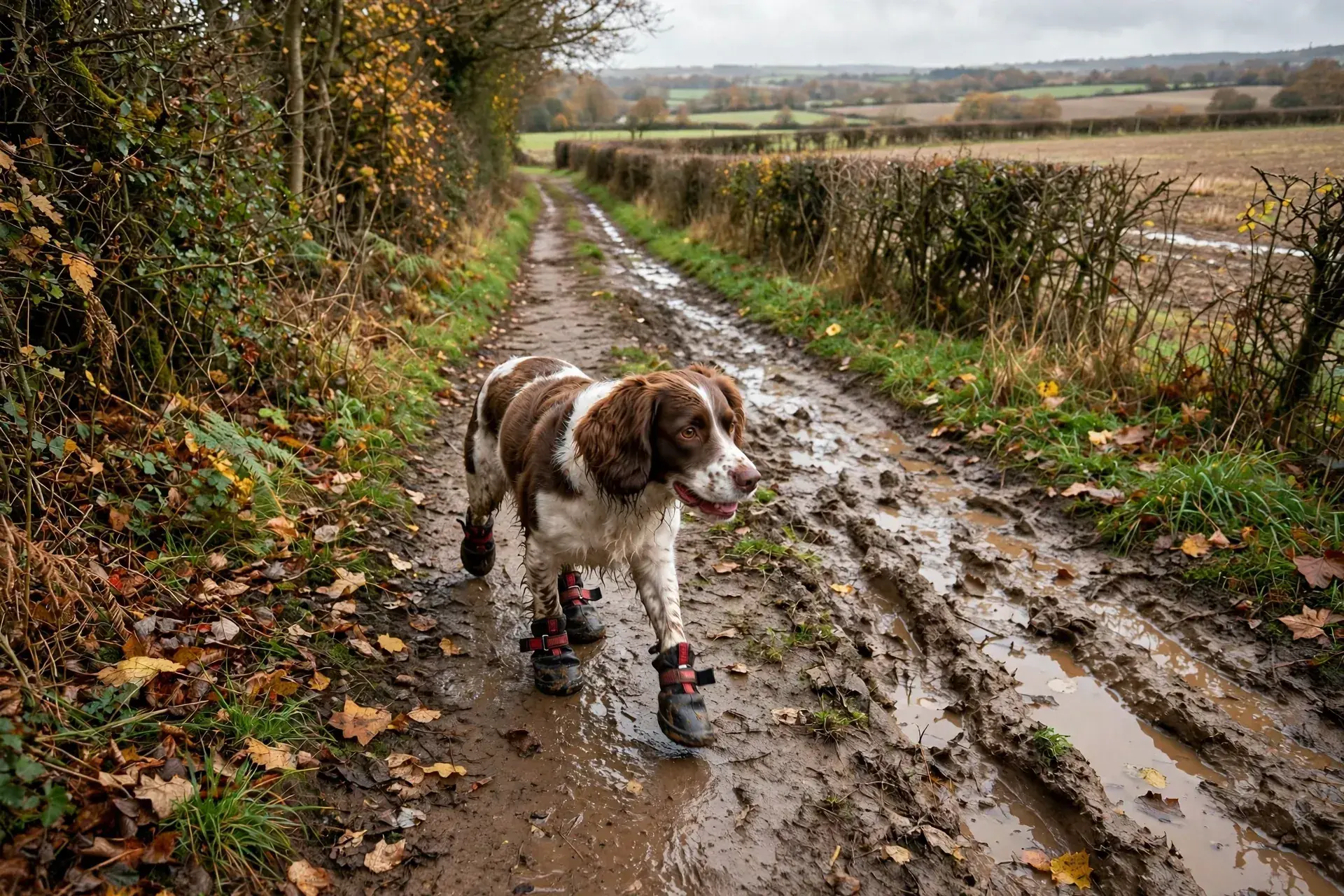
October mud is the defining feature of a pumpkin patch visit, and it deserves more planning than any other single factor. Pumpkin fields are worked soil, not grass, and after rain the rows become a mixture of wet earth, straw and churned ruts. Field entrances, wheelbarrow routes and the ground around food stalls get muddiest first, because every visitor walks the same line. Low-lying fields and heavy clay soils hold water longest, while sandy or free-draining soils recover faster. A farm may move picking to a firmer field after heavy rain, but it cannot pave a working field, so expect mud even on a dry day if the previous week was wet. Waterproof boots for people are essential, and for dogs, the question is not whether paws will get muddy, but how you will manage the mud afterwards. Our guide to best dog boots for muddy walks explains when boots help and when a good towel-down is the better option.
Paw care starts before you leave home. Trim long hair between the toes if your dog is prone to mud balls forming there, check for existing cuts or sore pads, and consider a paw balm if your dog's pads crack in wet weather. At the farm, avoid the deepest ruts and standing water where possible, not only for cleanliness but for safety: hidden stones, broken stems and uneven ground can cut paws, and stagnant water can harbour bacteria. If your dog steps in deep mud, let them walk it off on grass rather than trying to clean paws in the middle of the field. Grass at the field edge often removes the worst of the mud naturally, and a dog that can shake and walk normally will be more comfortable than a dog held still for a fussy clean in a crowd.
Washing facilities vary widely. Some farms provide an outdoor tap, a hose, a dog wash station or a shallow trough near the exit. Others provide nothing more than a grass verge and a bin. Check before you travel, and pack as if there is no wash station: two large towels, a drying coat if your dog will wear one, a bottle of clean water, a small bowl, dog-safe wipes for paws, and a plastic bag for muddy towels. A portable paw washer can help for short-coated dogs, but it is no substitute for a towel-down for a long-coated dog, whose belly, legs and tail will all carry mud. Dry the belly and legs first, then the paws, then the ears and tail, and check for burrs, thorns and small stones caught in the coat. If your dog has been in deep mud, check between the toes carefully, because mud packed between toes can cause soreness and limping later in the day.
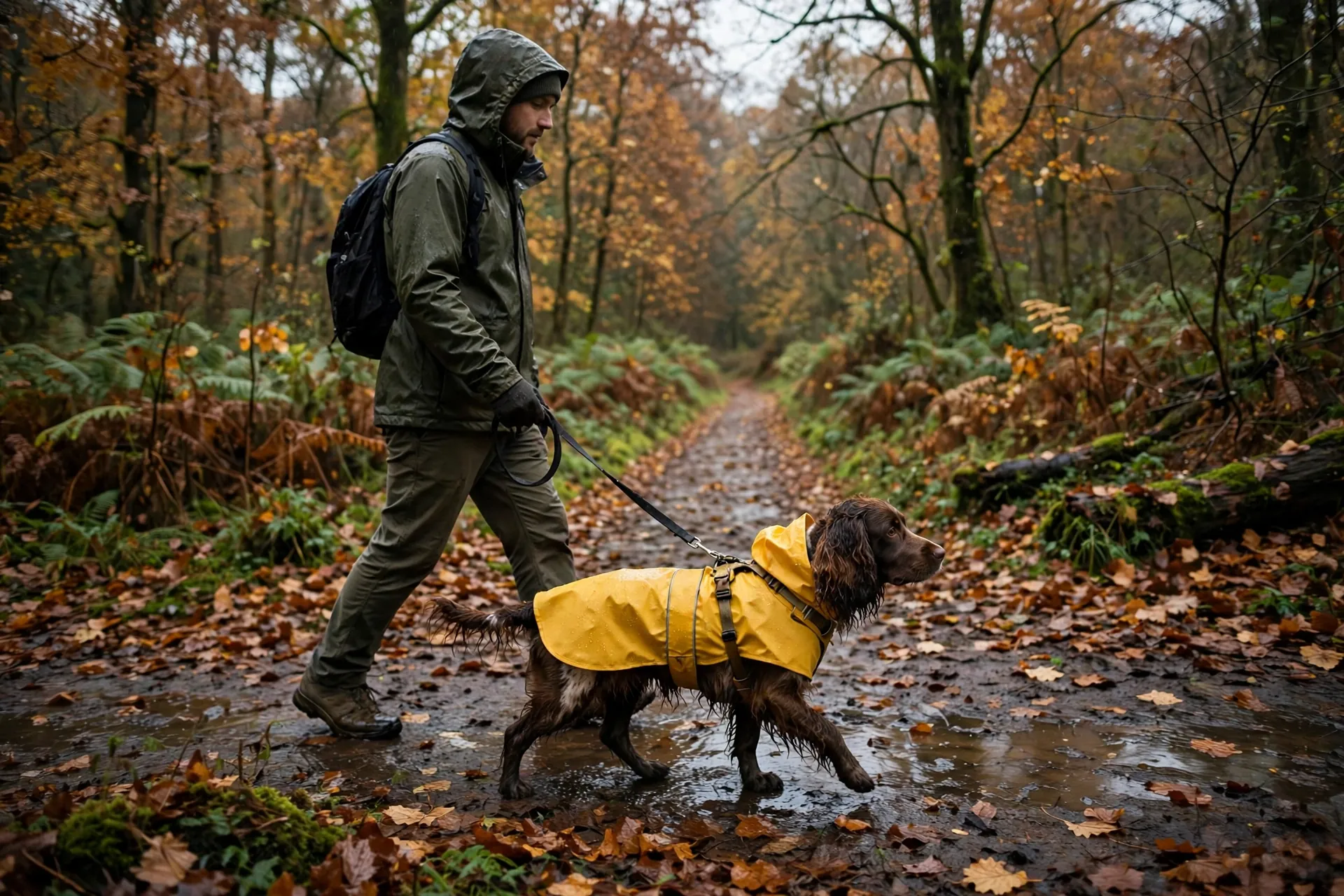
Protect the car as well as the dog. A waterproof boot liner, an old blanket over the back seat, and a towel on the seat where the dog travels will save a long clean at home. Keep a spare towel and a bag for muddy gear in the car, and change out of muddy boots before driving if you can. At home, a second towel-down, a check of paws and coat, and a drink of fresh water complete the routine. If your dog has been washed at the farm, make sure they are reasonably dry before a long drive, because a wet dog in a cold car can chill quickly in October. A drying coat worn for the journey home is often the simplest solution, and it keeps the car cleaner as well. Mud is not a reason to avoid pumpkin patches; it is a reason to pack properly and to leave time for cleaning, rather than rushing from field to car.
October crowds and off-peak strategy
Pumpkin patches follow a predictable October rhythm, and understanding it is the simplest way to give your dog a calmer visit. Early October is usually quiet: fields are open, pumpkins are plentiful, and visitors are spread across the month. Mid-October brings school groups, weekend families and the first Halloween events, and the final weekend before Halloween is often the busiest of the year, with timed tickets selling out, car parks filling early, and queues at food stalls, payment points and popular photo spots. The last weekend also brings the most noise, the most children in costumes, and the most dogs, which is a difficult combination for a reactive or anxious dog. If your dog struggles with crowds, early October on a weekday is not just a preference; it is the difference between a good visit and a stressful one.
Within a single day, timing matters almost as much as the date. Opening time is usually the quietest hour, because families with young children tend to arrive later in the morning, and coach groups often arrive mid-morning. A weekday arrival at opening gives you an empty field, a free choice of rows, and a car park close to the entrance, which shortens the walk with a dog and a wheelbarrow. Late afternoon can also be quieter, as day visitors leave, but light fades quickly in late October, and a muddy field in fading light is harder to navigate with a dog. The middle of the day, roughly eleven in the morning to three in the afternoon, is the peak on weekends, when queues, noise and congestion are at their worst. If you must visit at peak time, keep the visit short, choose a less popular field or row, and leave before the dog becomes overtired.
Weather interacts with crowds in ways that are easy to misread. A sunny Saturday after a wet week will be busier than a sunny Saturday after a dry week, because everyone has been waiting for a fine day. A drizzly weekday, by contrast, can be wonderfully quiet, provided you are prepared for mud and your dog does not mind rain. Check the forecast, but also check the farm's social media or booking page on the morning of the visit, because farms often post updates about field conditions, ticket availability and queue times. If a farm posts that it is very busy, believe it and consider another day, rather than hoping the crowd will thin by the time you arrive. A dog that arrives into a full car park and a long queue is already at a disadvantage before the visit begins.
Off-peak strategy also includes choosing the right farm, not just the right day. A large farm with multiple fields, a one-way system and timed entry will handle crowds better than a small farm with a single field and an open gate, even on the same Saturday. A farm that publishes a map, staggers entry and separates vehicle routes from pedestrian routes is signalling that it has thought about flow, and that usually benefits dogs as well as people. Conversely, a farm that relies on a single narrow entrance, a single payment point and a single cafe queue will feel crowded even with modest numbers. When you compare farms, look for these flow clues alongside the dog policy. A calm farm on a busy day is often a better choice than a busy farm on a quiet day, because the farm's layout shapes the dog's experience as much as the number of visitors does. For a broader autumn plan, our autumn dog holiday checklist covers warmth, waterproofing, lights and mud routines for the whole season.
Pumpkin safety: what dogs should not eat
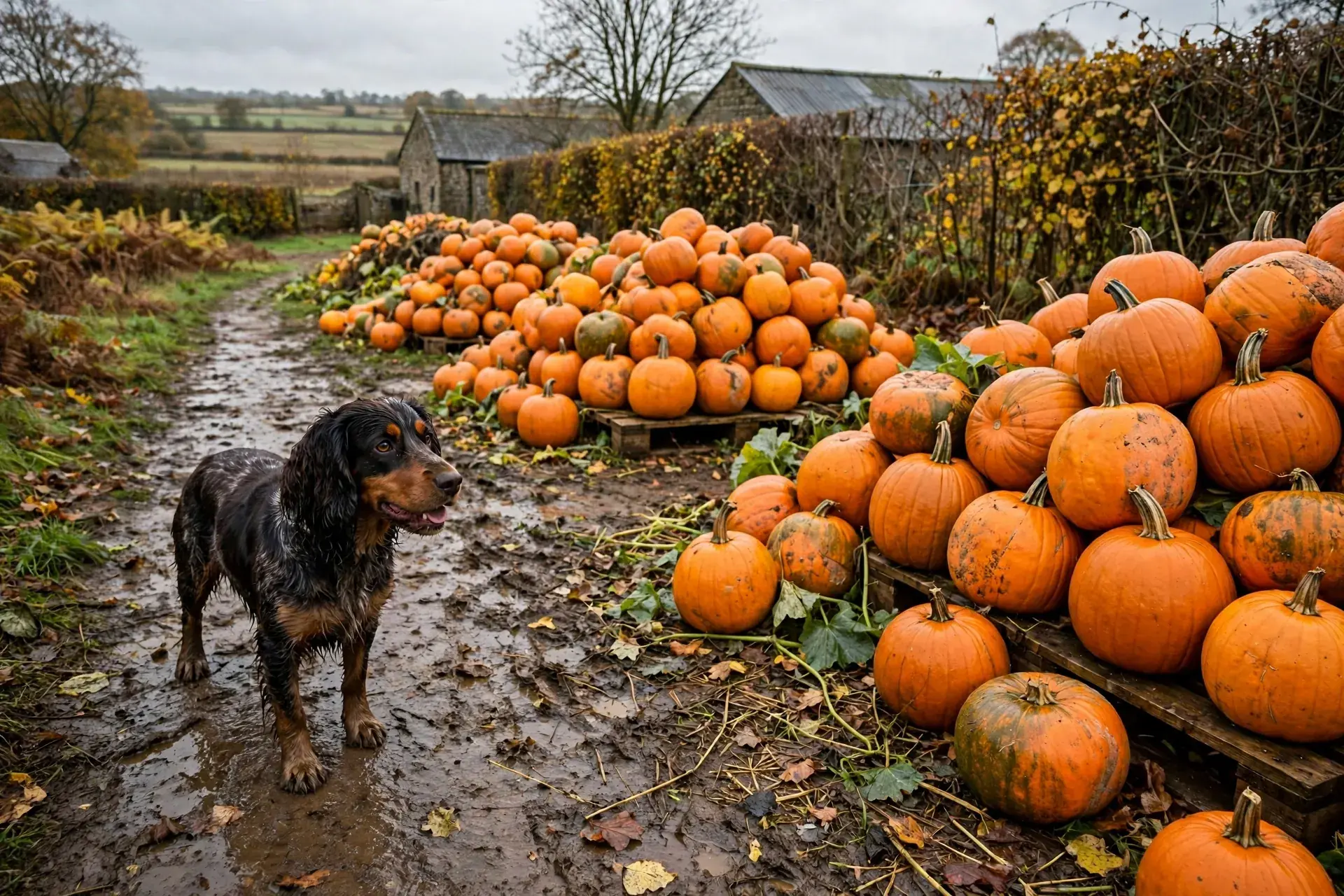
Pumpkin is a familiar autumn food, but a pumpkin patch is not a safe place for a dog to graze. Plain, cooked pumpkin flesh is often used in dog food and is generally considered safe in small amounts for healthy dogs, but that does not mean a raw pumpkin in a field is a suitable snack. Raw pumpkin is harder to digest, the skin is tough, and the stem is woody and indigestible. Leaves and vines are also unsuitable, and pumpkins that have been cut, dropped, left in the field for weeks or begun to rot can carry mould and bacteria. A dog that eats mouldy pumpkin, field waste or a pumpkin that other visitors have handled and discarded risks stomach upset at best and a veterinary visit at worst. The safest rule at a farm is simple: dogs do not eat pumpkins in the field, in any form.
Watch for the less obvious hazards as well. Pumpkins left to rot at field edges, in ditches or in waste piles are attractive to scavenging dogs precisely because they smell strongly, and they are the pumpkins most likely to be mouldy. Damaged pumpkins with soft spots, cuts or broken stems should be avoided by dogs as well as by shoppers. At Halloween, carved pumpkins left outdoors can develop mould quickly, and candles or lights inside carved pumpkins are a fire and ingestion risk if a dog knocks them over. At the farm itself, the main risks are stems, which can splinter or cause a blockage if swallowed, and the habit of mouthing pumpkins that other dogs have marked. If your dog picks up a piece of pumpkin, stem or vine, take it away calmly, offer a treat in exchange, and move on. Do not chase the dog around the field for it, because a chase often ends with the dog swallowing the item quickly.
Dogs with health conditions need extra care. Dogs with diabetes, pancreatitis, sensitive stomachs, food allergies or a history of blockages should not be given pumpkin treats at a farm, even if other dogs are eating them happily at home. Puppies, whose digestive systems are still developing, should not be given raw field produce. If your dog does eat something unsuitable at a farm, note what it was, how much was eaten and when, and watch for vomiting, diarrhoea, lethargy, loss of appetite or abdominal pain. Contact your vet promptly if any of these appear, or if your dog has eaten a large amount, a mouldy pumpkin or a stem. If you are unsure whether a food is safe for your dog, check the official guidance before you travel, and ask your vet rather than relying on a general article. This guide is not veterinary advice, and individual dogs vary.
Food safety extends beyond pumpkins. Farm cafes and food stalls sell hot food, drinks and seasonal treats that are not suitable for dogs, including chocolate, spiced drinks, foods containing xylitol or other sweeteners, and foods high in fat, salt or sugar. Keep dogs away from dropped food in food courts, and do not share human food from a stall as a reward for good behaviour, because a single shared bite can cause stomach upset and can teach a dog to beg at every stall. Bring your dog's own treats, in a pocket or a treat pouch, and use those for rewards. A familiar treat, given calmly at the right moment, is far more effective than a novel food, and it avoids the risk of an ingredient your dog cannot tolerate. If your dog has a known allergy, carry that information with you and be ready to explain it to other visitors who offer food, because well-meaning strangers often offer treats without asking.
Different dogs, different routes
There is no single ideal pumpkin patch route, because dogs differ so much in age, size, confidence and health. A young, sociable spaniel may enjoy a long walk through the field, a visit to the cafe terrace and a play area pass-through, while an older greyhound may prefer a short, level route, a quiet row and an early return to the car. A reactive dog may need a route that avoids the animal area, the play area and the busiest rows entirely, while a puppy may need frequent toilet breaks, short bursts of activity and a nap in the car between activities. Planning for the dog you actually have, rather than for an idealised dog, is what turns a generic day out into a good one.
Older dogs and dogs with mobility problems need a route check before you commit. Ask about the surface: firm headland paths, short grass and surfaced yard areas are far easier than deep mud, ruts and steep banks. Ask about distance from car park to field, field to cafe, and cafe to toilets, because a farm that looks compact on a map can involve several hundred metres of walking in practice. A dog with arthritis may manage a short picking walk but not a full farm tour, and a dog recovering from surgery should not be taken to a muddy field at all without veterinary advice. Bring a portable ramp if your dog travels in a high vehicle, a non-slip mat for the car boot, and a familiar bed or blanket for rest breaks. If your dog tires, cut the visit short without guilt. A short, happy visit is better than a long visit that ends with a sore, exhausted dog.
Puppies and adolescent dogs need a different kind of planning. A puppy under a year old is still learning to cope with novelty, and a pumpkin patch in October is a high-novelty environment. Keep the visit short, perhaps thirty to forty-five minutes in the field, with plenty of toilet opportunities and a calm exit before the puppy becomes overtired. Avoid letting a puppy greet every dog and every child, because overstimulation in a busy farm can lead to mouthing, jumping and an inability to settle afterwards. Carry the puppy through the busiest sections if they are small enough, or use a quiet path around the edge. Check vaccination status before any farm visit, and avoid areas where other dogs have toileted if your puppy is not fully vaccinated. If in doubt, check the official guidance before you travel and ask your vet about farm visits for puppies.
Reactive, anxious and noise-sensitive dogs can still enjoy a pumpkin patch, but only with a deliberately quiet plan. Choose early October, a weekday, opening time, and a farm with multiple fields so you can move away from crowds. Avoid the animal area, the play area and the food court at peak times, and use the picking field's outer rows, where there is space to move aside. Bring a familiar blanket, a long-lasting chew for a rest break in a quiet corner, and a plan for leaving early if the dog's stress signs increase. Signs to watch for include panting when it is not hot, yawning, lip licking, turning away, tucked tail, ears pinned back, inability to take treats, and a sudden change from calm to frantic. If you see several of these together, leave. Leaving early is not a failure; it is good handling, and it preserves the dog's confidence for the next visit. A dog that leaves calmly will enjoy the next farm visit more than a dog pushed past its limit.
What to pack for a pumpkin patch day
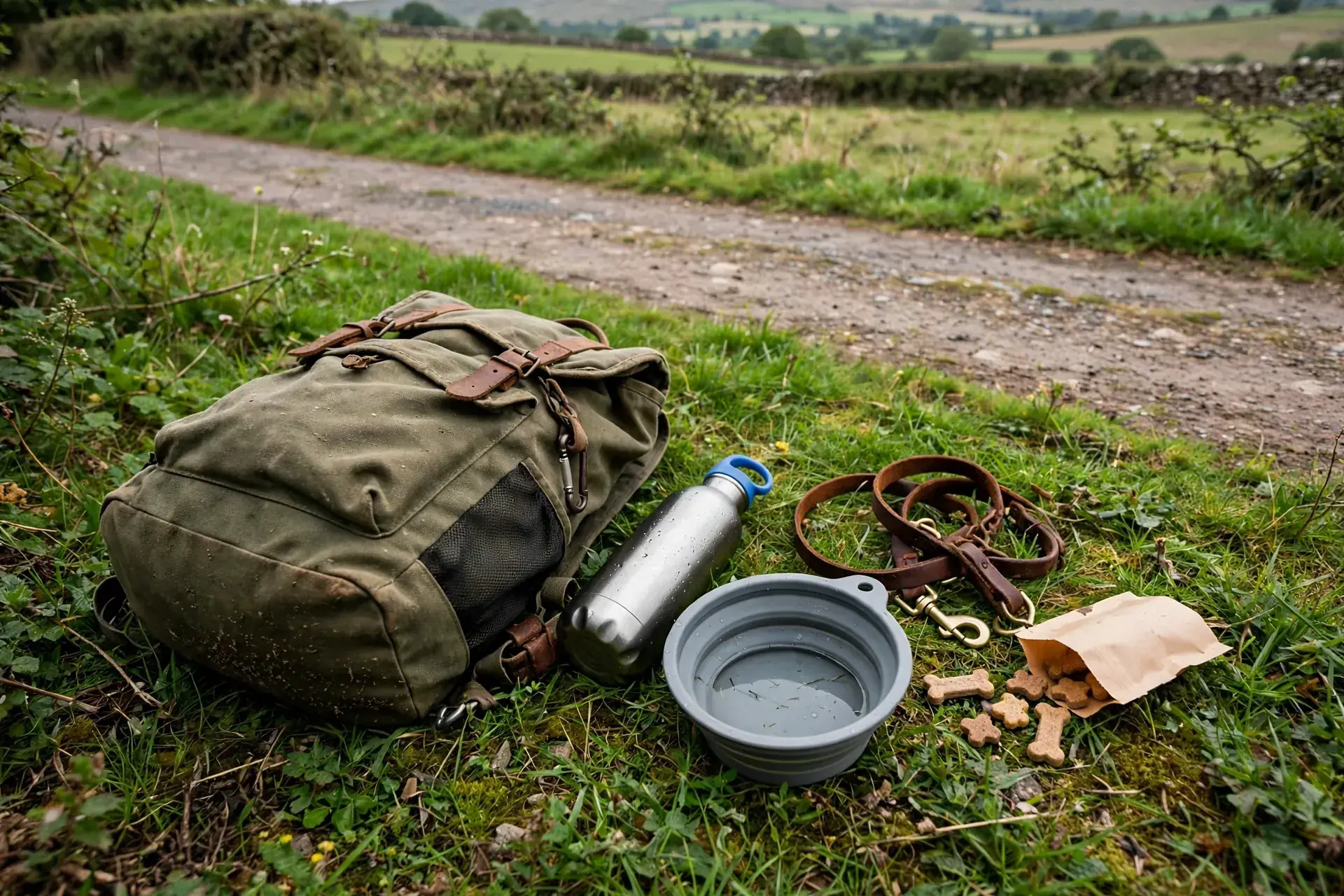
Packing for a pumpkin patch is closer to packing for a muddy country walk than for a shopping trip, and the list is worth writing out the night before. Start with the dog essentials: a secure lead, a harness or collar with an ID tag, poo bags, water and a bowl, your dog's usual treats, and any medication your dog needs. Add a towel, or preferably two, and a drying coat if your dog wears one. A small first aid kit for dogs is sensible for any farm visit: a bandage, antiseptic wipes suitable for dogs, tick tweezers and your vet's phone number saved in your phone. If your dog wears boots, pack them and a spare, because a lost boot in a muddy field is a common problem. If your dog does not wear boots, pack extra towels instead.
For people, waterproof boots with good grip are the single most important item, followed by a waterproof jacket, layers for a cold wind, and gloves that still allow you to hold a lead and a wheelbarrow handle. A rucksack or a cross-body bag works better than a handbag, because your hands need to be free for the dog, the wheelbarrow and the pumpkins. Bring cash or a card for tickets, food and pumpkin payment, and keep your phone charged for maps, farm updates and photographs. A plastic bag for muddy boots, a spare pair of socks, and a change of clothes for children will all be appreciated after a muddy field. If you plan to buy large pumpkins, bring a blanket or a box for the car boot to stop them rolling, and a pair of gardening gloves if you prefer not to handle muddy stems with bare hands.
Think about food and drink for the group as well as the dog. A farm cafe may have a queue, and a hungry group with a restless dog is a difficult combination. Pack water for everyone, a snack for the journey, and your dog's usual food if the visit will span a mealtime. Do not rely on the farm shop for dog food or treats, because most farms do not sell them. If your dog is on a special diet, bring enough food for the day plus a spare portion in case the visit runs longer than planned. A collapsible bowl is light and easy to pack, and a bottle of clean water for the dog is essential if the farm has no dog water point in the field. In October, daylight fades early, so a torch or a phone light for the walk back to the car is worth packing for late-afternoon visits.
Finally, pack for the journey home. A waterproof seat cover or an old blanket, a towel for the car seat, a bag for muddy gear, and a spare lead in case one gets muddy or broken will all make the drive home pleasanter. If your dog travels in a crate, line it with a towel that can be washed, and keep a dry blanket for the dog to lie on after a towel-down. If your dog travels on the back seat, a harness that attaches to the seat belt keeps the dog safe and keeps mud off the driver. Leave a change of clothes and a pair of clean shoes in the car for the driver, because driving in muddy boots is uncomfortable and unsafe if the pedals become slippery. A little preparation the night before turns a muddy farm visit from a chore into a story worth telling.
After the visit: car, home and leftovers
The visit does not end at the farm gate. A calm journey home, a proper clean at home, and sensible storage of pumpkins all matter, and they are easier if you plan them before you leave. In the car, settle the dog first, with a familiar blanket and a drink if the journey is long, and secure pumpkins so they cannot roll into the dog or onto the driver. A pumpkin rolling in the boot during braking is a hazard, and a dog loose in a car with rolling pumpkins is a distraction. Keep the car ventilated but not cold, especially if the dog is still damp, and stop for a toilet break on a long journey home rather than pushing through with a dog that needs to go. A short stop on grass, away from traffic, is better than an accident in the car.
At home, check your dog thoroughly. Look at paws for cuts, thorns and mud packed between toes, check the belly and legs for scratches from stems, and check ears for seeds, straw or debris picked up in the field. Brush out any burrs or tangles while the coat is still slightly damp, because dried mud and tangles are harder to remove later. Give your dog fresh water, a normal meal at the usual time, and a quiet rest. A dog that has had a busy farm visit may sleep heavily afterwards, and that is normal, but watch for limping, vomiting, diarrhoea or unusual lethargy in the hours after the visit, and contact your vet if any of these appear. Wash towels, drying coats and muddy gear promptly, because October mud left in a bag will smell quickly and can harbour bacteria.
Pumpkin storage deserves a paragraph of its own, because a pumpkin bought in October may need to last until Halloween or beyond. Store uncarved pumpkins in a cool, dry place out of direct sunlight, with air circulating around them, and check them regularly for soft spots or mould. A pumpkin with a soft spot should be used or discarded promptly, and a mouldy pumpkin should not be left where a dog can reach it. Carved pumpkins last only a few days, especially outdoors, and should be kept away from dogs, candles and heat sources. If you bought cooking pumpkins, use them promptly and store cooked pumpkin in the fridge, not at room temperature. If you are unsure how long a variety keeps, ask the farm or check the official guidance before you travel, because storage life varies by variety and by how the pumpkin was handled in the field.
Finally, keep a short note of what worked and what did not, for next year. Which farm welcomed dogs in the field, which route was firmest, which time was quietest, and what you wish you had packed? A few lines in a phone note will save you repeating the same mistakes next October, and they will help you choose a farm more confidently next time. Pumpkin patches change each year: fields rotate, routes change, animal areas move, and dog policies are updated. A note from this year, combined with a fresh check of the farm's current policy next year, is the best preparation there is. If this visit went well, consider sharing the farm's dog policy with other dog owners, because clear, current information about dog-friendly farms is genuinely useful, and farms that welcome dogs well deserve to be recognised for it.
Practical questions
Before you go
Are dogs allowed in pumpkin picking fields, or only in the car park and cafe?
It varies by farm. Some farms welcome dogs in the picking field on a lead, while others restrict dogs to outdoor seating, paths or a separate exercise area. Check the farm's own dog policy for the exact field you plan to visit before you travel, and confirm whether the rule changes at peak weekends.
Can my dog eat pumpkin picked at the farm?
Plain cooked pumpkin flesh is often fed to dogs in small amounts, but raw pumpkin, stems, leaves and mouldy or rotting pumpkins are a different matter. Do not let your dog chew stems, eat field waste or help itself to damaged pumpkins, and check the official guidance before you travel if your dog has a sensitive stomach or a health condition.
What should I do if the farm has animals my dog wants to chase?
Keep your dog on a short lead, stay on marked visitor routes and keep a clear distance from pens, fences and feeding areas. If your dog is highly aroused by livestock or poultry, skip the animal area entirely and use the picking field and cafe terrace instead. Never let a dog approach, bark at or worry farm animals, even through a fence.
How muddy do pumpkin patches get in October?
Very muddy after rain, especially on bare soil between rows, at field entrances and around wheelbarrow routes. Wear waterproof boots, bring towels and a drying coat, and plan a wash or towel-down before the car journey home. Farms on heavy clay soil and low-lying fields tend to hold water longest.
When is the quietest time to visit a pumpkin patch with a dog?
Weekday mornings in early to mid-October are usually quieter than the final weekend before Halloween, when timed-entry slots, school groups and families can make fields and car parks very busy. Arrive at opening, avoid the middle of the day at weekends, and check whether the farm uses timed tickets before you set off.