This guide is independent and contains no paid placement. If affiliate links are added later, they will be clearly marked and will not change our editorial checks.
Do not try to outrun the rain. Give the week a rhythm instead: one drying routine used every time, one short walk and one thinking game each day, one indoor outing, one slow day, and one day trip with a backup already chosen. That rhythm is what makes a rainy staycation feel like a holiday rather than a week stuck indoors.
A wet forecast is a different holiday, not a ruined one
Most dog holidays fail in rain for the same reason: the plan was written for sunshine and then patched, day by day, as each outing fell apart. The walk gets longer because it feels like compensation, the dog comes home soaked and overtired, the cottage floor gets muddier, and everybody ends the day slightly resentful of weather nobody could control. A rainy-week staycation works better when it is planned as its own kind of holiday from the start, with its own pleasures, its own pace and its own definition of a good day.
The first reframe is about distance. Dogs do not measure a good day in miles. A dog measures it in smells investigated, problems solved, people greeted, food earned and rest taken in a safe place. A forty-minute sniff walk in drizzle, where the dog chooses the pace and stops at every interesting verge, can leave a dog more satisfied than a two-hour march along a windswept ridge in driving rain. Rain actually helps here: wet ground holds scent longer, puddles are interesting, and quieter paths mean fewer encounters to manage. The week below is built on that observation, and on a second one, which is that rest is part of the holiday, not a failure to fill the day.
The second reframe is about the house itself. On a dry holiday, the cottage or rented house is mostly a base, a place to sleep between outings. On a rainy staycation, it becomes the main venue, and it deserves the same care you would give to choosing a walk. A home with a porch or utility room, a hard floor by the door, a garden or yard for quick toilet trips, and a comfortable corner where the dog can settle while you cook is worth more in a wet week than a prettier property with white carpets and no drying space. If you are staying at home rather than renting, the same logic applies: choose one room as the dog's rainy-week headquarters and set it up properly on day one, instead of improvising a towel system every evening.
The third reframe is financial and practical. A staycation already removes flights, long drives and much of the cost of a conventional holiday, and rain removes some of the remaining pressure: there is less reason to drive an hour to a famous beach, less temptation to book an expensive attraction to justify the day, and more reason to spend money locally, in small amounts, on things that genuinely help. A good raincoat for the dog, a second set of towels, a puzzle feeder, a covered market visit and one decent pub lunch will usually cost less than a single day out that everybody endures in a downpour. If you are weighing the season as a whole, our autumn dog holiday checklist covers the wider preparation for darker, wetter days, including lights, warmth and seasonal rule changes.
Finally, lower the bar for what counts as success. A successful rainy day is one where the dog has toileted comfortably, eaten, sniffed something new, solved something small, rested properly and gone to bed dry. That is a full day for most dogs. The plan below follows that standard across seven days, with enough variety that no two days feel identical, and enough repetition that the dog learns the routine quickly. Dogs settle faster when they can predict the shape of a day, and a predictable week is a calmer week for everyone in the house.
Day 1: Settle in and build the drying station
Day one sets the tone for the entire week, so resist the urge to cram it full. If you have travelled to a rental, arrive in daylight if you possibly can, because finding the toilet area, the bin store, the nearest tap and the best drying spot is much easier before dark, and a dog that knows where to toilet on the first evening will sleep better on the first night. Walk the boundary of the garden or the immediate surroundings before you unload everything, checking gates, gaps in fences, low windows and anything edible or sharp at nose height. Photograph any existing damage to the property, move cleaning products and anything toxic out of reach, and put the dog's bed in its agreed spot straight away, with a familiar blanket on top. Dogs read consistency as safety, and a bed that smells of home in a new room is worth more than any welcome pack.
Then build the drying station, and treat it as a proper piece of household infrastructure rather than a pile of towels by the door. The ideal station has a hard or tiled floor, a hook for the lead, a lidded box or bucket for muddy leads and boots, a stack of towels within reach, a drying coat if your dog will wear one, and a mat or old towel under the food and water bowls if those live nearby. Two sets of towels is a minimum for a wet week, because one set will often still be damp when the next walk ends. Microfibre towels dry dogs quickly and take up little space, but ordinary bath towels work perfectly well if you have enough of them and a place to hang them. A portable dog dryer is a luxury rather than a necessity, and some dogs dislike the noise, so introduce it gradually at home before relying on it during a holiday week.
The drying routine itself should be short, calm and identical every time. Lead off at the door, paws wiped or rinsed if they are muddy, body towelled from neck to tail, ears checked for trapped water if your dog is prone to ear problems, and then the drying coat on for twenty minutes while the dog settles with a chew or a drink. Keep the routine boring on purpose: no excited greeting, no chase around the house, no towel game that ends with a wet dog sprinting through every room. If the dog is very muddy, a rinse with lukewarm water in a shower, bath or outdoor tap is faster and kinder than scrubbing with a dry towel, but dry the dog thoroughly afterwards, especially the belly, legs and between the toes, where damp skin can become sore over a wet week. Check the official guidance before you travel if your dog has a skin condition, because some conditions change what products and drying methods are appropriate.
Food, rest and an evening walk complete day one. Feed at the usual time, keep the evening walk short and familiar, and let the dog explore the house at its own pace rather than touring every room on a lead. If you are staying at home, the same first-day discipline still pays off: clear the hallway, set up the station, and agree who dries the dog and who makes the tea, because the fastest way to ruin a rainy week is to argue about mud on the carpet on the first night. End the day with a note of what worked: which towel stack ran out, whether the coat fitted over a harness, and where the dog chose to sleep. Those small observations become the improvements for day two.
Day 2: Indoor enrichment and training games at home
Day two is the indoor day, and it is the day that proves the whole staycation can work. Start with a short morning toilet walk, no longer than the dog needs, and then bring the energy indoors deliberately. The aim is not to exhaust the dog physically but to tire the brain, because mental work is genuinely tiring for dogs in a way that owners often underestimate. A dog that has spent twenty minutes solving problems, sniffing out hidden food and practising known cues will often settle for a long nap afterwards, and that nap is the proof that the session worked.
Scent games are the easiest place to begin, and they need almost no equipment. Scatter a portion of the dog's breakfast kibble in the garden or across a room so the dog has to search rather than eat from a bowl, hide treats in cardboard boxes, rolled-up towels or muffin tins covered with tennis balls, or lay a simple scent trail by dragging a treat along the floor and hiding the reward at the end. Start easy so the dog succeeds quickly, then make the hides slightly harder across the week. For dogs that already enjoy searching, a formal "find it" game, where you hide a scented cloth or a specific toy and ask the dog to search room by room, can fill a whole afternoon in short bursts. Keep each session to five or ten minutes, with rest between rounds, because a frustrated dog is not an enriched dog, and ending on a success keeps the dog keen for the next session.
Training games work just as well indoors and have the added benefit of strengthening the cues you will need on wet walks later in the week. Practise recall between two people in different rooms, rewarding the dog for coming promptly; practise a solid "wait" at internal doors, which translates directly to safer road crossings and muddy gates; and practise settling on a mat, rewarding calm behaviour on the mat for gradually longer periods. New tricks are also fair game on a rainy day: a nose touch to your hand, a spin, a "middle" position between your legs, or a polite paw all give the dog a problem to solve and give you something to laugh about together. Keep the tone light, use food rewards the dog values, and stop before the dog loses interest, because a short happy session beats a long drilling session every time.
Puzzle feeders and food toys deserve a place on day two as well, and they are covered in more detail on day five, but the principle is worth establishing now: food earned through effort is more satisfying than food delivered in a bowl, and it slows down fast eaters at the same time. A stuffed Kong, a snuffle mat, a lick mat smeared with a dog-safe spread, or kibble hidden in a rolled towel all count, and rotating between them keeps the novelty alive across the week. Watch the total daily food allowance, though, because treats used for training and enrichment still count as calories, and a week of generous rainy-day rewards can quietly add up. Reduce the bowl portion by roughly the amount used in games, and save the richest rewards for the hardest tasks.
Finish day two with a calm evening. A short garden toilet trip, a gentle grooming session if the dog enjoys it, and an early settle on the mat or bed will show you whether the indoor approach is working. If the dog is restless, the answer is usually not a longer walk in the dark but a second short scent game before bed, or a chew that gives the jaw something lawful to do. Note what tired the dog most: scent work, training, food puzzles or a combination. That note becomes the template for the slow day on day five and for any future day when the forecast turns truly foul.
Day 3: Covered markets, garden centres and dog-friendly indoor venues
By day three, most dogs and most owners are ready to go somewhere, and a covered outing scratches that itch without pretending the weather does not exist. Covered markets, garden centres, farm shops with indoor areas, pet shops, bookshops that welcome dogs, and larger homeware stores are the backbone of a rainy-week staycation, because they offer novelty, smells, people and a roof in roughly equal measure. The dog gets a genuine outing, with new surfaces, sounds and scents to process, and you get to browse, shop and have a coffee without standing in a downpour holding a lead in one hand and an umbrella in the other.
Preparation matters more than destination. Before you set out, confirm that dogs are welcome inside, not only on an outdoor terrace or in a car park, because the difference matters enormously in rain. Some garden centres welcome dogs throughout, others restrict them to certain departments, and a market hall may welcome dogs while individual stalls have their own rules. Check the official guidance before you travel when a venue's policy is unclear, and have a second venue in mind in case the first is unexpectedly closed or crowded. Our guide to dog-friendly cafes explains how to check indoor policies properly, and the same checks apply to any indoor venue: ask about size limits, lead rules, whether dogs must stay on the floor, and where the nearest toilet area is.
On arrival, give the dog a moment to take in the new environment before expecting good behaviour. A few minutes of sniffing near the entrance, a drink if one is offered, and a calm walk around the quieter aisles first will settle most dogs far better than marching straight to the busiest section. Keep the lead short but not tight, reward calm glances at people and other dogs, and watch for signs that the dog has had enough: yawning, lip licking, pulling towards the exit, or a sudden inability to respond to a known cue. A successful indoor outing for a dog is often shorter than the owner planned, perhaps thirty to forty-five minutes, and leaving while the dog is still coping is much better than pushing on until the dog is overwhelmed and the rest of the week has to repair the experience.
Etiquette in indoor venues is simple but worth stating plainly. Keep the dog off displays, food counters and other people's shopping, clean up immediately if there is an accident, and do not let the dog approach other dogs or children without an invitation. A mat or blanket for the dog to lie on in a cafe area gives the dog a defined job, which is to settle, and gives other visitors a clear signal that the dog is under control. If the venue has a cafe, a short sit-down with a drink is a useful training opportunity in itself: the dog learns that cafes mean lying quietly and watching the world, and you learn how long your dog can realistically manage before restlessness sets in. That knowledge is valuable for every future trip, wet or dry.
End the day with a practical review. Which venue worked best, and why? Was it the quieter garden centre with wide aisles, or the market hall where the dog could watch people from a corner? Did the dog cope better before lunch or after a nap? A rainy week is an excellent time to build a personal list of reliable indoor venues near home or near a favourite rental area, because that list will serve you on every future wet weekend, not just this one. Write it down, with opening hours and dog rules, while the details are fresh.
Day 4: Short wet walks that still tire a dog
Day four returns outdoors, but on rainy-week terms: short, sniffy, and chosen for ground conditions rather than scenery. The goal is a walk that tires the dog through interest and movement, not a route that impresses a step counter. Two shorter walks in a day will usually serve a dog better than one long slog, because the dog gets two rounds of novelty and two chances to toilet comfortably, and you get two chances to dry the dog properly rather than one epic drying session after an epic soaking.
Route choice is the skill of the day. Woodland paths with a canopy overhead stay drier than open fields, forestry tracks and surfaced trails hold up better than clay paths and riverside meadows after days of rain, and a sheltered valley walk beats an exposed coastal path when the wind is up. A beach in rain can be wonderful, because the sand is firm, the crowds are gone and the dog can run freely where local rules allow, but check the tide, the wind and the access path before you go, and keep the dog on lead near cliffs, swollen streams and sea defences. Avoid flooded paths, fast-moving water and fields with livestock in wet weather, when gates are heavy, ground is slippery and visibility is poor. When a route is uncertain, check the official guidance before you travel, and choose the safer surfaced option without feeling that you have settled for second best.
Technique matters as much as route. Let the dog sniff. This is the single most effective way to tire a dog on a short walk, and it costs nothing. Walk on a long line where it is safe to do so, so the dog can range, investigate verges and work scent without pulling, and pause whenever the dog pauses, because a dog that is sniffing is a dog that is working. Scatter a few treats in grass or leaf litter for a searching game midway through the walk, practise recall a couple of times when the dog is already coming towards you, and finish with a calm walk home rather than a sprint, so the dog arrives at the door in a settled state and the drying routine can begin without a chase. For older dogs, puppies and dogs with joint problems, keep the walk shorter still, choose flat and even ground, and watch for limping, reluctance or a sudden change of gait, which are reasons to turn back early.
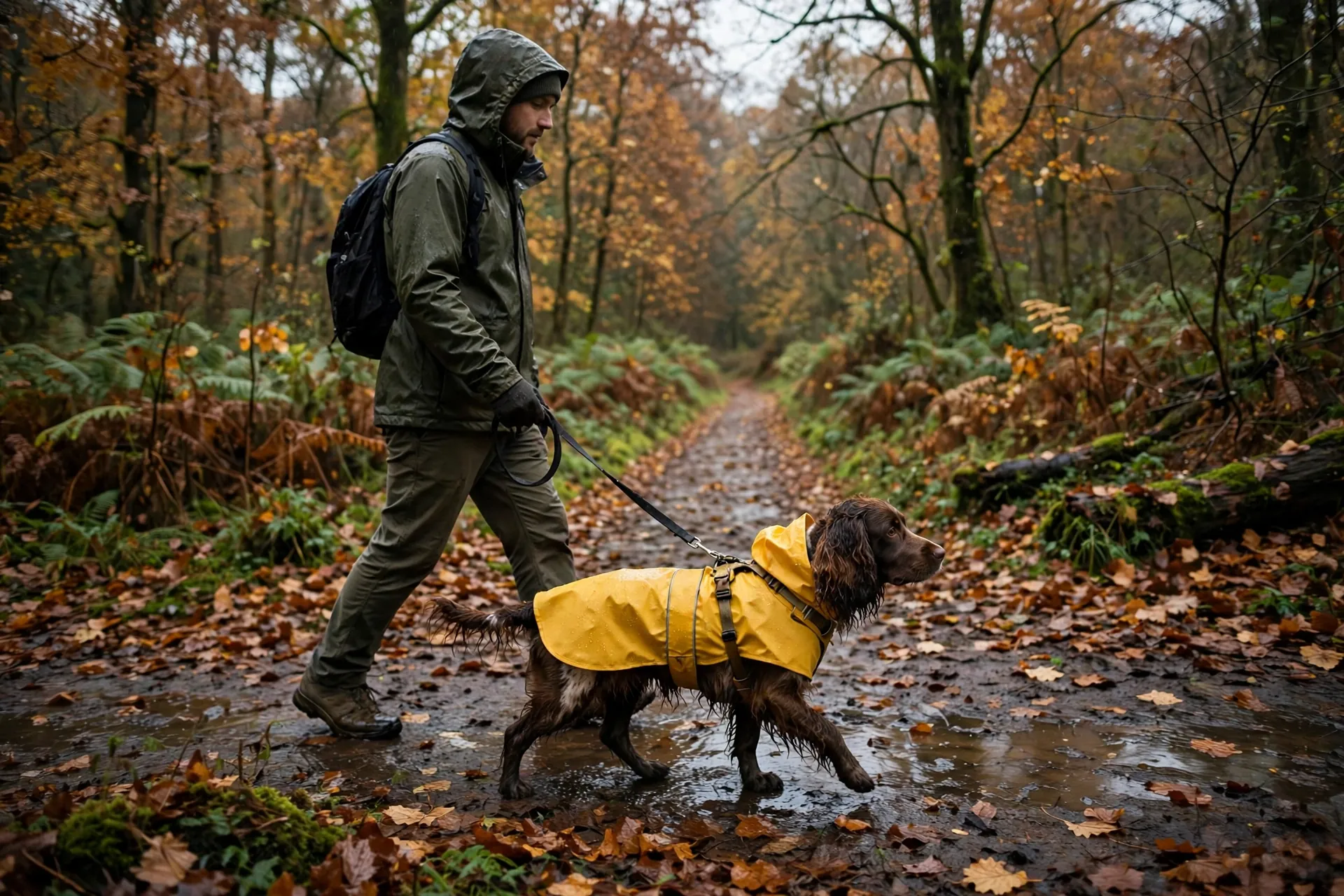
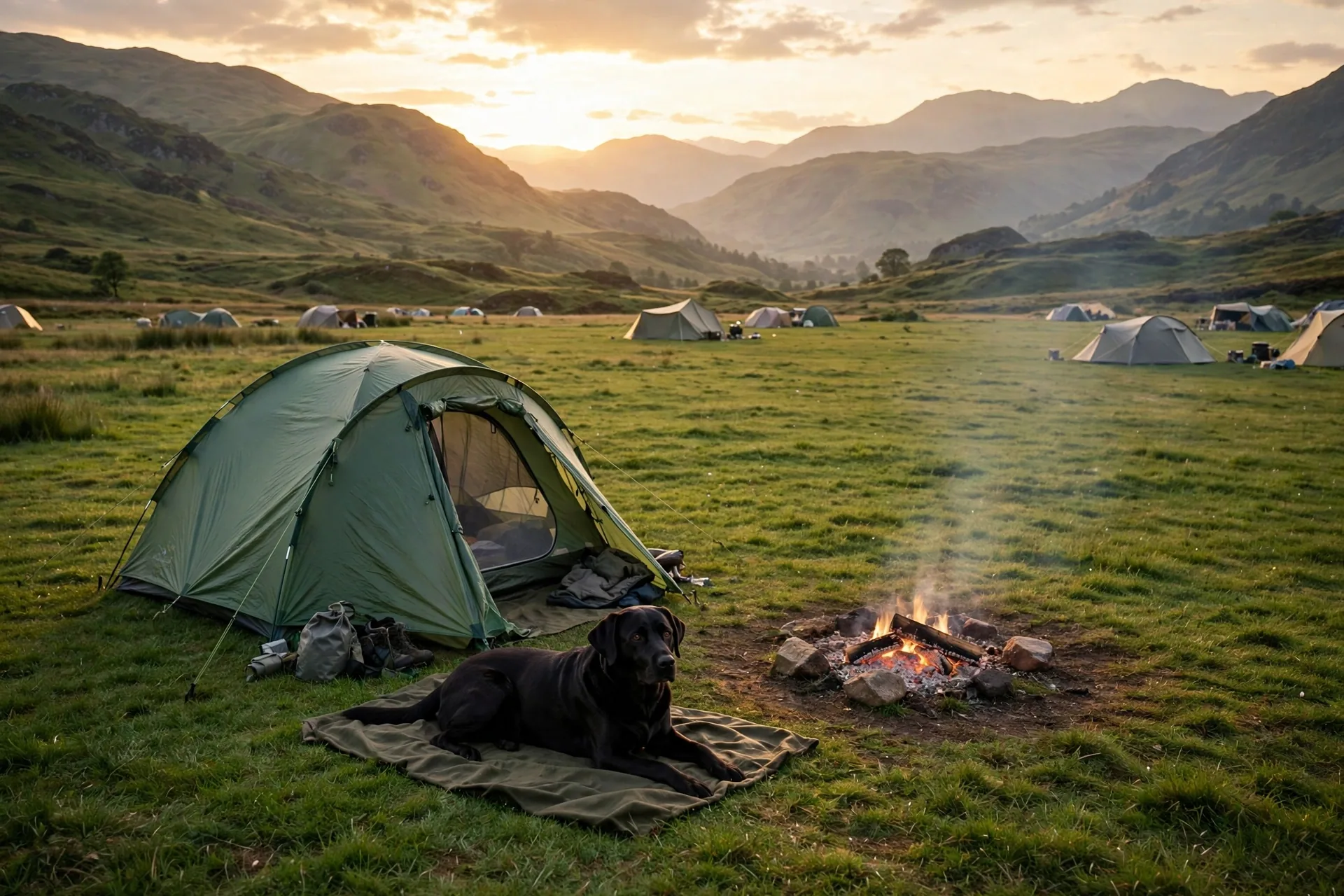
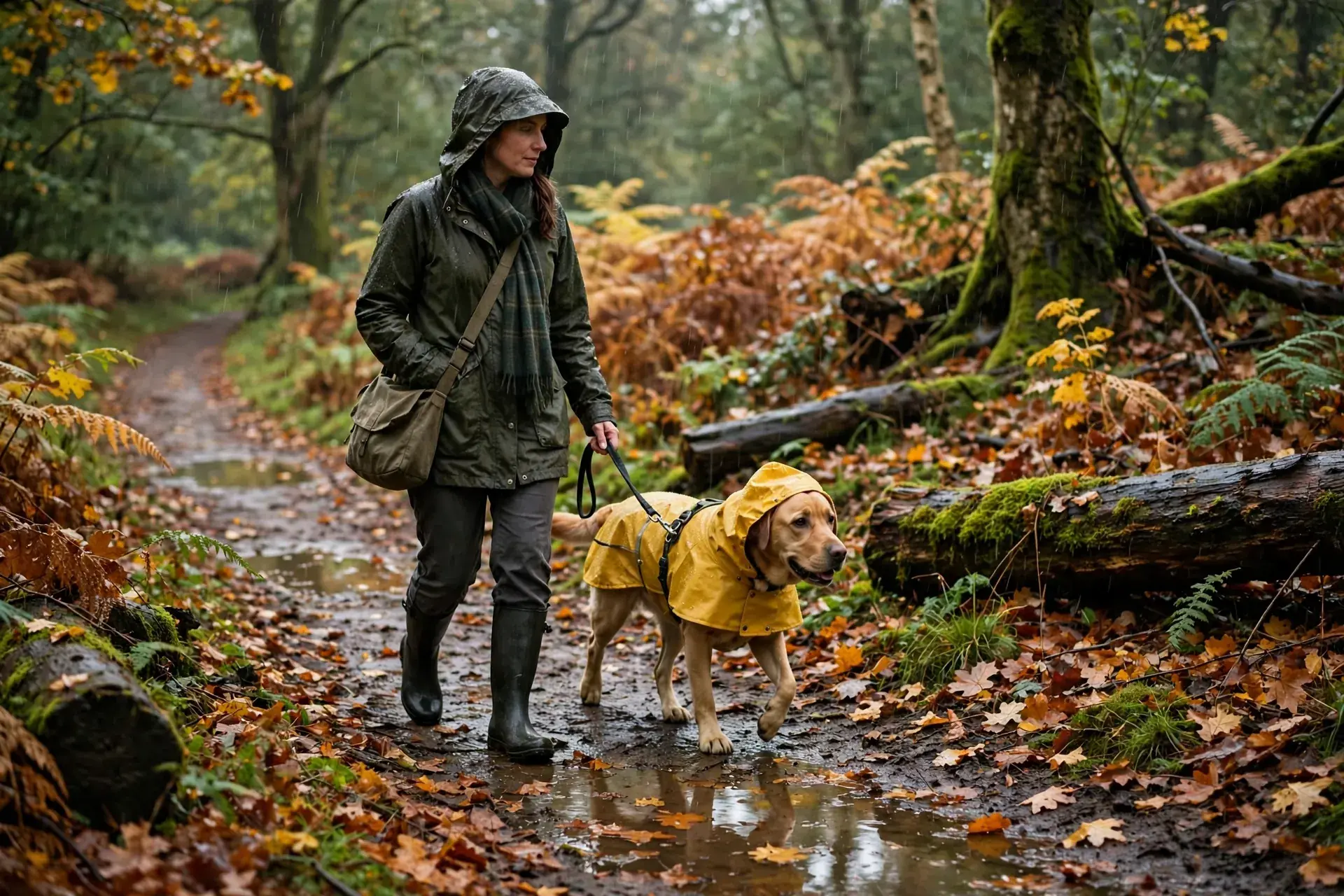
Clothing and kit complete the picture. A well-fitting waterproof coat keeps many dogs comfortable and dramatically reduces drying time, but it must allow free leg movement and must not rub at the neck or belly, so try it at home before relying on it for a week. A harness that fits over the coat, a lead that is comfortable when wet, and a towel or drying coat waiting at the door are the rest of the system. For the owner, waterproof trousers are often more useful than a better jacket, because wet legs make the whole walk miserable and shorten it unnecessarily. If you camp in wet weather as well as staycation, the same ground and drying logic applies, and our camping with a dog guide covers tent drying, sleeping arrangements and wet-weather site choices in detail.
Back home, use the drying station exactly as on day one, and then let the dog rest properly. A wet walk followed by a warm, dry settle is one of the great pleasures of a rainy week for a dog, and it is worth protecting: no immediate second outing, no bath unless genuinely needed, and a drink and a chew while the coat dries. If the dog sleeps deeply after a short sniff walk, that is not laziness. That is the walk working exactly as it should.
Day 5: A slow day of grooming, rest and puzzle feeders
Day five is deliberately slow, and it is the day that many staycations need most by midweek. After two outing days, the dog has had plenty of novelty, and a day built around rest, grooming and quiet food puzzles lets the dog consolidate everything it has learned. Owners sometimes worry that a slow day means a bored dog, but boredom and rest are not the same thing, and a dog that has been well exercised mentally and physically for four days will usually welcome a quieter rhythm, especially if the slow day still contains interesting food, gentle touch and short garden breaks.
Grooming is the centrepiece, and it works best when treated as a calm bonding activity rather than a chore to rush through. Brush the coat thoroughly, checking for mats behind the ears, in the armpits and between the toes, where wet-week tangles form quickly. Check paws for cracks, cuts, thorns or trapped grit, and trim nails if they need it, or at least check their length, because long nails change a dog's gait and become more troublesome on slippery wet ground. Clean ears gently if your dog is prone to ear problems after wet walks, and check the teeth and gums while you are at it, because a slow day is the ideal time to notice small changes. Keep sessions short, reward calm cooperation, and stop before the dog becomes fidgety, because grooming should end as a pleasant memory, not a struggle.
Puzzle feeders carry the mental work on a slow day. Rotate through the full collection: a stuffed Kong frozen overnight, a snuffle mat with breakfast scattered through it, a lick mat with a thin smear of dog-safe spread, a rolled towel with kibble hidden in the folds, and a simple cardboard box puzzle with treats inside boxes within boxes. Spread these across the day rather than offering them all at once, so the dog has something to look forward to at intervals, and keep the total food within the daily allowance by reducing the bowl portion accordingly. For dogs that gulp food, puzzle feeders also slow eating and reduce the risk of stomach discomfort, which is a genuine benefit after a week of richer training treats. If you are trying a new feeder for the first time, supervise the dog, because some dogs chew puzzle toys apart when frustrated, and a slow day should not end with a vet visit.
Rest itself deserves active protection on day five. Give the dog a quiet corner away from foot traffic, keep the television and music at a moderate level, and avoid inviting visitors or starting noisy household projects that undo the calm. Dogs sleep for much of the day in any case, and a slow day simply lets that sleep happen without interruption. A short garden toilet trip every few hours, a brief scent game in the afternoon, and a gentle evening walk around the block are enough activity to keep the day feeling like a holiday rather than a confinement. By the evening, most dogs will be visibly settled, and owners often report that the slow day is the night their dog sleeps best all week, which tells you everything about how much rest matters.
Day 6: A local day trip with a wet-weather backup
Day six is the expedition day, kept local on purpose. A day trip within an hour of base, rather than a long drive to a famous destination, leaves more time for the outing itself and less time for a wet dog in a car. Choose a place with a genuine dog appeal: a country house with dog-friendly grounds and an indoor cafe, a coastal town with a covered market and a beach that allows dogs at that time of year, a woodland visitor centre with surfaced trails and a sheltered picnic area, or a village with a dog-friendly pub, a riverside walk and a shop worth browsing. The best rainy-week day trips have at least two dog-friendly elements, so that if one disappoints, the other still makes the journey worthwhile.
The wet-weather backup is not an afterthought; it is half the plan, and it should be chosen before you leave home. Pick an indoor venue in the same area as the main outing, confirm its dog policy and opening hours, and decide in advance what forecast will trigger the switch. A useful rule is to switch if heavy rain is forecast for the whole outing period, if wind speeds make exposed walking unpleasant, or if the main route is likely to be flooded or dangerously muddy. Write the trigger down, because deciding in the car, with a wet dog and a disappointed family, is much harder than deciding at the breakfast table. When the backup is used, treat it as a successful change of plan rather than a consolation prize, because the dog will take its cue from your mood, and a cheerful switch to a garden centre cafe beats a miserable persistence with a flooded path.
Travel planning for a wet day trip is mostly about the car. Line the boot with an old towel or a waterproof liner, pack a second towel and a drying coat for the return journey, and bring water and a bowl so the dog can drink without sharing yours. Take a spare lead, a poo bag supply that is larger than you think you need, and a change of socks for yourself, because dry feet change the whole journey home. If the dog is prone to car sickness, feed a smaller breakfast and allow a settling stop before the main walk, and if the dog is anxious in the car, keep the journey short and the destination familiar rather than ambitious. On arrival, follow the same pattern as day three: a moment to sniff and settle, a short walk first, and a cafe stop only when the dog is calm enough to enjoy it.
Lunch is often the highlight of a day trip, and dog-friendly pubs and cafes in rain have a particular cosiness that a sunny terrace cannot match. Look for a table near the door but not in the draught, a floor that is easy to clean, and staff who are genuinely relaxed about dogs, because a tense welcome makes the whole meal tense. Bring the dog's mat if you have one, order food that does not require you to leave the table for long, and keep the meal to a length the dog can manage. A forty-five-minute lunch with a settled dog is a triumph; a two-hour lunch with a restless dog under the table is a lesson for next time. Finish the outing with a short final walk or garden visit, so the dog toilets before the drive home, and dry the dog before loading the car, not after arriving home, because a dry dog travels more comfortably and the car stays cleaner.
Day 7: Pack the week away and plan a fair-weather follow-up
Day seven is for packing, reflection and a gentle final outing, and it matters more than it looks, because the way a holiday ends shapes how it is remembered. Start with a short morning walk on a favourite route from the week, ideally one the dog already knows, so the last walk feels easy and satisfying rather than experimental. Let the dog sniff, take a photograph if you like, and then come home to pack while the dog rests, rather than packing around an unsettled dog that senses a change and becomes anxious.
Packing the week away is also a practical task. Wash and dry all towels, coats and bedding properly before storing them, because damp items stored in a bag will smell musty by the next wet weekend and may harbour skin irritants. Clean mud from leads, harnesses and boots, check the drying coat for broken clips or worn straps, and note anything that needs replacing: a second towel set, a better raincoat, a puzzle feeder that survived the week, or a garden centre that deserves a return visit. If you rented a property, leave it as you found it, with particular attention to floors, bedding and any dog-related marks, because a clean departure protects your deposit and your reputation as a dog-owning guest. A short note to the host about what worked well for a dog in rain is often appreciated and costs nothing.
Reflection is the quiet heart of day seven. Ask what the week taught you about your dog: which walks tired the dog most, which indoor venue suited the dog best, how long the dog can settle in a cafe, whether scent games or training games worked better, and what the ideal rhythm of a rainy week actually looks like for your household. Write these answers down, even briefly, because memory fades and next winter's wet week will arrive sooner than you expect. The notes also make a useful packing list for the next staycation, and they turn one rainy week into a repeatable template rather than a one-off improvisation.
Finally, plan a fair-weather follow-up while the motivation is fresh. Choose one dry-weather outing that the rain prevented, such as a longer coastal walk, a beach at low tide, or a countryside pub garden, and put a provisional date on it, even if that date moves later. The follow-up matters psychologically: it stops the rainy week feeling like a missed opportunity and turns it into the first half of a longer holiday story, with a sunny second chapter still to come. It also gives the dog something to look forward to in the only sense that matters to a dog, which is that the lead, the car and the walking boots will come out again soon. End the week with a final settle, a final chew, and the knowledge that a wet forecast never cancelled anything. It simply asked for a different kind of week, and you gave the dog one.
Practical questions
Before you go
Can a dog staycation be tiring enough without long walks?
Yes, if the tiredness comes from sniffing, thinking and problem-solving rather than distance alone. Short scent walks, training games, puzzle feeders and calm settling practice use a surprising amount of mental energy, and many dogs sleep more soundly after a focused indoor session than after a long, overstimulating walk in poor weather. Mix one short walk with one thinking game each day, and watch the dog's evening rest: deep, relaxed sleep is the best measure of whether the day worked.
How do I keep a wet dog and a rented cottage dry all week?
Build one drying station by the door and use it every time, without exception. Towel the dog down, use a drying coat if you have one, keep muddy leads and boots in a lidded box, and ventilate the room afterwards. Two sets of towels and bedding, rotated and dried properly, protect both the dog and the property far better than a single set worked to exhaustion, and a waterproof mat under bowls prevents the slow spread of damp across a floor.
What should I check before taking my dog to an indoor venue?
Confirm that dogs are welcome inside, not only on an outdoor terrace, and ask whether there are size limits, lead rules or areas where dogs are not allowed. Check the floor surface, the distance to a toilet area, and whether the venue is likely to be busy at the time you plan to visit. When a rule is unclear, check the official guidance before you travel, and always have a second venue in mind in case the first does not work out.
Is it safe to walk my dog in heavy rain and strong wind?
Light and moderate rain is usually fine for a healthy dog with a coat and a towel waiting at home, but heavy rain combined with strong wind, flooding, fallen branches or very cold temperatures is a reason to shorten the walk or stay indoors. Check the forecast and local flood or path warnings, keep the dog on lead near swollen water, and watch for shivering, reluctance or limping. When conditions are genuinely severe, an indoor enrichment day is the safer and kinder choice.
How do I plan a wet-weather backup for a day trip?
Choose the backup before you leave, not when the rain arrives. Pick an indoor venue in the same area as the main outing, confirm its dog policy and opening hours, and decide in advance what forecast will trigger the switch. That way a change of plan feels like part of the day rather than a disappointment, and the dog still gets an outing, a cafe stop and a new set of smells to investigate.