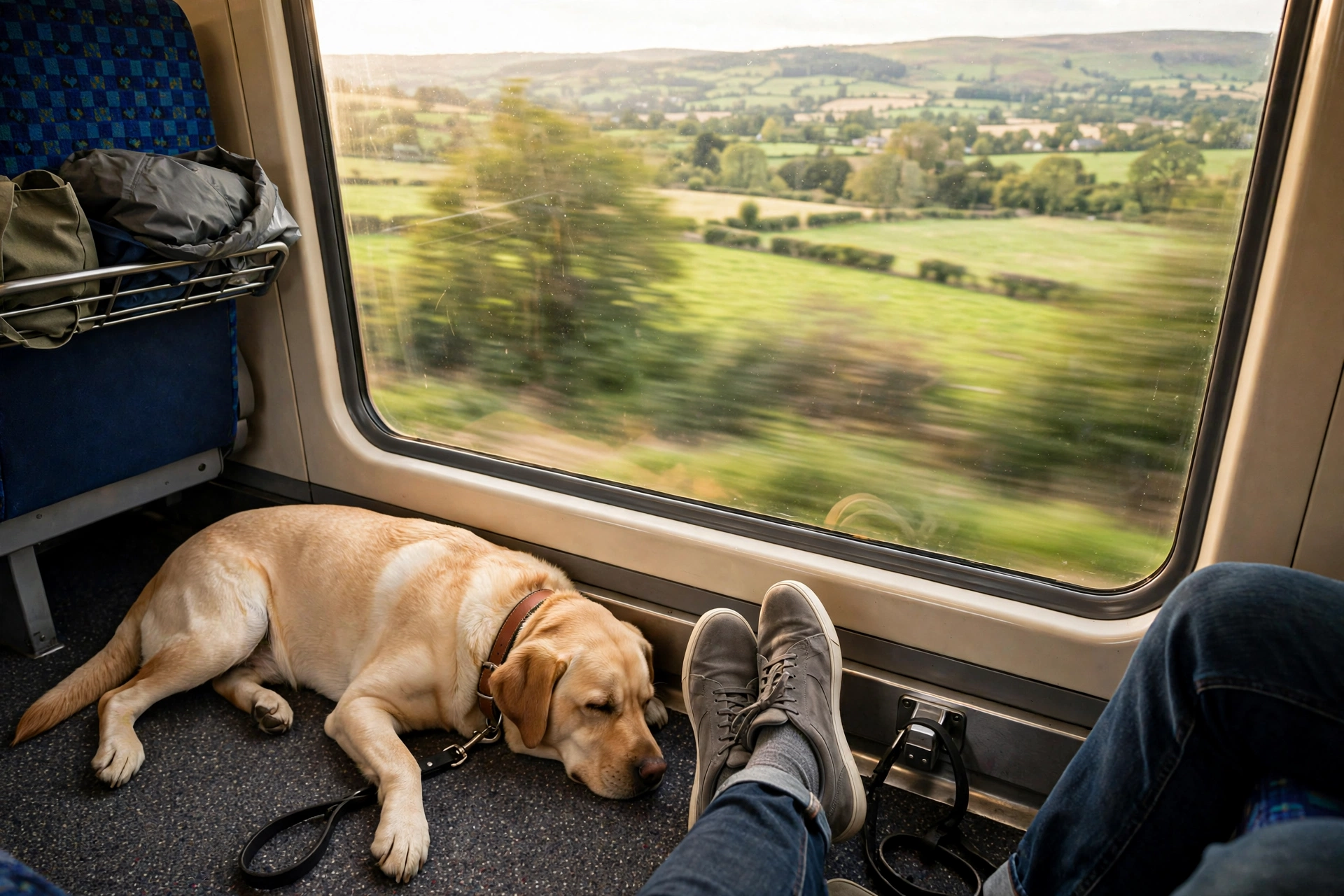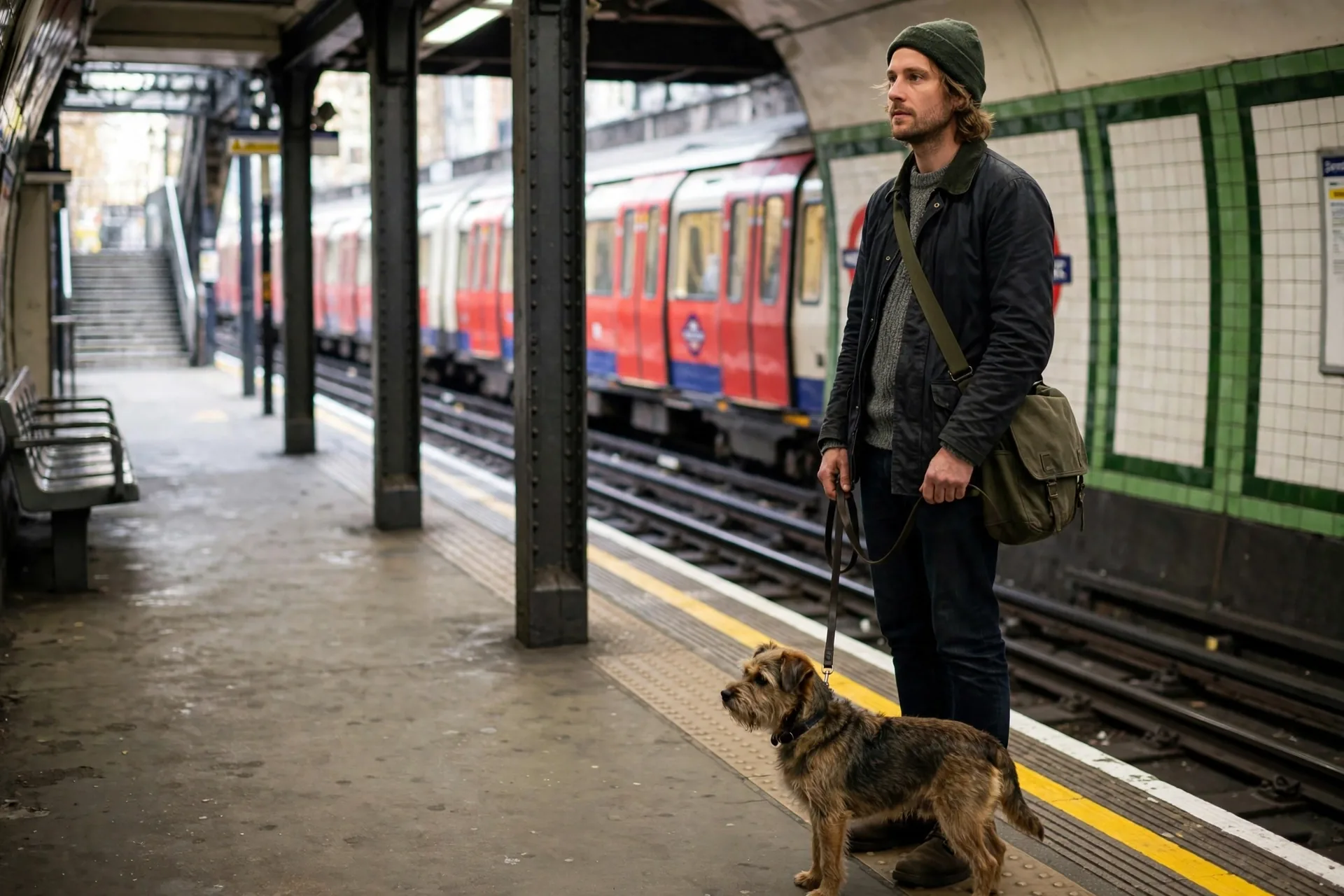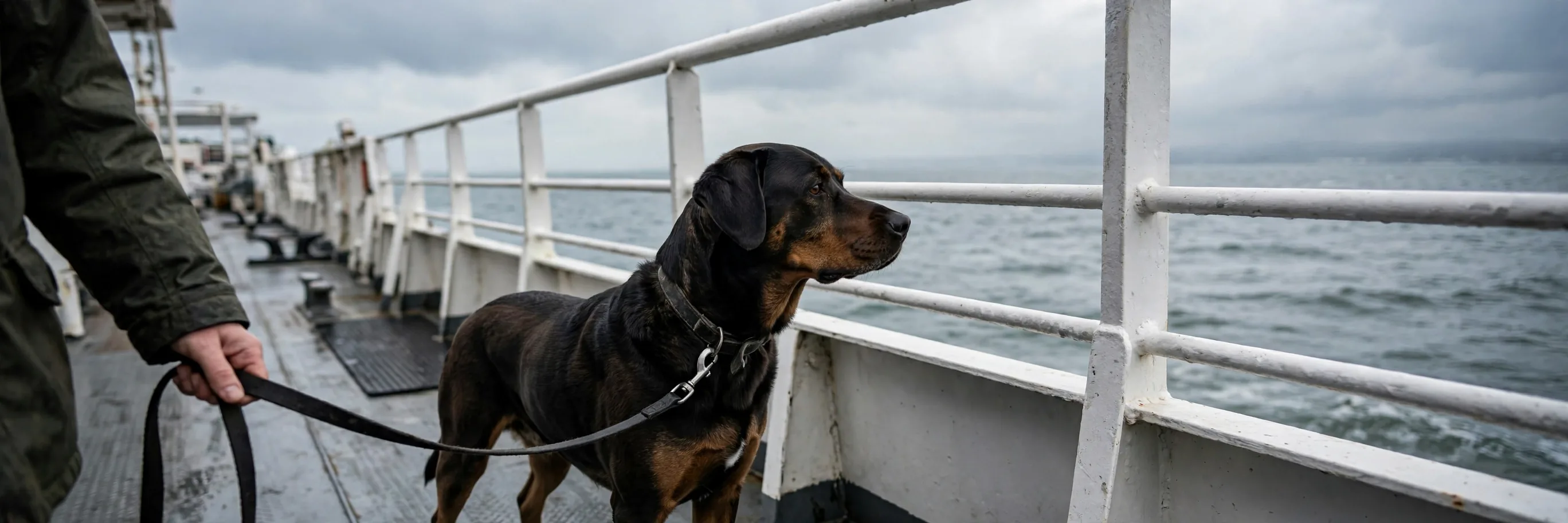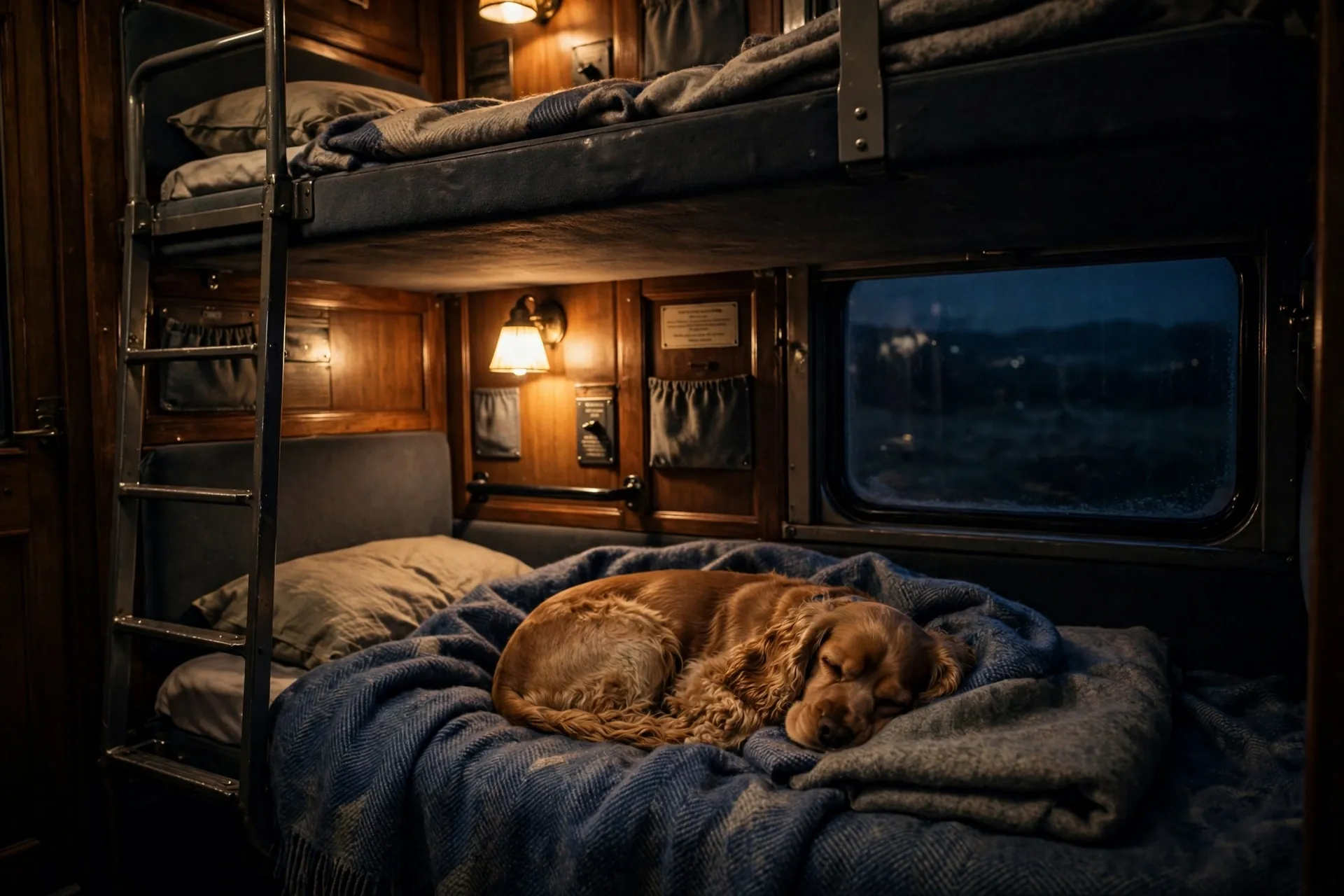
This guide is independent and contains no paid placement. If affiliate links are added later, they will be clearly marked and will not change our editorial checks.
Yes, dogs can usually travel on both UK sleeper services in a booked cabin, for a pet charge and under strict lead and behaviour rules — but a sleeper is not a daytime train with a bed attached. Book the dog onto the reservation, plan for no toilet break until morning, and check the operator's latest policy before booking, because cabin eligibility and fees change.
The short answer, honestly
Britain has only two scheduled sleeper trains, and that scarcity shapes everything in this guide. The Caledonian Sleeper links London Euston with Scotland, splitting overnight for Edinburgh, Glasgow, Aberdeen, Inverness and Fort William. The Night Riviera links London Paddington with Cornwall, running through Reading, Taunton, Exeter, Plymouth and Truro to Penzance. Both have carried pet dogs in cabins under their pet policies, and both are a world away from the daytime rule most owners know, where dogs generally ride free on ordinary trains.
That difference matters because a sleeper sells you a private, lockable room for eight or more hours, not a seat for ninety minutes. The operator has to clean that room for the next passenger, protect other guests sleeping a wall away, and keep narrow corridors clear at 2am. So expect a fee, a limit on numbers, and conditions that would never apply on a local service. Expect, too, that the details move: cabin types are refurbished, pet charges are revised and booking systems change how a dog is added. Every price and rule in this guide is therefore framed as what to confirm, and the safe habit is simple — check the operator's latest policy before booking, then get your specific dog on your specific reservation in writing.
One more distinction before anything else. Assistance dogs are not pet dogs in law or in operator policy, and they travel under separate rights and arrangements. This guide is about pet dogs. If you travel with an assistance dog, go directly to the operator's accessibility team rather than relying on pet pages, and read the wider background in our guide to taking a dog on UK trains, which covers the National Rail conditions that sit underneath both sleepers.
The two services at a glance
Choosing between them is rarely a choice at all, because they go to opposite ends of the country. What you are really comparing is the shape of the night. The Caledonian Sleeper is the longer, more hotel-like operation, with a choice of cabin grades, a club car for higher-grade passengers, and very early arrivals or portions that sit in the destination station so guests can stay in bed a little longer on some routes. Journey times from London are roughly seven to twelve hours depending on the Scottish destination, which is a long time for a dog to stay in one small room.
The Night Riviera is shorter and simpler. It leaves Paddington late in the evening and reaches Penzance in the morning, with single and twin berths and a seated coach for passengers who prefer not to book a cabin. The Cornish night is typically around eight hours end to end, and intermediate stops in Devon and Cornwall come very early, which matters if you are alighting at Plymouth or Truro with a half-asleep dog and luggage. Berths on both services are compact: a bed or two, a washbasin in most cabin types, minimal floor space, and a door that locks. Neither train offers a dog exercise area, a dog toilet, or room to pace.
Both services can be busy in predictable waves. The Caledonian fills around school holidays, the Edinburgh festival season and winter breaks to the Highlands. The Riviera fills on summer Fridays and before Cornish holiday weeks. Dog-friendly capacity is not separate from that pressure — if cabins sell out, there is no spare pet cabin waiting — so summer and festival dates need booking far earlier than a daytime ticket ever would.
Caledonian Sleeper with a dog
The Caledonian Sleeper sells several ways to spend the night, from reclining seats through classic rooms to club rooms and double rooms with en-suite facilities on its newer trains. For a dog owner, the headline question is never the thread count. It is whether the room type you want accepts a dog on the date you want, how many dogs are permitted per room, and what the pet charge covers. Historically the service has welcomed dogs in rooms for a fee rather than expecting owners to sit up all night in the seated coach, but room eligibility has not been identical across every grade, and premium rooms are the ones most likely to carry extra conditions.
Ask three Caledonian-specific questions before paying. First, does the pet charge apply per dog or per room, and does it include the deep clean the room will need afterwards? Second, are dogs allowed in the lounge or club car, even briefly, or must your dog stay in the room for the entire journey apart from boarding and alighting? The safe working assumption is the room, full stop. Third, what is the arrival arrangement for your portion of the train? Some Scottish arrivals allow a later stay in the berth, while others require a prompt exit, and a dog that needs an immediate walk will not care about a lie-in policy either way.
Northbound, the practical rhythm is this: board at Euston in the evening, settle the dog before departure, and treat the room as your world until Scotland. Southbound from Inverness, Aberdeen or Fort William, boarding times are earlier in the evening and the night is longer. Dogs that cope well tend to be dogs that already sleep through household nights without asking to go out. Dogs that patrol, bark at corridor noises or need a 3am garden visit will find a sleeper room hard, and no fee buys a soundproof door.
Night Riviera with a dog
Great Western Railway's Night Riviera is a smaller operation with a loyal following, running between Paddington and Penzance with berths that convert from seating by day to beds by night and a lounge car for berth passengers. Its pet arrangements have generally allowed dogs in berths when booked in advance, again for a charge and again with the dog expected to stay in the cabin rather than tour the train. Because the fleet and the policy are smaller, small print matters even more here: whether a solo traveller with a dog must book sole occupancy of a twin berth, for example, changes the price dramatically.
Ask Riviera staff specifically about sole occupancy, about volunteering for the seated coach if berths are full, and about early alighting. A passenger leaving at Exeter or Plymouth in the small hours must have the dog ready to move quietly through a sleeping train, lead on, without a farewell barking round in the corridor. If your Cornish destination is a long way beyond Penzance, also plan the morning connection honestly: a tired owner, a dog that has held on all night and a branch-line wait on a cold platform is a poor start to a holiday, so a taxi for the last leg is sometimes money well spent. For the London end of the trip, our guide to dogs on the London Underground explains how to cross the capital to Paddington without using escalators your dog cannot manage.
The Riviera's charm for dog owners is the morning it buys you. Step off at Penzance at breakfast time with the whole first day ahead, rather than losing it to a five-hour daytime drive or train ride. That benefit is real only if the dog arrives rested rather than stressed, which is why the settling routine later in this guide matters more than any upgrade.
Choosing a cabin that fits a dog
Start with floor space, not bed luxury. A dog needs a patch of floor, roughly its own bed size, that is not the only route between the berth and the door or the basin. In the smallest single cabins that patch can be surprisingly tight once a suitcase is stowed, so pack soft bags that squash under the berth rather than a hard case that claims the floor. Twin and double rooms give more ground room but also a second human's worth of luggage, and an en-suite door swinging into the dog's corner is a nightly annoyance worth picturing in advance.
Think about where the dog will actually sleep. Most dogs settle best on their own familiar bedding placed in the lowest, darkest corner, away from the door. A dog on the bed is a policy question as much as a comfort one: many operators expect dogs off the bedding and furniture, and a damage or cleaning dispute is not how anyone wants a trip to end. Bring a washable throw even if your dog normally stays on the floor, because a wet evening walk at the departure station can turn paws muddy minutes before boarding.
Noise profile is the third filter. Rooms near the lounge car hear voices and doors until late; rooms near the ends of coaches can hear coupling and corridor traffic at splitting or joining points, which on the Caledonian happens at Edinburgh in the night as portions divide for different destinations. Light sleepers, canine and human, do better mid-coach. You cannot always choose an exact room, but you can request a quieter position when you book the dog in, and operators will note a request even when they cannot guarantee it.
Booking step by step
The golden rule is to add the dog before money becomes hard to move. Sleeper fares and cabin supplements often sit under advance, partly refundable or non-refundable conditions, and a human-only booking discovered to be wrong a week before travel may have no suitable cabin left to move into. Work through these steps in order.
- Pick the route and date, then read the pet page for that operator on that day. Note the cabin types that accept dogs, the number limit and the current pet charge. Policies change, so check the operator's latest policy before booking rather than trusting a blog, including this one.
- Choose the cabin type for floor space and sole occupancy. Decide whether a partner, a second dog or a large breed makes the smallest room unrealistic.
- Add the dog through the operator's own channel. Use any online pet option if offered, otherwise phone. State the number of dogs, breed and approximate size, and ask directly whether the dog may stay in the cabin all night.
- Confirm the rules that affect your night. Lead and muzzle expectations in corridors, whether dogs may enter the lounge car, what happens on early arrival, and the latest boarding time for passengers with dogs.
- Get the total in writing. Fare, cabin supplement, pet charge and any cleaning charge as one figure, with the dog named on the confirmation or in a follow-up email you keep.
- Book the surrounding legs to match. A connecting daytime train, a taxi at the far end and the first dog-friendly stop after arrival all belong in the same plan.
- Reconfirm a few days before travel. A short call or message checking that the dog is still on the reservation catches timetable and coach changes that automated emails sometimes bury.
If any step produces a vague answer — “it should be fine, just turn up” — treat that as a no until someone puts it in writing. Platform staff at 10pm cannot invent a pet cabin that does not exist on that night's formation.
Fees, tickets and the total
Owners used to daytime rail often assume the dog is free, because on most ordinary UK trains pet dogs do travel without a ticket. Sleepers break that assumption. Expect a distinct pet charge, historically in the range of a modest flat fee per stay rather than a per-mile fare, with the precise amount, and whether it is charged per dog or per cabin, varying by operator and over time. Treat any figure quoted second-hand as out of date until the operator confirms it for your date, and check the operator's latest policy before booking for the current number.
The dog charge is rarely the biggest cost anyway. The real levers are cabin grade, sole occupancy of a twin room as a solo traveller, and how far ahead you book. Advance sleeper fares can be far below flexible ones, but they lock you into a train and usually into stricter refund terms — a risk if your dog's health or behaviour makes the trip uncertain. Weigh a slightly dearer flexible ticket against the cost of losing the whole booking because a vet visit went badly the day before.
Also price the journey you are avoiding. A sleeper that looks expensive beside a daytime advance fare looks different beside a daytime fare plus a night in a dog-friendly hotel near the station, plus parking, plus a lost day of holiday. Add everything on both sides: pet charge, hotel, meals on board if you plan to buy them, taxis at both ends, and the kennel or pet-sitter cost you are not paying because the dog is coming with you. That honest total, not the headline berth price, is the comparison worth making.
Lead, muzzle and corridor rules
Corridors on sleeper trains are narrow, carpeted and busy at boarding, then quiet and dark for hours. The working rules are consistent across both services even where the wording differs. Keep your dog on a short lead whenever the cabin door is open, in corridors, in vestibules and on platforms. Never let a dog roam the train, visit other cabins, or settle in a doorway. If staff ask for a muzzle in a shared area, or if your dog is anxious around strangers at close quarters, a well-fitted, previously trained muzzle is a sensible thing to carry — but introduce it at home weeks before, never for the first time on a train at midnight.
Behaviour is the rule underneath all the others. A dog that barks repeatedly through the night is not a minor nuisance in a sleeper; it is a coach full of people who paid for sleep. Be honest about your dog's reaction to footsteps outside a door, to unfamiliar beds and to being woken by movement. Dogs that cannot settle are better on a daytime train where a walk at an interchange and a change of scene can reset them. Staff can require a disruptive dog to be removed from the train at a station stop, and that is a miserable outcome at an unfamiliar platform in the dark.
Cleanliness rules are equally plain. Dogs should stay off beds and seats unless the operator explicitly says otherwise, must not foul corridors, vestibules or cabins, and any accident is the owner's job to clean immediately and report to the host or guard. Carry more cleaning kit than you expect to need: bags, wipes, a small towel, and a sealed bag for soiled material until you reach a proper bin at your destination.
Boarding at Euston and Paddington
Evening boarding is the calmest part of sleeper travel if you do it in the right order. Arrive with time in hand, because both London termini are large, busy and full of exciting smells, dropped food and rolling suitcases at dog height. Give the dog a proper walk and a toilet opportunity before entering the station — green space near Euston and the canal-side and streets around Paddington both offer options, but neither is at the platform, so build in half an hour rather than five minutes. Feed the main evening meal early enough that the dog has been out afterwards, not at the concourse.
Find your train on the departure board, but wait for the platform and boarding call before heading down with luggage and dog together. Sleeper boarding usually opens well before departure, and getting into the cabin early is the single best settling trick available: bed down, water offered, door closed, lights low, and the departure shunts and announcements absorbed from a safe den rather than a crowded platform. Introduce yourself to the host for your coach, mention the dog before they discover it, and ask where to find them in the night if you need help.
Keep the departure routine dull. No excited tour of the train, no trip to the lounge car “to see”, no last-minute platform photo session beside a moving-service road. Collar or harness with an up-to-date ID tag, lead short, bag handles clear of paws. If your dog is unsettled by the gap or the step up into the coach, lift small dogs and let large dogs board at the widest, calmest door the host suggests rather than persisting at a busy one.
The overnight toilet problem
This is the section to read twice. A sleeper train gives your dog no legitimate toilet opportunity between boarding at night and arrival in the morning. There is no dog relief area on board, using a corridor, vestibule or cabin floor is fouling, and intermediate stations are not toilet stops for passengers: doors may be released only for booked passengers, stops can last a minute or two in the small hours, platforms may be unstaffed and dark, and a train will not wait while a dog sniffs a lamp post. Planning to “hop off quickly somewhere” is planning to be left behind, or worse, separated from a dog on a departing train.
So the strategy is prevention, in three layers. Layer one is timing: a long, unhurried evening walk with every opportunity to go, as close to boarding as practical, after the evening meal. Layer two is selection: puppies, elderly dogs, dogs on medication that increases urination, and dogs recovering from illness are poor sleeper candidates however much you want the trip, because eight to twelve hours is simply beyond them. Layer three is contingency: washable pads or a washable mat in the cabin corner, bags, wipes and a change of bedding, so that an accident — if a genuinely unavoidable one happens — is contained, cleaned instantly and never discovered by the next passenger or the cleaning crew without your having dealt with it.
Morning urgency is the mirror image. The dog's first need on arrival outranks breakfast, photographs and the lounge car farewell. Have the lead ready before the train stops, know which exit you are heading for, and go straight to a suitable outdoor spot away from the concourse before taxis, connections or coffee. In Scottish city arrivals and at Penzance alike, the first patch of ground is minutes away if you have looked at a map the night before. Do that small piece of homework in the cabin, not while your dog dances on the platform.
Food, water and sleeping set-up
Recreate the home night as closely as a two-metre cabin allows. Your dog's own bed or blanket, carrying home smells, beats any new travel bed bought for the occasion. Set it up in the chosen corner before the train moves, let the dog investigate while you unpack, and keep the routine in the home order: water, a last sniff of the room, lights down, quiet. A long-lasting chew is useful for the first twenty minutes while departure noises are at their peak, provided your dog chews calmly rather than guarding food in strange places; if there is any guarding history, skip food distractions entirely.
Water needs a travel plan of its own. Offer a drink at boarding and again if the dog wakes and paces, using a spill-proof bowl on a mat in the corner by the basin. Do not overfill a bowl on a moving train, and do not restrict water cruelly to solve the toilet problem — a thirsty, stressed dog is worse than a managed one. The balance comes from the pre-boarding walk and sensible evening timing, not from dehydration. Keep a sealed bottle of your own water for the dog in case the cabin supply is awkward to use at night.
Temperature and air are easy to overlook. Cabins can run warm, and a dog that sleeps cool at home may pant and shuffle all night in a stuffy berth, keeping you both awake. Use the cabin ventilation controls early rather than at 3am, position the bed away from any heater outlet, and bring nothing heavier than the dog's normal indoor bedding. If your dog sleeps in a crate at home and the cabin grade genuinely fits a folded crate, ask the operator whether one may be brought; otherwise a familiar blanket boundary, practised at home with a “settle” cue, does the same job for most dogs.
If the sleeper refuses: alternatives
Refusal comes in two forms. The first is at booking: no pet cabin on your date, a dog over a size or number limit, or a policy that has changed since you last looked. The second is at the platform: a dog that was never added to the reservation, is out of control in the station, or whose paperwork of confirmation the crew cannot see. Both are easier to prevent than to argue with, and arguing at night, with a train about to leave, rarely ends well. Accept the decision, keep the dog calm and switch to the plan you made in advance — which means making one before you travel.
The strongest alternative is the same route by day. Daytime trains to Scotland and Cornwall take five to eight hours, dogs generally travel under the ordinary National Rail pet conditions, and a long mid-journey break can be built in at an interchange. It costs a day rather than a night, but for a young, elderly or unsettled dog it is honestly the kinder product. A second option is to split the journey: a daytime leg to a city on the route, a night in a dog-friendly hotel near the station, and an early train to finish. That turns the toilet problem into a normal evening walk and gives everyone a real bed.
Driving the whole way is the third option, with proper rest stops every couple of hours, and for some destinations a ferry leg may form part of a longer touring route — our guide to dogs on UK ferries covers how pet arrangements work at sea if your Scottish or wider trip involves a crossing. What not to do is leave the dog in a car on a motorail-style service or in station parking overnight, or book a sleeper under someone else's name hoping rules will bend. The operators run these trains every night; they have heard every version. A clean booking, a settled dog and a written confirmation will beat improvisation every single time.
Practical questions
Before you go
Can dogs travel in a sleeper cabin or only in seated coaches?
On both UK sleeper services dogs have generally been allowed in private cabins or berths when booked correctly, not just in seated coaches, but the exact cabin types, number limits and charges differ by operator and can change. A seated ticket does not automatically entitle a dog to a cabin. Check the operator's latest policy before booking and get the dog added to the reservation in writing.
How much does it cost to take a dog on a sleeper train?
Expect a separate pet charge on top of your own fare or cabin supplement, rather than assuming dogs ride free as they usually do on daytime trains. The amount, whether it is per dog or per cabin, and whether cleaning is included have varied over time. Ask for the all-in total for your exact date and cabin type before you pay, and check the operator's latest policy before booking.
How do I book a sleeper berth with a dog step by step?
Choose the route and cabin type first, then contact the operator or use its pet booking option to add the dog before paying the balance, state breed, size and number of dogs, confirm lead and corridor rules, and keep the written confirmation. Do not simply buy a human-only cabin online and arrive with a dog hoping staff will sort it out at the platform.
What happens if my dog needs the toilet during the night?
Plan as if there is no toilet stop for your dog until morning. Sleeper trains do not provide dog relief areas, corridors and vestibules must not be used, and intermediate stops are short, often locked and not a safe or permitted chance to step off. Give a proper walk before boarding, carry puppy pads and cleaning supplies for an emergency, and choose a daytime train if your dog cannot comfortably last the night.
Can my dog be refused travel on a sleeper train?
Yes. Staff can refuse a dog that is out of control, distressed, fouling, a danger to others, or not booked under the operator's pet policy, and a cabin can be refused if the dog was never added to the reservation. Assistance dogs are treated differently in law. If a sleeper refuses your pet dog, switch to a daytime service, split the journey with an overnight dog-friendly stay near the station, or drive that leg instead.