This guide is independent and contains no paid placement. Bus rules are set by Transport for London and can change, so check TfL's latest conditions of carriage before you travel.
Yes — are dogs allowed on buses in London? They are, on TfL buses, free of charge, on a lead or in a carrier and under control. Boarding is at the driver's discretion. Keep to one dog per person, stay on the lower deck on the floor, keep the aisle and doors clear, and be ready to wait for the next bus if yours is crowded or already carrying a dog.
The short answer: yes, with the driver in charge
It is raining in that particular London way that is not quite heavy enough for an umbrella and far too steady to ignore. The bus stop shelter is full, your dog has shaken canal-path water over your shoes twice, and the display has just flicked from three minutes to due. This is the moment most owners actually need the answer — not in a warm kitchen the night before, but with a wet dog pressed against their leg and a double-decker pulling in. So here it is plainly: dogs are allowed on London buses. You do not need to hide a small dog in a bag, you do not need to buy it a ticket, and you do not need to apologise for existing. You do need to understand that a London bus is not a train carriage or a Tube platform with a different paint scheme. It is a smaller, more personal space, run on the spot by one driver who can see exactly who is trying to board, how full the bus already is, and whether your dog will fit safely into the journey that is already under way.
That distinction explains almost everything else in this guide. Transport for London — TfL — permits dogs on its bus network, but permission is conditional. The dog must be under control, it must not endanger or inconvenience other passengers, and the driver has discretion at the door. A calm dog on a short lead, standing clear while other passengers board first, will be waved on to most buses without drama. The same dog lunging at the doorway, trailing a long lead across the pavement, or trying to greet every passenger in the queue creates a different decision for the driver, and the driver is entitled to make it. Treat boarding as something you earn in ten seconds of visible calm, not as a right you argue about on the step.
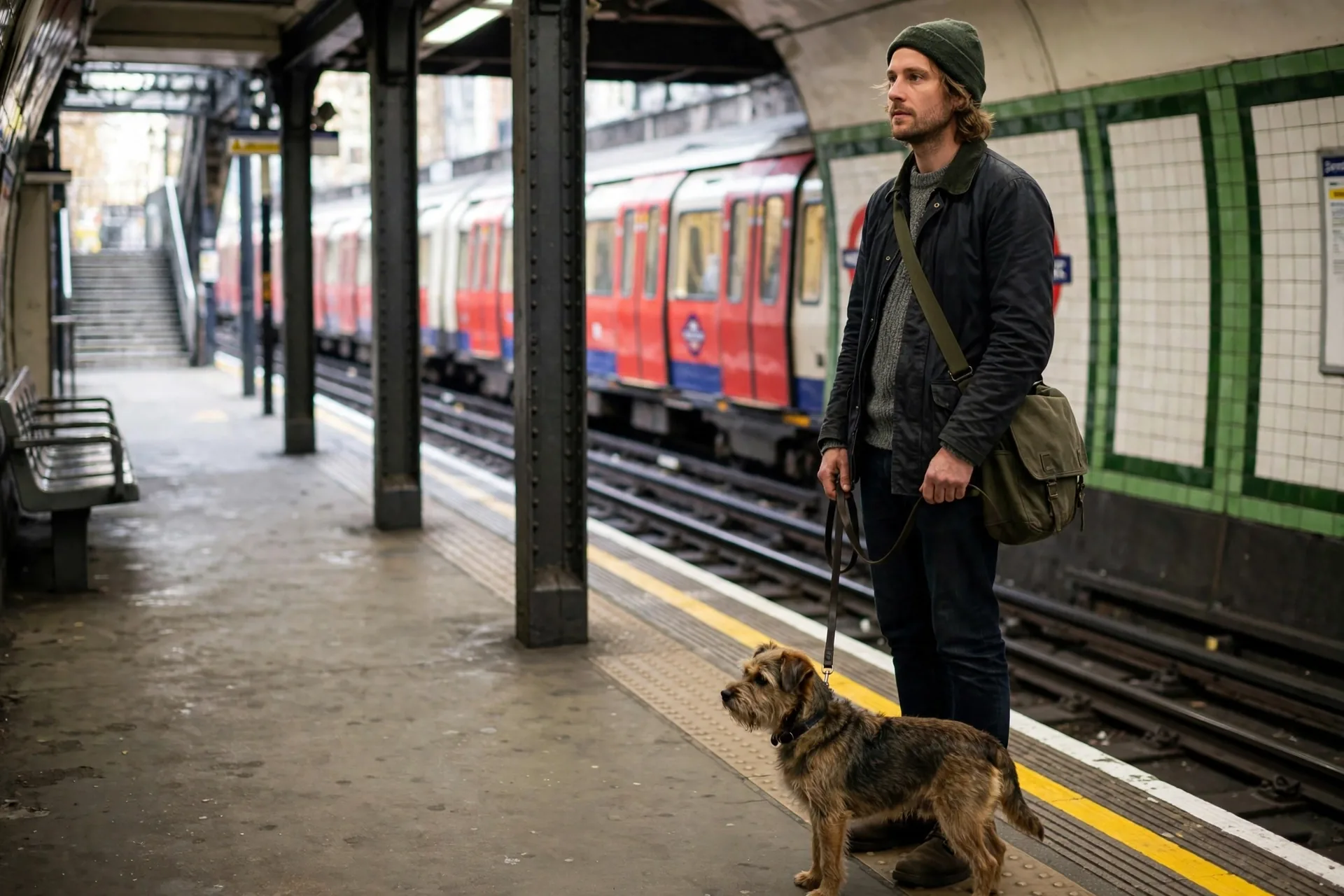
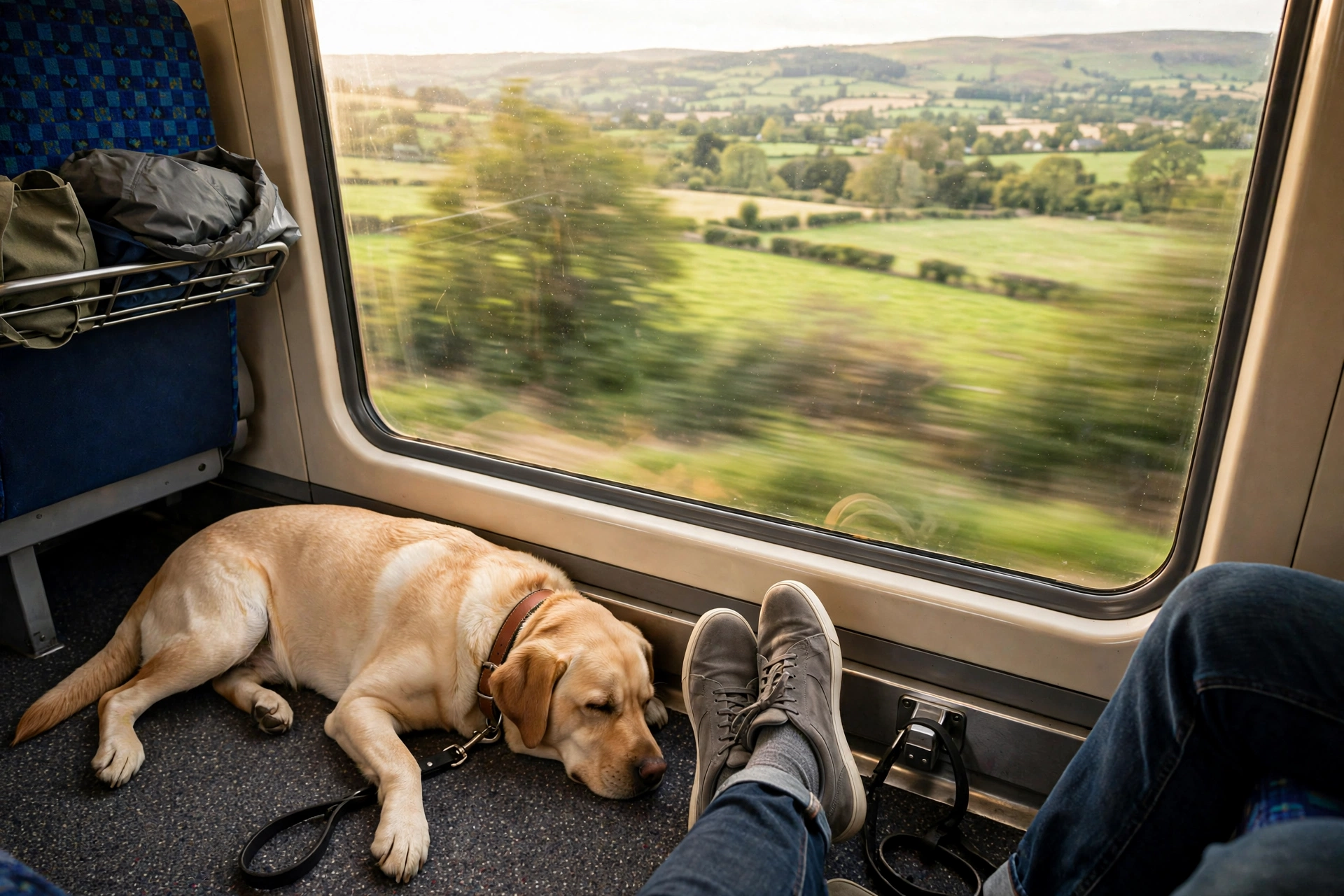
This guide covers London buses only. The rules for the Tube are related but not identical — escalators, station rules and carrying requirements matter far more underground — so if your journey mixes the two, read our separate guide to dogs on the London Underground as well, and plan each leg on its own terms. Likewise, a bus to a mainline station follows bus rules, while the train that follows it follows National Rail rules; our guide to taking a dog on UK trains explains that second leg. Keeping the legs separate in your mind prevents the most common mistake: assuming that because a dog was accepted on one service, the next one works exactly the same way.
One final framing point before the detail. TfL publishes conditions of carriage that govern the network, and operators run individual routes on TfL's behalf. Most of the time you will never need to quote a document at anyone, and you should not try. What you need is the practical version: be visibly in control, keep the dog small in the space even if the dog is not small in body, protect the wheelchair area, and accept a refusal gracefully. Do that, and London buses become one of the easiest, cheapest and most flexible ways to move around the capital with a dog — to a park across the borough, to a vet, to a friend's flat, or simply home again when the rain wins.
Free travel for dogs — and what free does not mean
Dogs travel free on London buses. There is no dog ticket, no pet fare added at the reader, and no need to tap anything extra when you board. You pay your own fare exactly as you would without a dog — contactless, Oyster or another valid method — and the dog simply travels with you. That sounds like a small detail, but it shapes how you should board. Because there is no transaction for the dog, there is also no receipt that entitles the dog to a seat, a set amount of floor space, or carriage regardless of conditions. Free travel is generous, and it works precisely because owners are expected to keep it low-impact.
Do not let free travel lull you into treating the bus as a kennel on wheels. Your dog should not sit on a seat, even a fold-down seat, even on an empty late-night bus, and even if the paws are clean. Seats are for passengers, and a driver or another passenger is entitled to object to a dog on upholstery. The floor is the dog's place, tucked as close to your feet as the layout allows. Similarly, free does not mean unlimited in number. One person arriving with three dogs, however sweet-natured, asks the driver to solve a space and control problem that a single fare was never meant to cover, and a refusal in that situation should surprise nobody.
Free travel also does not change priority on board. London buses are built around a shared middle space that serves, at different moments, wheelchair users, people with buggies, people with luggage and people with dogs. Of those, the wheelchair user has clear priority for the designated wheelchair space. If you have settled your dog in or near that bay — which many owners do because it is the roomiest patch of floor — you must move immediately and without debate when a wheelchair user boards. Practise the move in your head before you need it: where will you stand instead, which way will the dog turn, and how will you keep the lead short while other passengers shuffle around you? A smooth, cheerful relocation keeps goodwill intact for the next dog that boards that route.
Assistance dogs sit in a different legal and practical category from pet dogs, and conflating the two helps nobody. An assistance dog is trained to perform tasks for a disabled person and has strong legal protection for access to transport. If an assistance dog is already on board when you try to board with a pet dog, expect the driver to protect the working dog's space, and expect to wait for the next bus if the two dogs cannot travel calmly apart. That is not discrimination against your pet; it is the system working as it should. Never describe a pet as an assistance dog to secure boarding — apart from being dishonest, it makes life harder for the handlers who depend on the real thing.
Driver discretion and the one-dog guidance
If you remember only one phrase from TfL's approach, make it this: at the driver's discretion. The driver is responsible for the safety of everyone already on the bus, for keeping to a schedule on streets that rarely cooperate, and for the doorway itself, where most problems happen. From the cab, a driver can see a wet dog, a crowded lower deck, a buggy in the bay, a passenger who is frightened of dogs edging backwards, and a queue building behind you — all in the same glance. Their decision weighs all of that, not just your dog in isolation. A refusal is therefore rarely a judgement that dogs in general are unwelcome. It is usually a judgement that this dog, on this bus, at this minute, does not fit.
The situations most likely to produce a refusal are predictable, which means most of them are avoidable. A bus that is already full, with standing passengers in the aisle, has nowhere safe for a dog to lie without becoming a trip hazard. A bus already carrying a dog — particularly a large or unsettled one — may not be able to add a second without the two meeting in a narrow aisle. A dog that is barking continuously, snapping, straining towards other passengers or soaked and shaking mud across the floor gives the driver a nuisance problem before you have even tapped in. And a dog whose owner is on the phone, lead looped loosely round one wrist, reads as out of control even if the dog itself is mild. You cannot fix crowding, but you can fix presentation: short lead, dog at heel, phone away, and a step back to let others board first.
Closely linked to discretion is the one-dog expectation. TfL guidance is generally understood as one dog per passenger, for the simplest of reasons: control. One lead in one hand leaves the other hand free for the fare reader, the handrail and the grab pole when the bus brakes. Two leads, even from two calm dogs, tangle, cross the aisle and divide your attention exactly when the bus lurches away from a junction. If you genuinely need to move two dogs across London, the reliable options are unglamorous — travel with a second adult so each dog has its own handler, move the dogs one at a time, or book a taxi that has agreed in advance to carry both. Turning up at a busy stop with two large dogs and hoping for the best is not a plan; it is a coin toss with the driver holding the coin.
What should you actually say at the door? Very little. A brief, friendly check — a raised hand, eye contact with the driver, and a gesture towards the dog at your feet — lets the driver nod or shake their head before you commit to the step. If the answer is no, a quick “no problem, thanks” and a step away from the doors keeps the bus moving and keeps you in the driver's good books for the route generally; drivers remember both courtesy and confrontation on regular services. Arguing, filming, or quoting rules you half-remember will not change the outcome on that bus and may harden attitudes for the next owner in the queue behind you.
Leads, carriers and staying in control
The lead is the whole system. On a London bus your dog should be on a lead, held securely, for the entire journey — boarding, travelling and getting off. Choose the lead for the bus, not for the park you have just left. A short, fixed-length lead, roughly the length that keeps the dog at your heel without spare loops trailing on the floor, is ideal. Retractable leads are a poor fit for buses: the thin cord is hard for other passengers to see, the dog can be three metres away before the brake engages, and the handle clatters and rolls in the aisle. If a retractable lead is all you have, lock it at its shortest setting before the bus arrives and keep it locked until you are back on the pavement.
Harness or collar is your choice, but think about pressure and escape routes. A nervous dog that backs out of a loose collar at the sound of the doors will do it at the worst possible moment, in traffic. A well-fitted harness gives you control without choking a dog that lunges, and a handle on the back of the harness is genuinely useful for guiding a dog into a tight floor space. Whatever you use, check the fit at the stop, not on the bus: two fingers under straps, clips fully closed, identity tag on. A dog that gets loose on a bus is not a funny story; it is a safety incident that can end with the bus stopped, the doors held, and every passenger delayed while you crawl under seats.
Carriers change the picture for small dogs. A small dog in a secure, ventilated carrier or bag is contained, calm for many dogs, and legible to a driver at a glance — there is simply less to object to. If your dog travels happily in a carrier on your lap or at your feet, busy buses become much more feasible, and other passengers are far less likely to be troubled. The carrier must be fully closed if there is any chance the dog will wriggle out, and it still goes on the floor or your lap, not on the seat beside you. Never use a carrier as a way to smuggle in a dog that is frantic inside it; a carrier that rocks, whines and claws for twenty minutes is a nuisance in a box, and the driver can still ask you to leave.
Muzzles deserve a calm word, because owners often ask whether TfL requires one. There is no general rule that every dog must be muzzled on a London bus. But a muzzle you have trained at home — fitted properly, introduced gradually, and worn without distress — can transform a journey for a reactive dog and visibly reassure everyone around you. It signals that you have thought about other people, which is exactly the signal a driver wants to see. What does not work is forcing a brand-new muzzle onto a stressed dog at the bus stop. That dog will paw, panic and perform, and you will have made boarding less likely, not more. If your dog cannot yet wear a muzzle calmly, that is useful information: choose quieter buses, shorter hops and off-peak times while you train, rather than rehearsing in public.
Control also means the basics that never make it into rules documents. Do not feed your dog on the bus — smells, crumbs and resource-guarding around food are avoidable problems. Do not let children you do not know stroke the dog without a clear invitation from you, and be ready to say a polite no; a bus is too confined for a dog that is merely tolerating attention. Keep a poo bag and a small pack of wipes in your pocket for the journey you hope never happens, because a dog that is sick or has an accident on board is your mess to deal with immediately, and the driver should be told at once so the area can be dealt with properly.
Boarding step by step: the ten seconds that decide it
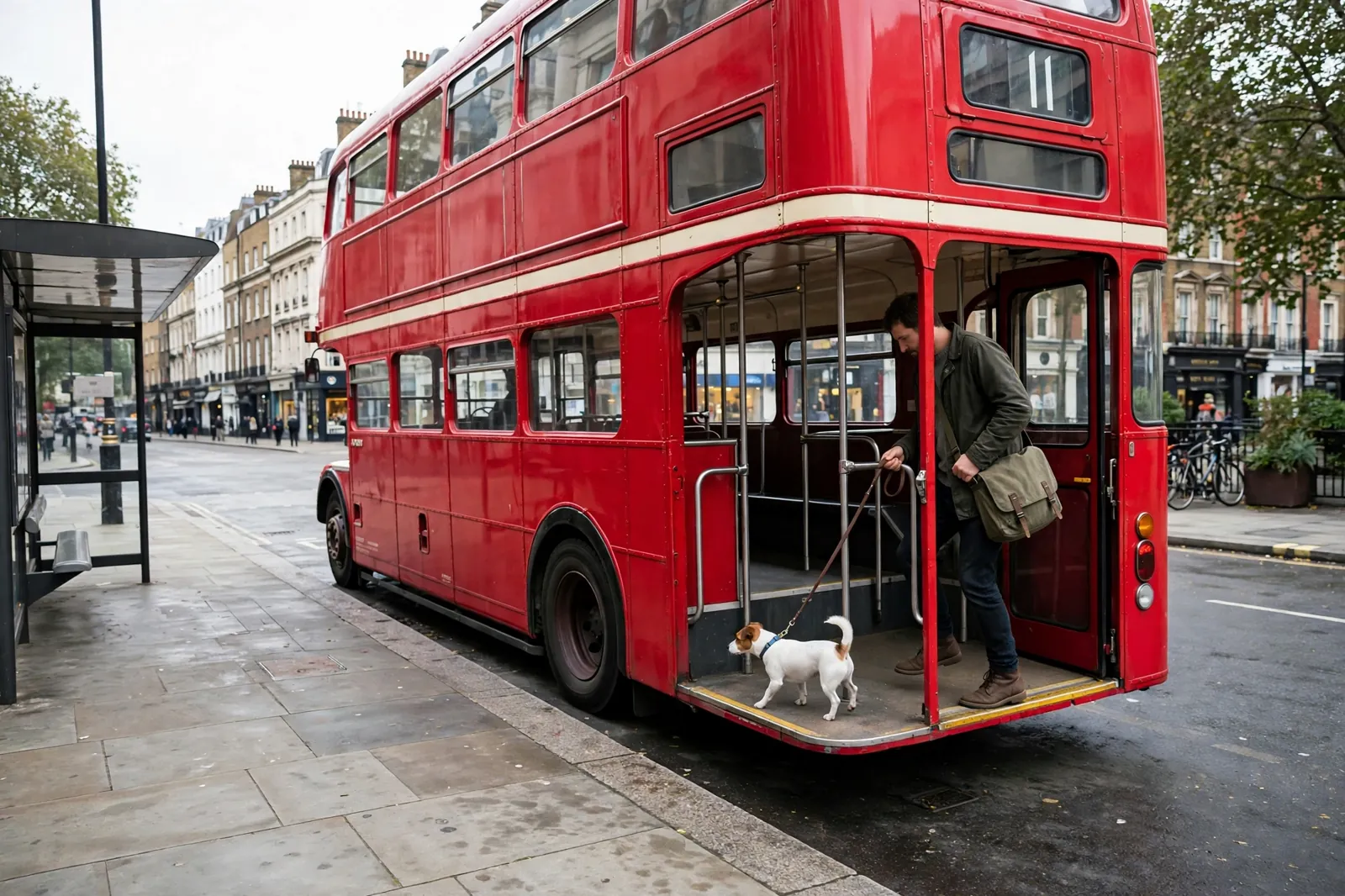
Good bus journeys with a dog are won at the stop, before the doors open. Start by choosing your position. Stand where the driver can see you and the dog together, slightly back from the kerb edge, with the dog on the side away from the road. If the stop has a shelter and a crowd, do not bury yourself at the back with the dog hidden among legs; a driver who spots the dog early can plan the stop, open the doors fully and judge the space. Let the bus come to a complete halt. London buses kneel and ramps move, doors swing and cyclists filter past on the inside — a dog surging forward at a still-moving bus is in danger from all of them.
Let other passengers get off first, then let boarding passengers without dogs go ahead of you if the doorway is narrow or the queue is tight. This costs you nothing — you are not competing for a seat that will vanish — and it gives you a clear view into the lower deck: where is the buggy, is there already a dog, how much floor is genuinely free? Make eye contact with the driver and get the nod. Then board decisively. Hesitation in the doorway, with the dog half in and half out while you fumble for a card, blocks everyone and frays tempers. Card or phone ready in your free hand, lead short in the other, dog following close: tap, walk straight to your chosen floor space, and settle the dog before the bus pulls away. Buses move off promptly, and a dog still standing braced in the aisle when the bus accelerates will scrabble, panic or be thrown against legs.
The step up itself troubles some dogs more than owners expect. Most modern London buses have low floors, but there is still a gap, a change of surface, a hiss of doors and a beep from the reader, all at once. Small dogs can be carried over the threshold if that is safer than a leap — being carried briefly while boarding is sensible, though once inside, the dog returns to the floor. Older dogs and dogs recovering from injury may need a moment to place their feet; take it, without letting the dog sit down in the doorway. If your dog flatly refuses the step, do not drag. A dog hauled aboard by the lead arrives stressed, and you have taught it that buses mean being forced. Step away, let the bus go, and treat the refusal as training information for another day.
Getting off deserves the same forethought, in reverse. Decide your stop early and move towards the doors in good time, while the bus is moving steadily rather than braking. Press the bell yourself — do not rely on the crowd — and position the dog so you exit together, dog close, neither of you catching the lead in the door or around a pole. At busy stops, it is often easier to let the main surge off first and follow immediately behind, rather than threading a dog through a wall of alighting passengers. Once on the pavement, step clear of the doors and the cycle lane before you stop to rearrange leads, check phones or reward the dog. The doorway of a bus is a working space; keep it that way at both ends of the journey.
Where to stand, where to sit, and the lower-deck rule of thumb
Stay downstairs. The lower deck is where dogs belong on a double-decker: it is close to the doors, it has the shared flexible space, and it avoids the single most awkward piece of furniture on the bus for a dog — the staircase. The stairs on a London bus are steep, narrow, turning and busy, with passengers coming down who cannot see a dog coming up until you meet on the bend. Even a fit, confident dog gains nothing from the upper deck, and a dog that freezes halfway up those stairs blocks the bus. Single-decker buses remove the question, but the same principles apply: floor, forward-facing settled position, clear of the aisle. If you are travelling on a route you know uses a particular vehicle type, plan for the tighter one.
Within the lower deck, your target is a patch of floor where the dog can lie or sit tucked against your legs without extending into the walkway. For many owners that is the area just beside or just behind the wheelchair bay when it is unoccupied, or the floor in front of your own seat near the front of the bus, where the ride is calmer and the driver can see you. Avoid the immediate doorway swing, the footwell of the stairs, and any position where the dog's tail, paws or lead will lie across the path to the exit. A large dog may need to stand for a short hop if lying down would sprawl; for anything longer than a few stops, a dog that cannot settle on the floor is telling you the journey is too much for it today.
Sitting etiquette is simple and strict: you sit, the dog does not. Keep the dog off seats entirely, including when the bus is nearly empty and including “just for a photo”. Apart from hygiene, it sets an expectation problem for every owner who follows. Keep bags off the neighbouring seat too if the bus fills up — a dog at your feet plus a rucksack on a seat is how owners earn the sideways looks that turn into complaints. If your dog is small enough to be in a closed carrier on your lap, that is the one tidy exception to floor-or-nothing, and even then, be ready to put the carrier at your feet if space gets tight.
Movement during the journey should be minimal. Once settled, stay put. Do not let the dog wander to investigate a shopping bag, a toddler's dropped snack or another passenger's ankles, and do not allow meet-and-greets with a second dog across the aisle — two dogs performing introductions in a moving, confined space can escalate from sniffing to snapping with no room for either owner to intervene cleanly. If the bus brakes sharply — and London buses do — a short lead and a dog already braced against your legs will absorb it. A dog standing loose in the aisle will not. Finally, watch the temperature. Buses can get warm in summer even with opening windows, and a dog on the floor sits in the warmest, stillest air. For a thick-coated, older or flat-faced dog, a long cross-London bus ride on a hot afternoon can be a genuine welfare problem; shorter hops, morning or evening travel, and a hard look at whether the journey is necessary at all are the responsible answers.
Wet dogs, muddy paws and the etiquette that keeps dogs welcome
Return to that rainy bus stop. Your dog is now allowed aboard — and is also, undeniably, damp. Wet dogs are the everyday reality of London bus travel for much of the year, and how you handle the water decides how welcome you are. Before boarding, use the wait productively: let the dog shake on the pavement, well away from the queue — a shake aimed at a stranger's suit will be remembered long after the journey — and give paws and belly a quick wipe if you carry a small towel or microfibre cloth. A lightweight drying coat, put on before you board, contains a surprising amount of damp and mud and signals to the driver that the floor will survive the journey. None of this is a formal rule. All of it is the difference between a driver waving you on and a driver doing the maths on a wet dog and a full bus and saying no.
On board, position a wet dog away from other passengers' feet and bags where you can, and keep the shake under control by keeping the dog settled and close — most dogs shake when they stand and turn, so a dog kept lying down keeps its water to itself. If your dog does soak or muddy the floor, own it: a wipe from your pocket, a quick apology to anyone affected, and no pretence that it did not happen. Passengers are remarkably forgiving of an owner who deals with a mess and remarkably unforgiving of one who studies the ceiling. TfL's permission for dogs survives on thousands of these small moments going well; every owner who leaves a muddy, oblivious trail makes the next driver's discretion a little tighter.
The rest of good etiquette is mostly about reading the humans. Some passengers love dogs and will beam at yours; some are allergic, some are frightened, some have cultural or personal reasons for wanting distance, and all of them paid the same fare as you. Your job is to keep your dog in your space so thoroughly that nobody else has to manage their feelings about it. That means no lead stretched across the aisle for the dog to “say hello”, no assumption that a child reaching out is an invitation you must accept, and a ready, cheerful “sorry, we're training, please ignore him” for anyone who tries to feed or fuss the dog at the wrong moment. If a passenger is visibly distressed by the dog's presence, move if you possibly can, even if you boarded first. You lose a seat; the dog-owning community keeps its reputation. Those trades are worth making every time.
Noise is the last piece. Occasional alert barks at the doors happen, and most passengers shrug them off. Sustained barking — at passengers boarding, at dogs outside the window, at the bus itself — is a nuisance the driver can act on, and settling a dog that has wound itself up in a confined, moving space is genuinely hard. Prevention beats cure: a dog that has had a toilet break and a chance to burn off the sharpest energy before a longer bus ride, a familiar chew-free calming routine of quiet praise for settled behaviour, and a position where the dog faces you rather than the whole bus all help. If the barking will not stop, the decent move is yours to make before the driver makes it: get off at the next safe stop, walk it out, and catch a later bus. Frustrating in the moment, it protects every future journey.
Crowded buses, peak times and choosing your moment
London buses have a rhythm, and dog owners who learn it travel easily while those who fight it have miserable journeys. The morning peak, roughly the school and commuting surge, fills lower decks with standing passengers, buggies and school bags; the evening peak adds tired commuters and rain. A medium or large dog in that mix is not impossible, but it is the hardest version of bus travel: no floor to lie on, leads at ankle height among moving feet, and a driver making fast decisions. If your journey is flexible, shift it. A bus twenty minutes after the peak often has the same route, half the passengers and a driver with time to be kind. Off-peak, mid-morning, early afternoon and later evening are the dog owner's natural territory.
School-run times deserve a special mention even outside the classic peaks. Buses that pass secondary schools fill suddenly with large groups of teenagers, noise and backpacks swung at dog height. A confident dog may find it entertaining; most dogs find it a lot. If your regular route has that pattern, either travel a few minutes earlier or let one bus go and take the next — drivers on school-heavy routes will often quietly prefer the dog on the quieter bus too. Football matches, stadium events and major demonstrations create the same effect in specific places at specific times; a quick check of what is on near your route saves a very crowded education.
Short hops change the calculation in your favour. A three-stop ride to the big park, standing with your dog tucked in the flexible space for four minutes, is reasonable at times of day when a forty-minute cross-borough trek would not be. Think in terms of the dog's total experience, not just the rulebook: how long standing braced, how many door cycles, how many strangers stepping over the lead. Conversely, for a long journey, consider whether the bus is even the right tool. A direct bus beats two changes; two changes on a wet evening with a tired dog is where good intentions fall apart. Our guide to taking a dog on UK trains may offer a faster option for the long leg, with the bus doing what it does best at either end — the first and last mile through your own neighbourhood, where routes are frequent and you can simply get off and walk if it is not working.
Finally, build slack into any bus journey that matters. If you have a vet appointment, a train to catch or a check-in time, the bus-plus-dog combination needs a buffer for the full bus you let go, the refusal you did not expect, or the dog that needed a toilet stop two streets from the surgery. One spare bus — ten or fifteen minutes on most London routes — is the cheapest insurance in this entire guide. Owners get into trouble not because buses are unreliable, but because they planned as if every bus would be empty, on time and delighted to see them. Plan for the ordinary bus, and the ordinary bus will usually treat you well.
Changing buses and using interchanges — only what affects the bus leg
Many London journeys need two buses, and the change is where dogs get stressed, because the journey restarts: new stop, new queue, new driver, new discretion decision. Treat each bus as a completely fresh boarding, because it is. Your first driver waving you on guarantees nothing about the second. At the interchange, give the dog a minute on the pavement — water if it is warm, a toilet opportunity on a suitable verge or side street before you reach the next stop, and a chance to shake off the tension of the first ride. Then reset completely: short lead, dog calm at your side, card ready, eye contact, nod. Owners who rush a change, dragging a flustered dog straight from one doorway to another, are the ones who collect refusals.
Where you change matters as much as how. Big interchanges — the bus stations and station forecourts at places where buses, Tube and trains meet — offer frequent services and staff, but they also concentrate crowds, announcements, pigeons and dropped food. If your route gives you a choice, changing at a quieter pair of stops a street apart is often calmer for a dog than a major hub, even if it adds a short walk. That walk is frequently a feature, not a bug: five minutes on the pavement between buses does more for a dog's composure than any gadget. When you do use a major interchange, keep the dog out of the main passenger flow, away from departure-board crowds, and never tied to a railing or left while you check a screen inside — a tethered, unattended dog at a bus station is unsafe, against the spirit of every rule on this page, and likely to be moved on.
A brief word on the station side of interchanges, only where it touches your bus journey. If your bus terminates outside a Tube or rail station and your onward leg goes inside, the rules change at the station door: on the Underground, for example, dogs must be carried on escalators, which rules out many larger dogs entirely and is covered in detail in our London Underground dogs guide. Do not discover that at the top of an escalator with a bus to catch behind you. Decide at home which mode does which leg, check that the dog can actually do every leg, and have a bus-only or walk-only fallback for the return. The most common interchange failure is a journey that works outbound — bus, then a kind friend's lift — and collapses on the way home when the only remaining option is a service your dog cannot use.
Hopper fares and journey planning tools can help with cost and timing for you, but they know nothing about your dog. An app will cheerfully route you onto three buses with two tight changes, or onto a bus that duplicates a stretch you could walk through a park in the same time. Sense-check every suggested route with the dog in mind: total time on board, number of boardings, how busy each corridor is at that hour, and where you would bail out and walk if a leg went wrong. A slightly slower route with one change and a park in the middle is, for most dogs, the faster journey in every way that matters.
If you are refused: staying calm and your best alternatives
It will probably happen one day, even to a careful owner with a well-behaved dog: the headshake at the door, the apologetic palm, the bus pulling away without you. How you handle the next sixty seconds decides whether it is a minor delay or the story you tell angrily for a week. First, accept it on the spot. The driver does not owe you a hearing at the doorway, other passengers should not be delayed by a debate, and there is almost always another bus. Step back, keep the dog close, and let the stop clear. If the driver gives a reason — full, dog already on board, buggy coming — file it away; it is useful information about that route and time, not a personal verdict.
Then work your options in order. The simplest is patience: on most London routes the next bus is minutes away, emptier or emptier-looking, and your dog gets a pavement break in between. If the route is infrequent, walk to the next stop along the route or to a parallel route — a five-minute walk sometimes moves you past the school, station or junction that was filling every bus. If the problem is persistent — peak time, a known busy corridor — change the plan rather than repeating it: travel earlier or later, split the journey with a longer walk through a park, or switch the long leg to a train if your dog travels well by rail. What you should not do is try to board at the rear or middle doors where fitted, slip on behind a crowd, or send the dog on with another passenger. Evasion converts a discretionary no into a justified one, for you and for the next owner.
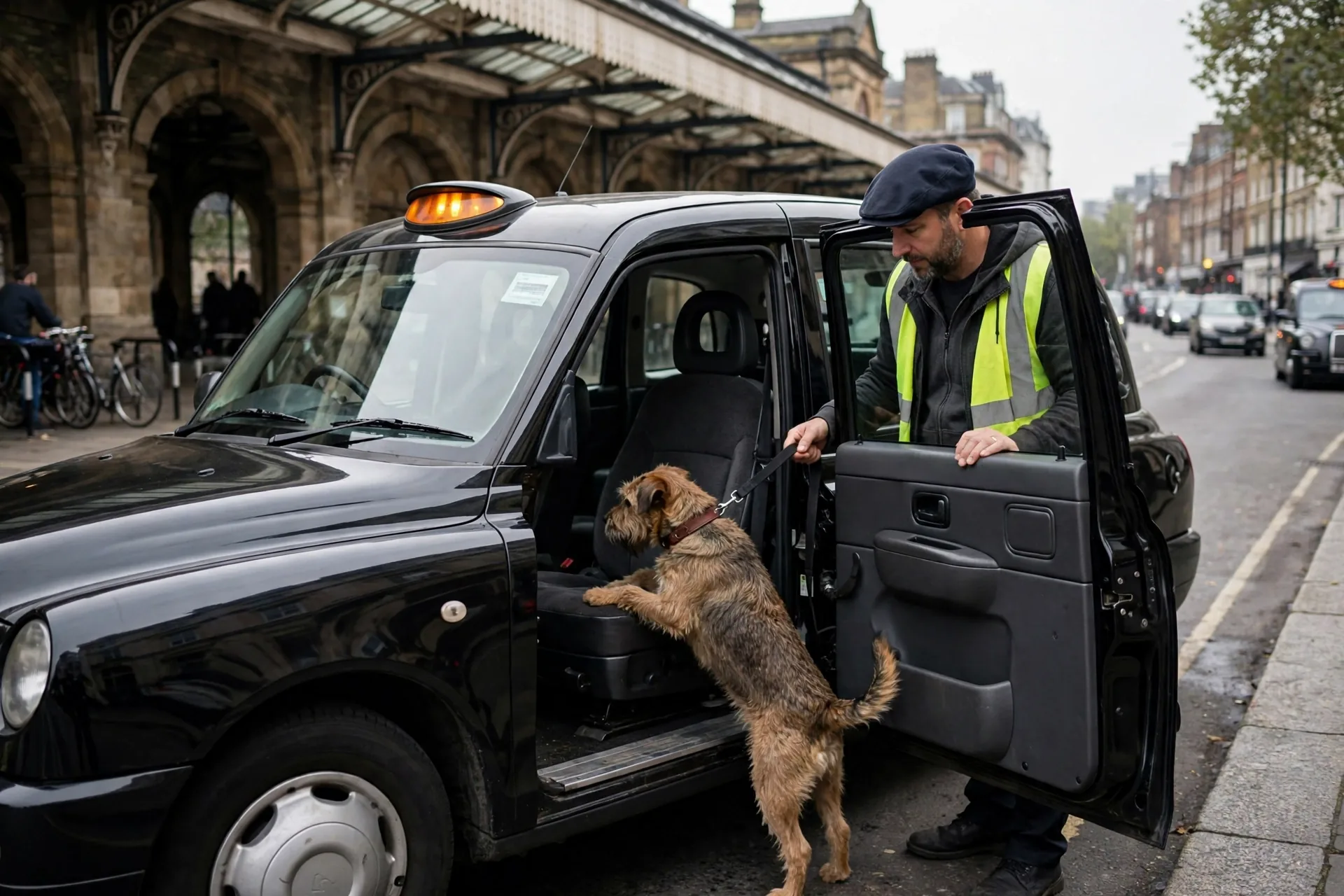
Taxis are the pressure valve for the journeys buses cannot do: the refused boarding with an appointment looming, the injured dog coming home from the vet, the two-dog move. The catch is that taxi and private-hire drivers can generally choose whether to carry a pet dog — assistance dogs are different and are covered by equality law — so the booking conversation matters. Our guide to dog-friendly taxis in the UK explains how to phrase the request, what to declare about size and number, and what cleaning-fee surprises to avoid. State the dog clearly when you book, bring a blanket for the seat or footwell, and you will build a small list of firms that know you and say yes quickly — worth more than any app filter on a wet night.
Keep refusals in perspective when you get home. One refusal on a packed rainy evening is the system working; a pattern of refusals is information about your timing, your route or your dog's presentation, and each of those can be adjusted. Adjust the lead, the hour, the towel, the training — in that order of ease — before concluding that London buses are closed to you. For the overwhelming majority of dogs and owners, they are not. They are open, free and frequent, run by drivers who wave well-prepared dogs aboard all day. Your job is simply to arrive at the door looking like one of those owners: calm dog, short lead, ready card, realistic timing, and a plan B you are genuinely willing to use. Do that, and are dogs allowed on buses in London will stop feeling like a question at all — it will just be how you and your dog get around. Before you travel, check TfL's latest conditions of carriage for any change to the detail in this guide.
Practical questions
Before you go
Are dogs allowed on buses in London?
Yes. Dogs are allowed on Transport for London bus services, provided they are on a lead or in a suitable carrier and under control. Travel is at the driver's discretion, so a driver can refuse boarding or ask you to leave if the dog is a danger or a nuisance to other passengers. Always check TfL's latest conditions of carriage before you travel, as the detail can change.
Do dogs travel free on London buses?
Yes. Dogs travel free on London buses and do not need a ticket, an Oyster card or a contactless payment. Only the human passengers pay. That free travel depends on the dog behaving and staying under control for the whole journey, and it does not override the driver's discretion to refuse a dog that would endanger or inconvenience other passengers.
Can a London bus driver refuse my dog?
Yes. TfL allows dogs at the driver's discretion. A driver may refuse if the bus is already crowded, if another dog is already on board, if your dog is wet, muddy, aggressive or out of control, or if boarding would be unsafe. Do not argue at the doorway. Step back, keep your dog calm and take the next bus, walk to a quieter stop, or use another route.
How many dogs can I take on a London bus?
TfL guidance is generally understood as one dog per passenger, because you must be able to control the dog fully with a lead held securely. Two dogs, however well behaved, are much harder to keep clear of the aisle and doors on a moving bus. If you need to move two dogs, travel with a second adult, make separate trips, or use a pre-booked dog-friendly taxi instead.
Does my dog need a muzzle or a carrier on a London bus?
There is no general TfL rule that every dog must wear a muzzle or travel in a carrier on a London bus. A lead is the key requirement, and a small dog may travel in a carrier if that keeps it calmer and safer. If your dog is reactive, a well-fitted muzzle it is already trained to wear can help other passengers feel comfortable and may make a driver more willing to let you board.
Can my dog sit on a seat on a London bus?
No. Dogs should stay on the floor, clear of the aisle, doors and priority areas, and should not sit on seats. Keep your dog on a short lead close to your feet on the lower deck where possible. You must give up space in the wheelchair and buggy area if a wheelchair user needs it, and move promptly if the driver asks you to reposition.