This guide is independent and contains no paid placement. If affiliate links are added later, they will be clearly marked and will not change our editorial checks.
Dog friendly treehouses exist, but they are rare, expensive and not for every dog. The deciding questions are the stairs, the deck rails and the dog's nerves at height. If the stairs are a proper staircase, the deck is solidly railed, and the dog is calm up high, a treehouse can be magical. If any of those fail, choose a ground-level cabin instead. Check the official guidance before you travel.
What a treehouse stay is, in practice
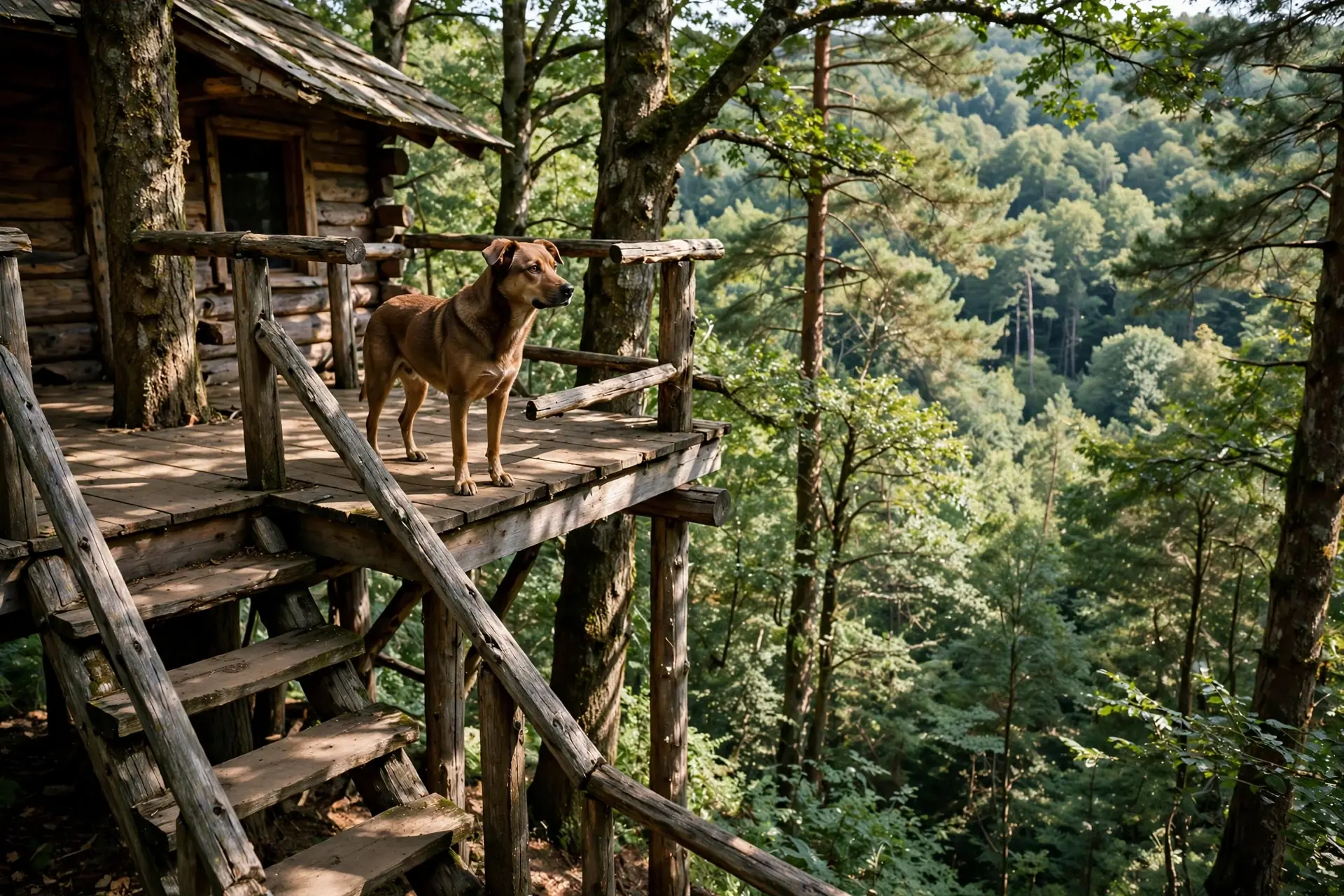
A treehouse is a small wooden cabin built up in the trees, reached by stairs or a ladder, with a deck, a bed and a view through the branches. Some are built around a living tree, with the trunk passing through the room; others are built on stilts among the trees, with the forest as the setting rather than the structure. Inside, a typical treehouse has a double bed, a small kitchen or kitchenette, a shower room, and a wood burner or an electric heater. The space is small, often a single room with a sleeping platform, and the ceiling is low, so it feels like a cabin that happens to be in the air.
Treehouse sites are usually small and quiet. A site may have one treehouse, or a handful spread through a wood, each with its own clearing, its own deck and its own view. The woodland setting is the point: birdsong in the morning, the sound of wind in the leaves, and a view that changes with the light. For a dog, the setting is both the attraction and the problem. The woodland is full of smells, squirrels, birds and other dogs, and the treehouse itself is a small, unfamiliar room at the top of a staircase. A dog that loves woods and settles quickly will enjoy it; a dog that is nervous, reactive or afraid of heights may not.
The treehouse is also a sound amplifier. Wooden floors carry every footstep, the deck carries every bark, and the trees carry sound a long way. A barking dog in a treehouse is heard across the whole wood, and a dog that paces at night will keep the whole site awake. The small space means the dog is always close to you, which is comforting for some dogs and claustrophobic for others. If your dog is used to a house with rooms to move between, a single-room treehouse can feel cramped, and the dog may pace or whine. Spend the first evening quietly, let the dog explore the room, and give it a bed in a corner where it can settle and watch you. The treehouse rewards a calm dog and punishes a restless one.
The different kinds of treehouse
Not all treehouses are the same, and the differences matter more for a dog than for a person. The first kind is the true treehouse, built in and around a living tree, with the trunk inside the room and the branches through the deck. These are the most atmospheric and the most awkward: the floor is uneven, the trunk takes up space, and the structure moves slightly in the wind. The second kind is the stilt house, built on posts among the trees, with a flat floor, a proper staircase and a solid deck. These are the most dog-friendly, because they behave like a small cabin on legs, and the stairs are usually a proper staircase rather than a ladder.
The third kind is the cabin in the trees, a wooden lodge built at ground level in a woodland clearing, with a deck and a view through the trees but no climb at all. These are often marketed as treehouses, and they are the best choice for a dog that cannot manage stairs, because the dog walks in at ground level. The fourth kind is the luxury treehouse, with a hot tub on the deck, a copper bath inside and a price to match. These are the most expensive and the least dog-friendly, because the hot tub, the deck and the luxury fittings are all hazards for a dog, and many luxury treehouses do not accept dogs at all. Our broader guide to glamping with a dog in the UK compares treehouses with bell tents, yurts and shepherd huts, and the pattern is clear: the higher and the more luxurious the stay, the fewer dogs it welcomes.
When you browse, look past the photographs and find out which kind you are looking at. Ask the owner how high the treehouse is, how you reach it, and whether the floor is flat. A treehouse three metres up with a proper staircase is a different proposition from one ten metres up with a ladder, and the photographs rarely show the difference. The height matters for the dog's nerves, the stair design matters for the dog's legs, and the floor matters for the dog's footing. A dog that is happy on a staircase at home will usually manage a treehouse staircase; a dog that has never climbed stairs will struggle, and a dog with arthritis should not be asked to climb a ladder at all.
The house rules, written for a room in the sky
Treehouse owners write their dog rules around two things: the height and the wood. The first rule is almost always about the lead. Expect the dog to be on a lead from the car park to the foot of the stairs, up the stairs, on the deck and on every woodland path around the site. Some owners ask you to carry a small dog up the stairs rather than letting it run ahead, because a dog that rushes up open steps can slip, and a dog that rushes down them can pull you with it. Read the booking confirmation email carefully, because that is where the rules usually live, rather than on the glossy listing page. If the confirmation says nothing about dogs, call the owner and ask, and keep the reply.
Numbers are usually tight. One dog is the norm, two is the common maximum, and three is rare, because the floor of a treehouse is small and the deck is smaller. A large dog fills a treehouse in a way that a large dog never fills a cottage, and some owners set a weight limit, so ask whether one applies and what it is. Breed rules turn up here too: a few owners will not take certain types, and the honest approach is to declare the breed when you book rather than on arrival. Assistance dogs sit outside these limits, as they should, and no pet fee should apply to them, but tell the owner in advance so the right treehouse can be set aside. If an owner is vague about any of this, treat that as information: a treehouse that has hosted dogs before will have answers ready.
Noise is the rule that owners enforce most strictly, because a bark in a wood travels. A dog that barks at squirrels, at other dogs or at every footstep on the stairs will be heard by every other treehouse on the site, and most sites run quiet hours in the evening. Keep the dog inside with the door shut if it is reactive, walk it at quiet times, and ask for a treehouse at the edge of the wood if one is free. The chewing rule follows from the building itself: wooden walls, blinds, soft furnishings and a small room mean a bored dog can do expensive damage in minutes, so never leave the dog alone in the treehouse, and bring a chew to keep it occupied in the evening. If there is a hot tub on the deck, ask where it sits, whether its cover locks, and how the dog is kept away from it, because the water is hot and the chemicals are harmful.
Stairs, ladders and getting the dog up there
Access is the single biggest practical question for a treehouse with a dog, and it is the question most people forget to ask. A treehouse is reached by stairs, a ladder or a ramp, and each one is a different challenge. A proper staircase, with a handrail, closed treads and a gentle slope, is manageable for most dogs, especially if the dog is used to stairs at home. An open-tread staircase, where the dog can see through the gaps between the steps, frightens many dogs, because they cannot judge where to put their paws. A steep ladder is the hardest of all: most dogs cannot climb a ladder, and carrying a large dog up a ladder is dangerous for both of you.
Before you book, ask the owner for the exact access: how many steps, how steep, whether the treads are open or closed, whether there is a handrail, and whether there is a landing halfway. Ask for a photograph of the stairs, because the listing photographs usually show the treehouse and the view, not the staircase. If the dog is older, has joint problems, is very small, or is afraid of stairs, a treehouse with a ladder or open-tread steps is the wrong choice, and a ground-level cabin is better. If the dog can manage stairs, practise at home: a staircase with a lead, a treat at the top, and a calm descent. A dog that rushes downstairs is a fall risk, so teach a slow, controlled descent before the trip.
Think about the night-time toilet trip, because that is when the stairs matter most. A dog that needs to go out at 2am must go down the stairs in the dark, in the rain, on a lead, with a torch, and then come back up again. A staircase with a handrail and a light is manageable; a ladder in the dark is not. Ask the owner whether the stairs are lit, and bring a head torch as a backup. If the dog is a puppy, a small dog or an older dog, consider whether you can carry it down the stairs safely, and whether the stairs are wide enough for you to carry it. A dog that cannot get down the stairs at night will have an accident in the treehouse, and that is a cleaning bill and a miserable night for everyone.
Deck safety: rails, gaps and paws
The deck is the best part of a treehouse and the most dangerous part for a dog. A well-built deck has a solid balustrade at least a metre high, with balusters close enough together that a small dog cannot slip through, and decking boards with no gaps a paw can catch in. A poorly built deck has a low rail, wide gaps, a rope balustrade, or decking with gaps that trap paws and claws. Before you book, ask the owner about the deck: how high is the rail, how wide are the gaps, and is the decking solid? Ask for a photograph of the deck, because the listing photographs usually show the view from the deck, not the rail itself.
On arrival, inspect the deck before the dog goes onto it. Walk the perimeter, check the rail for loose boards, check the gaps between the balusters, and check the decking for gaps, nails and splinters. If the deck has a rope balustrade, keep the dog on a lead and do not let it lean on the rope. If the rail is low, keep the dog away from the edge, and never let the dog jump up onto the rail. Small dogs are the most at risk, because they can slip through gaps that a large dog cannot, and a fall from a treehouse deck can be fatal. A puppy or a small dog should be carried on the deck until you are sure it is safe, and a dog should never be left unsupervised on a raised deck, even for a minute.
The deck is also a heat and cold problem. In summer, a wooden deck in direct sun can be hot enough to burn paws, and a dog that lies on a hot deck will overheat. In winter, a deck can be icy, and a dog that slips on ice at height is in danger. Check the deck surface on arrival, and put a mat down for the dog to lie on. If the deck is the only outdoor space, the dog will spend a lot of time there, so make it comfortable: a bed, a water bowl, and shade. And keep the dog's lead on the deck until you know the dog is calm, because a dog that sees a squirrel from a treehouse deck will forget the height and chase it. A lead is the cheapest safety device a treehouse has.
Working out the real price of a treehouse stay
Treehouses sit at the expensive end of glamping, and the nightly rate is the first thing to get straight. A treehouse night commonly costs two or three times a yurt night for the same dates, and the gap grows in school holidays and on summer weekends, when the few dog-friendly treehouses in the country are chased by a lot of people. The pet charge comes on top of that rate, typically around thirty to sixty pounds per dog for the stay, though some owners price it per night instead. Firewood, breakfast hampers, towels and bedding are sometimes included and sometimes charged separately, so the rate on the listing page is rarely the amount that leaves your account.
The deposit works differently from a hotel hold. Many owners take a refundable sum, often a hundred to two hundred pounds, or a pre-authorisation on your card, and it is returned after checkout if the treehouse is undamaged. Think of that deposit as the first slice of a repair bill rather than a ceiling on what you might owe, because a chewed door frame, a scratched floor or a torn blind in a bespoke wooden building can cost far more to fix than the deposit covers. Damage is the reason owners are cautious about dogs, and the reason a calm dog that sleeps on its own bed is worth more than any insurance product you can buy. If something does get damaged, tell the owner straight away; a repair found at checkout is always priced more harshly than one reported honestly.
To judge value, price the whole stay rather than the nightly rate. Add the pet charge, the deposit, the firewood and any extras, then compare that total with a yurt or a cabin in the same area for the same dates. A treehouse that costs twice a yurt but gives the dog a proper staircase, a safely railed deck and a quiet wood is money well spent; a treehouse that costs three times a yurt and has a ladder, a rope deck and a hot tub the dog must avoid is not. Midweek nights and shoulder-season dates are usually much cheaper, and the dog-friendly treehouses are the ones that go first, so book as soon as your dates are firm. If no dog-friendly treehouse is free, a ground-level cabin in the same wood gives the dog the trees without the climb, usually for less money.
Wind, rain and the height question
A treehouse moves. A true treehouse, built around a living tree, sways in the wind, and a stilt house creaks and shifts as the wind loads the structure. For most people the movement is part of the charm, but for a dog it can be unsettling. A dog that is sensitive to movement, or that has never been up high, may pace, whine or refuse to settle when the treehouse moves. Ask the owner how much the treehouse moves in a wind, and whether it is a true treehouse or a stilt house, because a stilt house on solid posts moves less than a treehouse in a living tree. If the forecast is for a storm, the owner may advise against staying, and that advice should be followed.
Rain is the other weather problem. A treehouse roof keeps the rain out, but the deck is exposed, and the stairs are exposed, so every trip out with the dog means rain on the stairs and mud on the deck. A wet dog in a small wooden room gets everything damp fast, and the room has nowhere for the dog to dry except the floor. Pack two drying coats, a towel for the door, and a waterproof mat for the dog's bed, and dry the dog on the deck under a cover if you can. Ask the owner whether there is a covered area on the deck, or a porch, because a treehouse with no cover is a wet stay in a British winter. Our guide to dog friendly campsites in the UK covers the same rain and mud problems at ground level, and the advice transfers, with the added complication of the stairs.
Height itself is a question of temperament. Some dogs are unbothered by height, and will stand on a deck ten metres up and look at the view. Others are frightened, and will hug the wall, refuse to go onto the deck, and pace at night. There is no way to know until the dog is up there, so the honest advice is to consider the dog's history: has it been on a balcony, a bridge, a viewing platform, or an open staircase? If it was calm, it will probably be calm in a treehouse. If it was frightened, a treehouse is a gamble. A dog that is afraid of heights will not enjoy the stay, and a frightened dog in a small room at height is a welfare problem, not a holiday. In that case, choose a ground-level stay and enjoy the woodland from the ground.
Five photographs to ask the owner for
Listings show the bed, the view and the fairy lights. They rarely show the things a dog owner needs to see, so ask the owner for five photographs before you pay. First, the staircase, taken from the bottom looking up, so you can judge the slope, the tread and the handrail. Second, the deck rail at close range, so you can see the height and the gaps between the balusters. Third, the room itself, with the bed in shot, so you can see where a dog bed would go and how much floor is left. Fourth, the path from the car park to the foot of the stairs, because a long, muddy carry with luggage and a dog is a poor start. Fifth, the ground below the deck, so you can see where the dog will toilet and whether there is a road or a fence nearby.
Those photographs answer most of the questions, and the ones they do not answer are worth asking in writing. How high is the treehouse, and does it sway when the wind gets up? Is the bathroom inside the treehouse, or down the stairs and across the wood, which matters a great deal at two in the morning? If there is a hot tub, does its cover lock, and can the dog be kept clear of it? Where does the dog toilet, is there a fenced patch anywhere, and is there livestock in the neighbouring fields? What are the cancellation terms, and what happens to the deposit if you need to move the dates? An owner who answers these plainly has hosted dogs before; an owner who waves them away has not, and that is useful to know before money changes hands.
Reviews repay a different kind of reading. Skip the five-star praise about romance and views, and read the three-star reviews instead, because that is where the stairs, the deck, the cold and the noise get mentioned. Search the reviews for the words stairs, deck, barking and cold, and see what comes up. Then look at a map and measure the distances that matter: the nearest vet, the nearest shop, the nearest pub that welcomes dogs, and the nearest walk that does not need a car. Those distances matter more at height, in the rain, than they do from a cottage door, and a treehouse an hour from the nearest vet is a different risk from one ten minutes away. Finally, check whether anyone is on site overnight, because a warden or an owner nearby is worth a lot if the dog is distressed or the stairs are icy in the morning.
Packing when everything goes up the stairs
The packing problem in a treehouse is not what to bring, but how to carry it. Everything that goes into the treehouse must go up the stairs, and everything must come down again, so pack for two trips in a rucksack rather than one trip with a wheeled suitcase, which is useless on steps. Give the dog its own bag: its bed or a familiar blanket, food in a sealed tub, a collapsible bowl, the lead, the harness and a torch. A heavy ceramic bowl is a bad idea in a treehouse, because it slides on a wooden floor and it is heavy to carry; a rubber-based bowl that grips the floor is better, and a collapsible one weighs nothing at all.
The deck needs its own small kit. A mat for the dog to lie on, because bare boards are hot in the sun and cold in the shade, a water bowl that will not tip if the dog nudges it, and a shade plan for midday, because a deck with no cover is no place for a dog in a heatwave. The night kit lives by the door: a head torch, so your hands are free for the lead on the stairs; a spare lead and a spare collar; poo bags; and a cloth for muddy paws. A long-lasting chew and a food toy earn their weight many times over, because they keep the dog settled in a small room in the evening, when the alternative is pacing, whining and chewing the furniture.
Leave the big crate at home unless you have measured both the stairs and the room. A crate that fits your car may not fit up a staircase, and a crate that fits up the staircase may take up most of the treehouse floor, blocking the door and the stove. A bed and a blanket do the same job in a treehouse, with far less carrying. Pack a small first-aid kit for the dog, with tweezers for thorns, a bandage, and the phone numbers of the vet at home and the vet nearest the site, written on paper rather than only in a phone that might run flat. Check the microchip details before you leave, because a dog that slips a lead in a dark wood is a real risk, and a correct phone number on the chip is the fastest way back. And check the official guidance before you travel, because an owner's rules, prices and facilities change, and only the owner can confirm them.
Dusk, the climb and the first morning
Get there before dark. That single decision does more for a treehouse stay with a dog than any amount of packing, because the first climb in daylight is a different experience from the first climb at night with luggage, a lead and a torch. Park, walk the wood on the ground first, and let the dog sniff the base of the stairs, the clearing and the toilet area. Then climb together, slowly, with a treat waiting at the top. Let the dog walk the deck on the lead, sniff the door and the room, and find the corner where its bed will go. Put the bed against a wall, away from the door and away from any stove, and let the dog settle there with a chew while you bring the bags up in a second trip.
Evenings in a treehouse are noisy in a way a cottage never is. The wood creaks, branches move against the roof, owls call, and the wind comes through the leaves in waves. A dog that has had a good walk, a meal and a calm hour will sleep through most of it; a dog that arrived late, ate late and is already wound up will pace. If the dog barks at a sound, answer it calmly and briefly, then redirect it to its bed, because scolding a frightened dog in a strange room only adds to the fear. The toilet trip in the night is the awkward part: down the stairs in the dark, on a short lead, with the head torch on, then back up again, slowly. If the dog will not come down, do not drag it; carry a small dog, or wait and try again in a few minutes with a treat.
Morning is the reward for the climb. The light comes through the branches, the birds are loud, and the dog is ready to be down the stairs before you are properly awake. Take it down early, give it a long walk in the wood while the dew is still on the leaves, and eat breakfast on the deck if the weather allows. By the second evening the dog will know the stairs, the deck and the bed, and the height will have become ordinary. The stays that go wrong usually share one of three mistakes: the climb was rushed in the dark, the dog was left alone too soon, or the dog spent the middle of the day on a hot deck with nowhere cool to lie. Avoid those, and most dogs take to a treehouse far faster than their owners expect. Our guide to camping with a dog in the UK covers the same slow-arrival routine at ground level, and the principle is identical up in the trees: arrive early, keep the first evening quiet, and let the dog learn the place at its own pace.
Practical questions
Before you go
Are treehouses dog friendly in the UK?
A few are. Treehouses are scarce, and only a minority take dogs. Those that do normally spell it out on the listing, add a pet charge and set conditions on leads, decks and sleeping arrangements. Confirm the exact treehouse, not just the site, accepts dogs, in writing, and check the official guidance before you travel for the latest rules.
Can my dog climb the stairs to a treehouse?
Some can and some cannot. A wide staircase with a rail and closed treads suits most dogs, while a ladder or steep open steps defeat many. Get the owner to describe the access or send a photo: step count, slope, handrail and lighting. Elderly, tiny and arthritic dogs may need carrying, so ask whether that is practical on those particular stairs.
Are treehouse decks safe for dogs?
It comes down to the rail and the gaps. A rail a metre or more high, balusters close together and solid boards underfoot are fine for most dogs. Wide gaps, low rails and rope balustrades are not, and small dogs are most at risk. Walk the deck yourself first, keep the dog on a lead there, and never leave it out there alone.
How much does a dog friendly treehouse cost?
Treehouses sit at the expensive end of glamping, often well above a yurt or a bell tent for the same dates, and the pet charge comes on top, typically thirty to sixty pounds per dog for the stay. Get the whole bill in writing first: nightly rate, pet charge, deposit, firewood and anything else, before you pay.
Can I leave my dog alone in a treehouse?
As a rule, no. Owners generally ask guests to keep the dog with them, because a dog on its own in a little wooden room can chew fittings, scratch floors and bark, and bark carries a long way through trees. Eat somewhere the dog can join you, or cook at the treehouse. If short absences are allowed, get the exact limit in writing and never leave a dog that barks.
What if my dog is afraid of heights?
Then a treehouse is probably the wrong stay. Dogs that flinch on bridges, balconies and open staircases rarely relax ten metres up in a room that moves in the wind. Ask the owner how high it is and whether it sways, and if the answer worries you, take a ground-level cabin or a yurt in the same wood instead.