This guide is independent and contains no paid placement. If affiliate links are added later, they will be clearly marked and will not change our editorial checks.
A dog friendly yurt is a round canvas tent with a real bed, a wood burner and a proper floor — closer to a cabin than to camping, but with no fence, no bathroom of its own and a canvas wall a dog can chew. Check the dog rules, the heating and the rain plan before you book, and expect a pet fee on top of the yurt price. Check the official guidance before you travel.
What a yurt stay is, in practice
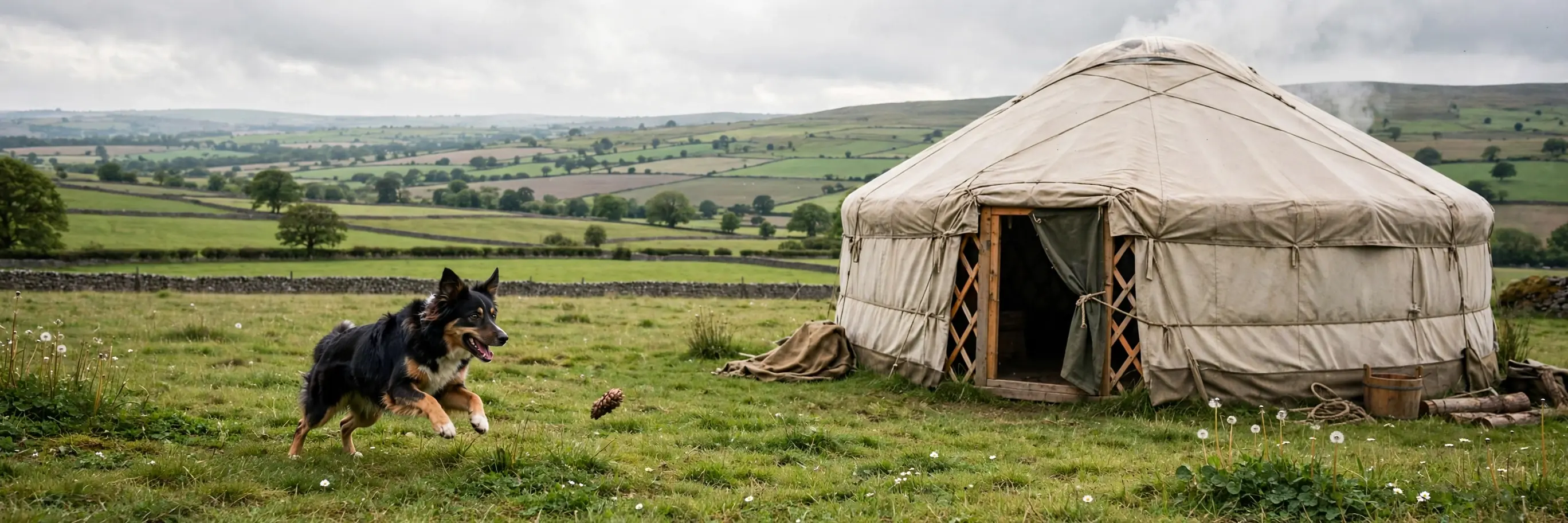
A yurt is a round tent built on a wooden frame, with a canvas cover, a central roof ring and a proper floor, and it has become one of the most popular forms of glamping in the UK. Inside, a typical yurt has a double bed, a small table and chairs, a wood-burning stove, and sometimes a sofa or a day bed. The floor is usually wood or a heavy groundsheet, the walls are canvas over a lattice frame, and the door is a wooden door or a heavy canvas flap. It is a single round room, so everything happens in one space: sleeping, eating, drying the dog and sitting out the rain. That simplicity is the charm, and it is also the challenge with a dog.
Yurt sites vary enormously. Some are small farms with two or three yurts in a field, a shared shower block and a fire pit. Others are larger glamping sites with a dozen yurts, a communal kitchen, a shop and organised activities. The dog's experience depends on the site as much as on the yurt: a quiet farm with a field to walk in suits a dog far better than a busy site with yurts close together and children running between them. When you browse, look past the photographs of the bed and the stove, and look for the practical details: how far apart are the yurts, is there a dog field, is there a covered area for wet days, and how far is the nearest road. Those are the details that decide whether the dog enjoys the stay.
The yurt itself is a sound and smell amplifier. Canvas walls do not block noise the way brick does, so a barking dog is heard by every neighbouring yurt, and a neighbouring dog is heard by yours. The round shape means there are no corners for a nervous dog to hide in, and the single room means the dog is always in the same space as you, which is comforting for some dogs and overstimulating for others. A dog that settles well in one room at home will usually settle in a yurt; a dog that needs its own space, or that is unsettled by new sounds, may struggle. If your dog has never slept in a tent, a yurt is a gentler introduction than a small dome tent, because there is headroom, a real bed and a stove, but it is still a tent, and the first night will tell you a lot.
Yurt, bell tent or cabin: the real differences
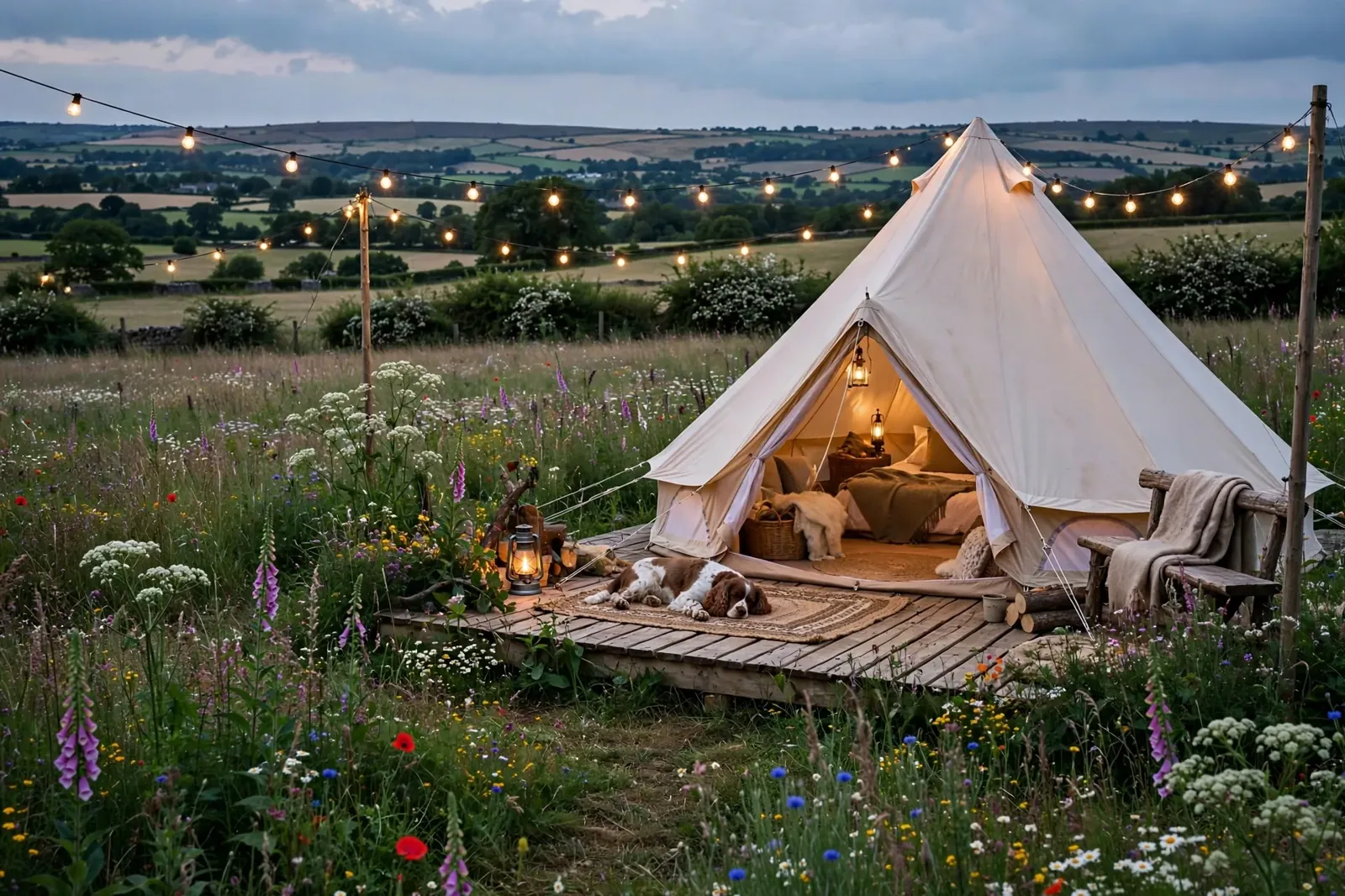
A yurt and a bell tent look similar in a photograph, but they feel different with a dog. A bell tent is a single skin of canvas over a central pole, with a groundsheet and usually no stove, while a yurt has a wooden lattice wall, a proper door, a wooden floor and a wood burner. The yurt is sturdier, warmer and more weatherproof, and the door can be shut properly, which matters when a dog is inside and the rain is horizontal. The bell tent is lighter, cheaper and more open, and it suits a summer weekend with a calm dog, but it is less forgiving in a storm. A cabin or a lodge is a different category again: solid walls, a bathroom, a kitchen and a lockable door, at a higher price and with less of the outdoors feeling.
For a dog, the key differences are floor, heat and security. A yurt's wooden floor is easier to clean than a tent groundsheet and kinder to paws than cold canvas, and a wood burner gives real heat on a cold night, which a bell tent cannot match. The yurt's door can be closed against a dog that wants to wander, while a bell tent's flap is easily pushed open by a determined nose. A cabin beats both on all three counts, but it costs more and it feels less like an adventure. Our broader guide to glamping with a dog in the UK compares bell tents, yurts, shepherd huts and safari tents side by side, including the costs and the booking checks that apply to all of them.
Price is the other difference. A yurt night usually costs more than a bell tent night and less than a cabin night, and the gap widens in school holidays. The yurt price usually includes the bed, the bedding and the use of the site facilities, but it rarely includes the pet fee, the firewood or the towels, so the headline price is not the total. When you compare a yurt with a tent pitch or a cabin, compare the all-in total for the same dates, with the dog included, and think about what the dog gets for the money. A yurt that costs twice a tent pitch but gives the dog a warm, dry room and a proper bed is good value; a yurt that costs nearly as much as a cabin but gives the dog no more than a tent does is not.
The dog rules at yurt sites
Yurt sites that welcome dogs usually set a small number of clear rules, and they are worth reading in full before you book. The most common rule is that dogs must be on a lead at all times outside the yurt, because the site is open ground and other guests, children and livestock are nearby. The second is a limit on the number of dogs, usually one or two per yurt, with more only by prior agreement. The third is that dogs must not be left unattended in the yurt, because a bored dog can chew canvas, scratch the floor and bark at every passer-by. The fourth is a rule about where the dog can go: the yurt and the pitch are usually fine, while the shower block, the communal kitchen and the shop are not.
Breed and size rules appear less often at yurt sites than at holiday parks, but they do exist, and they are worth asking about if your dog is large or of a type listed under the Dangerous Dogs Act 1991. Some sites ask for the breed at booking, and some ask for dogs to be muzzled in shared areas, so declare the breed honestly rather than hoping nobody notices. Assistance dogs are a separate category and should not count against pet limits or incur pet fees, but tell the site in advance so the right yurt can be allocated. If the site's rules are vague, that is a warning sign: a site that has thought about dogs will have written rules, and a site that has not may not be ready for a dog at all.
The rule that causes the most trouble is the one about leaving the dog alone. Many owners assume they can pop to the pub or the shop and leave the dog in the yurt, but most sites forbid it, and the reason is practical: a dog alone in a canvas room will bark, and the barking will be heard by every yurt on the site. If you plan to eat out, check whether the local pub welcomes dogs, or plan to cook at the yurt and eat outside with the dog beside you. If the site does allow short absences, confirm the exact time limit and the conditions, and never leave a dog that barks, chews or is anxious when alone. The site manager's job is to keep every guest happy, and a barking dog in a yurt is the fastest way to make that job hard.
Fees, deposits and the all-in price
The pet fee at a yurt site is usually a flat charge per dog per stay, and a common range is £25 to £50 per dog, though some sites charge per night and some charge nothing at all. The fee is meant to cover the extra cleaning, and it is usually stated on the booking page, but it is not always included in the headline price, so the total can surprise you at checkout. Ask for the all-in total before you pay, including the yurt price, the pet fee, any damage deposit, any charge for bedding or towels, and any charge for firewood. A site that gives a clear total in writing is a site that has its paperwork in order.
The damage deposit is the second cost to understand. Some sites take a refundable deposit of £100 to £200, returned after the stay if the yurt is undamaged, while others take a card pre-authorisation. Canvas is expensive to repair, and a chewed wall panel, a scratched floor or a stained rug can cost far more than the deposit, so the deposit is not the limit of your liability. If the dog damages the yurt, the site can charge the full repair cost, and the deposit is only the first part of it. The best protection is prevention: a crate or a bed the dog knows, a chew to keep it busy, and never leaving the dog alone in the yurt.
Firewood and extras add up too. Some sites include a basket of firewood; others charge per basket, and a cold weekend can use several. Bedding and towels are sometimes included and sometimes charged, and the same applies to a breakfast hamper or a hot tub. When you compare sites, compare the total for the same stay, with the same extras, and check what is included in the yurt price. A cheaper yurt that charges for everything can cost more than a dearer one that includes the firewood, the bedding and the pet fee. And book early for school holidays and bank holiday weekends, because the dog-friendly yurts go first, and the sites with the best dog rules are the ones that sell out earliest.
Heating, cold nights and comfort
A yurt with a wood burner can be warm and cosy, but the heat is not constant, and the dog feels the difference. The stove heats the round room quickly, and the temperature near the stove can be very hot, while the edges of the yurt, near the canvas wall, stay cool. A dog that sleeps beside the stove may overheat, while a dog that sleeps by the wall may be cold, so the dog's bed should be placed where the temperature is even, away from the stove and away from the draught by the door. Ask the site how the yurt is heated, whether the stove is the only heat source, and whether fuel is included, because a yurt with a stove and no fuel is a cold yurt.
Night is the test. The stove burns down, the temperature falls, and the canvas walls do not hold heat. A dog that is warm at 10pm may be cold at 3am, and an older dog or a short-coated breed will feel it first. Bring the dog's own bed, a blanket and a drying coat, and put the bed on a mat rather than directly on the wooden floor, which is cold in the morning. If the site provides an electric heater as well as the stove, ask whether it can be left on overnight, and check the fire safety rules: a heater near a dog bed is a hazard, and a stove guard is essential if the dog moves around at night. Never leave the stove burning with the dog alone in the yurt, and never let the dog sleep against the stove.
Summer brings the opposite problem. A yurt in direct sun heats up fast, and the canvas traps the heat, so a yurt that is cosy in April can be stifling in July. Ask the site whether the yurt is shaded, whether the roof ring opens for ventilation, and whether there is a shaded spot outside for the dog during the day. A dog that is hot will pant, seek shade and drink more, and a yurt with no ventilation is not a safe place for a dog in a heatwave. If the forecast is hot, choose a yurt under trees, bring a cool mat for the dog, and plan the day so the dog is out in the shade rather than in the yurt at midday. Our guide to camping with a dog in the UK covers the same heat and cold problems in a tent, and the advice transfers directly to a yurt.
Rain, mud and the drying problem
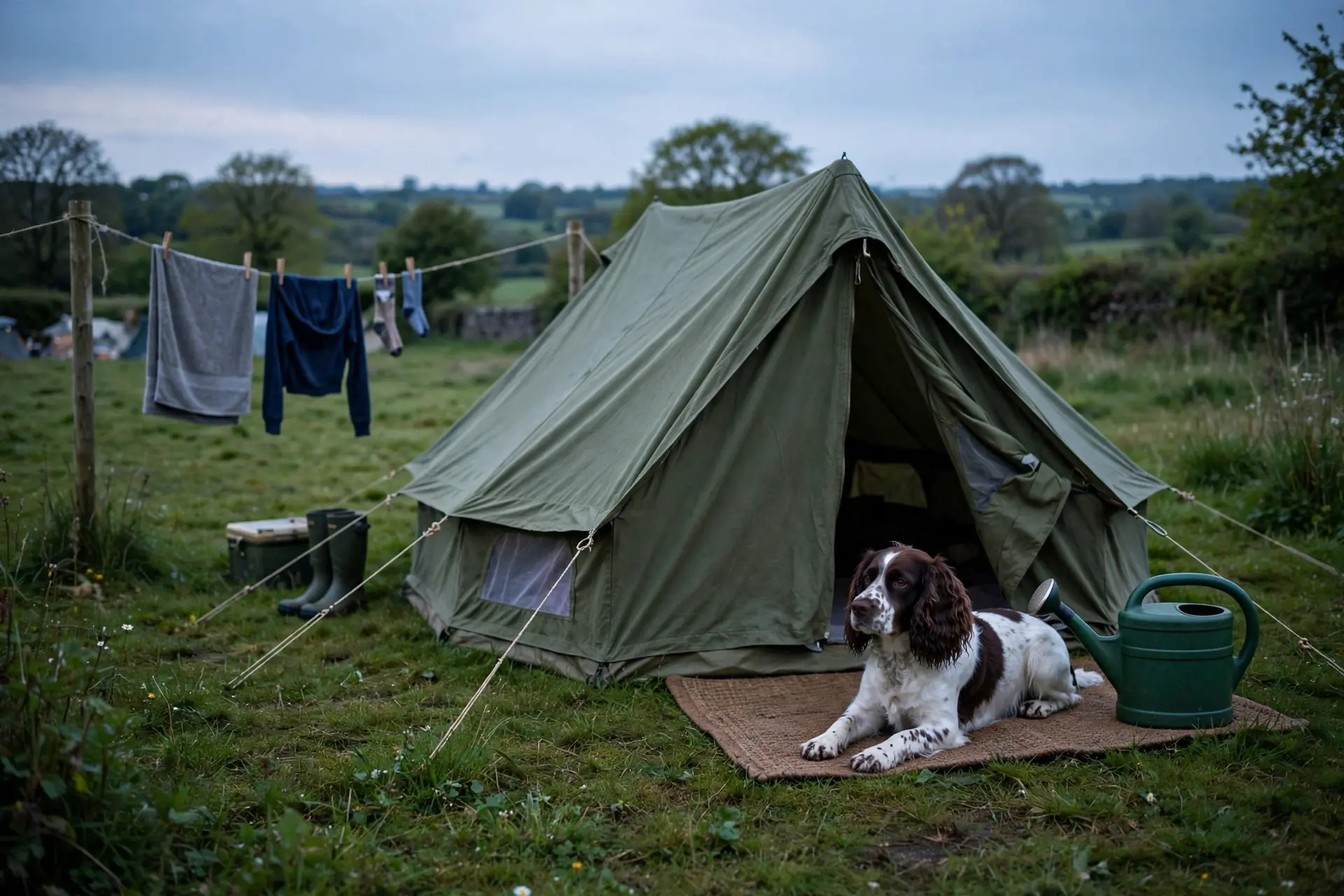
Rain is the real test of a yurt stay, because the yurt keeps the rain out but the dog brings the wet in. A single wet walk can soak the rug, the bed and the floor, and a week of rain can leave the yurt damp and smelling of wet dog. The solution is a system, not a single towel. Pack two drying coats, because one will be wet while the other dries, a towel for the door, a waterproof mat for the dog's bed, and a lidded box by the door for muddy leads and collars. Dry the dog outside the yurt if you can, under a porch or a tarpaulin, and only bring a dry dog inside.
Ask the site before you book whether there is a drying area, a covered porch or an outdoor tap. A site that has thought about wet dogs will have one of these, and a site that has not will expect you to improvise with a single bath towel. Check the ground outside the yurt, because a yurt on a slope with a muddy entrance makes every trip in and out a cleaning job, while a yurt on gravel with a hard standing is far easier. If the site has a dog wash station, use it, and if it does not, bring a portable shower or a large water container. Ventilation matters too: a yurt with a wet dog inside and the door shut will steam up, so open the roof vent and crack the door, even in cold weather, to let the damp out.
Plan the walks around the ground, not just the distance. Woodland paths on clay, riverside meadows and farm tracks can be impassable after days of rain, while forestry tracks, coastal paths and surfaced trails stay usable. Ask the site which local walks hold up in wet weather, because the staff give this advice constantly and it is rarely written down. Keep the dog's paws clean with a portable paw washer, and check for cuts and thorns after every walk, because wet ground hides hazards. And if the rain is relentless, have a wet-day plan that does not involve the yurt: a dog-friendly café, a covered market, or a drive to a beach where the dog can run in the rain and be dried in the car.
Boundaries, livestock and the lead rule
Most yurts have no fence, and that is the single biggest difference from a cottage or a holiday park. The yurt sits on open ground, the field stretches away in every direction, and the dog can see sheep, rabbits, other dogs and the road. The lead rule exists for a reason: a dog off the lead on open ground can be in a neighbouring field, on a road, or chasing livestock within seconds. Keep the dog on a lead or a long line outside the yurt, and use a long line rather than a short lead when the dog needs room to sniff, because a long line gives freedom without giving up control.
Livestock is the serious risk. Sheep, cattle and horses are common around yurt sites, and a dog that chases sheep can cause a farmer to take action, including shooting the dog in the most serious cases. The law is clear: a dog worrying livestock can be shot by the landowner, and the owner can be liable for the damage. Never let the dog off the lead near livestock, and if sheep are visible from the yurt, keep the dog on a short lead and walk it away from the field. Check the site's surroundings on arrival: where are the fences, where is the road, and where is the livestock? A yurt near a busy road needs the same care as a yurt near sheep, because a dog that slips the lead at the door can be on the road in seconds.
Other dogs are the second risk. Yurt sites attract dog owners, so there will be other dogs on the site, and they will be on leads too, but a reactive dog meeting another reactive dog on a narrow path between yurts is a confrontation waiting to happen. Walk the dog at quiet times, keep a distance from other yurts, and use the dog field if the site has one. If your dog is reactive, tell the site when you book, and ask for a yurt at the edge of the site, away from the footpaths and the communal areas. A quiet pitch at the edge is worth more than a pretty pitch in the middle, and the site will usually try to help if you ask early. Our guide to dog friendly campsites in the UK covers the same pitch-choice and boundary questions for tent pitches, and the logic is identical.
Booking checks that matter
Before you pay for a yurt, run through a short checklist, and get the answers in writing. First, confirm that the specific yurt you are booking accepts dogs, and how many, because a site may have dog-friendly yurts and non-dog yurts, and the one in the photograph may not be the one you get. Second, confirm the pet fee and the damage deposit, and what they cover. Third, ask about the heating: is there a wood burner, is fuel included, and is there an electric heater as well? Fourth, ask about the bathroom: is it private to the yurt, shared with other yurts, or in a separate block, and how far is it from the yurt at night?
Fifth, ask about the ground and the access: is the yurt on flat ground, is there a hard standing for the car, and how far is the walk from the car to the yurt with luggage and a dog? Sixth, ask about the wet-weather facilities: is there a covered area, a drying room or an outdoor tap? Seventh, ask about the local walks: which ones are dog-friendly, which ones are on leads, and which ones hold up in wet weather? Eighth, ask about the cancellation terms, because a yurt booked in January for August may need to move, and the deposit terms matter. A site that answers all eight clearly is a site that knows its product; a site that answers vaguely is a site to think twice about.
Check the reviews, but read them like a dog owner. A review that says "lovely yurt, beautiful views" tells you nothing about the dog, while a review that says "the dog loved the field, the site was quiet, the yurt was warm" tells you everything. Look for reviews from dog owners specifically, and look for the complaints: barking dogs, muddy pitches, cold nights and rude neighbours are all mentioned in reviews, and they are the things that matter. If the site has no reviews from dog owners, that is not necessarily a bad sign, but it means you should ask more questions before you book. And check the location on a map: how far is the nearest vet, the nearest shop and the nearest dog-friendly pub, because those distances matter more in the rain than they do in the sunshine.
What to pack for a yurt with a dog
Packing for a yurt is closer to packing for a cottage than for a tent, because the yurt has a bed and a floor, but the dog still needs its own kit. Start with the dog's bed or a familiar blanket, because the dog needs a place that smells like home in a round room that smells like canvas. Add a waterproof mat under the bed, a drying coat or two, a towel for the door, and a lidded box for muddy leads and collars. Pack the dog's usual food, a water bowl that will not slide on a wooden floor, and any medication, with the vet's instructions. A long-lasting chew and a food toy will keep the dog busy in the evening, and a worn item of your clothing will help the dog settle.
For the yurt itself, pack a torch, because the walk from the yurt to the bathroom at night is dark, and a head torch is even better, because it leaves your hands free for the lead. Pack a pair of wellington boots, because the ground around a yurt is muddy after rain, and a waterproof jacket for the dog walks. Pack a small first-aid kit for the dog, with the vet's number and the number of a vet near the site. If the yurt has a wood burner, the site will usually provide firelighters and matches, but bring your own as a backup, and check whether you need to bring your own firewood or whether it is supplied. A portable fan is useful in summer, because a yurt in the sun can be hot, and a cool mat for the dog is worth the space.
Do not pack the dog's crate unless you know it fits, because a yurt is a single round room and a large crate takes up a lot of it. Measure the yurt's floor space from the site's description, and compare it with the crate's footprint. A crate can be a great tool for a dog that settles in one, but in a yurt it can also block the door or the stove, so think about the layout before you bring it. If the dog does not use a crate, a bed and a blanket are enough. And pack a spare lead and a spare collar, because a lead lost in a field on the first day is a problem that a spare solves in seconds. Finally, check the official guidance before you travel, because the site's rules, prices and facilities change, and the only reliable source is the site itself.
The first night in a round room
The first night in a yurt sets the tone for the whole stay, and a little care makes it a good one. Arrive in daylight, because setting up in the dark with a dog is stressful for everyone. Walk the pitch before you unload: check the boundary, the distance to the road, the nearest toilet walk, and where the other yurts are. Let the dog sniff the yurt, the pitch and the surrounding field, and give it a toilet break before you go inside. Set up the dog's bed in the spot you have chosen, away from the stove and the door, and let the dog settle there with a chew while you unpack.
Keep the first evening quiet. Light the stove if there is one, cook something simple, and let the dog get used to the sounds of the yurt: the canvas moving in the wind, the stove crackling, the rain on the roof. A dog that has had a good walk, a meal and a calm evening will sleep well, while a dog that has had a rushed arrival, a late meal and a noisy evening will be restless. If the dog barks at a noise outside, reassure it calmly rather than scolding it, because the dog is telling you it heard something new. If the dog cannot settle, a short walk outside and a toilet break will often do more than an hour of soothing.
The morning after is the reward. A yurt morning is a slow one: the light comes through the canvas, the birds are loud, and the dog is ready for a walk before you are. Take the dog out early, before the site wakes up, and give it a proper walk while the dew is still on the grass. That early walk sets the dog up for the day, and it gives you a quiet hour to plan. By the second night, the yurt will feel like home to the dog, and the round room will feel normal. The dogs that struggle in yurts are usually the ones that were rushed on arrival, left alone too soon, or kept in a hot, stuffy yurt all day. Avoid those three mistakes, and most dogs will love a yurt stay.
Practical questions
Before you go
Are yurts dog friendly in the UK?
Many are, but not all. Yurt sites that welcome dogs usually say so clearly, charge a pet fee and set rules about leads, numbers and where the dog can go. Some sites accept dogs only in certain yurts, and a few do not accept them at all. Always confirm in writing that the specific yurt you are booking accepts dogs, and check the official guidance before you travel for the latest rules of the site you choose.
How much does a dog friendly yurt stay cost?
A yurt stay usually costs more than a tent pitch and less than a cottage, with prices rising sharply in school holidays and at weekends. Expect a pet fee of around 25 to 50 pounds per dog per stay on top of the yurt price, though some sites charge per night. Ask for the all-in total, including the pet fee, any damage deposit and any charge for bedding or towels, before you pay.
Are yurts warm enough for a dog in winter?
A well-made yurt with a wood burner or a heater can be warm in winter, but the temperature drops fast once the fire goes out, and the canvas walls do not hold heat like a brick building. Bring the dog's bed, a blanket and a drying coat, and ask the site how the yurt is heated and whether fuel is included. Older dogs and short-coated breeds feel the cold more, so plan for a cold night even if the day is mild.
Can I leave my dog alone in a yurt?
Usually not, or only for a short time. Most yurt sites ask owners not to leave dogs unattended in the yurt, because a bored dog can chew canvas, scratch the floor and disturb neighbouring yurts. Plan as if the answer is no: eat at places where the dog is welcome, or take the dog with you. If the site does allow short absences, confirm the exact rule in writing and never leave a barking dog alone.
What if it rains during a yurt stay with a dog?
Rain is the real test of a yurt stay. The canvas keeps the rain out, but a wet dog in a round room with a rug and a bed gets everything damp fast. Pack two drying coats, a towel for the door, a waterproof mat for the dog's bed, and a covered spot outside where the dog can be dried. Ask the site whether there is a drying area or a covered porch, and check the ground outside the yurt, because a muddy entrance makes every trip in and out a cleaning job.
Do yurts have enclosed gardens for dogs?
Rarely. Most yurts sit on open ground with no fence, and the dog must be on a lead or a long line outside the yurt. Some sites offer a fenced area or a dog field, but that is the exception rather than the rule. Ask the site about the boundary, the distance to the nearest road, and whether livestock is nearby, because a dog that chases sheep on unfenced ground is a serious problem.