This guide is independent and contains no paid placement. If affiliate links are added later, they will be clearly marked and will not change our editorial checks.
A life jacket does not teach your dog to swim. It buys the dog time and gives you a grab handle when cold, currents, fatigue or panic take over — and only if it fits properly. Pick bright colour, under-jaw floatation, a strong handle and a fit that stays level in the water.
Does your dog actually need a life jacket? The yes-no test
Start with the dog, not the catalogue. A young Newfoundland and a ten-year-old pug heading to the same lake need completely different answers, and "my dog is a good swimmer" answers a different question than "my dog is safe in this water today". Work through the checks below before you spend anything. If any of them points to yes, buy the jacket.
The clearest yes comes from body shape. Flat-faced breeds — pugs, French bulldogs, English bulldogs, shih tzus and their crosses — carry heavy heads on short muzzles, and many tire quickly because they cannot breathe efficiently while swimming. Lean, low-body-fat breeds such as greyhounds, whippets and lurchers sink lower in the water than they expect and feel the cold sooner. Short-legged breeds like dachshunds and corgis paddle hard for little forward motion. Our brachycephalic travel guide covers the breathing issue on land too; in water the same anatomy is simply less forgiving.
Age and condition are the next filter. Puppies under about six months lack coordination and tire without warning — one minute of enthusiastic splashing is all it takes. Senior dogs may still love water while hiding arthritis, heart weakness or reduced stamina; cold water stiffens old joints fast. Dogs recovering from surgery or injury, even if the vet has cleared gentle exercise, should never test a healing body without floatation. And any dog on its first swim of the season, or first swim ever, is a beginner regardless of breed.
Then look at the water, not the dog. Any moving water deserves a jacket: rivers with current, tidal estuaries, and the sea even on a calm day, because rip currents and cold do not announce themselves. British sea temperatures sit below 15°C for most of the year outside high summer, and cold water drains a dog's strength far faster than a warm pool does. Boats, canoes, kayaks and paddleboards are a special case: a jacket is not for the swimming, it is for the fall — a dog knocked off a board half a mile out needs to float while you paddle back to it. Finally, even the strongest swimmers benefit on long swims, in choppy water, or when the day involves repeated dips; fatigue is the quiet killer that owners rarely budget for.
There is one honest no. A healthy, experienced swimmer paddling in calm, shallow, familiar freshwater on a warm day, with you standing beside it, gains little from a jacket — and a badly fitting one can add more risk than it removes. But notice how many conditions that sentence carries. On a travelling holiday, where the water is unfamiliar and the distractions are new, most owners find the yes list longer than they expected.
Decoding the anatomy of a dog life jacket
Every decent dog life jacket is doing the same four jobs: keeping the head up, keeping the body level, staying put, and giving you something to grab. Once you know which part does which job, you can read any product page in thirty seconds and spot the jackets that are costumes with buckles.
Buoyancy placement is the heart of it. The floatation panels should run along the chest, belly and sides, with enough foam under and around the neck to support the head — this is sometimes called a chin float or under-jaw panel. A jacket with foam only on the back leaves the heavy end — the head — free to dip, which is exactly what exhausts flat-faced and short-legged dogs. Pinch the foam: good jackets use firm, springy closed-cell foam that rebounds. If it stays dented, it is already losing its lift.
The grab handle is the single most important feature for real rescues. It should sit on the mid-back, be wide enough for a full gloved hand, and be stitched through the jacket's structural webbing rather than tacked to the outer shell. Test the stitching in the shop: lift the whole jacket by the handle. If the handle flexes or the fabric puckers, it will not hold a wet, panicking 30-kilo dog being hauled through surf or onto a paddleboard.
Straps decide whether the jacket stays where the buoyancy is designed to be. Look for at least two belly straps with quick-release buckles positioned clear of the armpits — buckles that sit in the elbow fold will rub the skin raw within an hour. A crotch or belly-band strap running between the back legs stops the classic failure: the jacket riding forward until it is around the dog's ears, pushing the head down instead of holding it up. That single strap is the difference between a jacket that works when the dog panics and one that turns into a hazard.
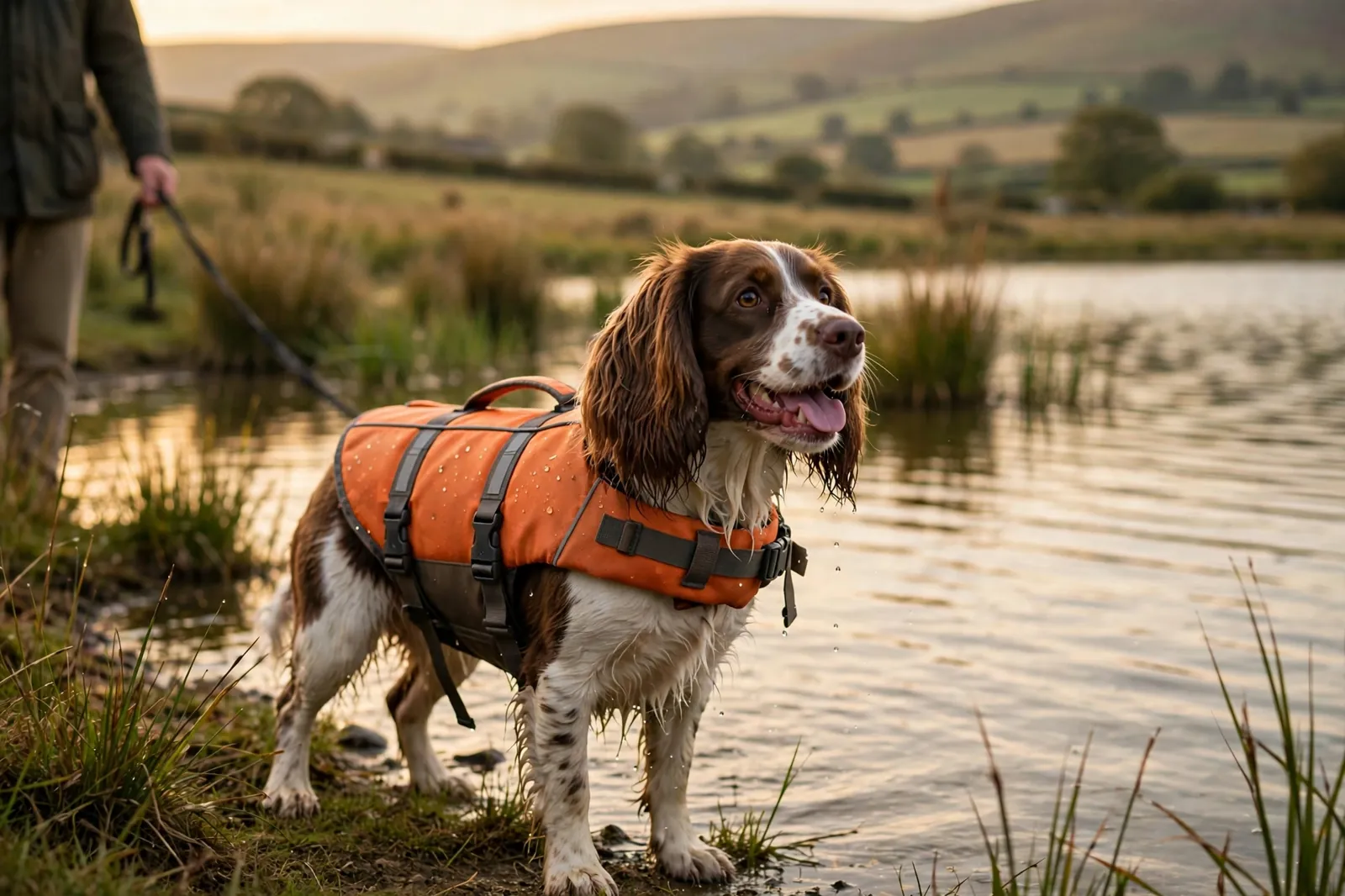
Visibility and details finish the job. Bright orange, yellow or red are genuinely easier to spot in grey British water than navy or camouflage patterns; reflective piping and trim matter for evening swims. A D-ring on the back lets you clip a lead for controlled entries, though it is not a substitute for a proper harness on land. Mesh underbelly panels drain water and reduce drag, and all edges should be smooth with no zips or velcro in places where fur catches. If a jacket needs a manual to put on, it will be skipped on the days it matters most — two or three buckles, colour-coded, is the sweet spot.
How to measure your dog and run the three-minute fit test
Size charts differ between makers, so treat the letter on the label as a rumour and your tape measure as the truth. Take three measurements on a standing, relaxed dog. Chest girth is the one that matters most: measure around the widest part of the ribcage, just behind the front legs, with the tape snug but not tight. Then neck circumference at the base of the neck, and back length from the base of the neck to the base of the tail. Write all three down before you open a single product page, because comparing numbers beats comparing "mediums" that mean different things everywhere.
Start with the maker's chart using chest girth first and back length second. If your dog falls between two sizes, the usual advice is to size down — a slightly snug jacket floats correctly, while a loose one shifts, rides up and can push the head under when the dog tires. The exceptions are deep-chested breeds with narrow waists, like greyhounds, where the belly strap may need the larger size and the neck strap taken in; and growing puppies, where you should buy for today and accept that the jacket may last one season, not three.
The land test takes ninety seconds. Fasten all straps, then slide two flat fingers under the chest and belly straps — they should go in with mild resistance. Run your hand along the inside: no bunched skin at the armpits, no buckle pressing into the elbow fold. Now lift the jacket by the grab handle with the dog standing. A correct fit rises a little and settles; a wrong fit pulls forward over the shoulders toward the ears. If it migrates on dry land, it will migrate much faster in water.
The water test is the one most people skip, and it is the one that counts. On the first outing, keep the dog on a long line in shallow water and watch three things. The dog should float level, not nose-down or tail-down. The chin float should keep the mouth clearly above the surface without the dog straining its neck up. And the jacket should stay put when the dog shakes, turns and paddles — the shake test is brutal and honest. Check again after ten minutes of swimming: wet straps stretch, and foam settles. If anything has shifted, dry the dog, tighten one notch, and test again. A jacket that passes dry and fails wet is the wrong jacket.
Re-check the fit through the season. Dogs gain and lose condition on active holidays, thick winter coats go on and off, and puppies grow in visible jumps. A jacket that was perfect in June can be a loose hazard by August on a lean, fit, well-exercised dog. The two-finger check before the first swim of each trip takes seconds and catches the drift.
Match the jacket to the water: lakes, rivers, sea and boards
Not all water asks the same of a jacket. Buying one "for the holiday" without naming the water is how people end up with a calm-lake vest for a Cornish surf beach. Match the features to the venue you will actually visit.
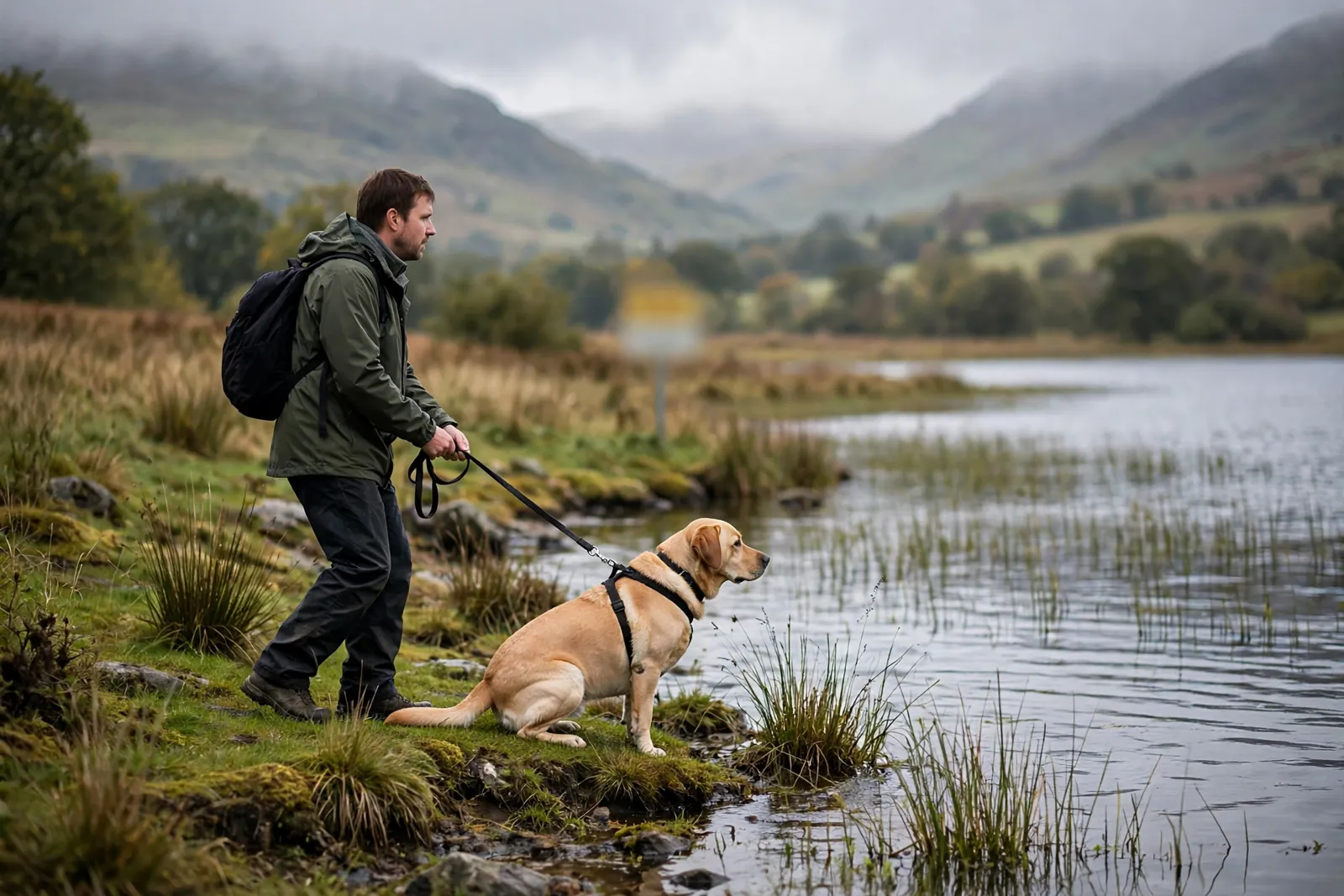
Lakes and reservoirs are the friendliest water, but they have their own traps. Entries are often slippery — algae-slicked stone, soft mud, sudden drop-offs — so a strong handle helps you steady the dog in and out. In warm months, still water can carry blue-green algae, which can be fatal to dogs long before any swim is finished; know what a bloom looks like and keep the dog out of suspicious water entirely, jacket or not. Our blue-green algae guide shows the warning signs. Reeds and lily beds tangle legs, so a jacket with a smooth, snag-free outer shell matters more here than maximum buoyancy.
Rivers add current, and current changes the physics. Even a gentle-looking flow doubles the effort of swimming, and strainers — fallen branches and debris — pin dogs that get swept into them. On rivers, keep the dog on a long line attached to the jacket's D-ring, never tie the line to yourself, and choose entry points with a clear downstream run-out rather than weirs or bridges. The handle is your emergency brake: it is how you lift a dog out of a snag in seconds.
The sea is the most demanding venue. Cold water saps strength, waves break rhythm, and salt irritates eyes and stomachs when dogs drink the spray. For sea swimming, insist on high-visibility colour, chin support that holds against chop, reflective trim, and a fit tight enough to survive surf without riding up. Rinse the jacket in fresh water after every sea session — salt crystals chew through stitching and buckles over a season, and the replacement-signal section below shows what to look for. And if your holiday involves getting to the coast by ferry — to Ireland, the Channel Islands or the continent — read our guide to dogs on UK ferries before you book, because the crossing itself has its own rules and kennel arrangements.
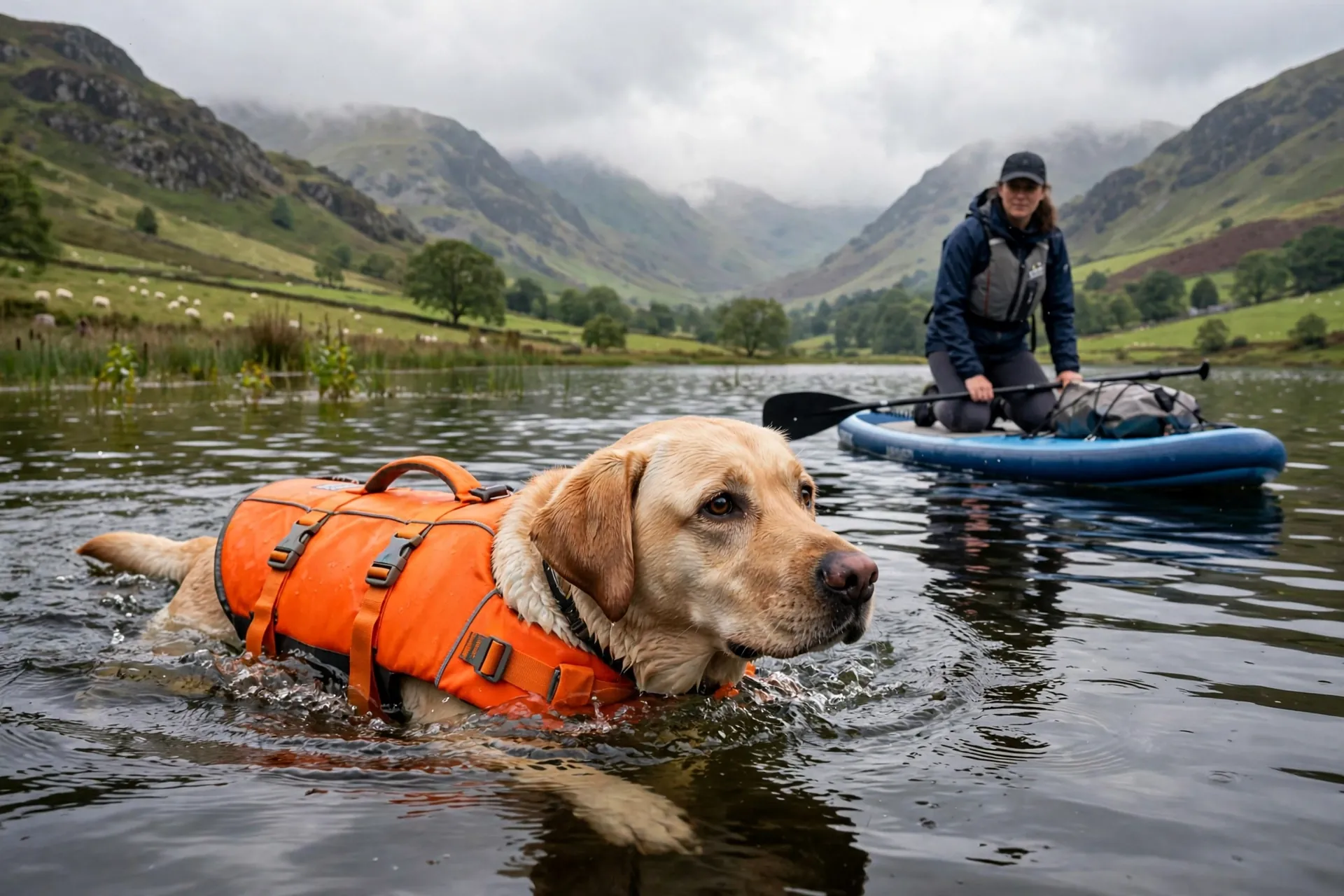
Boards, canoes and kayaks are where the handle earns its price. Dogs fall off paddleboards; it is a matter of when, not if. The jacket keeps the dog floating while you turn the board around, and the handle is how a 25-kilo dog gets hauled back aboard without capsizing both of you. Practise the lift on dry land first — a wet dog is heavier and less cooperative than you expect. Trim matters too: a heavy dog scrambling aboard one side can tip a narrow board, so train the dog to come to the tail or the centre, not the rail. On canoes and kayaks, a slim-profile jacket with the bulk under the chest rather than around the neck lets the dog lie down comfortably between the seats without overheating.
Whatever the venue, the supervision rules do not change. A jacket is a safety margin, not a supervisor. Our dog swimming safety guide covers the rest of the picture — safe entry points, cold water, tides and what to do when things go wrong — and it is worth reading alongside this one before the first swim of the holiday.
First swims: a five-step water confidence routine
Most dogs that "hate" life jackets have never been introduced to one — they have had one strapped on, marched to the water and expected to perform. Five short sessions, spread over a few days, turn the jacket from a novelty into background. Do this at home before the holiday, not on the beach on day one.
Step one: the jacket is furniture. Leave it on the floor for a day. Reward the dog for sniffing it, stepping on it, lying near it. You are aiming for boredom — a dog that ignores the jacket is a dog halfway to wearing it.
Step two: wear it like a coat. Drape it over the back, fasten one strap, treat, remove. Build to all straps over two or three short sessions, always ending while the dog is still happy. Practise lifting the handle gently and rewarding calm — the first time the dog feels that lift should not be during a rescue.
Step three: shallow water, dog's choice. At a calm edge, let the dog wade in wearing the jacket. No throwing, no dragging, no "encouraging" pushes. Some dogs march straight in; others need three visits. Let the dog set the pace, keep sessions under ten minutes, and finish with play on the bank.
Step four: short swims with a safety line. In water you can stand in, let the dog swim a few metres on a long line while you stay close. Watch the float: level body, supported chin, jacket staying put. If the dog panics, you are right there to lift by the handle and walk out — a calm exit teaches more than a dramatic rescue.
Step five: build the real thing gradually. Add distance, depth and mild chop over several outings, not one. Keep the first proper swim short and successful, and always end before the dog is tired — tired dogs learn that water equals exhaustion. End every session with something the dog loves: a game, a warm towel, a treat. The jacket should predict good things.
Two rules run through all five steps. Never force entry — a dog thrown in once can take months to trust water again. And keep the human-to-dog ratio generous: one handler per dog in the water, because a panicking dog plus a distracted owner is how two swimmers get into trouble instead of one.
Rinse, dry, retire: care and replacement signals
A life jacket is safety equipment, not a coat, and it degrades like safety equipment. Salt, sun and repeated compression wear it down, usually slowly enough that owners do not notice until the season it is needed. A small maintenance routine and an honest annual inspection keep the margin real.
After every swim, rinse the jacket in fresh water — essential after the sea, wise after lakes and rivers too, where silt and organic matter work into stitching. Squeeze out the excess water without wringing the foam panels, then hang it to dry in shade with airflow. Never tumble-dry it, never leave it scrunched in a hot car boot for a week, and never store it damp in a sealed bag: mildew eats the inner lining and the smell alone will put the dog off wearing it. Store it flat or loosely hung, straps done up so the buckles do not snag other kit.
Inspect it properly at the start of each season and after any hard incident — a snag on rocks, a dog chewing a strap, a season of weekly sea swims. Work through the retirement signals. Foam that stays compressed when you release the pinch has lost lift. Cracked or crumbling foam inside a torn shell is finished. Frayed straps, stitching that has pulled away from the webbing, and buckles that slip or no longer click firmly are all failures waiting for the worst moment. A handle that stretches or whose stitching has puckered will not hold a lift. And the fit test from the fitting section still applies: if the jacket that was snug last year now rides up in the water, the dog has changed shape and the jacket has not.
For a dog that swims weekly in salt water, budget for a working life of a few hard seasons, not a decade — rinse and shade-dry to stretch it, but do not stretch it past the inspection. For the occasional lake swimmer, a good jacket can last years if it is stored dry and passes the annual check. Either way, retire on evidence, not on a birthday: a three-year-old jacket that passes every test is safer than a one-year-old jacket with a cracked buckle. When you do replace, keep the old one for dry-land training with a new puppy or as a spare — but mark it clearly so it never goes back into the water as safety equipment.
One practical packing note for travelling: the jacket counts as kit, not as an afterthought. Pack it where it is reachable on arrival — car boot top layer, not buried under the tent. If the first swim of the holiday happens an hour after you park, which it often does, the jacket in the bottom of the boot might as well be at home.
Seven myths that quietly make life jackets useless
Bad advice about dog life jackets is rarely dramatic — it is the quiet kind, repeated in good faith, that leaves owners confident and dogs unprotected. These are the seven we hear most.
Myth one: all dogs can swim. Some breeds are genuinely built for water — Newfoundlands, Labradors, Portuguese water dogs — but many are not, and even strong swimmers are not strong in all water. Brachycephalic breeds, heavy low-slung breeds and lean sighthounds all struggle in ways their enthusiasm hides. Judge the dog in front of you, not the species.
Myth two: a life jacket means I can stop watching. A jacket extends the window in which a rescue works; it does not remove the need for one. Dogs still get tangled, still swallow water, still get swept, still panic. The jacket buys minutes. You are still the lifeguard.
Myth three: bigger is safer. An oversized jacket is one of the most dangerous mistakes in this whole guide. Loose jackets ride forward, push the head down, tangle legs and exhaust the dog faster than no jacket at all. Between sizes, go down, and verify in the water.
Myth four: a human buoyancy aid works fine on a dog. Human vests put floatation where an upright torso needs it, the straps foul a dog's legs, and there is no grab handle. It is the wrong shape for the wrong animal, and in a panic it can ride up around the head. Dogs need dog-shaped buoyancy.
Myth five: colour is just fashion. On grey water under a grey sky, a navy or black jacket is nearly invisible at twenty metres. Bright orange, yellow or red is a safety feature, not a style choice — it is how you find your dog in chop, and how a rescuer finds it if you cannot.
Myth six: my dog hates it, so wearing one is cruel. Dogs hate novelty and restriction, not jackets. The five-step routine in the training section works on almost every dog because it removes the novelty before the water is involved. Giving up after one bad fitting teaches the dog that freezing gets the strange thing taken off.
Myth seven: jackets are only for the sea. Cold lakes, fast rivers, boats, paddleboards, tired old dogs, young dogs, first swims — most of the situations where jackets save dogs have nothing to do with salt water. If the rule is "jacket for the sea only", the lake holiday is exactly where the gap opens.
The thread through all seven is the same: a life jacket is a system — right dog, right water, right fit, right habits — and every part has to hold. Get the system right and it is the cheapest safety upgrade a water-going dog owner can buy. Check the official guidance for any venue with specific rules before you travel, and treat this guide as the starting point, not the whole answer.
Practical questions
Before you buy
Do dogs really need life jackets, or can they just swim?
Many dogs swim adequately in calm, warm, familiar water, but a life jacket is still the right call for flat-faced breeds, puppies, seniors, first-time swimmers, and any dog on a boat, paddleboard, or cold or moving water. It does not teach swimming; it buys the dog time and gives you a grab handle when something goes wrong.
How tight should a dog life jacket be?
Snug but not restrictive: you should be able to slide two flat fingers under the chest and belly straps. The real test is in the water, where the jacket must float the dog level with the chin supported and must not ride forward over the head when you lift the handle.
Can I use a human buoyancy aid on my dog?
No. Human buoyancy aids are shaped for an upright human torso, so the floatation sits in the wrong places on a dog, the straps do not clear the legs, and there is no grab handle. A poorly fitting human vest can ride up around the dog's head and make swimming harder, not easier.
When should I replace a dog life jacket?
Replace it when the foam stays compressed or cracked, the stitching or straps are frayed, buckles no longer hold, or the dog has grown out of it so the jacket rides up in water. For a dog that swims weekly in salt water, inspect the jacket every season and expect to retire it after a few hard seasons.
My dog freezes or panics when the jacket goes on. What now?
Go back to dry land and rebuild the association: treats for looking at the jacket, treats for each strap, short wear sessions indoors, then shallow water at the dog's own pace. Most refusals are about novelty and restriction, not the jacket itself, and nearly all dogs accept it within a week of short positive sessions.
Which life jacket features matter most for sea swimming with a dog?
For the sea, prioritise high-visibility colour, a strong grab handle for lifting the dog through surf or onto a board, chin support to keep the head above chop, reflective trim for low light, and a secure fit that will not ride up in waves. Rinse the jacket in fresh water after every sea swim.