This guide is independent and contains no paid placement. If affiliate links are added later, they will be clearly marked and will not change our editorial checks.
Most dog car sickness improves with short, calm, repeated trips, a light meal three to four hours before travel, steady fresh air, a stable resting place with a forward view, and smooth driving with breaks. If sickness happens on most trips or does not improve with training, ask your vet: do not guess at medication or doses.
Start with a five-minute test drive
Forget the holiday route for a moment. The most useful first step for a dog that gets car sick is a five-minute drive around quiet streets, ending somewhere ordinary. No motorway, no winding hill road, no exciting destination that sends the dog into a spin before you have even left the driveway. The point is not to get anywhere. It is to give the dog a short, uneventful experience of motion, and to give you a clean baseline: what does this dog actually do in the car when the journey is tiny?
Set the test up the same way you would set up a real trip, because a test that changes everything at once tells you nothing. Use the dog's usual resting place, whether that is a crate, a harness on the back seat, or a secured boot space. Put down the same blanket or travel bed the dog will use later. Load the dog calmly, close the doors without a long farewell speech, and drive gently for five minutes. Then stop, offer a little water, take a short pavement walk, and drive home the same quiet way. The whole exercise should feel deliberately boring.
Watch the dog rather than the clock. A dog that settles, lies down, watches the world go by and steps out calmly has passed the first test, even if it drooled a little at the start. A dog that pants hard, drools in long strings, licks its lips constantly, yawns repeatedly, whines, vomits, or goes unusually still and glassy-eyed has told you something important, and that something is worth more than any general advice. Note the time when the signs started, whether they began before the car moved, and how long they lasted after you stopped. Those three details separate a dog that is sick from motion from a dog that is anxious about the car itself, and they will shape everything you do next.
Repeat the five-minute drive a few times on different days before you lengthen it. If the dog improves, you have a training plan that is already working. If the dog is sick every single time, even on a flat, straight, five-minute loop, you have useful evidence to take to your vet, and you have saved the dog a miserable hour on a holiday route that would only have made the association worse. Either way, the five-minute test has done its job. It replaces guessing with observation, and it keeps the dog's trust intact while you work out the next step.
Why dogs get car sick
Motion sickness in dogs, as in people, comes from a mismatch between what the balance organs sense and what the eyes see. The vestibular system in the inner ear reports movement, acceleration and changes of direction. The eyes report something else again, especially when the dog is low down, facing sideways, or watching hedges and fences rush past at close range. When those two reports disagree, the brain can interpret the conflict as a problem, and nausea follows. That is why a dog can be perfectly well on a straight, smooth road and suddenly unwell on a series of bends, roundabouts and stop-start traffic.
The inner ear does a lot more than balance. It also helps the body understand gravity, head position and rotation, and it is sensitive to the small, repeated forces of a moving car: braking, cornering, speed bumps, camber changes on rural roads, and the gentle rocking of a car on a motorway. A dog that cannot see the horizon, or that is sliding around on a slippery seat, gets a noisier, more confusing set of signals than a dog that is stable, facing forward, and able to watch the road ahead. This is also why the same dog may cope well as a passenger in one car and struggle in another, or on one route and not another. The vehicle, the road surface, the seating position and the dog's own posture all feed into the same system.
Stress makes the picture worse without being the whole story. A dog that has been sick in the car before may start drooling before the engine starts, because the car itself has become a predictor of nausea. That learned association is real, and it is why simply driving further and hoping the dog gets used to it often fails. At the same time, stress alone does not explain vomiting in a relaxed puppy that has never had a bad car experience. Both mechanisms can be present at once, and a good plan addresses both: reduce the motion problem with setup and driving, and reduce the anxiety problem with short, positive, predictable trips.
It also helps to understand what motion sickness is not. It is not disobedience, and it is not a dog being difficult. A dog cannot choose not to feel nauseous, and scolding a sick dog only adds stress to the next journey. It is not usually a sign of a serious disease on its own, but it can overlap with ear problems, balance disorders and anxiety, which is why persistent or unusual cases deserve a veterinary check. Understanding the mechanism matters because it points to remedies that actually help: stability, a forward view, fresh air, gentle driving, and gradual exposure, rather than distractions, excitement or punishment.
Puppies, adults and dogs that never improve
Puppies are the classic car-sickness patients, and for a straightforward reason: their vestibular system is still maturing. Many puppies are sick on their first few car journeys, especially the journey home from the breeder or rescue, which is often their longest trip so far, on unfamiliar roads, after a day of huge change. That first journey is a poor predictor of the future. A puppy that vomits once on the way home may travel happily within a few months, once its balance organs have developed and once short, calm trips have built a better association with the car.
The usual pattern, when it happens, is gradual improvement over the first year. Short trips get easier first, then medium trips, then longer ones. Setbacks are normal: a winding coastal road, a hot day, a full stomach or a rushed departure can bring back signs that had seemed to disappear. A setback does not mean the training has failed. It usually means one variable changed, and going back a step for a week or two is the right response. Keep a simple note of journey length, road type and outcome, and the pattern will usually show itself.
Adult dogs that have always been sick are a different case. Some adults never fully outgrow motion sickness, just as some people never do. That does not mean every journey has to be miserable, but it does mean expectations should be honest. An adult dog that is reliably sick after twenty minutes may still manage a ten-minute trip to a local walk with the right setup, and may need veterinary advice, careful route planning and realistic journey limits for anything longer. The goal shifts from curing the problem to managing it well enough that the dog can still enjoy the parts of travel that matter.
There is also a group in between: adult dogs that were fine and then start being sick. A change in pattern deserves attention. New vomiting, drooling or reluctance to get in the car in a dog that previously travelled well could reflect an ear problem, a change in the car or seating position, a new route with more bends, or a stressful experience that has changed the dog's association with travel. If the change is sudden, or if it comes with head tilting, balance problems, ear scratching, discharge, pain or hearing changes, ask your vet promptly rather than treating it as ordinary motion sickness. If you are unsure whether a product, rule or local arrangement applies to your situation, check the official guidance before you travel.
Sickness or anxiety? How to tell
Telling motion sickness from travel anxiety changes the remedy, so it is worth spending a little time on the distinction. True motion sickness usually starts after the car has been moving for a while, often on bends or in stop-start traffic, and the signs are physical: drooling, lip licking, nausea, vomiting, and sometimes diarrhoea. The dog may be calm at the start of the journey and deteriorate as motion continues. Anxiety, by contrast, often starts before the car moves at all: panting, pacing, whining, trembling or refusal to get in when the lead comes out or the car door opens.
Many dogs show both. A dog that has been sick several times may become anxious about the car, and an anxious dog may then feel worse once the car moves, because stress heightens nausea. The five-minute test helps here. Signs that appear only after several minutes of motion point more towards motion sickness. Signs that appear while the car is still parked, or that improve once the dog is out of the car even though the journey was short, point more towards anxiety. Signs that start before departure but then turn into vomiting on the move suggest a mixture, which is common and not a reason to give up.
For anxiety-led cases, the car itself needs rebuilding as a safe place before distance matters. Short sessions with the engine off, treats and calm praise in the parked car, a familiar blanket, and a routine that never rushes the dog can help. For motion-led cases, the priorities are different: a stable resting place, a forward view, smooth driving, fresh air and short journeys that end before nausea builds. Most real dogs need a bit of both, which is why the gradual plan in this guide combines calm car sessions with slowly increasing motion, rather than treating the two as separate problems.
One practical warning: excitement is not the same as happiness in the car. A dog that spins, barks and leaps about when it sees the car may be over-aroused rather than keen, and over-arousal makes nausea more likely. A calm loading routine, a settled resting place, and a boring first few minutes of driving often help an excitable dog more than an exciting destination. If the dog arrives over-excited and then is sick on the way home, the return journey, when the dog is tired and full of the day's excitement, may need to be shorter, slower and broken by a stop.
Feeding, water and the empty-stomach trap
Feeding timing is one of the few remedies you can control completely, and it is worth getting right before you change anything else. A full stomach sloshing around on bends is an obvious problem, but a completely empty stomach can be a problem too, especially on a long journey when bile and hunger combine with motion. The middle ground works best for most dogs: a light, familiar meal three to four hours before departure, so the stomach is neither full nor empty, and the food is something the dog digests easily.
What counts as light depends on the dog, but the principle is simple: a smaller portion of the dog's usual food, with no rich extras, no new treats, and no scavenged snacks on the morning of travel. A dog that normally eats twice a day can have a slightly reduced breakfast before a lunchtime departure, with the rest of the day's food offered after arrival. A dog that normally eats once a day may do better with a small portion a few hours before travel and the main meal later, rather than a large meal an hour before you leave. Keep the food boring and familiar. Travel day is not the day to try a new flavour, a new brand, or a generous helping of leftovers.
Water needs a different approach. Do not withhold water to prevent vomiting, because a dehydrated dog feels worse and recovers more slowly, and because vomiting itself loses fluid. Offer small amounts often instead: a few laps at each stop, a portable bowl in the car that you can offer when parked, and a calm opportunity to drink after the journey. Ice cubes or a small amount of water in a lidded bowl can suit dogs that gulp, but never leave a large open bowl sloshing around in a moving car. If the dog vomits, wait until it has settled, then offer a little water and watch whether it stays down before offering more.
Treats during training deserve the same discipline. Tiny, plain, familiar treats, given sparingly for calm settling, are useful. A pocket full of rich, crumbly, high-value treats, handed out constantly on a winding road, can undo the benefit of a careful meal. If you are testing whether a new setup helps, keep the treats constant across trips so you are testing the setup, not the snacks. The same logic applies to chews: a long-lasting chew can settle some dogs, but a dog that is already nauseous may chew frantically, swallow pieces, or drop the chew and then feel worse. Save chews for settled dogs on straight roads, and remove them on bends.
For longer journeys, plan food around stops rather than around the clock. A stop every two hours is a sensible rhythm for most dogs, and it gives a natural point for a small drink, a toilet break and a short walk. Do not feed a full meal at a motorway service area and then drive straight on. If the journey is long enough that the dog must eat during the day, feed a small portion at a stop, then allow at least an hour of rest before driving again. That rest period matters: a dog that eats and immediately faces a winding road is being set up to fail.
Set up the car: air, view and restraint
The car's interior is a small environment you can tune, and three variables matter most: airflow, the dog's view, and physical stability. Fresh air helps many dogs, but the way you provide it matters. A window opened a few centimetres gives steady ventilation without a blast of wind, noise and smells that can overstimulate a sensitive dog. Air conditioning set to a cool, steady temperature, with a vent directed towards the back of the car, is often better than a window wide open on a motorway. The goal is moving, fresh, cool air, not a gale. Never let a dog put its head fully out of a moving car: flying debris, insects and sudden braking make that dangerous, however much the dog enjoys it.
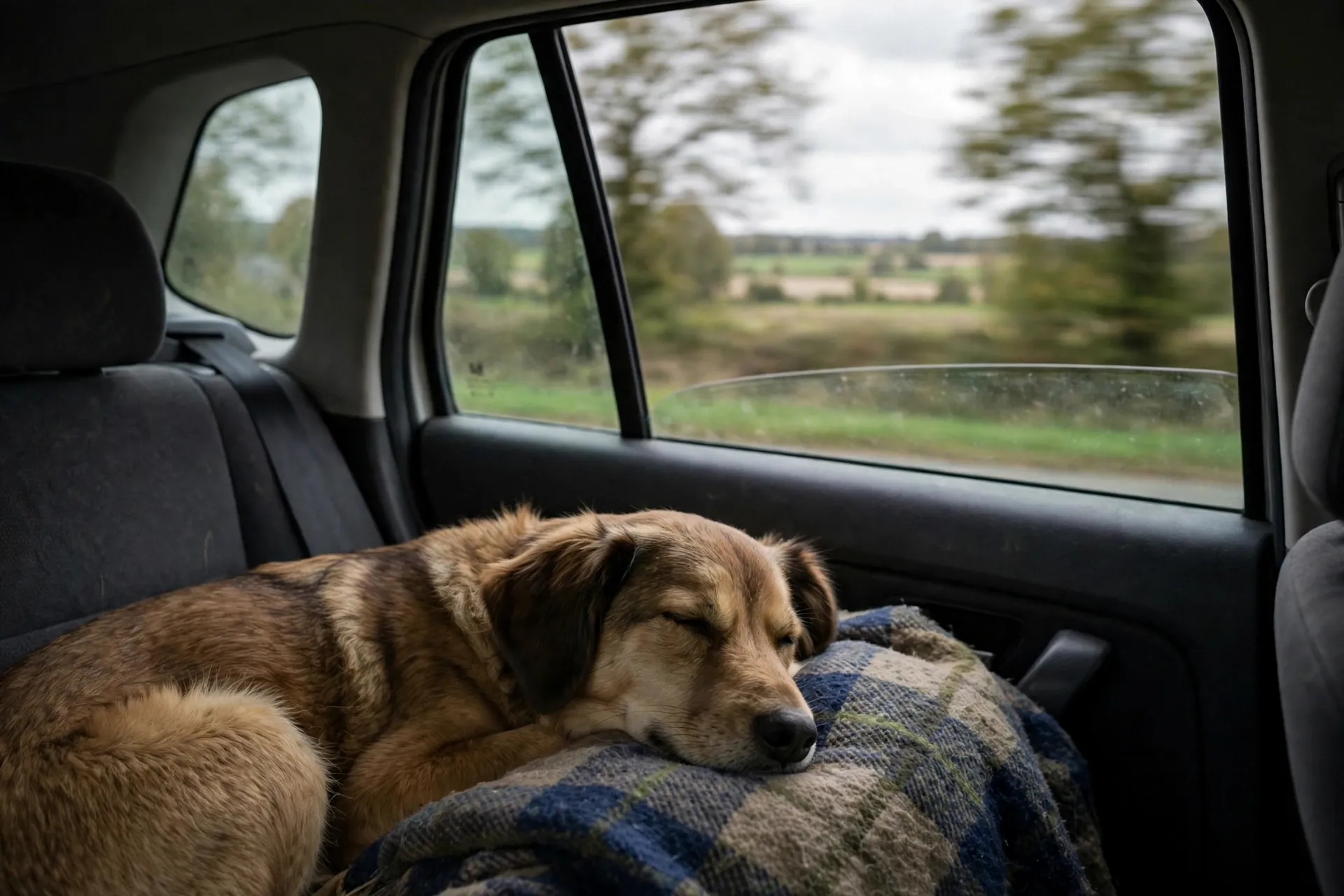
View is the second variable, and it is often overlooked because the dog cannot tell you what it sees. A dog facing forward, able to see the road ahead and the horizon, usually copes better than a dog facing sideways watching the world rush past at close range, or a dog facing backwards in a boot with no view at all. Where the car allows it, a forward-facing position on the back seat, or a crate positioned so the dog can see forward through the car, is a good starting point. If the dog travels in the boot, check what it can actually see from its resting position. Some dogs settle better with a partial view blocked by a cover, because a constantly moving side view is worse than a calm, restricted one. Experiment on short trips, not on holiday routes.
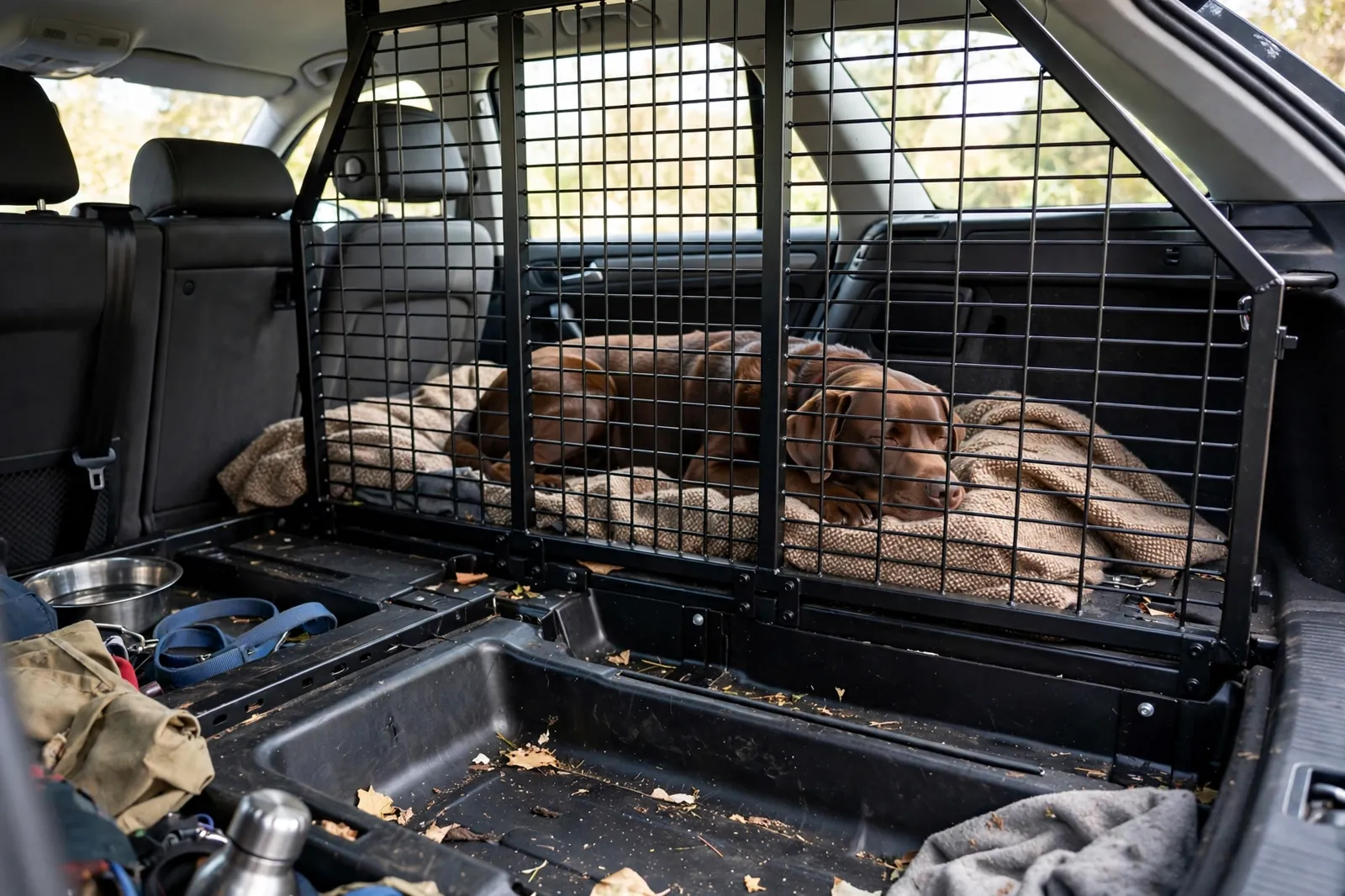
Stability is the third variable, and it is where good equipment earns its keep. A dog sliding across a leather seat on every bend gets a constant stream of confusing balance signals, plus the stress of never finding a secure footing. A non-slip mat, a fitted seat cover with grip, or a travel bed with a non-slip base can transform the experience. A properly fitted restraint matters for safety as well as stability, and UK drivers should remember that the Highway Code expects dogs to be suitably restrained so they cannot distract the driver or injure themselves or others. A car boot dog guard can help keep a boot-travelling dog in its own space, while a harness or crate keeps a back-seat dog from sliding or climbing. Our guide to choosing between a harness and a crate explains the trade-offs in detail.
The resting surface itself deserves attention. A familiar travel dog bed that smells of home, placed in the same position every time, gives the dog a predictable place to lie down and stay down. A dog that lies flat, with its head resting and its body supported, usually copes better than a dog that stands, paces or tries to climb into the front. Avoid piling the resting place with loose blankets that bunch up and slide, and avoid strong air fresheners or new cleaning products in the car: a dog's sense of smell is far more sensitive than yours, and a new chemical smell on top of motion can be enough to tip a borderline dog into nausea.
Temperature ties all three variables together. A hot, stuffy car makes nausea worse, and dogs overheat faster than people, especially on a sunny day with the sun on the rear windows. Keep the car cool before the dog gets in, park in shade while loading, and never leave a dog alone in a parked car, even for a few minutes. If the car has rear sun shades, use them. If the journey involves a long wait in traffic, plan a stop rather than sitting in a hot queue with a sick dog. A cool, ventilated, stable car is not a cure on its own, but it removes several triggers at once, which is exactly what a dog on the edge of nausea needs.
A gradual training plan that actually works
Gradual training, sometimes called desensitisation, is the remedy with the best long-term record for motion sickness, and it works because it is gradual. The plan below is built around short steps, repeated until each one is easy, and it assumes you have a few weeks rather than a few days. If your holiday is next weekend, use the short version: keep every journey as short and calm as possible, use the setup advice in this guide, and start the full plan when you return.
Step one is the parked car. For a few days, let the dog get in and out of the parked car calmly, with the engine off, a familiar blanket in place, and a few tiny treats for settling. Keep sessions to five or ten minutes, and end before the dog gets restless. If the dog will not settle in a parked car, there is no point adding motion yet. Step two adds the engine: sit in the car with the engine running, still parked, and let the dog experience vibration and noise without movement. Again, keep it short and calm, and finish with a pleasant walk.
Step three is the five-minute drive from the start of this guide, repeated on quiet streets until it is boring. Only then move to step four: ten minutes, then fifteen, then twenty, then thirty, adding time in small increments and only when the previous length was comfortable on two or three separate occasions. Mix in a straight, smooth route before you try a winding one, and a quiet time of day before you try rush hour. A dog that copes with twenty minutes on a dual carriageway may still struggle with twenty minutes on narrow country lanes, and that is normal. Treat road type as a separate variable, and increase only one thing at a time: either length or difficulty, never both on the same trip.
Step five is the destination. Early training trips should end somewhere calm and pleasant but not wildly exciting: a short pavement walk, a quiet field, a visit to a friend's garden. A trip that ends in a dog park full of other dogs, a beach, or a long, exciting walk can leave the dog over-aroused for the return journey, which then becomes the hard leg. As the dog improves, gradually add more interesting destinations, but keep the return journey in mind. Many owners find the journey home is harder than the journey out, because the dog is tired, has eaten, or is still excited. Planning a stop before the home leg, or splitting the return into two shorter drives, often solves a problem that looks like a training failure.
The golden rule of the whole plan is to go back a step when a step fails. If a twenty-minute trip produces vomiting after two comfortable fifteen-minute trips, return to fifteen minutes for a week. That is not wasted time. It rebuilds confidence and prevents the car from becoming a place where sickness is expected. Keep a simple log: date, journey length, route type, feeding time, weather, and outcome. Patterns emerge quickly from a log, and a log is also the most useful thing you can show your vet if you need advice.
On the road: driving, breaks and signs to watch
How you drive matters as much as how you set up the car. Smooth, anticipatory driving reduces the forces that trigger nausea: gentle acceleration, early braking, slow and steady cornering, and a speed that lets you avoid sudden changes of direction. On winding roads, a slightly slower pace with a steady line through bends is kinder than rushing between corners. On motorways, a steady lane and a constant speed are usually easier than frequent lane changes. Avoid sudden stops where you can, and give the dog a few seconds of warning by slowing gradually rather than braking late.
Breaks are not wasted time; they are part of the remedy. A stop every two hours, or sooner if the dog shows early signs, lets the dog rebalance, drink, toilet, and reset its association with the journey. A good break is short and calm: a few minutes on a lead, a drink, a sniff around a quiet area, and then back in the car without a long, exciting walk that leaves the dog panting and over-aroused. Motorway service areas can be noisy and busy, so look for a quieter layby, a village car park, or a side road where the dog can step out without traffic roaring past. If you are unsure about local stopping rules, check the official guidance before you travel.
Learn the early signs, because acting early is far more effective than reacting to vomiting. Drooling that increases beyond normal, repeated lip licking, yawning when the dog is not tired, restlessness, pacing in the crate, whining, panting that does not match the temperature, and a sudden stillness or glassy stare can all be early warnings. Some dogs go quiet before they are sick, which is easy to mistake for settling. If you know your dog's early signs, pull over at the next safe place, let the dog out for a few minutes, offer water, and only continue when the dog has settled. Pushing on in the hope that the dog will get used to it usually makes the rest of the journey worse.
Passengers have a role too. A calm passenger who sits near the dog, speaks quietly, and keeps a hand resting nearby can help a nervous dog settle, but a passenger who constantly fusses, offers treats every minute, or reacts loudly to every drool can add to the arousal. Keep conversation calm, avoid sudden movements, and do not try to distract a nauseous dog with toys or games. A dog that is feeling sick does not want to play; it wants stillness, fresh air and a predictable environment. If you are travelling alone, a mirror that lets you glance at the dog without turning around is safer than trying to watch it constantly.
Music and scent are often suggested, and the evidence for them is modest. Calm, low-volume music or talk radio at a steady level may help some dogs by masking sudden road noise, but loud or changing music adds stimulation. A familiar blanket that smells of home is more useful than a new calming spray, because familiarity itself is calming. If you try a scent product, introduce it at home first, on a day when the dog is not travelling, so you can tell whether the dog likes it or finds it unpleasant. Never use a strong new scent in the car on a long journey as a first test.
The clean-up kit and what to do mid-journey
Even with the best plan, a dog may still be sick, and being prepared turns a miserable incident into a manageable one. Pack a clean-up kit that lives in the car, not in a bag you might forget. The essentials are simple: a roll of paper towels or several old towels, plastic bags for soiled material, a spare blanket or travel bed cover, a bottle of water and a portable bowl, wet wipes for paws and fur, a small bottle of pet-safe cleaner for the car interior, and a change of clothes for yourself if the journey is long. Keep the kit in a lidded box or bag that will not slide around, and check it before every long trip.
When the dog is sick, the first priority is safety. Pull over in a safe place, switch off the engine, and only then deal with the mess. Do not try to clean up while driving, and do not let the dog out beside fast traffic. Once stopped, let the dog out on a lead, offer a little water, and check whether it has settled or is still retching. Clean the resting place, replace soiled bedding with the spare, and air the car for a few minutes. A sick dog that is put straight back onto a soiled, smelly blanket will feel worse, and the smell itself can trigger further nausea.
Do not scold the dog, and do not make a fuss. A calm, matter-of-fact clean-up, with a quiet word and a short walk, teaches the dog that being sick in the car is not a disaster, which helps the next journey. Do not offer a large meal immediately after vomiting. Wait until the dog has settled, offer small amounts of water, and feed a small, plain meal later, once you are home or at your destination. If the dog vomits repeatedly, cannot keep water down, or seems lethargic, unresponsive or in pain, seek veterinary advice promptly rather than continuing the journey.
Protecting the car also protects the dog's routine. A waterproof, washable cover over the seat or boot, with a familiar blanket on top, means a clean-up is a quick swap rather than a deep clean at the roadside. Avoid plastic sheeting that rustles, slides or makes the dog sweat; a fitted, non-slip, washable cover is quieter and more stable. After a journey where the dog has been sick, clean the car properly at home, including any hidden corners where vomit may have lodged, because a lingering smell can make the next trip harder. Air the car thoroughly, and wash the blanket before the next journey so the dog starts fresh.
After the journey: recovery and record-keeping
What happens after arrival matters more than most owners realise. A dog that has been sick needs time to recover before it is expected to enjoy a walk, a meal or a new place. Give it water, a quiet place to lie down, and a short, calm toilet walk. Do not immediately launch into the exciting part of the holiday. A dog that arrives, vomits, and is then taken straight to a busy beach or a dog park will associate the whole day with feeling unwell, not just the car.
Feeding after travel should be gradual. Offer a small portion of familiar food once the dog has settled, and watch whether it stays down before offering more. If the dog refuses food for a few hours after a difficult journey, that is not unusual, but if refusal continues into the next day, or is joined by diarrhoea, lethargy or other signs, ask your vet. Keep the evening routine as close to home as possible: same bed, same feeding time, same last outing. Familiarity after travel helps the dog recover faster and makes the return journey easier.
Record-keeping is the unglamorous habit that makes every other remedy work better. A notebook, a phone note, or a simple spreadsheet with a row per journey is enough. Record the date, departure time, feeding time and amount, journey length, route type, weather, temperature, seating position, whether the dog drooled, vomited or settled, and when signs started. After a dozen journeys, patterns usually jump out: perhaps the dog is fine on motorways but sick on country lanes, fine in the morning but sick in the afternoon, or fine after a small breakfast but sick after a large one. Those patterns let you change one variable at a time, instead of changing everything and hoping.
Recovery also applies to the human side of the trip. A journey with a sick dog is stressful, and it is tempting to decide never to travel again, or to rush the next trip to prove it was a one-off. Neither helps. Review the log calmly, pick the next step that is slightly easier than the failed journey, and give the dog a short, successful trip before the next long one. Confidence, for dogs and owners, is built from a run of manageable experiences, not from one heroic long drive.
When to ask a vet, and what not to try
Most mild, puppy motion sickness can be managed with the steps in this guide, but there are clear reasons to ask a vet. Seek advice if sickness happens on most trips despite gradual training, if it does not improve as a puppy matures, if it is getting worse, or if it is joined by other signs such as diarrhoea, loss of appetite, lethargy, weight loss, balance problems, head tilting, ear pain or discharge. A vet can examine the ears and balance system, check for other causes of vomiting, and discuss whether anxiety is playing a major role. Bring your journey log, because it helps the vet distinguish motion sickness from other problems far faster than a general description.
A vet may discuss medication for dogs whose sickness is severe or persistent, and may suggest a trial on a short journey before a long one. This guide deliberately gives no drug names, doses or schedules. The right option, if any, depends on the dog's age, weight, breed, health, other medication and the type of journey, and a dose that suits one dog could be unsuitable or unsafe for another. Never use leftover medication from another dog, never use human travel-sickness products without veterinary advice, and never guess a dose from the internet. If a vet does prescribe something, follow the instructions exactly, note the effect on your journey log, and report any drowsiness, agitation or other unexpected effects promptly.
There are also remedies to avoid. Herbal products, essential oils and calming supplements are widely sold, but their evidence for motion sickness is limited, and some products that are safe for people are not safe for dogs. Do not put essential oils in the car, on the dog's bedding or near its face without veterinary advice, and be cautious about any product that claims to cure motion sickness quickly. Ginger is sometimes suggested for nausea in dogs, but the amount, form and safety depend on the individual dog, so ask your vet before trying it rather than adding it to food on travel day. If a product's claims sound too good, or if it has no clear ingredient list, leave it out.
Finally, do not try to solve motion sickness by withholding food and water for a whole day, by driving faster to get it over with, or by forcing a reluctant dog into the car repeatedly. All three make the problem worse: dehydration and hunger increase nausea, speed increases the forces on the balance system, and forced, frightening loading builds anxiety that will haunt the next journey. Patience is not just kinder; it is more effective. A dog that trusts the car, even if it still sometimes feels sick, is far easier to help than a dog that fears it.
Special cases: small breeds, flat faces and older dogs
Small breeds face a particular set of car problems that are easy to miss. A small dog on a large, slippery seat slides more, sees less, and may be bounced around by bumps that a larger dog absorbs. A raised, secured booster seat or a well-fitted crate that brings the dog to window height, with a non-slip base and a harness attachment, can help, but only if it is properly secured and does not turn the dog into a projectile in a sudden stop. Never place a small dog loose on a dashboard, on a lap while driving, or on an unsecured cushion. The restraint rules that apply to large dogs apply just as firmly to small ones.
Flat-faced breeds, such as bulldogs, pugs and French bulldogs, need extra care in the car for reasons beyond motion sickness. These breeds are more prone to breathing difficulties, overheating and stress in warm, stuffy conditions, and nausea plus breathing difficulty is a worrying combination. Keep the car cool, keep journeys short, watch for laboured breathing or excessive panting, and stop promptly if breathing becomes difficult. If a flat-faced dog regularly struggles in the car, ask your vet for breed-specific advice before planning a long journey, and consider whether a train or a closer destination would be kinder. If you are unsure about breed-specific travel rules or arrangements, check the official guidance before you travel.
Older dogs bring a different mix of issues. Arthritis can make getting in and out of the car painful, which makes the dog reluctant before motion even starts. A ramp, a low step, or a car with a lower boot lip can help, and a thick, supportive travel bed can reduce discomfort on the journey. Older dogs may also have weaker balance, reduced hearing or vision, and other health conditions that affect nausea, so a new pattern of sickness in an older dog deserves a veterinary check rather than an assumption that it is just travel sickness. Keep journeys shorter, breaks more frequent, and loading as easy as possible, and remember that an older dog that travels well for thirty minutes may still struggle with two hours.
Multi-dog households add another layer. One sick dog can unsettle the others, especially if vomiting happens in a shared boot space or if the sick dog's distress raises the arousal of the whole car. Where possible, give each dog its own defined space, keep the calmest dog's routine unchanged, and clean up promptly so the smell does not affect the others. If one dog needs training trips, do those trips with that dog alone where practical, so the other dogs are not repeatedly exposed to short, boring journeys that teach them nothing. Conversely, a calm, experienced dog can be a steadying presence for a nervous puppy, provided the puppy is not overwhelmed by the older dog's excitement.
A pre-journey checklist
Use this checklist the night before a longer trip, and again before you load the dog. It is deliberately short, because a checklist that takes twenty minutes will not be used. Tick each item, and do not skip the ones that feel obvious: most failed journeys fail on an obvious step, not an exotic one.
- Meal timed: Light, familiar meal three to four hours before departure. No new food, no rich treats, no large meal at the last stop.
- Water ready: Portable bowl, bottle of water, and a plan for small drinks at stops rather than a large bowl in the moving car.
- Resting place set: Same blanket or travel bed, non-slip base, familiar smell, and a restraint that is fitted and checked.
- Air and temperature: Car cooled before loading, steady ventilation planned, rear sun shades if sunny, and no strong new smells.
- Route chosen: The smoother, straighter option where possible, with stops planned every two hours and a quiet place to stop identified.
- Clean-up kit packed: Paper towels, bags, spare bedding, wipes, pet-safe cleaner, water and a spare lead, all in one box.
- Driving plan agreed: Gentle acceleration and braking, slower on bends, and a passenger briefed to stay calm and quiet.
- Log ready: A note of feeding time, departure time and route, so you can record the outcome and spot patterns.
- Vet details saved: Your own vet's number and the number of a vet near your destination, saved in your phone before you leave.
- Expectations honest: A journey length the dog has already managed, or a plan to split a longer journey with a proper break.
If you can tick all ten, you have done the practical work. The rest is patience on the road: watch the dog, stop early if signs appear, and remember that a calm, short, successful journey is worth more than a long, miserable one that proves nothing. Over weeks, those successful journeys add up, and for many dogs they add up to a car that is no longer a problem.
Practical questions
Before you go
Can a puppy outgrow car sickness?
Many puppies do. The balance organs in the inner ear are still developing in young dogs, so motion that an adult dog tolerates easily can trigger nausea in a puppy. Gentle, short, positive practice trips often help as the puppy matures, but if sickness continues past the first year, or gets worse rather than better, ask your vet for advice rather than simply waiting longer.
Should I feed my dog before a car journey?
A light meal three to four hours before travel usually works better than a full bowl just before you leave, and better than a completely empty stomach on a long journey. Offer water little and often at stops, and keep treats small and plain during training trips so you can tell whether the car, the food, or excitement was the problem.
Does opening a window help a dog with motion sickness?
Fresh, moving air can help, but a wide-open window is not the remedy by itself. Open a window a few centimetres for steady ventilation, keep the dog safely restrained so it cannot put its head fully out, and combine airflow with smooth driving, a forward-facing view where possible, and regular breaks. If the dog is still drooling heavily or vomiting on short trips, ventilation alone is unlikely to fix it.
How do I start gradual car training for a sick dog?
Start with the engine off, then a five-minute drive around quiet streets, and only lengthen the trip when the dog stays calm and settled. Keep every step boring and predictable: the same resting place, the same calm greeting, and a quiet destination such as a short pavement walk. If the dog is sick, go back a step instead of pushing on, and end the session on a calm note.
What should I do if my dog is sick in the car?
Pull over safely, offer water, and clean up without fuss or scolding. Use paper towels and bags from your clean-up kit, air the car, and let the dog settle before you continue. Do not offer a large meal straight away, and note what happened - journey length, road type, feeding time and weather - so you can spot a pattern before the next trip.
When should I ask a vet about motion sickness?
Ask your vet if sickness happens on most trips, does not improve with gradual training, or is joined by other signs such as diarrhoea, lethargy, loss of appetite, balance problems or ear pain. A vet can check for inner-ear, balance or anxiety problems and discuss whether medication is suitable for your dog. This guide gives no drug names or doses, because the right option depends on the individual dog.