This guide is independent and contains no paid placement. If affiliate links are added later, they will be clearly marked and will not change our editorial checks.
Protect exposed pale skin, not just the whole dog. Sunscreen made for dogs goes on pink noses, pale ears and thinly haired bellies, shade and midday breaks do most of the work, and any redness, peeling or soreness deserves a day out of the sun and, if it worsens, a vet check.
Start with the pink nose
It often starts with something small. A dog comes in from the garden, flops onto the cool kitchen floor, and the tip of a pink nose looks a shade deeper than it did that morning. The ears, if they are white or pale, feel warm. Nothing dramatic has happened. There has been no beach, no holiday, no hours of baking heat. There has only been a bright British afternoon, a sunny patch of lawn, and a dog that likes to lie exactly where the light falls.
That small change is a useful warning, because dogs do not sunburn in the way people expect them to. A thick-coated dog can spend a summer afternoon in the garden and show nothing at all, while a thin-coated dog with a pink nose can burn on the same day, in the same garden, in the same sun. The difference is not toughness or breed loyalty or how much a dog seems to enjoy the heat. The difference is how much skin is exposed, how much pigment that skin carries, and how long it stays in direct sun without a break.
The nose is the place most owners notice first, and for good reason. It is almost always uncovered, it points into the sun when a dog lies facing the light, and it is one of the few places where pale skin is easy to see. A pink nose has little melanin, the pigment that helps absorb ultraviolet light, so it burns sooner than a dark nose. The bridge of the nose, the top edge of the ears, and the thin skin around the eyes are in the same position: constantly exposed, rarely protected by fur, and easy to overlook until they turn red.
This guide begins there on purpose. If you check one thing before a summer walk, check the exposed pale skin. Look at the nose in daylight, not under kitchen lights. Look at the tips and edges of the ears, especially if they are white, and look at the belly and inner thighs when the dog rolls over for a scratch. Those are the places sunburn finds first. Everything else in this guide — sunscreen, shade, hats, timing, and what to do when skin does burn — follows from that one habit of looking.
It is also worth saying what this guide is not. It is not a substitute for veterinary advice, and it is not a claim that every dog needs sunscreen every day. Many dogs, especially dark-coated dogs with dense fur, need little more than shade and sensible timing. The aim here is narrower and more practical: to help you recognise the dogs and the days when sun protection matters, to choose products that are actually safe for dogs, and to build a summer routine that protects skin without turning every walk into a chore.
Who is most at risk
Risk is not evenly spread across dogs, and the highest-risk dogs are usually easy to spot once you know what to look for. The single strongest factor is pigment. Pale skin burns more readily than dark skin, in dogs just as in people, and pigment varies across a single dog's body. A dog can have a dark back and a pink belly, dark ears and a pale nose, or a mostly white coat with dark patches. Judge the exposed areas individually rather than judging the dog by its overall colour.
Coat thickness matters almost as much. A dense double coat blocks a large amount of ultraviolet light before it reaches the skin, while a short, single, thin coat lets much more through. Dogs that have been clipped short for summer, dogs whose coats are naturally fine, and dogs with areas of sparse hair are all more exposed than they look. Clipping a thick-coated dog short in the hope of keeping it cool can therefore increase sunburn risk, which is one reason to discuss any major clip with a groomer or vet before summer rather than improvising in June.
Hairless and nearly hairless dogs sit at the top of the risk list. Chinese Cresteds, Xoloitzcuintli and other hairless breeds have almost no natural barrier, and they need sun protection whenever they are outside in bright conditions, not only on the hottest days. The same applies to any dog with a shaved patch after surgery or veterinary treatment: the skin underneath has not been exposed before, it is often paler than the surrounding skin, and it can burn quickly. If your dog has a shaved area, check the official guidance before you travel and ask your vet how long that area needs protection.
Certain breeds are mentioned often in sunburn advice because pale skin and thin coats are common in them. Dalmatians, white Bull Terriers, white Boxers, Staffordshire Bull Terriers with extensive white markings, and other predominantly white dogs are frequently named, as are Whippets, Greyhounds and other short-coated sighthounds. Breed is only a shortcut, though. An individual dark-coated dog with a pink nose and pale ears can be at greater risk than a white dog whose ears and nose are heavily pigmented. Look at the dog in front of you, not only at the breed label.
Age and health change the picture too. Puppies have thinner, more sensitive skin and less experience of seeking shade, so they need closer supervision and shorter sun exposure. Older dogs may have thinner coats, drier skin, or medical conditions that make them less able to move out of the sun on their own. Dogs with diagnosed skin conditions, dogs on medication that increases sun sensitivity, and dogs recovering from skin surgery should be treated as higher risk until a vet says otherwise. If a medication leaflet mentions photosensitivity, take that seriously and ask the prescribing vet what it means for outdoor time.
Finally, behaviour matters. Some dogs are natural sun-seekers. They follow the sunny patch across the garden as it moves, lie belly-up on a hot patio, and fall asleep in full sun. Others seek shade instinctively and are rarely a concern. If your dog is a sun-seeker, the risk is higher simply because exposure is longer, and shade needs to be made more attractive than the sunny spot: a cool mat, a breeze, a water bowl and a comfortable bed in the shade will do more than repeatedly calling a sleeping dog indoors.
How sunburn works in British weather
British summers confuse sun protection because the air often feels mild even when ultraviolet light is strong. Ultraviolet radiation is not the same as heat. A breezy 22-degree day in Cornwall, a bright morning in the Lake District, or a cloudy afternoon in Edinburgh can all carry enough ultraviolet light to burn pale skin, especially between late morning and mid-afternoon. Wind and cloud cool the skin and remove the warning sensation of heat, which is why dogs — and people — can burn on days that never felt scorching.
Cloud is the most common source of false confidence. Thin or broken cloud can let a large proportion of ultraviolet light through, and ultraviolet light also reflects off water, light sand, pale paving and even light-coloured walls. A dog lying beside a white-painted cottage wall, on a pale patio, or near the water at a reservoir is receiving direct sun plus reflected sun. That is why a dog can burn on a day when the sky never looked fully clear, and why shade under a thin tree canopy is not always as protective as it appears.
Time of day matters more than most owners realise. Ultraviolet intensity in the UK is generally highest around the middle of the day, roughly from 11am to 3pm in summer, and it rises with altitude and with clearer skies. A long midday walk on open downland is a very different exposure from the same walk at 8am or after 6pm. This does not mean dogs must stay indoors all midday — many dogs need a toilet break and a short stretch — but it does mean the long, open, sunny walk is better moved to the cooler, lower-sun hours, with midday kept short, shaded and close to home.
Duration matters as much as intensity. Sunburn is cumulative over a day. A morning in the garden, a midday walk, and an afternoon on a sunny patio add up, even if no single session seemed long. Dogs that spend the whole day moving between sunny spots, or that sleep for hours in one sunny place, accumulate far more exposure than dogs that dip in and out of shade. Think of the whole day's sun, not just the walk, when you decide whether sunscreen and shade are needed.
Water adds another layer. Wet skin and wet fur offer less protection, and a dog that swims and then lies in the sun to dry is exposed on skin that is still damp. Sunscreen also washes off in water, so a swim effectively resets the protection clock. The same applies to rain followed by bright sun: a damp coat dries in the sun, and the dog may stay in that sunny spot longer because drying feels pleasant. After any swim or soaking, dry the dog lightly, reapply sunscreen to exposed areas if needed, and move the drying-off spot into shade.
For a broader picture of hot-weather planning, our heatwave week guide covers cool-hour walks, shade and water through a full hot spell, and it pairs well with the skin-specific advice here. Sunburn and overheating often arrive together, but they are not the same problem: a dog can be cool, panting normally and drinking well, and still be burning on its nose and ears. Treat them as two separate checks on every hot day.
Choosing a pet sunscreen
The first rule of choosing sunscreen for a dog is simple: buy a product made for dogs. Human sunscreen is formulated for human skin and human behaviour, and dogs lick. That single difference changes which ingredients are acceptable. Several ingredients common in human products, including zinc oxide, can cause stomach upset and other problems if a dog ingests them in quantity, and some fragrances, alcohols and chemical filters irritate dog skin or eyes. A product that is perfectly safe on a person's shoulder can be a poor choice on a dog's nose, where it will almost certainly be licked within minutes.
Look for a pet sunscreen that states clearly on the label that it is made for dogs, that it is safe if licked in small amounts, and that it gives a sun protection factor. There is no single perfect SPF number for dogs, and a higher number is not automatically better if it means a thicker, stickier product that the dog immediately rubs off. What matters more is that the product is easy to apply thinly and evenly, that it stays on the nose and ears without running into the eyes, and that you will actually use it every time it is needed. A product that sits unused in a cupboard because it is messy protects no dog at all.
Form matters. Balms and sticks work well on noses and ear tips because they can be applied precisely and are less likely to drip. Sprays can be useful for larger thinly haired areas such as a belly, but they must never be sprayed near the face: spray onto your hand first, then rub it on, so nothing reaches the eyes or is inhaled. Lotions suit broader areas but can feel greasy on fur and may be licked off more readily. If you have more than one dog, or a dog that hates having its face touched, a stick for the nose and a spray-on-hand for the belly is often the most workable combination.
Check the ingredient list and the warnings, and keep the product information with your summer kit. Avoid products containing zinc oxide, para-aminobenzoic acid (PABA) and salicylates unless a vet has specifically advised otherwise, and be cautious with strong fragrances and essential oils, which can irritate skin and encourage licking. If your dog has a known skin condition, allergies, or is on medication, ask your vet to recommend a product rather than choosing by price or packaging. Vets see sunburn cases every summer and can usually name products that suit sensitive dogs.
Storage and expiry matter too. Sunscreen degrades in heat, so a tube left all summer in a hot car boot or on a sunny windowsill may be far less effective by August than it was in May. Store pet sunscreen in a cool place, check the expiry date before the summer season, and replace a tube that has separated, changed smell or become gritty. Buy a fresh tube for a holiday rather than relying on last year's half-used bottle, and keep a spare in the car kit if you travel often.
Finally, treat sunscreen as one layer, not the whole plan. No sunscreen blocks all ultraviolet light, no sunscreen survives swimming, rolling and shaking unchanged, and no sunscreen protects a dog that lies in full sun for hours. The hierarchy is shade first, timing second, clothing third where appropriate, and sunscreen for the exposed skin that remains. A dog that is mostly in shade with sunscreen on its nose is far better protected than a dog in full sun with a thick layer of sunscreen and nothing else.
Applying it so it stays on
Application technique decides whether sunscreen works in real life. Start indoors, before the excitement of the walk, when the dog is calm and you can work without rushing. Apply sunscreen 15 to 30 minutes before going outside so it has time to settle on the skin. If you apply it at the garden gate while the dog is already pulling towards the field, half of it will end up on your hands, the lead and the dog's fur, and very little will be on the skin where it is needed.
Work through the exposed areas in the same order every time so nothing is missed. Start with the nose: a thin, even layer over the top and sides, avoiding the nostrils themselves. Then the ears, especially the tips and the thin outer edges, and the skin around the eyes only if the product is specifically suitable for that area and can be applied without getting into the eyes. Then the belly and inner thighs if they are sparsely haired, and any other pale, thinly haired patch you have identified. Use a small amount and rub it in gently rather than piling it on thickly; a thick layer is more likely to be licked, shaken off or rubbed onto bedding.
Distract the dog for a few minutes after application. A short training game, a chew, or a calm settle on a mat gives the product time to dry and reduces the chance that the dog immediately licks its nose clean. Watch the first few applications carefully: some dogs tolerate a balm on the nose without fuss, while others sneeze, paw at their face or rub their nose along the sofa. If your dog consistently removes the product, try a different form — a stick instead of a lotion, for example — and apply it in two very thin layers rather than one thick one. Never hold a dog down to force application; a stressed dog that associates sunscreen with a struggle will be harder to protect next time.
Reapplication is where most sun protection fails. Sunscreen rubs off when a dog shakes, rolls, swims, pants heavily, is towelled dry, or wears a harness that moves across the skin. As a working rule, reapply after swimming, after towelling, after a long roll in the grass, and at least every two hours in strong sun, following the product label where it gives a shorter interval. On a full beach day, that can mean three or four applications, which is normal and expected. Pack enough product for the whole day, not just the first application, and keep it somewhere you can reach it without unpacking the whole car.
Patch-test any new product before a long day out. Apply a small amount to one ear tip or a small area of belly skin, wait 24 hours, and check for redness, itching, swelling or unusual licking. If the skin reacts, stop using the product and ask your vet for an alternative. A reaction to sunscreen can look similar to mild sunburn, so a patch test before the first sunny holiday is worth the patience it takes. Note the product name and the reaction in your phone so you do not buy the same one again by mistake.
Children and other dogs can undo good application without meaning to. A child stroking a sunscreened ear, another dog licking a friend's nose, or a dog rubbing its face on grass will all remove product. On multi-dog walks, check each dog separately rather than assuming one application covered the group. If one dog is a persistent licker of other dogs' faces, apply that dog's sunscreen last, or keep the dogs apart for a few minutes until the product has dried.
Shade, timing and the day plan
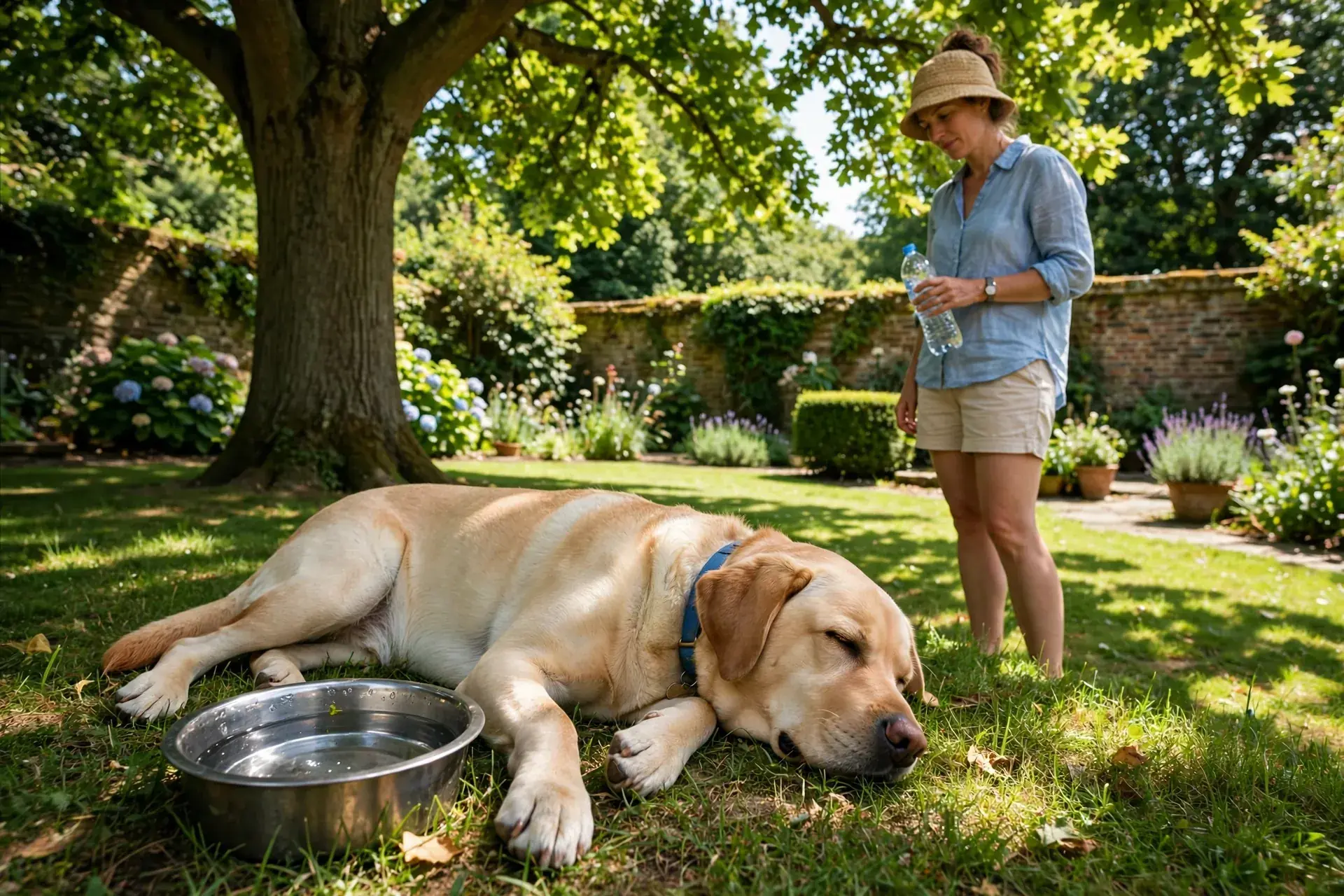
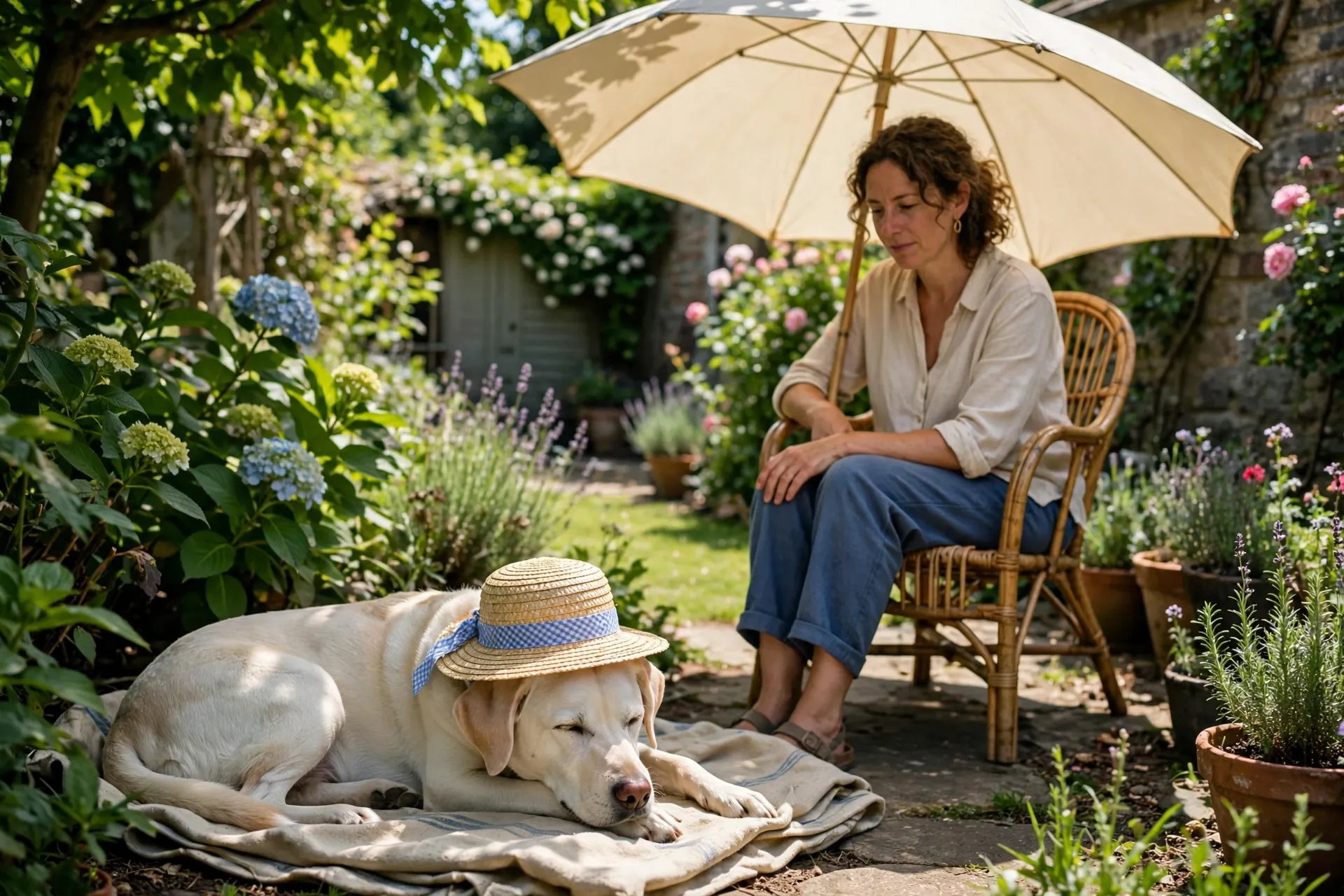
Shade is the most reliable sun protection there is, and it costs nothing. A mature tree, a parasol, a beach shelter, a garden gazebo or even a parked car positioned to cast a long shadow can cut ultraviolet exposure dramatically, especially when the shade is deep and the dog can lie fully inside it. Dappled shade under thin leaves is better than full sun, but it is not the same as solid shade: patches of direct sun still reach the skin through gaps in the canopy, and a dog that lies half in and half out of dappled light is still burning on the exposed half.
Plan the day around shade rather than adding shade as an afterthought. Before a garden afternoon, set up a shaded bed with a water bowl, a chew or a lick mat, and a breeze if you can arrange one. The shaded spot needs to be at least as comfortable as the sunny spot, or a sun-seeking dog will simply move. A thin blanket on hot paving in the shade is less inviting than a raised bed, a cooling mat or a patch of grass in the shade, so invest the effort where the dog will actually lie. On holiday, check the shade at the accommodation at different times of day: a patio that is shaded at 9am may be in full sun by 1pm, and a garden that looks shady in photographs may lose its shade entirely at midday.
Timing is the second pillar. In summer, make the long walk the early or late one. An 8am walk on open moorland, a 7pm walk along a river path, or a woodland walk under a full canopy are all lower-risk than the same route at noon. Keep midday outings short, local and shaded: a toilet break, a sniff around a shady garden, a short loop under trees. Puppies, older dogs and thin-coated dogs benefit most from this shift, but every dog benefits on a genuinely hot or very bright day, because timing also reduces overheating risk.
Build rest breaks into every sunny outing, and make them real breaks. A dog that stops in the shade, drinks, and lies down for ten minutes is cooling and reducing its sun exposure at the same time. A dog that is marched from sunny field to sunny field with only a brief pause at a stile is not resting, even if the walk includes a few trees. Carry water, offer it often, and watch for the dog choosing shade on its own: when a dog that normally trots ahead starts lagging, seeking tree shadows or lying down, that is information, not disobedience.
At home, rotate the garden if you can. Dogs often have a favourite sunny corner that becomes a trap on bright days, especially south-facing patios and sun traps between walls. A portable shade sail, a large parasol or a pop-up shelter can break up a sun trap cheaply, and moving the water bowl and bed into the shade removes the reason to lie in the sun in the first place. If the dog insists on the sunny spot, bring the dog in for a midday rest indoors, with a chew or a frozen lick mat to make the indoors appealing rather than a punishment.
Clothing, hats and goggles
Clothing can protect skin that sunscreen struggles to cover, provided the dog tolerates it and does not overheat. A lightweight, light-coloured, loose-fitting sun shirt or a UV-protective vest can shield a thinly haired back and belly, and it is particularly useful for hairless dogs, dogs with shaved patches, and dogs that will be outside for a long time. Choose breathable fabric, check that it does not rub under the legs or around a harness, and introduce it gradually at home before relying on it on holiday. A garment that a dog chews, freezes in or tries to escape from is not protection; it is stress.
Watch the overheating trade-off carefully. Any extra layer adds warmth, and on a hot day a sun shirt can make a dog hotter even while it protects the skin. On very hot days, shade and timing are safer than clothing, and a wet cooling vest or a damp bandana may be a better choice than a dry sun shirt. If you use a sun garment, check underneath it regularly for redness, dampness or rubbing, and remove it as soon as the dog moves into shade or indoors. Never leave a dog unsupervised in a sun garment, a hat or goggles.
Hats divide opinion, and for good reason. A well-fitted dog sun hat with a brim can shade the nose bridge and the top of the head, which is useful for dogs that tolerate headwear and walk calmly in it. Many dogs, however, paw a hat off within minutes, and a hat that slips over the eyes is a hazard on a walk. If you try a hat, fit it at home over several short sessions, use treats to build a positive association, and check that the chin strap cannot snag and that the dog can still pant freely. A hat that stays on for a garden photo but comes off on the first walk has not solved anything.
Goggles, sometimes called doggles, have a narrower but genuine role. They protect eyes from bright glare, wind, dust and water spray, and they can help dogs with certain eye conditions on veterinary advice. They do not replace sunscreen on the nose and ears, and they are not needed for most dogs on an ordinary walk. If a vet recommends goggles, fit them carefully, check for fogging and rubbing, and introduce them slowly. If a vet has not recommended them, spend the money on shade and sunscreen first.
For most dogs, the practical clothing rule is simple: use a light sun shirt for long, bright, outdoor days when the dog tolerates it and the temperature allows, use a hat only if the dog genuinely accepts it, and never let clothing become an excuse to keep a dog in full sun for hours. Clothing extends safe time in the sun; it does not remove the limit.
Gardens, beaches and walks
Different places create different sunburn risks, and the most dangerous place is often the most familiar one: the garden. Gardens feel safe, so dogs stay out longer, owners stop supervising, and the sunny patch goes unnoticed for hours. A dog left in a garden on a bright day needs the same protection as a dog on a walk: shade set up before the dog goes out, water within reach, sunscreen on exposed skin if the dog is at risk, and a midday check. South-facing gardens, walled gardens that trap heat, and gardens with pale paving or decking all intensify exposure through reflection and trapped warmth.
Beaches add reflection, wind and water to the mix. Sand, especially pale sand, reflects ultraviolet light upwards onto bellies and inner thighs, while sea breeze cools the skin and hides the feeling of burning. A dog that swims and then dries in the sun loses its sunscreen in the water and gains wet-skin exposure on top. Plan beach days with a windbreak or beach shelter, a shaded spot for drying off, fresh water for drinking and rinsing, and sunscreen reapplied after every swim. Keep the long beach walk to the early or late hours, and use the middle of the day for shade, rest and a short paddle rather than a long run in full sun.
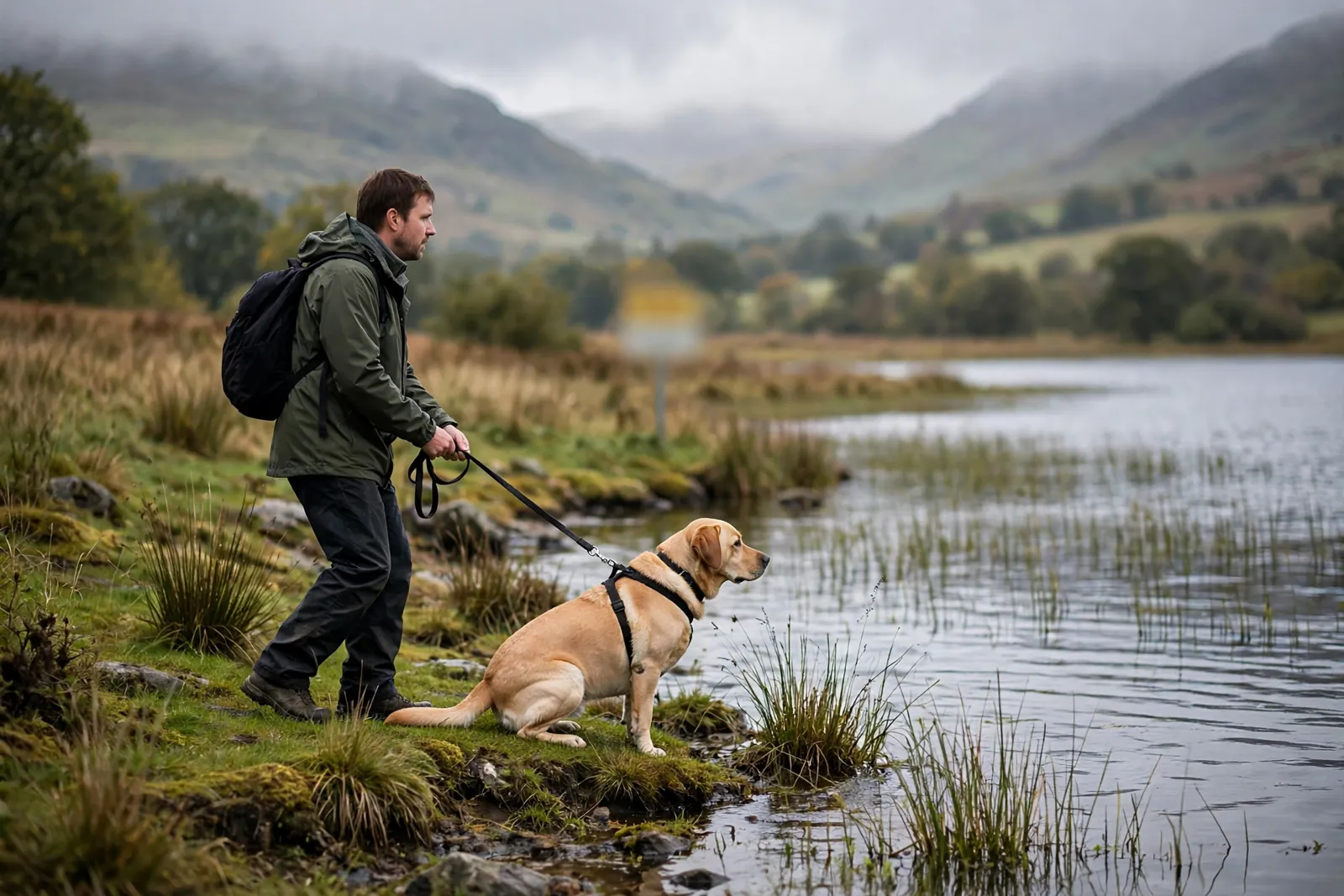
Walks need route thinking, not just distance thinking. An open ridge walk, a chalk downland path with no trees, or a riverside path with no canopy is a high-exposure route, however beautiful it is. A woodland trail, a shaded lane, a park with mature trees, or a route that alternates sun and shade is far kinder to pale skin. Check the route on a map before you go, note where the shade is, and carry a portable shade option — even a large umbrella — if the route has long open stretches and the dog is at risk.
Ground surfaces matter for reflected sun and for paws. Pale concrete, light gravel, sand and decking reflect more ultraviolet light than grass or dark soil, and they also hold heat that burns paws. If the ground is too hot for the back of your hand, it is too hot for paws, and a dog that is already uncomfortable on its feet is less likely to settle in shade. Grass, shaded paths and woodland floors are kinder on both counts. On a bright day, choose the grass verge over the pale pavement where you safely can.
Water safety belongs in any summer guide, because sunny days are swimming days. Before letting a dog swim in a lake or slow river, check for warnings about blue-green algae, which can be extremely dangerous to dogs. Our blue-green algae guide explains how to spot a bloom, what to do in an emergency, and how to choose safer water. Sun protection and water safety are separate checks, and both deserve a minute before the dog goes in.
Cars, windows and travel
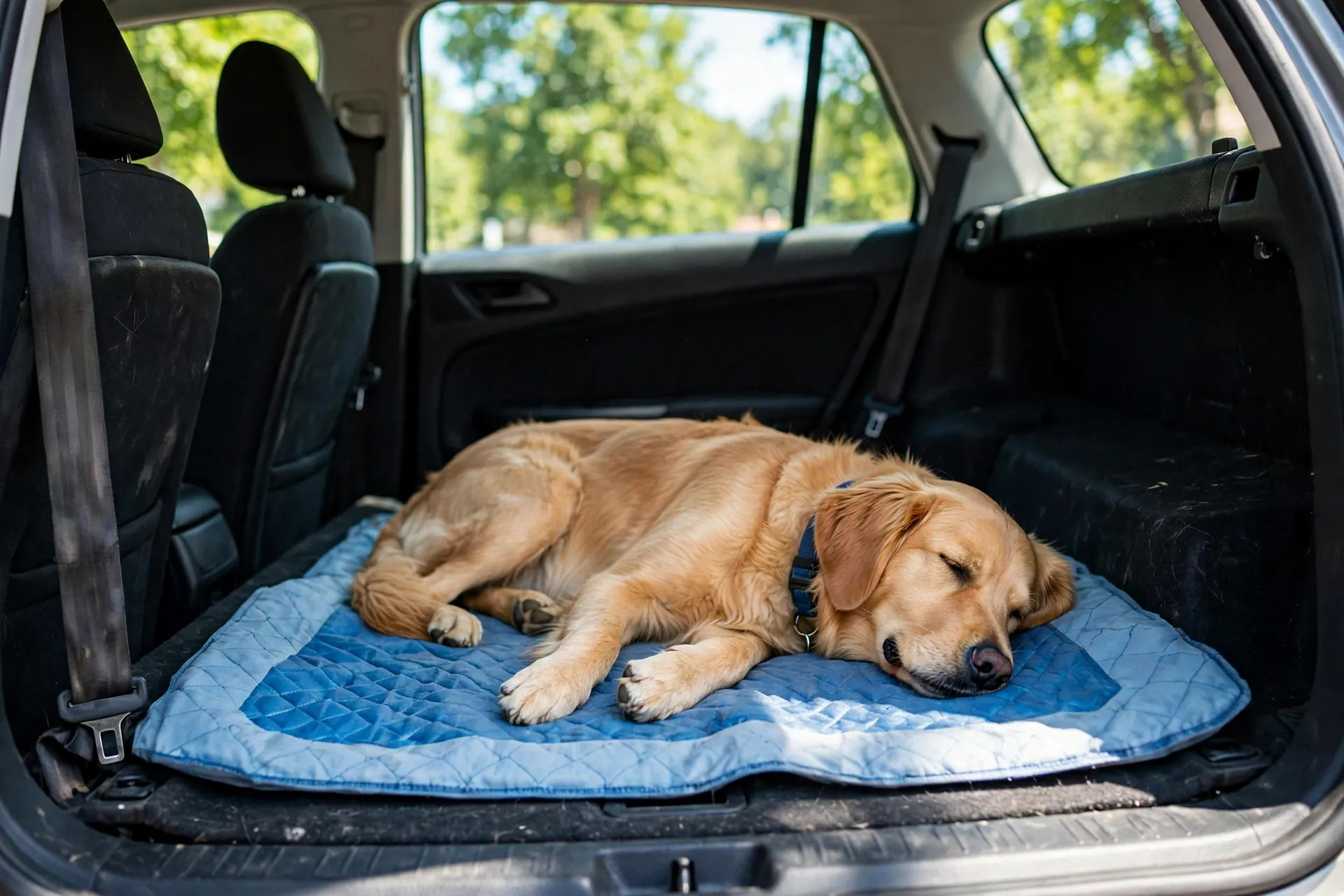
Cars concentrate sunburn risk in ways owners often miss. Glass blocks most ultraviolet B light but lets a significant amount of ultraviolet A through, so a dog sitting in a sunny car seat by a window is still receiving ultraviolet exposure, especially on the side facing the sun. A long sunny drive with a pale-eared dog pressed against the window can therefore burn ears and the side of the face even though the dog is technically indoors. Window shades, a light cover over the crate or seat area, and sunscreen on exposed skin all help, and rotating the dog's position on very long journeys reduces one-sided exposure.
Heat is the more urgent car risk, and it must never be confused with sunburn protection. A parked car in summer can reach dangerous temperatures in minutes, even with windows cracked and even on a day that does not feel extreme. Never leave a dog in a parked car in warm or sunny weather, however short the errand seems, and never rely on a sunshade, a cracked window or a fan to make a parked car safe. For driving, use air conditioning or moving airflow that actually reaches the back seat, offer water at stops, and plan shaded parking for every break. Our cooling mat guide covers how to keep the back seat genuinely cool on summer journeys.
Holiday accommodation brings its own car-like traps. Conservatories, glass-fronted lodges and south-facing rooms with large windows can become sun traps, and a dog sleeping in a patch of sun through glass for hours is still exposed to ultraviolet A. Check where the dog's bed sits in relation to windows at different times of day, move the bed into shade or into a cooler room at midday, and use curtains or blinds to break up direct sun through glass. A dog that follows the sun patch across a conservatory floor is telling you where the problem is.
On public transport and in cafes, the same principles apply on a smaller scale. A sunny window seat on a train, a south-facing pub garden table, or a cafe terrace with no parasol can all give a pale dog an hour or more of direct sun. Choose the shaded table, ask for a parasol, or move the dog's bed into the shadow of the table. These small choices add up across a holiday, and they cost nothing.
Puppies, seniors and dogs in recovery
Puppies need a gentler approach. Their skin is thinner and more sensitive, their coats may still be developing, and they have not yet learned to seek shade or to tell you when they are uncomfortable. Keep puppy sun exposure short, always supervised, and mostly in shade. Apply pet sunscreen only to the areas that genuinely need it, patch-test first, and watch for licking: puppies explore the world with their mouths, and a sunscreened nose is an invitation to lick. Short, frequent, shaded outings build good habits far better than one long sunny walk that ends with a red nose.
Senior dogs present the opposite problem: they may be less mobile, less able to move out of the sun, and more likely to fall asleep in a sunny spot and stay there. An older dog with arthritis may not want to get up from a warm patio even when the sun becomes too strong, and an older dog with a thinning coat has less natural protection than it had at five. Check on senior dogs more often on bright days, move their bed into shade yourself rather than waiting for them to move, and keep midday garden time short. If a senior dog has a medical condition, ask the vet whether sun exposure needs specific limits.
Dogs in recovery deserve special care. After surgery, a shaved patch is vulnerable skin with no fur barrier and often little pigment, and it may also be sore or itchy, which makes licking more likely. Follow the vet's instructions about covering or protecting the area, and do not apply sunscreen to a wound or a healing incision unless the vet has said it is safe. Some surgical areas need to be kept covered with a light garment or kept out of sun entirely for a period; check the official guidance before you travel and follow the discharge notes exactly. The same caution applies to dogs with skin conditions, hot spots, or areas treated with topical medication, where sunscreen could interfere with treatment.
Dogs on medication need a check too. Some medicines increase sensitivity to sunlight, and the effect may not be obvious until the dog has been outside for a while. If a medicine leaflet mentions sun sensitivity, photosensitivity or avoiding sun exposure, raise it with the vet or pharmacist and ask what it means in practice: shorter outings, more shade, protective clothing, or avoiding midday sun altogether. Do not stop a prescribed medicine because of a sun warning; adjust the outdoor plan instead, with veterinary advice.
Sunburn signs to watch for
Sunburn in dogs is easy to miss in its early stages because fur hides much of the skin. The first signs are usually on the places you can see: a nose that looks pinker, redder or slightly swollen, ear tips that feel warm or look flushed, or pale skin around the eyes that looks irritated. The dog may lick or paw at the area, flinch when it is touched, or become reluctant to have its ears handled. These early signs are easy to dismiss as excitement, tiredness or a minor irritation, which is why a deliberate daily check matters.
As sunburn develops, the signs become clearer. Skin may stay red after the dog has been indoors for an hour or more, rather than fading quickly. It may feel dry, tight or warm to the touch. The dog may scratch, rub its face on furniture or grass, or show discomfort when a collar, harness or lead touches the affected area. In more severe cases, skin can blister, peel, crack or weep, and the edges of the ears may become crusty or sore. Hair loss over a burned patch, especially on the nose bridge or ear tips, is a sign that the burn was significant and deserves veterinary attention.
Behavioural signs are just as important as visible ones. A normally enthusiastic dog that becomes quiet, reluctant to walk, off its food, or unusually clingy after a sunny day may be in pain, even if the skin changes look minor. Panting that continues long after the dog is cool, restlessness at night, or a reluctance to lie on one side can all point to sore skin. Dogs are often stoical about sunburn, so do not wait for dramatic signs before acting: if the skin looks red and the dog is uncomfortable, treat it as sunburn and keep the dog out of the sun.
Repeated sunburn leaves its own clues. Skin that burns every summer can become thickened, darker or lighter in patches, or develop persistent crusts on the ear tips and nose. Chronic sun damage increases the risk of skin problems over time, including skin tumours in some dogs, particularly on sparsely haired, lightly pigmented areas. This is the long-term reason sun protection matters: it is not only about avoiding one sore afternoon, but about preventing cumulative damage across many summers. A dog that burns repeatedly needs a vet review and a stricter sun routine, not just more sunscreen.
Make the check a habit. Once a day in summer, in good light, look at the nose, the ear tips and edges, the skin around the eyes, and the belly and inner thighs. Run a hand gently over those areas and note warmth, dryness or flinching. A thirty-second check after the evening walk catches most sunburn early, when shade, cooling and rest are usually enough, and it gives you a baseline so you can tell what has changed.
What to do if skin burns
If you suspect sunburn, the first step is to stop further exposure. Move the dog into shade or indoors, and keep the dog out of direct sun for the rest of the day, even if the redness looks mild. Offer fresh water, let the dog settle, and avoid further walks in bright sun. A dog that has burned once is more vulnerable for the rest of that day, and a second dose of sun on already irritated skin will make the burn worse.
Cool the area gently. A clean, damp, cool cloth held against the nose, ears or belly for a few minutes at a time is usually enough for mild sunburn. You can also rinse the area gently with cool fresh water, especially after swimming in salt water or after contact with sand. Do not use ice directly on skin, do not use very cold water for a prolonged soak, and do not scrub the area. The aim is to cool and soothe, not to shock the skin or to remove layers of it.
Keep the dog from making the burn worse. Dogs lick sore skin instinctively, and licking introduces bacteria, removes healing skin and increases irritation. A light, breathable cover, a recovery suit where appropriate, or a buster collar for a short period may be needed if the dog will not leave the area alone, but use these only as directed and check underneath regularly. Distraction helps: a chew, a lick mat, a calm training game or a settle on a cool mat gives the dog something else to focus on while the skin calms.
Do not reach for human remedies. Human after-sun lotions, antiseptic creams, calamine, essential oils, butter, toothpaste and home remedies found online can irritate dog skin, cause stomach upset if licked, or interfere with veterinary treatment. The same applies to human painkillers, which must never be given to a dog without veterinary direction. If you want to apply anything beyond cool water, ask your vet first, and tell the vet exactly what product you are considering. For most mild sunburn, cool water, shade, rest and time are the right treatment.
Monitor the burn over the next 24 to 48 hours. Mild redness should fade, the skin should feel less warm, and the dog should become more comfortable. If redness spreads, blistering appears, the skin weeps or cracks, swelling increases, or the dog becomes lethargic, loses appetite or shows signs of pain, contact your vet. Keep a note of when the burn happened, how long the dog was in the sun, and what the skin looked like at each check: that information helps a vet judge severity quickly, especially if you need a phone consultation on a weekend.
When to call the vet
Most mild sunburn can be managed at home with shade, cooling and rest, but some situations need veterinary help promptly. Call your vet if the skin blisters, cracks, weeps or bleeds, if the ears or nose swell noticeably, if the dog is in obvious pain when the area is touched, or if the dog becomes lethargic, stops eating, vomits or seems unwell after a sunny day. These signs can indicate a more severe burn, a secondary infection, or heat-related illness alongside sunburn, and they should not be left to see if they improve on their own.
Call sooner rather than later for certain dogs. Puppies, senior dogs, hairless dogs, dogs with diagnosed skin conditions, dogs on medication that increases sun sensitivity, and dogs with shaved surgical areas all have less margin for error. A burn that would be minor in a healthy adult dog can become a bigger problem in a dog that is already vulnerable, and early veterinary advice can prevent a minor burn from becoming an infected or chronic problem. If you are unsure whether a burn counts as mild, a phone call to the practice is a reasonable and responsible step.
Repeated sunburn is itself a reason for a vet visit, even if each individual burn seemed mild. A dog that burns several times in one summer, a dog whose ear tips stay crusty between summers, or a dog that develops a persistent sore, lump or patch of changed skin on a sun-exposed area should be examined. The vet can check for chronic sun damage, rule out other skin conditions that look similar, and help you build a stricter protection plan. Early examination matters because skin changes that are caught early are far easier to manage than those left for another summer.
Prepare for the call or visit with useful details. Note when the dog was in the sun and for how long, whether sunscreen was used and which product, whether the dog swam or was towelled, and what the skin looked like when you first noticed it. Take a clear photograph in daylight if you can do so without stressing the dog. Save the number of your vet and, on holiday, the number of the nearest emergency vet before you need either: rural practices can be a drive away and may close early, and a sunburn emergency is a poor time to start searching.
Finally, treat a vet visit as a planning opportunity, not only as treatment. Ask the vet to review your dog's individual risk — nose pigment, ear pigment, coat, age, medication and skin history — and to recommend specific products and routines for the rest of the summer. A five-minute conversation after a first burn can prevent the second, third and fourth burns, and it gives you a plan you can trust rather than a collection of internet tips.
Myths that leave dogs unprotected
Several persistent myths leave dogs unprotected every summer. The first is that dogs cannot get sunburn because they have fur. Fur does protect skin, but it does not cover the nose, the ear tips, the skin around the eyes, the belly or the inner thighs, and thin fur protects far less than thick fur. A dog can be fully furred and still burn badly on exactly those exposed places.
The second myth is that British sun is too weak to matter. British ultraviolet levels are lower than those in the Mediterranean or Australia, but they are more than enough to burn pale skin on bright days, especially at midday and especially with reflection from water, sand or pale surfaces. The mild air temperature makes this myth particularly dangerous, because a dog can burn on a day that never felt hot.
The third myth is that cloud means safety. Cloud reduces ultraviolet light, but it does not remove it, and thin cloud can let most of it through. A dog that spends a cloudy afternoon in the garden is still accumulating exposure, and a dog that lies in dappled shade is still receiving direct sun through gaps in the leaves. Use shade and sunscreen on bright cloudy days as well as on clear ones.
The fourth myth is that one application of sunscreen lasts all day. Sunscreen wears off through shaking, rolling, swimming, towelling, panting and harness movement, and most products need reapplication every couple of hours in strong sun. A single morning application before a full beach day is not a protection plan; it is a good start that needs repeating.
The fifth myth is that a dark coat means a dog is safe everywhere. A dark-coated dog may have a pink nose, pale ears or a sparsely haired belly, and those areas can burn even when the back is fully protected. Check the individual dog, area by area, rather than assuming the coat colour tells the whole story.
The sixth myth is that sunburn is only a cosmetic problem. Mild sunburn is uncomfortable and usually heals, but repeated or severe sunburn damages skin over time and can contribute to longer-term skin problems. Protecting a dog from sunburn is not fussiness; it is the same kind of routine care as checking paws after a walk or keeping fresh water available.
A sun kit packing checklist
A small sun kit, packed before summer and kept by the door, removes most of the friction from sun protection. Keep it simple enough that you will actually carry it, and complete enough that a sunny day does not catch you without the essentials. The list below covers a day out; for a holiday, pack spares of the items that run out fastest.
- Pet sunscreen, in the right form: a stick or balm for noses and ears, plus a lotion or spray for larger thinly haired areas if your dog needs it. Check the expiry date at the start of summer.
- A portable shade option: a parasol, a pop-up shelter or a shade sail for the garden, and a windbreak or beach shelter for the coast.
- Water and a bowl: fresh water for drinking, plus extra water for rinsing and cooling skin if needed. A collapsible bowl weighs almost nothing and earns its place every time.
- A cooling mat or a damp towel: for the shaded resting spot, in the car, and at the accommodation. A mat that stays flat and cool is worth more than a complicated gadget.
- A light sun shirt, if your dog tolerates one: breathable, light-coloured and loose-fitting, with no rubbing under the legs or around a harness.
- A clean, damp cloth: for gentle cooling if skin turns red, and for wiping sand, salt water or sunscreen residue from around the eyes.
- Vet numbers: your own practice and the nearest emergency vet at your destination, saved in your phone before you travel.
- A lead and a plan: a route that includes shade, a midday break indoors or in deep shade, and a shorter alternative if the day turns brighter or hotter than expected.
Pack the kit once, then maintain it. Replace sunscreen at the start of each summer, wash the sun shirt and the cooling mat after a holiday, and check that the shade shelter still opens easily before the first beach trip. A kit that is ready by the door is a kit that gets used; a kit that lives in the loft is a list of good intentions. And if a summer day still ends with a pink nose despite your best efforts, do not blame yourself or the dog: move into the shade, cool the skin, rest, and adjust the plan for tomorrow. Sun protection is a habit built over a season, not a single perfect day.
Above all, keep the routine proportionate. Most dogs do not need a full sun kit for a short morning walk under trees, and most summer days do not need every item on this list. The dogs that need the most protection are the pale, thin-coated and hairless dogs, on the brightest days, in the middle of the day, in open places. Match the protection to the dog and the day, check the exposed skin every evening, and let shade and timing do the heavy lifting. That is the whole secret of dog sun protection in the UK: notice the pink nose early, protect it simply, and enjoy the summer from the shade.
Practical questions
Before you go
Can dogs really get sunburn in the UK?
Yes. British summers are milder than many holiday destinations, but ultraviolet light still reaches exposed skin on bright days, and it can pass through light cloud. Dogs with pink noses, pale ears, thin coats or sparsely haired bellies are the most likely to burn, especially around midday. Sunburn is not only a holiday problem: a long garden afternoon, a beach walk or a sunny car journey can be enough, so treat sun protection as part of the summer routine rather than an emergency measure.
Can I use my own sunscreen on my dog?
No. Human sunscreen is not made for dogs, and several common ingredients, including zinc oxide, can be harmful if a dog licks them off its nose or coat. Some sprays also contain fragrances or alcohol that irritate skin. Use a product made for dogs, check that the label says it is safe if licked in small amounts, and test it on a small patch of skin first. If you are unsure about an ingredient, ask your vet before you use it.
How often should I reapply dog sunscreen?
Follow the product label, and reapply more often than you think you need to. As a working rule, apply it 15 to 30 minutes before going out, then reapply after swimming, heavy panting, towelling, rolling or a long walk, and at least every two hours in strong sun. Sunscreen rubs off ears when a dog shakes, washes off in water and wears away where a harness sits, so a single morning application is rarely enough for a full day outside.
Which dogs need sun protection most?
Dogs with pink or lightly pigmented noses, white or pale ears, short or thin coats, shaved areas after surgery, and sparsely haired bellies and inner thighs face the highest risk. Breeds often mentioned include Dalmatians, white Bull Terriers, Staffordshire Bull Terriers with pale patches, Chinese Cresteds and other hairless or thin-coated dogs, but any individual dog with exposed pale skin can burn. Older dogs, puppies and dogs recovering from skin problems also deserve extra care, and check the official guidance before you travel if your dog has a diagnosed skin condition.
What should I do if my dog's skin looks red or peels?
Move your dog into the shade, cool the area gently with a damp cloth and fresh water, and keep the dog calm and out of further sun for the rest of the day. Do not apply human after-sun, antiseptic creams or essential oils, and do not let the dog keep licking the sore skin. Watch for blistering, swelling, weeping, pain when touched, loss of appetite or lethargy, and contact your vet promptly if any of these appear. Repeated or severe sunburn is a reason for a vet check, not just a home remedy.