This guide is independent and contains no paid placement. If affiliate links are added later, they will be clearly marked and will not change our editorial checks.
Measure chest, back length and neck before you shop, choose waterproof over merely water-resistant for regular British rain, match insulation to your dog's coat and activity level rather than to the coldest day you can imagine, and test the coat with harness, lead and a proper walk before you commit.
Measure first: the tape-measure test
The most useful tool in winter coat shopping costs almost nothing: a soft dressmaker's tape measure, a calm dog, and five unhurried minutes. Start while the dog is standing squarely on all four feet, not sitting, lying down or leaning against your leg for a treat. A sitting dog shortens its back and changes its chest shape, which is exactly how a coat that looked right in the kitchen ends up riding up on the first hill. If your dog will not stand still, ask someone else to hold a treat at nose height while you measure, and take each measurement twice. When the two readings differ, use the larger one and check it against the manufacturer's size chart rather than guessing between sizes.
Three measurements matter most. First, the chest girth: wrap the tape around the widest part of the ribcage, just behind the front legs, keeping it snug but not tight enough to compress the coat of fur underneath. This is the measurement that decides whether straps close comfortably or dig in, and it is the one owners most often underestimate on deep-chested breeds such as spaniels, boxers and whippets. Second, the back length: measure from the base of the neck, where a collar normally sits, along the spine to the base of the tail. Do not include the tail itself, and do not stretch the tape over a curved back. Third, the neck circumference, taken loosely where the coat collar will sit, with room for two fingers underneath. Some coats also ask for a waist measurement just in front of the hind legs, which matters for dogs with a pronounced tuck-up, such as greyhounds and lurchers, where a straight-cut coat can gape or flap.
Record the numbers in centimetres as well as inches, because brands switch units without warning and rounding errors compound across three measurements. Write down the dog's weight too, but treat it as a cross-check only: two dogs of the same weight can have completely different chest depths and back lengths, and weight alone has sent many well-meaning buyers to the wrong size. If your dog is between sizes on any chart, the usual rule is to size up when the chest is the tight measurement and to check the return policy carefully when the back length is the tight one, since an over-long coat can catch on the hind legs or soak up mud at the hem. Keep the note on your phone for the whole winter, because puppies grow, older dogs lose muscle, and a coat bought in November may need re-measuring by February.
Fur changes the reading, and winter fur changes it most. A double-coated dog measured after a summer clip will measure differently once the winter coat comes in, so measure in the coat the dog will actually wear underneath the new jacket, or with no extra layer if that is the plan. Thick fur compresses under a tape, so do not pull hard to get a smaller number; the coat has to fit over that same fur on a cold morning. Conversely, a dog that has just been groomed or clipped may need a warmer coat for a few weeks while the fur regrows, which is worth factoring into timing: buying straight after a clip is not the moment to choose the thinnest shell in the range. If you are buying for a puppy, expect growth and check whether the brand offers adjustable straps or a slightly longer cut that can be taken in, rather than buying two sizes too big and hoping the dog grows into a coat that currently trips them up.
Finally, compare your numbers with the chart for that specific coat, not with the chart of a different coat from the same brand. Cut varies enormously between a slim rain shell, a padded parka and a full-coverage all-weather suit, even when the label size is identical. A size medium in one style can be a generous fit and a snug fit in another. That is why the tape measure beats the label every time: it turns a hopeful guess into a checkable decision, and it makes returns far less likely. When a chart gives a range, such as a chest of 55 to 65 centimetres, place your dog inside that range rather than at its very edge, so that a thick jumper underneath or a slightly fuller winter coat does not push the fit over the limit on the coldest walk of the year.
Waterproofing, warmth and breathability
British winter weather rarely delivers cold alone. It delivers cold plus rain, cold plus wind, or cold plus the particular damp that soaks through from wet grass, puddles and low mist. A coat therefore has to solve three problems at once: keeping water out, keeping warmth in, and letting the moisture a working dog produces escape. Fail on the first and the dog gets wet and cold; fail on the third and the dog gets damp from the inside, which feels just as miserable and is harder to notice until the coat comes off and the belly fur is clammy. Understanding the fabric labels helps you judge which compromise a coat has made, and for which kind of walk it was designed.
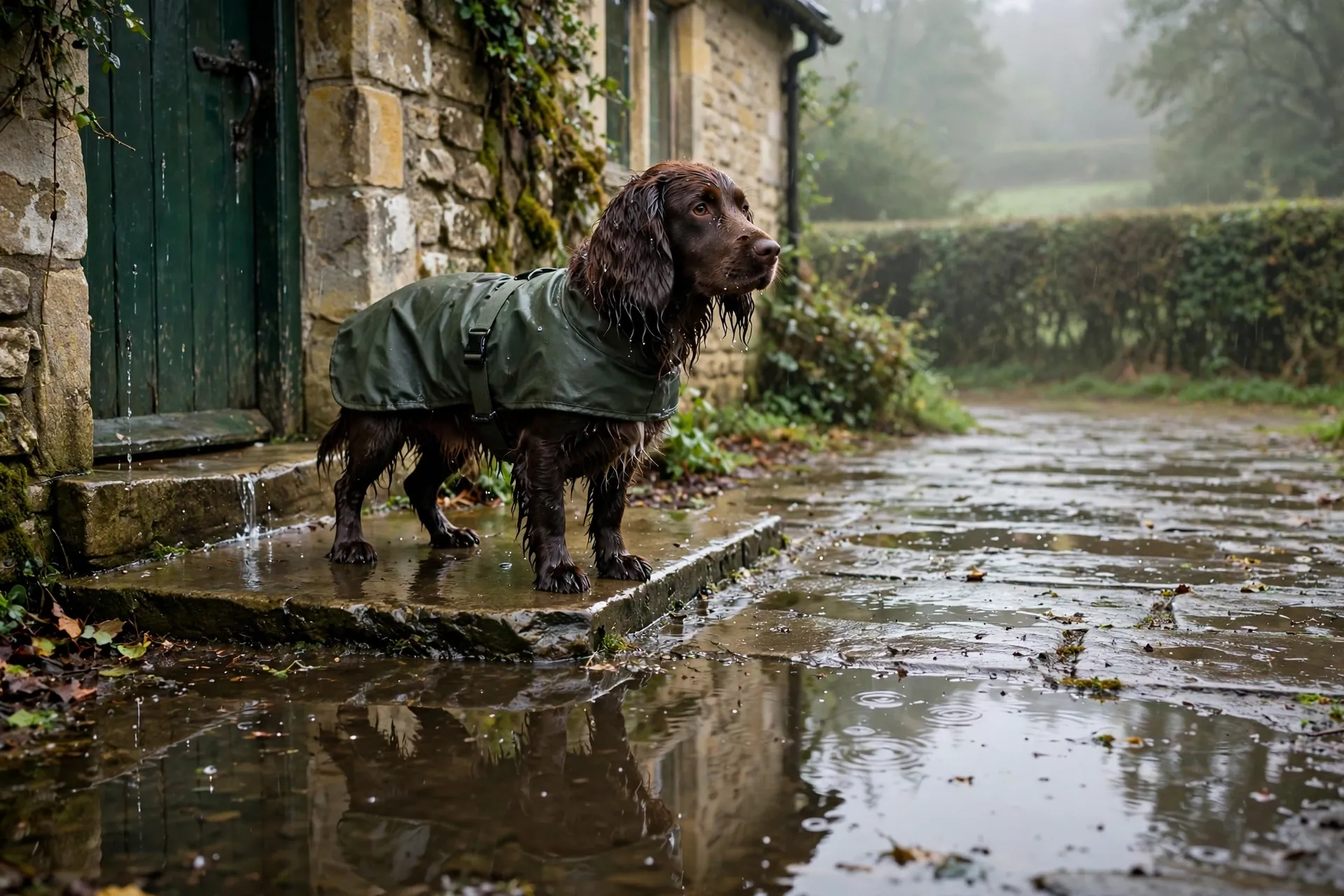
Waterproof and water-resistant sound similar and behave very differently in sustained rain. A water-resistant or showerproof shell is treated to shed light rain, which is fine for a ten-minute pavement walk in drizzle but often soaks through on a forty-minute country walk in steady rain. A genuinely waterproof coat uses a waterproof membrane or coated fabric with sealed or taped seams, so water cannot creep in through the stitching. Seams matter as much as the face fabric: an otherwise waterproof jacket with open seams will leak along every stitch line once the rain settles. If the product description does not mention seam sealing, taped seams or a hydrostatic head rating, treat its waterproof claim with caution and look for independent reviews that test it in real rain rather than under a tap. For dogs that swim, wade or love muddy ditches, even a waterproof coat will not keep the legs and belly completely dry, which is why belly coverage and leg length deserve as much attention as the back panel.
Insulation is the second layer of the decision, and more is not always better. A thin fleece lining suits a short-coated dog on a brisk walk, while a thick padded or synthetic-fill coat suits a slim dog standing around at a bus stop, a puppy class held outdoors, or a slow lead walk in freezing wind. The trap is buying for the coldest imaginable day and then overheating the dog on an ordinary active walk. Dogs cool themselves mainly by panting, and a heavily insulated coat on a dog that is running, playing or pulling uphill can trap heat surprisingly fast. Signs of overheating include heavy panting that does not settle, seeking shade or cold ground, slowing down, or trying to rub the coat off. If you see those signs, stop, remove the coat, offer water and let the dog cool before continuing. A versatile middle ground for many British winters is a waterproof shell with a removable fleece or quilted liner, so the same coat can be a light rain jacket in October, a warm coat in January, and a shell again on a mild wet day in March.
Breathability is the quiet feature that separates a good winter coat from a sweaty one. Membranes and vents allow warm, moist air to escape while keeping rain out, and underarm or back vents help on active walks. A coat with no ventilation and a non-breathable plastic-feeling outer may keep rain out perfectly and still leave a dog damp underneath after twenty minutes of running. Mesh linings help the coat slide over fur and reduce clamminess, while a smooth lining also makes the coat easier to put on a wriggling dog. Windproofing matters too, especially on exposed coastal paths, hilltops and open fields where wind strips heat faster than still cold air. A high collar or a snood-style neck that protects the throat without covering the ears or eyes can make a real difference on a windy headland, provided the dog tolerates it and it does not ride up and block vision.
Material choices carry practical trade-offs beyond warmth. Nylon and polyester outers tend to be tough, light and quick to dry, while waxed cotton looks traditional but needs reproofing and dries slowly. Fleece linings are warm and soft but hold water if the outer leaks, whereas synthetic fills keep insulating better when damp and dry faster than down. Down is warm for its weight but loses insulation when wet and is harder to wash, which makes it a poor first choice for a dog that rolls in mud. Reflective trim is not a fabric question but it belongs in the same decision: British winter walks happen in low light, and reflective piping or panels on the sides and rear make a dog visible to drivers, cyclists and other walkers long before a torch beam finds them. Check that reflective details survive washing, because trim that peels after two washes is decoration rather than safety equipment.
Breed, age and activity: who needs what
No single coat suits every dog, because dogs differ so much in their natural insulation, body shape and way of moving through winter. A thick-coated collie, husky or Newfoundland carries its own winter jacket and may need only a waterproof shell for the wettest walks, or nothing at all on a cold, dry day. At the other end of the scale, a whippet, Italian greyhound, chihuahua, French bulldog or any slim, short-coated dog loses heat quickly from a large surface area relative to body mass, and often benefits from a warm coat as soon as temperatures drop into single figures, especially when standing still. Between those extremes sit the majority of pet dogs: spaniels, Labradors, terriers and crossbreeds whose need depends less on breed label and more on coat density, body fat, fitness and the walk itself.
Age and health reshape the calculation further. Puppies cannot regulate temperature as efficiently as adults, tire sooner, and have less body fat, so short, warm, well-fitting coats and shorter walks make more sense than pushing a young dog through a long cold outing to prove a point. Elderly dogs, particularly those with arthritis, often stiffen in cold and damp, and a warm coat that covers the hips and lower back can make the difference between a willing walk and a reluctant shuffle. Dogs recovering from illness, surgery or a recent clip, and dogs with conditions that affect circulation or coat quality, may need extra warmth even if their breed would normally cope; if you are unsure whether a coat is appropriate for a dog with a medical condition, ask the vet who knows that dog rather than relying on a general guide, and check the official guidance before you travel if a journey or a new activity is involved.
Activity level is the variable owners most often forget. A dog that runs off lead for an hour generates far more heat than the same dog walking slowly on a lead beside a pushchair, and a dog that spends half the walk standing while its owner chats at a gate cools down quickly between bursts. Think about the slowest part of your usual walk, not the fastest: the ten minutes waiting at a stile, the pause while you take photographs, the slow stretch back to the car. That is when a coat earns its keep. Conversely, high-energy dogs on open runs may need only a light waterproof layer, because a heavy padded coat can overheat them and restrict the very movement that keeps them warm. Sighthounds illustrate the shape problem as well as the warmth problem: a deep chest, narrow waist and long back mean standard cuts often fit nowhere properly, so brands with sighthound-specific patterns, adjustable belly straps and longer back lengths are worth seeking out rather than forcing a generic coat to fit.
Body shape deserves the same attention as breed. Barrel-chested bulldogs and pugs need generous chest room and a coat that does not press on the throat or restrict breathing, which is especially important for flat-faced breeds that already work harder to breathe in cold air. Long-backed dachshunds need length without excess fabric dragging at the rear, and a coat that covers the belly helps because their underside sits close to wet ground. Stocky, low-slung breeds pick up more mud and spray than tall dogs, so belly coverage and easy washing matter more than maximum insulation. Dogs with thick neck ruffs, such as spitz types, may find high collars irritating, while dogs with thin ears and exposed skin may appreciate a snood on the coldest days, provided it does not slip over the eyes. The pattern is consistent: start from the dog in front of you, its shape, its coat and its health, and let the breed label be a hint rather than a verdict.
Two coats for different jobs often beat one coat asked to do everything. A light waterproof shell for wet, active walks and a warmer padded coat for cold, slow outings covers more British winter days than a single heavy waterproof parka that overheats the dog in October and still soaks through at the seams in a February downpour. If budget allows only one, choose the coat that matches your most common walk in your most common weather, not the extreme trip you take twice a year. A dog that walks mainly on pavements in a town needs different leg coverage and reflectivity from a dog that walks mainly on muddy bridleways, and a dog that travels by car to walks needs a coat that is easy to put on in a car park with cold hands and a dog that would rather be running already.
Fit and freedom of movement
A coat that fits on a standing dog can still fail on a moving one. The test is not whether the dog looks tidy in the hallway but whether the shoulders rotate freely, the front legs reach forward without the chest strap catching, and the back panel stays put when the dog trots, turns, jumps a small ditch or ducks under a low branch. Watch the first walk closely: a coat that twists to one side, rides up over the shoulders, or bunches behind the front legs is telling you something the size chart could not. Dogs compensate for a poor fit by shortening their stride, which is easy to miss if you are looking at the coat rather than at the gait. Film a short clip on your phone if you are unsure, and compare the dog's movement with and without the coat on the same stretch of path.
Check each pressure point in turn. The neck opening should sit comfortably without pressing on the windpipe, especially when the dog pulls or looks up. The chest strap should allow two fingers underneath, and the belly strap should be snug enough to stop flapping without squeezing the ribs when the dog breathes hard after a run. Leg openings, where a coat has them, must not rub the armpits, because that skin is thin and chafes quickly on a long walk; a dog that suddenly starts licking its armpits after walks may be reacting to a coat rather than to the weather. The rear of the coat should end before it interferes with toileting, and on male dogs the belly panel must leave enough clearance that it does not become soaked or soiled on every outing. That last point is a common reason for returns, and it is rarely mentioned on product pages, so check it on the first short walk rather than discovering it miles from home.
Closures affect fit as much as measurements do. Velcro-style fastenings are quick with cold hands and allow fine adjustment, but they clog with fur and mud and lose grip over a winter, so check them regularly and trim loose threads that catch. Zips give a neater, more secure closure but can snag long fur and are harder to fasten on a dog that will not stand still. Clip buckles are sturdy and easy to operate with gloves, though they add bulk under a harness. Whichever system a coat uses, practise fastening it indoors first, with treats and calm praise, so the dog does not learn to associate the coat with a wrestling match in a cold car park. A coat that takes two minutes of struggle to fit will be worn less often, however good its fabric, and a dog that dreads the routine will be harder to dress on the wettest days when it matters most.
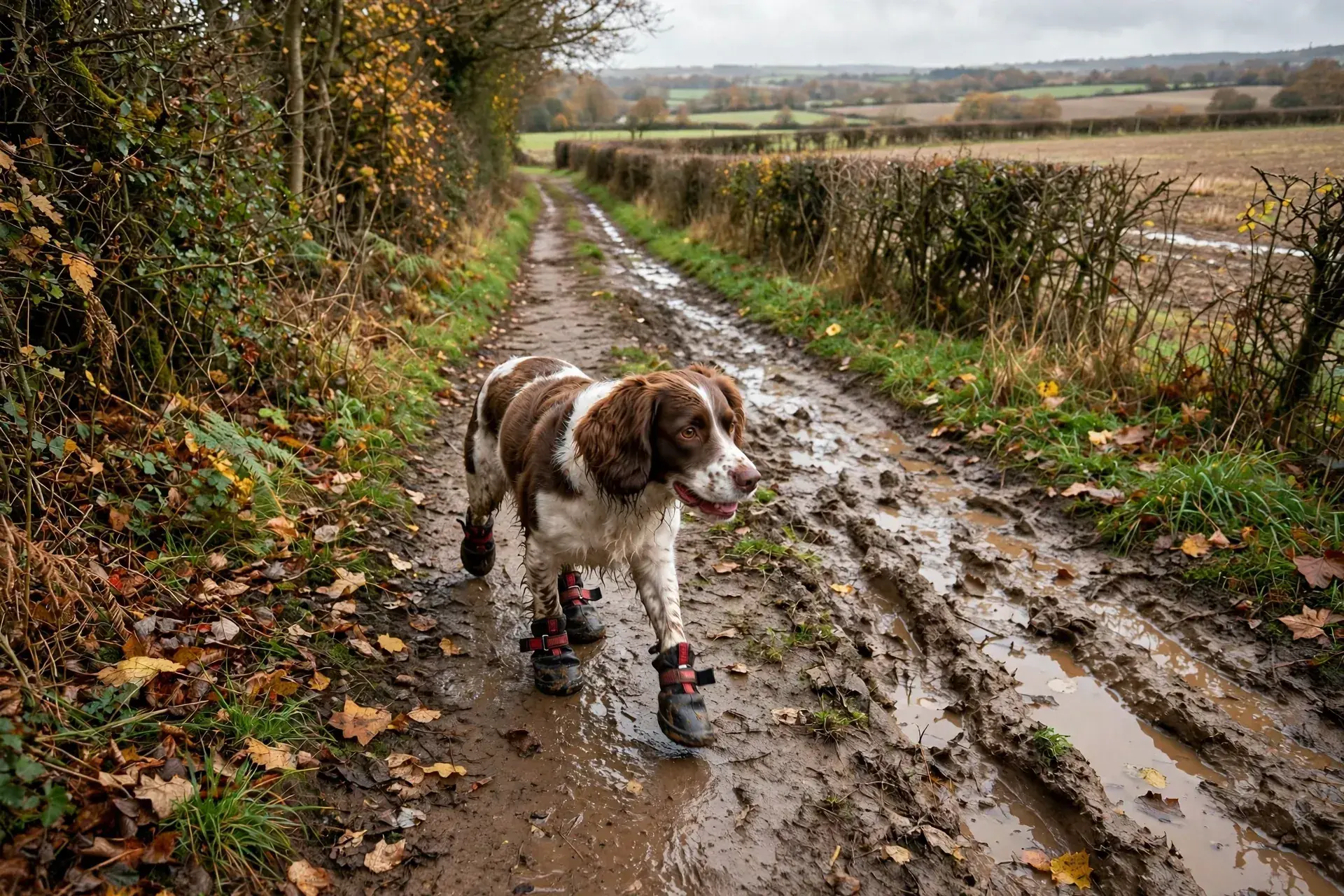
Harness compatibility is part of fit, not an afterthought. Some coats have a slot or opening on the back for a harness lead attachment, while others are designed to be worn over a harness with the lead threaded through. A third group works best under a harness, with the harness straps holding the coat in place. Each approach can work, but mixing them badly causes problems: a coat worn over a harness can shift and pull the harness out of position, while a harness worn over a coat can compress insulation and change how the straps sit on the chest. Test the exact combination you will use, including the lead clip, and walk the dog around the house and garden before a proper outing. If your dog also needs boots for muddy walks, try boots and coat together as well, since a dog adjusting to two new items at once moves differently from a dog adjusting to one.
Growth, weight change and seasonal fur all mean fit is not a one-time decision. Re-check the chest strap and back length monthly through winter, especially for puppies, adolescent dogs and dogs on a weight-management plan. A coat that fitted perfectly in November can become tight by January if a dog gains winter weight, or loose if an older dog loses muscle. Adjustable straps extend the useful life of a coat considerably, and a coat with a slightly longer, adjustable belly panel often outlasts a fixed-size coat by a whole season. When a coat no longer fits, retire it rather than forcing it: a tight coat that restricts breathing or chafes is worse than no coat on a short walk, and a loose coat that flaps, catches or trips the dog is a hazard on stiles, fences and muddy banks.
Trying a coat on properly
Introduce a new coat gradually, even if the dog has worn coats before. Let the dog sniff it, lay it on the floor with treats nearby, and drape it over the back without fastening it on the first session. Fasten one strap, reward calmly, and build up to a full fitting over a few short sessions rather than forcing a complete outfit on a suspicious dog in one go. This matters more than it sounds: a dog that learns coats mean pressure and fuss will resist every winter morning, while a dog that learns coats mean treats and walks will stand still for fastening. Keep sessions short, end before the dog gets fed up, and never chase a dog around the house with a coat, which teaches exactly the wrong lesson.
Once the coat is on, run through a movement checklist before you leave the house. Ask the dog to walk, turn in both directions, sit, lie down and stand again. Watch for a shortened stride, a reluctance to sit, a coat that rides forward over the shoulders when the dog lowers its head to sniff, or a rear hem that lifts and exposes the belly when the dog trots. Offer a treat from the ground to check head-down movement, since sniffing is a large part of a dog's walk and a coat that blocks it will frustrate the dog all outing. Check toileting posture too: a dog that cannot squat or lift a leg comfortably in a coat will either hold on, which is unhealthy on a long walk, or soil the coat, which is unpleasant for everyone. A five-minute indoor trial catches most of these problems while a return is still simple.
Then do a short real walk, not a long expedition, as the first outdoor test. Choose a familiar, low-distraction route of ten to fifteen minutes, in weather similar to the coat's intended use, and bring the lead, harness and any other gear the dog will normally wear with it. Observe the dog at the start, middle and end of the walk: does the coat stay centred, do straps need re-tightening after movement, does mud collect in a particular fold, and does the dog's gait change as it tires? Check the skin afterwards, especially the armpits, groin, neck and belly, for redness or rubbing, and check whether the fur underneath is dry or damp. A coat that leaves the dog damp inside on a short walk will be worse on a long one, and a coat that rubs in fifteen minutes will cause a sore in an hour.
Buying online makes this trial even more important, because photographs flatten shape and reviews describe other people's dogs. Order early enough that a return or exchange does not collide with a holiday or a cold snap, keep the tags and packaging until the trial walk is done, and check the return terms before the first fitting: some sellers refuse returns on items that have been worn outdoors, while others allow a trial period. If the coat is for a holiday, do the trial at least a week before departure, so a replacement can arrive and be tested too. Note the size that worked, the strap settings and any adjustments on your phone, because next winter you will not remember whether it was the medium with the belly strap on its loosest setting or the large with the chest taken in.
Rain, snow and mud: care on the walk
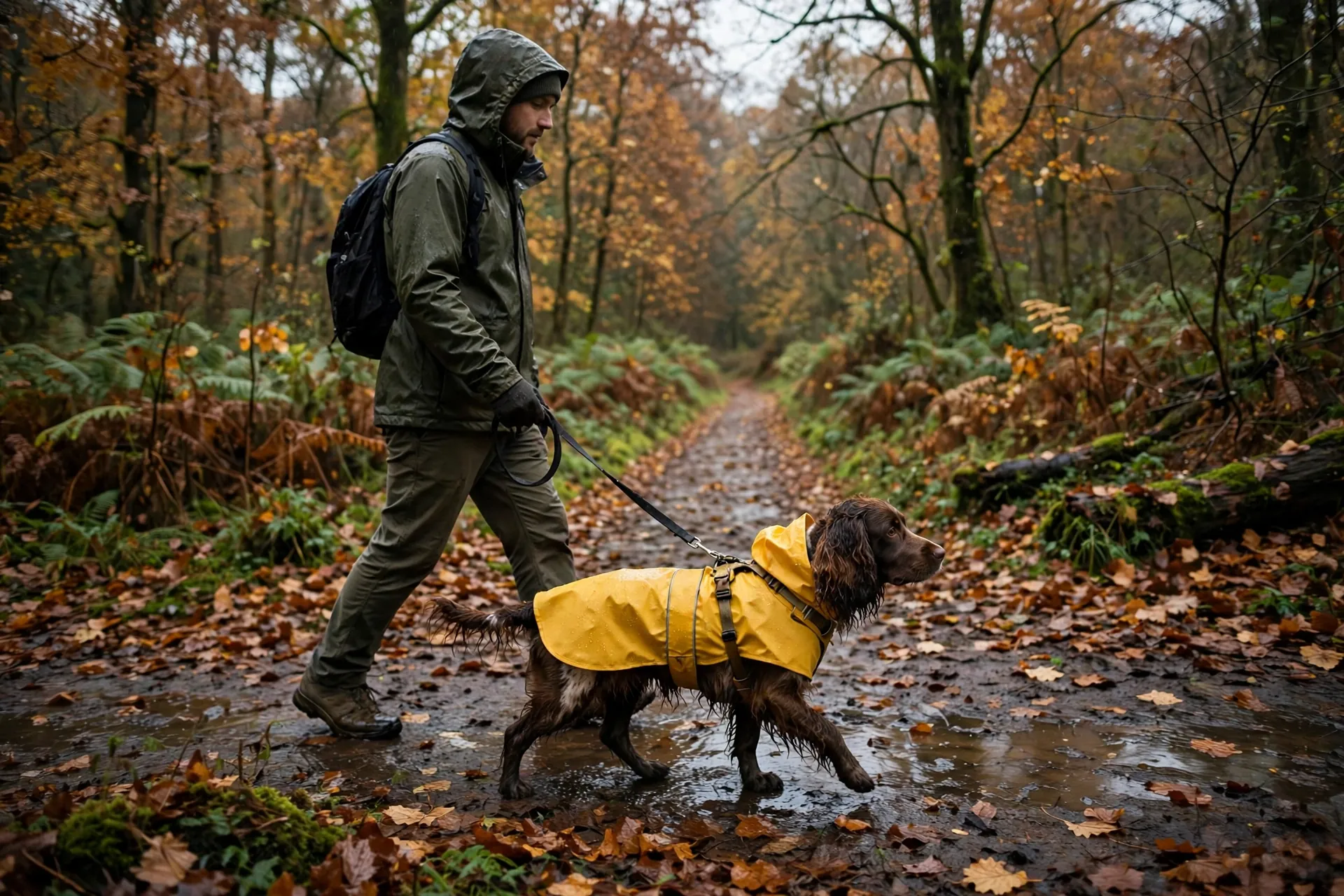
A winter coat changes the walk routine, not just the dog's temperature. In rain, the coat's job is to keep the core dry, but legs, paws, ears and the underside of the tail still get wet, and that water travels. Wipe paws and lower legs at the car or the door, check between the toes for mud, grit and ice, and pay attention to the belly fur that sits under the coat's hem, where trapped damp can chill a dog after the walk ends. On snowy days, watch for ice balls forming between the toes and in the fur of the lower legs, which can make a dog limp or chew at its feet; a short pause to clear them beats pressing on while the dog grows distressed. Salt and grit on pavements deserve a rinse too, since they irritate paws and are unpleasant if licked off, and a dedicated paw wash or a bowl of lukewarm water by the door makes this a two-minute job rather than a chore.
Layering can help on the coldest, wettest days, but it needs care. A thin fleece under a waterproof shell adds warmth without the bulk of a single heavy coat, and it can be removed if the dog warms up mid-walk. The risk is bulk: two layers that fit individually can combine into a stiff, restrictive outfit that changes gait and traps sweat between layers. If you layer, test the combination on a short walk first, check that straps still close without strain, and make sure the inner layer does not bunch under the outer shell's leg openings or harness straps. A drying coat after the walk is a different tool from a winter walking coat, and the two complement each other well: the walking coat keeps rain off outdoors, while a dog drying coat draws moisture out of the fur afterwards and helps the dog warm up indoors without a long towelling session.
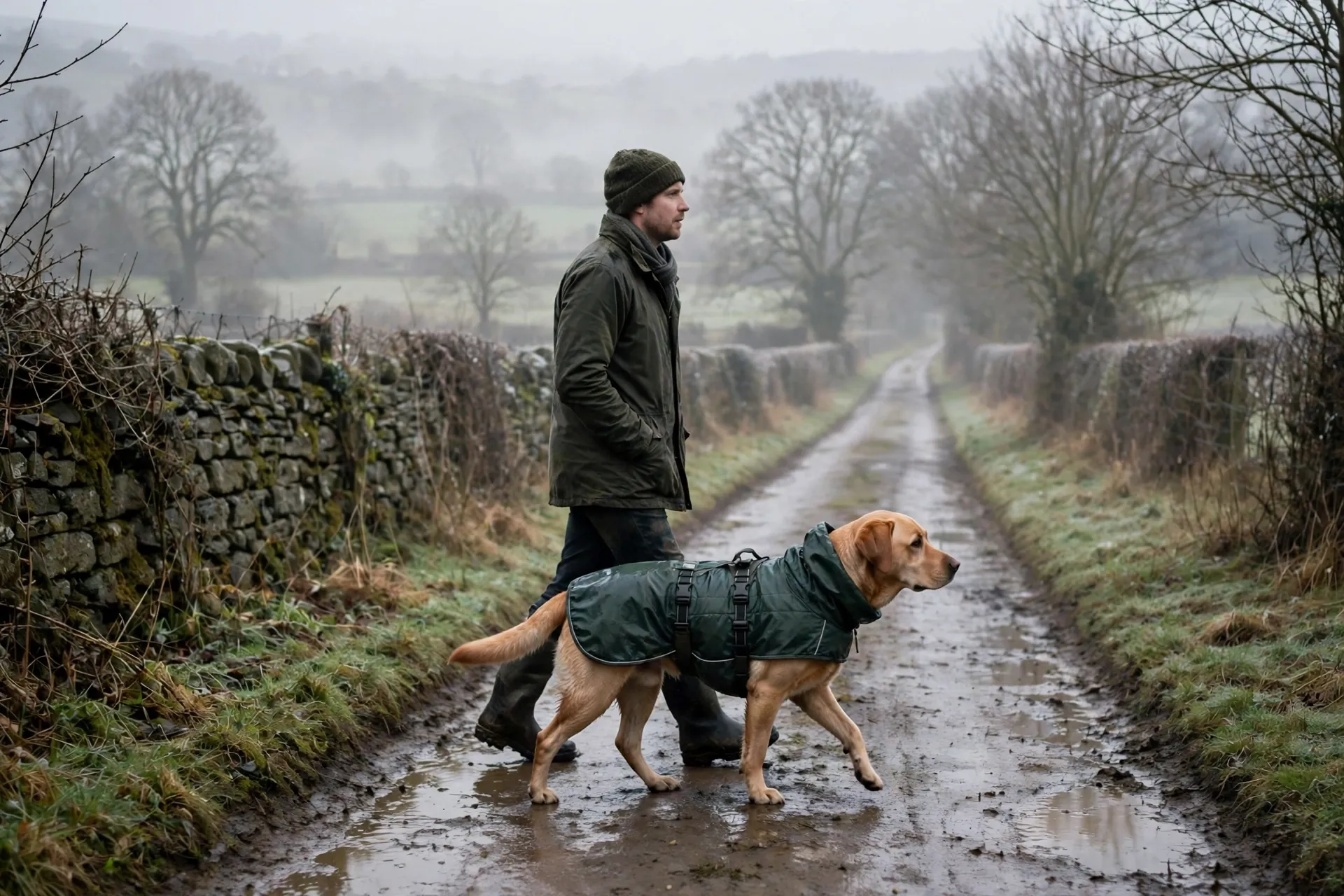
Visibility and safety need extra thought in winter, when walks happen in dusk, fog or driving rain. Reflective trim on the coat helps, but a light on the harness or collar adds a moving point of light that drivers notice sooner than a reflective stripe, and a bright or light-coloured coat is easier to spot on a misty field than a dark one. Keep the dog on a lead near roads, frozen water and livestock, because winter coats can muffle sound slightly and snow can hide familiar hazards such as ditches, broken fences and thin ice. Never let a dog walk on a frozen pond or lake, whatever the coat, and be cautious on icy pavements and wooden bridges, where a coated dog can slip just as easily as an uncoated one. If the dog does slip or fall, check for limping and soreness once home, since cold muscles and adrenaline can mask a strain until the dog cools down.
Mud management starts before the walk, not at the back door. A coat with good belly coverage keeps much of the splatter off the fur, but the lower legs and paws will still need attention, and the coat itself will collect mud along the hem and straps. Shake the coat outdoors before coming inside, wipe the hem with a damp cloth if it is only lightly soiled, and save full washing for when it is genuinely needed, since overwashing wears out waterproof treatments faster. Keep a towel, a paw wash and a spare lead by the door through winter, so the routine is ready when you return cold and wet rather than improvised each time. Dogs that hate being towelled often tolerate a drying coat far better, and a calm post-walk routine protects the coat as well as the flooring: a dog that is allowed to shake, roll and charge through the house in a muddy coat will need far more cleaning than one that is dried at the door.
Washing, drying and reproofing
How a coat is washed decides how long its waterproofing lasts. Always follow the care label first, because a method that suits one fabric can ruin another: high heat can damage membranes, fabric softener can coat waterproof treatments and reduce their performance, and harsh detergents can strip the durable water-repellent finish that makes rain bead on the surface. As a general rule, wash a winter coat only when it needs it, use a gentle cycle or hand wash with a mild, technical wash product designed for waterproof clothing, and skip fabric softener entirely. Close all Velcro fastenings before washing, so they do not snag the lining or collect fluff, and turn the coat inside out if the label suggests it, to protect the outer face and reflective trim.
Drying matters as much as washing. Hang the coat in a ventilated room away from direct radiator heat, a tumble dryer on high heat, or an open fire, all of which can damage membranes, melt reflective details or shrink linings. Air-drying takes longer in winter, so plan for it: hang the coat where air circulates, open a window slightly if condensation is a problem, and allow a full day before the next walk if possible. Having a second, lighter coat or a drying coat for the interval avoids the temptation to put a damp coat back on a dog, which defeats the purpose of the coat entirely. While the coat dries, inspect it properly: check seams for fraying, straps for stretched elastic, Velcro for clogged hooks, zips for sticking, and reflective trim for peeling. Small repairs, such as re-stitching a loose strap or replacing a worn fastening, are quick when caught early and far cheaper than a replacement coat mid-winter.
Reproofing restores the water-beading finish that wears off with washing, abrasion and time. The sign that reproofing is due is simple: water stops beading and starts soaking into the face fabric, even though the membrane underneath may still keep the dog dry for a while. Once the outer fabric wets out, the coat becomes heavier, colder and slower to dry, so reproofing is worth doing before a wet spell rather than after it. Wash the coat first, then apply a reproofing spray or wash-in product made for the fabric type, following the product instructions exactly, and allow it to cure fully before the next walk. Test the result with a light sprinkle of water: it should bead and roll off rather than darken the fabric. If reproofing does not restore performance and the membrane itself is leaking at the seams, the coat has reached the end of its waterproof life, however good the lining still looks.
Storage between winters affects next year's coat more than owners expect. Wash and fully dry the coat before storing it, because mud, salt and damp left in a cupboard over summer can stain, smell and weaken fabric. Store it hanging rather than compressed in a bag, away from direct sunlight and damp, with fastenings closed so Velcro does not collect dust. Note the size, the strap settings and any repairs needed on a label or in your phone, so next autumn starts with a check rather than a surprise. If the dog has grown, lost weight or changed shape over the year, re-measure before the first cold walk rather than assuming last year's fit still holds, and try the coat on indoors before relying on it on a holiday.
A buying checklist that prevents returns
Before you pay, run through a short checklist that turns the advice in this guide into a single decision. First, confirm the three measurements against the chart for this exact coat, not a similar one, and note where your dog sits inside each size range. Second, decide the coat's main job: wet active walks, cold slow walks, or a compromise for both, and choose waterproofing and insulation to match that job rather than the most extreme weather in the forecast. Third, check belly coverage, rear length and toileting clearance for your dog's sex and shape, since these are the fit details that cause the most returns. Fourth, test harness compatibility in the combination you will actually use, including the lead clip position. Fifth, check closures for ease with cold hands and gloves, reflective trim for visibility, and washing instructions for practicality. If any answer is unknown, ask the seller before ordering rather than hoping the coat will resolve it on arrival.
Price and value deserve a calm look too. A cheap coat that leaks, chafes or falls apart in six weeks costs more, in money and in wet walks, than a mid-priced coat that lasts three winters with reproofing. Look for reinforced stitching at stress points, sturdy straps and buckles, and a lining that will not pill into uncomfortable lumps after washing. At the same time, the most expensive coat is not automatically the best for your dog: a premium mountaineering-style coat may be overkill for a town dog that walks mainly on pavements, while a simple, well-fitting waterproof shell may be perfect. Read reviews from owners of similar breeds and shapes, and discount reviews that praise a coat after one indoor fitting; the useful reviews describe a wet, muddy, hour-long walk and what the dog looked like underneath afterwards.
Think about the whole winter wardrobe, not just the coat in isolation. A coat, a drying coat, a towel routine, paw care and a lead light form a system, and gaps in one part undermine the others. If you already own a good drying coat, you may need less insulation in the walking coat, because the dog can warm up quickly indoors afterwards. If you walk mainly in the dark, reflectivity and a light may matter more than an extra layer of padding. If your dog travels to walks by car, a coat that is easy to put on and take off in a car park, and that packs small enough to live in the boot without creasing into a stiff bundle, will be used more often than a coat that is technically warmer but awkward to handle. The best coat is the one that is on the dog, fitting well, on the walks you actually take.
- Measurements checked: chest, back length and neck recorded, compared with this coat's own chart, with room for winter fur.
- Weather matched: waterproof, not just water-resistant, for regular rain; insulation matched to activity, not to the coldest day.
- Movement tested: shoulders free, stride unchanged, sitting and toileting comfortable, harness and lead working together.
- Care understood: washing method, drying time and reproofing plan known before purchase, not discovered after the first muddy walk.
- Return route clear: trial walk done early, tags kept, return terms checked, and the working size and strap settings noted.
Common mistakes worth avoiding
The most common mistake is buying by breed size label instead of by measurement. A label that says a coat fits a Labrador can still be wrong for a particular Labrador, because Labradors vary in chest depth, length and weight, and crossbreeds vary more. The second mistake is buying too much coat: a heavy, long, fully lined parka for a dog that runs hard for an hour overheats the dog, restricts movement and ends up carried home in a bag. The third is the opposite, buying a fashionable thin shell for a slim, elderly or short-coated dog and expecting it to provide warmth it was never designed to give. Both errors come from shopping for an image of winter rather than for the dog's actual walks, and both are avoided by the tape measure and the short trial walk.
Other mistakes are subtler. Some owners leave a wet coat on a dog indoors after a walk, thinking the coat will keep the dog warm, when in fact a damp coat chills the dog and irritates the skin; the coat should come off at the door and be replaced, if needed, by a dry drying coat. Some owners wash a waterproof coat with fabric softener or dry it on a hot radiator, then wonder why it leaks in November. Some forget the belly: a coat that protects the back beautifully but leaves the belly exposed to spray from wet grass will still leave a small dog soaked from below. And some owners assume a coat replaces fitness, acclimatisation and common sense: a dog that has spent autumn indoors still needs shorter, gradually longer walks as winter arrives, whatever it is wearing, and no coat makes an icy, flooded or dangerous route safe.
Finally, do not let a coat become a substitute for watching the dog. The signals that matter are behavioural and easy to read once you look for them: shivering, a tucked tail, reluctance to go out, lifting paws, slowing down, seeking shelter, heavy panting, or trying to remove the coat. A dog that is comfortable in its coat walks with a normal gait, sniffs happily, moves freely and settles quickly afterwards with dry, warm fur under the coat. If the signals say otherwise, change something: adjust the fit, change the layer, shorten the walk, or leave the coat off for a short, dry outing and reassess. Winter walking should be enjoyable for both ends of the lead, and a well-chosen coat is one of the simplest ways to keep it that way through the darkest, wettest months of the British year.
Practical questions
Before you go
Does every dog need a winter coat in the UK?
No. Healthy dogs with thick double coats often cope well with cold, dry weather, while slim, short-coated, young, elderly or unwell dogs feel the cold much sooner. Judge by your own dog: shivering, reluctance to walk, lifting paws or seeking shelter are clearer signals than any breed chart. A coat is a tool for warmth and weather protection, not a fashion requirement.
How tight should a dog winter coat fit?
Snug enough to stay in place, loose enough to slide two fingers under the chest strap and to allow a full, natural stride. If the coat pulls at the shoulders, rides up over the back or restricts the front legs, it is too tight or the wrong shape, even if the length measurement matches the size chart.
What is better for a wet British winter: waterproof or water-resistant?
For regular rain, a fully waterproof outer with sealed or taped seams keeps a dog drier for longer than a water-resistant shell, which sheds light showers but soaks through in sustained rain. Check the belly coverage too, because spray from wet grass and puddles soaks a dog from below even when the back stays dry.
Can my dog wear a winter coat and a harness at the same time?
Yes, if the combination is planned. Some coats have a harness opening on the back, while others work better worn over a harness with the lead clipped through the opening. Test the full combination at home first: the coat must not twist, bunch under the harness straps or block the harness from sitting on the chest as designed.
How do I dry a dog winter coat after a rainy walk?
Shake off loose water outdoors, hang the coat in a ventilated spot away from direct radiator heat, and let it air-dry before storing it. Wash it only as the care label directs, reproof the outer fabric when water stops beading, and check straps, zips and reflective trim while it dries so small damage is found before the next wet walk.
Should a dog wear a coat indoors in winter?
Usually not. A coat designed for outdoor cold can overheat a dog in a centrally heated home, and damp indoor air trapped under a coat can irritate skin. Save the winter coat for walks and cold outbuildings, and use a light indoor fleece only if a vet or a genuine draughty home makes it necessary, removing it if the dog pants or seeks cool floors.