This guide explains how abbey dog rules are usually structured. It does not replace the official page for the abbey you plan to visit, because individual sites set their own rules and change them for services, events, filming and conservation work.
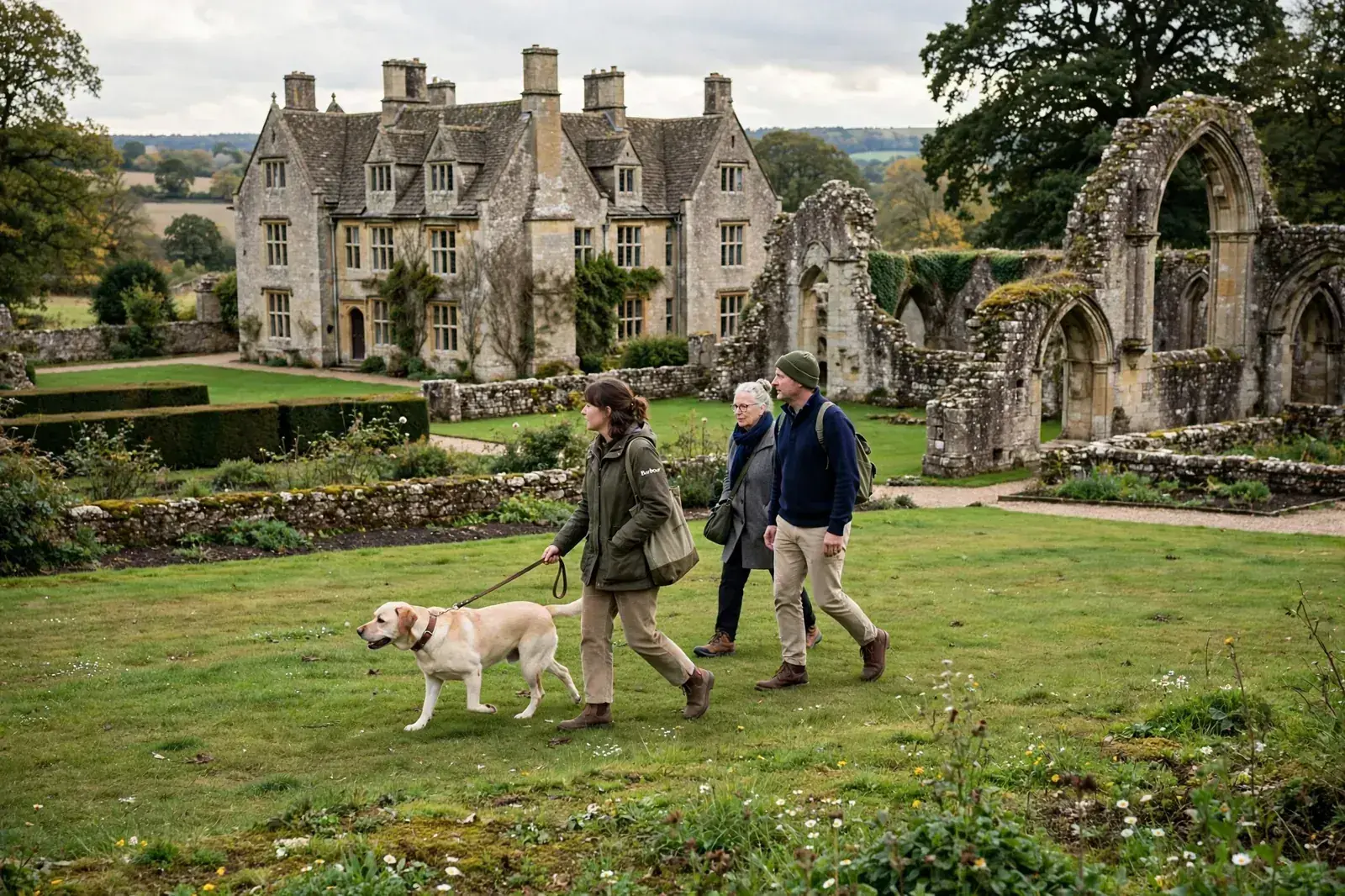
Think of an abbey visit as two visits in one: an open-air walk through ruins and grounds where dogs are often welcome on a lead, and a roofed interior where dogs are commonly restricted. Check both halves for the specific abbey before you travel, keep the lead short around masonry, livestock and memorials, and have a plan for one person waiting outside if the interior is closed to dogs.
The grounds and interior split
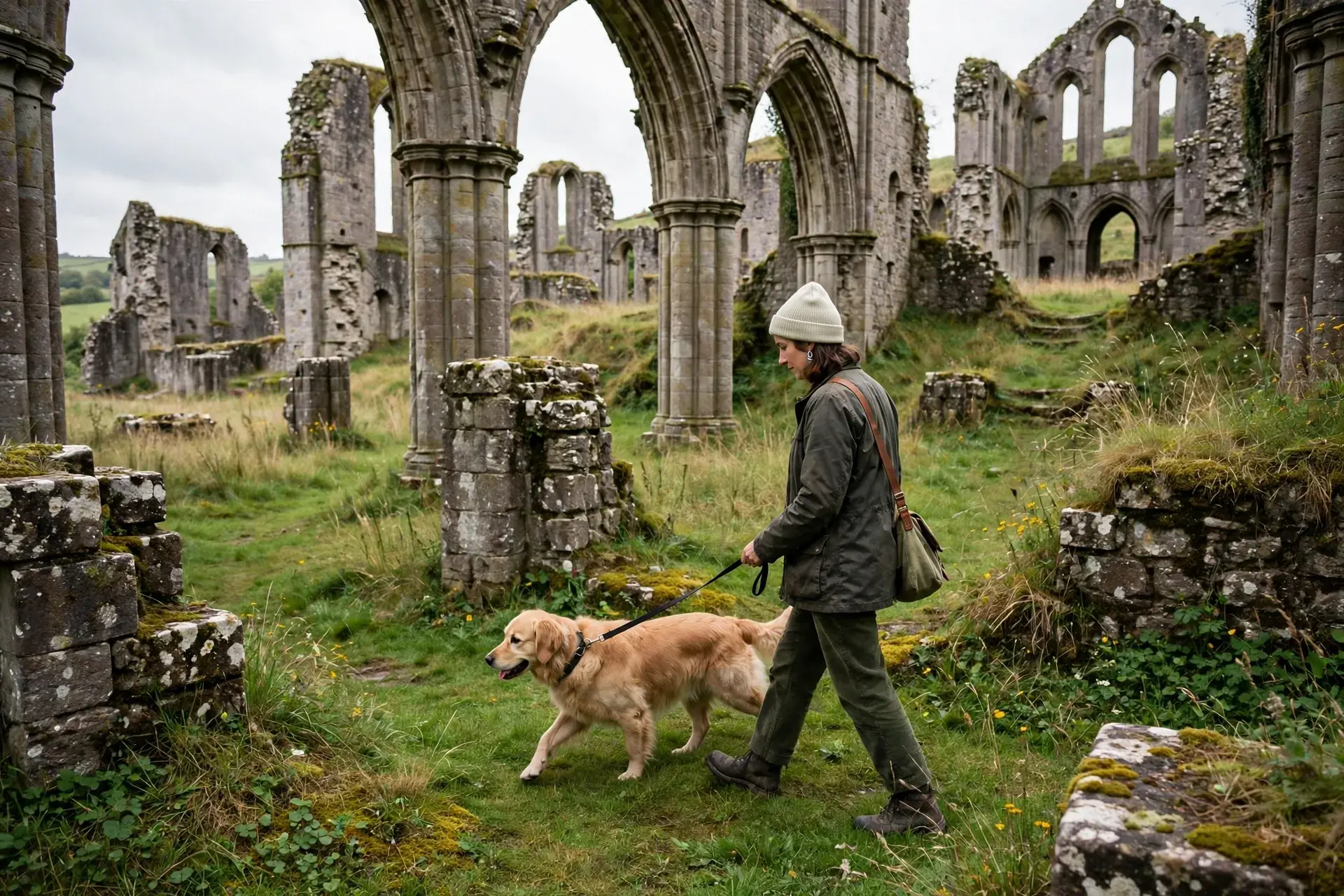
The single most useful distinction for dogs at UK abbeys is not between one abbey and another. It is between the open air and the roof. A roofless nave, a grassy cloister garth, a riverside precinct and a wooded approach walk behave like a park with old stones in it. A roofed chapel that is still used for worship, a small museum room, a shop, a cafe interior and a ticket hall behave like indoor heritage spaces, with tighter rules, closer quarters and far less room for a dog to settle without blocking someone else. Once that split is clear, most of the confusion about abbey dog policies disappears, because the same site can reasonably welcome a dog in one half and restrict the dog in the other without contradicting itself.
That split also explains why a short online search can seem contradictory. One visitor report praises an abbey as wonderfully dog-friendly because the dog enjoyed an hour among the arches. Another report calls the same abbey restrictive because the dog had to wait outside a chapel or an exhibition. Both can be accurate descriptions of different parts of the same day. The practical question is therefore never only whether an abbey is dog-friendly in general. It is where, exactly, the dog may go, on what kind of lead, and what happens at each doorway. A site map, read before arrival, is worth more than a dozen general reviews, because it shows which lawns, paths and buildings belong to the dog part of the visit and which belong to the human-only part.
Grounds themselves are not one uniform zone either. The lawn immediately around the great church ruins is often the most managed and most crowded part of the site, with guided groups, school parties, wedding photography and visitors standing still to look upward at arches. Dogs cope better there on a short lead, close to their owner, with frequent pauses rather than a long free wander. Outer precincts, orchards, water meadows and estate walks can feel calmer and more spacious, but they bring their own conditions: grazing animals, water, unfenced drops, nesting birds in spring and fragile archaeology underfoot. A dog that is relaxed on a wide riverside path may still need close control on the narrow wall-walk beside it, and a dog that is steady among ruins may still pull toward ducks, sheep or a picnic left on a bench.
Interiors deserve separate planning because the reasons for restriction are practical, not merely traditional. A chapel in use for prayer or a service needs quiet and a clear aisle. A museum room may hold textiles, books, carved stone or metalwork that cannot be replaced if a wet coat brushes past or a lead swings into a case. A shop doorway is narrow, stocked at dog-nose height and busy with people carrying bags. A cafe interior adds food, hot drinks and allergy considerations. None of this means a dog is unwelcome on the whole site. It means the interior is the part most likely to require a different arrangement, and the kindest arrangement is usually decided before arrival: one adult waits with the dog in the grounds, the group takes turns inside, or the interior is simply skipped on a dog day and saved for a return visit without the dog.
Assistance dogs are treated separately from pet dogs at most heritage sites, and that distinction matters for planning as well as for fairness. A rule that says no pet dogs inside a chapel does not automatically apply in the same way to a trained assistance dog, although even assistance dogs may be asked to follow staff guidance around services, fragile displays or restricted conservation areas. If you travel with an assistance dog, it is still worth checking the official guidance before you travel for that abbey, because access routes, toilet areas and any temporary closure will be site-specific. Do not assume that a pet-dog restriction, or a pet-dog welcome, tells you the assistance-dog rule.
Finally, remember that abbeys are rarely owned and run by a single body with a single rulebook. English Heritage, Historic Environment Scotland, Cadw, the National Trust, local councils, cathedrals, parish churches, private estates and charitable trusts all manage abbey sites in different ways, and even sites under one umbrella organisation set local rules for their own layout, livestock, events and staffing. A membership or a brand name is a helpful starting point for research, not a guarantee. The habit that protects every abbey day out is the same in England, Scotland and Wales: find the official page for that abbey, read the dog section in full, and note the date you read it. Our guide to English Heritage dogs explains how umbrella rules and local exceptions interact, which is a useful companion when an abbey belongs to a larger heritage organisation.
Abbeys in England
England has the largest and most varied abbey landscape for dog owners, from vast Cistercian valleys in Yorkshire to coastal headlands, city precincts and small parish ruins tucked into villages. The pattern that repeats across the country is the grounds-and-interior split described above, but the balance shifts with each site. A large landscape abbey may give a dog an hour of grassy ruins and riverside paths, while a compact urban abbey may offer a short, beautiful circuit and a stricter interior rule because every room is small and busy. Neither is better in the abstract. The right choice depends on how long your dog can settle, how much open space they need, and whether your group is happy to split up for an interior visit.
Fountains Abbey, North Yorkshire. Fountains is the classic large-scale abbey day out, set in a wooded valley with extensive ruins, water gardens and long estate walks. That scale is both its attraction and its demand: a dog needs stamina for the distances, a lead for the managed ruin areas, and a plan for the water features and any grazing or wildlife areas on the wider estate. Dogs are commonly described as welcome in the outdoor areas, with roofed buildings more restricted, but the estate is large enough that a single general statement is a poor substitute for the site page, so check the official guidance before you travel to Fountains Abbey. Arrive early on a busy day if your dog is unsettled by crowds, and build in a proper toilet walk before the ruins rather than expecting the first lawn to serve that purpose.
Rievaulx Abbey, North Yorkshire. Rievaulx sits in a quieter, more enclosed valley than Fountains, and its appeal for dogs is the sense of space around tall, roofless walls rather than a long estate circuit. That makes it a good candidate for an older dog or a dog that prefers sniffing and standing still to covering miles, provided the dog can manage uneven ground and steps around the ruins. The same hedging applies as everywhere in this guide: published visitor information commonly points to dogs being welcome outdoors on a lead, with interiors restricted, but local conditions change, so check the official guidance before you travel to Rievaulx Abbey. Take water in summer, because exposed stone reflects heat and there is little shade among the highest walls at midday.
Whitby Abbey, North Yorkshire. Whitby adds wind, steps and a headland to the abbey equation. The ruins stand high above the town and the sea, which makes for dramatic photographs and a very exposed walk on a blustery day. Dogs that are nervous in wind, or that pull toward gulls and cliff edges, need a short lead and a route that avoids the most exposed edges. The visitor centre and any roofed exhibition space should be treated as a separate question from the headland ruins, so check the official guidance before you travel to Whitby Abbey. Pair the visit with a sheltered walk in town afterwards, rather than expecting a tired or windswept dog to enjoy a second exposed circuit immediately.
Bolton Abbey, North Yorkshire. Bolton Abbey is a useful example of a site where the abbey, the river, the woods and the wider estate all matter, and where the dog day is really a landscape day with ruins in the middle of it. River paths, stepping stones and woodland trails attract families and dogs alike, which means leads, water safety and consideration for other walkers matter more than they do on an empty lawn. The priory church itself, where it remains in use, must be treated as a worship space first and a sightseeing stop second, so check the official guidance before you travel to Bolton Abbey. If your dog swims, plan for a drying towel and a lead walk back through the ruins rather than a wet dash past other visitors.
Kirkstall Abbey, Leeds. Kirkstall offers a different kind of English abbey day: an urban ruin in parkland, reachable without a long rural drive, with open grass, a river nearby and a visitor centre that may have its own rules. Urban abbeys are often the easiest first step for a city dog, because the visit can be short, the exit is close, and a cafe or park walk can follow without another car journey. The trade-off is that urban sites can be busy at weekends, with joggers, cyclists, children and other dogs sharing the same paths, so a short lead and a calm greeting routine matter more than distance. As with every entry here, check the official guidance before you travel to Kirkstall Abbey, and confirm whether any museum or exhibition room is open to dogs on the day you visit.
Glastonbury Abbey, Somerset. Glastonbury combines extensive grassy ruins with a town that is itself a destination, which makes it tempting to treat the abbey as one stop on a long wandering day. For a dog, a long wandering day is harder than a single focused visit, especially in summer heat on open lawns with little shade. Plan the abbey as the main event, with water, shade breaks and a shaded rest, and treat the town walk as optional rather than obligatory. The abbey grounds are commonly described as dog-welcoming on a lead, while roofed buildings and any exhibition areas follow stricter rules, so check the official guidance before you travel to Glastonbury Abbey. Keep the dog away from any area set aside for a service, concert or private event, even if that area was open on a previous visit.
Tewkesbury and other working abbeys. Some English abbeys remain working parish or abbey churches, and those sites deserve an extra layer of respect. A working church may welcome a well-behaved dog in the grounds and even in parts of the building at quiet times, yet close the same space during a service, a wedding, a funeral or choir practice. The dog rule may therefore depend not only on the site but on the hour. If you plan to visit a working abbey, check the service times as well as the dog guidance, arrive outside service hours if you intend to look around, and be prepared to leave promptly and quietly if a service begins. Check the official guidance before you travel to any working abbey you plan to visit, and do not rely on a weekday rule to cover a Sunday morning.
Abbeys in Scotland
Scottish abbeys are often smaller, redder in stone, and more closely tied to river valleys and Border towns than their English counterparts, and that geography shapes the dog day. The Borders abbeys in particular lend themselves to a touring route, with several sites within a short drive of each other, but a touring route is not automatically a good dog route. Two abbeys in one day can mean two car journeys, two new sets of rules, two car parks and twice the excitement, which suits a settled adult dog far better than a young or anxious dog. One abbey done slowly, with a riverside walk and a rest, is usually the better first experience.
Melrose Abbey, Scottish Borders. Melrose is the best-known Borders abbey, with elaborate carving, a compact town setting and a museum element that must be checked separately from the ruins. The town itself offers cafes, streets and a riverside walk that can extend or soften the visit, but the town also adds traffic, pavement walking and other dogs on narrow streets. A dog that is calm on a town pavement will enjoy Melrose as a combined abbey and town day. A dog that is reactive in town may do better with a quieter abbey first. Published guidance commonly describes dogs as welcome in the outdoor abbey areas on a lead, with interiors restricted, so check the official guidance before you travel to Melrose Abbey. Note the opening pattern for the day, because a late arrival that misses the interior opening still leaves a worthwhile ruins walk if the grounds remain accessible.
Dryburgh Abbey, Scottish Borders. Dryburgh is quieter and more wooded than Melrose, set beside the River Tweed with a sense of seclusion that many dogs prefer. Woodland paths, riverbanks and burial grounds combine here, which means the lead rules are about more than crowd control: they protect wildlife, river safety and the dignity of memorial areas. Keep the dog on paths, away from grave markers and river edges where the bank is steep or fast, and give other visitors space at viewpoints and bridges. As with the other Scottish entries, check the official guidance before you travel to Dryburgh Abbey, because woodland closures, river conditions and event days can change the accessible route without changing the general dog policy.
Jedburgh Abbey, Scottish Borders. Jedburgh stands in the town itself, with tall, roofless walls that dominate the skyline and a visitor experience that is compact enough for a shorter dog visit. Compactness is an advantage for dogs that tire quickly or dislike long estate walks, but it also means there is less room to move away from a busy group or a barking dog. If your dog needs space, visit at a quieter time, use the outer grounds for settling before entering the most enclosed ruin areas, and keep greetings brief. Check the official guidance before you travel to Jedburgh Abbey, and confirm whether any exhibition or upper-level area is accessible to dogs, since upper levels and narrow stairs are common restriction points.
Sweetheart Abbey, Dumfries and Galloway. Sweetheart Abbey, in the village of New Abbey, is a gentler, village-scale site that suits a slower visit and a dog that prefers quiet lanes to major attractions. Village abbeys often share their setting with residents, a churchyard, a small car park and local dog walkers, so the etiquette is closer to neighbourhood etiquette than to attraction etiquette: pick up promptly, keep the dog off memorials and flower beds, and do not block lanes or gates. That village scale can be a virtue, because the visit can be combined with a short countryside walk rather than a full attraction day. Still, check the official guidance before you travel to Sweetheart Abbey, because a small site can close a section for conservation or a service without the publicity that a large site would give the same closure.
Kelso Abbey and the wider Borders. Kelso Abbey, now a striking ruin in the town centre, illustrates a point that applies across Scotland: a ruin that is partly open and partly integrated into a town needs a different reading from a fenced attraction. Some areas may be freely accessible from the street, others may be managed, and the dog rule may depend on which part of the precinct you are standing in. When a site is not a single gated attraction, walk the boundary first, look for local signs, and treat any churchyard or memorial ground as a lead-only, no-toilet area even if the wider park allows more freedom. Check the official guidance before you travel to Kelso Abbey, and ask locally if the signage is unclear rather than guessing at a boundary that residents and visitors both use.
Abbeys in Wales
Welsh abbeys reward a slower, more rural approach. Many sit in valleys, beside rivers or on the edge of villages, with fewer facilities than a large English estate and a stronger sense of remoteness. That remoteness is part of the charm, but it also means the practical details matter more: phone signal may be patchy, the nearest vet may be further away, a cafe may be seasonal, and a car park may be small. A Welsh abbey day with a dog works best when the abbey is paired with one good walk and one reliable refreshment stop, rather than stacked with three attractions and a long drive between them.
Tintern Abbey, Monmouthshire. Tintern is the most photographed Welsh abbey, with great window tracery standing roofless above the River Wye. Its fame brings coaches, photographers and school groups, especially in summer and at weekends, so a dog that is calm in a crowd will enjoy it more than a dog that is easily overwhelmed. The river and the village add water, traffic and pavement walking to the day, and the Wye Valley walks nearby offer a longer, calmer alternative once the ruins have been seen. Published information commonly describes dogs as welcome in the abbey grounds on a lead, with any roofed visitor facilities following stricter rules, so check the official guidance before you travel to Tintern Abbey. Arrive early or late in the day if you want the great windows without the densest crowd.
Valle Crucis Abbey, Denbighshire. Valle Crucis, near Llangollen, is a more intimate abbey in a valley setting, with grassy ruins, a fishpond and walks that connect to the wider Dee Valley. Its smaller scale suits a dog that prefers quiet sniffing to spectacle, and it pairs well with a canal or riverside walk in Llangollen for a full but unhurried day. Smaller sites also mean smaller margins for error: a single muddy path, a closed toilet area or a grazing field can change the whole visit, so check the official guidance before you travel to Valle Crucis Abbey. Keep the dog on a lead around the pond and any livestock on adjoining land, and do not let a dog drink from ornamental water without checking whether it is safe and permitted.
Strata Florida Abbey, Ceredigion. Strata Florida sits in remote mid-Wales, in a landscape of hills, rivers and narrow roads that rewards careful driving and a full tank of fuel. The remoteness means fewer crowds and a more contemplative ruin, but also fewer fallback options if the weather turns or the dog becomes unsettled. Pack water, food, a towel and a phone charger, and let someone know your route if you are walking beyond the abbey into open hills. The abbey grounds are commonly described as accessible to dogs on a lead, with any indoor interpretation area following separate rules, so check the official guidance before you travel to Strata Florida Abbey. Do not treat a remote abbey as a place to let a dog roam: open hills bring sheep, ground-nesting birds and unfenced water, all of which require close control.
Neath Abbey, Neath Port Talbot. Neath Abbey offers an industrial-valley contrast to the rural idyll: substantial ruins close to a town, with a history shaped by iron, coal and later industry as well as by monastic life. That setting makes it a good choice for a shorter, urban-edge visit, especially combined with a park or riverside walk rather than a long rural drive. Urban-edge ruins can have uneven surfaces, industrial archaeology and less formal visitor infrastructure, so keep the dog on a short lead, watch for broken ground and litter, and carry bags even if bins are sparse. Check the official guidance before you travel to Neath Abbey, and confirm access arrangements, because a site with multiple ownerships or access points can have different rules at different entrances.
Across Wales, language and place-name details are also worth a moment of care. Welsh abbey names, village names and signage may appear in Welsh, English or both, and a satnav may pronounce or spell a village differently from a local sign. Save the abbey name, the village name and the postcode before you lose signal, and do not rely on a single mapping app to find a small rural car park. If you are combining abbeys across Wales and England in one trip, remember that the managing organisations differ at the border: Cadw guidance does not automatically apply in England, and English Heritage guidance does not automatically apply in Wales. Each abbey still needs its own check.
Lead rules around ruins, livestock and graveyards
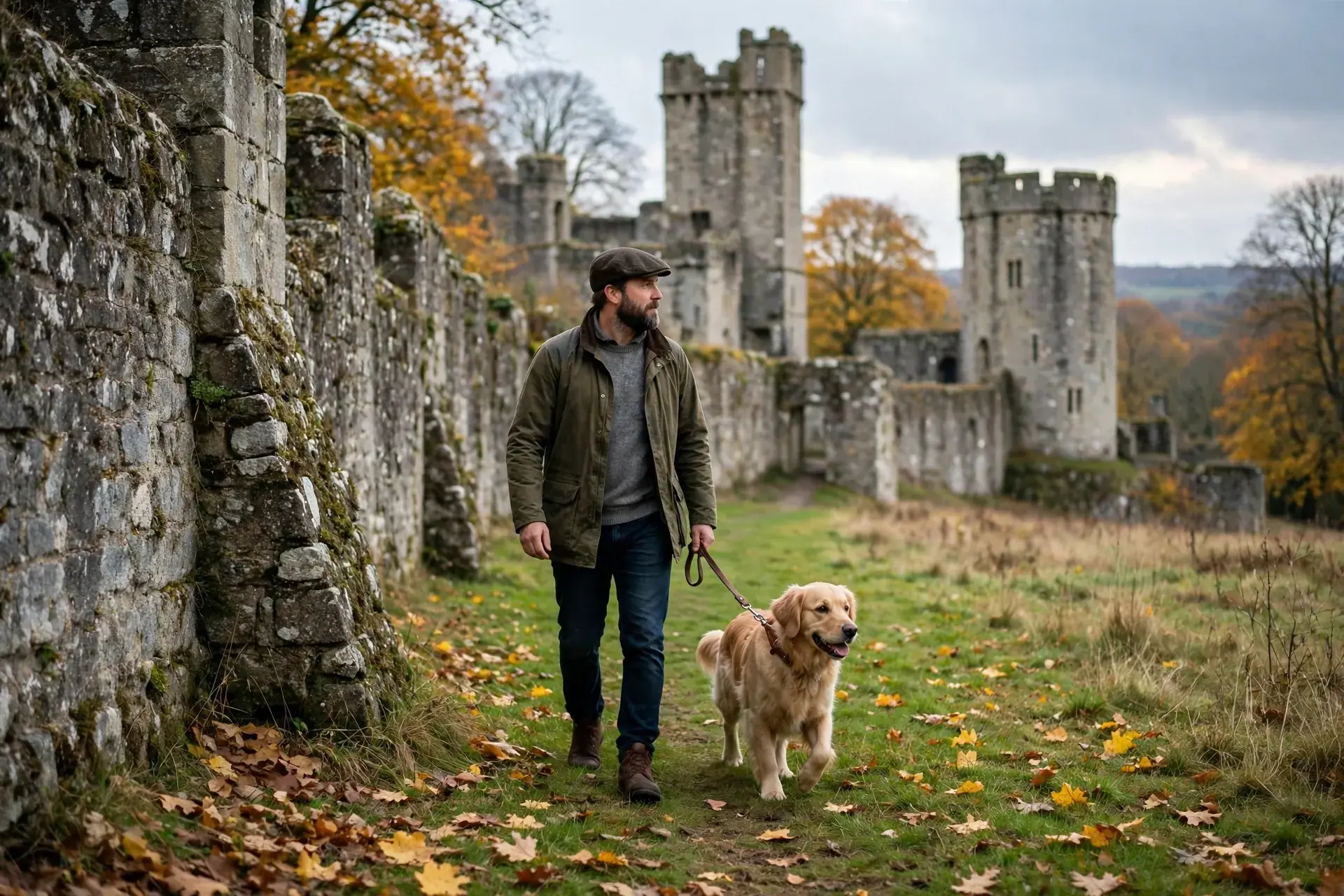
Lead rules at abbeys are rarely about a single length of lead. They are about control in specific places: around other visitors, around fragile stone, around animals, around water and around memorials. A long line that is perfect on an open estate walk can be a hazard among ruins, where it can trip a visitor, wrap around a column, snag on a low wall or allow a dog to step onto a grave. A short lead, held with slack rather than tension, is the default that works in almost every abbey zone. If the site allows a longer lead or off-lead exercise in a designated field, treat that as a separate zone with its own start and end point, not as permission that carries back into the ruins.
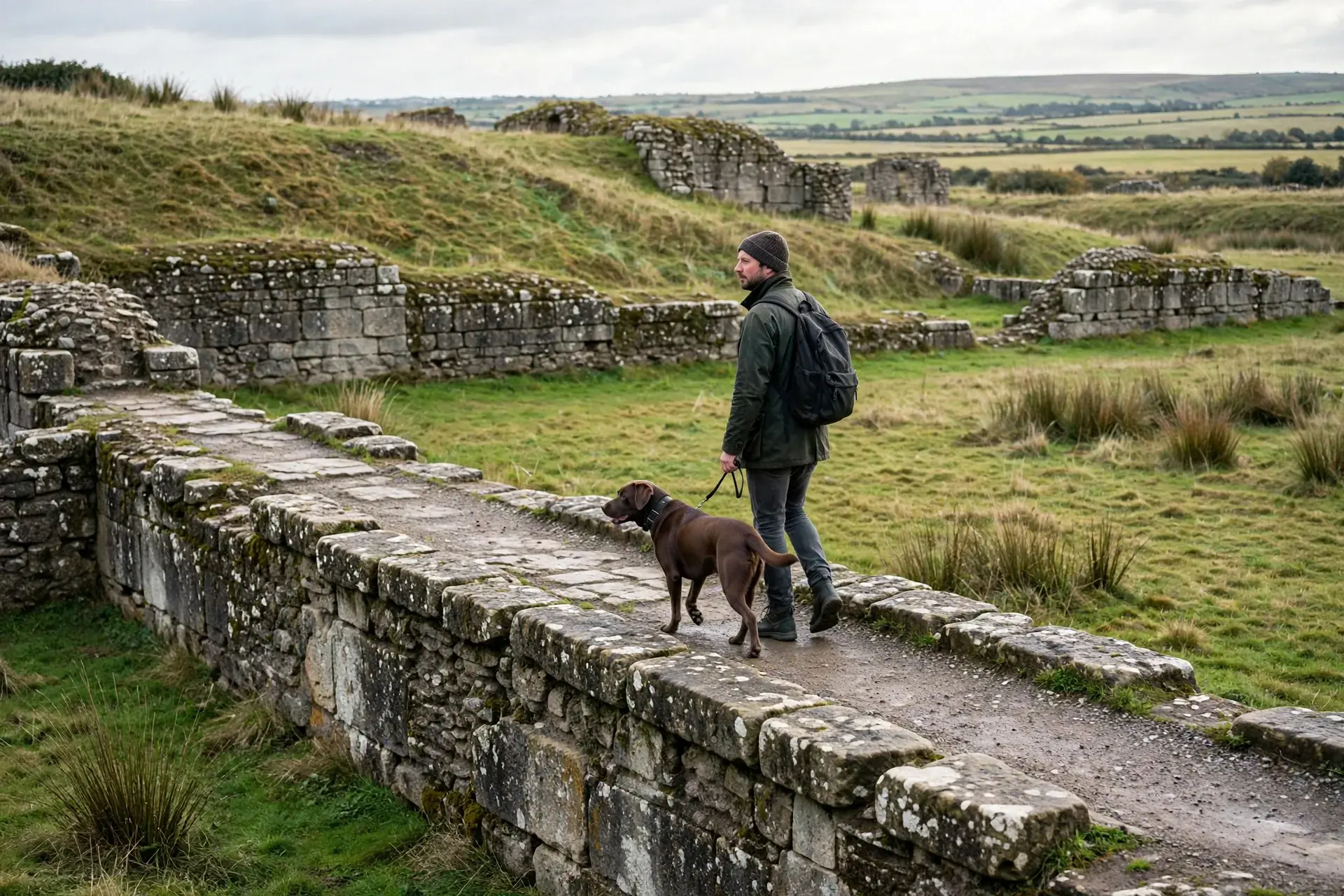
Ruins themselves create hazards that a lead helps you manage. Low walls invite jumping, but the far side may be a drop, a ditch, a thorny bank or a restricted conservation area. Broken steps and worn thresholds are slippery even in dry weather, and a dog pulling up a narrow stair can unbalance both dog and owner. Crumbling masonry, loose stones and areas fenced off for safety should be treated as absolute boundaries, not as suggestions: a dog that scrambles onto a wall can dislodge stone, injure paws and damage archaeology that cannot be repaired. Keep the dog on the path, at ground level, and away from any wall, arch or scaffold that is signed as unstable or closed.
Livestock changes the lead rule from good practice to a legal and safety matter. Many abbey estates graze sheep, cattle or horses in adjoining fields, and some precincts share boundaries with working farmland. Dogs must be kept under close control around livestock, and on a lead where the site or the farmer requires it, because a chasing incident can injure animals, injure the dog and create liability for the owner. Even a dog that has never chased sheep can react to a flock moving suddenly, to lambs in spring or to cattle approaching a fence. If a path crosses a grazing field, keep the dog on a short lead, walk steadily through the field without stopping for prolonged sniffing, and leave by the same gate you entered. If livestock are loose on a path or a gate is open, turn back and report it rather than trying to pass through.
Graveyards and burial grounds require the same close control for a different reason: respect. Many abbeys contain or adjoin burial grounds that are still in use, with recent graves, flowers, wreaths and families visiting. Dogs should stay on paths, never toilet on graves, memorials or flower beds, and never be allowed to dig, scratch or mark stonework. A dog that lifts a leg on a headstone, even unintentionally, creates distress that no apology fully undoes. If your dog needs the toilet, do it before entering a burial ground, on a grass verge or designated area away from memorials, and carry bags and water for cleaning up. Children visiting a family grave deserve the same quiet and space as worshippers in a chapel.
Other visitors deserve a lead rule too, even when the site does not spell one out. Abbey ruins attract people who may be nervous around dogs, allergic, unsteady on their feet or simply trying to photograph an arch without a dog in the frame. A dog that rushes up to greet strangers, however friendly the intention, can spoil a visit for someone else and can startle a child on uneven steps. Train a simple default before an abbey trip: the dog walks beside you, passes other people without greeting unless invited, and settles on a mat or blanket during pauses. That default, practised at home and on local walks, does more for abbey access than any equipment purchase.
Equipment choices should support that control without adding risk. A well-fitted harness with a handle gives better control on steps than a collar alone, especially for a strong or elderly dog. A standard short lead, about one to two metres, is more predictable among ruins than a retractable lead, which can extend suddenly around a corner or into a restricted area. A long line has a place on an open estate walk, but it should be clipped short or swapped for a short lead before re-entering the ruins. Muzzles are not generally required at abbeys, but a dog that is known to scavenge, snap at strangers or chase livestock may be safer and calmer with a muzzle the dog has been trained to wear, and some sites may require one in specific circumstances, so check the official guidance before you travel to any abbey where your dog's behaviour could be an issue.
Photography and picnic etiquette
Abbey ruins are among the most photographed places in Britain, and a dog in the photograph can make the image memorable or ruin it, depending on how the moment is managed. The best abbey dog photographs are usually the simplest: the dog sitting on a path with an arch behind them, the dog walking away along a grassy nave, or the dog resting on a blanket while the owner looks at the stonework. Those images work because the dog is settled, the lead is discreet, and the background is the abbey rather than a crowd of other visitors. Rushing a photograph with an unsettled dog, a taut lead and a stranger's picnic in the frame rarely produces a keeper and often creates a nuisance for everyone nearby.
Photography etiquette starts with other people. Do not block a path, an archway or a viewpoint for a long posed session, especially when a guided group is waiting to pass. Do not photograph other visitors, children or private ceremonies without permission, and do not enter a roped-off area for a better angle. Tripods can be a trip hazard on narrow paths and may be restricted in busy interiors, so check the site rules before setting one up. Drones are a separate matter entirely: most heritage sites prohibit or strictly control drone use, and a drone over ruins, livestock or nesting birds is not a casual addition to a dog walk. If aerial photography matters to you, seek permission in advance and expect the answer to be no on a normal visitor day.
Picnics follow a similar logic: they are welcome in many abbey grounds, but only in the right place and with the right precautions. Look for a designated picnic area, a lawn away from paths and memorials, or a spot on the outer precinct where food will not attract other dogs or distract a guided group. Avoid picnicking directly against ruins, on grave areas, on flower beds or in a doorway, and never light a barbecue unless the site explicitly permits it in a designated spot. Most abbeys prohibit open fires and barbecues for obvious reasons: dry grass, historic timber, thatch nearby and the risk of a fire spreading through a ruin are not acceptable trade-offs for a cooked lunch.
Food safety for dogs is part of picnic etiquette, not an afterthought. A picnic blanket at ground level puts sandwiches, fruit, bones, chocolate and grapes within easy reach of a curious dog, and other visitors' picnics are just as tempting. Keep the dog's own food and treats in a sealed container, feed the dog from their own bowl rather than from the shared blanket, and watch for dropped food from neighbouring groups. Cooked bones, chocolate, grapes, raisins, onions and xylitol-sweetened products are dangerous for dogs, and a dropped chicken bone on a ruin path is a genuine emergency rather than a minor mess. If your dog scavenges, keep them on a lead throughout the picnic and use a settle mat a short distance from the food.
Litter, including dog waste, is the least glamorous part of abbey etiquette and the part that most affects whether dogs remain welcome. Carry more bags than you think you need, pick up immediately, and use the bins provided or take waste home if bins are full or absent. Do not leave a bag by a wall, on a path or hanging from a branch, even with the intention of collecting it on the way back: bags are forgotten, blown away or mistaken for litter, and a single bag left in a ruin can undo a great deal of goodwill. The same applies to food packaging, tissues and wet wipes. An abbey that looks cared for is an abbey where dogs are more likely to stay welcome, and visitors notice the standard set by other dog owners.
Seasonal photography and picnic notes are worth building into the plan. In spring, low light through arches is beautiful but grass may be wet and nesting birds may restrict certain paths. In summer, harsh midday light washes out stone and dogs overheat quickly on exposed lawns, so early morning or late afternoon gives better photographs and a happier dog. In autumn, fallen leaves hide uneven ground and wet stone, so slow down even if the colours are tempting. In winter, low sun creates long shadows and dramatic arches, but paths ice over and daylight is short. In every season, the photograph that respects the site, the dog and other visitors is the one worth keeping.
Wet weather and seasonal notes
British abbeys are outdoor attractions in a climate that does not respect itineraries, so wet-weather planning is not a backup plan but part of the main plan. Rain changes every element of an abbey dog visit: stone becomes slippery, grass becomes mud, paths become puddles, and a dog that was calm in sunshine may become restless, cold or overexcited in wind and rain. The sites that cope best with rain are those with surfaced paths, sheltered cloister walks, a covered visitor area where a dog can wait, and a nearby cafe or town walk for a warm finish. Sites that are mostly exposed lawn and steep steps become harder, slower and less enjoyable in heavy rain, and it is better to shorten the visit than to push a wet, cold dog through a full circuit.
Paw and coat care after rain deserves more attention than most guides give it. Wet stone and muddy paths can cut paws, irritate skin between toes and chill a small, elderly or short-coated dog quickly. A drying coat, two towels and a paw check at the car are a minimum kit for a wet abbey day, and a portable water bottle matters even in rain, because a dog that has been running in wind may still be thirsty. Check paws for grit, thorns and small stones after walking on gravel paths, and dry ears for breeds prone to ear infections. If the dog is shivering, limping or reluctant to walk, end the visit: no photograph or interior is worth a chilled or injured dog.
Seasonal changes also affect what is open, what is crowded and what wildlife needs protection. Spring brings lambing, nesting birds and wildflowers that may be protected, so keep dogs on paths and on leads near fields and hedgerows, and do not allow a dog to chase birds or enter fenced wildflower areas. Summer brings heat, crowds, school holidays and events such as concerts, weddings and open-air theatre, which can close parts of a site or change the dog rule for a day. Autumn brings fungi, fallen fruit and conkers, all of which can be toxic or a choking hazard if a dog scavenges, so keep a scavenging dog on a lead under trees. Winter brings ice, short days, early closures and storm damage, so check opening hours and path closures on the morning of travel, not the week before.
Event days deserve a specific warning. An abbey that welcomes dogs on an ordinary Tuesday may restrict dogs during a concert, a wedding, a filming day, a re-enactment or a large school event, because the site needs crowd control, quiet for performers or safety around equipment. Event restrictions are often published on the event page rather than the general dog page, so check both before travelling on an event date. If you arrive and find an event in progress, follow staff directions even if they differ from the general rule you read online: staff are managing the site as it is on that day, and arguing about a web page helps neither the dog nor other visitors.
Coastal abbeys, such as Whitby, add a further seasonal layer that is worth planning for in its own right. Our guide to dog-friendly beaches rules covers seasonal beach restrictions, tide times and lead rules that often apply to the coastal walk before or after an abbey visit, and those rules can matter more than the abbey rule itself on a combined day. A beach that bans dogs in summer, a tide that cuts off a coastal path, or a cliff path closed for erosion can all change the shape of the day. Check the beach and the abbey separately, and do not assume that a dog-friendly abbey guarantees a dog-friendly beach nearby, or vice versa.
Finally, think about the journey home in wet or seasonal conditions. A wet dog in a car needs a towel, a waterproof boot liner or a crate cover, ventilation without a draught, and a stop for water and a toilet break on a long drive. A muddy dog that is allowed to roam a car will arrive home stressed and will make the next trip harder to start. A short, calm routine at the car — towel, water, settle, lead on — turns the end of the abbey visit into a predictable finish rather than a chaotic scramble. That routine is especially important after a wet winter visit, when daylight is fading and the drive home may be longer than expected.
Planning checklist
A good abbey day with a dog is rarely improvised from scratch. It is assembled from a handful of checks made the night before, a short conversation at the entrance, and a willingness to adapt when the site on the day differs from the site on the web page. The checklist below is designed to be used the evening before travel and again in the car park, when a two-minute pause can prevent most of the common abbey problems: a dog that needs the toilet in the ruins, a lead that is too long for a narrow stair, a picnic in the wrong place, or a group split awkwardly at a chapel door.
- Official dog page saved: Find the official page for that abbey, read the grounds rule and the interior rule separately, note any event or seasonal restriction, and save a screenshot. Check the official guidance before you travel to the abbey you have chosen, and re-check on the morning of travel if the weather or an event could change access.
- Route and parking confirmed: Note the postcode, the car park location, the walk from car park to entrance, and whether the route involves steps, a steep bank or a road crossing. Save an offline map for rural abbeys where signal may fail.
- Toilet walk first: Plan a toilet walk before entering the ruins, on a verge, field edge or designated area away from memorials and paths. Carry bags, water and a spare bag, and do not rely on the first abbey lawn to serve as a toilet area.
- Lead and control kit: Pack a short lead, a harness with a handle, a settle mat or blanket, and a long line only if you know there is a designated open area where it is permitted. Leave retractable leads at home for ruin areas.
- Interior plan agreed: Decide in advance who waits with the dog if an interior is closed to dogs, where they will wait, and how long the interior visit will take. Agree a meeting point and a phone check-in time.
- Weather and ground kit: Pack a drying coat, two towels, water and a bowl, paw balm or booties if your dog uses them, and a waterproof layer for yourself. Check the forecast for wind and rain, not only temperature.
- Livestock and wildlife awareness: Note any grazing fields, rivers, ponds or nesting areas on the route, and keep the dog on a short lead through those zones even if the wider estate allows more freedom.
- Food and picnic plan: Decide where you will picnic, what the dog will eat and drink, and how food will be kept out of reach. Pack the dog's food separately and keep dangerous foods out of the shared blanket area.
- Health and safety contacts: Save the nearest vet, the site phone number and a breakdown contact before you leave. Note any medication, allergy or mobility need the dog has, and carry it in the day bag rather than leaving it in the car.
- Exit and home routine: Plan a calm finish at the car, a towel and water stop, and a toilet break on a long drive home. End the visit while the dog is still happy rather than pushing on to a second site when the first has already tired them.
If the checklist reveals a problem, treat that as useful information rather than a reason to force the visit. A dog that cannot manage steps, a site that is closed for an event, a forecast of heavy rain on an exposed headland, or a group that cannot agree an interior plan are all good reasons to choose a different abbey, a different day or a shorter visit. Britain has enough abbeys, in enough settings, that a changed plan is rarely a lesser plan. The abbey that suits a calm older dog on a quiet weekday may not suit a young, energetic dog on a busy bank holiday, and the reverse is also true. Choose the match, not the reputation.
When the visit goes well, the habit to keep is the same habit that made it go well: check the specific site, respect the grounds-and-interior split, keep the lead short where it matters, and leave the site as clean and quiet as you found it. Abbey ruins survive because generations of visitors have treated them with care, and dogs remain welcome in many of them because dog owners have shown, visit after visit, that a dog on a lead, on a path, with a responsible owner is no threat to stone, wildlife or other visitors. That record is worth protecting, one abbey at a time.
Practical questions
Before you go
Can dogs go inside UK abbey churches and chapels?
Often not, or only in limited areas. Open-air ruins and grounds are usually the more dog-welcoming part of a visit, while roofed chapels, museums, shops and exhibition rooms commonly restrict dogs to assistance dogs. The boundary varies by site and can change for services, events or conservation work, so check the official guidance before you travel.
Do dogs need to stay on a lead at abbey ruins?
In most managed abbey grounds, yes. Short leads are the safe default around other visitors, uneven masonry, water, livestock and graveyards, even where a wider estate walk later allows more freedom. Look for the signs at the entrance and follow the stricter rule where the site sets one.
Are abbey grounds safe for dogs after rain?
They can be slippery, muddy and harder to read after rain. Mossy steps, worn stone, wet grass banks and riverside paths all need a slower pace and a short lead. Pack a towel and a drying coat, keep paws off fragile stonework, and skip steep or flooded routes rather than pushing on.
Can I picnic with my dog at a UK abbey?
Many abbey grounds allow picnics in designated areas, but the details differ: some sites restrict food to certain lawns, ban barbecues, or ask visitors to keep dogs away from cafe terraces. Use a blanket away from paths and memorials, keep food low and guarded, and take every scrap home or to a bin.
What should I check before visiting an abbey with a dog?
Check five things on the official site page for that abbey: whether dogs are allowed in the grounds, whether any interior is open to dogs, the lead rule, any seasonal or event restriction, and where dogs can go to the toilet. Screen-shot or save the page, because a general heritage brand rule does not guarantee the rule at one particular abbey.
Which abbey is best for a first visit with a dog?
The best first visit is usually a large, open, grassy site with level paths, clear signage and a nearby walk for a proper toilet break before you enter. Choose the abbey whose published dog guidance is clearest and whose grounds suit your dog's age, mobility and tolerance for crowds, rather than the most famous ruin on the list.