This guide is independent and contains no paid placement. If affiliate links are added later, they will be clearly marked and will not change our editorial checks.
Think of a Roman visit as two visits in one. The outdoor part — wall walks, fort earthworks, amphitheatre bowls and ruined bath foundations in the open air — usually welcomes dogs on leads. The indoor part — museums, exhibition galleries and roofed bath buildings — commonly restricts dogs to assistance dogs only. Plan around that split, check the official guidance before you travel for the exact site, and you can enjoy Roman Britain without leaving anyone disappointed at the door.
The split that shapes every Roman day
Roman Britain survives in two very different forms, and dogs are treated differently in each. The first form is landscape: long wall lines running over ridges, rectangular fort platforms cut into hillsides, amphitheatre hollows open to the sky, and road lines that still read as tracks across fields. These are outdoor places managed for walking, weather and livestock as much as for history, and dogs on leads usually fit into that picture without difficulty. The second form is interior: glass cases holding coins and pottery, reconstructed rooms with painted plaster, bath halls kept at controlled temperatures, and narrow corridors where school groups queue. Dogs are far more likely to be refused there, not out of hostility to dogs, but because fragile objects, tight spaces and conservation conditions leave little room for a four-legged visitor.
That single distinction explains most of the confusion dog owners report about Roman sites. One visitor writes that a site was wonderfully dog-friendly, and another insists the same site refused their dog, and both can be right: the first walked the ramparts and the earthworks, while the second tried to take the dog into the museum. The lesson is to research a site in two halves rather than as one verdict. Ask, first, what outdoor ground is open to dogs and on what lead rules, and second, what indoor rooms exist and whether dogs may enter any of them. A site with generous outdoor ruins and a small indoor museum is a very different day from a site where the main attraction is entirely indoors, even if both carry the same vague label of dog-friendly on a listing page.
Ownership and management add another layer. Roman remains in Britain are looked after by a mix of national heritage bodies, local councils, museums, trusts and private owners, and each sets its own rules. A wall section managed as open countryside may follow countryside access rules, while a ticketed fort museum a few miles away follows its own house policy. Two sites run by the same organisation can still differ, because one has a modern visitor centre with wide galleries and another has a cramped Victorian building with a single staircase. Never carry a rule from one site to the next. Instead, treat every Roman day as a fresh check, and keep the official page for that exact site saved on your phone so you can show it at the gate if a staff member and a website appear to disagree.
The practical consequence is cheerful rather than discouraging. Roman Britain is unusually well suited to dog days, precisely because so much of it is outdoors. Walls, forts, towns and roads were built across open country, and walking them with a dog feels closer to how they were first experienced — on foot, in weather, over distance — than viewing them through glass ever could. The trick is to build the day around the outdoor majority, treat any indoor museum as a bonus that may need a split visit, and finish somewhere the dog can rest properly, such as a grassy picnic area or a dog-welcoming cafe nearby. If you plan that way, the indoor restriction stops feeling like a rejection and starts feeling like a scheduling detail.
Start on Hadrian's Wall
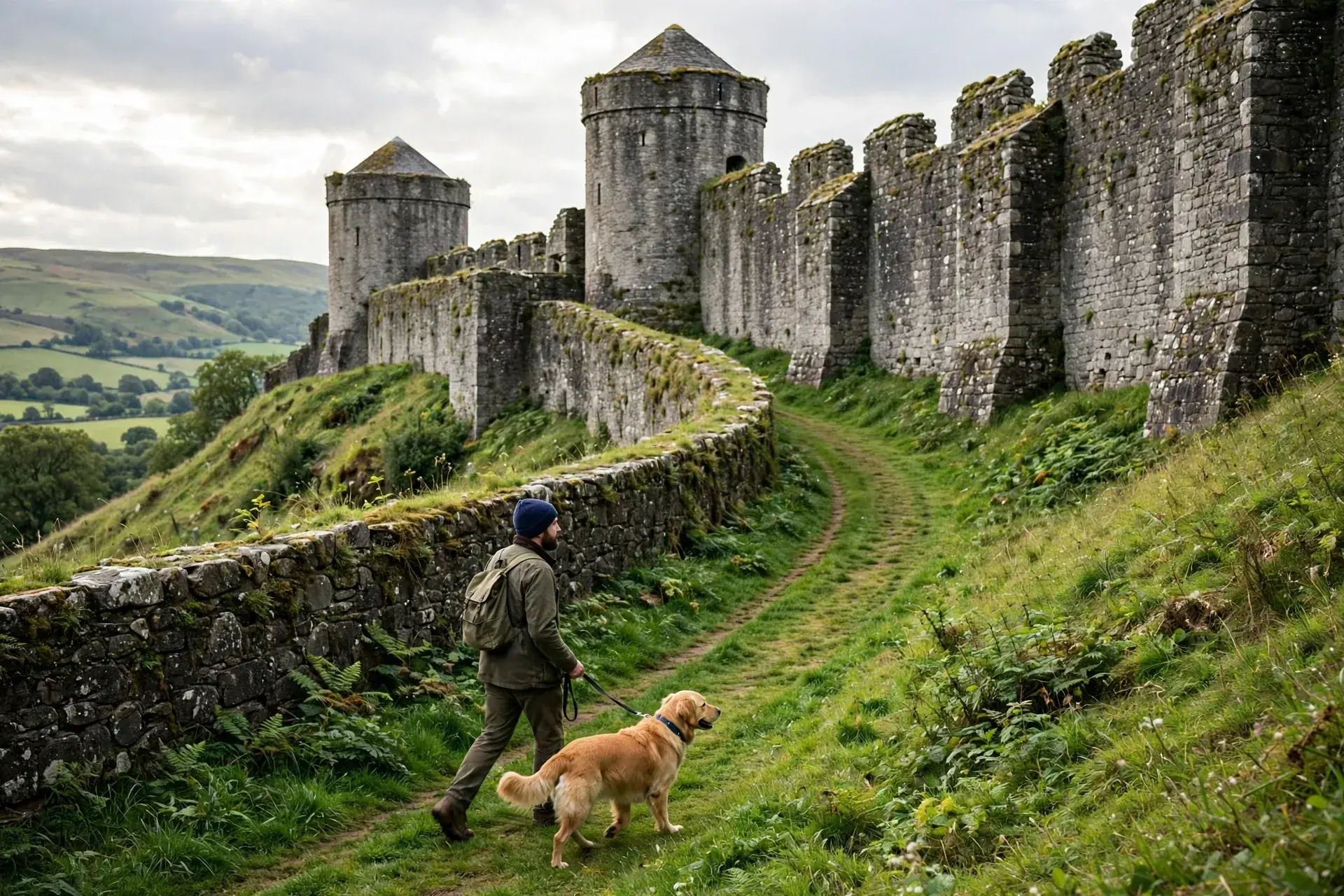
Begin, as this guide does, on a walking stretch of Hadrian's Wall. The Wall runs for 73 miles across northern England, from the Solway Firth in the west to the North Sea in the east, and its most dramatic central section crosses high, open ridge country between green valleys. A dog on a lead, trotting along a grassy path beside a stone wall that has stood in some form for nearly two thousand years, with sheep-dotted pasture falling away on either side, is the classic Roman dog walk — and it needs no ticket, no queue and no indoor compromise at all. That is why the Wall makes such a good entry point: it shows, in a single walk, what Roman Britain does best for dogs, which is open ground, long views and a sense of journey.
The Wall is not one uniform path, and that variety is part of its appeal. Some stretches run beside a surviving stone curtain wall several courses high, where you can trace towers and milecastles as you walk. Others cross open moorland where the Wall survives mainly as a ditch and bank, and the interest lies in the landscape and the line of the frontier rather than in standing masonry. Village stretches pass pubs, churches and farm tracks, and city stretches in the east run through parks and along riversides. A dog owner choosing a first Wall walk should therefore choose by terrain and length, not by fame alone: a short, level, grassy section near a car park suits an older dog or a puppy far better than a steep, exposed ridge section that looks magnificent in photographs but demands stamina and sure footing.
Walking the Wall also teaches the habits that serve at every other Roman site. You learn to keep a dog close where the path crosses farmland, to watch for gaps in dry-stone walls where a small dog might slip through, to carry water because ridge-top stretches have no taps, and to read the weather, because an exposed ridge in wind and rain is a different walk from the same ridge in calm sunshine. Those habits transfer directly to fort earthworks in Wales, amphitheatre bowls in the south-west and ruined towns in the Midlands. Start with the Wall, even if only for a two-mile out-and-back section, and the rest of Roman Britain becomes easier to judge.
One caution belongs at the very start. The Wall is a protected ancient monument, and its stonework is fragile. Dogs should stay on the path, should not be allowed to scramble over wall stones, dig at earthworks or chase livestock, and should be kept on a lead wherever the path crosses farmland or runs beside a road. Climbing on the Wall is discouraged for people as well as dogs, both to protect the monument and to avoid falls from uneven masonry. A dog that walks beside the Wall, rather than over it, gets the full experience while leaving the monument intact for the next visitor — which is, after all, the point of a frontier that has already lasted nineteen centuries.
Walking the Wall with a dog
Planning a Wall walk with a dog starts with distance, and the honest answer is usually shorter than the ambition. The full Hadrian's Wall Path is a multi-day trail, but most dog days work best as a single section of two to five miles, chosen so the dog finishes as happily as it started. Look for a circular or out-and-back route rather than a linear route that strands you miles from the car, and check where the path meets roads, because some sections cross or follow busy roads where a short lead and close control matter most. If you are walking with children or a second dog, build in even more margin: a group moves slower than a solo walker, and a tired dog at mile four still has to walk home.
Water and shade deserve the same attention as distance. Ridge-top sections offer magnificent views and almost no shelter, so on a warm day carry more water than you think you need, for the dog as well as for yourself, and plan a shaded rest stop in a valley or village. Streams along the route are not always safe drinking sources, because they may pass through farmland, so a collapsible bowl and a bottle carried from the car are more reliable. In cold or wet weather the problem reverses: wind chill on an exposed ridge can tire a small or short-coated dog quickly, so a dog coat, a drying towel in the car and a warm vehicle to return to all matter. Check the forecast for the ridge, not just for the nearest town, because conditions at height can be several degrees colder and considerably windier.
Livestock is the other constant of Wall walking. Sheep graze freely across much of the Wall corridor, and cattle appear on lower sections, so a reliable recall is helpful but a lead is the real safeguard. Keep the dog on a lead through farmland, near livestock and at any point where the path narrows beside a drop or a road. If your dog has a strong chase instinct, choose a section with fewer livestock encounters or walk at a quieter time of day, and never rely on a long line near a cliff edge or a road crossing. Farmers along the Wall are generally welcoming to responsible walkers, and keeping a dog close is the simplest way to keep that welcome intact. For wider countryside manners, our guide to English Heritage dog rules explains how heritage bodies typically frame lead and livestock expectations.
Facilities along the Wall are uneven, which is part of its character and part of its planning challenge. Some sections have car parks, toilets, cafes and museums close at hand, while others have only a layby and a footpath sign. Before setting out, note the nearest car park, the nearest village with a shop or pub, and the nearest veterinary practice, and save them offline in case mobile signal fails on the ridge. Toilets for people and water for dogs are not guaranteed at every trailhead, so start with both sorted. A simple rule covers most Wall days: if you cannot name where you will park, where you will turn back and where the dog will drink, the route is not yet planned.
Amphitheatres and open-air ruins
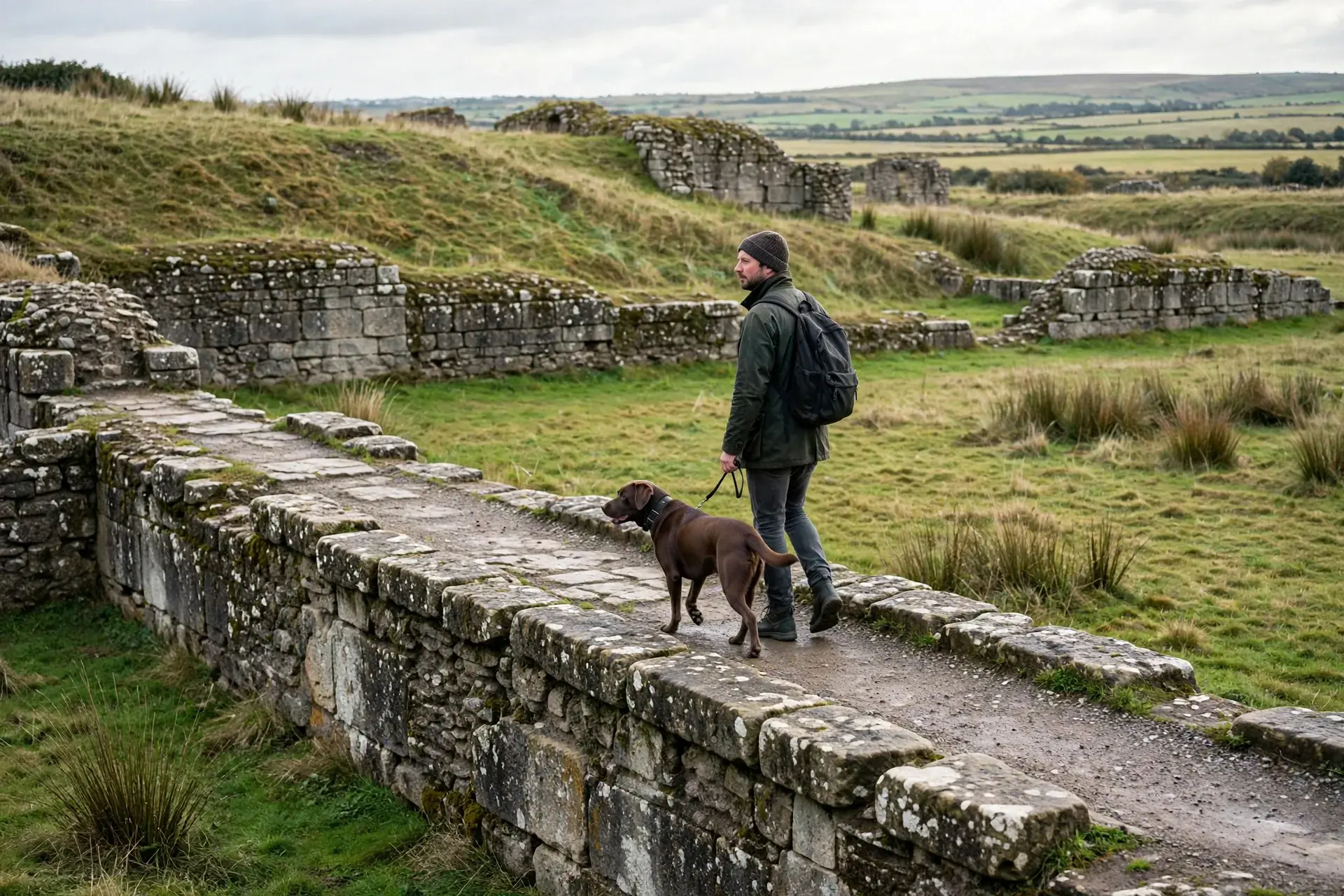
Amphitheatres are among the most dog-friendly Roman structures in Britain, because they are essentially landscape: a great grassy bowl, often with surviving entrance passages and seating banks, open to the sky. A dog can walk the arena floor, climb the banks and sniff the edges of the structure while the owner reads the shape of the building from the inside out, which is far more instructive than any model. The same holds for other open-air ruins: fort gateways standing as arches, town walls tracing a circuit through a modern town, villa foundations laid out as low walls on grass, and road sections preserved as raised causeways. All of these reward slow walking, and all of them suit a dog that is content to walk on a lead and pause while its owner looks.
The details still matter. Amphitheatre banks can be steep, and wet grass on a bank is slippery for dogs as well as people, so take the gentler slope where one exists and keep a short lead on descents. Some amphitheatres sit within larger parkland or nature reserves, which brings its own rules about leads during bird nesting season or near grazing animals, so read the local notices at the entrance rather than assuming a single Roman rule covers the whole site. Town walls bring a different hazard: the circuit may cross roads, pass through car parks or narrow beside traffic, so a town-wall walk needs the same road awareness as any urban dog walk, with the added distraction of steps, gates and archways that tempt a dog to dart ahead.
Villa sites deserve a special note, because they vary more than any other Roman type. Some villas are little more than foundations on open grass, perfect for a dog walk with a history lesson attached. Others centre on a roofed mosaic room or a small museum, where the outdoor grounds are modest and the indoor rooms are the main event. Before visiting a villa with a dog, check whether the mosaics are under cover, whether the grounds are large enough for a proper walk, and whether there is shade and water for the dog while one person views the interior. A villa with extensive grounds and a visible mosaic pavement outdoors can be a wonderful dog day; a villa whose entire interest sits inside a single heated room is better saved for a dog-free visit or a split visit.
Open-air ruins also offer the best chance to combine Roman history with a longer countryside walk. Many forts, wall sections and amphitheatres sit on or beside public footpaths, so a Roman visit can be the centrepiece of a circular walk that includes woodland, riverside or village lanes. That combination suits dogs far better than a visit built around standing in queues: the dog gets movement, sniffing and variety, and the owner gets history in context rather than history behind glass. When choosing between two open-air sites, prefer the one with a walk attached over the one that is only a fenced enclosure, because the walk is what turns a good visit into a good day.
Bath complexes and water sites
Bath sites are where the outdoor-indoor split becomes most visible, because a Roman bath was a roofed building, and its modern presentation often remains roofed too. The great bath complexes that draw visitors today usually combine open courtyards and terraces, where dogs may be welcome on leads, with heated indoor halls, plunge pools and exhibition galleries, where dogs are commonly restricted to assistance dogs only. The city of Bath is the famous example: its streets, riverside walks and surrounding hills are superb dog territory, while the roofed bath buildings themselves follow museum rules. Our guide to Bath with a dog helps separate the walkable city from the ticketed interior, which is exactly the separation a bath visit requires.
Smaller bath sites follow the same pattern at a gentler scale. A fort bath-house surviving as low foundations on grass is an open-air ruin and usually dog-friendly, while a bath-house with a reconstructed roof, a mosaic floor under cover or an interpretation centre attached will often restrict dogs indoors. Hot springs and thermal water add a safety note of their own: dogs must not be allowed into bathing pools, hot water channels or any water that is heated, chemically treated or signed as not for drinking. Even lukewarm spring water can carry minerals and treatments that upset a dog's stomach, so carry fresh drinking water and keep the dog away from open water features unless a sign explicitly says the water is safe.
Water sites beyond baths — harbours, river quays, wells and springs — bring the usual waterside cautions. Riverbanks beside Roman quays can be steep, slippery and fast-flowing after rain, and harbour walls have drops that a dog on a long lead could reach too quickly. Keep the lead short near water, watch for algae in still pools, and rinse the dog's paws after walking through muddy river margins. None of this should put you off waterside Roman sites, which are often the most atmospheric of all, but it should shape where you let the dog run and where you keep it close.
The best approach to any bath complex is to plan the day as a pair of experiences. Enjoy the outdoor terraces, courtyards and surrounding streets together, then split for the indoor halls if the dog cannot enter, with one person staying outside with the dog. Many bath cities have excellent outdoor alternatives for the waiting half of the party: a riverside path, a park, a garden or a dog-welcoming cafe within a few minutes' walk. If no such alternative exists, consider visiting the bath interior on a separate trip and spending the dog day on the outdoor Roman landscape nearby instead. Both experiences are worthwhile; they simply do not have to happen at the same hour.
Museums and indoor rooms
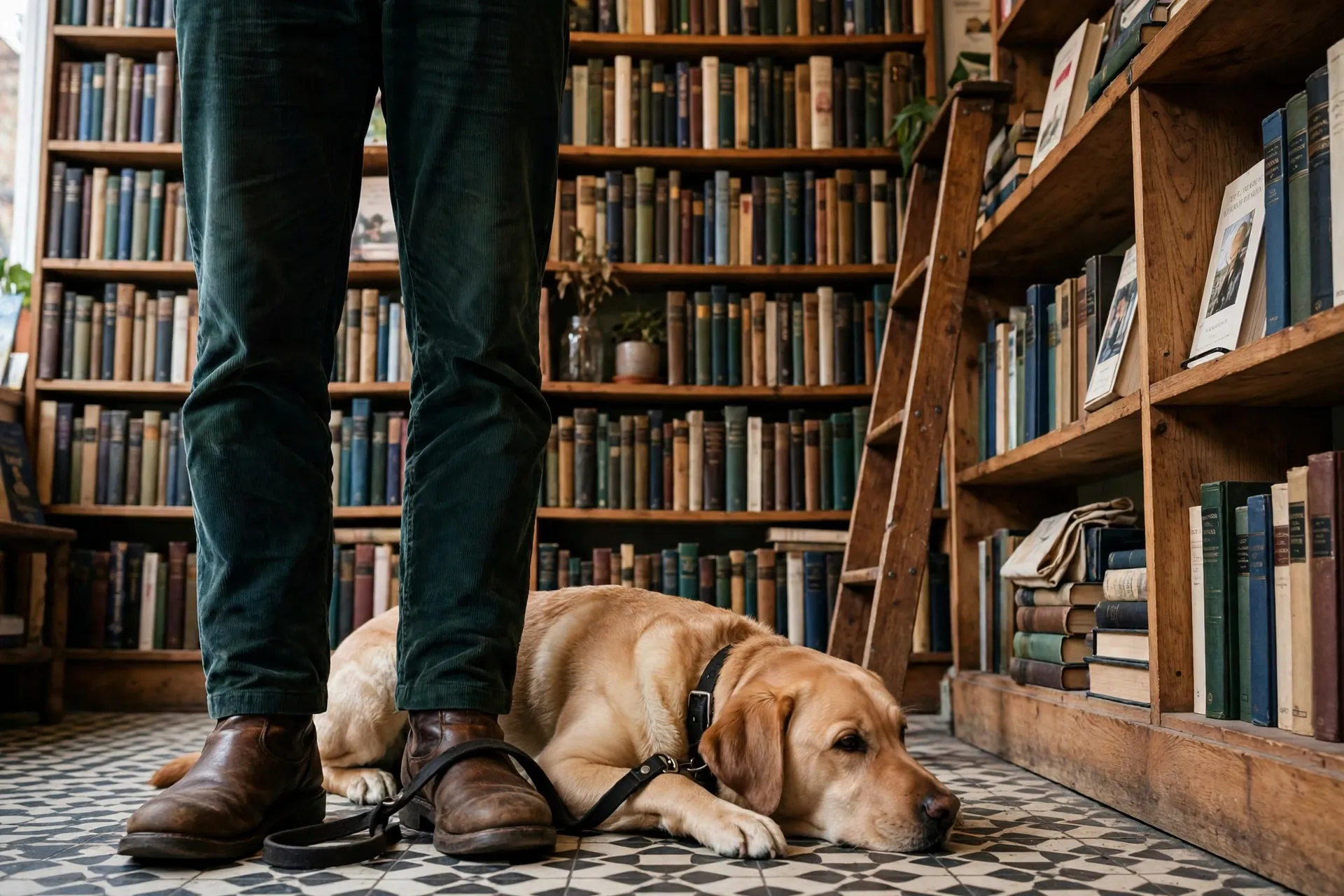
Indoor Roman museums range from single-room displays in a fort gatehouse to major city museums with galleries of armour, jewellery, inscriptions and mosaics. As a general rule, the larger and more artefact-rich the museum, the less likely it is to admit pet dogs, and assistance dogs are normally welcome everywhere by law. The reasons are practical: fragile objects in open or low cases, narrow galleries designed for single-file school groups, temperature and humidity controls that depend on closed doors, and the simple fact that a dog in a crowded gallery can block an escape route or startle another visitor. Understanding those reasons makes the refusal easier to accept, and it also helps you predict it: if the main attraction is a collection, expect a restriction; if it is a landscape, expect a welcome.
Some museums soften the split in useful ways. A museum may admit dogs to its shop and cafe but not its galleries, may allow dogs in a ground-floor atrium but not upstairs, or may provide a shaded outdoor area where one visitor can wait with the dog. These partial permissions are worth asking about, because they change the plan: a museum with a dog-welcoming cafe gives the waiting party somewhere comfortable to sit, while a museum with no waiting facilities at all pushes you firmly towards a split visit or a different day. Always ask the specific question — which rooms, if any, admit dogs — rather than the general one, because a general answer of dog-friendly may refer only to the grounds. For the wider picture on indoor heritage rules, see our guide to dogs in museums in the UK.
Split visits work best when they are planned rather than improvised at the door. Agree before arrival who views the museum first, how long that takes, and where the other person will walk the dog meanwhile. Check whether re-entry is allowed, so the second person can then visit without paying twice, and check whether tickets are timed, which may make swapping harder. If you are travelling solo with a dog, the honest options are narrower: choose a site whose outdoor ruins are substantial enough to carry the day on their own, visit the museum on a day when the dog is staying elsewhere, or accept that the museum will wait for another trip. None of these is a failure; all of them beat leaving a dog alone in a car, which must never be an option, even for a short visit, because a parked car heats dangerously fast and cools uncomfortably in winter.
Children add one more consideration to museum planning. A child who wants to see armour and mosaics and a dog that cannot enter the gallery create a genuine conflict, and the best solution is usually to divide the adults, not to rush the child or distress the dog. Let the child take the museum at a proper pace with one adult while the other adult gives the dog a proper walk, then meet for lunch and compare notes. Roman sites with both a museum and extensive grounds are ideal for this pattern, because neither half of the party feels short-changed. Sites where the museum is the whole visit, with no grounds to speak of, are better kept for a family day without the dog.
Stone, heat and paws
Roman surfaces were built for sandals, hobnailed boots and cart wheels, not for modern dog paws, and the ground underfoot deserves real attention. Flagstones can be uneven, with gaps wide enough to catch a small paw; gravel paths can be sharp; grass banks can hide rabbit holes; and reconstructed surfaces may be smoother but harder and hotter than the original earth. A dog that walks happily on a grassy wall path may struggle on a long stretch of rough stone, so vary the route where you can, choosing grassy or earth alternatives alongside stone sections, and watch the dog's gait: a dog that starts picking its way carefully, lagging behind or lifting a paw is telling you the surface hurts.
Summer heat is the most serious paw hazard at Roman sites, because stone and paved courtyards absorb and hold heat. On a hot day, test any stone surface with the back of your hand and hold it there for several seconds: if it is uncomfortable for your hand, it is too hot for paws. Walk in the morning or late afternoon rather than at midday, seek grass and shade, and carry water for cooling as well as drinking — a splash over the paws and belly helps a hot dog, though never pour cold water over a severely overheated dog without veterinary advice. Remember that heat affects the whole dog, not just the paws: short-nosed breeds, older dogs, overweight dogs and dark-coated dogs overheat faster, and a roofed courtyard with no breeze can be hotter than an open ridge with wind. Plan shorter visits in heat, and be ready to abandon the plan for shade and water.
Wet weather brings the opposite set of surface problems. Rain makes flagstones and marble-smooth reconstructions slippery, turns earth paths to mud and fills low-lying ruins with puddles that may hide uneven ground. A dog that slips on wet stone can strain a leg just as a person can, so slow down, keep the lead short on descents and steps, and avoid polished surfaces after rain where a grassy alternative exists. Mud is a lesser problem but a real one: a muddy dog in a car after a ruin walk is a familiar British ending, so pack towels, a drying coat and a waterproof car cover, and choose a route home that allows a quick rinse if the site has an outdoor tap.
Boots divide opinion, and the honest answer is that they help some dogs and hinder others. A dog with sensitive paws, a healing injury or a condition that makes rough ground painful may benefit greatly from well-fitted boots, but boots must be introduced at home over several short sessions, never first tried on a ruin walk. An unfamiliar boot changes a dog's gait, can rub between the toes, and can fall off on a bank or in mud, creating a hazard of its own. For most healthy dogs, the better approach is route choice, pacing and paw checks: inspect paws after each section, look between the toes for grit and small stones, and carry a simple first-aid kit with a bandage and antiseptic wipes in case of a cut. A dog that is checked regularly will tell you, by its movement, when a surface has become too much.
Seasons, crowds and livestock
Roman sites change character with the seasons, and the best season for a dog visit is not always the best season for a history visit. Spring and autumn usually offer the kindest balance: cooler ground, fewer crowds, open paths and dogs that can walk for longer without overheating. Summer brings school holidays, coach parties and hot stone, which means queues at museums, crowded courtyards and midday heat — all manageable with an early start, but worth planning around. Winter brings quiet sites and low light, which can be magical on a frosty wall walk, but also brings mud, ice on stone steps and shorter opening hours, so check seasonal opening times before travelling rather than assuming a site is open year-round.
Crowds affect dogs more than they affect people, because a crowded courtyard gives a dog nowhere to retreat. A nervous or reactive dog may cope well on an open wall path and struggle badly in a packed museum forecourt or a narrow fort gateway at peak time. If your dog is sensitive to crowds, choose weekday mornings, avoid school holiday weeks, and prefer open-air sites with space to step aside over enclosed sites with single-file routes. Look for the quieter entrance or the less-photographed stretch: the famous viewpoint will be busy, but a mile of wall in either direction is usually empty, and the history is exactly the same.
Livestock and wildlife rules run across almost every outdoor Roman site, because walls and forts sit in working farmland. Sheep are the most common encounter, but cattle, horses and ground-nesting birds all appear in season, and each brings its own lead requirement. Keep dogs on leads around livestock at all times, and on a short lead near cattle, which can behave unpredictably around dogs. During lambing season, usually spring, take extra care and obey any temporary signs asking for dogs to be kept on leads or kept to marked paths. Ground-nesting birds, protected by law, are easily disturbed by a dog running through long grass in spring and early summer, so keep to paths in those months even where the wider site allows off-lead walking.
Events add a final seasonal layer. Roman sites host re-enactments, festivals, night openings and school holiday activities, and these can be wonderful or overwhelming depending on the dog. A re-enactment with drums, crowds and costumed soldiers may thrill one dog and terrify another, so check the events calendar before visiting and decide whether the event is a reason to go or a reason to choose a quieter day. Fireworks at autumn events are a particular hazard for noise-sensitive dogs and should be checked in advance. The quietest Roman day is usually an ordinary weekday outside school holidays, with no event running — which, happily, is also when the stones themselves are easiest to appreciate.
Three Roman day plans
The first day plan is the Wall day, and it suits almost any dog that enjoys walking. Choose a single central section of two to four miles, park at one end, walk out and back along the wall line, and finish in a village pub garden or cafe that welcomes dogs. Pack water, a bowl, a lead and a towel, and allow twice the time you think the distance needs, because stopping to look at milecastles, photograph the view and let the dog sniff is the point. This plan needs no tickets, no indoor compromise and no complicated logistics, which makes it the safest first Roman day and a good test of how your dog handles historic landscapes before you attempt a busier site.
The second day plan is the southern open-air day, built around an amphitheatre or a ruined town. Arrive early, walk the amphitheatre bowl and the surrounding parkland, then move to a nearby town wall circuit or villa foundations for a second, shorter walk after lunch. This plan works well for dogs that enjoy variety but tire on long single walks, because it breaks the day into two moderate sections with a rest and a meal in between. Choose a lunch stop that welcomes dogs indoors as well as on a terrace, so bad weather does not spoil the break, and keep the afternoon section short enough that the dog finishes the day relaxed rather than exhausted.
The third day plan is the museum-and-grounds day, designed for a party that wants both the collection and the dog. Pick a site with substantial outdoor grounds as well as a museum, agree a split-visit plan before arrival, and let each adult take the museum in turn while the other walks the dog around the grounds. Meet for lunch, compare what each person saw, and finish with a joint walk around the outdoor ruins. This plan takes more coordination than the other two, but it gives everyone the full visit, and it teaches a useful lesson: a Roman site does not have to be experienced all at once, by everyone, to be experienced well. Families with children often find this is the only plan that genuinely works at museum-heavy sites.
Whichever plan you choose, build in an exit. A dog that is coping well at 11am may be tired, hot or overstimulated by 2pm, and a good plan has a natural stopping point — a car park, a cafe, a shady picnic area — where you can call the day complete without feeling you have missed something essential. Roman Britain rewards return visits far more than marathon days: there are enough walls, forts, towns and villas to fill years of dog days, so there is no need to cram them into one. Leave something for next time, and the dog will associate Roman sites with good walks rather than with long, tiring days.
Packing and pre-trip checks
A Roman day pack is a countryside walk pack with a few heritage extras. The essentials are a lead (and a short lead for roads and livestock), a collapsible bowl and water, poo bags, a towel and a drying coat, a dog coat for cold or wet weather, and a basic first-aid kit. Add a torch if the route may finish in fading light, a map or an offline route saved on your phone, and the car essentials: a waterproof cover, a spare towel and drinking water for the journey home. If your dog wears boots, pack spares, because a lost boot on a ruin bank is hard to replace. If your dog is on medication, carry it in the day pack rather than leaving it in the car.
The pre-trip checks matter as much as the packing. First, check the official guidance before you travel for the exact site: dog rules, opening times, ticket requirements, path closures and any seasonal restrictions. Second, check the weather for the site itself, including wind and temperature at height for wall sections, and adjust the route length and start time accordingly. Third, note the nearest veterinary practice and its opening hours, and save the number on your phone. Fourth, if the site is ticketed, check whether tickets must be booked in advance, whether dogs need to be declared at booking, and whether re-entry is allowed for a split visit. Fifth, check parking: where it is, what it costs, and how far it is from the start of the walk, because a long walk from the car park to the site can exhaust a small dog before the visit begins.
On arrival, take ten unhurried minutes before the history begins. Walk the dog around the car park or the entrance area, offer water, let the dog toilet in an appropriate spot, and check the entrance notices for any rule that has changed since you last looked online. This settling period helps the dog adjust to a new place, gives you time to spot hazards such as busy roads or livestock near the entrance, and prevents the common mistake of marching straight into the most exciting part of the site with a dog that is still full of car-journey energy. A calm start makes for a calm visit, and a calm visit makes for a dog that is welcome back.
Finally, remember the responsibilities that keep Roman sites welcoming to dogs. Keep to paths and away from fragile masonry, keep the dog on a lead where required and around livestock always, pick up after the dog even on open moorland, and do not let the dog dig at earthworks or disturb wildlife. These are small courtesies, but they are the reason sites continue to welcome dogs: every responsible visit makes the next dog's visit more likely. Roman Britain has survived for nearly two thousand years; with a little care, dogs will be walking its walls and amphitheatres for many years to come.
Practical questions
Before you go
Are dogs allowed at Roman sites in the UK?
Often yes outdoors and often no indoors. Many open-air ruins, wall walks and fort earthworks welcome dogs on leads, while indoor museums, exhibition rooms and bath buildings commonly restrict dogs to assistance dogs only. Always check the official guidance before you travel, because the rule can change between the outdoor grounds and the indoor rooms of the same site.
Can dogs walk Hadrian's Wall?
Yes, dogs can walk long stretches of the Hadrian's Wall Path, which follows open countryside, farmland and village paths. Keep your dog on a lead near livestock, roads and cliff edges, carry water, and plan shorter sections for older or smaller dogs. Check the official guidance before you travel for any temporary path closures or local restrictions.
Why are dogs often refused inside Roman museums?
Indoor museums protect fragile artefacts, control temperature and humidity, and manage narrow galleries where a dog could bump a case or block an exit. The restriction is usually about the building and its collection, not about dogs in general, which is why the same site may welcome dogs across its outdoor ruins but not inside its exhibition rooms.
Do Roman stone surfaces hurt dogs' paws?
Rough, uneven and wet stone can sore paws, and sun-heated flagstones can burn them in summer. Test the surface with your hand, choose grassy or earth paths where they exist, take breaks, and check paws after each section. Boots help some dogs, but introduce them at home first, because an unfamiliar boot on a ruin walk can cause more trouble than it prevents.
What should I do if one of us wants the museum and the dog cannot go in?
Split the visit: one person explores indoors while the other walks the dog around the outdoor grounds, then swap if the site allows re-entry. Some sites have shaded outdoor waiting areas, but never leave a dog alone in a car. If you are travelling solo, choose a site with extensive outdoor ruins for that day and save the museum-heavy site for a trip without the dog.