This guide is independent and contains no paid placement. Flowering dates and site rules vary by year and by wood, so check the official guidance before you travel.
Go in late April or May, keep the dog on a lead and on marked paths, never pick a flower, and choose a quiet weekday morning over a famous wood at the weekend. The flowers last a few weeks; the bulbs they grow from take years to recover if crushed.
Why bluebells are protected
Britain holds roughly half of the world's population of the native bluebell, Hyacinthoides non-scripta, and that fact alone explains why the flower is treated differently from other spring blooms. A bluebell wood is not a garden display but a habitat that has built up over decades, with bulbs multiplying slowly underground and a carpet that returns each spring only if the bulbs survive the rest of the year. It takes about five years for a bluebell seed to grow into a flowering bulb, which means damage done in one spring can still be visible several springs later. When thousands of visitors walk off the path in a single weekend, the crushed bulbs do not recover by the following year, and the carpet thins in exactly the places where people stood to take photographs.
The law reflects that fragility. Wild bluebells are protected under the Wildlife and Countryside Act 1981, and it is an offence to pick them or to dig up bulbs, with the protection applying to the plant in the wild rather than to cultivated bulbs bought from a garden centre. The offence is not a technicality aimed at children with a single stem; it exists because commercial-scale picking once threatened whole woods, and because small-scale picking, multiplied by thousands of visitors, has the same effect. Dog owners are part of that arithmetic, because a dog that runs through the flowers crushes bulbs just as effectively as a person who steps off the path, and a dog that digs can destroy a bulb outright. Knowing the law matters, but understanding the biology behind it matters more, because it explains why rangers and wardens are strict about paths in April and May.
There is also a distinction worth knowing between native bluebells and the Spanish bluebell and hybrids that have spread from gardens. Native bluebells have slender, arching stems with flowers mostly on one side and a sweet scent, while Spanish bluebells stand more upright with flowers all around the stem and little scent. Hybrids blur the line, and many woods hold a mixture, but the protection and the path rules apply regardless of which type is in front of you, because the habitat is what is being protected, not just the individual flower. Do not try to identify your way around the rules: if the wood asks visitors to stay on paths, stay on paths, whatever the flower looks like.
For a dog owner, the practical consequence is simple and non-negotiable. The dog stays on the path, on a lead, for the whole of the bluebell section of the walk, even if the dog is well trained, even if the wood looks empty, and even if another visitor's dog is off lead in the flowers. The rule is not about your dog's obedience but about the ground: bulbs near the surface cannot tell a well-behaved paw from a careless boot. A wood that welcomes dogs in spring is trusting its visitors to protect a habitat that cannot protect itself, and that trust is repaid by keeping paws on the path.
When the flowers actually appear
Bluebells flower for only a few weeks each year, and the window moves with the weather, which is why a fixed date in a guidebook is never quite right. In a mild spring, southern woods can be in flower by mid-April, while northern and upland woods may not peak until mid-May, and a cold snap can delay the whole display by a week or more. The peak, when the carpet is densest and the scent strongest, usually lasts about two weeks within that window, with a week of building colour before it and a week of fading after it. Planning a long journey around a single weekend is therefore a gamble, and checking local reports in the week before you travel is the only reliable method.
Local sources are better than national headlines. A wood's own social media, a local wildlife trust page, a walking group forum or a recent visitor report will tell you whether the flowers are "coming into flower", "at peak" or "going over", and those three phrases are the ones to look for. Photographs posted in the last few days are more useful than articles from last year, because the season shifts annually, and a wood that peaked in late April one year may peak in early May the next. If you are travelling a long way, choose a wood with a longer walk attached, so the day is worthwhile even if the flowers are a week early or late, rather than staking the whole trip on a single carpet.
Time of day changes the experience as much as the date. Early morning light filtering through a beech canopy onto a bluebell carpet is the classic view, and it comes with fewer visitors, cooler air for the dog and a wood that still holds birdsong rather than chatter. Midday in a popular wood can be crowded, with paths blocked by photographers and dogs on leads tangling in bottlenecks. Late afternoon light can be beautiful, but it also brings tired children, dogs that have been walking all day, and, in May, the first midges in some western woods. For a first bluebell walk with a dog, a weekday morning is the kindest choice, and it is worth taking a morning off work for if the alternative is a famous wood on a bank holiday weekend.
Weather in the flowering window is famously changeable. A sunny April morning can turn to a sharp shower by lunchtime, and a wet spring produces muddy paths that make staying on the path harder, because visitors step aside to avoid puddles and trample the edges. Dress for a spring shower, pack a towel for the dog, and accept that a bluebell walk in light rain can be magical: the colours deepen, the scent strengthens, and the wood empties. The flowers do not mind rain, and neither should you, provided the dog is warm and dry enough afterwards.
Finding a wood that welcomes dogs
Most bluebell woods are not purpose-built attractions but nature reserves, National Trust properties, Forestry England sites, Woodland Trust woods or privately owned woodland with public access, and each type has its own dog rules. Nature reserves often require dogs on leads throughout, and some exclude dogs from sensitive areas during the breeding season, which overlaps exactly with bluebell flowering. National Trust and Forestry England sites usually welcome dogs on leads on waymarked trails, with clear signage at the entrance, while Woodland Trust woods vary by site and are often more permissive. The entrance sign is the authority on the day, and it overrides anything you read online, so photograph it or read it carefully before unclipping a lead.
Choosing between a famous wood and a local one is the biggest decision, and for a dog owner the local one usually wins. Famous woods attract coaches, photography workshops and queues, and a dog on a lead in a queue of photographers is a dog that will be stepped on, spoken to by strangers and asked to wait while strangers compose shots. A smaller, lesser-known wood, found through a local wildlife trust or a walking guide, offers the same flowers, the same scent and the same canopy, with space to walk at a dog's pace and step aside without blocking a path. The flowers do not know they are famous, and neither does the dog, so choose space over reputation.
Practical facilities matter more in spring than in summer, because the walk is often longer than expected and the weather can turn. Check for parking near the trailhead, a toilet area for the dog away from the flowers, and a nearby cafe or pub for afterwards, because a bluebell walk that ends with a wet dog and nowhere to sit is a walk that ends badly. Some woods have no facilities at all, which is fine if you plan for it, with water, a bowl and a towel in the car, but not fine if you discover it halfway round. A wood with a visitor centre also has staff who can tell you the current flowering state and the best path for a dog, which is information worth asking for.
Access is a final consideration. Bluebell paths are often uneven, rooty and muddy, with stiles or kissing gates that suit some dogs and not others. If your dog is older, small or struggles with steps, look for a wood with a surfaced or level trail, and check whether the route is a loop or an out-and-back, because a loop that turns muddy halfway is harder to abandon than a path you can retrace. A short, level bluebell walk that the dog enjoys is worth more than a long, difficult one that leaves the dog exhausted, and the flowers are just as beautiful from a short path.
The spring lead season
Spring is the lead season in British woods, and bluebell season sits right in the middle of it. From March to July, many sites ask for dogs on leads because ground-nesting birds are breeding, deer have young, and small mammals are raising litters in the undergrowth. A dog running through a bluebell carpet in May is not just crushing bulbs; it may also be disturbing a nest that is invisible from the path, and a single disturbance can cause a bird to abandon eggs or chicks. The lead rule in spring is therefore about wildlife as well as flowers, and it applies even in woods where dogs run free in winter.
The lead itself should be a standard short lead, not a long line, because a long line in a wood wraps around trees, snags on brambles and gives the dog enough range to reach the flowers or a nest before the owner can react. A harness that the dog knows, rather than a collar that the dog pulls against, makes a woodland walk more comfortable for both of you, especially on a muddy path where the dog may lunge at a squirrel. If your dog is a strong puller, practise loose-lead walking before the bluebell season, not during it, because a wood full of distractions is the hardest place to learn a new skill.
Other dogs in a spring wood need the same courtesy as at any other time, but the stakes are higher, because a greeting that goes wrong in a narrow woodland path has nowhere to go. Keep your dog moving past other dogs, reward a calm pass, and do not stop for a nose-to-nose meeting in a bottleneck between bluebell beds. If your dog is reactive, choose a quieter wood, walk at a quieter time, and be ready to step off the path, onto a bare patch of ground, to let others pass, rather than stepping into the flowers to make room. The flowers will thank you, and so will the other dog's owner.
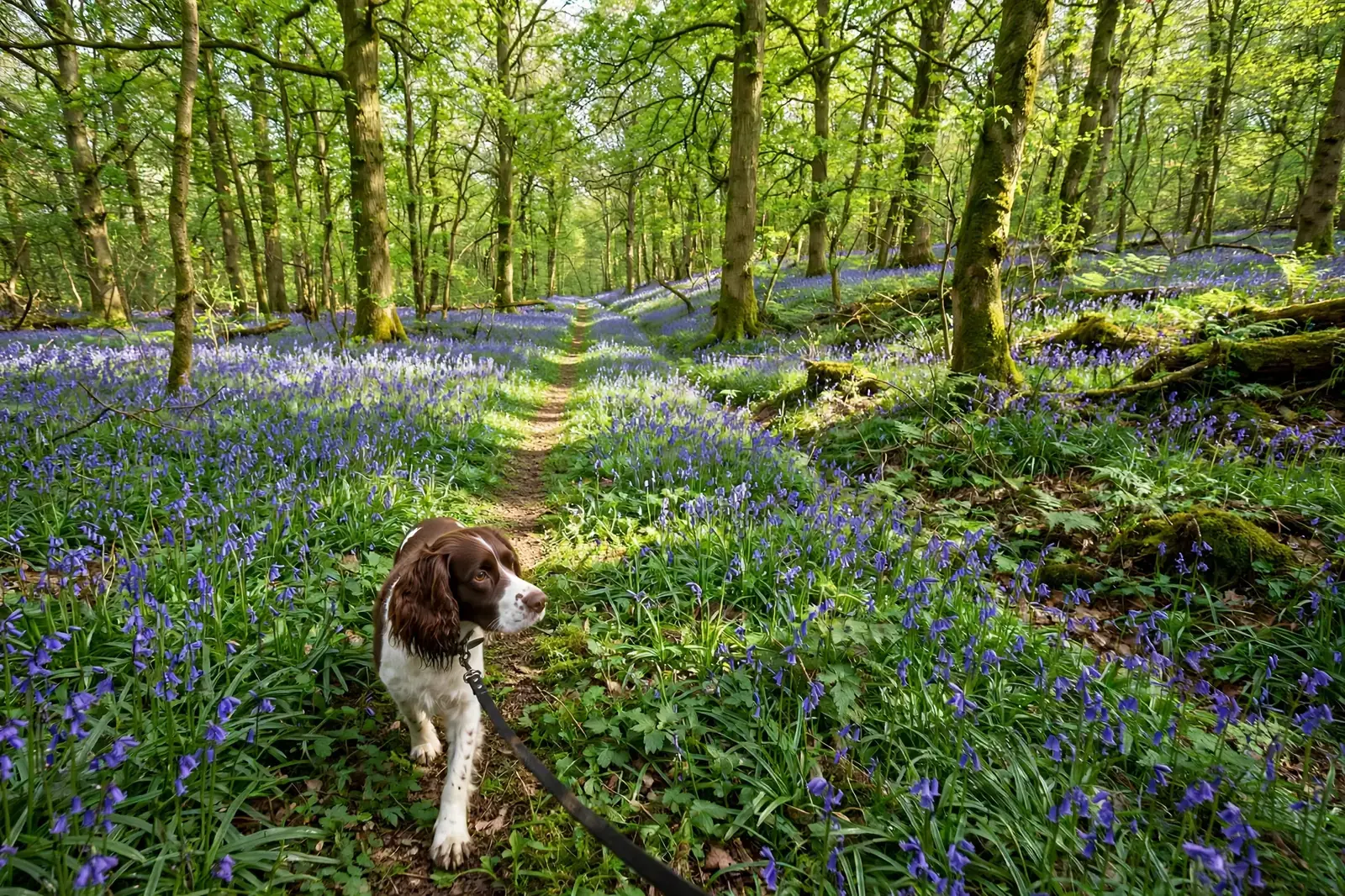
There is a temptation, in an empty wood, to let the dog off lead "just for a minute" for a photograph among the flowers. Resist it, not only because it breaks the site rules but because it teaches the dog that flowers are a place to run, and because a photograph of a dog among bluebells is not worth a crushed patch that takes years to recover. The best bluebell photographs with a dog are taken from the path, with the flowers as a carpet behind the dog, and they are honestly more beautiful than a photograph taken inside the flowers, because they show the wood as it is, not as a backdrop.
Staying on the path, properly
Staying on the path sounds simple until you are in a wood where the path is muddy, narrow and crowded, and the flowers are inches away on either side. The practical meaning is this: the dog's paws stay on the surfaced or worn path, the dog does not step onto the flower carpet to sniff, toilet or pose, and the owner does not step onto the carpet either, even to take a photograph or to let another visitor pass. If the path is blocked, wait, or step onto bare ground, a tree root or a path edge that is already worn, rather than onto flowers. If the path is flooded, turn back or take an alternative route, rather than walking around the puddle through the flowers, because the edge of the path is where bulbs are most vulnerable.
Toileting is a particular problem in a bluebell wood, because a dog that needs to go will not wait for a convenient bare patch. Plan for it by toileting the dog thoroughly before entering the flower section, on a verge or a car park edge where there are no flowers, and by keeping the walk through the densest flowers relatively short. If the dog does toilet on the path, clean it up immediately and completely, because dog waste adds nutrients that change the soil and harm the woodland flora over time. Carry extra bags in spring, and carry a small bottle of water to rinse a path if needed, though most woods ask simply for prompt bagging and binning.
Children need the same briefing as dogs, in language they understand. A child who runs through bluebells is doing exactly what a wood invites a child to do, so the briefing has to come from the adult before entering the wood: stay on the path, look with eyes, and save running for the open field afterwards. A child who understands that the flowers take years to grow is often more careful than an adult who should know better, and a woodland walk that includes that explanation is a better walk for everyone. If the group includes young children, choose a wood with a clear path and a play area or open space nearby, so the children's energy has somewhere legitimate to go.
Rangers and volunteers in bluebell woods are not being difficult when they remind visitors about paths; they are protecting a habitat they have watched for years, and they can tell you which path is best for a dog, where the flowers are thickest, and where the quiet corners are. A friendly question at the entrance, such as "which path is best with a dog on a lead today?", often produces a better walk than any guidebook, and it signals that you are a visitor who cares. Woods that feel respected keep welcoming dogs, and woods that feel trampled restrict access, so the path rule is also a rule about next year's access.
Birds, deer and other spring wildlife
A bluebell wood in spring is a breeding habitat, and the wildlife is often invisible to a visitor who is looking at flowers. Wood warblers, chiffchaffs, blackcaps and woodpeckers sing from the canopy, while robins, wrens and blackbirds nest low in brambles and holly, and a dog that crashes through the undergrowth can disturb all of them without the owner noticing. Deer, particularly muntjac and roe, use bluebell woods for cover in spring, and a dog that chases a deer can cause injury to the deer, to itself and to anyone in its path. The lead rule, again, is the answer, but so is awareness: if you see a deer, stop, shorten the lead, speak calmly and wait for it to move away, rather than letting the dog fixate or lunge.
Badgers, foxes and small mammals are also active in spring, and their paths cross woodland trails at dawn and dusk. A dog that scent-marks every badger run or digs at a sett entrance is disturbing a protected mammal, and badger setts are protected by law, so keep the dog on the path and away from obvious holes and earthworks. Squirrels, the most common trigger, deserve a plan of their own: a dog that lunges at every squirrel will have a miserable walk in a spring wood, so practise a "leave it" or a calm pass at home, and reward the dog for looking at a squirrel and then looking back at you. A woodland walk is a training opportunity, but only if the owner treats it as one, with treats, patience and realistic expectations.
Insects are part of spring wildlife too, and they affect dogs directly. Ticks become active as the weather warms, and a dog that walks through bracken or long grass at a wood edge can pick them up, so check the dog after the walk, especially around ears, armpits and groin, and remove any tick promptly with a tick hook. Midges and biting flies appear later in spring in some western woods, and a dog with thin ears or a short coat may be bothered by them, though most dogs cope. Bees, which are abundant in a flowering wood, are usually harmless to a dog that leaves them alone, but a dog that snaps at bees can be stung on the mouth or nose, so discourage snapping and keep the dog moving through the densest flower areas rather than standing still among them.
The wider point is that a bluebell wood is not a park with flowers added, but a living system in its busiest season, and a dog owner who walks quietly, keeps to the path and leaves wildlife alone is participating in that system respectfully. The reward is a wood that sounds alive: birdsong overhead, a woodpecker drumming, a deer slipping away through the trees, and the scent of bluebells on the air. That is a richer walk than any photograph, and it is the walk a dog will remember, because dogs experience a wood through scent and sound far more than through sight.
Photography etiquette in flower
Bluebell photography has its own etiquette, born of the damage caused by photographers stepping off paths to get a low angle or a clear foreground. The rule is the same as for walking: the photographer stays on the path, the dog stays on the path, and the flowers stay untrampled, however tempting the shot from inside the carpet looks. A low angle can be achieved from the path by crouching or kneeling on the path itself, and a dog photographed from the path with flowers behind it looks just as beautiful as a dog photographed inside the flowers, because the carpet, not the dog's position in it, is the subject.
Timing and light make more difference than position. Early morning light, slanting through the canopy, gives depth and colour that midday light flattens, and an overcast day gives soft, even light that is kind to both flowers and dogs. A dog that is photographed early in the walk, while it is still fresh and the path is quiet, will look relaxed, while a dog photographed after an hour of waiting while its owner composes shots will look bored. Take the photograph quickly, reward the dog, and move on, rather than making the dog a model for twenty minutes. The best bluebell photographs with a dog are often the unposed ones: the dog looking down a path, ears up, flowers on either side, taken in a second.
Other photographers deserve the same courtesy as other walkers. Do not block a path for a photograph, do not set up a tripod across a narrow trail, and do not ask a stranger to hold your dog while you compose a shot, because a stranger holding a lead in a wood is a loose dog waiting to happen. If a viewpoint is busy, take your photograph and move on, and if you want a quiet shot, walk further into the wood where the crowds thin, rather than waiting for a famous viewpoint to empty. Drones are a separate matter: most nature reserves prohibit them, and a drone over a breeding wood is a serious disturbance, so leave it at home and enjoy the wood at ground level, where the flowers are.
One final photography point: do not pick a flower to hold in a photograph, even one that has already fallen. A fallen flower is still part of the wood's cycle, and a photograph that shows a picked bluebell normalises picking for everyone who sees it. The same applies to social media captions: a photograph from the path, captioned with the wood's name and a note that dogs stayed on leads, does more for bluebell conservation than a photograph from inside the flowers, however beautiful it looks. Woods survive because visitors protect them, and photographs are part of that protection.
Spring ground: mud, ticks and pollen
Spring ground in a bluebell wood is a mixture of leaf litter, mud, tree roots and, after rain, standing water, and it demands sensible footwear and a dog that is prepared for it. Wellies or waterproof walking boots are the minimum for the human, and a towel in the car is the minimum for the dog, because a woodland path after a wet April week is muddy in a way that a summer path is not. Check the dog's paws after the walk for mud packed between toes, small cuts from sharp sticks, and ticks, and dry the dog thoroughly before the car journey home, because a wet dog in a cold car chills quickly in spring.
Ticks deserve a paragraph of their own, because spring woods are prime tick habitat and dogs are prime tick hosts. Check ears, neck, armpits, groin and between toes after every woodland walk in spring, and remove any tick with a tick hook, twisting gently until it releases, rather than pulling or burning it. Keep a tick hook in the car during bluebell season, and know the signs that warrant a veterinary visit, such as a tick that cannot be fully removed, a spreading red ring, or a dog that becomes lethargic after a walk. Tick prevention, whether a collar, a spot-on or a tablet, should be discussed with your vet before the season, not after the first tick is found.
Pollen and scent affect some dogs in spring, though less dramatically than they affect people. A dog that sneezes repeatedly in a flowering wood, rubs its face, or develops watery eyes may be reacting to pollen, and the answer is usually a shorter walk and a wipe of the face afterwards, rather than medication, but persistent symptoms deserve veterinary advice. The scent of bluebells itself is strong, and some dogs find it overwhelming in a dense carpet, showing it by sneezing, shaking their head or wanting to move on quickly. Respect that signal: a dog that wants to move through a dense flower section is telling you the scent is too much, and a brisk walk through to more open woodland is kinder than insisting on lingering.
Adders, though rare, are a spring woodland hazard worth knowing about, because they emerge from hibernation in spring and bask on sunny path edges. A dog that investigates a basking adder can be bitten on the nose or paw, and an adder bite is a veterinary emergency, so keep the dog on the path, away from sunny banks and log piles, and seek urgent veterinary help if a bite is suspected. The risk is low, and it should not stop you walking in a bluebell wood, but it is another reason the path rule matters: the path is the safest place for the dog as well as for the flowers.
After the walk: tea, water and a check
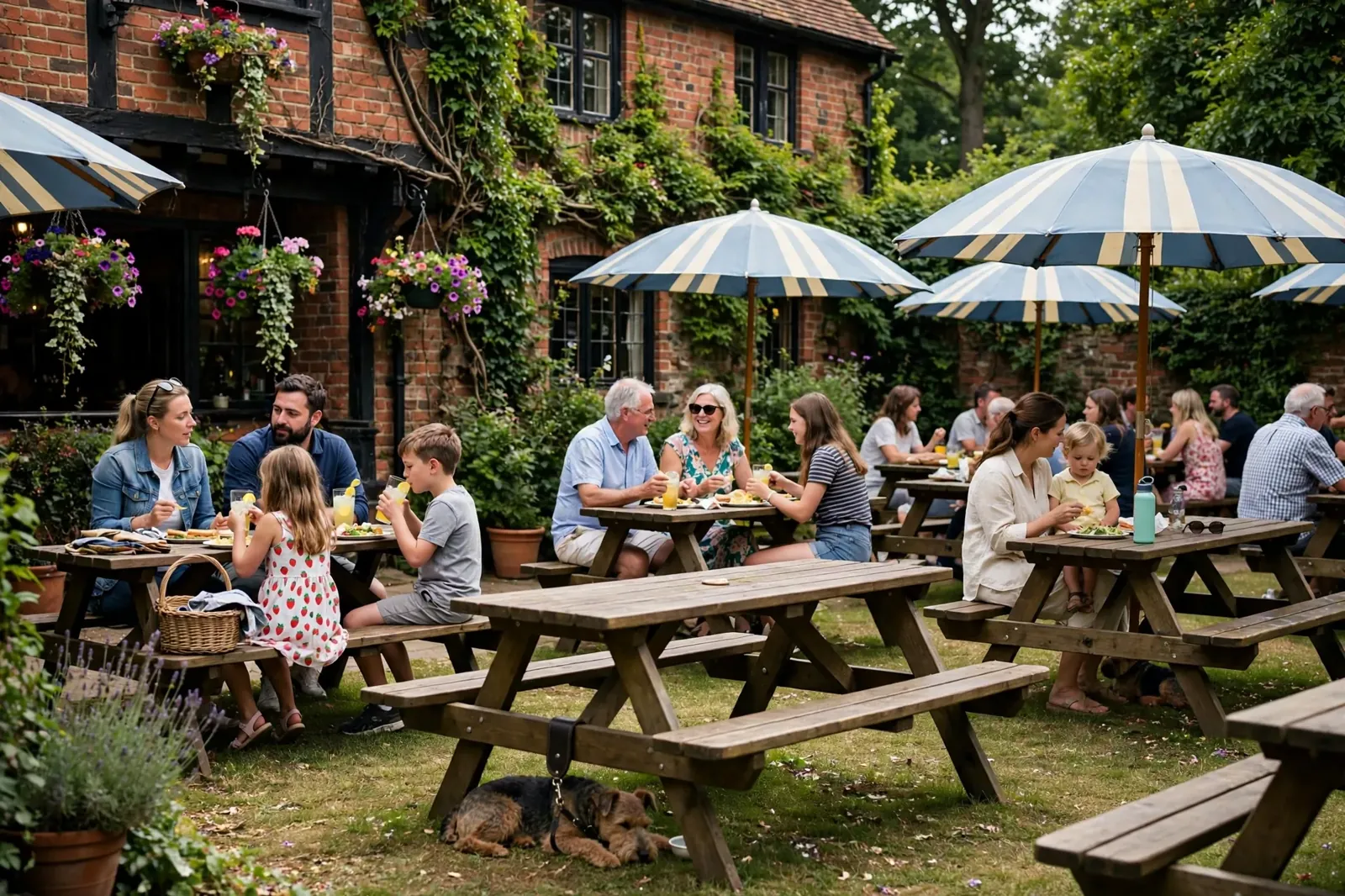
The end of a bluebell walk is a good moment for a routine that serves both dog and owner. Offer water first, because a dog that has walked a woodland path in spring sun is often thirstier than it appears, and a drink before the car journey prevents the dog drinking frantically at home. Towel the dog's paws and belly, check for ticks, cuts and mud packed between toes, and give the dog a few minutes to toilet on a suitable verge before the drive. If the walk ended near a cafe or pub, a sit outside with the dog settled on a blanket is a pleasant end to the morning, and our guide to dogs in pub gardens covers the etiquette of that stop, including water bowls and table manners.
If the bluebell walk is part of a longer spring break, the same path discipline applies to the rest of the trip. Spring is the season when many coastal and countryside rules tighten, and our explanation of dog-friendly beach rules is a useful companion, because beaches that welcome dogs freely in winter often restrict them from spring onwards. Planning a spring break as a whole, with the bluebell walk as one element, avoids the frustration of discovering a beach ban or a reserve exclusion halfway through a holiday. The dog, as ever, benefits from a plan that considers the whole day, not just the highlight.
Finally, record what you found. A note of the wood, the date, the flowering state and the dog's behaviour helps you plan next year's visit, and it helps other dog owners if you share it, because bluebell flowering shifts each year and local knowledge is the most valuable kind. A wood that was perfect on a weekday morning in late April may be crowded on a weekend in May, and a note that says so saves someone else a wasted journey. Woods survive because people care about them, and caring includes sharing honest information about when to go, where to park and how the dog coped. That is the quiet work of a good dog owner in spring, and it is work worth doing.
Practical questions
Before you go
Is it illegal to pick bluebells in the UK?
Yes, in most cases. Wild bluebells are protected under the Wildlife and Countryside Act 1981, and picking them, or digging up bulbs, is an offence, so admire them and leave them where they grow.
Do dogs have to stay on a lead in bluebell woods?
Often yes in spring, because woods hold ground-nesting birds and young wildlife, and many sites ask for leads from March to July. Check the site's own signs, and keep the dog on the path.
When do bluebells flower in the UK?
Usually from mid-April to late May, with southern woods flowering first. The display lasts only a few weeks, so check local reports before travelling a long way.
Can dogs damage bluebells just by walking?
Yes, because bluebell bulbs sit close to the surface and are easily crushed by feet and paws. Staying on marked paths is the single most important thing a dog owner can do.
Are bluebells poisonous to dogs?
Bluebells are toxic if eaten, and can cause vomiting and stomach upset, so do not let your dog chew flowers, leaves or bulbs, and seek veterinary advice if a large amount is eaten.
What is the quietest time to visit a bluebell wood with a dog?
A weekday morning, early in the season, is usually quietest. Famous woods get very busy at weekends in peak flower, when a dog on a lead has little room to move.