This guide is independent and contains no paid placement. Store policies change, and a national help page is not a guarantee about any single branch on any single day, so the guidance here is framed as policy interpretation rather than a promise about a particular store.
For the full chain-by-chain comparison, see our main guide to dogs in UK supermarkets — this page does not repeat that table. Instead, it explains why the rule exists and the alternatives that actually work.
Most large UK supermarkets admit assistance dogs and refuse pet dogs, and that split is the whole story in miniature. There is no general law that bans dogs from shops, and no general law that admits pet dogs to them either. Each retailer sets its own rule, food retailers have strong reasons to set a restrictive one, and the practical answer for a dog owner is therefore not to argue the rule at the door but to choose a shopping method that was designed around it: delivery, collection, taking turns, or a genuinely dog-welcoming shop of a different kind.
Two kinds of dog, two different answers
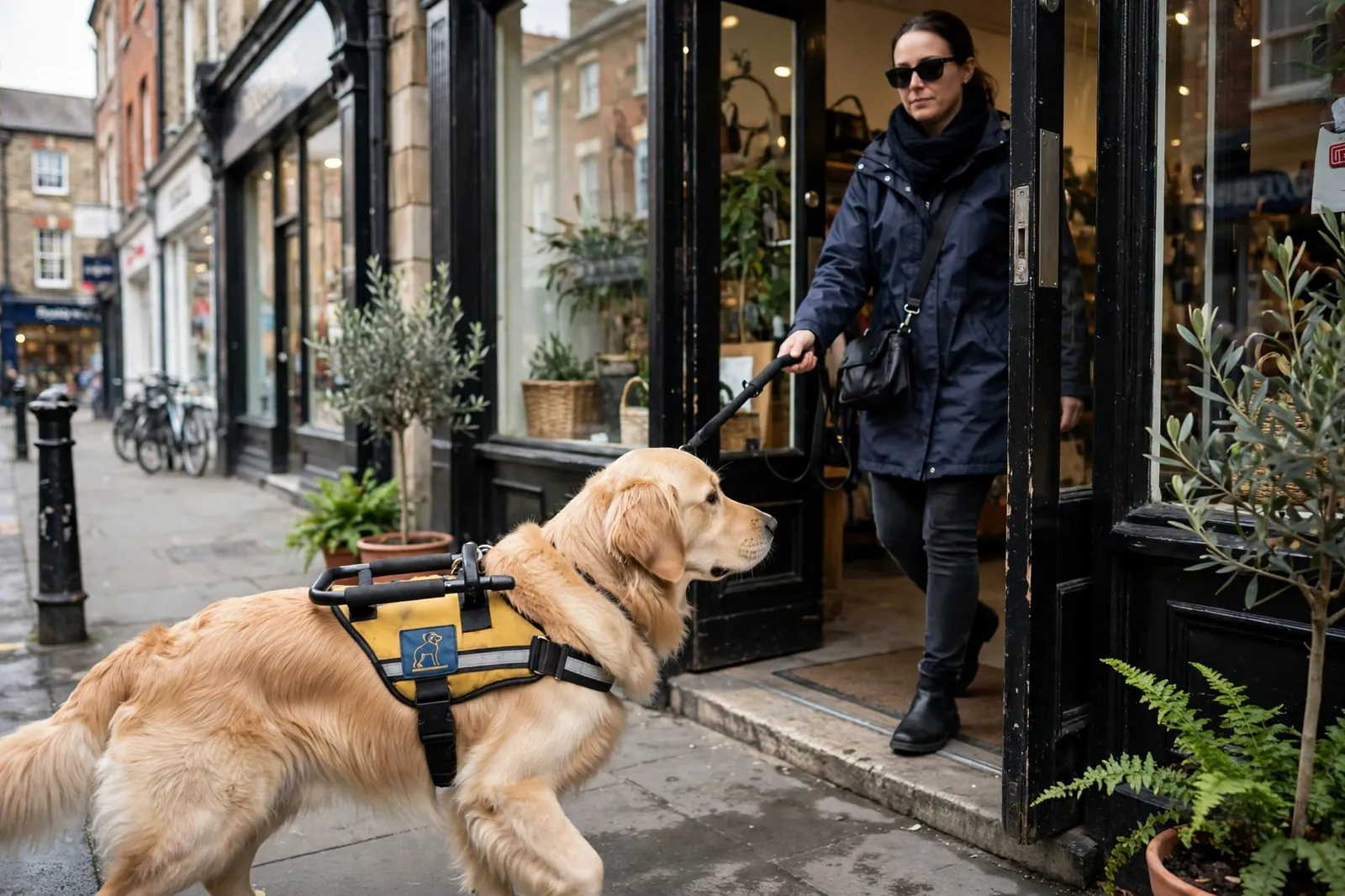
Almost every misunderstanding about dogs in supermarkets comes from treating all dogs as one category. In policy terms there are two, and they are answered by different systems. The first is the pet dog: a companion animal, however well behaved, however small, however beloved. The second is the assistance dog: a dog trained to perform tasks that mitigate a disability, such as guiding a blind handler, alerting a deaf handler, or supporting a handler with another disability. The law treats the second category as an extension of the handler's access to a service. It treats the first category as a matter for the business to decide.
That distinction is set out in the Equality Act 2010, which applies in England, Scotland and Wales, with equivalent protections in Northern Ireland under separate disability discrimination law. A service provider that refuses entry to an assistance dog risks unlawful discrimination, because the dog is not a discretionary extra but part of how the handler uses the service. The same reasoning does not extend to a pet dog. A supermarket that refuses a pet dog is not discriminating against the owner in the legal sense; it is exercising the ordinary right of a business to set conditions of entry, much as it may set conditions about trolleys, photography or opening hours. Understanding this split removes most of the heat from the subject. The question is not whether a particular dog is good, clean or quiet. The question is which category the dog falls into, and the answer to that question decides the outcome before anyone reaches the door.
Emotional support dogs sit in an uncomfortable middle ground in everyday conversation, and it is worth being precise about them. In the United Kingdom, an emotional support dog does not carry the same legal right of access as an assistance dog, even where the owner's need is real and documented. Some retailers may admit such a dog as a matter of goodwill, and some individual managers may use their discretion generously, but neither goodwill nor discretion creates a legal duty, and neither can be relied on as a plan. Owners who depend on an emotional support animal should therefore plan exactly as pet dog owners plan: assume refusal, choose an alternative shopping method, and treat any admission as a welcome exception rather than an entitlement. Conflating the two categories helps nobody, least of all assistance dog handlers, whose legal position is weakened whenever it is presented as just another form of pet access.
The practical consequence is that supermarket policy pages almost always phrase the rule as an exception rather than a permission. They say, in effect, that dogs are not admitted, with assistance dogs excepted. That wording is deliberate. It tells staff that the default answer is no, it tells assistance dog handlers that their position is protected, and it tells everyone else not to expect a negotiation at the entrance. It also explains why arguments about a particular dog's behaviour rarely change anything. A policy written for thousands of stores and millions of shoppers cannot be rewritten at the door for one well-behaved spaniel, and a member of staff who made an exception for one dog would have no principled way to refuse the next twenty. The rule is blunt because it has to be applied by people who are also scanning groceries, managing queues and answering a hundred other questions.
There is one further distinction worth drawing, because it confuses even experienced dog owners: the difference between a dog that is trained and a dog that is certified, registered or jacketed. In the UK there is no single statutory register of assistance dogs and no legal requirement that an assistance dog wear a particular jacket or carry a particular card, although many handlers do use jackets, harnesses and identification issued by recognised training organisations. A supermarket that demands a specific form of proof as a condition of entry would be on difficult ground, but a handler who can show identification calmly will usually resolve a query faster than one who cannot. The detailed picture, including identification, taxis, housing and what to do when refused elsewhere, is set out in our guide to assistance dog access rights in the UK. For supermarket purposes, the essential point is simpler: the legal category, not the jacket, is what matters, and the jacket is best understood as a practical aid to a conversation that the law has already settled.
Why a food shop is not like a pub
Dog owners often ask why a dog that is welcome in a pub garden, a cafe or even a bookshop is refused by a supermarket a few doors away. The comparison feels unfair, and in a sense it is, because the two settings are not comparable in the ways that matter to a retailer. A pub or cafe admits dogs into a seated, supervised space where the dog stays beside one table, where staff can see every animal in the room, and where the number of dogs at any moment is small. A supermarket admits shoppers into a moving crowd: hundreds of people an hour, trolleys turning blind corners, children at face height with a dog, open chilled cabinets, loose fruit and vegetables, bakery displays, and a constant flow of deliveries through the same doors. The risk profile is not a larger version of the cafe's risk profile. It is a different kind of risk altogether.
Food hygiene is the reason retailers themselves give most often, and it deserves a fair hearing rather than a dismissal. A supermarket is not a kitchen, and the law does not impose a single blanket ban on dogs in food retail premises, but a retailer is responsible for the hygiene of its premises and for the safety of its customers, and it must be able to demonstrate that it has managed the risks. Dog hair near open food, a dog shaking off rain in a chilled aisle, a lead stretched across a walkway, a dog that urinates on a display: none of these is a daily catastrophe, but each of them is a foreseeable incident in a store that serves thousands of people, and each of them is difficult to manage once the doors are open to all dogs. A restrictive policy is, from the retailer's point of view, a way of removing a whole class of incidents at once, rather than managing them one by one with staff who are already busy.
Allergies and other shoppers are a second consideration, and one that dog owners sometimes underweight. A supermarket is an essential service in a way that a cafe is not. People who are allergic to dogs, people who are frightened of dogs, and people whose own assistance dogs need to work without distraction all have to shop, and they cannot simply choose another supermarket in the way they might choose another pub. A retailer that admits pet dogs into a crowded food store is therefore not only balancing the preferences of dog owners against its own convenience; it is balancing them against the needs of other customers who have no equivalent choice. That argument does not settle the question on its own, and it would not justify refusing an assistance dog, whose handler's need is protected by law. But it helps explain why a business that is happy to welcome dogs into a quiet corner of a cafe may still refuse them in a store where every customer must pass through the same aisles.
Insurance and consistency complete the picture. A national chain writes one policy for hundreds of stores, and that policy must work in a small high-street convenience store as well as in a vast out-of-town hypermarket, on a quiet Tuesday morning as well as on a chaotic Saturday afternoon. A policy that depends on a manager's judgement about each individual dog would produce different answers in different stores, different answers on different days, and a steady stream of complaints from customers who were refused after seeing another dog admitted. A single, easily explained rule, assistance dogs only, is easier to train staff in, easier to display on a door, and easier to defend when a customer asks why. It is also, it should be said, easier for a head office to insure. None of this means that a more permissive policy would be impossible. It means that a more permissive policy would be more expensive to run, harder to enforce fairly, and riskier to defend, and that most large food retailers have decided the trade is not worth making.
It is worth noting what this argument does not claim. It does not claim that dogs are unhygienic in any absolute sense, or that a clean, calm dog is a danger to a sealed tin of beans. It claims something narrower and more defensible: that a supermarket is a high-throughput food environment where a single rule must serve every store, and that the retailers who run such environments have, by and large, reached the same conclusion about where to draw the line. Smaller retailers with a single premises, a slower pace and a manager who knows the regulars may reasonably draw it somewhere else. That is not inconsistency or hypocrisy. It is the predictable result of different businesses weighing the same factors at different scales, and it is why the honest answer to the question "can I take my dog shopping?" is almost always "it depends on the shop, and for a supermarket the answer is usually no."
How to read a supermarket policy
Supermarket policies are published in several places at once, and they do not always say exactly the same thing. A chain's help centre may state the national position in one sentence. A store's door may carry a sign that says the same thing more bluntly. A social media reply from a customer service account may add a detail, such as an offer of help with shopping, that the help page omits. A local news story may report that a particular branch has trialled something different. None of these sources is wrong, but they operate at different levels, and reading them as if they were all the same document is a reliable way to be disappointed at the door.
The hierarchy is straightforward once it is stated. The national policy is the default, and it is the one a shopper should plan around. The store notice is the local application of that policy, and it is the one that will actually be enforced on the day. Staff discretion sits underneath both, and it can soften a policy in an individual case, for example where a manager helps a customer with an assistance dog or offers to keep shopping while a customer waits, but it cannot be counted on to reverse a national rule for a pet dog. A social media reply, however friendly, is evidence of what a customer service team believes the policy to be, not a permission slip for a particular store. When these levels disagree, the safest reading is the most restrictive one that is actually displayed at the store you intend to visit, and the most reliable check is a short, polite question to that store before you travel, rather than a screenshot of a web page from another branch.
Language matters too, and supermarket wording rewards close reading. "Assistance dogs welcome" is a statement of legal compliance, not an invitation to bring a pet. "Dogs welcome" without qualification, where it appears at all in a food retail context, usually belongs to a different kind of business, such as a garden centre or a farm shop, and should not be transferred to a supermarket of the same brand that happens to share a site. "Well-behaved dogs on leads" is a condition, not a guarantee: it describes the dogs that would be admitted under a permissive policy, and it tells you nothing about whether that policy applies in the store you are standing outside. And "at the manager's discretion" means precisely what it says: the answer may be yes today and no tomorrow, depending on staffing, crowding and the manager's judgement, which is a poor foundation for a weekly shop but a reasonable basis for a one-off question.
Policies also change, and they change for reasons that have nothing to do with any individual shopper. A chain may revise its help pages after a complaint, trial a different arrangement in a new store format, or tighten enforcement after an incident in one branch. A store that was relaxed about dogs in an outdoor seating area may fence that area off, and a store that previously turned a blind eye may display a new sign after a head-office reminder. For that reason, any guide to supermarket policy, including this one, is a snapshot with a date on it. The date matters. A policy summary from three years ago is not evidence about today, and a policy summary from today is not a promise about next year. Check the official guidance before you travel, and treat the store's latest published notice as the authority for that store, subject to the qualifications set out in the next section.
Finally, it is worth distinguishing between a policy and a practice. A store may have an assistance-dogs-only policy and still, on a quiet morning, wave through a small dog carried in a bag, because no member of staff chose to intervene. That is not a change of policy, and it does not create a precedent. The next member of staff, or the same member of staff on a busier day, may enforce the written rule, and a shopper who relied on the earlier leniency will feel, understandably, that the rules have changed. They have not. The written rule was there all along, and the earlier admission was an exercise of discretion, not a revision of it. Planning around written policy rather than remembered leniency is less exciting, but it produces far fewer confrontations at the entrance.
If entry is refused
Refusal feels personal, especially when the dog in question is calm, clean and clearly no trouble to anyone. It helps to remember that a refusal at a supermarket door is almost always the application of a written policy rather than a judgement about an individual dog, and that the member of staff delivering it is rarely the person who wrote the policy. A calm, brief response serves the shopper better than an argument, and it serves the next dog owner better too, because staff remember confrontations and carry them into the next encounter. The practical goal is not to win the argument at the door. It is to get the shopping done, to preserve the position of assistance dog handlers who genuinely depend on access, and to leave with the information needed to choose a better method next time.
For a pet dog owner, the appropriate response to a refusal is to accept it, to ask politely whether there is any assistance the store can offer, such as help with carrying shopping or a suggestion for a collection point, and to move on to an alternative. Arguing that the dog is well behaved, that other stores have admitted it, or that the policy is unfair will not change a national rule, and it risks creating exactly the kind of incident that makes a retailer less inclined to consider a more permissive policy in future. It also risks blurring the line that protects assistance dog handlers, because a retailer that has just dealt with a heated dispute about a pet dog is less likely to handle the next query about an assistance dog with the patience it deserves. The kindest thing a pet dog owner can do for assistance dog handlers is to accept a pet refusal gracefully and to keep the two categories distinct in every conversation about access.
For an assistance dog handler, the position is different, and the response should be different too. A refusal of an assistance dog is a serious matter, because it denies access to an essential service, and it should be treated as such without becoming a confrontation. The handler should explain briefly that the dog is an assistance dog, ask to speak to a manager or to customer services, and note the date, time, store and the role of the person spoken to. Any written response, receipt or reference number should be kept. If the matter is not resolved in store, the handler can pursue a complaint through the retailer's own process and, if necessary, seek advice about the legal position. Check the official guidance before you travel for the current complaint route, and read our assistance dog access rights guide for the wider picture, including identification, taxis and housing, which all raise the same underlying question of how a legal right is asserted politely and effectively.
There is one further point that belongs in this section because it is often raised in the heat of a refusal: the idea that a dog that is carried, kept in a bag or pushed in a trolley is somehow not a dog for policy purposes. Asda's published wording addresses this directly, by stating that dogs are not to be taken or carried into stores, and the reasoning generalises. A carried dog is still a dog in a food environment, still sheds hair, still needs to be managed if it becomes distressed, and still creates the same precedent problem for staff. A bag or a trolley may make a dog less visible, but it does not change the policy category, and a shopper who relies on concealment is relying on staff not noticing rather than on a permission. That is a fragile basis for a weekly shop, and it is unfair to staff, who are placed in the position of either enforcing a rule against a concealed dog or ignoring a rule they are employed to apply.
None of this is intended to minimise the frustration of a refusal. Shopping is a basic task, and being unable to do it in the ordinary way because a dog is with you is a real inconvenience, particularly for a person who lives alone with a dog, or who is travelling and has no one to wait with the animal. The frustration is legitimate, and it is precisely why the alternatives section matters. A refusal is not the end of the shopping trip. It is information about which method fits this shop, and the methods that follow are not consolation prizes. They are, for many households, better ways of shopping altogether, with or without a dog in the picture.
Shopping alternatives that actually work
The most reliable alternative is also the most obvious, and it is worth stating plainly because dog owners sometimes overlook it in favour of more complicated workarounds: have the groceries delivered. A delivery removes the policy question entirely, because the dog never needs to enter a store, and it removes the welfare question too, because the dog stays at home in familiar surroundings. For a household that shops weekly, a regular delivery slot is not a compromise. It is a system, and it is the system that many dog owners adopt permanently once they have tried it, regardless of whether a particular store would admit their dog. The costs and minimum order values vary by retailer, and they should be compared in the ordinary way, but the policy advantage is absolute: no door to be refused at, no dog to be left anywhere, no weather to worry about.
Click-and-collect, or collection from a locker or a drive-through point, is the next best option, and it deserves a careful description because it is often misunderstood. In a typical click-and-collect arrangement, the shopper orders online, drives to the store, and collects bagged shopping from a designated point, often without entering the sales floor at all. The dog may remain in the car during the brief collection, but only where that is safe and legal, which means mild weather, a short wait, ventilation, and a dog that is comfortable waiting in a car. In warm weather, a car becomes dangerous with shocking speed, and no shopping trip is worth that risk. The safe version of click-and-collect is one in which the collection takes a few minutes, the car is in shade or the weather is cool, and the shopper can see or return to the car quickly. If any of those conditions fails, delivery is the better choice, and the small extra cost of delivery is a poor reason to gamble with a dog's safety.
Shopping in turns is the oldest alternative, and it remains the best one for households with two adults, or for a traveller with a companion. One person shops while the other waits with the dog, and the roles reverse on the next trip, or the shopping is done in a single visit while the dog waits with a companion outside the store in a comfortable, supervised place. The key word is supervised. A dog waiting with a person is in a different position from a dog tied outside alone, even for a few minutes, because the companion can respond to weather, to passers-by, to another dog, and to the dog's own distress. For a travelling household, this method also pairs naturally with a stop at a dog-welcoming place afterwards: the shopping is done efficiently, and the dog's outing is a walk, a park or a cafe, rather than a wait outside a supermarket. The rules for a calm day out in shared spaces, including beaches where dogs are welcome at certain times, are covered in our guide to dog friendly beach rules, which is a useful companion to a shopping trip that ends at the coast.
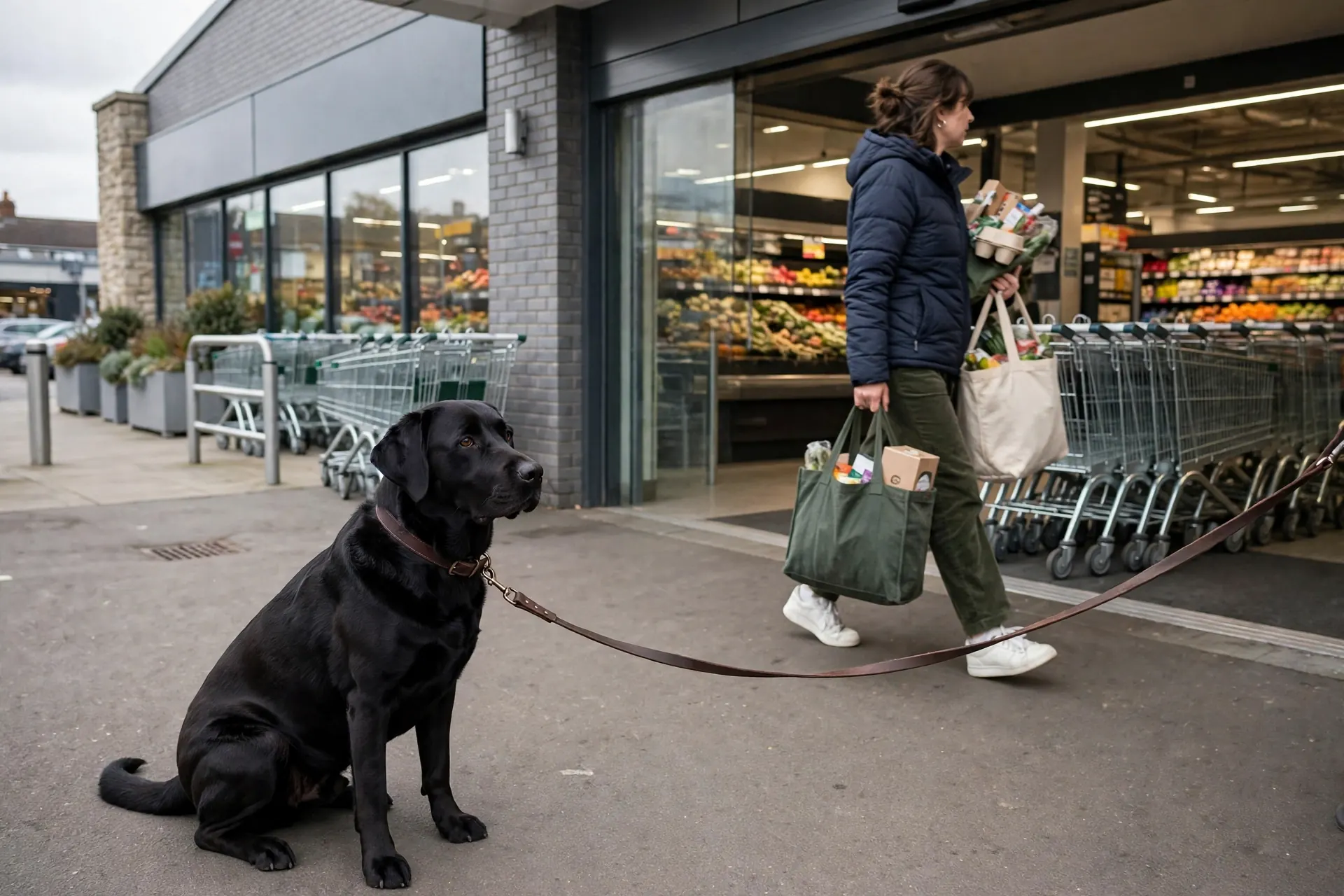
Tying a dog outside a store deserves a frank paragraph, because it is the alternative that most dog owners reach for first and that carries the most risk. A dog tied outside a supermarket is exposed to theft, to weather, to other dogs, to children who approach without asking, and to the dog's own anxiety, and a few minutes can feel very long to a dog that can see its owner disappear through automatic doors. Theft of dogs from outside shops is a real and widely reported problem, and a dog that is friendly, small or of a sought-after breed is at particular risk. If there is no alternative to a very brief, supervised wait outside, it should be in mild weather, in sight of the entrance, for the shortest possible time, with the dog's lead secured to something fixed and the owner able to return immediately. But a brief wait of that kind is not a system for a weekly shop. It is an emergency measure, and a household that finds itself relying on it every week should switch to delivery or to shopping in turns, which are systems rather than gambles.
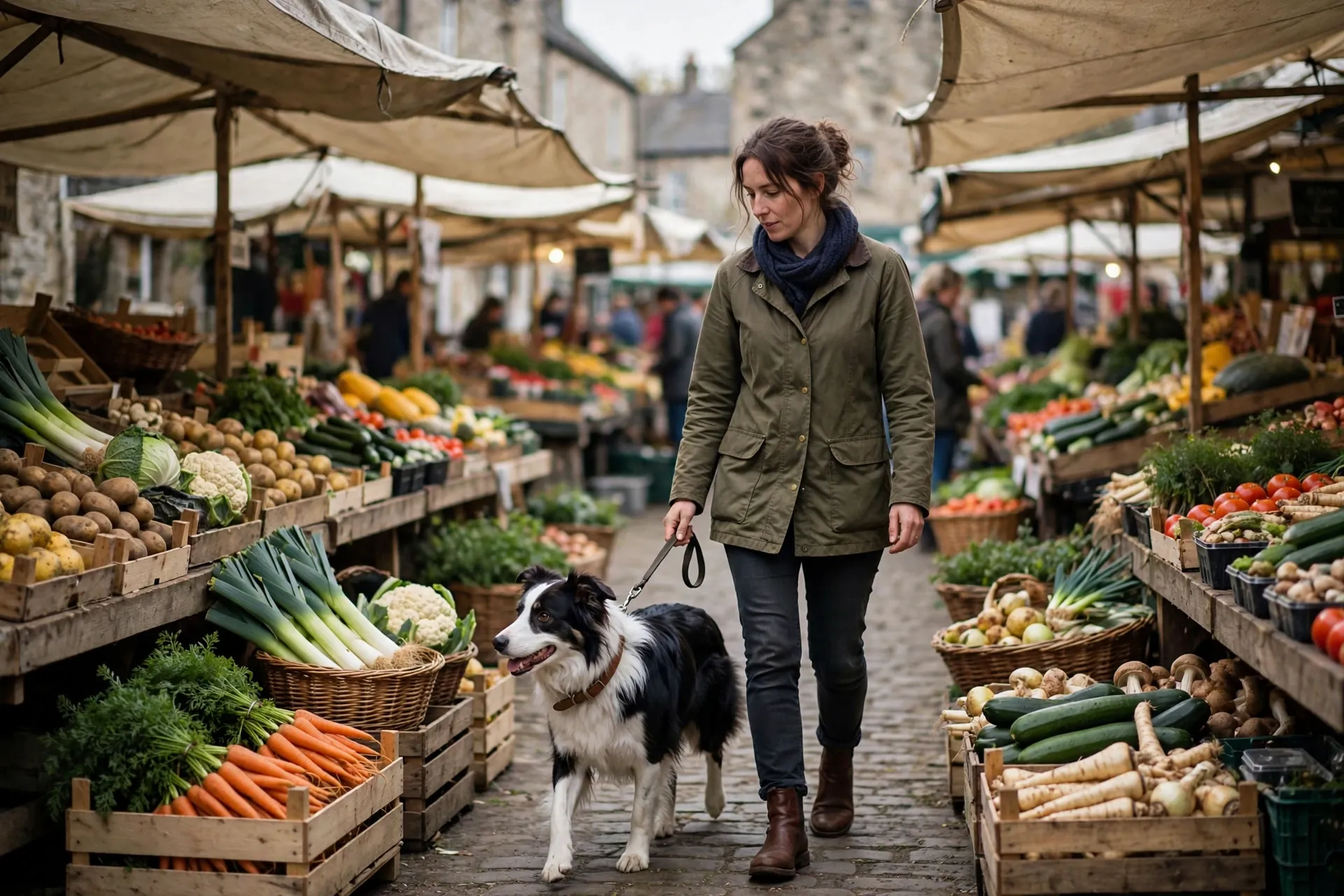
Local, dog-welcoming shops are the final alternative, and they are the most enjoyable one. A farm shop, an independent grocer, a butcher, a bakery or a market stall that welcomes dogs is not a substitute for a supermarket in terms of range or price, but it is a genuine option for a smaller shop, for a travelling household that needs a few items, or for a day when the outing itself matters as much as the shopping. Outdoor markets are particularly useful in this respect, because the dog is outside, the food is on stalls, and the policy is usually set by the market rather than by a national chain. Our guide to dogs at farmers markets explains how to browse stalls calmly, keep a dog clear of food, and handle busy crowds, all of which apply to a market shop just as they apply to a market visit. The point is not that a market replaces a supermarket. It is that a dog owner's shopping does not have to be an all-or-nothing choice between a supermarket that refuses the dog and no shopping at all. A mix of methods, delivery for the weekly shop, a market or farm shop for fresh items, and a dog-welcoming cafe for the outing, is often the most satisfying arrangement, and it is one that no single policy needs to permit.
Three questions before you leave home
After the policy detail, it is useful to reduce the whole subject to three questions that can be asked before any shopping trip, in order, in under a minute. The first question is: does this trip require a large supermarket at all? If the list is long, if the prices matter, or if the items are only available in a large store, then the answer is yes, and the planning should start from the supermarket's assistance-dogs-only rule. If the list is short, or if the shop is really an excuse for an outing, then a different kind of shop may serve better, and the supermarket question falls away. Asking this question first prevents the common mistake of starting with the store and then trying to fit the dog around it, when starting with the list would have shown that the store was never necessary.
The second question is: where will the dog be during the shopping, and is that place safe, comfortable and lawful for the whole duration? A dog at home, a dog with a companion, a dog in a cool car for a two-minute collection, and a dog tied outside a store for twenty minutes are not variations on the same answer. They are different answers with different risks, and the second question forces them to be distinguished. If the honest answer is that the dog will be somewhere unsafe, uncomfortable or unlawful, then the shopping method is wrong, however convenient it looks on paper, and it should be changed before anyone leaves the house. This question is also the one that protects a household from the slow drift into a bad habit: a wait outside that was once brief and supervised becomes, over weeks, a longer and less supervised wait, because nobody stopped to ask whether it was still safe.
The third question is: what will happen if the plan fails? If the delivery slot is missed, if the collection point is closed, if the companion is delayed, or if the store enforces its policy more strictly than expected, what is the fallback? A fallback does not need to be elaborate. It can be as simple as leaving the shopping until tomorrow, ordering a smaller delivery, or asking a neighbour to collect a few essentials. But a plan without a fallback is a plan that will, one day, produce a dog left somewhere it should not be, because the shopper felt that there was no alternative. The best shopping routine for a dog owner is therefore not the fastest routine or the cheapest routine. It is the routine with a fallback, because a routine with a fallback is one that never has to improvise with a dog's welfare.
Those three questions also explain why this guide has spent more time on policy interpretation than on a list of stores. A list of stores goes out of date, and a list of permissive stores invites a shopper to travel to a particular branch in the hope of a particular answer. Three questions do not go out of date, and they work for any store, any chain and any change of policy, because they ask about the shopping task, the dog's welfare and the fallback, rather than about a sign on a door. They are also, it should be noted, the questions that a good retailer would ask itself when writing its policy: what is this environment, what are the risks, and what happens when the plan fails? A shopper who asks the same questions is not arguing with the retailer. The shopper is thinking in the same terms as the retailer, and that shared way of thinking is what makes the eventual arrangement, whatever it is, a stable one.
One last consideration belongs here, because it is easy to lose sight of it in a discussion of rules. A supermarket trip is a small part of a dog's life, and a dog's life is not improved by winning access to a supermarket. It is improved by walks, by company, by rest, and by the absence of stressful waits outside shops. A shopping routine that keeps the dog comfortable, even if it means the dog never enters a supermarket, is a better routine than one that secures entry at the cost of a stressed, crowded hour in a trolley aisle. The policy, in the end, is not the enemy of a good life with a dog. It is a constraint, like weather or opening hours, and the households that live happiest with it are the ones that treat it as a design constraint for a better routine, rather than as an insult to be overcome. Check the official guidance before you travel, check the store's latest notice, and then choose the method that fits the dog you actually have.
Practical questions
Before you go
Can I take my pet dog into a UK supermarket?
In most large UK supermarkets, no. The usual published position is assistance dogs only, and that applies to the main store, smaller convenience formats and in-store cafes alike, subject to the latest notice at the individual store. Check the official guidance before you travel, and plan on the assumption that a pet dog will wait outside the sales floor.
Does the Equality Act 2010 cover emotional support dogs in shops?
No. The Equality Act 2010 protects assistance dogs that are trained to carry out tasks for a disabled person. An emotional support dog, however valued by its owner, does not carry the same legal right of access to shops in the UK. A retailer may still choose to admit one, but that would be a voluntary choice rather than a legal duty.
Why do supermarkets refuse pet dogs when pubs and cafes often welcome them?
A supermarket is a food retail environment with open chilled cabinets, unpackaged produce, trolleys and very high footfall, and its operator sets a single national rule it can enforce consistently. A pub or cafe makes a different commercial judgement about a smaller, seated space. The difference is a matter of each business's policy and risk assessment, not a sign that one of them has misunderstood the law.
What should I do if my assistance dog is refused entry to a supermarket?
Stay calm, explain briefly that the dog is an assistance dog, and ask to speak to a manager or to customer services. Note the date, time, store and the name or role of the person you spoke to, and keep any receipt or written response. If the matter is not resolved in store, check the official guidance before you travel about the complaint route, and read our assistance dog rights guide for the wider picture.
What is the safest alternative if I cannot leave my dog at home?
For most households the safest alternatives are ordering groceries for delivery, using click-and-collect with the dog remaining in the car only where it is safe and legal to do so, or shopping in turns with another adult. Never leave a dog unattended in a car in warm weather, and never tie a dog outside a store for longer than a brief, supervised wait in mild conditions.
Do supermarket dog policies ever change?
Yes. Chains revise help pages, trial different formats and change local arrangements, and an individual store manager may apply the national rule more or less strictly on a given day. Treat anything you read, including this guide, as a snapshot: check the store's latest published notice before you set out, and check the official guidance before you travel.