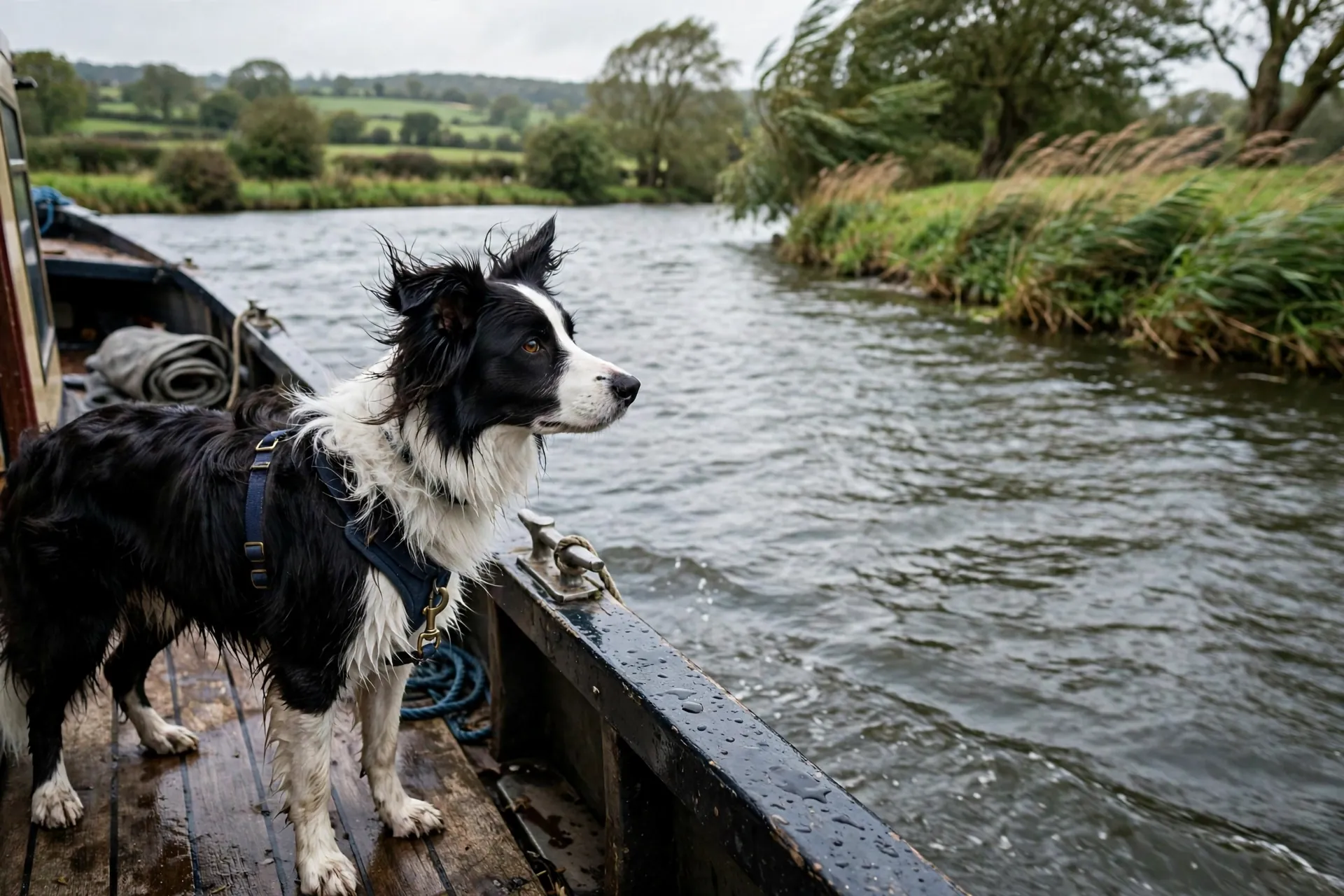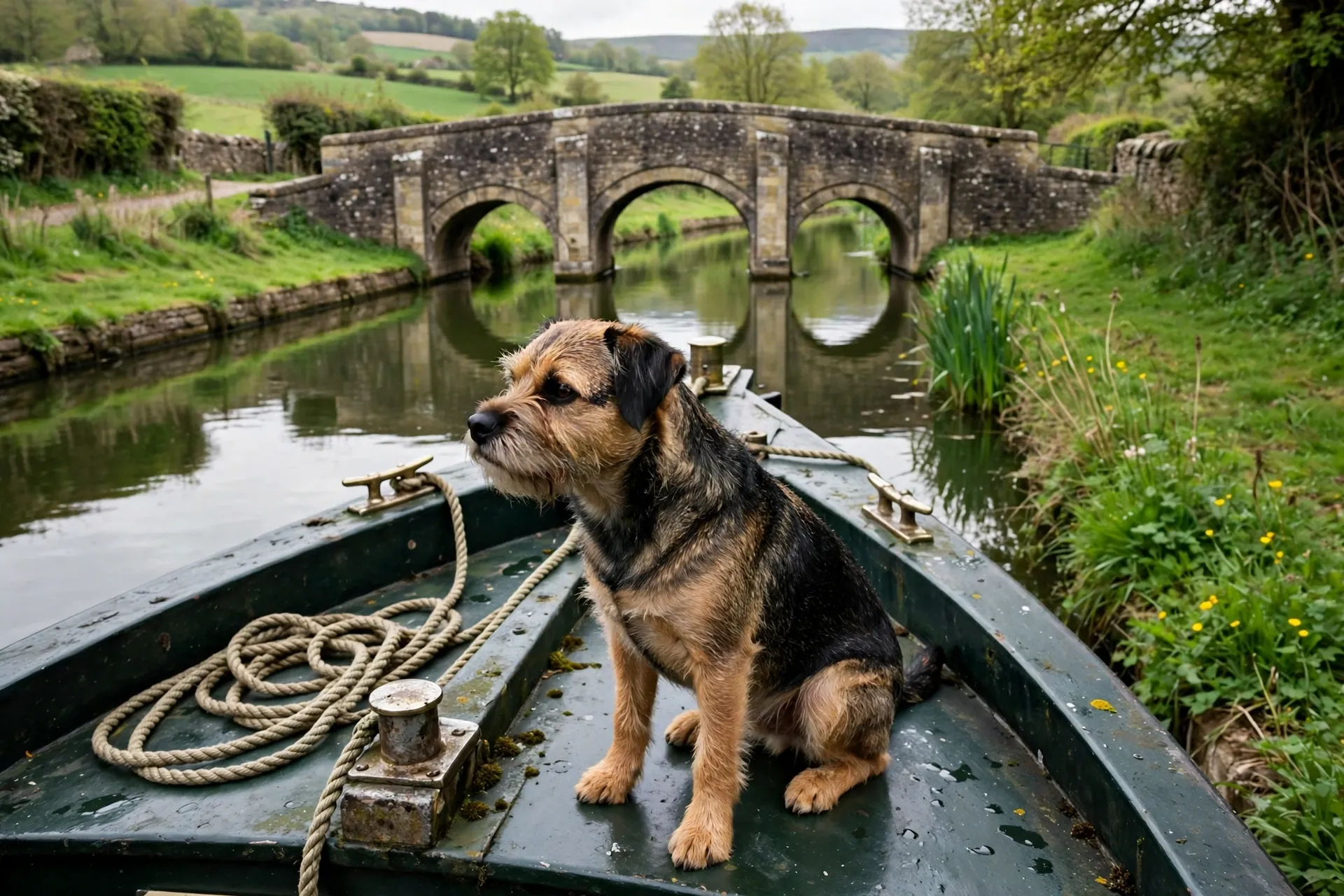
This guide is independent and contains no paid placement. Operator rules change by boat, route and season, so treat the checks here as the questions to ask, not as a promise that every sailing works the same way.
A short, slow river cruise can be an excellent dog day out when the water is sheltered, the sailing is short, the dog has a defined spot on deck, and the timetable includes a proper shore stop. The problems rarely come from the river itself. They come from steep boarding steps, a long stretch with nowhere to toilet, a crowded cabin on a hot day, or a dog that has had no chance to settle before the boat moves. Choose the sailing around those four points and most of the day takes care of itself.
What a river cruise day out really is
A river cruise day out, in the sense used here, is a short passenger sailing on inland water: typically one to three hours, out and back or between two riverside landings, on a boat crewed by the operator. The dog travels as a passenger for the day, not as a liveaboard companion. That distinction matters, because it changes every practical question. There is no cabin to retreat to overnight, no mooring routine to learn, and no expectation that the dog will sleep on board. Instead the whole trip is one contained outing, closer in spirit to a guided walk with a boat in the middle than to a boating holiday.
The water itself is the main reason these trips suit many dogs. A wide, slow river, a sheltered reach below a weir, or a gentle stretch between locks usually produces far less roll than open coastal water. The boat moves steadily, the banks stay close, and there are constant things to watch: ducks, moored boats, bridges, riverside gardens, walkers on the towpath. For a dog that enjoys watching the world but finds a long car journey or a busy town centre tiring, that steady, low-effort novelty can be just right. It is also why this guide keeps sea-going safety separate. Tides, swell, spray, harbour chop and longer exposure to wind are a different set of risks, and advice written for the sea will overstate the danger on a calm river while missing the real river issues, such as boarding steps, lock queues and long gaps between landings.
Not every inland sailing is equally calm, however. Rivers change character along their length. A broad lower reach near a town may feel almost still, while a narrower, faster stretch upstream, a section exposed to wind across open water, or a run that crosses a busy commercial channel can feel livelier. Rain upstream can raise the flow, and a strong wind against the current can chop up even a familiar stretch. None of this makes a river cruise unsuitable, but it does mean the word river on a booking page is not enough information on its own. Ask how long the sailing lasts, whether it stays on sheltered water, whether it passes through locks, and where it stops. A forty-five-minute town-centre loop and a three-hour rural sailing with one landing are both river cruises, yet they ask very different things of a dog.
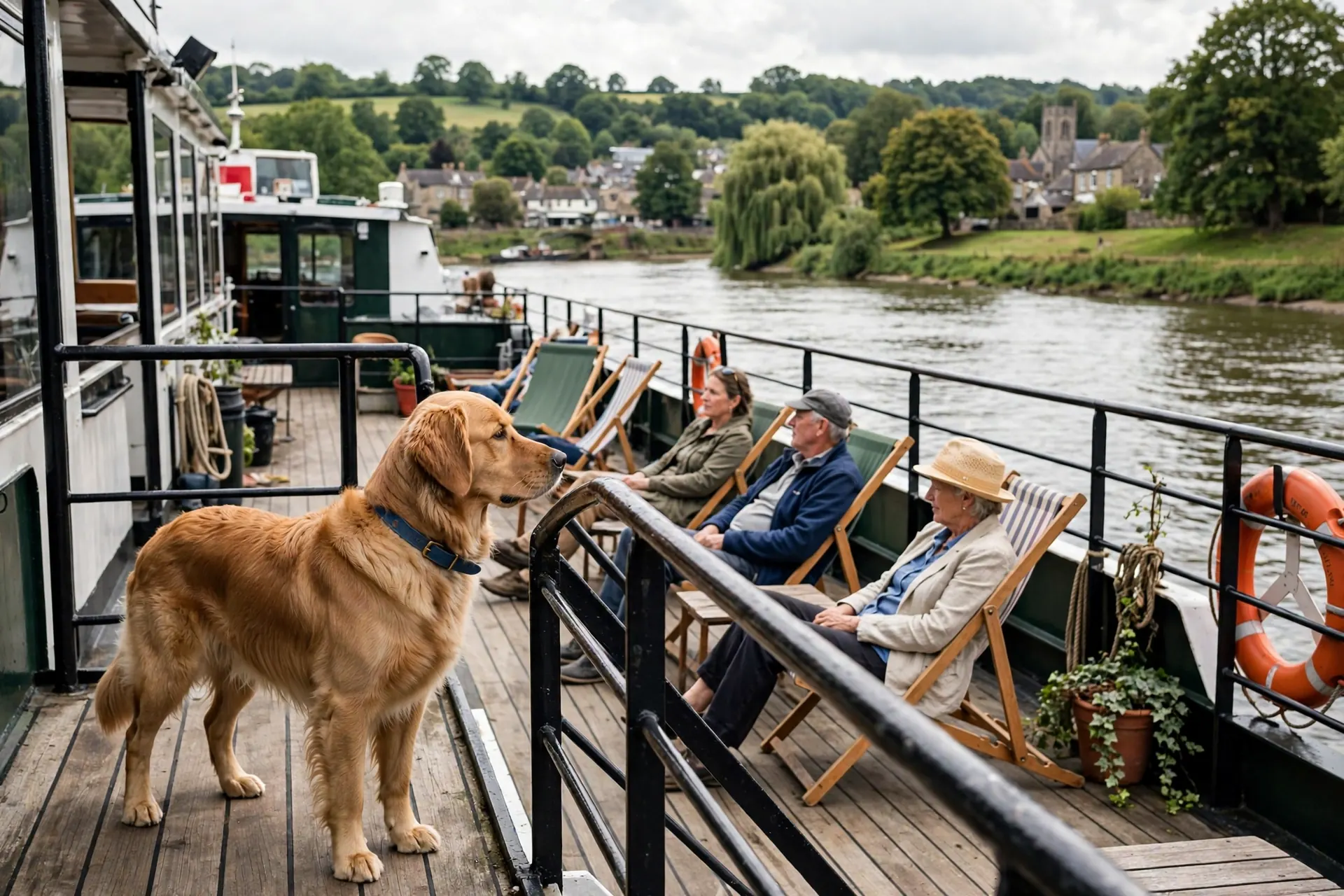
It also helps to picture the boat before booking. Day-trip river boats range from small open launches with bench seating to larger two-deck vessels with a covered saloon, a bar counter and an open upper deck. Some have wide, flat boarding areas and a stable platform at water level; others load from a steep pontoon or a narrow gangway with a step up onto the deck. Dogs usually cope well with the first kind and may struggle with the second, especially older dogs, small dogs and dogs that dislike unstable surfaces. Photos on an operator website show the boat from the outside, which is useful, but the boarding arrangement and the seating layout matter more than the paintwork. If the operator has a short video of passengers boarding, watch it with your dog in mind: the width of the gangway, the height of the step, the presence of a handrail and the amount of waiting space at the top all show up quickly.
Finally, set expectations about what the dog will actually do. Most dogs spend a river cruise doing very little, and that is a success. A settled dog on a blanket, head up, watching the bank, occasionally accepting a treat and a drink, is enjoying the trip in exactly the right way. Dogs that need constant running, digging or chasing will not get that from a boat, so a good riverside walk before boarding is not optional decoration. It is what turns the cruise from a containment exercise into a restful middle part of a longer day out.
Choosing a sailing that suits your dog
Start with duration, and be conservative for a first trip. A sailing of about an hour gives a nervous or first-time dog a complete experience without a long commitment: time to board, settle, watch the banks, and land again before tiredness or restlessness builds. A two-hour sailing can work well for a relaxed dog that has already done a shorter trip, particularly if it includes a landing halfway. A full afternoon sailing, or a trip that combines a cruise with a long coach or walking section, is better kept for a second or third outing, once you know how your dog responds to engine noise, movement and being settled among strangers. If the only sailing available is long, check whether you can break it by landing early, or whether a shorter route runs on another day.
Next, consider the boat type in relation to your dog. An open-deck boat suits dogs that like fresh air and a view, but it exposes them to sun, wind and rain, and it can be noisy when the boat is full. A boat with a covered saloon gives shelter and a calmer acoustic environment, yet some saloons restrict dogs to a particular area, require dogs to stay under a table, or forbid dogs inside altogether while allowing them on deck. Neither arrangement is automatically better. A sun-sensitive dog with a thick coat may be happier in shade with a breeze, while a sound-sensitive dog may prefer the muffled interior to an open deck full of conversation and commentary. Ask where dogs are allowed to sit, whether they can move between deck and saloon, and whether seating is fixed benches or loose chairs that let you create a small buffer zone around your dog.
The route matters as much as the boat. A town-centre loop with frequent sights, bridges and other boats passing close by gives a busy, stimulating ride. A rural stretch with long green banks, fewer passengers boarding and alighting, and a landing at a riverside meadow gives a quieter one. Neither is right for every dog. A confident, social dog may enjoy the town loop and the attention it brings. A reactive dog, a dog that barks at other dogs, or a dog that fixates on water birds may find the quieter route far easier, even if the scenery is less dramatic for the humans. When choosing, think about your dog's triggers rather than the postcard. Ducks at close range, a dog on a passing boat, children running along a pontoon, and a loudspeaker commentary are all common triggers, and they cluster differently on different routes.
Time of day is a quiet but powerful choice. A first sailing of the morning is often calmer, cooler and less crowded, with more space to spread out and settle. A lunchtime sailing can coincide with a bar service and a fuller boat, which suits a bombproof dog but adds noise and food smells for a dog that begs or guards. A late-afternoon sailing in summer can be warm on an open deck, while an evening sailing may run into cooler air and fading light that makes the landing walk harder. For a first trip, a morning sailing on a weekday, if available, stacks the odds in your favour: fewer passengers, a fresher dog, and daylight left afterwards for a proper walk and toilet stop.
Group size and booking style deserve a question too. Some operators sell individual seats on a scheduled sailing, so you share the boat with whoever else books. Others offer private hire for small groups, which can be ideal for a dog that struggles with strangers but is a larger expense. A scheduled sailing with a stated passenger limit is a reasonable middle ground, especially if you can ask how full a particular departure usually is. A boat that carries two hundred people will feel very different from a launch that carries thirty, even on the same river. If your dog is large, ask about space under or beside seating, because a big dog that cannot lie flat without blocking an aisle will spend the trip being asked to move.
Booking checks that prevent surprises
The phrase dog-friendly covers a wide range of realities, so the booking check is where this guide earns its keep. Before paying, confirm five things in writing, ideally by email so you can show the message at boarding if needed. First, that dogs are accepted on the exact sailing you want, not merely on some sailings. Second, where dogs may sit: open deck only, a named part of the saloon, or anywhere except a food-service area. Third, whether there is a charge per dog, and whether assistance dogs are treated differently. Fourth, the lead rule and any requirement for a mat, blanket or muzzle. Fifth, the cancellation and no-show position if the weather turns or the dog is unwell on the day. Operators that answer these questions clearly are usually the ones whose crews handle dogs calmly on the day.
Charges and conditions vary enough that guessing is unwise. Some operators carry dogs free, some charge a small fee, and some limit the number of dogs per booking or per boat. Size and breed conditions are less common on day boats than in some accommodation, but they do occur, particularly where a boat has a small saloon or a strict insurance condition. Declare your dog honestly at booking, including size and number, rather than hoping nobody notices at the gangway. A refusal at boarding, with a disappointed family and a dog that has already had an exciting walk to the pier, is far worse than a booking that was never made. If you travel with two or more dogs, ask explicitly whether the limit is per party or per boat, and whether each dog needs its own handler.
Ask about the practical geography of the trip, not just the headline route. Where exactly does boarding happen, and is there parking or a drop-off point nearby that does not require a long walk through a busy town centre with an excited dog? Is there a grass area near the pier for a last toilet stop, and is it accessible before boarding, or will you need to find one in the surrounding streets? Where are the scheduled landings, how long does the boat stay at each, and can passengers stay on board at a landing if the dog is settled? Can you alight early if the dog becomes distressed, or does the boat only stop at fixed points? The answers shape your whole day, including how much water, food and patience to pack.
Commentary, music and food service are worth asking about because they change the sensory load. A live commentary through loudspeakers, a brass band on a themed sailing, or a bar serving hot food throughout the trip can all unsettle a dog that would be perfectly calm on a quiet sailing. Themed sailings, such as evening dinner cruises or party boats, often have different dog rules from daytime sightseeing sailings, even with the same operator. Do not assume a daytime dog policy carries over to an evening event. If the sailing includes a meal, ask where dogs sit during service, whether dogs are allowed near tables, and whether the crew expects dogs to stay on the floor rather than on seats.
Finally, check what happens when plans change. River levels, high winds, lock closures and mechanical problems can all alter a sailing at short notice. Ask how the operator contacts passengers, whether a cancelled sailing is refunded or rescheduled, and whether a dog that has travelled to the pier counts differently from a human passenger for refund purposes. Keep the booking confirmation, the dog policy message and the operator phone number together on your phone, and save the pier address separately so you are not searching for it while holding a lead in one hand. These small administrative steps sound dull, but they are what keep a minor disruption from becoming a stressful day.
Boarding without a scramble
Boarding is the most concentrated moment of risk and excitement in the whole day, so it deserves a plan of its own. Arrive early enough that you are not rushing, and use the waiting time for a calm toilet walk and a drink, not for a high-energy game beside the pier. Dogs that board already tired, toileted and a little settled are far easier to guide across a gangway than dogs that arrive breathless from a run and desperate for a toilet. If the pier area is busy, wait a little distance away until the queue shortens, then join when there is space to move at your own pace rather than being pressed forward by the crowd behind you.
Look at the boarding surface before you step onto it. Pontoons move slightly with the water and with foot traffic, metal gangways can be slippery when wet, and a step from pontoon to deck can be higher than it looks from the bank. Let the dog approach at its own speed, keep the lead short but not tight, and avoid pulling a hesitant dog forward, which can turn a cautious pause into a panicked scramble. A dog that will not step onto an unfamiliar surface may do better if you walk confidently ahead, keep your body relaxed, and let it follow, or if a crew member holds the boat steady while you guide it across. If your dog uses a ramp at home, ask in advance whether a ramp can be used at boarding, and whether crew can assist, because improvising with a portable ramp on a moving pontoon needs space and permission.
Once on board, go straight to your spot and settle before the boat moves. Put down a familiar blanket or mat, offer water, and let the dog sniff the immediate area while you keep the lead managed and out of the aisle. This settling window, even if it is only a few minutes before departure, matters more than any treat trick. Dogs that board and immediately stand at the rail, pulling toward every new sight and sound, often stay aroused for the whole sailing. Dogs that are given a defined place, a drink and a moment of calm tend to stay in that calmer state once the engine starts. If seating is unallocated, choose a spot near an exit but not in the main flow of passengers, with a solid barrier or bulkhead on one side if possible, so the dog does not have to monitor movement from every direction.
Think about who handles the dog during boarding and landing. One person managing tickets, bags, a lead and a gangway step is a lot to coordinate, especially with a large or strong dog. If you travel as a pair, let one person board first with the bags and secure the seats, while the other brings the dog across last, when the gangway is quieter. If you travel alone, pack light for the boat itself: a small bag with lead, water, bowl, bags, towel and treats, leaving larger luggage in the car or in storage if the operator provides it. Crew members are generally willing to help, but they cannot hold your dog and your luggage at the same time, so make the handover easy by being ready before you reach the gangway.
Landing reverses the same points, with one extra caution: dogs often surge forward when they see land, especially after a period of sitting still. Keep the lead short as the boat approaches the pier, wait for the gangway to be fully secured, and do not let the dog rush ahead of you onto a moving pontoon. A short pause on deck while other passengers disembark can feel slow, but it gives the dog a calmer exit and gives you a clear path. Head straight for the nearest grass or riverside path after landing, before any cafe stop or photograph, because a dog that has waited through a whole sailing will be grateful for a prompt toilet opportunity.
Deck, cabin and seating rules
Deck rules on a river boat are usually simple, but they are not always the same, so learn the version that applies to your sailing. The most common pattern is that dogs stay on a short lead, on the floor, on a blanket or mat, and off the seats and tables. Some boats allow dogs on the open deck only and keep the saloon dog-free, which is a reasonable arrangement on a warm day but a cold or wet one if you have no shelter. Others allow dogs in a defined part of the saloon, often near the entrance, and ask owners to keep dogs under the table. A few smaller launches have no indoor space at all, so the whole trip is outdoors. None of these arrangements is a problem if you know it before booking; all of them become a problem if you discover them after boarding with a dog that needs shade or shelter.
The seating question is worth pinning down because it affects comfort for a long stretch. A dog that must lie on a hard deck for two hours without a mat will fidget, seek a softer spot, and possibly end up in an aisle. A familiar blanket solves most of this, and it also gives the dog a scent anchor in a new environment. Bring a blanket that is large enough for the dog to lie flat, not just sit, and that you do not mind getting damp or muddy. If the boat has fixed bench seating, check whether there is floor space in front of or beside your seat; if seating is in rows with little floor space, a smaller dog that can settle under a seat may be easier than a large dog that needs the aisle. Ask the operator about this when booking, describing your dog's size honestly rather than hoping the boat will somehow expand.
Movement around the boat needs its own rule. Dogs generally should not wander the deck, visit other passengers, or move between decks unsupervised, even if they are friendly. A river boat deck is a confined space with trip hazards, ropes, mooring equipment and open edges, and a wandering dog can quickly be underfoot. Keep the dog in its spot for the sailing sections, and use landings for movement, sniffing and stretching. If you want to take photographs from another part of the deck, do it during a landing or ask your travelling companion to stay with the dog. This is not about being strict for its own sake; it is about keeping a small, moving space predictable for a dog that cannot read the boat's layout the way you can.
Food and drink rules overlap with seating rules. Many boats serve drinks and snacks on deck, and some run a full bar or cafe service. Dogs should not be fed from tables, should not beg from neighbouring passengers, and should not be given alcohol, rich food or bones that could splinter. Keep treats small, low-odour and easy to eat without crumbs spreading across the deck, because crumbs attract other dogs and create exactly the kind of floor-level competition that leads to squabbles. Water is the exception to restraint: offer it regularly, in small amounts, in a bowl that will not slide across the deck when the boat turns or meets a wash from a passing vessel.
Toileting on board is almost always prohibited, and where a boat has no dog toilet area, that prohibition is absolute. Do not assume a corner of the deck, a patch of astroturf, or a mop bucket counts as an arrangement. Plan the day so the dog does not need to go on board, and carry a contingency for accidents: bags, paper towels, a spare blanket and a calm manner. If an accident happens, clean it promptly, tell the crew, and do not make a scene that adds to the dog's stress. Crews have seen it before, and a quick, matter-of-fact clean-up preserves goodwill for the next dog owner far better than embarrassment or argument.
Motion, heat and life jackets
Motion on a slow river is gentle, but gentle does not mean absent. A boat turning in a wide reach, meeting the wash of a passing cruiser, or passing through a lock can produce a small roll or a change in engine vibration that a sensitive dog notices. Signs of unease include drooling, lip licking, yawning, restlessness, whining, pacing, or a sudden desire to stand when the dog was settled. These signs can also mean heat, excitement or a need to toilet, so do not jump to a single explanation. Offer water, check the dog is not too hot, give it a chance to settle again, and note whether the signs ease once the boat is back on a straight, steady stretch. A pattern across several trips is more informative than one restless moment.
Feeding on cruise day should be planned around motion. A light meal several hours before sailing, rather than a large meal immediately beforehand, reduces the chance of sickness and leaves the dog comfortable rather than sluggish. Avoid rich treats, large chews and unfamiliar food on the boat, and keep water available in small, frequent offers rather than a large bowl that invites gulping. If your dog is known to be travel sick in cars, mention it to your vet well before the trip and ask whether any preparation is appropriate; do not borrow another dog's medication or guess a dose on the morning of sailing. Puppies and young dogs often outgrow travel sickness, but a first boat trip is not the occasion to test that theory with a long sailing and a full stomach.
Heat is a more common problem than motion on summer river cruises. An open deck in direct sun, with little breeze when the boat is moored or moving slowly, can heat up quickly, and a dog in a thick coat cannot remove layers or explain that it is too warm. Choose shade where possible, bring water and a portable bowl, and consider a cooling mat or a damp towel for the dog to lie on. Watch for heavy panting that does not ease in shade, drooling, restlessness or a reluctance to lie down. If the dog shows these signs, move to the coolest available spot, offer water, dampen the paws and belly with cool water if the crew permits, and be ready to leave at the next landing. Never leave a dog unattended on a boat, in a car at the pier, or in a closed cabin while you go ashore, even for a few minutes on a warm day.
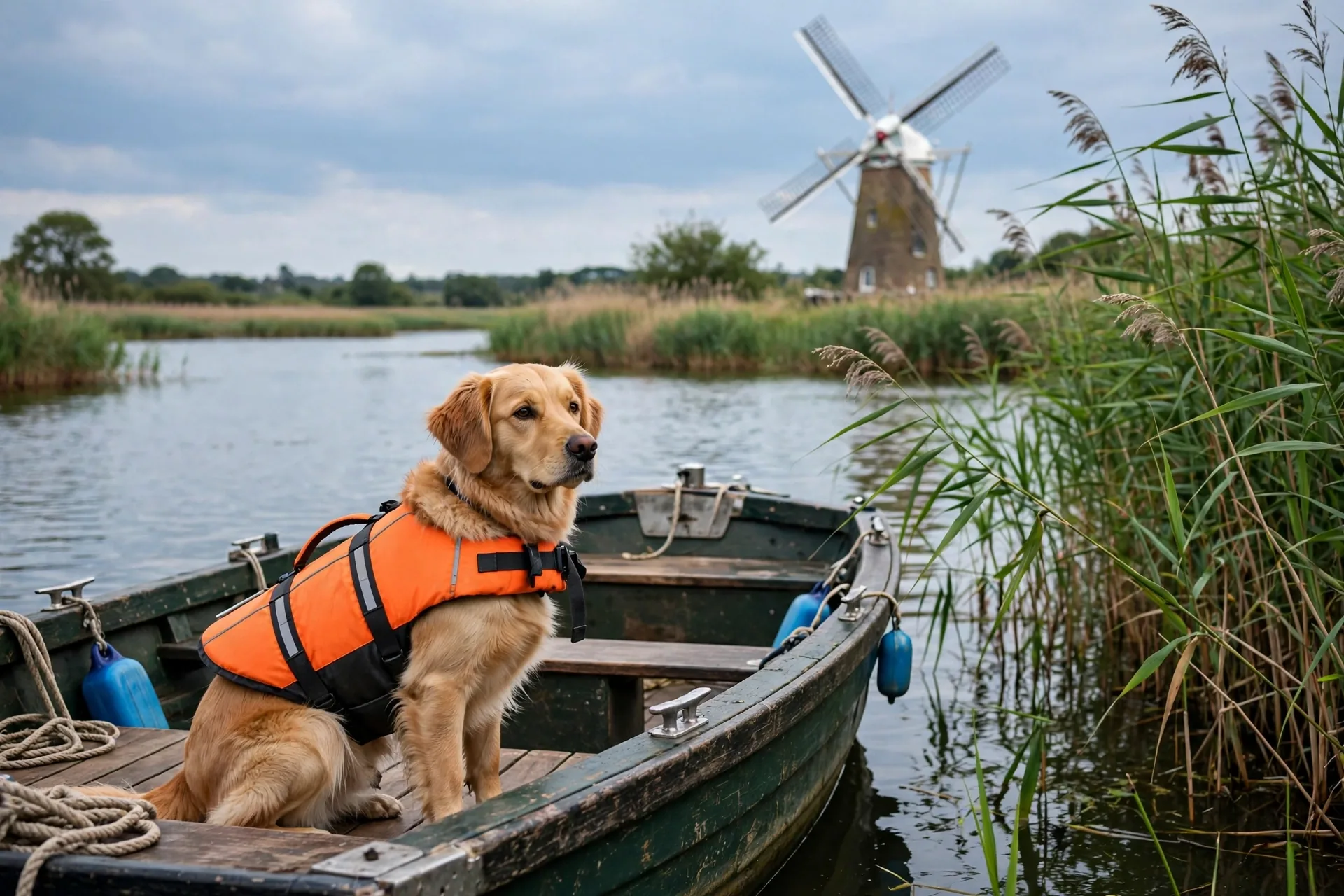
Life jackets deserve a separate decision, even on calm water. A river is not a swimming pool: banks can be steep, currents near weirs and locks can be strong, and a dog that falls or jumps in may struggle to climb back onto a boat with a high freeboard. A well-fitting canine life jacket with a sturdy handle gives you a way to lift the dog out, keeps its head supported if it tires, and makes the dog more visible in the water. Fit matters more than brand: the jacket should be snug without restricting breathing or movement, with straps adjusted at home and checked again on the day, because a loose jacket can ride up or slip off in the water. For detailed fitting advice, see our guide to choosing a dog life jacket in the UK. Dogs that swim strongly in a lake may still benefit from a jacket on a boat, because falling from a moving deck is different from choosing to enter the water from a beach.
Not every dog needs a jacket on every sailing, and operators rarely require one for a short, sheltered river trip, but the decision should be based on your dog, not on what other passengers are doing. Small dogs, puppies, elderly dogs, brachycephalic breeds, dogs with joint problems, and dogs that lean over rails or chase birds are all stronger candidates for a jacket. If you use one, introduce it at home first with treats and short wears, so the boat is not the first place the dog experiences straps, buckles and a handle on its back. A dog that is already uncomfortable in a jacket will spend the cruise trying to remove it, which defeats the purpose and adds restlessness to a confined space.
Shore stops, walks and toilet breaks
Shore stops are where a river cruise becomes a proper day out rather than a long sit, so read the timetable as a dog owner reads it: as a series of toilet and movement opportunities. A sailing that stops for thirty minutes at a riverside village gives the dog a walk, a toilet break, a drink and a change of scene. A sailing that stops for ten minutes at a concrete landing with no grass nearby gives a leg stretch at best. Neither is wrong, but they need different preparation. Before booking, ask how long each stop lasts, what the landing surface is, whether dogs can go ashore at every stop, and where the nearest grass or path is. If the answer is vague, assume the shortest, least convenient version and plan accordingly.
Use each landing in a deliberate order: toilet first, then a short walk, then water, then any cafe or photograph stop. Dogs that are taken straight to a busy cafe terrace after a long sailing often become restless, not because they dislike cafes, but because they still need to toilet and move. A ten-minute sniff walk along a riverside path, with time to toilet properly, settles most dogs far better than a quick dash to the nearest patch of grass. Keep the lead on at landings unless a sign clearly says dogs may be off lead in a defined area, and be particularly careful near water edges, lock sides and moored boats, where a loose dog can slip, jump in, or approach another boat's dog without warning.
Plan the walk before boarding as well as the walk at landings. A riverside walk of twenty to forty minutes before the sailing, ending near the pier, gives the dog exercise, toileting and a chance to settle its excitement before the confined part of the day. After the final landing, another short walk, rather than an immediate car journey, lets the dog toilet again and decompress. If the cruise ends at a different landing from where it started, check the return arrangement in advance: whether you walk back, catch a return sailing, or need transport. A dog that has enjoyed a cruise but then faces an unexpected long walk back along a busy road will not remember the day fondly, and neither will you.
Riverside paths have their own hazards that are easy to overlook when you are focused on the boat. Blue-green algae in warm, still water can be dangerous to dogs that drink from or swim in affected water, so keep dogs out of scummy or discoloured water and check local notices at landings. Livestock may graze riverside meadows, with dogs required to be on a lead near sheep and cattle. Anglers, cyclists and other walkers share towpaths, so a long lead that stretches across the path can trip a cyclist or tangle with another dog. Keep leads short on narrow paths, step aside for cyclists, and carry water for the dog rather than letting it drink from the river, which may contain runoff or algae even when it looks clear.
For a longer day that combines a cruise with a shore walk, our Norfolk Broads guide explains hiring, mooring and towpath routines in a landscape where water, paths and landings are closely linked, even though a day cruise is a different arrangement from hiring a boat. The shared lesson is the same: the shore part of the day needs as much planning as the water part. A cruise timetable that looks perfect on paper can still fail if the landings offer nowhere sensible for a dog to walk, toilet and drink, so treat landing quality as a booking criterion, not an afterthought.
Onboard etiquette that keeps everyone relaxed
Good manners on a river boat are mostly about space, noise and predictability. Other passengers have paid for a relaxing trip, and many will love your dog, but love does not mean they want a wet nose in their picnic or a lead across their feet. Keep the dog in its own area, discourage jumping up, and do not assume every stranger wants to stroke your dog. A short, friendly explanation, such as asking people to let the dog come to them rather than reaching over its head, protects both the dog and the passenger. Children in particular should be invited to interact only with your permission and while you hold the lead, because a child running toward a seated dog on a moving boat can startle even a friendly animal.
Other dogs are the most likely source of tension. Two dogs that would greet politely in a park may react differently when both are confined, on leads, and unable to move away. Keep distance where possible, avoid nose-to-nose greetings in a narrow aisle, and do not let leads tangle across a walkway. If another dog is barking or lunging, increase distance calmly rather than correcting your dog loudly, which usually raises the arousal of both animals. If your dog is the one barking, act early: move to a quieter corner, create distance from the trigger, and offer a calm settling activity. Waiting to see whether barking stops on its own often means waiting until other passengers are already annoyed, and a crew member has to intervene.
Noise, smell and mess are the three things passengers notice most, and all three are manageable. Barking is the obvious one, but whining, scratching at the deck, and the sound of a bowl sliding across a hard floor also carry in a quiet saloon. Bring a non-slip bowl or a bowl that sits inside a silicone mat, keep treats quiet and low-odour, and avoid squeaky toys on board. Smell comes from wet dogs, strong treats and accidents; a towel, a drying coat if the weather is wet, and prompt cleaning handle most of it. Mess is the easiest to prevent: bags, paper towels and a spare blanket in a small bag by your feet mean an accident is a brief interruption, not a crisis that requires a search through luggage.
Crew instructions deserve prompt, good-humoured compliance, even when they feel inconvenient. If the crew asks you to move, to keep the dog on a particular side, to stay seated during a lock passage, or to keep the dog off a certain deck, there is usually a safety or operational reason: a mooring rope, a low bridge, a boarding movement, or a passenger with an allergy or fear. Arguing the point in front of other passengers helps no one and makes the crew less willing to accommodate dogs on future sailings. A calm response, a quick move, and a treat for the dog once settled again is the pattern that keeps dog-friendly policies alive.
Finally, remember that your dog's behaviour reflects on the next dog owner who books. Operators keep dog policies because most dogs and owners make them work; they restrict policies when a minority of trips cause complaints, damage or safety incidents. Leaving your area clean, thanking the crew, and reporting any problem honestly, such as a loose deck board or a confusing sign, all contribute to keeping river cruises open to dogs. If you finish a sailing and a fellow passenger says your dog was well behaved, that is not just a compliment. It is part of the reason the next family with a dog will be welcomed on board.
Weather, seasons and when to stay ashore
British river weather rewards flexibility. A bright, still morning can turn into a breezy afternoon, and a shower that would be a minor inconvenience on a walk can make an open deck slippery and a dog miserable if there is no shelter. Check the forecast for wind as well as rain, because wind across open water creates chop, increases spray, and makes boarding from a pontoon less stable. Check river conditions too where the operator publishes them, because high water after heavy rain can change a route, close a landing, or increase the flow through a lock cut. If the operator advises against travelling, or if conditions have changed since booking, take that advice seriously rather than treating the ticket as a reason to press on.
Seasons change the dog calculation in ways that go beyond temperature. Spring brings nesting birds that excite dogs at the water's edge, lambs in riverside fields, and paths that can be muddy after winter rain. Summer brings heat, busy boats, algae risks in warm still water, and wasps around riverside cafes. Autumn brings cooler air, quieter sailings, and fallen leaves that hide uneven landing surfaces, but also a more relaxed atmosphere that suits many dogs. Winter sailings are fewer, shorter and colder, and a dog that is happy on a summer deck may shiver on a winter one without a coat and a blanket. There is no single best season; there is a best match between season, sailing length, shelter and your dog's coat, age and health.
Heat deserves a firm rule of its own. If the forecast is hot, choose a shaded or covered sailing, travel in the morning, and be prepared to cancel if the dog cannot stay cool. Signs of heat stress include heavy, prolonged panting, drooling, restlessness, vomiting, or collapse, and they require immediate cooling and veterinary advice; do not wait for the next landing if the dog is in distress, but alert the crew at once so the boat can reach land as quickly as possible. Cold deserves similar respect for small, elderly, short-coated or arthritic dogs: a windproof coat, a blanket, and a warm drink stop after landing are not luxuries. Dogs lose heat through wet fur after rain or spray, so a towel and a drying coat belong in the boat bag even on a day that starts dry.
Thunderstorms, high winds and flooding are stay-ashore conditions, not challenges to overcome. Lightning near water, a boat struggling against a strong current, or a landing that is flooded or closed all create risks that no amount of good behaviour can cancel. If you arrive at the pier and conditions look worse than forecast, ask the crew directly whether the sailing is still suitable for a dog, and be willing to accept a no. A cancelled cruise with a riverside walk instead is still a good day out; a frightening sailing that puts a dog off boats for good is a much worse outcome. Keep the operator's phone number handy so you can check before travelling on a doubtful day, rather than discovering a cancellation at the pier with a dog already excited for a trip.
Water quality and riverside hazards also vary with season, and uncertainty here should be handled conservatively. If a landing notice warns about algae, pollution, or a closed path, follow it, keep the dog on a lead, and do not let it drink from or swim in the river at that spot. If you are unsure whether a warning applies to your sailing, check the official guidance before you travel, and ask the operator or the local authority for the current position. A short delay to verify is always better than a veterinary emergency after the trip, and crews and rangers are used to being asked.
Packing and a calm day-out timeline
Pack for the boat as a small, self-contained kit, not as a full holiday bag. The essentials are a short lead and a spare lead, a harness that fits well, a familiar blanket or mat, a collapsible bowl and water, poo bags, paper towels, a towel, treats in a sealed pouch, any regular medication, and a life jacket if you have decided to use one. Add a coat for the dog in cold or wet weather, a cooling mat or damp towel in heat, and a chew or long-lasting treat for settling, provided it is quiet and will not create crumbs or a mess on deck. Keep the kit in one small bag that fits under or beside your seat, so you are not unpacking a large rucksack in a crowded aisle while the boat is boarding.
Identification and health basics belong in the same kit. The dog should wear a collar with an identification tag, and you should carry your phone with the vet's number saved, plus the operator's number and the pier address. If your dog has a medical condition, such as epilepsy, diabetes or a heart condition, carry any medication the vet has prescribed for travel, and tell your travelling companion where it is. This is not pessimism; it is the same logic as carrying water. Most trips will need none of it, but the one trip that does will be far calmer if everything is in one place and easy to reach without standing up and leaving the dog unattended.
A calm timeline for cruise day might look like this. The evening before, check the booking, the dog policy message, the weather and the river conditions, lay out the boat kit, and give the dog its normal evening routine. On the morning, feed a light meal well before departure, take a proper walk that includes toileting, and arrive at the pier early enough to walk the immediate area again and offer water. Board calmly, settle on the blanket, and keep the first part of the sailing uneventful: water, a few quiet treats, and time to watch the banks. At each landing, toilet first, walk briefly, then enjoy the stop. After the final landing, walk again before the car journey, offer water, and let the dog decompress at home with its normal routine rather than another exciting outing immediately afterwards.
If the day includes a meal ashore after the cruise, plan that part with the same care as the boat. A riverside pub garden can be a lovely end to the day, but a dog that has just spent two hours settled on a boat may need a walk and a toilet break before sitting again. Our guide to dog pub garden etiquette covers lead manners, settling on a blanket, and handling food smells in a garden setting, all of which apply directly after a cruise. If you are combining a cruise with a beach walk on the same trip, check seasonal dog rules for that beach in advance through our dog-friendly beaches rules guide, because a beach that welcomes dogs in winter may restrict them in summer.
The final test of a good river cruise day is not whether the photographs look impressive, but whether the dog comes home tired in a contented way, drinks normally, toilets normally, and settles easily that evening. A dog that comes home overstimulated, restless or reluctant to settle has probably had too much novelty, too long a sailing, or too little chance to toilet and move. Use that feedback for the next booking: a shorter sailing, a quieter route, an earlier departure, or a longer shore walk. River cruises reward repetition done well. The second trip, on a route you already know, with a dog that already understands boarding, settling and landing, is often far more relaxing than the first, for the dog and for you.
Practical questions
Before you go
Are dogs allowed on all UK river cruises?
No. Each operator sets its own dog policy, and it can differ between routes, boats and sailing times. Some welcome dogs on open decks only, some allow them in certain cabins, and some do not take dogs at all. Confirm the policy for your exact sailing in writing before you book, rather than relying on a general dog-friendly label.
Do dogs need a life jacket on a calm river cruise?
A well-fitting life jacket is a sensible precaution even on calm water, especially for dogs that cannot swim strongly, are small, elderly, or likely to lean over the side. It also gives you a handle for a quick lift back on board. Check the fit at home first, and check the official guidance before you travel if you are unsure about local rules.
Can a dog go to the toilet during a river cruise?
Usually not on board, so plan around the timetable. Walk your dog well before boarding, note every scheduled landing, and ask the crew where the nearest grass or riverside path is at each stop. Carry bags, water and a towel, and keep the pre-boarding walk unhurried so the dog has a real chance to go.
What if my dog gets seasick on a river?
True seasickness is less common on slow, sheltered rivers than at sea, but motion, heat, excitement and a full stomach can still cause drooling, restlessness or sickness. Feed a light meal well before sailing, offer small sips of water, keep fresh air moving, and sit where the motion feels smallest. If your dog is regularly travel sick, ask your vet before the trip.
Should a dog stay on a lead for the whole cruise?
In most cases, yes. Keep a short lead attached on gangways, decks and at landings, even if your dog is calm, because a sudden horn, a passing boat wash or another dog can change the picture in seconds. Some operators require leads at all times and may ask dogs to stay on a mat or blanket beside their owner.
What if my dog barks through the commentary?
Move to a quieter corner of the deck, increase the distance from the trigger, and give your dog something calm to do, such as settling on a familiar blanket with a chew. If barking continues and other passengers are disturbed, step ashore at the next landing or cut the trip short rather than hoping it will pass. Crews appreciate owners who act early.