This guide is independent and contains no paid placement. Course rules change, so check the official guidance before you travel.
A dog belongs on a golf course only when it can stay quiet, stay on a lead and stay off the greens. Check the course policy first, keep the dog clear of every playing line, carry water and waste bags, and be ready to step aside or cut the round short if the dog cannot settle.
Etiquette first, golf second
A golf course is a shared sporting ground, not a dog park with flags in it. Players are trying to concentrate, the surfaces are maintained at considerable cost, and a single bark at the wrong moment can spoil a shot that someone has waited several minutes to take. That is why the order of priorities matters: the dog must be quiet, under control and out of the way before anyone worries about scorecards, handicaps or club selection. If your dog cannot yet manage that standard for the length of a round, a shorter visit, a practice session or a walk around the clubhouse grounds is a kinder and more honest choice than a full eighteen holes.
The simplest rule to carry onto the course is this: the dog stays off the greens, stays out of the playing line and stays quiet while anyone is preparing to play. Everything else in this guide follows from that one sentence. A dog that lies calmly beside a bench while a group putts out, that walks steadily on a short lead between holes and that ignores other dogs, wildlife and passing buggies is welcome almost anywhere dogs are allowed at all. A dog that pulls towards every new group, barks at the sound of a struck ball or chases across a green will not be welcome for long, however friendly its intentions may be. Golfers are generally tolerant of a well-behaved dog; they are understandably less tolerant of a disruption they did not choose.
It also helps to think about the course from the greenkeeper's point of view. Greens are mown to a few millimetres, bunkers are raked to a consistent texture and tee boxes are levelled and repaired between rounds. Paw prints on a green, a dug patch in a bunker or a toilet stop on a tee do not just look untidy; they change how the surface plays for the next group. Most course rules that mention dogs are therefore not about disliking dogs at all. They are about protecting surfaces that take daily work to maintain, and about keeping play fair for everyone who has paid to be there. Understanding that motivation makes the rules easier to accept and easier to follow without resentment.
Finally, remember that your dog reads the atmosphere of the course long before you do. A golf course is full of new sounds: the sharp crack of a driver, the shout of "fore", the rumble of a buggy, the click of spikes on a path. Some dogs settle quickly once they realise these sounds are background noise. Others become alert, restless or vocal, especially on their first visit. Arrive early, let the dog sniff the car park and the practice area, and watch how it responds to the first few shots before committing to a full round. A calm first ten minutes is a far better predictor of the day than any amount of hopeful planning at home.
Course policies are not all the same
There is no single national rule for dogs on golf courses in the UK, and that variation is the first thing to plan around. A private members' club may allow dogs only when accompanied by a member, only on certain days or only in the clubhouse and its garden. A municipal or pay-and-play course may be more relaxed, but may still restrict dogs during competitions, on weekend mornings or in peak season. A resort course may welcome dogs in the hotel grounds but not on the course itself. The only safe approach is to ask the specific course, for the specific day and time you intend to play, and to keep the answer with your booking confirmation.
When you ask, ask precisely. "Are dogs allowed?" is a start, but it rarely gives you enough to plan on. Better questions include: are dogs allowed on the course itself or only in the clubhouse grounds; must the dog stay on a lead at all times; are there times of day or days of the week when dogs are not permitted; are dogs allowed in the clubhouse, the bar or the terrace; and is there any charge for bringing a dog? Some courses ask that dogs be kept off the course during competitions or society days, when the course is at its busiest and the pressure on pace of play is greatest. Others restrict dogs to quieter weekday afternoons, which may suit a first visit very well. If you are a visitor rather than a member, say so, because visitor rules are sometimes stricter than member rules, and a member guest may be subject to different conditions again.
Time of day matters more than many visitors expect. Early morning rounds often coincide with greenkeeping work, dew on the grass and groups playing quickly before work. Midweek afternoons are frequently the calmest window for a dog's first course visit: fewer groups, less pressure to keep up, and more space to step aside when needed. Weekend mornings, by contrast, are usually the busiest and least forgiving time to introduce a dog to a course. If the course offers a twilight rate or a quiet nine-hole option, that can be an excellent compromise for a dog that is still learning course manners, and it gives you a natural point to leave before tiredness sets in.
Also check what happens around the clubhouse, because the round is only part of the day. Some clubhouses welcome dogs in the bar but not the dining room; others allow dogs on the terrace only; a few have a dedicated dog-friendly room or a water bowl by the door. Knowing this in advance avoids the awkward moment of finishing a round and discovering that the dog cannot join you for lunch. A similar check applies to the car park and the practice facilities: a dog that is welcome on the course may still need to wait elsewhere during a lesson or a competition presentation. If any part of the policy is unclear, check the official guidance before you travel rather than assuming the most generous reading.
Fairway safety: flying balls and buggies
A golf ball is small, hard and capable of travelling a long way at considerable speed, and that fact shapes every safety decision on the course. A driver can carry a ball well over two hundred yards, and even a mishit from a neighbouring fairway can arrive without warning. Dogs do not understand that a white speck in the sky is a hazard, and many will watch it with interest or move towards it. Your job is to keep the dog out of the landing area, out of the line of play and under close control whenever anyone nearby is about to strike a ball. When you hear "fore", treat it as an instruction to protect the dog immediately: pull the dog close, crouch if you need to, and cover the dog with your body if a ball is genuinely heading your way.
Position matters. Never stand or settle the dog directly behind a player, in front of a tee, or on the far side of a green where an approach shot is expected. The safest waiting spots are well to the side of the line of play, behind the group that is playing, and away from blind corners where a ball can appear over a hill or through trees with no warning. On dogleg holes and on courses where fairways run close together, be especially alert: a ball from the adjacent hole is often the one that causes trouble, precisely because nobody in your group was expecting it. Teach the dog, before the course visit, to settle on a mat or beside a bench on cue, so that waiting does not become a wrestling match at exactly the moment when everyone needs to be still.
Golf buggies add a second safety consideration. A buggy is quiet, it moves at walking pace or faster, and it follows paths that dogs may also be using. Dogs that chase wheels, that dart in front of moving vehicles or that are startled by a buggy appearing around a corner are at real risk, and so are the buggy occupants if they have to swerve. Keep the dog on a short lead near every path, never let the dog walk loose beside a moving buggy, and keep a firm grip when a buggy passes. If your dog is allowed to ride in a buggy, which many courses do not permit, the dog must be secured, must not be able to jump out while the buggy is moving, and must not obstruct the driver. Ask the course before you book if buggy use with a dog matters to your plans, and have a walking alternative ready if the answer is no.
Other course traffic deserves the same attention. Greenkeeping machinery, delivery vehicles and maintenance staff may be working on the course during your round, often early in the morning. Keep the dog clear of mowers and aeration equipment, and do not let the dog approach staff who are working. Wildlife is another distraction: rabbits, squirrels, deer and ground-nesting birds are common on parkland and links courses, and a dog with a strong chase instinct can be very difficult to hold on a long lead in open ground. If your dog has a reliable recall in open spaces, that helps, but the course rule will almost always require a lead anyway, so treat recall as a backup rather than the plan. A short lead, a calm handler and a habit of stopping well clear of other groups will prevent most fairway safety problems before they start.
Greens, tees and bunkers are out of bounds
Greens, tee boxes and bunkers are the most protected surfaces on any golf course, and dogs should be kept off all three. A green is a finely tuned putting surface: even a few paw prints can leave marks that affect the roll of the ball, and a dog that runs across a green during play can damage the surface and disrupt the group that is putting. Tee boxes are smaller and more concentrated, so a dog's toilet stop or a few excited circles there can leave a lasting mark. Bunkers are hazards filled with sand that must stay evenly raked; a dog that digs or runs through a bunker can undo that work in seconds and leave a hazard that plays unfairly for the next group.
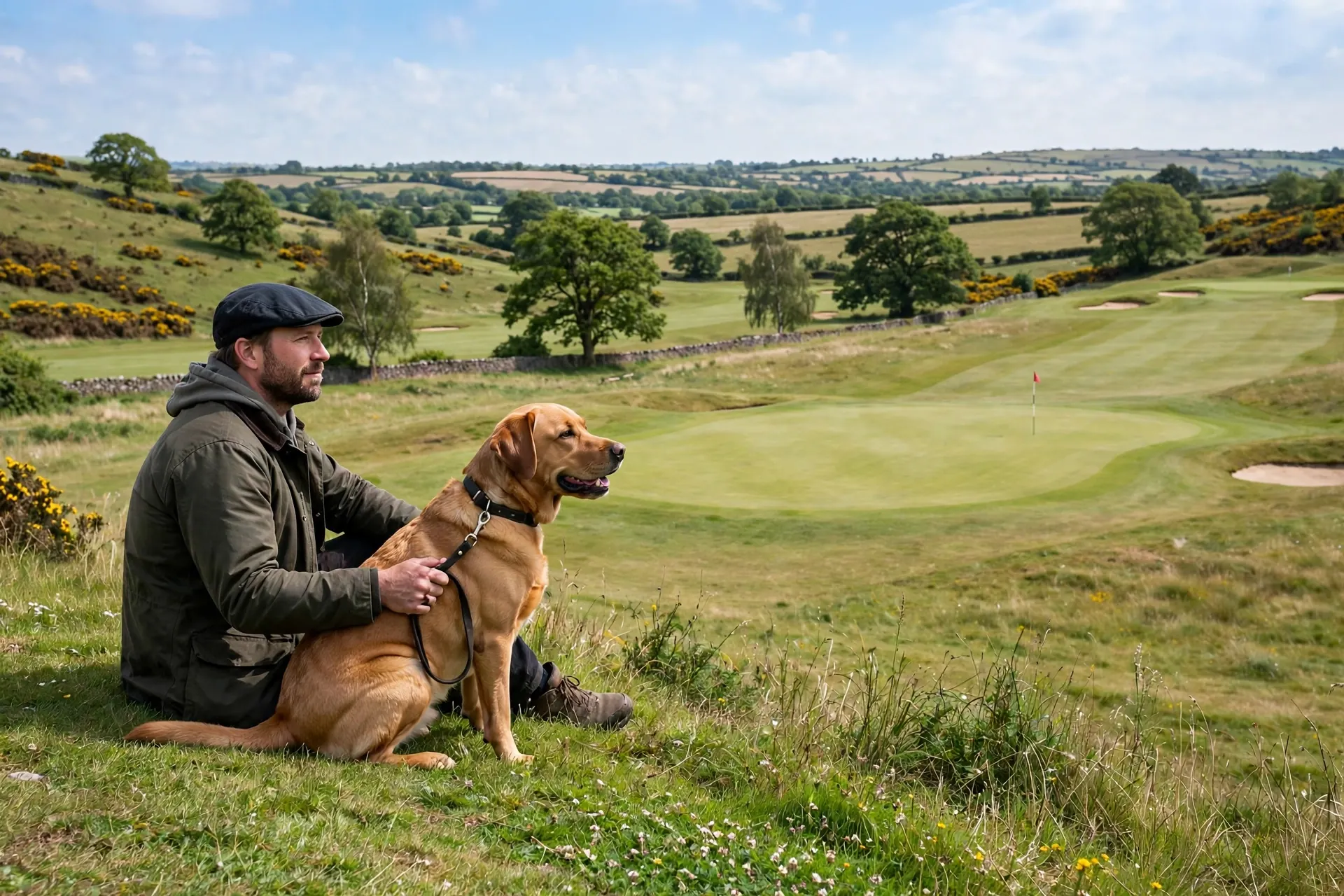
The practical approach is to plan the dog's route hole by hole. Walk on the fairway edges, the rough or the paths rather than cutting across greens or through bunkers. When your group reaches a green, settle the dog well to the side, on the approach side if possible, and away from the line of putts. Keep the lead short and the dog still while anyone putts, and do not let the dog wander onto the green to greet another player or to investigate the flagstick. The flagstick itself is a magnet for curious dogs, so keep the dog at a distance from it and from the hole. If the dog needs a toilet break, take it on the rough or on a path well away from any green, tee or bunker, and clean up immediately and completely.
Damage is not only about paws. Wet paws on a dry green, muddy paws after rain, and claws on a soft surface after watering can all leave marks. On wet days, carry a towel and wipe the dog's paws before approaching a green area, and be ready to keep the dog further back than usual. On dry, hot days, the issue is different: greens may be watered and soft, and a dog that runs across them can leave deeper prints. Either way, the rule is the same: the dog does not go on the green, whatever the weather. If your dog is struggling to settle near greens, walk the dog a little further away, let it sniff and relax, and rejoin the group once putting is finished rather than forcing a long, tense wait beside the flag.
It is worth explaining this rule to everyone in your group before the first tee, not just to the person handling the dog. Playing partners who understand why the dog is waiting to the side are less likely to invite it onto the green for a photograph or to call it over during a putt. Children in the group, in particular, may not realise that a green is a playing surface rather than a lawn, so a brief explanation at the start of the round prevents most problems. If a course has a specific local rule about dogs and greens, follow that rule even if it is stricter than the general guidance here, and check the official guidance before you travel if the course website is unclear.
Leads, fouling and other players
A lead is not optional on most courses, and it is worth choosing the right one for the job. A short, fixed-length lead gives you the most control near tees, greens and paths, and it prevents the dog from drifting into another player's line or onto a green while you are distracted by your own shot. Retractable leads are a poor choice on a golf course: they allow the dog to roam several metres, they can tangle around other players or equipment, and they make it harder to pull the dog close quickly when a ball is struck or a buggy passes. A hands-free waist lead can work for a calm dog on open fairways, but it still needs to be short enough to keep the dog beside you, and you should be able to gather it in one hand instantly.
Fouling rules on a golf course are the same as anywhere else in public, but the stakes feel higher because the ground is a playing surface. Pick up after your dog immediately, every time, and carry the bag to a bin rather than leaving it beside a path or hanging it from a fence. Bring more bags than you think you will need, because a long round on a large course can take four hours or more, and a dog that has had a change of routine, travel and excitement may need to go more than once. If there are no bins on the course, carry a sealed bag holder and take the waste with you; leaving it, even briefly, is not acceptable on a course where other players will walk the same ground.
Consideration for other players extends beyond fouling. Keep the dog quiet during swings and putts, and move the dog away from the tee before anyone addresses the ball. If the dog barks, do not shout over it or make a scene; move calmly away, settle the dog, and apologise briefly once play has resumed. Most golfers will accept a single interruption graciously, especially if they can see that you are taking it seriously. Repeated barking is a different matter, and it is the handler's responsibility to recognise when the dog is not coping and to leave the course, even if that means abandoning the round. A short, enjoyable visit that ends early is far better than a long round that ends with a complaint to the clubhouse.
Meeting other dogs on the course deserves a plan too. Two dogs on leads meeting on a narrow path can quickly become a tangled, noisy encounter, and on a golf course that encounter will disturb play as well as stress both dogs. When you see another dog approaching, step off the path, put your dog on the far side away from the other dog, and keep moving calmly past without stopping for a greeting. If the other dog is off the lead, which should not happen on a course but occasionally does, keep your dog close, avoid eye contact between the dogs, and move steadily away. The same approach works for encounters with walkers, joggers and other course users who may not expect to meet a dog around the next corner.
Water, shade and the long round
A round of golf is long, and a dog's needs during that time are easy to underestimate. Eighteen holes typically take three and a half to four and a half hours, much of it spent waiting between shots, and a dog that is used to a forty-minute walk may find that duration tiring, boring or stressful. Water is the most important item to carry: bring a bottle for the dog as well as for yourself, and a collapsible bowl, and offer water at every few holes rather than waiting until the dog is panting. Do not rely on course ponds, streams or water hazards for drinking water, because they may contain algae, fertiliser runoff or other hazards, and a dog that drinks from a pond may also disturb play or damage the bank.
Shade is the second essential. Golf courses are often open, with little natural shade on fairways, and a dog waiting in direct sun for several hours can overheat quickly, especially brachycephalic breeds, older dogs and dogs with thick coats. Plan shade stops at trees, shelters and the clubhouse terrace, and carry a lightweight shade cloth or a cooling mat on hot days if the course allows it. Watch for the early signs of overheating: heavy panting that does not settle, drooling, a reluctance to walk, or a dog that seeks shade and lies flat. If you see those signs, stop play, move to shade, offer water in small amounts, and cool the dog gradually. Do not wait until the dog is in distress to act, and do not continue a round in high heat because the group is keen to finish.
Weather changes the calculation in both directions. In cold, wet weather, a dog that is standing still for long periods between shots can become chilled, especially a small, older or short-coated dog. A waterproof coat, a towel for drying, and a warm layer for waits on exposed holes all help, and a shorter round is a sensible choice in winter. In summer, early morning or late afternoon rounds are cooler and quieter, and they reduce the risk of heat-related problems. Check the forecast before you travel, and be willing to change your plans if the weather turns extreme. A dog that is comfortable will be quieter and easier to manage, which makes the whole round better for everyone.
Food and toilet planning complete the picture. Feed the dog at the usual time if possible, and avoid a large meal immediately before the round, which can cause discomfort during a long walk. Give the dog a proper toilet opportunity before the first tee, and build in toilet stops on the rough or on paths during the round, well away from greens and tees. Carry treats for quiet rewards, but use them sparingly and discreetly, so that the dog is not rustling, crunching or begging noisily during someone's swing. A small treat pouch that opens quietly is worth more on a golf course than a noisy packet of biscuits, and a calm, rewarded dog is far easier to keep settled through a long round.
Pace of play and your playing partners
Pace of play is one of the most sensitive topics in golf, and a dog inevitably slows a group down a little. Settling the dog at each green, picking up after it, carrying water and keeping it clear of other groups all take time. The way to handle this is to be honest about it before the round, to keep the group moving efficiently, and to let faster groups play through when the course allows it. If you are playing with strangers, tell them at the first tee that you have a dog with you, explain how you will manage it, and ask them to tell you immediately if the dog is disturbing their play. That conversation, held early and calmly, prevents most friction later.
Practical pace habits help more than any apology. Be ready to play when it is your turn, rather than settling the dog and then searching for a club. Keep the dog's waiting spot close to where you will play from, so that you are not walking back and forth between the dog and the ball. If the dog needs a toilet stop, take it while others are playing, not when it is your turn to hit. If the group behind is waiting, and the course etiquette allows it, wave them through at a suitable hole rather than rushing a stressed dog through the next three holes. Most golfers would far rather play through once than follow a slow, tense group for nine holes.
Communication within your own group matters just as much. Agree before the round who is responsible for the dog at each stage, especially if the handler is also playing. A dog that is passed between players, or that is left with someone who is not paying attention while they prepare to putt, is a dog that will wander. If one person in the group is not playing, that person is the natural dog handler, and the round will go far more smoothly. If everyone is playing, take turns handling the dog, and make sure the handler is never the player who is about to take a shot. A simple rota, agreed at the first tee, avoids confusion and keeps the dog's care consistent throughout the round.
Finally, know when to stop. A dog that is barking repeatedly, pulling constantly, panting heavily or showing signs of stress is telling you that the round is too long, too hot, too busy or simply too much for today. Leaving after nine holes, or even after six, is not a failure; it is good dog ownership and good golf etiquette. The course will still be there another day, and a dog that leaves on a positive note is far more likely to enjoy its next visit than a dog that is pushed through a miserable afternoon. Thank your playing partners, apologise briefly if the dog disturbed play, and make a note of what to change next time: a quieter tee time, a shorter round, more shade stops, or more settling practice at home.
Links, parkland and the driving range
Not all golf courses present the same challenge for a dog, and choosing the right type of course for your dog's first visit can make a real difference. Links courses, found mainly on coastal dunes, are open, windy and exposed, with few trees, firm turf and long views. For a dog, that openness can be both a blessing and a problem: there is plenty of space to keep clear of other groups, but there is little shade, the wind carries sound and scent, and the course is often shared with walkers, wildlife and grazing animals. A dog that is easily distracted by rabbits or by distant movement may find a links course overstimulating, and a dog that dislikes wind may struggle to settle on an exposed green.
Parkland courses, the most common type inland, are set among trees, hedges and landscaped grounds, with more defined fairways and more natural shade. For many dogs, parkland is the easier introduction: trees provide shade stops, hedges give a sense of boundary, and the layout tends to keep groups more separate. The challenges are different rather than absent. Woodland edges attract squirrels and birds, leaf litter can hide hazards, and narrow tree-lined paths can make meeting another dog or another group more sudden. On a parkland course, keep the dog on the fairway side of the trees rather than letting it disappear into the woodland, and be alert for ticks after a round in long grass or bracken, checking the dog thoroughly at home.
The driving range is a useful stepping stone that many dog owners overlook. A range session is short, it takes place in one location, and it lets the dog experience the sound of struck balls, the sight of other players and the atmosphere of a golf facility without the commitment of a full round. Some ranges welcome dogs on a lead in the seating area or on the terrace, while others do not allow dogs near the bays at all, so check before you go. A successful range visit, where the dog lies quietly for twenty or thirty minutes while balls are hit nearby, is excellent preparation for a course visit, and it gives you a realistic sense of whether your dog is ready. If the dog cannot settle at a range, it is unlikely to settle on a course, and that knowledge saves everyone a difficult round.
Other formats are worth considering too. A nine-hole course, a par-three course or a pitch-and-putt course offers a shorter, less formal introduction, often at a lower cost and with a more relaxed atmosphere. These courses may also be more tolerant of dogs, because the stakes of a disrupted putt are lower and the pace is often slower. A short course is also a better fit for an older dog, a puppy that is still learning, or a dog that tires quickly. Whichever type of course you choose, the same rules apply: quiet, on a lead, off the greens, and clear of other players. The course type changes the scenery and the distractions, but it does not change the etiquette.
Before you go: a practical checklist
A little preparation at home makes the course visit far easier. Start with the basics: a short fixed lead, a spare lead, plenty of waste bags, a water bottle and a collapsible bowl, a towel, and a treat pouch. Add a settling mat or a familiar blanket if your dog uses one, because a familiar scent helps a dog relax in a new place. Pack a waterproof coat for the dog in wet or cold weather, and a cooling aid in hot weather. Bring the dog's usual food if the visit will span a mealtime, and a small first-aid kit that includes tick removers, antiseptic wipes and any medication your dog needs. Check that your dog's identification tag is secure and that the microchip details are up to date, because a large, open course is a place where a loose dog can travel a long way quickly.
Training preparation matters as much as packing. Before the course visit, practise the skills the dog will actually need: settling on a mat for several minutes while you stand nearby, walking calmly on a short lead past distractions, waiting quietly while you stand still, and ignoring balls, other dogs and wildlife. Practise in a park or a garden first, with gradually increasing distractions, rather than expecting the dog to learn these skills on the first tee. A dog that can settle for ten minutes at home while you chat to a neighbour is well on the way to settling beside a green. A dog that cannot settle for two minutes in a quiet garden is not ready for a golf course, and no amount of equipment will compensate for that gap.
On the day, arrive early and give the dog time to adjust. Let the dog toilet before the round, walk the car park and the practice area, and watch how the dog responds to the sounds of the course. Check in with the clubhouse staff, confirm the dog policy for the day, and ask where the dog is welcome and where it is not. Tell your playing partners about the dog, agree who will handle it, and agree a plan for what happens if the dog cannot settle. That plan might be as simple as one person taking the dog back to the car or to the terrace while the others finish the round, and having it agreed in advance removes the pressure of deciding in the moment.
After the round, the dog's day is not quite finished. Check for ticks, burrs and cuts, especially after parkland or links courses, and clean muddy paws before the car journey home. Offer water and a quiet rest, and watch for any signs of overheating, lameness or stress that may have been masked by excitement during the round. If the dog enjoyed the visit, note what worked: the tee time, the course type, the shade stops and the settling routine. If the visit was difficult, note that too, and adjust one thing at a time for the next visit rather than changing everything at once. A calm, well-planned course visit can become a regular pleasure for both dog and owner, and it starts with the simple decision to put etiquette first.
For other days out that pair well with a round, our guides to garden centres and coffee chains cover the shopping and cafe stops that work after a morning on the course, including lead rules, seating and where dogs are welcome indoors.
Practical questions
Before you go
Are dogs allowed on all UK golf courses?
No. Policies vary by course, and some courses do not allow dogs at all while others allow them only on a lead, only at certain times, or only in the clubhouse grounds. Always check the course's own rules before you travel, and get the answer in writing if you are booking a round.
Can my dog walk on the greens or in the bunkers?
As a general rule, no. Greens are delicate playing surfaces and bunkers are hazards that are easily damaged by paws and digging. Keep your dog on the fairway edges, the rough or the paths, and well away from greens, tee boxes and bunkers unless the course explicitly says otherwise.
Should my dog stay on a lead on a golf course?
Yes, in almost every case. A lead keeps your dog out of other players' lines, away from flying balls and clear of greens and bunkers. Even a well-trained dog can be startled by a shouted warning or a ball landing nearby, so keep the lead short near tees, greens and paths.
What should I do if my dog barks during someone's swing?
Move away quietly, settle the dog, and apologise briefly once play has resumed. Prevention matters more than apology: keep distance from tees and greens, watch for the signs that your dog is about to bark, and be ready to step aside before a player addresses the ball.
Can my dog ride in a golf buggy?
Only if the course allows it, and many do not. Ask before you book, and never let a dog ride unrestrained or jump in and out of a moving buggy. If buggies are not an option, plan a shorter round or a walking route that suits your dog's fitness and the weather.
What should I pack for a dog on a golf course?
Pack a short lead, waste bags, water and a collapsible bowl, a towel for wet grass, and shade or a cooling aid on warm days. Add a spare lead, a treat pouch for quiet rewards, and a plan for a toilet stop before the first tee so the round starts calmly.