This guide is independent and contains no paid placement. Screening rules change from event to event, so always check the official guidance before you travel and the listing for the exact date you plan to attend.
Pick a shorter, earlier, quieter screening; sit at the edge with a clear exit route; give the dog its own blanket, water and something to chew; and plan toilet breaks and an early exit before you sit down. If the dog cannot settle in a busy, noisy, dark field, a cinema night is the wrong evening out, however dog-friendly the listing looks.
Think in evenings, not in films
Most guides to dog-friendly days out describe a venue. An outdoor cinema is better understood as an evening: travel in daylight, waiting in a queue, settling on damp grass, two hours of sound and moving light, a cold final half hour, and then a crowded walk back to the car in the dark. A dog does not watch the film. A dog experiences the whole evening, and the film itself is only the middle section. Planning around that middle section alone is why otherwise sensible owners end up with a restless dog at 10.30pm and no graceful way out.
Start from the end and work backwards. What time will you actually get home? How long will the dog have gone without a proper toilet break? How cold will it be when the sun has been down for two hours? How will you carry a blanket, a chair, a bag and a lead through a dispersing crowd while keeping the dog close? If any of those answers is awkward, fix it before you book: choose a nearer venue, a shorter film, an earlier start, or a night when someone else can stay with the dog. The film choice matters less than the shape of the evening around it.
That evening shape also explains why two dogs can react so differently to the same event. A dog that sleeps through a busy pub garden may still struggle at an outdoor screening because the sound comes from large speakers, the light flickers, and everyone around sits still for a very long time while facing the same way. A dog that is brilliant on a long walk may be terrible at lying still for two hours. Neither dog is being difficult. The setting simply asks for a skill — long, calm settling in a stimulating place — that not every dog has practised, and that no amount of enthusiasm from the owner can substitute for on the night.
It helps to treat the first outdoor cinema as a trial, not as a tradition. Choose a low-stakes screening, accept that you might leave halfway through, and judge the evening by the dog, not by whether you saw the ending. A dog that settles for forty minutes and then needs to leave has still had a useful first experience, provided the exit was calm. A dog that is pushed through two uncomfortable hours because tickets were expensive has learned that cinema evenings are something to dread. The cheaper lesson is the better one.
Choose the screening: volume, length and weather
Volume is the first filter, and it is the hardest to check in advance. Outdoor screenings use PA speakers sized for a field, not a living room, and sound carries differently outdoors: there is no wall to absorb it, and a breeze can push it in unexpected directions. Listings rarely publish decibel figures, so use proxies. A large festival-style screening with a stage, live music before the film, or a crowd in the thousands will be louder than a small garden or courtyard screening for a few hundred people. A screening billed as family-friendly, with an earlier start and a children's film, is often — not always — mixed at a lower level than a late-night blockbuster with heavy action sound. If the organiser offers a quieter or relaxed screening, take it for a first visit, even if the film is not your first choice. If you cannot find any information about sound, check the official guidance before you travel, and ask the organiser directly what the speaker layout is and whether there is a quieter area.
Length is the second filter, and it is the one owners most often underestimate. A film advertised as 100 minutes means at least two and a half hours on site once you add gates, trailers, an interval if there is one, and the exit. A three-hour epic, plus a late start, can mean a dog lying on cold grass from 8pm until nearly midnight. For a first visit, look for a film under 100 minutes, ideally a comedy, animation or gentle drama without long battle scenes, car chases or sudden loud effects. Shorter does not mean less enjoyable: a dog that copes well for ninety minutes and goes home happy is a better result than a dog that endures a classic and goes home stressed.
Start time matters as much as length. Many UK outdoor screenings start at sunset, which in midsummer can mean 9pm or later, with the film finishing after 11pm. In spring and early autumn, sunset comes earlier, the evening cools sooner, and the whole event can be over at a more dog-friendly hour. An early-evening screening, where it exists, gives you daylight for arrival and settling, a shorter period of darkness, and a journey home that does not feel like the middle of the night. If the only option is a very late start, weigh it honestly against your dog's normal bedtime and last toilet routine. Dogs, like people, have a point in the evening after which settling gets harder rather than easier.
Weather is the third filter, and British weather deserves respect here because the audience cannot move indoors. Check the forecast for the venue itself, not just the nearest town, and look at wind as well as rain. Wind carries sound, flaps blankets, blows litter across the field, and chills a lying dog far faster than still air at the same temperature. A forecast of light rain may be tolerable with a waterproof layer and a groundsheet, but heavy rain, gusty wind or a thunderstorm forecast should end the plan. Organisers sometimes cancel or move a screening at short notice; check the official guidance before you travel on the day itself, and have a backup plan that does not involve standing in a field hoping the rain stops.
Genre deserves a thought too. Films with sudden silence followed by a loud jump scare, sustained gunfire, explosions or screaming will startle many dogs, even dogs that seem fine with everyday noise. Dialogue-led films, musicals with steady volume, and animations with predictable sound are usually easier, though no genre is guaranteed calm. If you know a particular sound — fireworks on screen, a siren, a dog barking in the film — is a trigger for your dog, do not test it in a field full of strangers. Choose another film. The dog will not appreciate the plot, and you will spend the screening managing a reaction instead of watching anything.
Finally, check the dog policy for that exact screening, not just for the venue in general. Some organisers welcome dogs at most screenings but exclude them from opening nights, premieres or sold-out events. Others allow dogs only in a designated area, or only on leads of a certain length, or not at all when food is served in the seating area. A blanket statement on a venue website that dogs are welcome does not guarantee that your date is covered. Read the listing, read the terms at checkout, and save a screenshot or email of the dog policy for that date. If the policy is unclear, check the official guidance before you travel rather than assuming the gate staff will be flexible.
Is your dog a good fit for sound and light?
Sound sensitivity is not the same as being frightened of thunder, though the two often overlap. A dog can be calm during a thunderstorm at home, where it knows the rooms and can retreat to a safe corner, and still struggle with amplified sound in an open field where there is nowhere to retreat and the sound seems to come from everywhere. Look at your dog's history honestly. Does it pace during fireworks, bark at sudden noises, hide when a lorry reverses, or take a long time to recover after a startling sound? Does it settle again quickly, or does it stay wired for an hour? A dog that recovers quickly from a single startle may cope with a screening if you sit far from the speakers. A dog that stays aroused long after a noise has stopped is telling you that a two-hour film will be a long accumulation of stress, not a series of small, manageable moments.
Light sensitivity is less talked about but just as real at an outdoor cinema. The screen is a large, bright, flickering surface in an otherwise dark field. Some dogs ignore it completely. Others track every movement, fixate, whine, or try to chase what moves. Dogs that are highly visually reactive — to television, to passing cyclists, to birds — are more likely to find a giant moving image hard to ignore. Seating position helps here: sitting side-on to the screen, or at an angle where the dog can look away easily, is kinder than sitting dead centre with the screen filling the dog's whole field of view. A blanket with raised sides, or a dog bed with a bolster, can also help a dog that needs a visual boundary to settle.
Age and health change the calculation. Puppies that are still learning to settle, and that have not yet been exposed to crowds gradually, are rarely ready for a full outdoor screening. Older dogs may cope beautifully with the calm settling but struggle with cold, damp ground, a long evening without a comfortable toilet break, or a walk back to the car over uneven ground in the dark. Dogs with hearing loss may seem unbothered by volume, but they can still be unsettled by vibration, crowd movement and the general atmosphere, and they cannot hear your recall if they wander. Dogs on medication, dogs recovering from surgery, and dogs with anxiety that is currently being managed should only go if the outing fits the plan you already have with your vet or behaviourist. If in doubt, check the official guidance before you travel and talk to your vet about whether this particular evening is a sensible step.
A practical test before you commit to tickets is worth more than any checklist. Take the dog to a busy, noisy, outdoor setting for a similar length of time — a summer fete, a beer garden with music, a park event — and watch what happens after the first half hour. Does the dog lie down, sigh, and doze? Does it keep scanning, shifting position, asking to move, or needing constant reassurance? Can it take a treat gently, or is it too aroused to eat? A dog that can eat, drink, yawn and lie flat in a busy place has the raw material for a cinema evening. A dog that cannot eat and cannot lie down after thirty minutes in a busy place is unlikely to improve because the setting is a film. For more on reading those early signals, see our guide to calming dog anxiety on UK trips, which covers stress signals and gradual desensitisation in more detail.
None of this means that only bombproof dogs can enjoy outdoor cinema. Many sensitive dogs do well when the conditions are right: a short film, a quiet corner, a familiar blanket, a long chew, and an owner who is prepared to leave early. The judgement is not about labelling the dog as sensitive or not. It is about matching the dog you have, on this evening, to the screening in front of you, and being willing to change the plan when the match is wrong.
Seats, blankets and the route in and out
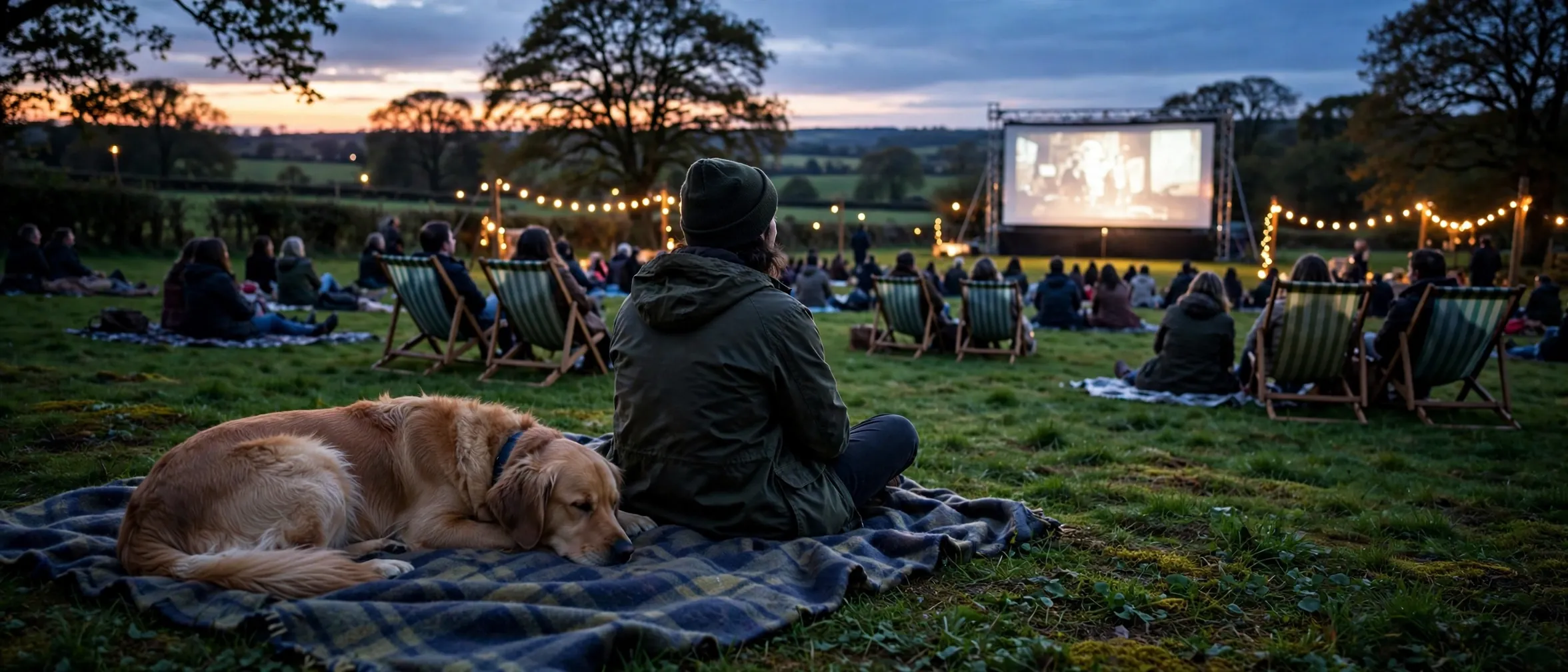
Where you sit matters more than what you sit on. The best dog spot at an outdoor cinema is usually at the edge of the audience: the back row, a side aisle, or a corner where only one side faces other people. An edge spot gives the dog fewer neighbours to monitor, fewer hands reaching over to say hello, and fewer feet to dodge when someone goes for food. It also gives you the most important thing of all, a clear route out that does not cross other people's blankets. In the middle of a crowd, every toilet trip becomes an obstacle course of picnic rugs, guy ropes, cables and sleeping children. At the edge, it becomes a short, calm walk.
Distance from the speakers is the next decision. Sound falls off with distance, so sitting further back is the simplest volume control you have. The trade-off is the view, which matters less than it seems: outdoor screens are large, and a slightly smaller picture from the back is a small price for a dog that can actually relax. Avoid sitting directly beside a speaker stack, under a speaker on a pole, or in a natural bowl where sound collects. If you arrive and realise the speaker is right behind your blanket, move before the film starts, even if the new spot has a worse view. Moving after the lights go down is harder for everyone.
Think about the blanket itself as the dog's territory for the evening. A blanket that smells of home, laid out in the same orientation as the dog's bed at home, settles many dogs faster than a brand-new picnic rug. Put the dog's blanket slightly behind or beside your seating, not in the main walkway, and keep the lead attached to you or to a fixed point you control, never tied to a chair that could move. Leave a little slack so the dog can shift position and lie flat, but not so much slack that the dog can wander into the next blanket or tangle around a stranger's legs. A short lead for crowded moments and a slightly longer lead for settling moments is a useful combination, and it is worth practising the switch at home before the night.
Plan the route in the same way you would plan a fire exit. When you arrive, walk the dog from your blanket to the toilet area, to the water point if there is one, and to the exit, before you unpack anything. This does two jobs at once: the dog learns the route while it is still daylight and relatively quiet, and you learn where the trip hazards, gates, steps and dark corners are. Note where the ground changes — from grass to gravel, from flat to sloping — because a dog that is fine on grass may hesitate on gravel in the dark. If the route passes through the densest part of the crowd, look for an alternative along the edge, even if it is slightly longer. A longer calm route beats a shorter stressful one every time.
Seating type also affects the dog. Deckchairs and camping chairs are fine, but a low picnic setup, where you sit on the ground beside the dog, often settles a dog faster because you are at its level and can offer a calm hand without leaning over. If you do use chairs, keep the dog's blanket clear of chair legs and make sure a folding chair cannot collapse onto a paw. Bring a groundsheet under the blanket if the grass is damp: a cold, wet blanket is one of the fastest ways to turn a settled dog into a restless one. A small, raised dog bed can help on wet ground, provided it is stable and the dog is used to it.
Finally, think about neighbours. A brief, friendly word when you arrive — that your dog is friendly but settling, that you may need to slip out during the film, that a treat is welcome or not — prevents most misunderstandings. Most people at a dog-friendly screening expect dogs and are tolerant, but nobody enjoys a lead across their picnic or a dog investigating their food. A little courtesy at the start buys a lot of tolerance later, especially if you do need to leave halfway through.
Arrive early and settle before dark
Arriving early is not about getting the best view. It is about giving the dog time to adjust while the field is still half empty, the light is still good, and the sound system is not yet at full volume. Aim to arrive at least forty-five minutes before the advertised start, and longer if the venue is large or the queue for entry is likely to be slow. Use that time deliberately: a toilet walk on arrival, a sniff around the edge of the field, a drink, and then settling on the blanket while other people are still arriving. A dog that has already investigated the field is far less likely to be overwhelmed when the crowd thickens and the music starts.
Keep the arrival routine boring and predictable. The same sequence you use at home before a rest — toilet, water, a short settle, a chew — works just as well in a field, and familiarity is calming in an unfamiliar place. Avoid stacking novelties: a new blanket, a new harness, a new chew, a new group of friends and a new venue all on the same evening is a lot for any dog. Change one thing at a time. If the blanket is new, make sure the chew is familiar. If the venue is new, make sure the lead and harness are the ones the dog already trusts.
Exercise before the screening helps, but timing matters. A good walk earlier in the day, or a calm sniffy walk near the venue before gates open, takes the edge off restlessness without tiring the dog to exhaustion. A frantic game of fetch immediately before the film, by contrast, can leave a dog aroused and panting just as you need it to lie still. Aim for pleasantly tired, not wired. For older dogs or dogs with limited stamina, a short toilet walk and a chance to sniff is enough; do not add a long walk on top of a long evening.
Feeding needs a similar balance. A dog that arrives hungry will be distracted by every food smell in the field. A dog that arrives having just eaten a large meal may need the toilet sooner and may feel uncomfortable lying still. A normal meal at the normal time, a few hours before the screening, plus a small snack on arrival, is a sensible middle ground. Bring the dog's usual food or treats rather than a novelty rich treat that could upset its stomach on a night when a toilet trip is already inconvenient.
As dusk falls, watch the transition. The moment when daylight fades, the screen lights up and the volume rises is the hardest part of the evening for many dogs. Stay close, keep your body language calm, and offer the long-lasting chew or enrichment toy you saved for this moment. Do not make a fuss, do not repeatedly reassure in an anxious voice, and do not force the dog to look at the screen. A calm owner, a familiar blanket and something to chew will do more than any amount of talking. If the dog settles within ten minutes of the film starting, the evening is likely to work. If it is still pacing, panting or whining after twenty minutes, that is information, not failure — and it may be time to use the exit plan you made on arrival.
During the film: settling, food and other dogs
Once the film is running, your job is mostly to be boring. Sit still, keep the lead loose, and let the dog doze. The dogs that cope best at outdoor cinema are usually the ones whose owners do the least: no constant stroking, no stream of treats every minute, no whispered commentary. Occasional calm touch is fine, especially if the dog seeks it, but a dog that needs continuous handling to stay settled is a dog that is not really settled. Watch the body, not the film, for the first twenty minutes. A dog that sighs, lies on its side, and lets its eyes close is comfortable. A dog that lies with its head up, ears pricked, scanning every movement, is coping rather than relaxing, and may need a quiet break.
Chews and enrichment are your best tools, used sparingly. A long-lasting chew, a lick mat with a smear of something the dog already tolerates, or a stuffed enrichment toy can give a dog a job to do while everyone else watches the screen. Choose something quiet — no squeakers, no crinkly packaging, no bone that will be dropped and rolled under a neighbour's chair. Save the best chew for the middle of the film, when attention is most likely to wander, rather than using it all up before the trailers. And keep water within reach throughout: dogs pant more when they are warm or mildly stressed, and a dog that has to ask for water is a dog that will get up and move.
Food smells are one of the biggest challenges of an outdoor cinema, and they are everywhere: popcorn, hot dogs, burgers, chips, sweets and other people's picnics. Train a reliable leave-it before you go, and keep your own food in closed containers rather than open bags at nose height. Never give a dog food from a cinema stall unless you are certain it is safe for dogs; chocolate, onions, garlic, grapes, xylitol and cooked bones are all dangerous, and even plain popcorn can be a choking risk for some dogs. If neighbours offer your dog food, a polite refusal is perfectly acceptable, and it is easier if you have said so when you arrived.
Other dogs are the other major variable. At a dog-friendly screening you will be surrounded by dogs you do not know, some of them off-lead in their owners' laps, some of them reactive, some of them puppies that want to say hello to everyone. Keep your dog on lead throughout, even if other owners let theirs wander, and do not allow on-lead greetings in the seating area: two dogs meeting nose-to-nose on short leads, in a tight space, with nowhere to retreat, is a classic recipe for a snap. If another dog approaches yours, step calmly between them, move your dog a little to the side, and carry on. Your dog does not need to meet every dog in the field to have a good evening.
Children add a further layer. Many family screenings have children running between blankets, dropping food, and wanting to stroke every dog they see. This is lovely when your dog enjoys children and tiring when it does not. If your dog is nervous around children, sit away from the family area if you can, and be ready to advocate for the dog: a friendly but firm request not to stroke a resting dog is reasonable, and most parents will understand if you explain briefly. Do not let a child feed your dog, and do not let a dog that is already aroused be petted by strangers in the dark.
Toilet breaks and leaving without a fuss
Toilet planning is where many cinema evenings quietly fail. A dog that has been lying still for two hours, in a stimulating place, with water available, will very likely need the toilet before the credits roll, and a dog that needs the toilet but cannot get to a suitable spot will become restless, vocal or distressed. Build at least one planned toilet break into the evening, even if the dog seems fine. The interval, if there is one, is the obvious moment. If there is no interval, choose a quiet scene — a long dialogue passage, a musical number, a slow stretch — rather than waiting for a dramatic climax when everyone else is also moving.
Use the route you walked on arrival, keep the lead short through the crowd, and take a torch even if the venue is lit, because the path to the toilet area is often darker than the seating area. Carry poo bags in a pocket, not in a bag left on the blanket, so you are never caught without them. Clean up immediately, even in the dark and even if the ground is rough; outdoor venues rely on dog owners doing this properly to keep welcoming dogs, and a single badly managed evening can change a venue's policy for everyone. If the venue has a designated dog toilet area, use it. If it does not, choose a discreet grass edge away from seating and food areas, and clean up thoroughly.
Leaving early should be planned, not improvised. Decide before the film starts what your exit signal is: persistent pacing after twenty minutes, repeated whining, panting that does not settle, attempts to leave the blanket, or any sign of distress. When you see that signal, leave calmly and without apology. Packing up in the dark is easier if you have kept your belongings together, your lead is already in your hand, and your route to the exit is the edge route you identified on arrival. Do not wait for a convenient scene if the dog is distressed; a calm early exit is better than a dramatic late one. You can always watch the ending at home.
The final exit, when the whole audience leaves at once, needs its own plan. If your dog is stressed by crowds, wait five or ten minutes after the credits, let the main rush pass, and then walk out at your own pace. If your dog is cold or tired, the reverse may be better: leave promptly, before the crowd thickens around the exit gates. Either way, keep the dog close, the lead short, and your torch on. Car parks after an outdoor screening are busy, dark and full of reversing cars and people who are not looking for dogs at ankle height. Walk on the pavement or the marked pedestrian route where one exists, and do not let the dog off lead in the car park, however tempting it is after a long evening of lying still.
Once home, give the dog a final toilet break, fresh water and a chance to settle in its own bed before you go to sleep yourself. A short, calm wind-down at home — a few minutes of quiet company, no exciting play — helps the dog process the evening. If the dog was stressed, do not punish or scold it for anything that happened during the film; it was coping as best it could. Note what worked and what did not, while it is fresh: the screening length, the seating position, the chew that helped, the moment the dog started to struggle. That note is what turns one trial evening into a better second evening, if there is one.
What to pack for a night screening
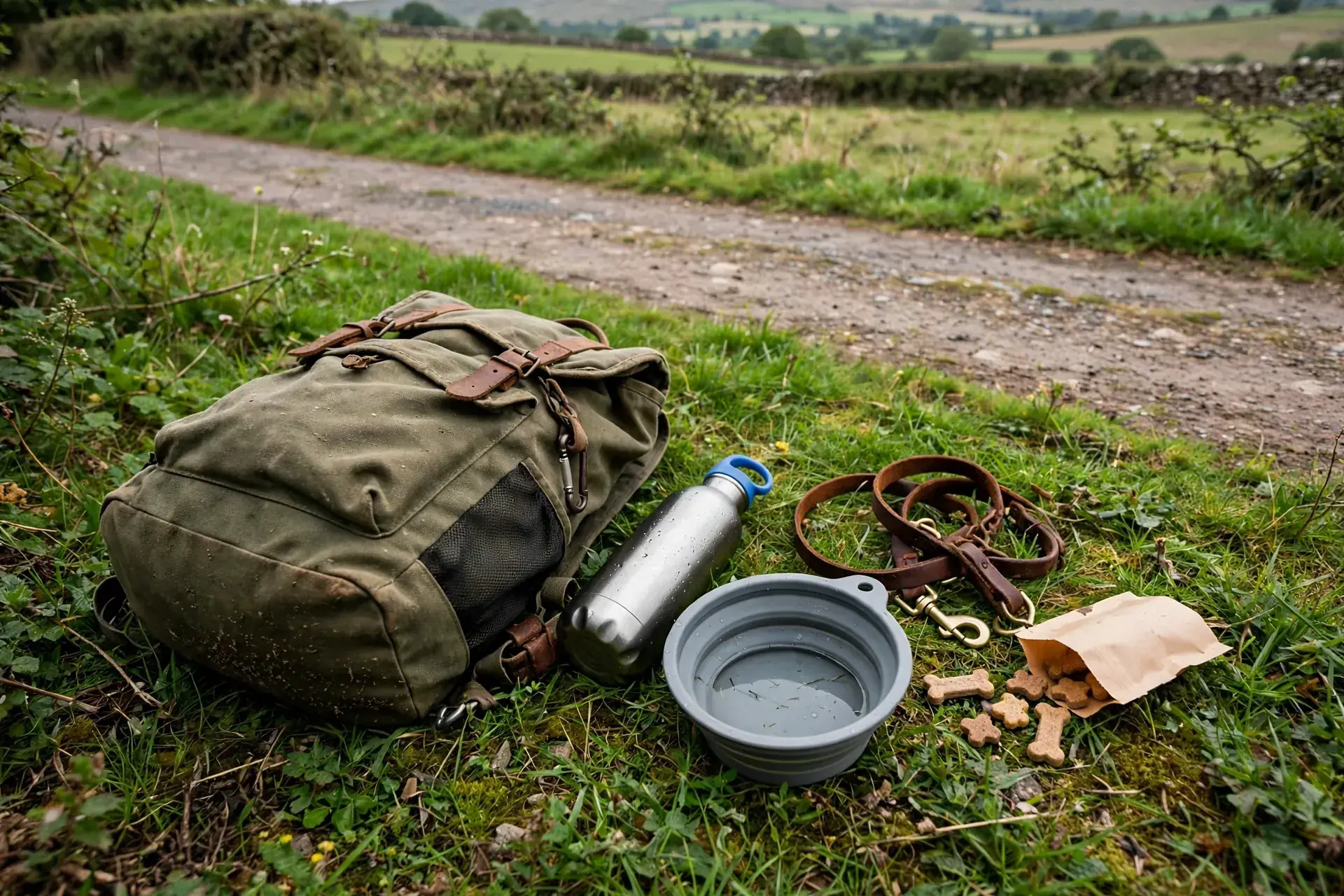
Packing for an outdoor cinema is different from packing for a day trip, because the evening adds cold, darkness and a long period of stillness. Start with the dog's own kit: a familiar blanket or bed, a groundsheet to go underneath it, a lead and a spare lead, a harness or collar the dog is comfortable wearing for hours, water and a bowl that will not tip over on grass, poo bags, a towel, and a warm layer such as a dog coat or fleece for later in the evening. A coat is not overkill in a British summer evening: temperatures can drop several degrees after sunset, and a lying dog loses heat faster than a walking one. If your dog does not normally wear a coat, introduce it at home first rather than on the night. Our dog day trip packing list covers the general day-out essentials in more detail, and most of it transfers directly to an evening screening with the addition of warmth and light.
For settling, pack a long-lasting chew the dog already knows, an enrichment toy that is quiet, and a small supply of the dog's usual treats for rewarding calm behaviour. Avoid anything new, rich or noisy. A lick mat can be useful if the dog already uses one at home, but take a version that will not slide around on grass, and bring a bag to take it home in. A familiar-smelling item — the blanket from the dog's bed, a worn item of your clothing if the dog finds it comforting — can help more than any new product. Do not rely on calming supplements, sprays or gadgets you have never tried: if you are considering a calming aid, try it at home first, and check the official guidance before you travel if you are unsure whether it is appropriate for your dog.
For you and the practical side, pack a torch with a red-light option if you have one, because red light disturbs neighbours less than white light when you walk to the toilet area. Pack a phone charger or a power bank, because you may need the phone for the journey home and for checking the organiser's updates. Pack wet wipes, a spare bag for rubbish, and a small first-aid kit for the dog, including anything the dog normally needs. If the venue allows chairs, bring a chair you can sit in for two hours without fidgeting; if it is blanket-only, bring a cushion or a low camping seat so you are not shifting around and disturbing the dog. Finally, pack a bag that closes properly. An open tote bag in a field at night is an invitation for a curious dog — yours or someone else's — to investigate.
Weather, cold and wet grass
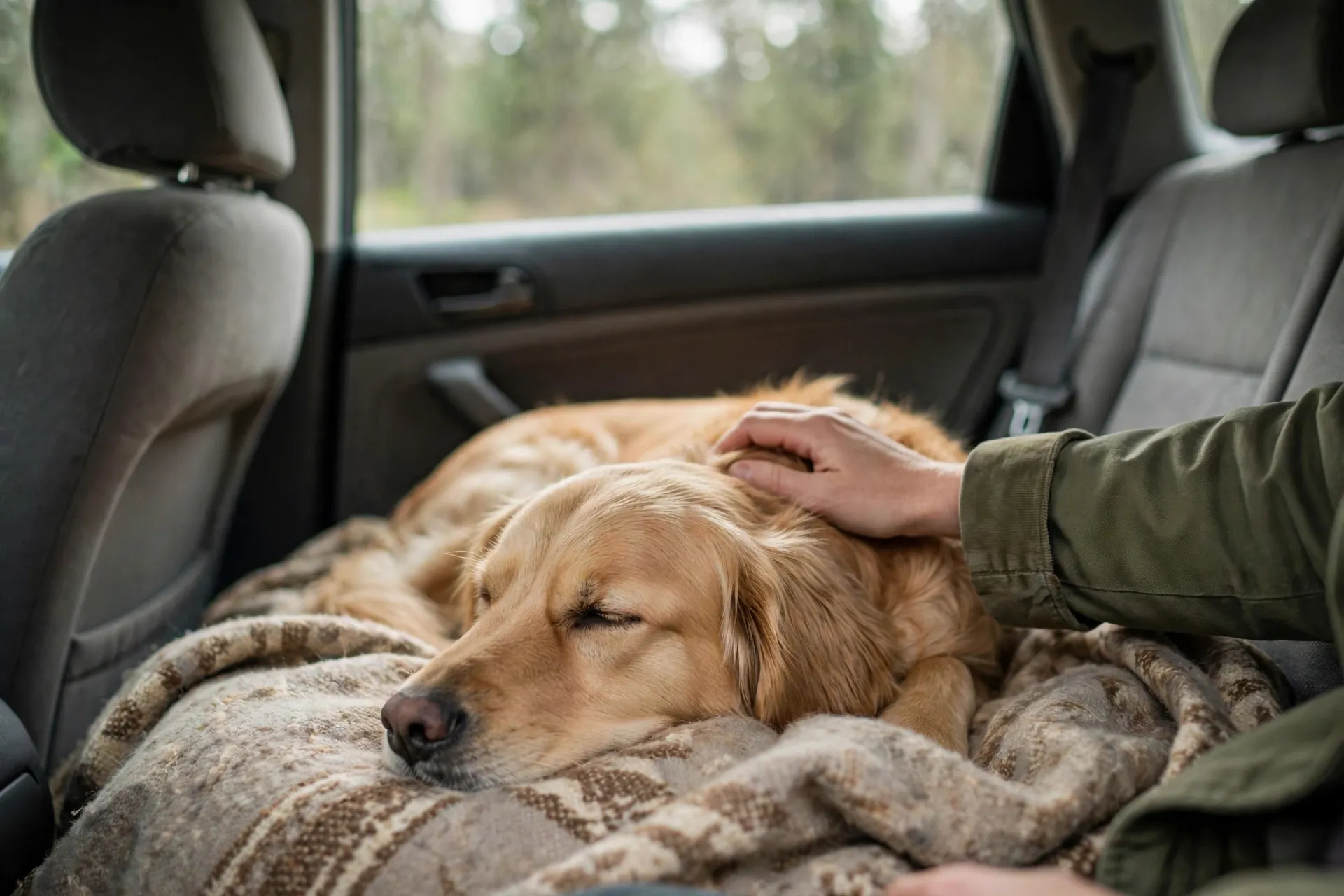
British outdoor cinema runs through the same weather that makes British picnics a gamble, and the dog feels it first. A dog lying on grass is in contact with the ground for the whole film, so ground temperature and dampness matter more than air temperature alone. A waterproof groundsheet, a raised bed or a thick blanket with a waterproof backing will keep the dog drier and warmer than a thin picnic rug. Check the ground when you arrive: if it is already wet, add the groundsheet before the dog settles, not after it has been lying on damp grass for an hour. If the grass is muddy, a towel for paws and a spare blanket for the journey home will save the car as well as the dog.
Cold is cumulative. A dog that is comfortable at 9pm may be shivering by 10.30pm, especially a short-coated, small, elderly or lean dog. Watch for shivering, curling tightly, tucking the tail, or seeking your body heat: these are signs to add the dog coat, move to a more sheltered spot, or leave. Do not wait until the dog is visibly miserable. A dog coat, a blanket over the back, and a warm drink of water — not hot — can extend the evening comfortably. For dogs that will not wear a coat, a thicker blanket and a sheltered position out of the wind are the alternatives. Wind chill is the hidden factor: a sheltered corner behind a hedge or a wall can be several degrees warmer than an exposed hilltop, even at the same venue.
Rain changes the decision entirely. Light drizzle with a waterproof layer and a groundsheet is manageable for a settled dog, though the audience will be in waterproofs and the atmosphere will be different. Steady rain, on the other hand, soaks blankets, chills dogs, makes the walk to the toilet area slippery, and often leads to a miserable exit through mud. Check the organiser's wet-weather policy before you book: some screenings go ahead in rain, some move indoors, some offer a transfer to another date. Do not assume a refund if you decide not to go in rain; check the terms at booking, and check the official guidance before you travel on the day. If the forecast is genuinely bad, the kindest decision for the dog is often to stay home, however disappointing that is for the humans.
Heat, though less common in the evening, still deserves a note for early summer screenings that start before sunset. A dog sitting on a dark blanket in direct sun, with no shade and no breeze, can overheat quickly. Bring water, offer it regularly, and move to shade if the dog is panting heavily before the film even starts. Never leave a dog in a parked car while you queue or buy food, even for a few minutes on a warm evening: car temperatures rise fast, and an outdoor screening queue is not a quick errand. If you need to leave the car, take the dog with you or wait in the car with the dog.
Rules, safety and the law in brief
The legal basics for a dog at a public event in the UK are straightforward, but worth stating plainly. You are responsible for your dog's behaviour, and you must clean up after it. The Dangerous Dogs Act 1991 and related legislation mean that certain types of dog are subject to specific controls, and individual venues may have their own breed or size conditions in addition to the law; declare your dog honestly at booking and check the official guidance before you travel if you are unsure how any rule applies to your dog. Keep the dog on a lead unless the venue explicitly allows off-lead areas, and keep it under control at all times, including in the car park and on the walk back to the car.
Venue rules vary, and they are part of the contract when you buy a ticket. Common conditions include a maximum number of dogs per booking, a requirement that dogs remain on leads, a ban on dogs in food service areas, and a designated seating area for dog owners. Some venues require dogs to be kept off furniture or off other people's blankets. Read the terms, follow them even if other owners do not, and remember that venues that have a bad experience with dogs may stop welcoming them. Your behaviour on one evening affects the next dog owner's chances.
Safety in the dark deserves its own checklist. Wear or carry something reflective for the walk back, keep the dog's collar or harness visible, and use a torch on paths. Watch for cables, guy ropes, tent pegs and uneven ground, all of which are harder to see after dark and all of which can trip a person or injure a dog. If the venue is in a rural location, be aware of livestock in nearby fields, and keep the dog well away from fences where animals are grazing. If fireworks or a display are part of the event, check in advance: a firework display after a film changes the evening completely for a noise-sensitive dog, and it is a reason to choose a different date.
Finally, know where the nearest vet is before you need one, especially if the venue is rural or the screening is late. Save the number of an emergency vet practice near the venue, not just your usual practice at home, because a rural emergency practice may be the only option open at 11pm. This is a precaution, not an expectation: most cinema evenings pass without incident. But a dog that eats something dropped on the grass, cuts a paw on a tent peg, or has a panic reaction in a crowd is much easier to help if you already know where to go and how long the drive is.
When to leave the dog at home
There is no shame in leaving the dog at home for an outdoor cinema, and for some dogs it is clearly the better choice. Leave the dog at home if it is still a young puppy that has not learned to settle in busy places, if it is reactive to other dogs or to strangers in close quarters, if it is currently anxious, unwell, in season, or recovering from treatment, or if the screening is very long, very late, very loud or in bad weather. Leave the dog at home if you cannot get an edge seat, if the venue's dog policy is unclear, or if you will be unable to leave early because you are travelling with a group that wants to stay to the end. A dog that stays home with a familiar person, in its own house, with its normal routine, is not missing out. It is having a better evening than a dog that spends three hours stressed in a field.
It is also worth being honest about your own evening. If you will spend the whole film watching the dog instead of the screen, worrying about every noise, and feeling guilty about every fidget, you will not enjoy the film either. A cinema evening is supposed to be a pleasure for both of you. If the conditions are not right for the dog, the pleasure is already compromised. Choose a different outing that suits the dog better — a walk, a pub garden, a daytime event — and save the outdoor cinema for a night when the dog can stay home comfortably, or for a screening that genuinely fits the dog you have.
That said, many dogs do enjoy outdoor cinema when the match is right, and the match is learnable. A short, early, quiet screening, an edge seat, a familiar blanket, a good chew and a calm early exit plan is a recipe that works for a surprising number of dogs, including dogs that are not naturally bombproof. Start small, judge by the dog, and build up only if the first evening goes well. The goal is not to prove that your dog can do cinema. The goal is an evening out that leaves both of you relaxed enough to want to do it again.
Practical questions
Before you go
Are dogs allowed at every outdoor cinema screening in the UK?
No. Dog admission varies by organiser, venue and screening, and some events welcome dogs only at selected showings. Check the listing for that exact date before you book, and keep the confirmation that says dogs are welcome.
How loud is too loud for a dog at an outdoor film?
There is no single safe volume for every dog, because distance, speaker position and the dog's own sensitivity all matter. Sit well back from the speakers, watch for pacing, panting, lip licking or attempts to move away, and leave early if those signs persist rather than waiting for the film to end.
What should I bring for my dog to an outdoor cinema?
Bring a familiar blanket or bed, a lead, water and a bowl, poo bags, a warm layer for later in the evening, a long-lasting chew or enrichment toy, and a torch for the walk to the toilet area. Pack a spare lead and a towel if the grass is damp.
Where should I sit with a dog at an outdoor cinema?
Choose an edge or back-corner spot with a clear path to an exit and to the toilet area, away from the speakers, the food queue and the main walkway. A spot your dog can leave without crossing other blankets is worth more than a central view.
Can I take my dog to a late-night outdoor screening?
Only if the timing suits your dog. A film that ends after midnight means a long evening, cold air, tired children and a busy exit in the dark. For most dogs a shorter early-evening or sunset screening is a kinder first experience.
What do I do if my dog needs the toilet during the film?
Take the dog out at the first natural break, or as soon as it shows restlessness, rather than hoping it will settle. Use the route you walked on arrival, keep the lead short in the crowd, clean up straight away, and return to the same blanket spot so the dog can settle again quickly.