This guide is independent and contains no paid placement. Racecourse policies change by fixture, so always check the official guidance before you travel.
Do not assume a racecourse welcomes dogs just because another course does. Check the named course, the named fixture and the enclosure on your ticket, keep your dog on a short lead, choose a quieter raceday for a first visit, and have an early exit plan.
Start with one rule: check this course, this fixture
A race day with a dog works best when it starts with a very specific question, not a general one. The useful question is not whether British racecourses allow dogs. It is whether this course allows dogs in this enclosure on this date, under what lead rules, and in which areas. Those four details change the whole day, and they change often enough that a friend's experience last season, a social media photograph, or a general list of dog-friendly venues is not a safe substitute for a current check.
The reason for the variation is practical rather than mysterious. A racecourse is a large working sports venue with horses moving through public areas, licensed bars, hospitality suites, betting halls, family enclosures, picnic lawns and car parks that fill and empty in waves. A course may be happy to welcome a settled dog on a quiet midweek fixture in an outdoor picnic enclosure, while the same course restricts dogs at a festival meeting when walkways are crowded, temporary structures narrow the routes, and staff need clear access for safety. Another course may allow dogs in the centre of the course but not in a covered grandstand, or in one enclosure but not in another. The policy is therefore a map, not a yes or no answer.
Treat any claim you read online as a starting point for verification. Look for the course's own visitor information, its frequently asked questions, and the terms attached to the ticket you are actually buying. If the wording is vague, use words such as dogs, pets, animals, leads and enclosures to search the course website, and read the result for the fixture type you plan to attend. Where a course runs flat racing in summer and jump racing in winter, the two seasons can have different layouts, different crowd sizes and different rules, so a summer answer may not carry over to winter. If you cannot find a clear answer, contact the course before you pay, keep the reply with your booking, and be ready to change plans if the answer is no. That single exchange is cheaper than a refused entry at the gate with a dog in the car.
It also helps to separate three kinds of permission that are often confused. Entry permission is whether a dog may come through the gate at all. Area permission is where that dog may go once inside. Behaviour permission is what the dog must do in those areas, such as staying on a lead, staying off furniture, or staying out of covered buildings. A course can grant the first while limiting the second and third quite tightly. For example, a dog might be welcome on an open lawn but not in a grandstand restaurant, welcome in a family enclosure but not in a members' area, or welcome at a daytime fixture but not at an evening meeting with music after racing. Planning around all three layers avoids the common disappointment of getting in, then discovering that the dog cannot go where the group wants to sit.
Finally, remember that your dog's own record matters as much as the written policy. A calm dog that settles on a mat, ignores passing horses and tolerates sudden applause will have a far easier day than a dog that pulls toward every animal, barks at crowds, or panics at loudspeakers. The policy tells you whether you may try; your dog's temperament tells you whether you should try on a busy day. If either answer is uncertain, choose a quieter fixture, a shorter visit, or a different day out altogether. A good race day for a dog is a short, boring, well-planned one, not a long test of endurance.
How racecourse dog policies differ
Across Britain, racecourse dog policies fall into broad patterns rather than a single national rule. Some courses present themselves as dog-friendly and welcome dogs in most outdoor areas, subject to leads and owner responsibility. Others allow dogs only in a named enclosure, often a picnic or family area, and ask owners to stay within that boundary for the whole visit. A third group allows dogs only on selected fixtures, such as family days or quieter midweek meetings, and excludes them from festivals, evening meetings or race days with concerts. A fourth group does not allow dogs at all, except for assistance dogs, which are handled under separate access rules and should not be confused with pet-dog policies. None of these patterns is a promise about a particular date, so always check the official guidance before you travel.
Enclosure wording deserves close reading. Grandstand, premier, family, picnic, centre course and hospitality are not interchangeable labels. A premier enclosure may include covered seating, indoor bars and restaurants where dogs are not permitted, while a family enclosure may include open lawns where dogs are welcome on leads. A centre-course enclosure can involve a separate entrance, a longer walk, and a different set of facilities, including different toilet blocks and food outlets. When you compare ticket options, check the dog rule for each enclosure separately, rather than assuming the cheapest or the most expensive ticket carries the same dog access. If you are travelling as a group, confirm that every ticket in the group sits in a dog-permitted area, because splitting the group across enclosures can leave one person alone with the dog while the rest watch from a stand.
Fixture wording matters just as much. Family days, ladies' days, festival meetings, charity racedays, evening fixtures and music nights can each carry extra conditions. A family day may welcome dogs but also bring children, face painting, fairground attractions and far more foot traffic than a normal fixture, which suits some dogs and overwhelms others. A music night after racing can keep crowds on site long after the last race, with louder sound and later finishes that change the journey home. A festival meeting can mean stricter bag checks, longer queues, one-way walkways and security cordons that make it harder to move a nervous dog to a quiet corner. The safest approach is to read the fixture page, not just the general dog page, and to look for any line that says dogs are not permitted at this event.
Assistance dogs sit outside these pet policies. If you rely on an assistance dog, check the course's access information and contact the venue in advance about seating, toilet facilities and routes, rather than relying on a pet-dog paragraph. Staff may ask reasonable questions about access needs, and advance notice helps them reserve suitable seating and explain the best route. Do not assume that a no-dogs fixture bans assistance dogs, and do not assume that a dog-friendly fixture automatically provides everything an assistance-dog handler needs. A short advance conversation usually resolves both questions.
It is also worth checking what happens if the policy changes after you book. Courses occasionally change enclosure layouts, close an area for maintenance, or add a restriction for a high-demand fixture. Keep your booking confirmation and any written dog confirmation together, check the course website again in the week before the fixture, and look for updates on the day itself. If a change leaves you without a suitable area, contact the course as early as possible rather than arriving and hoping. Early contact gives staff a chance to move your tickets, suggest another enclosure, or advise you to transfer to a quieter fixture, while a gate conversation leaves far fewer options.
Before race day: the preparation timeline
A race day timeline helps because most problems are created before arrival: the wrong enclosure, the wrong fixture, a dog that has never heard a loudspeaker, or a car journey with no shade plan. Start two or three weeks ahead with the policy check described above, then work through tickets, travel, training and packing in that order. Booking early matters on popular fixtures, not only for price but for enclosure choice, since dog-permitted areas can fill first or sell out while other enclosures remain available. If the dog-permitted enclosure is sold out, that is information, not a reason to buy a different enclosure and hope the dog can follow.
One week before the fixture, do a second check of the course website and the weather outlook, and build a simple plan for the day. Decide where you will sit, where the nearest exit and toilet area will be, where you can walk the dog away from crowds, and what time you will leave if the dog does not settle. Share that plan with everyone in the group so nobody is surprised when you suggest an early finish. Pack the dog bag at the same time, rather than on the morning, and include a short lead, a longer spare lead, a harness or collar that cannot slip off, a mat or blanket, a bowl, water, food or treats, poo bags, a towel, a drying coat in wet weather, and any medication the dog needs. Add a shade cover or umbrella if your chosen area has little natural shade, and a familiar toy or chew for settling, provided it will not become a guarding problem around strangers.
Training for a race day does not require a grandstand rehearsal. It requires short, calm practice with the elements a dog will actually meet: settling on a mat while people pass, walking on a short lead through a crowd, ignoring food dropped on grass, and coping with sudden noise. Practise in a busy park, outside a market, or near a sports ground, keeping sessions short and ending before the dog becomes overexcited or stressed. If your dog has never coped with loud applause, tannoy announcements, or horses at a distance, a quieter fixture is a kinder first test than a festival. Dogs that chase, lunge at moving animals, or bark continuously at strangers are unlikely to enjoy a racecourse, however well behaved they are at home, and a different day out may be the responsible choice.
On the morning of the fixture, give the dog a proper walk and toilet break before you travel, feed at the usual time, and avoid a huge meal immediately before a long car journey. Check the course website once more for late changes, traffic advice and gate opening times, and allow extra time for parking queues. A rushed arrival, with a dog that needs the toilet and an owner hunting for the right gate, is a poor start to a day that needs calm. Arriving early also gives you first choice of a quieter pitch, time to find water and shade, and a chance to settle the dog before the crowds build toward the first race.
For a first visit, treat the day as a trial rather than a full fixture. Plan to stay for two or three races, watch how the dog responds to the parade ring, the start, the finish and the movement of crowds between races, and be willing to leave after a successful short visit. A short visit that ends well teaches the dog that racecourses are manageable; a long visit that ends in distress teaches the opposite. Keeping the first visit short is not a wasted ticket. It is the investment that makes a second visit possible.
Crowds, noise and the first-visit test
Crowds at a racecourse behave differently from crowds on a high street. They gather, surge toward the rails for a race, cheer in a sudden wave, then disperse toward bars, food outlets and toilets before gathering again. For a dog, that rhythm can be confusing: long quiet periods on a mat, followed by a burst of movement, shouting and applause, followed by strangers walking past with food. Dogs that cope well with steady noise can still struggle with sudden noise, and dogs that cope well with people can still struggle when those people are all moving in the same direction at the same time. Watching one full cycle, from the walk to the rails to the dispersal after the finish, tells you more about your dog than any general advice.
Noise comes from several sources at once. Loudspeakers carry commentary and announcements across open ground, bookmakers and crowds add a constant murmur, and the finish of a close race brings a sharp rise in volume. Horses add their own sounds, from hooves on turf to the movement of horseboxes and parade-ring activity, and vehicles, music and public-address systems can overlap. A dog that is sound-sensitive may cope with one source and not with all of them together, especially if the dog cannot move away. Choosing a spot with distance from loudspeakers, a clear exit route, and a visual barrier such as a hedge or a low wall can reduce the load, but it cannot remove it entirely. If your dog has a known noise phobia, including fireworks or thunderstorms, discuss the fixture with your vet before booking and consider whether a racecourse is the right outing at all.
Space is the most useful tool you have. A pitch on the edge of a lawn, near an exit, with room to step back, gives the dog a way to increase distance from a trigger without leaving the venue. A pitch in the middle of a crowd, with people passing on both sides, removes that choice and can turn a mild worry into a panic. Arrive early to claim edge space, keep the lead short but not tight, and place the mat where the dog can see approaching people rather than being surprised from behind. If children want to stroke the dog, it is reasonable to say no, or to ask them to wait until the dog is settled, because a racecourse is not the place to practise meeting strangers if the dog is already over its threshold.
Watch for early signs that the day is becoming too much. Pacing, panting when it is not hot, yawning, lip licking, turning away, tucking the tail, refusing treats, or scanning constantly are all signals to move to a quieter area, offer water, and shorten the visit. Barking, lunging, or trying to bolt are later signals that the dog has already coped for too long. Leaving at that point is not failure. It is good ownership, and it protects other racegoers, horses and staff as well as the dog. Keep a simple rule for the group: if the dog cannot settle between races, the visit ends, even if the feature race is still to come.
Weather, tiredness and hunger amplify noise sensitivity, so the crowd plan and the comfort plan belong together. A dog that is hot, thirsty, or overdue for a toilet break will cope less well with a sudden cheer than the same dog after water, shade and a quiet walk. Build breaks into the day between races, rather than treating the fixture as a single long sit, and use those breaks to move, drink, toilet and reset. A dog that returns to the mat calm after a break is telling you the day is working; a dog that cannot settle after two breaks is telling you to go home.
Grandstands, picnic areas and lead rules
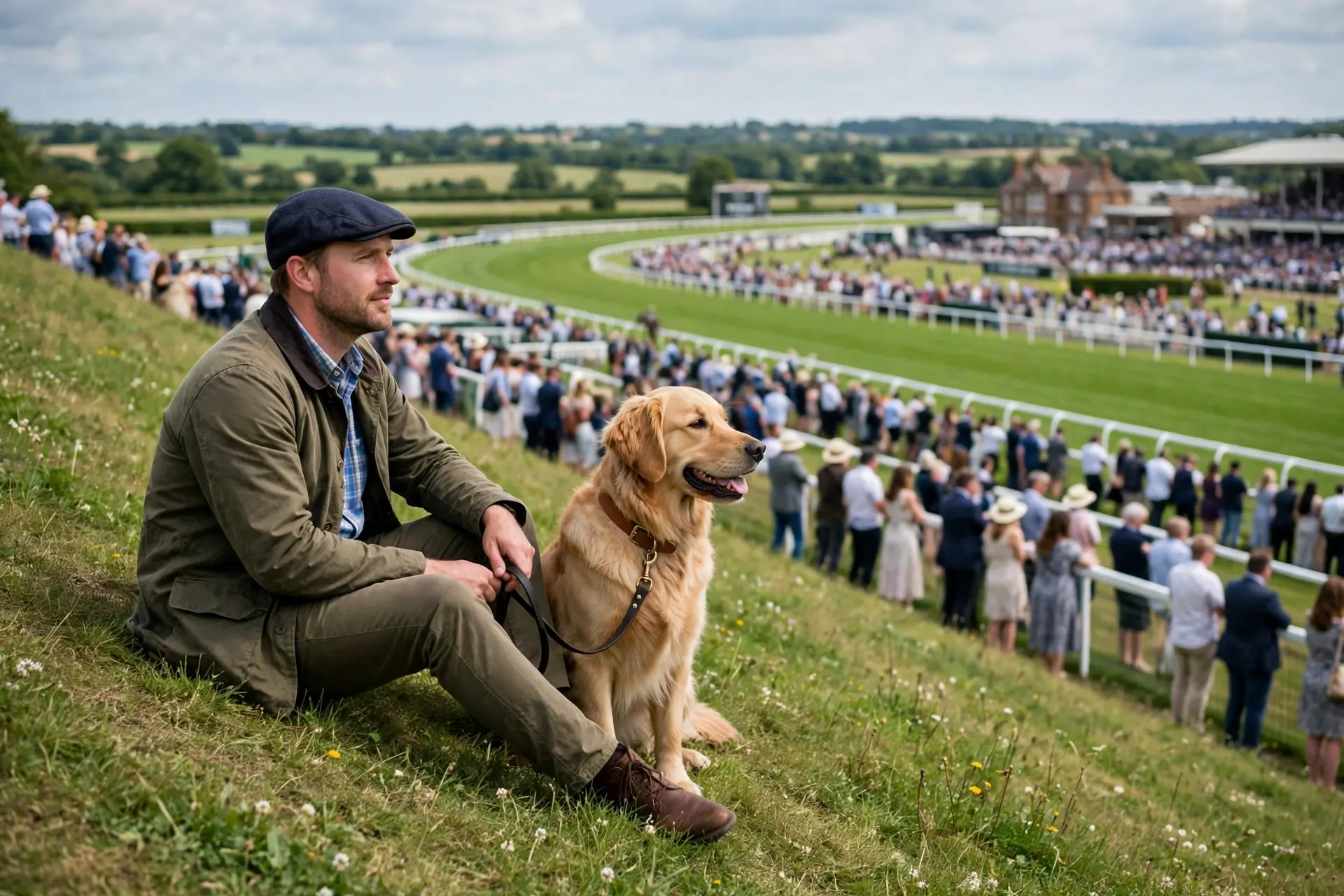
Grandstand and picnic areas follow different logic, and the lead rules follow the layout. A grandstand concentrates people in rows, stairways and narrow walkways, with limited room to step aside and a clear view of the track that tempts dogs to pull forward. A picnic area spreads people across lawns, with more room to choose distance, but also more dropped food, more loose children, and more dogs passing at close range. Neither area is automatically better for every dog. The right choice depends on your dog's size, sociability, and reaction to confinement, as well as on the course's own area rules for that fixture.
In almost every dog-friendly area, a short lead is the default. A short lead keeps the dog close in a crowd, prevents tangling around chairs, rails and other people's legs, and makes it easier to intervene if a horse passes or another dog approaches. Retractable leads are a poor choice at a racecourse: they allow a dog to reach a walkway, a food stall, or another dog before the owner can react, and the thin cord is a trip hazard in a crowd. Use a fixed lead of about one to two metres, a harness or collar that fits securely, and a second point of attachment if your dog is strong or prone to slipping a collar. Keep the lead in your hand, not looped around a chair, a table leg, or a fence, because a startled dog can pull furniture over or drag it into a walkway.
Covered stands, restaurants, bars and hospitality areas are the most common exceptions to a general dog-friendly policy. A course may welcome dogs on an open terrace but not inside the restaurant behind it, or on a lawn but not in a covered seating deck. That distinction matters for rain plans and meal plans: if the group wants to eat indoors, the dog may need to stay outside with one person, or the group may need to choose an outdoor food outlet instead. Check the rule for the exact building, not just the enclosure, and ask staff on arrival where dogs may and may not go. Staff directions on the day override any general impression, and arguing at a doorway helps nobody.
Picnic areas bring their own etiquette. Bring a mat that marks the dog's place, keep food in closed containers until you eat, clear up dropped food promptly, and keep the dog off other people's picnic rugs. Other dogs will pass within a few metres, so practise passing calmly on a short lead before the fixture, and be ready to move your mat if a neighbouring dog is reactive. Poo bags, a spare towel and a small brush for grass and mud belong in the picnic bag, not back at the car, because a racecourse lawn is a shared space and a single accident can sour the area for other dog owners. If the course provides bins for dog waste, use them; if it does not, bag waste and take it to a general bin or home.
Seating choices also affect other racegoers. Do not let a dog sit on a seat that someone else has paid for, block a stairway, lie across a walkway, or occupy a disabled-access route. Keep the dog under the seat, beside the mat, or in the space you have actually bought or claimed, and be ready to move if staff ask you to clear a route. A dog that is welcome in principle can still be asked to move if it is causing an obstruction, and a calm, quick move keeps the welcome intact for everyone. The same courtesy applies to photography: a racecourse photograph with a dog is a lovely souvenir, but do not let a photo session block a rail or a walkway during a race.
Horses, rails and sudden scares
Horses are the reason a racecourse is different from any other outdoor venue, and they deserve a separate safety plan. Racehorses are large, fast, highly trained animals that can still shy, spook, or react suddenly to a dog barking, a lead snapping, or a sudden movement near a rail. A dog that chases, barks at, or lunges toward horses is not merely badly behaved at a racecourse; it is a safety risk to riders, handlers, other racegoers and the horse itself. If your dog has a strong prey drive, a history of chasing livestock, or no experience of large animals, a racecourse may not be a suitable outing, however dog-friendly the policy appears.
Distance is the simplest safety rule. Keep well back from rails, parade-ring barriers and horse-walk routes, even when other racegoers crowd forward. Do not let a dog put its head through a rail, stand on a fence, or approach a horsebox ramp. When horses pass, shorten the lead, move the dog behind you or to the side away from the rail, and reward calm behaviour. If a horse is being led past at close range, turn the dog away, create space, and wait until the horse has passed before moving on. Never assume a horse is calm because it looks still; a still horse can move suddenly, and a dog that is already aroused can trigger that movement.
The parade ring is a particular pinch point. It concentrates horses, handlers, owners, photographers and spectators in a small ring, with limited exits and a high level of excitement. Many dogs find the parade ring overwhelming, even if they cope well on an open lawn, because the sounds, smells and movement are intense and close. Consider watching the parade from a distance, or skipping it altogether on a first visit, and use the time for a quiet walk instead. The same logic applies to the winners' enclosure after a race, where celebrations, cameras and crowds gather quickly. A dog does not need to see every part of the raceday to have a good day.
Sudden scares can come from outside the track as well. A starting gate, a siren, a helicopter, a low-flying aircraft, a burst of music, or a dropped tray can startle a dog that was coping well until that moment. Keep the lead secure at all times, avoid tying a lead to anything, and hold the lead in a way that cannot be pulled from your hand if the dog lunges. If the dog does bolt, do not chase it through a crowd or toward the track; call calmly, move toward a quieter area, and alert nearby staff if the dog is heading toward a restricted area. Prevention is far easier than recovery, which is why a secure harness, a short lead and a calm pitch matter more than any emergency plan.
After a scare, give the dog time to recover before deciding whether to continue. Move to a quiet area, offer water, let the dog sniff and settle, and watch for shaking, panting, or refusal to walk. Some dogs recover in ten minutes and can enjoy the rest of the day from a quieter spot; others remain aroused for an hour and will not settle again that day. Trust the dog's behaviour rather than the racecard. Leaving after a scare is not an overreaction. It is the decision that keeps the next visit possible, because a dog that leaves while still stressed may associate the venue with that stress for a long time.
Weather, ground and the long day outdoors
British race days are outdoor days, and the weather plan is part of the dog plan. Sun, wind, rain and cold each change the ground, the crowd and the dog's comfort in different ways, and a fixture that looks ideal in the morning can become difficult by mid-afternoon. Check the forecast for the course location, not just your home town, and check it again on the morning, because a racecourse on exposed ground can be windier, wetter, or hotter than a sheltered town a few miles away. Pack for the forecast you might get, not only the forecast you hope for, and check the official guidance before you travel for any weather-related changes to areas or facilities.
Heat is the most serious risk on a summer fixture. Open lawns offer little shade, grandstand steps absorb heat, and a dog sitting on hot ground or warm tarmac can overheat quickly, especially flat-faced breeds, older dogs, overweight dogs and dogs with thick coats. Bring water and a bowl, offer water regularly rather than waiting for the dog to ask, use a shade cover or umbrella, and place the mat on grass rather than on concrete where possible. Watch for heavy panting, drooling, lethargy, or reluctance to move, and move the dog to shade and cool water immediately if those signs appear. Never leave a dog in a parked car on a race day, even for a short visit to a bar or a toilet block, because a car heats dangerously fast in sun and a racecourse car park offers no reliable shade or supervision.
Rain changes the ground before it changes the mood. Lawns become slippery, walkways become muddy, and picnic areas can turn into a test of towels and patience. A drying coat, a towel, a mat that can be shaken out, and a spare lead that is easy to grip when wet all help, as does a plan for where the dog can toilet without crossing a churned-up lawn. In heavy rain, covered areas may fill quickly and may not permit dogs, so a wet-weather plan that assumes indoor shelter can fail. If rain is forecast for the whole fixture, consider whether a shorter visit, a different fixture, or a different day out is kinder to the dog. A dog that spends a race day wet, cold and unable to settle has not had a day out, even if the humans enjoyed the racing.
Wind deserves attention on exposed courses. Gusts carry sounds, smells and loose items across open ground, flap temporary structures, and can unsettle dogs that are already alert. Secure lightweight items, keep the mat weighted, and avoid pitching beside a flapping banner or a temporary fence that rattles. Cold weather brings the opposite problem: a dog sitting still on cold ground for hours can chill, especially small, short-coated, older, or arthritic dogs. A coat, an insulating mat, and regular movement breaks help, as does a shorter visit. Ground conditions matter for paws as well: frozen ground, sharp gravel, wet tarmac and muddy tracks can all cause discomfort, so check paws during breaks and clean mud and grit before the journey home.
The long day is a factor in itself. A race fixture can last five or six hours, with gates opening well before the first race and crowds leaving well after the last. A dog does not need to be present for every hour to have a good visit, and most dogs cope better with a defined middle section than with the full span. Plan toilet breaks between races, plan a quiet walk away from the main lawn at least once, and plan a finish time that leaves the dog with energy for the journey home. If the journey home is long, factor in a stop for water, a toilet break and a stretch, and avoid feeding a large meal immediately before a long drive. The best race day for a dog ends while the dog is still happy, not after the dog has used up every reserve.
Parking, entry and the first ten minutes
Parking and entry set the tone for the whole day, because a stressed arrival is hard to undo. Check in advance whether parking is free, paid, or included with a ticket, where the dog-permitted entrance is, and how far that entrance is from the dog-permitted enclosure. Some courses have a main entrance that is convenient for grandstand tickets but a long walk from a picnic enclosure, while others have a separate centre-course entrance with its own parking and facilities. Choosing the wrong car park can mean a long walk through crowds with a dog that already needs the toilet, so read the course map before you set off.
Arrive early, and use the first ten minutes deliberately. Park, give the dog water and a toilet break in a suitable area away from traffic, then walk calmly to the entrance rather than rushing. At the gate, have tickets ready, keep the dog on a short lead, and ask staff to confirm the dog-permitted areas and any changes for that fixture. That short conversation can save a long walk to the wrong stand. Once inside, find your pitch, locate water, toilets, exits and a quiet walking route, and settle the dog on its mat before exploring food outlets or betting facilities. A dog that starts the day settled on a known spot copes better than a dog that is dragged from queue to queue while the owner orients.
Car parks themselves need care. They fill in waves before the first race and empty quickly after the last, with vehicles, horseboxes and pedestrians sharing routes. Keep the dog on a lead from the moment it leaves the car, do not let it run between parked cars, and watch for moving vehicles when crossing. On arrival, note where you parked in a way that will still make sense after several hours and a crowded exit; a photograph of a nearby sign or a note in your phone helps more than memory after a long day. On departure, expect queues and tired drivers, and give the dog a toilet break before the journey home rather than discovering the need in a queue.
Ticket and bag checks can also affect a dog visit. Some courses check bags, limit what can be brought in, or restrict picnic items in certain enclosures, and those rules can affect a dog bag with food, water and treats. Check the course's conditions of entry before packing, and be ready to explain that a bowl, water and dog food are for the dog, not for a picnic. If the course restricts outside food in a grandstand enclosure, plan to buy food inside or choose a picnic enclosure where outside food is permitted. A small amount of advance reading avoids a gate conversation about a cool bag while a queue builds behind you.
Finally, agree an exit plan before you need it. Know the nearest exit from your pitch, the route back to the car park, and the point at which the group will leave if the dog does not settle. Share that plan with everyone, including children, so an early departure does not become a negotiation in a crowd. The exit plan is not pessimism. It is the safety net that lets everyone relax, because the dog's comfort has already been given a clear priority and a clear trigger.
During the day: a calm race day routine
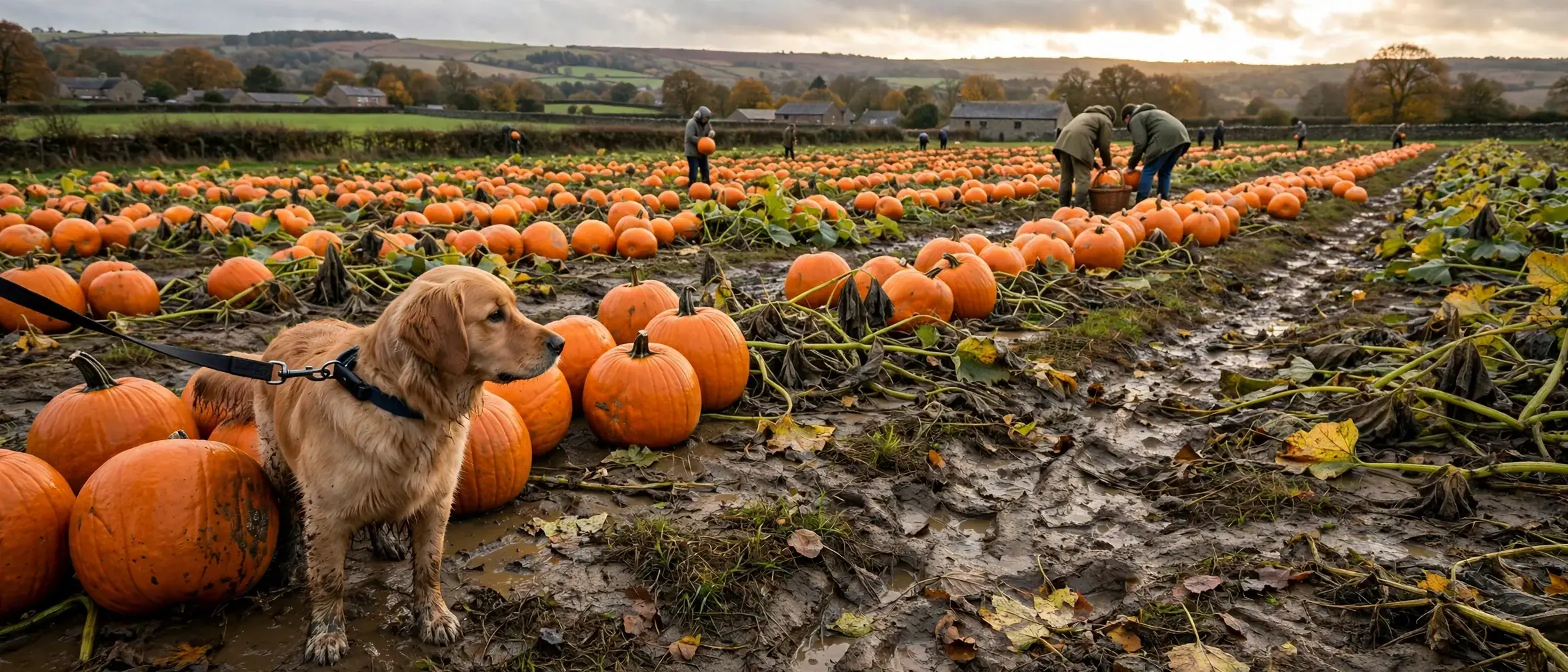
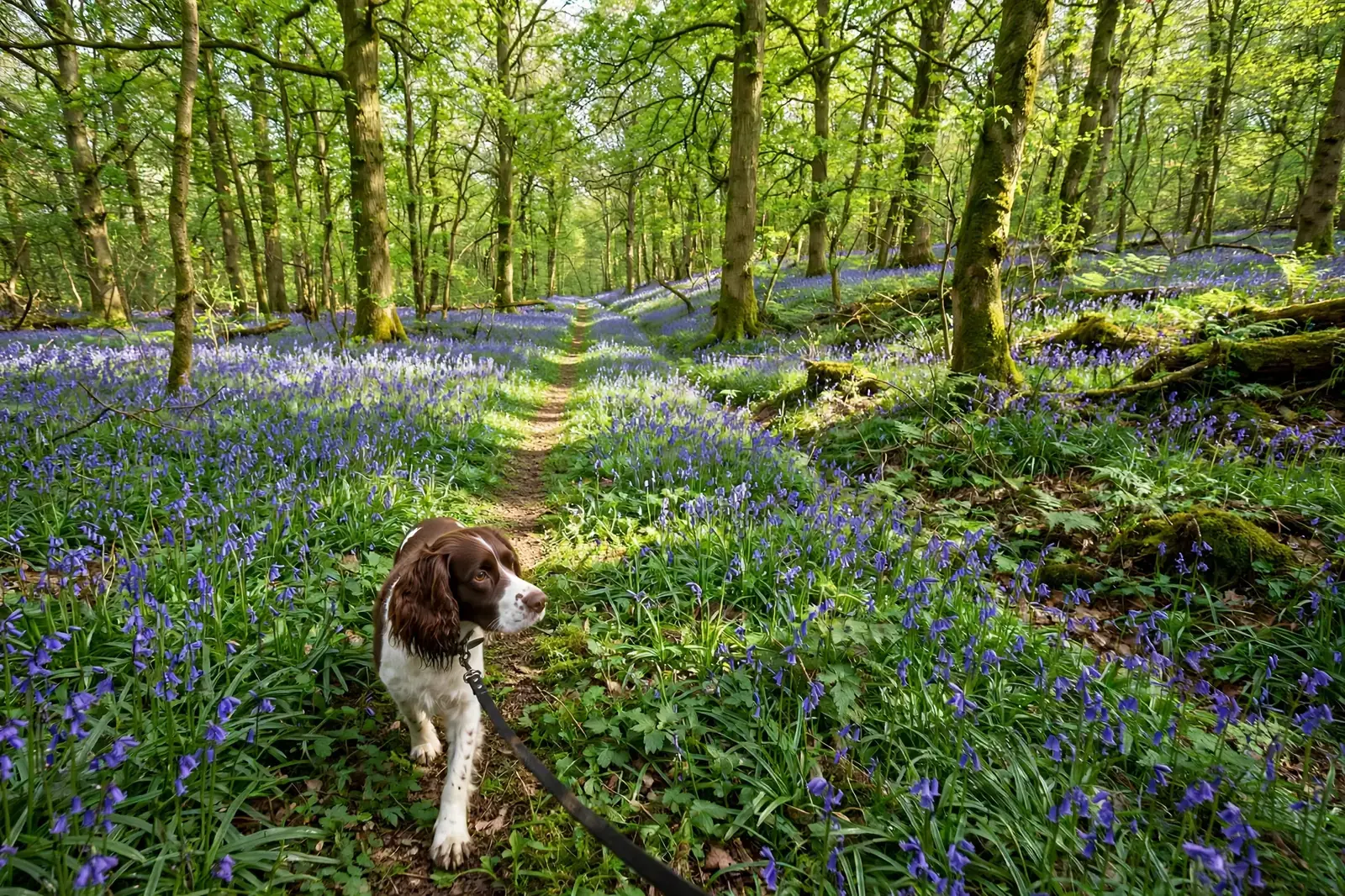
A calm race day routine repeats a simple cycle: settle, watch, break, reset. Between races, the dog rests on its mat, drinks, and watches people pass. During a race, the dog stays on a short lead, away from the rail, with the owner calm and still. After the finish, when crowds move, the dog stays put until the surge passes, then takes a short break for water, a toilet trip, and a quiet walk. That cycle, repeated across the fixture, is far more sustainable than trying to watch every race from the rail, visit every bar, and keep the dog moving all day. For a seasonal comparison of busy outdoor days, our guide to dogs at pumpkin patches covers mud, farm animals and crowd pacing that also apply at a busy racecourse, while our guide to dogs at bluebell woods is a useful contrast: a quiet woodland walk rewards slow pacing, path discipline and distance from other visitors in a way that transfers well to choosing a quiet racecourse pitch.
Food and water routines should stay close to home. Offer water little and often, keep treats small and frequent rather than large and rare, and avoid sharing rich racecourse food with the dog. Dropped food is a constant temptation on lawns, so practise a reliable leave command before the fixture and keep the dog's head away from other people's picnics. If the dog has a sensitive stomach, bring its usual food and avoid new treats on the day, because a racecourse is a poor place to discover a dietary upset. Keep medication, if any, in the dog bag and give it at the usual time, even if that means stepping away from a race to do so.
Toilet breaks need a plan, not improvisation. Find out on arrival where dogs may toilet, whether there is a designated area, and how far it is from your pitch. Take breaks between races, not during a race when walkways are busy, and always carry poo bags and clean up immediately. If the dog is reluctant to toilet in a busy area, a quieter corner away from crowds may help, but do not take the dog into a restricted area, a horse route, or a car park traffic lane to find privacy. A dog that cannot toilet comfortably may become restless, so a failed toilet break is itself a reason to move pitch or shorten the visit.
Social encounters need management throughout the day. Other dogs will pass, children will approach, and strangers will ask to stroke the dog. A short, polite refusal is perfectly acceptable, and a dog that is resting should not be woken for a photograph. If another dog approaches off lead, step between the dogs, shorten your lead, and move away calmly rather than letting an uncontrolled greeting happen on a lawn. If your dog is reactive, choose a pitch with distance, avoid peak movement times, and consider a muzzle if the dog is trained to wear one comfortably, not as a punishment but as a safety measure. A muzzle that the dog associates with treats and calm walks is a useful tool; a muzzle introduced for the first time at a racecourse is not.
End each block of the day with a check: is the dog still settled, drinking, and able to rest between races? If the answer is yes, continue. If the answer is no, move to a quieter area, take a longer break, or leave. That check is the whole routine in one question, and it matters more than seeing another race. A race day that ends with a dog still happy is a success, even if you missed the feature race, while a race day that ends with a distressed dog is not redeemed by a winning bet.
After the last race: leaving well
Leaving well starts before the last race, because the exit surge is often the busiest moment of the day. Crowds head for exits, car parks and transport at once, walkways narrow, and tired people move less predictably. If the dog is already tired, leaving before the last race can be the calmest choice, with a clear route to the car and a toilet break before the drive. If you stay for the last race, plan to wait a few minutes after the finish, let the first surge pass, and then walk out at a steady pace on a short lead. A few minutes of waiting on a quiet lawn is far easier than a forced march through a surge.
Once you are back at the car, give the dog water, check paws for mud, grit, or soreness, and settle the dog safely for the journey home with ventilation and a secure restraint. Avoid leaving the dog in a parked car while the group says goodbye, visits a shop, or waits for a lift, because the car can heat or cool quickly and the dog cannot choose to move. If the journey is long, plan a stop at a safe place for water, a toilet break and a stretch, and keep the dog on a lead at any service area. A race day that ends with a calm journey home is a race day the dog can remember positively.
At home, let the dog decompress. Offer water and its usual food, give it a quiet place to rest, and avoid another stimulating outing the same evening. Check for ticks after a day on grass, especially in warmer months, clean muddy paws, and look for any soreness, cuts, or signs of heat stress that appeared late in the day. If the dog was frightened, barked persistently, or refused to settle, note what triggered it: the fixture type, the enclosure, the weather, the time of day, or a particular moment such as the parade ring. That note is the most useful part of the day for planning the next visit, because it turns a general impression into a specific change, such as a quieter fixture, a different enclosure, or a shorter stay.
Finally, judge the day honestly before booking again. A dog that settled, drank, rested and walked calmly has passed the racecourse test and may enjoy a similar fixture again. A dog that coped only with constant management, or that needed an early exit, may enjoy a quieter fixture with a shorter visit, or may prefer a different kind of day out. There is no obligation to repeat a race day just because tickets were bought once, and a good owner changes the plan to fit the dog, not the other way round. The best measure of a race day is not how many races you watched, but whether the dog would happily go again.
Racecourses can be a rewarding day out for the right dog on the right fixture, with the right enclosure and a calm plan. The policy check comes first, the pitch choice comes second, and the willingness to leave early comes third. Get those three decisions right, and the racing itself can take care of the rest.
Practical questions
Before you go
Are dogs allowed at UK racecourses?
Some are, some are not, and many allow dogs only in certain enclosures or on certain racedays. Always check the specific course and the specific fixture before you travel, because a general dog-friendly reputation does not guarantee entry on the day you choose.
Do dogs have to stay on a lead at a racecourse?
In almost every dog-friendly area, yes. Keep your dog on a short lead in grandstands, picnic areas, walkways and near the parade ring, and never let a dog run loose near horses, rails or racegoers. Check the official guidance before you travel for the exact rule at your course.
Can dogs go into the grandstand at a racecourse?
It depends on the course and the enclosure. Some courses welcome dogs in outdoor grandstand areas, others restrict them to picnic enclosures or the centre of the course, and some keep dogs out of covered stands and hospitality areas. Confirm the permitted area for your ticket type before you book.
What should I do if my dog is frightened by race day noise?
Move away from the loudest areas, give the dog space and water, and shorten the visit rather than pushing through. Choose a quieter fixture, a less crowded enclosure and a spot with an easy exit for a first visit, and leave early if the dog cannot settle.
Are there water bowls and shade for dogs at racecourses?
Provision varies a lot. Some courses provide water points and shaded picnic areas, while others expect owners to bring everything. Pack a bowl, water, a mat and shade cover, and check the official guidance before you travel so you are not relying on facilities that may not exist.
Can I take my dog to a big festival raceday?
Festival days are usually the hardest test for a dog: larger crowds, longer days, louder celebrations and tighter walkways. Many courses restrict dogs at major festivals even when they allow them at quieter fixtures, so check the festival rules separately and consider a quieter raceday for a first visit.