This guide is independent and contains no paid placement. If affiliate links are added later, they will be clearly marked and will not change our editorial checks.
Ashbourne works best as a two-part day: a short, lively market town walk first, then a flat stretch of the Tissington Trail at the dog's pace. Keep dogs on a lead near cyclists and horses, carry water, and check the official guidance before you travel for market days and any trail closure.
Start with market day, not the trail
Most guides send you straight to the trail, but a dog day in Ashbourne is better the other way round. Begin in the town, because the market, the shops and the church spire give the dog a rich but manageable dose of novelty before the long, straight trail. A dog that has already sniffed a market street, watched a bus pass and settled outside a cafe will walk the trail more calmly than a dog taken straight from a car to thirteen miles of open track. The town also gives you the practical things the trail cannot: water, toilets, food, shade and a place to sit if the weather turns.
Market day changes the town's character, so check the official guidance before you travel for the current market days and layout. On a market morning the main street is busier, the smells are stronger, and the pavements narrow around stalls. That is not a reason to avoid it; it is a reason to plan it. Walk the market street once on a short lead, keep the dog on the side away from food displays, and do not stop in the middle of a walkway to browse. If your dog is reactive to other dogs, go early, keep to the wider side of the street, and cross over promptly when another dog approaches. A ten-minute market loop, well handled, is better training and better fun than an hour of stressful weaving.
Use the market as a shopping test as well as a walk. Independent shops, delis and bakeries line the town, and their dog policies vary, so ask before you enter with a dog rather than assuming. One person can shop while the other waits outside, which is often kinder than squeezing a large dog between displays. Buy the picnic or the trail snacks here, fill the water bottle, and note which cafes have outdoor seating for later. By the time you reach the trail head, the town has already done half the work of the day.
A town walk that teaches the day
Ashbourne's streets reward a slow circuit rather than a dash between landmarks. The long main street, the side lanes and the churchyard area offer a mix of surfaces, sounds and smells that tell you a great deal about your dog on that particular day. Is the dog pulling towards every other dog, or walking loosely? Is traffic noise a problem, or is the dog ignoring it? Are steps, grates and narrow pavements an issue? The answers shape how far you should go on the trail and whether cycling is a sensible idea at all.
Keep the town walk short and purposeful. Twenty to thirty minutes, with sniffing stops and a water break, is enough for most dogs before the trail. Look for a quiet green or a side street where the dog can toilet without blocking a pavement, and always carry bags and use them. Ashbourne is a working town, not a theme park, and residents, shoppers and delivery drivers share the same pavements. A dog that walks nicely here earns goodwill that benefits every dog visitor who comes after you.
Architecture gives the walk its pleasure, but dogs do not need a lecture. The Georgian frontages, the church and the old coaching inns are best enjoyed at a strolling pace, with the dog on a short lead and your attention split between the buildings and the pavement ahead. If you want photographs, stop in a doorway or a wide spot rather than in the middle of the street. A town walk done well leaves the dog settled, the owner oriented, and the rest of the day feeling easy rather than rushed.
Finding the Tissington Trail head
The Tissington Trail begins near Ashbourne and follows a former railway line north through the White Peak, which is why it is so well suited to dogs: the surface is generally firm, the gradients are gentle, and there are no stiles to negotiate on the main track. Finding the start is the only fiddly part, because the trail head sits a short distance from the town centre and the route out of town crosses roads and housing before it settles into open countryside. Allow time for this transition, keep the dog on a lead through the built-up section, and do not be surprised if the first half mile feels less rural than the photographs promised.
Check the official guidance before you travel for the trail head location, parking and any temporary diversion. Former railway trails are occasionally closed for resurfacing, tree work or drainage repairs, and a closure at the southern end can change the whole plan. If the main start is closed, a nearby access point further north may work, but only if you can park safely and reach it without a long road walk with the dog. Download an offline map before you leave the town, since signal can be patchy in cuttings and valleys.
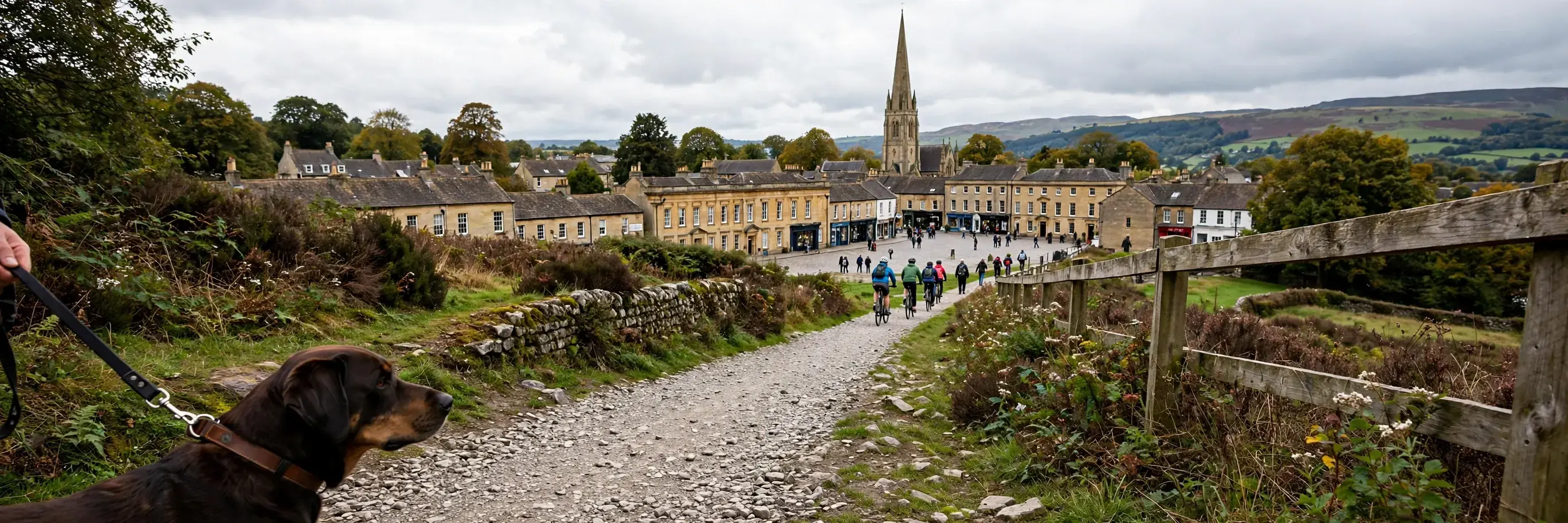
Set expectations at the trail head. The trail is shared with cyclists, walkers, runners and occasionally horses, and it is long and straight enough that other users can appear quickly from behind. Agree who holds the lead, where the dog will walk, and what you will do when a cyclist approaches. A dog that walks on the left, on a short lead, with room to step aside, is a safe trail dog. A dog on a long extendable lead stretched across the path is a hazard to everyone, including itself.
Walking the trail with a dog
Walking the Tissington Trail is gloriously undemanding in the best sense. The gradient is gentle, the surface is kind to paws, and the views open out over farmland and dales without any scrambling. That ease is exactly why distance creeps up on people: five miles out feels like nothing on a flat track, but the return leg doubles it, and a dog that trotted happily outward may plod home. Choose a turning point before you start, based on the dog rather than the map, and stick to it. A good first visit is three to five miles out and back in total, with water stops and sniffing breaks built in.
Shared-use etiquette is the main skill on this trail. Keep dogs on a lead or under very close control, step to one side for cyclists, and call the dog in early when you hear a bell or see a bike approaching. Cyclists travel faster than walkers expect, and a dog that darts across the path to greet another dog can cause a serious accident. If your dog chases bikes, wheels or runners, the trail is not the place to train that behaviour from scratch; use a short lead, a harness and a wide verge, and consider a quieter footpath instead. The same care applies to horses: give them a wide berth, keep the dog still and close, and wait until they have passed.
Water, shade and toilets need planning on a long straight trail. There are access points and villages along the route, but long stretches have no shop, no tap and no shade, so carry more water than you think you need and a bowl the dog will actually drink from. In summer, the exposed sections can be hot, and the dark tarmac or stone surface can warm paws; walk early, use the shaded cuttings, and check paws at every stop. In winter, the same cuttings can be icy or muddy, so shorten the walk and wear boots with grip. The trail is forgiving, but it is not a park with facilities every few hundred metres.
Cycling the trail with a dog
Cycling with a dog on the Tissington Trail is popular, and for the right dog it is a wonderful way to cover ground, but it is not a casual add-on to a family bike ride. A dog that runs beside a bike needs to be fit, fully grown, trained to a side and a pace, and comfortable with other cyclists, dogs and horses passing at speed. A dog that pulls, lunges or stops suddenly is dangerous on a bike, however gentle it is on foot. If you have any doubt, walk the trail first, watch how your dog reacts to bikes, and build up with very short rides on quiet ground before attempting a trail section.
Equipment matters more than enthusiasm. Use a proper bike attachment that keeps the lead low and away from the wheels, rather than holding a lead in your hand or looping it over the handlebars. A harness is safer than a collar for running, and a trailer or basket is the right choice for small, older or less fit dogs that still enjoy the outing. Carry water for the dog as well as for yourself, stop frequently, and watch for signs of overheating or sore paws: heavy panting, lagging behind, or a change in gait all mean stop, rest and walk the rest of the way. Never cycle a dog in heat, on a hot surface, or for a distance the dog has not built up to gradually.
Hire bikes add another layer of planning. If you hire in or near Ashbourne, confirm in advance that the hire includes a suitable dog attachment or trailer, and that the return time allows for a relaxed ride rather than a race back. A dog trailer changes the handling of a bike, especially on the gentle but real gradients and at gates, so practise in a quiet area before joining the main trail. When the ride is done well, it is one of the best dog days in the Peak District; when it is rushed, it is stressful for dog, rider and everyone they pass.
Tissington village as a turning point
Tissington village, a few miles north of Ashbourne along the trail, makes a natural turning point or lunch stop. The village is small, attractive and closely linked to the trail, with a hall, a church and a tea room tradition that draws walkers and cyclists. For a dog, the village offers a change of pace: a chance to leave the straight track, sniff village lanes, drink water and rest before the return leg. For the owner, it offers the decision point that matters most on a linear trail: turn back now, while the dog is still keen, or push on to the next access point.
Treat the village as a rest stop, not a second walk. Give the dog water, check paws, offer a snack if you use one, and sit for a while before deciding. Dogs that rest properly in Tissington return to Ashbourne happily; dogs that are rushed through a tea room queue and straight back onto the trail often fade halfway home. Check the official guidance before you travel for tea room dog policies and opening times, since village facilities can be seasonal and a closed tea room on a cold day changes the plan. Carry your own water and snacks regardless, so a closed cafe never becomes a problem.
If you turn back at Tissington, you have still had a proper Peak District day: a market town, a railway trail, a village and a return journey with views you missed on the way out. There is no prize for reaching the furthest point, and the dog will not remember the mileage. What the dog will remember is whether the day felt calm, whether water and rests came regularly, and whether the return leg was comfortable. Plan the turning point around that memory, not around a number on a map.
Eating, drinking and settling down
Ashbourne's cafes and pubs are well used to walkers and cyclists, and many welcome dogs, but the details vary by room, time of day and season. Check the official guidance before you travel for each place you hope to visit, and have a back-up in mind. A bar area may welcome dogs while the restaurant does not, a garden may welcome dogs in summer but close in winter, and a busy Saturday lunchtime may be a different proposition from a quiet weekday tea. Arrive with a mat and a water bowl, choose a corner table, and settle the dog before you order.
The etiquette that makes a pub visit work is simple and worth repeating. Keep the dog on a lead under the table, keep them off other people's food and feet, and clean up immediately if there is an accident. If your dog barks at other dogs, sit where you can see the door and redirect early, rather than waiting until another dog is already at your table. Our guide to dogs in pub gardens in the UK covers lead length, water bowls and table choice in detail, and Ashbourne's gardens and bar areas are exactly the places where those habits pay off. A settled dog is a welcome dog, and a welcome dog gets invited back.
Picnics solve many of the same problems more simply. Buy food in the town, eat at a trail-side bench or a quiet village spot, and let the dog rest on a mat while you eat. Pack food in sealed containers, keep it out of the dog's reach, and take every scrap of litter home. A picnic also lets you eat on the dog's schedule: after a walk, during a rest, or at the turning point, rather than at the busiest hour in the busiest cafe. For many dogs, a quiet picnic is more relaxing than a crowded pub, and relaxation is the point of the day.
Parking, toilets and the return leg
Parking in Ashbourne deserves the same planning as the walk. Choose a car park that is a short, safe walk from both the town centre and the trail head, and note the return route before you set off. A car park that is easy to find in the morning can be confusing after a long walk, especially with a tired dog and fading light. Keep the car stocked with water, a towel and a spare lead, and never leave a dog in a parked car while you shop, eat or explore, even for a few minutes.
Toilets, for people and dogs, are part of the plan too. Use town facilities before the trail, carry bags throughout, and bin waste properly at trail bins or take it home if no bin is available. On a long linear trail, waste bags carried for miles are a normal part of dog ownership, so bring more bags than you expect to need and a sealed bag holder. The return leg is when most people run out of water, patience or daylight, so build a margin into the plan: turn back earlier than you think necessary, and keep the last mile easy.
Finish the day in the town rather than at the car park if you can. A short, calm walk back through Ashbourne, a drink of water and a final toilet stop give the dog a gentle cool-down after the trail. It also gives you a chance to buy anything you missed in the morning and to note, for next time, which car park, cafe and trail section worked best. A dog day that ends calmly is a dog day the dog will enjoy repeating, and Ashbourne is a town that rewards a second visit.
Making Ashbourne a longer stay
Ashbourne makes a practical base for a longer Peak District stay, because it has shops, accommodation, food and transport links that smaller villages lack, while still sitting on the edge of the dales. From here, a different day is possible each day: a Tissington Trail ride one day, a Dovedale walk the next, and a market town or spa town visit when the weather turns. Bakewell with a dog offers a busier market town and river walks, while Castleton with a dog gives a wilder limestone landscape and a different kind of village day. Rotating the three keeps a week varied without long drives.
For accommodation, confirm dog rules in writing before you book: whether dogs can be left alone, whether there is a secure garden or a ground-floor room, what the cleaning charge covers, and whether the property suits a dog that is nervous, large or older. Our guide to dog-friendly holiday parks in the UK explains the questions that matter for any stay, and the same questions apply to a cottage or guesthouse in Ashbourne. A property near the trail head saves a daily car journey, but a property in a quiet side street may suit a reactive dog better than one on the main road.
Seasonal planning matters for a longer stay. Spring brings lambing and busy trails, summer brings heat and crowds, autumn brings quieter paths and mud, and winter brings short days and the need for torches and drying coats. Check the official guidance before you travel for any seasonal trail work, and keep a wet-weather alternative ready: a town day, a short village walk, or a cafe-based morning. A longer stay that includes a rest day is not a wasted day; it is the reason the dog stays happy for the whole week, and a happy dog is the whole point of choosing Ashbourne in the first place.
Practical questions
Before you go
Can dogs walk the Tissington Trail from Ashbourne?
Yes, dogs are commonly walked on the Tissington Trail, which is a surfaced former railway line. Keep dogs on a lead or under close control near cyclists and horses, pick up waste, and check the official guidance before you travel for any temporary closure or diversion.
Can I cycle the Tissington Trail with a dog?
Many people cycle with a dog running alongside or in a trailer, but only if the dog is fit, trained to run beside a bike, and comfortable with passing cyclists. Start with a short section, carry water, and use a proper bike attachment rather than holding a lead in your hand.
Is Ashbourne market dog-friendly?
The outdoor market area is generally easier with a dog than an indoor hall, but stalls, crowds and food smells need a short lead and a calm dog. Keep dogs away from food displays, do not block walkways, and check the official guidance before you travel for the current market days and rules.
Where should I park in Ashbourne with a dog?
Use a town car park within a short walk of the trail head and the town centre, and give the dog a toilet walk before you start shopping or cycling. Avoid leaving a dog in a car at any time of year, and keep water and a bowl in the car for the return journey.
Are Ashbourne pubs and cafes dog-friendly?
Many are, often in the bar or garden rather than the restaurant. Check the current policy before you travel, bring a mat and water bowl, and choose a quiet corner table so the dog can settle away from the main flow of people.
How far should I walk on the Tissington Trail with a dog?
Let the dog decide. A first visit of three to five miles out and back suits most dogs, and fit adult dogs can go further with water stops. Turn back while the dog is still keen, because the return leg is just as long as the outward one.