This guide is independent and contains no paid placement. Bank policies vary by branch and change, so check the official guidance before you travel and confirm the position with the individual branch before travelling.
There is no single UK rule for pet dogs in banks. Some branches welcome a calm dog on a lead, others ask the dog to wait outside, and the same banking group can apply different rules in different towns, so check the individual branch before travelling and always have a backup plan.
The errand that cannot be done from home
Picture the morning it happens. An online identity check has failed for the third time, the app asks you to show a passport in person, or a relative has handed you an envelope of cash that needs paying in before a deadline. The bank is ten minutes away, the dog is already by the door with a lead in its mouth, and the question you have not yet answered is the one that decides the whole trip: can the dog come inside, and if not, what happens to the dog while you are at the counter?
That is a different problem from choosing a dog-friendly cafe, where a refusal costs you nothing more than a change of table. A bank visit is often time-sensitive, document-heavy and hard to repeat. You may need to sign in front of staff, have a photograph taken, answer security questions, or hand over cash that you do not want to carry around town twice. The dog, meanwhile, has to cope with automatic doors, polished floors, a queue that does not move, strangers standing close behind, and a counter where your hands are busy and your attention is elsewhere. Planning for both halves of that visit, the paperwork and the dog, is what makes it manageable.
Start by separating the job from the journey. Write down exactly what the branch must do that no other channel can do. Common examples include verifying identity for a new account or a fraud hold, witnessing a signature, paying in a large amount of cash or a cheque that cannot be scanned at home, collecting a replacement card, sorting out a joint account, or discussing a mortgage, loan or bereavement matter that needs original documents. If the task is a simple balance check, a transfer, a payment or a change of address, the app or phone service may do it faster and with no dog dilemma at all. If the task genuinely needs a counter, the next step is to find out whether that particular branch, on that particular day, will let the dog in.
Timing matters as much as policy. A branch at 9am on a weekday, with a short queue and staff who have time to greet a dog, is a very different environment from the same branch at lunchtime on a Saturday, when the queue reaches the door and every new arrival squeezes past. Dogs that are relaxed in a quiet room can still struggle when a queue compresses, a child runs past, or a trolley rattles across a tiled floor. If you can choose, pick a quieter slot, allow extra time so you are not rushing the dog through the door, and build in a calm walk beforehand so the dog arrives settled rather than bursting with energy.
It also helps to be honest about the dog in front of you. A settled older dog that lies flat on a mat for twenty minutes is a good candidate for a short branch visit. A young dog that jumps up at strangers, barks at automatic doors, or panics on slippery floors is not, even if a branch would technically allow dogs in. A bank is a working building, not a socialisation exercise. Staff need to concentrate, other customers need to hear security questions without a barking interruption, and a nervous dog gains nothing from being pushed through a stressful queue. In that case the kindest and most practical choice is often to leave the dog at home with someone, take a second adult who can wait outside, or use another channel altogether.
Finally, remember that a bank branch is a security-sensitive space. Staff may ask you to keep the dog close, keep the lead short, and keep the dog away from the counter while cash is handled. That is reasonable, and it is easier to accept if you have practised it at home: a short lead, a settle on a mat, and a habit of waiting calmly while you stand at a kitchen counter with your hands busy. A few minutes of that practice before the real visit is worth more than any reassurance from a website.
Branch-by-branch comparison
The table below is a planning aid, not a guarantee. It summarises the kind of local practice that dog owners commonly report for each major group, and the questions worth asking that specific branch. Policies vary by branch and change, sometimes because a branch moves premises, changes its layout, or tightens security after an incident. A branch that welcomed dogs last year may have a new manager with a different approach, and a branch that once said no may now allow a quiet dog in a quiet corner. Check the official guidance before you travel and check with the individual branch before travelling, especially if the visit is urgent or involves a long journey.
| Banking group | What to ask about | Watch out for |
|---|---|---|
| Lloyds, Halifax and Bank of Scotland | These brands sit in the same banking group, but branches are run locally, so ask the named branch whether a calm dog on a lead may wait with you, and whether there is a quieter time to visit. Check the official guidance before you travel, and confirm with the individual branch before travelling. | Busy city-centre branches, narrow entrances and branches inside shopping centres may apply stricter local rules than a quieter suburban branch. |
| Barclays | Ask the specific branch about dogs in the main banking hall and in any separate appointment area, because the two spaces may be treated differently. If you have an appointment, ask for the dog to be noted on the booking. Check with the individual branch before travelling. | Appointment rooms are smaller and more enclosed than the main hall, so a dog that is fine in open space may still find a small meeting room difficult. |
| HSBC | Ask the branch directly, and be specific about the dog's size and behaviour, because a vague question tends to get a vague answer. If the branch is unsure, ask to speak to a manager rather than relying on a general helpline answer. Check with the individual branch before travelling. | Some branches share premises or have a separate premier or business area where different local rules may apply. |
| NatWest, Royal Bank of Scotland and Ulster Bank | These brands sit in the same group, but local practice can still differ, so ask the branch you plan to visit rather than assuming a sister branch's answer applies. Ask about the queue layout and whether there is somewhere to stand aside with the dog. Check with the individual branch before travelling. | Older branches may have steps, revolving doors or a narrow lobby that make entry awkward for a large dog, even when dogs are welcome in principle. |
| Nationwide | As a building society with a large branch network, Nationwide branches vary by location, so ask the branch about dogs in the main hall and whether a member of staff can suggest a quieter time. Check with the individual branch before travelling. | Smaller branches can have very little floor space, so a dog that needs room to settle may struggle even if it is allowed in. |
| Santander | Ask the named branch whether a dog may accompany you for a counter transaction and for an appointment, and whether the dog should stay in a particular area. Check the official guidance before you travel, and confirm with the individual branch before travelling. | City branches at lunchtime can be crowded and noisy, which is hard for a dog that is sensitive to people passing close behind. |
| TSB | Ask the branch about its current local practice, and mention if the visit will be short, such as paying in cash, or longer, such as a mortgage discussion. The length and nature of the visit can affect the answer. Check with the individual branch before travelling. | A short counter visit and a long seated appointment are different propositions for a dog, so do not assume permission for one covers the other. |
| Metro Bank | Metro Bank branches are often described by dog owners as dog-friendly, but that description is not a guarantee for every branch on every day, so still ask the branch you plan to visit. Ask whether water bowls, treats or a particular waiting spot are available, and whether the dog can stay during an appointment. Check with the individual branch before travelling. | A branch that is welcoming in general may still ask a dog to wait outside if the branch is unusually busy, if another customer has an allergy or fear, or if security requires it. |
| Co-operative Bank and Virgin Money | Both have smaller branch networks than the largest groups, which makes checking the individual branch even more important, because there may be no nearby alternative branch if the answer is no. Ask early, and ask what other channels can complete the same task. Check with the individual branch before travelling. | Branch closures and reduced hours mean the nearest branch may be further away than expected, so factor the dog's travel tolerance into the plan as well as the branch policy. |
Three patterns run through that table, and they are worth holding on to. First, branch discretion is the rule, not the exception. Head offices publish general guidance, but the person at the door on the day makes the practical decision, taking into account safety, space, other customers and the dog in front of them. Second, the type of visit changes the answer. A two-minute cash deposit is easier to accommodate than a forty-minute seated appointment with documents spread across a table. Third, a friendly reputation is not a promise. Even a branch that is well known for welcoming dogs can say no on a particular day, and that refusal is not necessarily a change of policy, just a judgement about that moment.
When you call, ask questions that give you a usable answer. Instead of asking whether the branch is dog-friendly, which invites a slogan, try this sequence: can a calm dog on a short lead come into the banking hall with me for a counter transaction; is there a quieter time of day when that would be easier; if I have an appointment, can the dog stay with me in the meeting room; and if the answer is no, what is the nearest alternative branch or channel that can complete this task? Write down the name of the person you spoke to, the date and the answer. If you arrive and a different member of staff gives a different answer, that note gives you a calm basis for asking a manager to clarify, without turning the visit into an argument.
Online-only banks and app-based accounts deserve a separate note. If your account has no branches at all, the dog question disappears, but the in-person identity problem can become harder, because there may be no counter to visit when an online check fails. In that case, ask the provider early what its alternative verification route is, whether a video call, a certified document by post, or a visit to a partner location will work, and how long it takes. Discovering that route the day before a deadline is stressful for you and pointless for the dog, who does not need to be part of it.
Finally, keep the comparison in proportion. The difference between one banking group and another matters less than the difference between a well-planned visit to a checked branch and an unplanned visit to an unchecked one. The branch that you have phoned, that expects you and your dog, and that you can reach at a quiet time, is almost always the better choice, even if another bank has a friendlier reputation in general.
Assistance dogs and the law
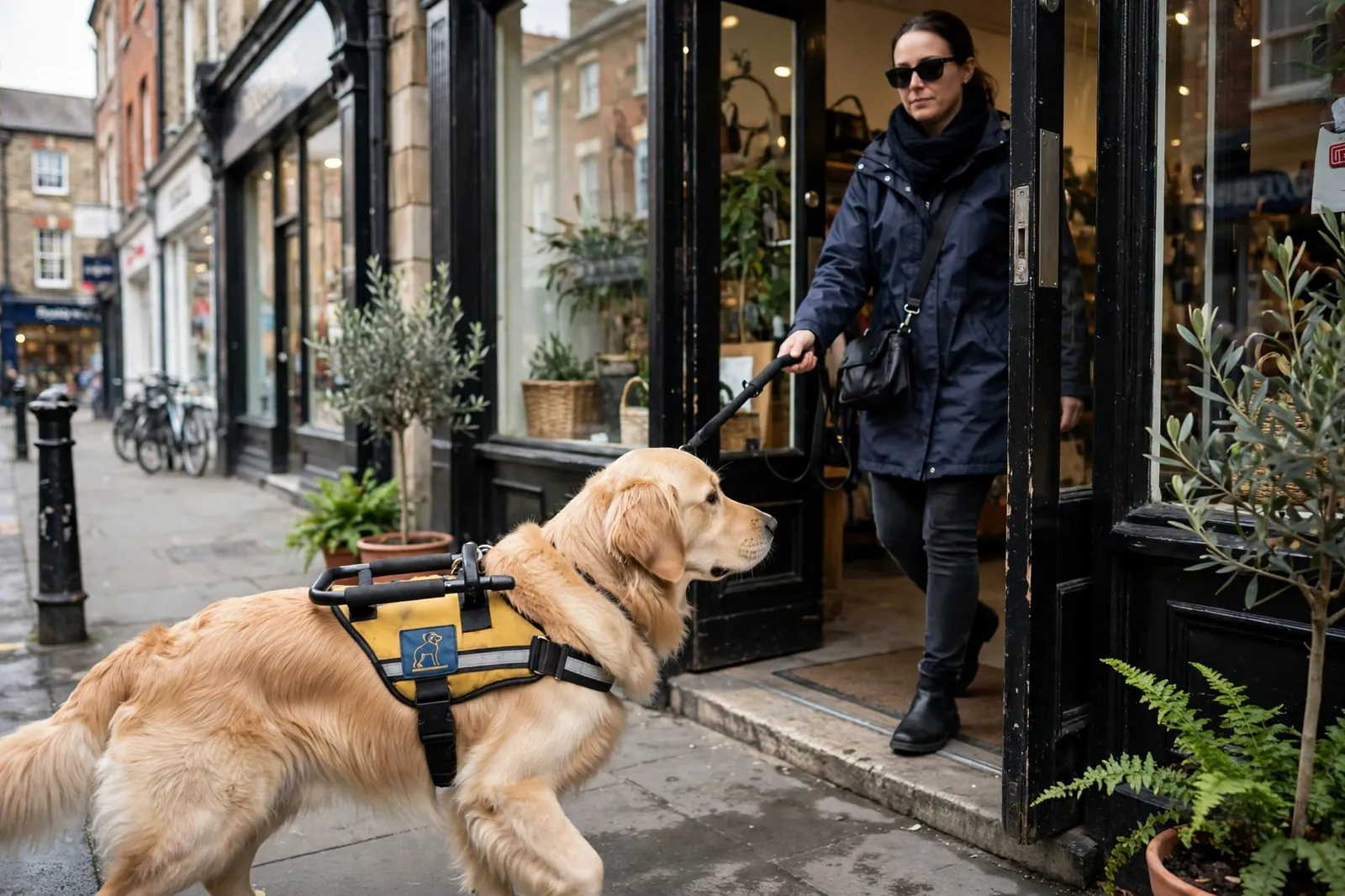
Assistance dogs are in a different category from pet dogs, and the distinction matters in a bank as much as anywhere else. In Great Britain, the Equality Act 2010 generally requires service providers not to discriminate against disabled people, and refusing an assistance dog that accompanies a disabled person can amount to discrimination. Similar protections apply in Northern Ireland under disability discrimination law. This guide is not legal advice, and the exact position depends on the individual circumstances, but the general principle is clear: an assistance dog is not a pet that a business may turn away at its discretion, and staff should not treat it as one.
There is no single official UK registration scheme for assistance dogs, and a handler is not generally required to carry a particular certificate to prove the dog's status. Many assistance dogs wear a harness or jacket and their handlers carry an identification booklet from a recognised training organisation, and showing that identification can smooth a conversation at the door. It is still worth knowing that a bank should not demand a specific document that does not exist in law, and should not ask intrusive questions about a person's disability. If a member of staff is unsure, asking politely to speak to a manager, and explaining calmly that the dog is an assistance dog, usually resolves the matter faster than a debate at the entrance.
Handlers still have practical responsibilities. The dog should be under control, on a lead or harness as appropriate, and settled during the visit. A bank may be entitled to ask a handler to manage a dog that is causing a genuine disruption, just as it may ask any customer to manage behaviour that affects others, but that is a different matter from a blanket refusal at the door. Keeping the dog's training sharp, arriving at a quiet time when possible, and bringing water and a mat for a longer appointment all help the visit go smoothly and reduce the chance of a misunderstanding.
For more detail on where assistance dogs must be welcomed, what identification is helpful, and how to handle a refusal, read our guide to assistance dog access rights in the UK. It covers shops, transport, housing and other everyday settings, so the bank visit can be read as one part of a wider set of rights rather than a one-off exception. Check the official guidance before you travel if your situation involves a dog in training, an owner-trained assistance dog, or a visit to Northern Ireland, where the legal framework is framed differently.
What to do if you are refused
A refusal at the door is frustrating, especially when you have already travelled and the task is urgent. The first move is to stay calm and get clarity. Ask politely what the reason is, whether it is a branch rule or a decision for today only, and whether a manager can confirm it. A branch may refuse a pet dog for a straightforward reason, such as a health and safety concern, a lack of space, or a busy period, and that refusal is generally within its rights. Knowing the reason helps you decide whether another branch, a quieter time, or a different channel will solve the problem, or whether the task needs a different plan entirely.
Do not tie the dog outside and go in anyway as a way of getting around the refusal, unless you have genuinely assessed that option and it is safe, which it rarely is in a busy town centre. A dog left alone outside a bank is visible, tempting to strangers, and exposed to traffic noise, other dogs and weather. It can also bark, slip a lead, or become distressed while you are out of sight, which creates a second problem on top of the first. If the refusal leaves you with no safe option for the dog, the sensible choice is to leave and replan, even if that means missing the slot you had hoped for.
For a pet dog, the next steps are practical rather than legal. Ask whether another branch nearby has a different local practice, whether an appointment at a quieter time would be possible, or whether the task can be completed by phone, app or post. If the visit was urgent because of a deadline, tell the bank that, because staff may be able to extend a deadline, accept a document by another route, or book the earliest appointment that works with a dog plan. Keep a note of the conversation, including the branch, the date, the time and the name of the person you spoke to, so you do not have to repeat the whole story if you call again.
For an assistance dog, the steps are different and should be followed in writing. Note the branch, date, time, the name of any staff involved, and the exact reason given. Ask for the refusal to be recorded, and follow the bank's formal complaints process, starting with its own complaints team and, if the matter is not resolved, the relevant ombudsman or equality body. Keep copies of every message, because a written record is far more useful than a remembered conversation if the complaint is escalated. You can also seek advice from an assistance dog organisation or a disability rights service, which can advise on the specific circumstances and help draft a complaint.
Whatever the category of dog, avoid turning a refusal into a confrontation at the counter. Staff at a bank are handling other people's money and security questions, and a raised voice makes it harder for everyone, including the next dog owner who asks the same question. A calm, specific request, a written note, and a clear follow-up through the proper channel will usually get you further, and it leaves the branch with a better impression of dog owners in general.
Appointment or walk-in
An appointment and a walk-in visit place different demands on a dog, and choosing between them is one of the most useful decisions you can make. An appointment lets you ask about the dog in advance, gives the branch a chance to prepare, and usually means a shorter wait once you arrive. It also lets you request a ground-floor room, a quieter time, or a longer slot if you know the dog needs time to settle. When you book, mention the dog explicitly, ask for that note to be added to the booking, and confirm it again the day before. If the appointment is for a sensitive matter, such as bereavement, fraud or debt, mention that the visit may take longer than usual, so the dog is not left waiting through an unexpectedly long meeting.
A walk-in visit is more flexible, which is useful when a problem arises suddenly, but it is also less predictable. You cannot control the queue length, the number of people standing close to the dog, or whether the branch is short-staffed that day. If you must walk in, choose a quieter time if you can: early morning on a weekday is often calmer than lunchtime or Saturday morning, and the last hour before closing can be rushed, which is not ideal for a dog that needs a calm settle. Check branch opening hours before travelling, because many branches now close earlier, close at lunchtime on some days, or operate reduced hours that are not obvious from a general search result.
For either type of visit, think about where the dog will be during the transaction itself. At a counter, the dog can usually lie beside you or slightly behind you, on a short lead, while you face the staff member. In a meeting room, the dog will need space to lie down without blocking the door, and you will need a hand free for documents, so a mat and a settled position matter more than a toy or a treat that rustles. If the meeting involves signing, practise at home: can you sign a piece of paper while holding a lead, without the dog pulling towards the table? If not, a second adult, a lead clipped to a belt, or a mat placed where the dog can settle without being underfoot will help.
Queue etiquette is part of the appointment question too. Keep the lead short, keep the dog on the side away from the next person in the queue, and avoid letting the lead stretch across a walkway where someone could trip. If another customer has a dog, keep a sensible distance between the two animals, even if both look friendly, because a bank queue is not a place for introductions. If your dog starts to bark, whine or pace, step aside if you can, give the dog a moment to settle, and be prepared to leave and return at a quieter time rather than pushing through a visit that is becoming stressful for everyone in the room.
One final appointment tip: ask what to bring, and bring it in a form the dog can cope with. Original passports, driving licences, proof of address, bank cards, appointment letters and, for cash deposits, sorted notes and completed paying-in slips all speed up the visit. A shorter visit is a kinder visit for the dog, and it reduces the chance that a staff member will need to ask you to wait while a document is checked elsewhere.
Dogs left outside or in the car
Leaving a dog outside a bank, or in a car while you go inside, is sometimes presented as the easy solution. In practice, both options carry risks that deserve a frank look before you rely on them. A dog tied to a railing outside a busy branch is exposed to strangers, passing dogs, traffic, rain and heat, and can be untied, stolen or frightened in the few minutes you are inside. Even a calm dog can become anxious when its owner disappears through automatic doors, and an anxious dog can slip a collar, chew a lead, or bark continuously, which draws attention and can lead to a complaint or a welfare concern.
A car is not a safe alternative on a warm day. The temperature inside a parked car can rise dangerously quickly, even when the outside temperature feels mild and even when a window is left slightly open. Dogs cannot cool themselves as efficiently as people, and a dog left in a hot car can suffer heatstroke in a short time. On a cool day, a car may be less immediately dangerous, but it is still an enclosed space where the dog cannot toilet, drink freely, or escape if it becomes distressed, and it can attract concern from passers-by who cannot tell how long the dog has been there. The safest rule is simple: do not plan a bank visit around leaving the dog in the car, and never leave a dog in a car on a warm day.
If you are travelling with another adult, the simplest safe plan is to take turns. One person waits outside with the dog, in shade and with water, while the other completes the transaction, then you swap if both people need to be seen. Choose a waiting spot away from the main entrance flow, where the dog can sit without blocking the pavement, and agree a time limit so the person outside is not left waiting through a long appointment. If you are travelling alone and the branch will not allow the dog in, the honest answer is usually to postpone the visit, use another channel, or arrange for someone to look after the dog at home.
There are a few situations where a very short outdoor wait can be managed, but they need strict conditions: a quiet location, a secure tie point that cannot be easily undone, a dog that is genuinely relaxed when left for a minute or two, a second person nearby who can keep an eye on the dog, and a task that really will take only a couple of minutes. A cash machine on the outside wall of the branch, used while the dog sits beside you on a lead, is a different matter from a dog tied alone while you queue inside for twenty minutes. If any of those conditions is missing, do not use the outdoor wait as a plan.
Weather and season change the calculation again. Summer heat, winter cold, heavy rain and fireworks season all make an outdoor wait harder, and a dog that is wet, cold or overheated will not settle well even if it is then allowed inside. Check the forecast, bring water in summer and a drying coat in winter, and be prepared to abandon the visit if the conditions turn against the dog. The bank task can usually be rescheduled; a dog's welfare cannot be undone as easily.
Alternatives when the dog cannot go in
When the branch answer is no, the next question is whether the task actually needs a branch at all. Many tasks that once required a counter can now be done through a banking app, by phone, by video call, or by post, and those channels remove the dog problem entirely. A transfer, a payment, a direct debit change, a replacement card request, a change of address and a balance or statement request are all commonly available without a visit. Check the official guidance before you travel, because the exact services, limits and security steps differ by bank, and some tasks still trigger an in-person check if the amount is large or the account has a fraud marker.
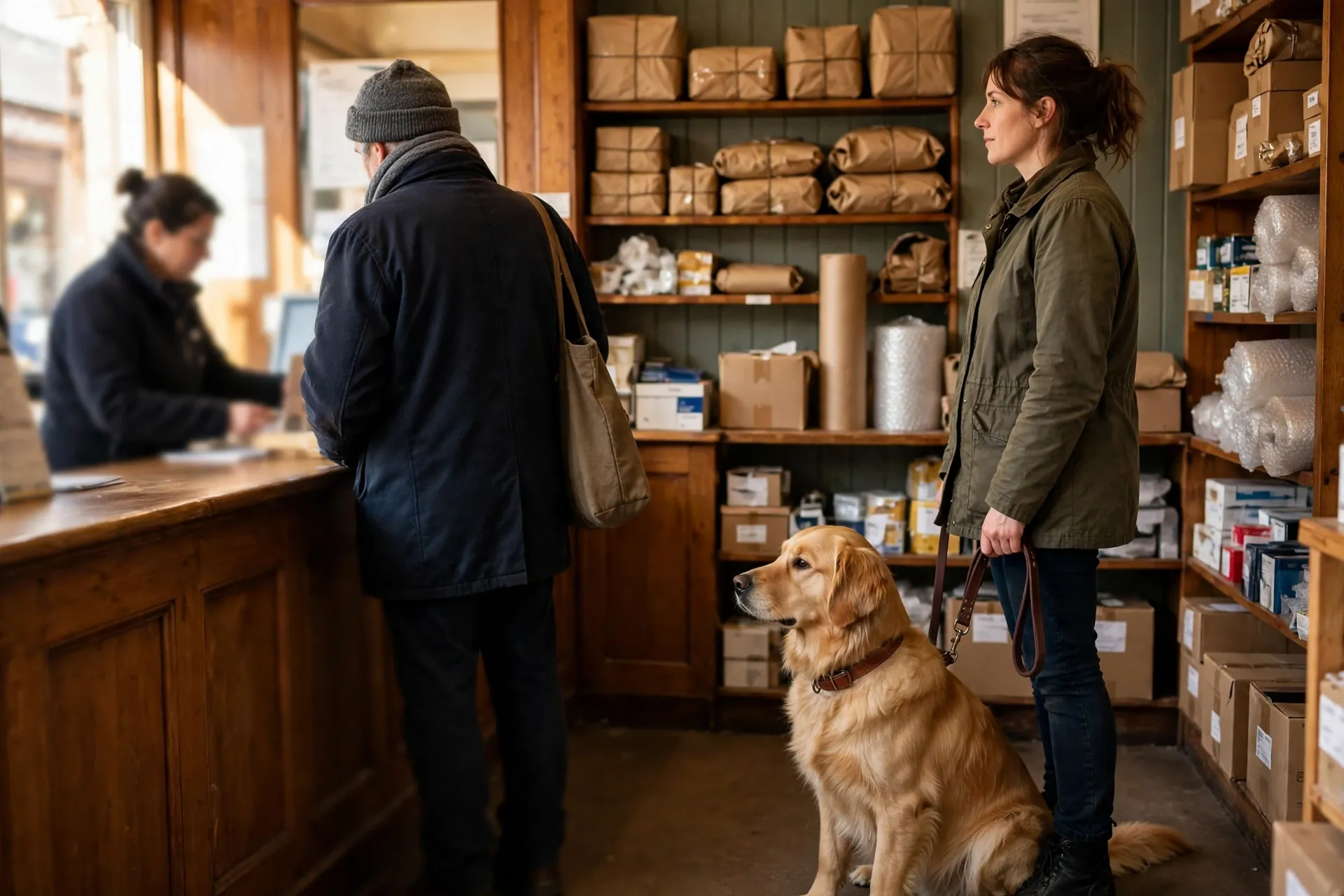
Cash is the task that most often forces a branch visit, but it is not the only route. Many banks allow customers to pay in cash and cheques at a Post Office counter, and to withdraw cash there too, subject to limits and to the bank participating in that service. Our guide to dogs in the Post Office covers the branch-by-branch picture there, which is also variable, so the same rule applies: check the individual Post Office branch before travelling, and do not assume that a banking service and a dog policy travel together. Cash machines outside a branch can handle withdrawals and, at some machines, deposits, while the dog stays beside you on a lead, which is often the simplest solution for a small amount.
Identity checks and signatures are the other common reason for a branch visit. If an online check has failed, ask the bank what alternative evidence it will accept, whether a certified copy by post will work, or whether a video verification call is available. For a signature that must be witnessed, ask whether a solicitor, a Post Office branch, or another approved witness can do it, and what form the bank requires. These alternatives take longer than a counter visit, so start them early, keep copies of everything you send, and use recorded delivery for original documents.
For longer discussions, such as a mortgage, a loan, a business account or a bereavement matter, a phone or video appointment may be offered even when the website emphasises branch appointments. Ask explicitly, and explain that an in-person visit is difficult because of the dog, without overstating the position. Banks handle accessibility and caring responsibilities every day, and a reasonable adjustment, such as a longer phone call or a video meeting, is often available even if it is not advertised. If the matter is complex and you would prefer to be seen in person, a second adult waiting outside with the dog remains the most reliable plan.
Finally, consider whether the errand can be combined with a dog-friendly part of the day, so the trip still feels worthwhile if the bank portion is short. A quiet walk before the visit, a dog-friendly cafe afterwards, or a visit to a nearby park can turn a stressful errand into a manageable outing. If the bank is part of a longer day out, our guide to dog friendly afternoon tea shows how to check seating, table etiquette and foods to avoid, which is a useful contrast: a tea room wants the dog to settle for an hour, while a bank wants the dog to settle for ten minutes, and planning for both in one day needs different timing. The key is to keep the bank visit itself short, calm and checked in advance, and to let the enjoyable part of the day happen elsewhere.
Before you leave home checklist
A short checklist, run through the night before, prevents most bank-visit problems. First, confirm the branch: its opening hours, its exact address, and its answer about dogs, with the name of the person you spoke to. Second, confirm the task: the documents you need, the amount of cash or the cheques involved, and whether an appointment is required. Third, confirm the dog plan: who will stay with the dog if the branch says no, where you will wait, and what you will do if the queue is long or the weather turns.
Pack for the dog as well as for the paperwork. A short, non-retractable lead gives you control in a queue, while a long lead creates trip hazards. A lightweight mat gives the dog a defined place to lie, which helps in a large, echoing hall. Water and a collapsible bowl matter in summer, and a few poo bags are essential for the walk to and from the branch. Avoid bringing a noisy toy, a squeaky ball, or a treat pouch that rustles every time you move, because all three draw attention in a quiet banking hall. If your dog wears a muzzle in busy places, bring it, and make sure the dog is comfortable wearing it before the visit, not trying it for the first time at the door.
Prepare the paperwork in the order you will need it. Put identity documents in an outer pocket or a separate envelope, so you are not searching through a bag while holding a lead. If you are paying in cash, sort notes by denomination, count them twice, and complete any paying-in slip at home if the bank provides one online. If you need to sign, bring your own pen, because a shared pen at a counter is one more thing to juggle. Photograph or photocopy important documents before you leave, and keep the copies separate from the originals, in case anything is mislaid during the visit.
Plan the journey with the dog in mind, not just the destination. Allow time for a toilet walk before entering the branch, and for a calm walk afterwards, so the dog is not desperate to go while you are at the counter. If you are driving, plan parking that does not require a long walk through a busy shopping centre, and never plan to leave the dog in the car as a fallback. If you are using public transport, check the rules for dogs on that service in advance, because a bus or train refusal on the way to the bank would leave you with two problems instead of one.
On arrival, give the dog a moment to take in the entrance. Let it sniff the doorway, walk in calmly on a short lead, and settle on its mat before you join the queue. Speak quietly to staff, explain that you have a dog with you, and ask where they would prefer the dog to wait. That small courtesy often makes the difference between a smooth visit and a tense one, because it shows staff that you have thought about their space as well as your own errand. When the transaction is done, leave promptly, praise the dog outside, and give it the walk it has earned. A bank visit that ends with a calm walk is a visit the dog will cope with better next time.
Keep this guide in proportion. Most bank visits with a dog are short, uneventful and perfectly manageable, provided the branch has been checked, the dog is settled, and there is a backup plan. The problems arise when the visit is assumed rather than checked, when the dog is left without a safe plan, or when a long, complex appointment is attempted with a dog that is not ready for it. Check the official guidance before you travel, check with the individual branch before travelling, and let the dog's needs shape the timing and the route, not just the bank's opening hours.
Practical questions
Before you go
Can dogs go into UK bank branches?
It depends on the branch. There is no single UK rule for pet dogs in banks, and permission can vary from one branch to another within the same banking group and can change over time. Always check with the individual branch before travelling, and have a backup plan in case the answer on the day is no.
Do assistance dogs have different rights in banks?
Yes. Assistance dogs are not pets for access purposes. In general, service providers in Great Britain must not refuse an assistance dog under equality law, and similar protections apply in Northern Ireland. If an assistance dog is refused, note the branch, date, time and reason given, and follow the bank's complaints process.
What should I do if a bank branch refuses my dog?
Stay calm, ask politely for the reason and whether a manager can confirm it, and do not argue at the counter. For a pet dog, the branch is generally entitled to say no, so switch to your backup plan: a second adult waiting outside, a quieter branch, an appointment, or an alternative channel such as the app, phone or post. For an assistance dog, record the details and complain in writing.
Is it safe to leave my dog outside a bank or in the car?
Leaving a dog tied outside a busy branch carries theft, escape and stress risks, and a car can become dangerously hot even on a mild day, so neither is a reliable plan. If no one can stay with the dog, postpone the visit or use an alternative channel instead. Never leave a dog in a car on a warm day, even with a window open.
What alternatives are there if my dog cannot go inside?
Many everyday tasks can be done through a banking app, by phone, by post, at a cash machine, or at a Post Office counter that offers banking services for your bank. Check the official guidance before you travel, because the services available and the limits that apply differ by bank and by task, especially for cash deposits, ID checks and signatures.