This guide is independent and contains no paid placement. If affiliate links are added later, they will be clearly marked and will not change our editorial checks.
Yes, some branches do — but there is no national rule. Whether your dog is welcome depends on the branch type and the shop hosting it, so ask staff first, keep your dog on a short lead in the queue, and never leave a dog tied up outside.
First question: which kind of Post Office
Most dog-policy guides start with the brand. For the Post Office, that is the wrong place to start, because "the Post Office" is not one kind of place. A large Crown branch on a high street, a small franchise counter inside a convenience store, a counter inside a larger retailer, and a mobile outreach service in a village hall are all Post Office branches, but they have different owners, different layouts, different staff and different rules. A dog that is welcome in one may not be welcome in another, and the reason is usually the branch type rather than the brand.
That is why the first question to ask yourself is not "Does the Post Office allow dogs?" but "Which branch am I visiting, and who runs it?" If you know your local branch, you probably already know its layout and its staff, and you may already know whether dogs are a normal sight there. If you are visiting a branch in a new town, you cannot assume anything from your home branch. Check before you go, or be ready to adapt when you arrive: the branch you find may be a counter in a shop that has its own rules, and those rules govern the shared space.
This variation is not a flaw in the system; it is how the Post Office network works. Branches are operated under different arrangements, and the person behind the counter is responsible for a small, busy, security-sensitive space. Their priority is serving customers safely and efficiently, and a dog in that space is welcome only as long as it does not get in the way of that job. Understanding that priority makes the rest of this guide straightforward: make the dog easy to have around, and most branches will be glad to have you.
Crown, franchise and outreach branches
Crown branches are the larger, directly managed branches, usually on a high street or in a town centre. They tend to have more space, more counters and a longer queue, and they are the branches where a well-behaved dog is most likely to be accepted without comment. Even here, though, there is no published national guarantee, and the branch manager can set rules for the day. A Crown branch that welcomes dogs on a quiet Tuesday may ask you to wait outside on a busy Saturday, and that is a reasonable decision, not a contradiction.
Franchise branches are run by a local business under a Post Office franchise, and they are often inside another shop: a convenience store, a newsagent, a larger retailer or a petrol station. Here the dog rules are set by two parties, not one: the Post Office counter and the host shop. If the host shop does not allow dogs, the Post Office counter inside it cannot overrule that, even if the counter staff are happy to see a dog. If the host shop does allow dogs, the counter staff may still ask you to keep the dog away from the counter area at busy times. Always ask the staff you can see, and accept that the answer may be "not in this part of the shop" rather than a simple yes or no.
Outreach and mobile services are a third category, and they are the least predictable for dogs. A mobile Post Office van, a part-time counter in a village hall or a community building, or a temporary service during a branch closure all operate in borrowed space with limited room. Dogs may be welcome, or they may not, depending on the venue and the day. If you use an outreach service, check with the operator or the venue before you bring a dog, and keep the visit as short as possible: these services are often under time pressure, and a dog in a small, crowded room makes everyone's job harder.
The practical lesson is to treat each branch as its own place. Once you know your local branches — which one welcomes dogs without fuss, which one sits inside a shop that does not, which one is best at a quiet hour — errands get much simpler, because you stop guessing and start choosing. That local knowledge, built up over a few visits, is more reliable than any general rule about the brand.
Queue etiquette: the heart of the visit
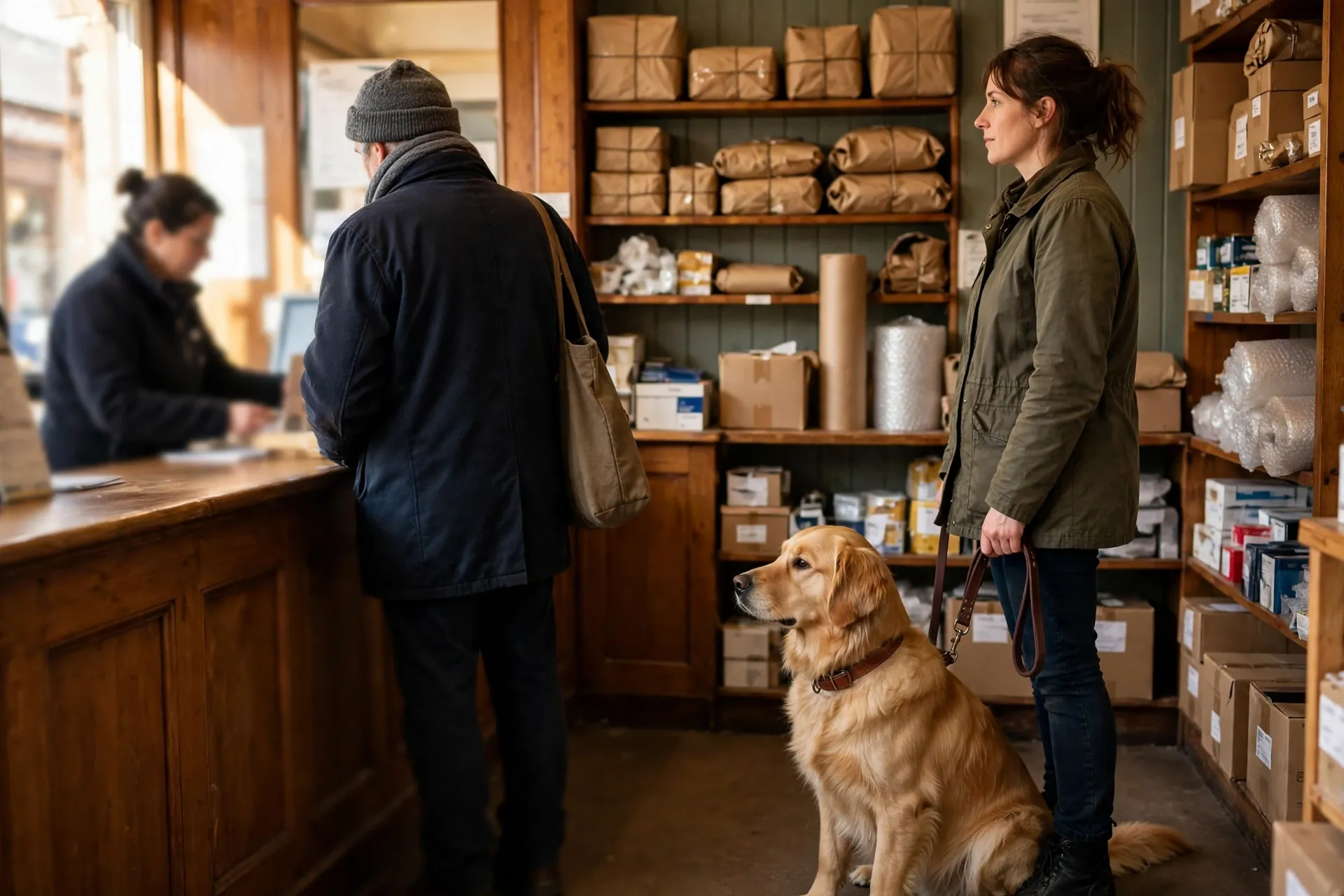
The queue is where a Post Office visit succeeds or fails with a dog, because Post Office queues are unlike shop queues. They are slow, they involve paperwork, and they bring together people who are carrying parcels, using walking aids, managing children, or dealing with complicated transactions. A dog in that queue needs to be calm, close and out of the way, for a period that can stretch from two minutes to twenty. That is a real test of a dog's patience, and it is worth training for before you rely on it.
The etiquette is straightforward. Keep your dog on a short lead, on your far side from the next person in the queue, and out of the path of people passing with parcels or trolleys. Do not let your dog sniff other customers' bags, parcels or legs, however friendly the intention. Give people space: if the queue is tight, stand slightly to one side so your dog is not pressed against the person behind you. If another customer has a dog, keep a gap between the dogs rather than letting them greet in a confined space, where a greeting can quickly become a scuffle.
Time matters as much as space. A dog that is fine for five minutes may not be fine for twenty, and a queue that is short when you join can grow while you wait. Before you join a long queue, judge whether your dog can cope with the wait: if not, come back at a quieter time, or take turns with another adult. If the queue grows while you are in it and your dog starts to struggle, it is kinder to step out and return later than to push through with a distressed dog. The parcel can wait; the dog's confidence in queues cannot be rebuilt as easily.
One more queue habit: have your parcel, form and payment ready before you join, so the counter visit is as short as possible. Fumbling for a form while holding a lead, a parcel and a pen is how parcels get dropped, dogs get tangled and queues get longer. Prepare at home, or at a table away from the queue, and the whole visit becomes smoother for everyone behind you.
At the counter: parcels, forms and hands
The counter itself is a small, security-sensitive space, and it needs a different kind of care from a shop floor. You will be handling a parcel, a form, a pen and payment, often while the member of staff weighs, scans and labels your item. Your dog needs to be settled and out of the way during this, not investigating the counter, the scales or the staff member's hands. A short lead, a dog that lies or sits beside you, and a free hand for the transaction make the difference between a smooth visit and a chaotic one.
Parcels deserve a specific thought. A large or heavy parcel plus a dog on a lead is a two-handed job with one hand missing, and a parcel set down on the floor becomes an object of intense interest to a dog. If you are posting something large, heavy or awkward, consider bringing another adult, or using a parcel drop-off at a quieter time. If you are alone, put the parcel on the counter as soon as you reach it, rather than setting it on the floor, and keep the dog on the far side from the parcel while you complete the transaction.
Forms and identification add another layer. Some Post Office transactions require identification, a signature or a form filled in at the counter, and these take time and concentration. A dog that is settled on a mat beside you is no problem; a dog that is pulling towards the door, barking at another customer or trying to reach the counter is a problem. If your dog cannot settle for the length of a form-based transaction, keep the visit to simple transactions, or practise settling in quieter places first. The counter is not the place to train a dog to settle.
Security is a real consideration for staff, and it is worth respecting. Post Office counters handle cash, identity documents and valuable items, and staff are trained to watch for anything unusual. A calm, well-controlled dog is unremarkable; a dog that is loose, barking or blocking the counter area is a distraction that staff cannot ignore. Making your dog easy to have around is not just polite: it is what keeps the branch welcoming for the next dog owner.
What to ask and what to watch for
When you arrive at a branch, a short question to staff prevents most problems: "Is it all right to bring my dog in today, and is there anywhere you would prefer we stand?" That second half matters, because staff may prefer you to wait in a particular part of the branch, or to keep the dog away from a busy counter, and they will tell you if you ask. Listen, thank them, and follow the answer even if it differs from what another branch told you.
Watch for signs as well. Some branches display a sign about dogs at the door, and some host shops display their own policy. A sign is a useful guide, but staff on the day have the final say: a sign that says dogs are welcome does not override a manager's decision on a busy day, and a sign that says nothing does not mean dogs are banned. When in doubt, ask a person, not a sign.
Also watch the other customers. A branch full of people with parcels, pushchairs and walking aids is a different environment from an empty branch, and a dog that is fine in the second may struggle in the first. If the branch is busy when you arrive, consider whether the errand can wait until a quieter time, or whether you can complete it quickly and leave. The best Post Office visits with a dog are short, calm and unremarkable, and they are planned that way.
For comparison with other everyday errands, our guide to dogs in UK supermarkets covers a similar problem — food areas, strict rules and branch variation — and the dogs in John Lewis guide shows how a large department store handles the same question differently. The pattern is consistent: check the branch, ask at the door, and have a backup plan.
Busy times: pension days and Christmas
Post Office branches have their own rhythm of busy times, and knowing it helps you choose when to visit with a dog. Pension and benefit payment days bring a surge of customers, many of them older and some using walking aids, and the branch can be crowded and slow. School holidays bring families with children. The Christmas period brings a flood of parcels, long queues and a branch full of people carrying large, awkward items. These are the worst times to bring a dog, even a confident one, because the space, the noise and the waiting time all rise together.
The quietest times are usually weekday mornings, after the first rush and before lunch, and late afternoons on weekdays. If your errand is not urgent, choose one of those windows, and keep the visit short. If your errand is urgent and the branch is busy, consider whether another branch nearby is quieter, or whether you can complete the errand without the dog and return for a browse with them another day. The parcel is rarely as urgent as it feels, and a calm dog is worth more than a posted parcel an hour earlier.
Rain changes the branch as well. People crowd inside to shelter, floors get slippery, and a damp dog shaking water over parcels and fellow customers is nobody's idea of a good visit. Towel the dog down before you enter, or put the errand off until you are both dry. Keeping a drying coat in the car turns this from a problem into a non-event, and it keeps the queue comfortable for everyone behind you.
Small spaces and reactive dogs
Many Post Office branches are small, and small spaces are hard for reactive dogs. A reactive dog in a narrow branch has nowhere to retreat, no distance from other dogs or strangers, and no way to avoid a trigger that appears suddenly around a corner. If your dog is reactive, a Post Office is probably not the right place to practise: the space is too confined, the triggers are too close, and the consequences of a reaction are too public. Choose a different errand, or visit with another adult who can wait outside with the dog.
For dogs that are anxious rather than reactive, the same logic applies in a milder form. A small, busy branch with fluorescent lights, announcements and strangers close by can be overwhelming, and an anxious dog may pant, pace or try to leave. If your dog shows these signs, cut the visit short, step outside, and try again at a quieter time. Repeated short, successful visits build confidence far better than one long, stressful visit that ends badly.
For calm, well-socialised dogs, a Post Office visit is a useful piece of everyday training: a short wait, a calm settle, a polite interaction with staff, and a reward afterwards. Keep the visits short, keep them positive, and end on a good note. A dog that associates the Post Office with a calm wait and a treat afterwards will be a dog that is easy to take anywhere, and that is the real value of a branch that welcomes dogs. If your dog does injure someone or damage property in a public place, check what dog travel insurance in the UK covers for third-party liability before you need it.
If the branch says no
A refusal at a Post Office branch is usually easy to work around, because the network itself gives you options. The simplest is geography: most towns have more than one branch, and a franchise counter that cannot take dogs may sit a short walk from a larger branch that can. Before you set out with a parcel and a dog, it is worth knowing which of your local branches is the dog-friendly one, and making that your default for errands when the dog is with you.
The second option is timing. A branch that is too crowded for a dog at pension-payment time or during the Christmas parcel rush may be quiet and welcoming on an ordinary weekday morning. If the item is not urgent, waiting a day or two for a quieter window costs nothing and changes the whole visit. And if you are posting with another person, the simplest solution of all is to take turns: one of you queues while the other waits outside with the dog, and the errand takes no longer than it would have anyway.
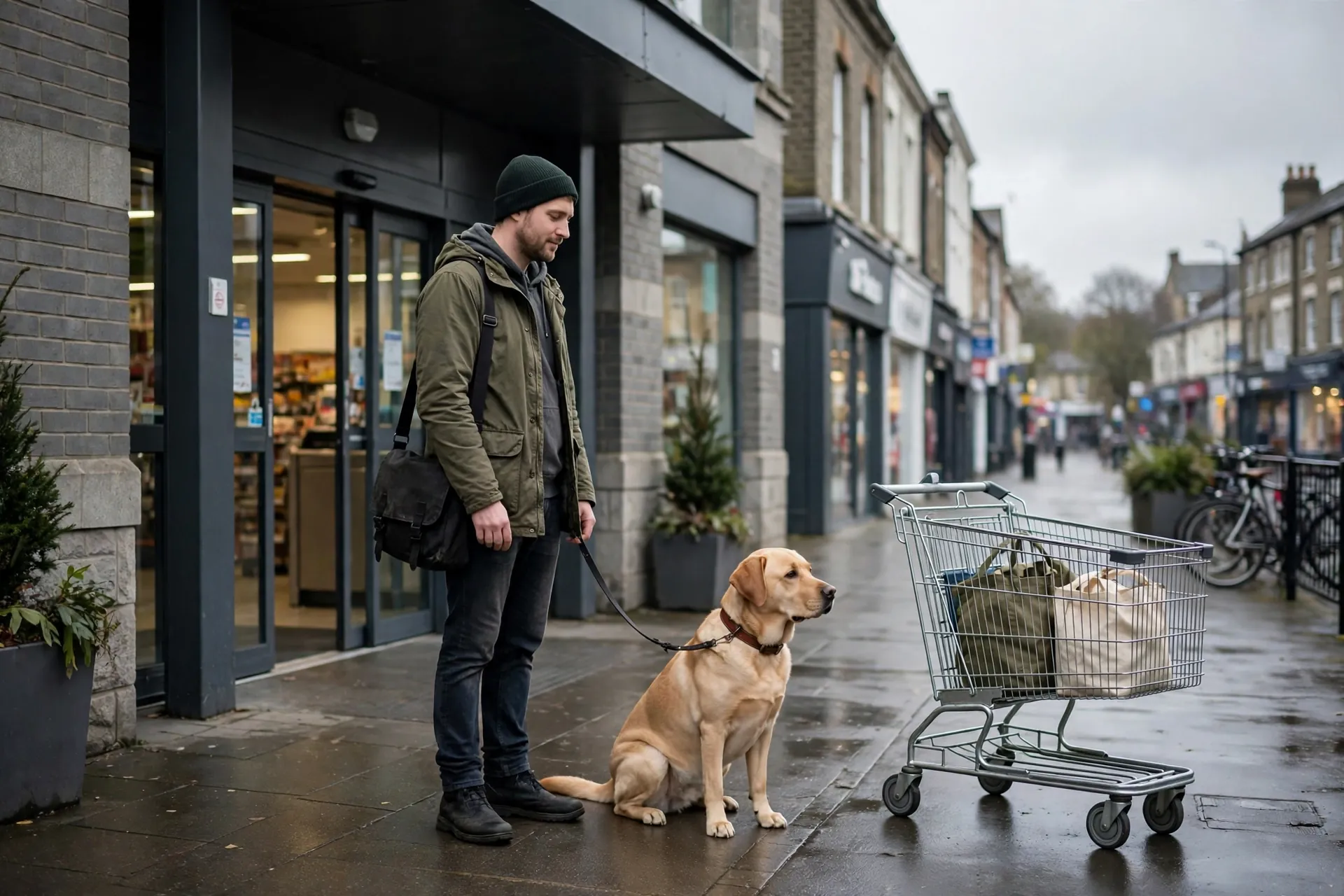
What you cannot do is leave the dog to wait alone. A dog tied to a railing outside a branch is exposed to theft and can panic and slip a lead, and a dog shut in a car is at the mercy of the temperature, which swings dangerously in both summer sun and winter cold. Neither is acceptable for an errand that can be done another day, at another branch, or with another adult. The parcel will keep; the dog's safety comes first.
Assistance dogs and counter service
For assistance dog handlers, a Post Office visit works differently from a pet owner's visit, because the law is on your side. The Equality Act 2010 requires shops and service providers to admit assistance dogs, and a Post Office branch — Crown, franchise or outreach — cannot refuse a guide dog, hearing dog or other trained assistance dog. You do not need to negotiate entry, and you do not need to explain your disability to be served.
What you can reasonably expect is practical help at the counter. Staff can read out a form, help with weighing and labelling a parcel, or direct you to a quieter counter if the main queue is long and crowded. If you use a mobile or outreach service in a village hall, the same right applies, though the space may be tighter and it helps to let the operator know you are there so they can make room. A calm word at the start of the visit usually gets you the help you need without any fuss.
Pet owners should understand why this distinction exists, because it protects everyone. A pet dog is admitted as a courtesy, and a branch can withdraw that courtesy when the shop is busy or the space is tight. An assistance dog is admitted as a right, because the handler needs the dog to use the service at all. Blurring the two — by claiming a pet is an assistance dog, or by arguing that a pet should have the same access — undermines the handlers who genuinely rely on the law. Keep the categories distinct, and both groups are better served.
One parcel, one lead, one free hand
A Post Office errand with a dog is a juggling act, so set it up to need as few hands as possible. Fill in forms at home, weigh and label the parcel if you can, and have payment ready before you join the queue. Carry the parcel in one hand and the lead in the other, and leave everything else in the car or at home: a Post Office queue is no place for a large bag, a coffee cup and a dog all at once. If the parcel is big enough to need both hands, bring another adult or choose a different day — a large parcel and a lead do not share hands well.
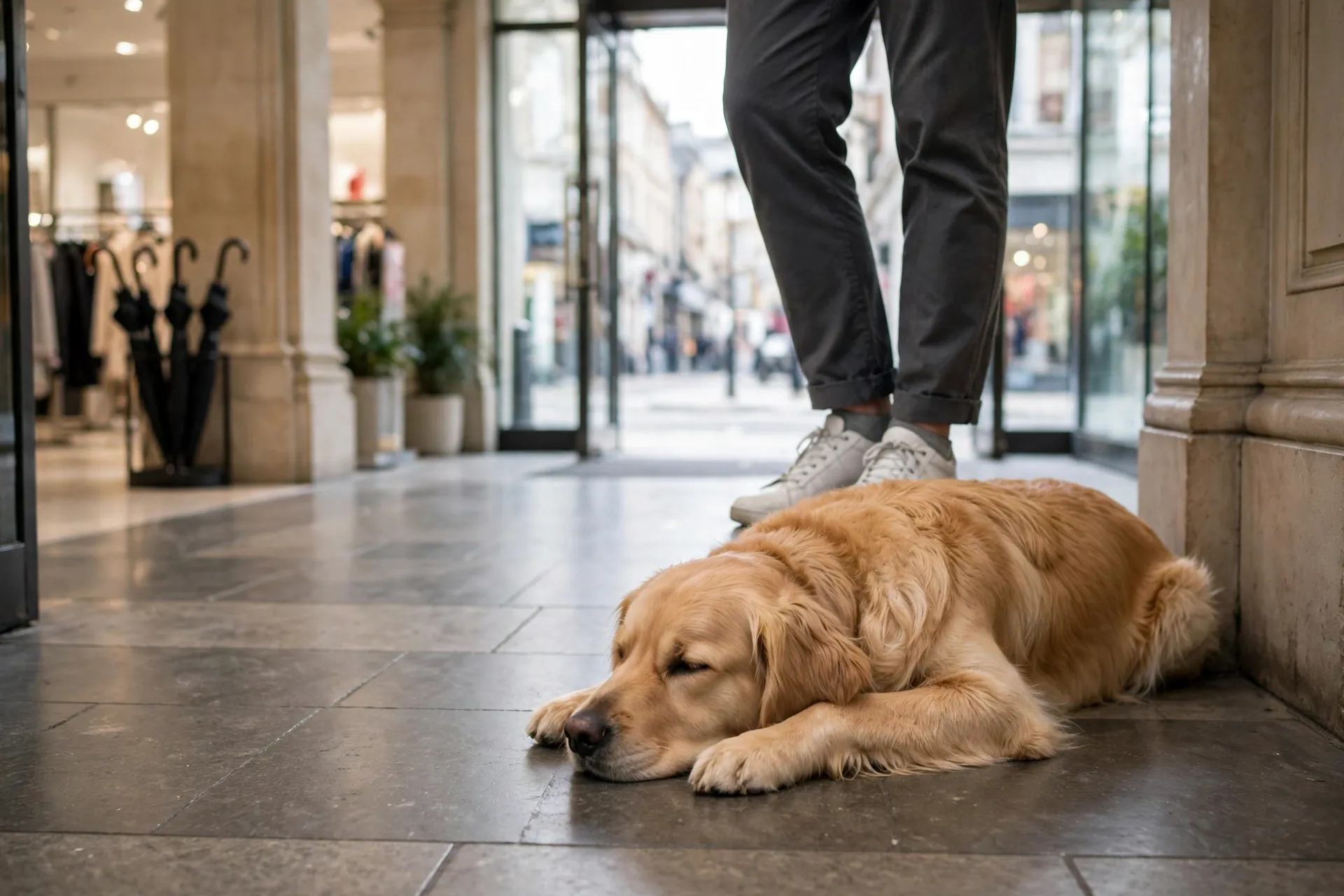
Before entering, give the dog a toilet walk and a minute to settle, so they start the queue calm. Afterwards, do the same in reverse: a short walk, a drink, and a treat for waiting quietly if that is how you reward your dog. The whole errand should feel uneventful, and that is the point. A Post Office visit is a small, practical outing, and the measure of success is a parcel posted and a dog that walks out as relaxed as they walked in.
Practical questions
Before you go
Are dogs allowed in every Post Office branch in the UK?
No. Post Office branches are run in different ways, and the rules can vary by branch. Some branches welcome well-behaved dogs, while others, especially small franchise counters inside another shop, may not. Always ask staff at the branch you are visiting, and follow their instructions on the day.
Can I take my dog into a Post Office inside another shop?
It depends on the host shop as well as the Post Office counter. A franchise branch inside a convenience store or another retailer follows the host shop's rules for the shared space, which may differ from a standalone branch. Ask staff when you arrive, and be ready to wait outside with the dog if the host shop does not allow pets.
How should my dog behave in a Post Office queue?
Keep your dog on a short lead, close to you, and out of the path of other customers. Queues in Post Offices can be long and slow, and other customers may be carrying parcels, using walking aids or managing children. Give other people space, keep your dog from sniffing bags and parcels, and step out of the queue if your dog becomes distressed.
Can I leave my dog outside the Post Office while I go in?
No, do not leave a dog tied up alone outside a Post Office, however quick the errand feels. A dog left alone is at risk of theft, escape or distress, and it can also block the pavement for other customers. If the branch does not allow dogs, take turns with another adult or come back another day.
Are assistance dogs allowed in Post Office branches?
Yes. Assistance dogs are protected by law and must be allowed into shops and service branches, including Post Office branches, under the Equality Act 2010. This applies even in branches that do not normally admit pet dogs, and it is separate from the discretionary welcome given to pets.
What should I do if a Post Office branch says no to my dog?
Accept the decision politely, because the branch has the right to set its own rules for pets. Options include visiting a different branch, asking another adult to wait with the dog, or posting your item another day. If the errand is urgent, consider whether another branch nearby welcomes dogs before you set out.