This guide is independent and contains no paid placement. If affiliate links are added later, they will be clearly marked and will not change our editorial checks.
Many parish churches welcome dogs on leads for a quiet look round, and some welcome them at services too. Cathedrals are stricter and more varied: grounds and cafes often yes, the interior often assistance dogs only, with exceptions. There is no national rule, so check that building's own wording before you travel.
The short answer: no single rule decides this
Start with the sign, not the assumption. A walk that passes a village church raises a simple question — can we pop inside? — but Britain has thousands of churches run by different parishes, dioceses and denominations, and no law and no central policy settles whether a pet dog may cross the threshold. The decision belongs to the people who care for that building, and it can legitimately differ from one valley to the next.
That local freedom explains the confusing mix of experiences dog owners report. One church leaves a water bowl by the porch and a visitors' book full of spaniel names. Another, ten miles away, keeps a polite notice asking owners to wait outside. Neither is being awkward. The first may have hard stone floors, a small congregation that knows every local dog and no fragile furnishings at paw height. The second may have just restored a medieval screen, host a daily toddler group or share its building with a food bank that has hygiene rules to meet. Context, not attitude, usually drives the answer.
Three distinctions unlock almost every policy you will meet, and this guide returns to them throughout. First, parish church or cathedral: smaller churches tend to be more permissive, larger visitor cathedrals more cautious. Second, the kind of visit: sightseeing, attending a service and attending a wedding or concert are treated as three different things, and permission for one does not imply permission for the others. Third, pet dog or assistance dog: assistance dogs sit in a separate category and a “no pet dogs” notice should never be read as applying to them. Hold those three distinctions and most church websites suddenly become easy to interpret.
One more principle is worth stating plainly at the start. A church is not a visitor attraction that happens to hold services; it is a place of worship that often also welcomes visitors. Owners who approach it in that spirit — asking rather than assuming, accepting a no gracefully, and leaving a building exactly as they found it — are the reason so many churches keep saying yes. Every muddy paw print left on a kneeler and every barking episode during a quiet prayer makes the next owner's welcome a little less likely.
Parish churches: often the warmest welcome you will get
If you are going to be welcomed anywhere with a dog, it will most likely be a parish church. Thousands of them stand open during the day for anyone to step in, and a good number state openly that dogs are welcome too. The logic is practical as much as pastoral: in rural areas the church is often the centre of a walking route, the congregation includes dog owners who arrive straight from a footpath, and a well-behaved dog on a lead causes no difficulty in a building designed for muddy agricultural boots long before it met muddy paws.
Typical parish arrangements fall into a few patterns. Some churches welcome dogs throughout the building at any open time, asking only for a lead and for owners to clear up any accident. Some welcome dogs for looking round but not during services, school visits or concerts, when the building is fuller and quiet matters more. Some restrict dogs to the porch, tower area or a designated part of the nave. And some, it should be said honestly, do not admit pet dogs at all — because of allergies in a small congregation, conservation advice, shared use with a playgroup or a bad experience that hardened opinion. All four positions are within the church's rights.
Look for the small signals that tell you which pattern you have found before you reach the inner door. A water bowl, a dog biscuit tin by the visitors' book, a “dogs welcome” line on the noticeboard or a photograph of the vicar's own dog in the parish magazine all point one way. Silence points nowhere in particular — it simply means you need to ask. If a sidesperson, churchwarden or volunteer is on duty, a cheerful “are dogs allowed in for a look round?” asked from the porch, with the dog visibly sitting outside the doorway, gets a friendly answer in almost every case. The asking itself signals that you will respect the reply.
Denomination makes less difference than individual practice, so do not build rules around it. Anglican parish churches are the ones walkers meet most often simply because there are so many of them, but Methodist, Baptist, United Reformed, Roman Catholic and independent churches each contain both welcoming and restrictive examples. Historic chapels in Wales, Church of Scotland kirks and the small mission churches of the Highlands follow the same local logic. Where a building is cared for by a conservation body rather than an active congregation — redundant churches preserved as historic sites, for example — the policy may be set by that body instead, much like the heritage rules covered in our guide to English Heritage sites with dogs, where grounds and interiors are frequently treated differently.
Cathedrals: the grounds and the interior are different questions
Cathedrals ask more of a dog owner because they carry more at once: daily worship, major civic services, school groups, concerts, queues of international visitors and, often, irreplaceable furnishings, textiles and stonework that conservation teams monitor closely. The result is not a blanket no. It is a layered answer, and reading it layer by layer saves wasted journeys.
The outer layer is the most generous. Cathedral closes, precincts, lawns and churchyards are public-feeling green spaces in the middle of cities, and dogs on leads are a normal sight in many of them — exercised before work, walked at lunchtime, photographed by the west front. Cafes attached to cathedrals frequently welcome dogs in an outdoor area and sometimes indoors too, and cathedral shops vary. If your plan is a city walk that pauses in the close, looks up at the tower and has coffee on the terrace, a dog will fit into that plan in a great many cathedral cities. A day out usually ends with a coffee stop, and dog friendly cafes UK helps you find ones that allow dogs inside, not just on the terrace.
The inner layer — the cathedral itself — is where policies genuinely diverge, and where you must not rely on generalisations, old reviews or a friend's visit two summers ago. A significant number of cathedrals admit only assistance dogs inside, and say so clearly on their visitor pages. Others have, at various times, welcomed well-behaved dogs inside for sightseeing visits, sometimes as a stated policy and sometimes as a trial, a seasonal arrangement or a special dog-friendly day. Widely shared stories about famously welcoming cathedrals are best treated as a prompt to check, never as a guarantee: trials end, chapters review policies, and a single incident can change a rule. Before travelling any distance, read the cathedral's own current wording — the section on how to decode that wording below explains exactly what to look for — and if the website is silent, email or phone the visitor team rather than turning up hopefully with a large dog at a ticket desk.
Practical cathedral realities matter as much as permission. Sightseeing entry may involve a suggested donation or a charge, timed entry at busy periods and bag checks; none of that is a problem for a settled dog, but a nervous dog in a slow queue surrounded by school parties is a different proposition. Stone floors echo, organs are loud, and vergers may direct you away from particular chapels, the choir or areas set for prayer. Go at the quietest sightseeing hour the cathedral offers, keep the visit short on a first attempt, and treat being inside a great building with your dog as a privilege to be used lightly rather than a right to be exercised to the full.
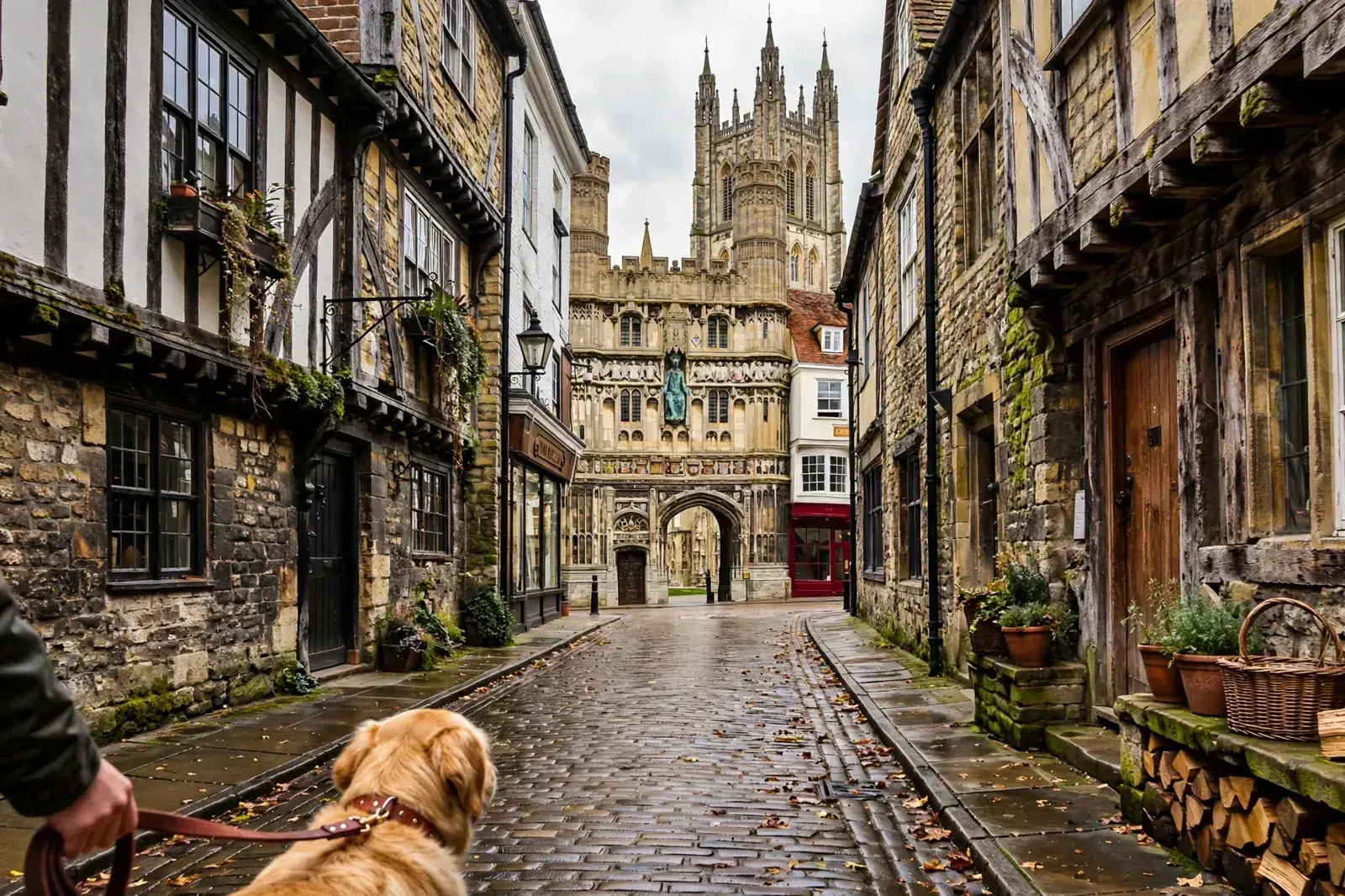
City planning helps here. Our guide to Canterbury with a dog shows the pattern that works in many cathedral cities: build the day around the streets, river walks and gardens your dog can definitely enjoy, treat the precincts as a welcome bonus, and only count the cathedral interior itself once you have confirmed the current policy in writing. A day designed that way cannot be ruined by a no at the door.
Services are different from sightseeing — plan them separately
The distinction owners most often miss is between visiting a church and worshipping in one. A church that happily admits dogs for a Tuesday afternoon look round may ask owners not to bring them to the Sunday service, not from hostility but because a service adds communion movement, music, children, elderly worshippers with limited mobility and long stretches of required quiet. The reverse also happens: a congregation that knows its members' dogs by name welcomes them every week, while keeping stricter rules for ticketed events.
If you would like to attend a service with your dog, the reliable route is to ask in advance — a message to the parish office or a word after a previous service — rather than arriving at the door at two minutes to eleven. Choose a shorter, simpler service for a first attempt rather than a major festival. Sit at the back or at the end of a row on an aisle, where you can slip out without disturbing anyone if your dog whines, and bring a familiar mat or blanket so the dog has a defined place to settle. Do not bring a dog to a service if it barks at other dogs, reacts to singing or cannot lie quietly for the length of the service; there will be other Sundays, and a settled reputation is worth more than one ambitious outing.
Some services are designed for animals and are the easiest entry point of all. Pet blessing services, often held around the feast of St Francis in early October or as part of harvest celebrations, explicitly invite dogs and other animals, and rural parishes in particular may hold them outdoors or in a churchyard. Crib services, carol services and other crowded family occasions sit at the opposite end of the scale: even dog-welcoming churches may reasonably ask owners to leave dogs at home when the building will be packed. Baptisms, as semi-private family services, follow the wishes of the family and the minister — always a case for asking, never assuming.
Dogs at services also interact with the ordinary law of public behaviour. Our guide to dogs on leads and UK law explains the wider picture — control in public places, livestock rules and local orders — and the same principle applies with extra force in a church: you are responsible for your dog's behaviour throughout, and “the church allows dogs” never transfers that responsibility to anyone else.
How to check before you go: read the exact wording
Because every building decides for itself, checking well is the core skill in this guide. The good news is that most churches and cathedrals now publish their position somewhere; the skill lies in finding the right page and reading its exact words rather than a hopeful summary of them.
Start with the church's own website, not a listing site. Look for pages headed visiting, opening times, accessibility or plan your visit — dog policies often hide inside accessibility sections, because that is where assistance dog information lives. Read the sentence about dogs completely. “Dogs are welcome” and “dogs are welcome in the grounds” are different permissions. “Assistance dogs only” is unambiguous. “Well-behaved dogs on leads are welcome for sightseeing but not during services” is a complete policy in one sentence, and it is more common than you might expect. Note the date of the page if one is shown; a policy written several years ago is a starting point for a confirming email, not a certainty.
For parish churches, the next layer is the diocese and parish listings. A Church Near You, the Church of England's directory, lists many parishes with facilities information, and diocesan websites link through to parish pages. In Wales, Scotland and Northern Ireland, equivalent denominational directories do a similar job. These listings are helpful but can lag behind a change of vicar or churchwarden, so treat a listing that says dogs are welcome as encouraging rather than conclusive, and a listing that says nothing as neutral.
If the published information is missing, contradictory or old, ask directly — and ask a precise question. “Are dogs allowed?” invites a vague answer. “We are walking through on Saturday with one dog on a lead — may we bring her inside for a short sightseeing visit, or would you prefer us to stay in the churchyard?” can be answered yes or no in a line, and wardens answering parish email inboxes much prefer it. Save the reply. Policies stated in writing settle any confusion at the door far more politely than a screenshot of a third-party review.
Finally, build a fallback into the day itself. Check where the churchyard path runs, whether there is a bench, a porch with shelter or a cafe nearby where one person can wait with the dog while others go inside. Two adults can take turns for ten minutes each and both see the interior; a solo walker with a dog that cannot come in still gets the tower, the churchyard, the lychgate carvings and very often the best photograph of the day. A visit planned with a fallback never feels like a rejection.
Inside etiquette: leads, paws, water and quiet
Permission gets you through the door; behaviour decides whether the permission survives. Church interiors are forgiving of a calm dog and unforgiving of small avoidable carelessness, so a short routine before, during and after the visit is worth making automatic.
Before you go in, give the dog a proper chance to relieve itself away from the churchyard — not on graves, memorials or planted areas — and clean up without exception. Wipe paws thoroughly at the porch, especially after rain: a small microfibre towel carried for church and cafe stops earns its space in a pocket many times over. Mud is the single most-cited reason in “we used to welcome dogs” conversations, because stone and tile floors show every print and historic floors can be damaged by grit. If your dog is soaked and dripping, admire the churchyard and come back on a drier day rather than towelling half-heartedly and hoping.
Inside, keep the lead short and fixed. A dog should walk at heel pace beside you, never range ahead on a retractable lead, and never be tied to pews, font covers, candle stands or door handles. Keep clear of lighted candles and pricket stands, flower arrangements, altar steps and any area roped or signed as set apart for prayer. Do not let a dog drink from a font, investigate a refreshment table or greet other visitors uninvited — however friendly the intention, a person in quiet reflection has not consented to meeting your dog. Water for the dog comes from your own bottle and bowl, offered outside in the porch or churchyard.
Noise deserves its own sentence. A single bark in a stone building is startlingly loud, and a whining dog during a service, a concert silence or a moment of private prayer is the fastest route to a policy review. If your dog will not settle within a minute or two, leave quietly and without embarrassment — wardens remember the owner who left early far more warmly than the one who stayed and shushed for twenty minutes. Equally, if an accident happens, tell someone and clean it properly rather than hoping it goes unnoticed; churches keep cleaning supplies for exactly this, and honesty preserves goodwill.
The same manners scale up well to other heritage interiors. If you are planning a weekend that mixes churches with larger attractions, the pawprint system explained in our National Trust guide for dog owners uses a similar logic — grounds generous, interiors selective, assistance dogs throughout — and reading the two systems together gives you a realistic sense of how British heritage buildings in general think about dogs.
When inside is a no: churchyards, porches and grounds still count
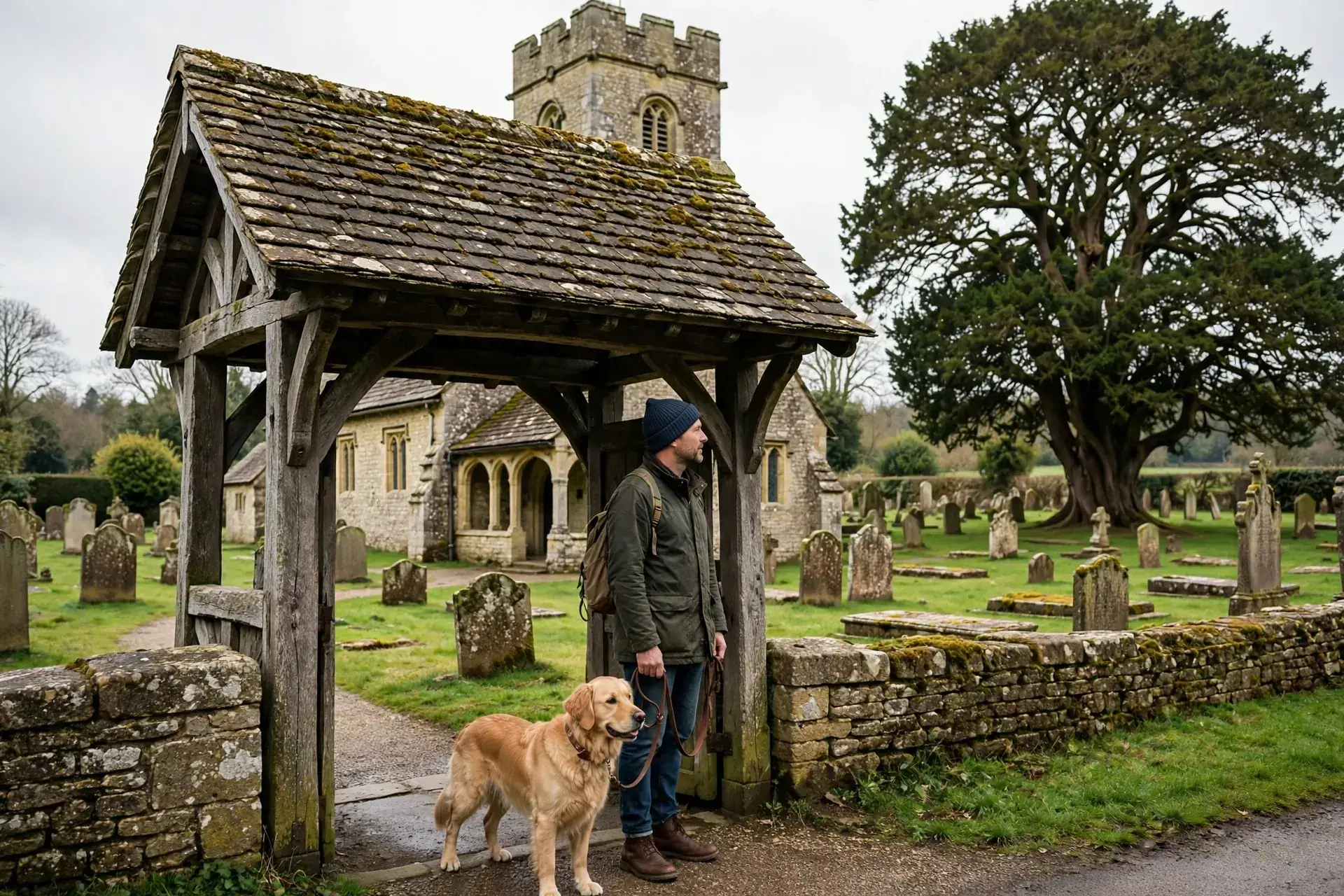
A closed door does not make a wasted stop. Churchyards are among the most rewarding places to explore slowly with a dog in Britain, and they are precisely where dogs are most consistently welcome — on a lead, with the obvious courtesies around graves and memorials. Many churchyards are managed for wildlife, with unmown corners, veteran yew trees, wildflower areas in summer and interpretation boards explaining both. A lead matters doubly here: for the nesting birds and slow-worms you cannot see, and for the people visiting a recent grave who deserve an undisturbed visit.
Read the churchyard as carefully as you would the interior. Lychgates often carry carvings, war memorial inscriptions or the names of local craftsmen. Porches shelter medieval graffiti, masons' marks and noticeboards that are effectively the village newsletter — walks, coffee mornings, the next pet blessing service. Sundials, table tombs, Commonwealth war graves and the occasional ancient cross all reward a slow circuit, and the tower that you cannot climb still gives its best view from the churchyard path. Photographers know that many churches look their finest from outside in low evening light, dog sitting patiently by the gate.
Respect the working parts of the space. Keep dogs off graves themselves, away from fresh floral tributes and out of any fenced memorial garden that is signed as private or quiet. If a funeral, interment or grave-tending visit is in progress, give it the whole churchyard and walk on — there is always another church, and this one will keep. Churchyards are also not dog exercise areas: no off-lead running, no ball games, no training sessions, however empty they appear. That restraint is what keeps the welcome intact for the next walker.
Weddings, christenings, concerts and other special cases
Special events rewrite the ordinary rules in both directions, so never extrapolate from a normal Sunday or a weekday visit. A church that welcomes dogs daily may exclude them from a ticketed candlelit concert because of capacity, cables, instruments and an audience that has paid for silence. A church that normally restricts dogs may happily include one particular dog — the couple's own — in a wedding by arrangement. The organisers' decision governs, and it is final for that event.
Weddings deserve a practical note because so many couples ask. If you hope your dog can attend a wedding, raise it with the minister and the couple at the earliest planning stage, not the week before. The workable pattern, where permission is given, usually involves a designated handler who is not in the wedding party, a seat at the back near an exit, a familiar mat, and a plan for the dog to leave before the reception photographs if it becomes restless. Ring-bearing roles and walking down the aisle make charming photographs and genuinely stressed dogs in about equal measure; a calm appearance for the ceremony and the photographs outside is the kinder ambition. Guests, as opposed to the couple, should assume their dogs are not invited unless the invitation says otherwise.
Concerts, plays and school performances follow the venue logic of any performance: assume pet dogs are not admitted unless the event is billed as relaxed or dog-friendly, which a small but growing number of daytime events now are. Remembrance services, civic services and funerals call for particular sensitivity — a funeral especially is a family's occasion, and a dog attends only at the family's clear invitation. Christmas is the busiest test of all: carol services fill churches to standing room, candles multiply and queues form in the dark, so even regular dog-welcoming congregations may reasonably run a dogs-at-home policy for their largest services. Checking the Christmas service list in advance prevents the one disappointment of the season.
Building a church stop into a dog walk that works
The most satisfying church visits with a dog rarely begin as church visits at all. They begin as walks — a circular route from a market town, a stretch of a long-distance path, a coastal walk between villages — where the church is the natural pause in the middle: shelter if it rains, a bench and a flask in the churchyard, ten quiet minutes inside if the policy allows. Planned that way, the dog has already exercised, toileted and settled before you reach the porch, which is exactly the state in which dogs behave best in buildings.
Sequence the day around that principle. Walk first, visit second. Carry the small church kit without thinking: short fixed lead, microfibre towel, poo bags, a bottle of water and a folding bowl, and a mat if you hope to stay for a service. Time a sightseeing visit for a weekday morning or early afternoon where you can, when buildings are quietest and volunteers have time to talk — churchwardens and local history volunteers are, incidentally, some of the best sources of walking advice in any village, and more than one excellent pub recommendation has come from a conversation that started with “is the dog all right to come in?”.
Manage your expectations about famous buildings and save your certainty for local ones. The parish church you can verify with one email will give you a better day than the celebrated cathedral you guessed about for two hours in a car. And when you find a church that welcomes you both properly — bowl by the porch, a note in the visitors' book from the last dog, a warden who asks your dog's name — sign the book, leave a donation in the box that reflects the welcome, and say thank you on the way out. Churches run on goodwill and small donations, and dog owners who visibly contribute to both are ambassadors for every owner who follows. That, more than any policy document, is how Britain's churches stay open to dogs.
Practical questions
Before you go
Are dogs allowed in all UK churches?
No. There is no single national rule. Many parish churches welcome well-behaved dogs on leads, but each church sets its own policy and it can differ between a sightseeing visit, a regular service and a wedding or concert. Always check the church or diocese website, the noticeboard and any sign on the door before you go in, and be ready to stay in the churchyard if dogs are not admitted that day.
Can I take my dog into a cathedral?
Sometimes, but cathedrals vary more than parish churches. Many welcome dogs in the grounds, close or cafe while allowing only assistance dogs inside the building itself. A smaller number allow pet dogs inside for sightseeing at quieter times. Policies change, so check the cathedral visitor pages for the exact wording on dogs before travelling, rather than relying on an old review or social media post.
Can I bring my dog to a church service?
It depends on the church and the service. Some congregations welcome dogs at regular worship and even hold dedicated pet blessing services, while others ask owners to leave dogs outside during services even if sightseeing visits with dogs are allowed. If you want to attend a service with your dog, contact the church in advance, sit near the back or an aisle, and leave promptly if your dog cannot settle quietly.
Does my dog need to be on a lead inside a church?
Yes, in practice always. Keep your dog on a short, fixed lead inside any church or cathedral and in the churchyard, unless a sign clearly says otherwise. A short lead protects stone floors, furnishings and other visitors, and it keeps your dog away from candles, flower arrangements and food at refreshments. Retractable leads should be locked short or left at home.
What about assistance dogs in churches and cathedrals?
Assistance dogs are in a different legal and practical category from pet dogs. Churches and cathedrals that restrict pet dogs will normally welcome assistance dogs throughout the building, including during services. If you travel with an assistance dog, carrying identification from your training organisation can make arrival smoother, but a pet dog policy on a website should never be read as applying to assistance dogs.