This guide is independent and contains no paid placement. If affiliate links are added later, they will be clearly marked and will not change our editorial checks.
Book only a screening that explicitly welcomes pet dogs. Walk and toilet the dog first, choose a short, gentle film, sit on an aisle near an exit, and leave at once if the dog cannot settle.
Ordinary screenings are not dog screenings
It is tempting to assume that a cinema that welcomes dogs in its foyer or bar will also welcome them in the auditorium, but that assumption causes most cinema problems for dog owners. In practice, the great majority of ordinary cinema screenings in Britain admit only assistance dogs. The auditorium is dark, the seats are fixed, the aisles must stay clear, and the audience has paid to watch a film without interruption. A pet dog in an ordinary screening is therefore not a grey area; it is usually a straightforward breach of the cinema's policy, and the owner may be asked to leave, with no refund, once the film has started.
The reasons are practical rather than personal. Cinema sound is amplified far beyond normal conversation, with sudden effects that can startle even a confident dog. The darkness removes the visual cues dogs rely on, so a dog that is calm in a bright cafe may become anxious when the lights go down and strangers sit close on both sides. Food smells, rustling bags and other people's feet all add stimulation, and a dog that needs the toilet has nowhere to go without disturbing a whole row. None of this is the dog's fault, and none of it is solved by a well-behaved dog in the abstract; it is solved by choosing a screening designed for dogs.
The check is therefore specific, not general. Look at the listing for the exact screening, on the exact date, at the exact cinema, and look for words such as dog-friendly, dogs welcome, or a named dog screening event. If the listing says nothing about dogs, assume pet dogs are not admitted to that screening, even if the cinema's foyer welcomes dogs or a different screening at the same cinema welcomed them last month. Check the official guidance before you travel, and keep the listing or confirmation on your phone. A screenshot of a dog-friendly listing resolves a door question in seconds, while a vague memory of a website does not.
What makes a screening dog-friendly
A genuine dog-friendly screening differs from an ordinary screening in ways that go beyond permission. The audience knows dogs will be present, so the social contract is different: a dog that sighs, shifts position or gives a single bark is an expected part of the event, not a disruption to be glared at. The cinema may leave the house lights up at a low level, lower the sound slightly, and allow more movement in and out of the auditorium. Some screenings provide water bowls in the foyer, a relief area outside, or staff who expect to help dog owners find seats. The film choice may also be gentler, with fewer sudden loud effects.
Even a dog-friendly screening has rules, and they are worth reading before you book. There may be a limit of one dog per owner, a requirement to keep dogs on a lead, a rule against dogs on seats, or a designated dog area in the auditorium. Some screenings ask owners to bring a blanket for the dog to lie on, which protects the seats and gives the dog a familiar place. Others restrict certain breeds or sizes for safety in a confined space, or require that dogs be toileted before entry. A screening that states its rules clearly is a screening that has run before and learned from it; a screening with no rules at all deserves a question to the cinema before you book.
Do not confuse a dog-friendly screening with a screening that merely tolerates dogs because nobody has complained yet. Tolerance without a policy leaves you exposed: a manager on the night, a complaint from another audience member, or a change of staff can end the visit abruptly. An advertised dog-friendly screening, by contrast, means the cinema has chosen to welcome dogs, briefed its staff, and told the rest of the audience what to expect. That preparation is what makes the evening enjoyable rather than anxious, and it is worth travelling further for a properly advertised screening than settling for an unadvertised hope nearby.
Chains, independents and pop-ups
Chain cinemas and independent cinemas approach dog-friendly screenings differently, and each has advantages. Large chains have standardised access policies, online booking systems and consistent auditorium layouts, which makes it easier to predict the experience, but dog-friendly screenings may be occasional, tied to a particular film release, or available only at selected sites. Independent cinemas, by contrast, often have more freedom to run dog-friendly events, a more informal atmosphere, and staff who know their regular dog audience by name, but their policies can vary from site to site and their auditoriums may be smaller, with tighter rows and fewer exits.
Pop-up cinemas, outdoor screenings and community film clubs add a third option. An outdoor screening in a park or a garden can be far easier for a dog than an indoor auditorium, because there is space, air and an easy exit, and the audience is generally more relaxed about movement. The trade-offs are weather, ground conditions, darkness on the walk home, and other animals or children in an open space. A drive-in screening, where available, is another distinct case: the dog stays in the car with you, which suits some dogs and stresses others, and the car must be ventilated, comfortable and never left with the dog alone while you use facilities. Check the official guidance before you travel for each format, because pop-up and drive-in rules are set by the organiser, not by a national chain policy.
Whatever the venue type, book through the cinema's own listing where possible, and read the event details rather than a third-party summary. Third-party listings can be out of date, can confuse a dog-friendly screening with an ordinary one, or can omit the conditions that matter, such as a one-dog limit or a no-dogs-on-seats rule. If you book through a third party, confirm the dog policy with the cinema directly before the day. A five-minute confirmation call is a small price for an evening that does not end at the door.
Assistance dogs at the cinema
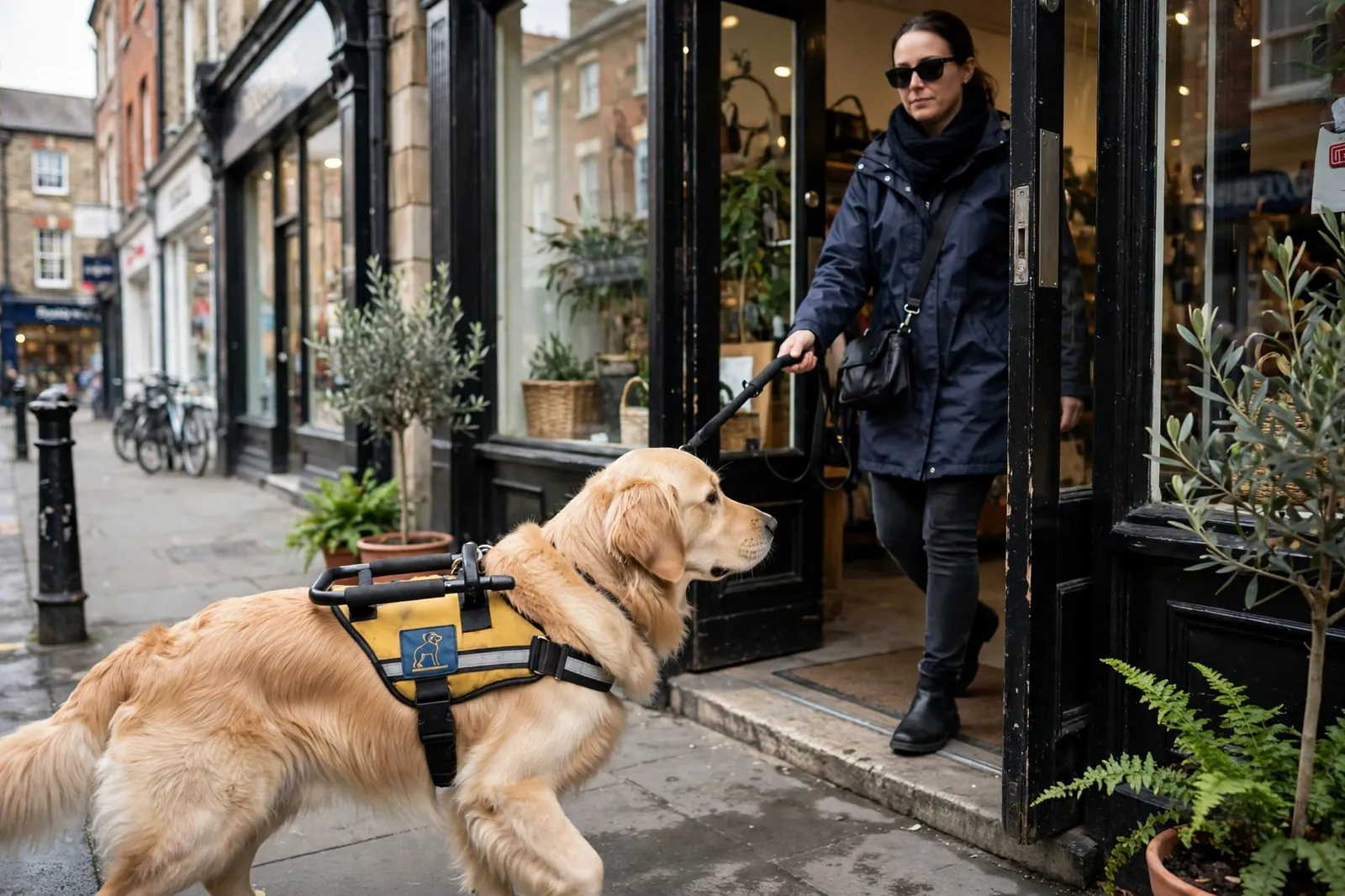
Assistance dogs are in a different category from pet dogs at the cinema, as they are in theatres and galleries. An assistance dog has access rights in Britain and should be welcome at any screening, not only at dog-friendly screenings, with floor space beside the handler. Cinemas should be able to advise on accessible seating, aisle width and the nearest exit, and many can reserve a seat with extra floor space if contacted in advance. Our guide to assistance dog access rights in the UK explains the position in full, including what to do if access is refused.
For handlers, a little advance planning still improves the visit. Contact the cinema's access team or customer service before booking, explain that you will attend with an assistance dog, and ask about seating, sound levels for the chosen film, and the nearest toilet and relief area for the interval or for leaving early. Some cinemas offer audio description, subtitled screenings or relaxed screenings that may suit a handler's needs better than a standard screening, and combining those access features with assistance dog access can make a visit far more comfortable. Ask about the whole visit, not just the seat.
Pet dog owners should not treat assistance dog access as a precedent for pet dogs, and should never present a pet as an assistance dog to gain entry to an ordinary screening. The distinction protects people who rely on assistance dogs, and misusing it undermines that protection. If a cinema does not run dog-friendly screenings, the honest options are to enjoy the film without the dog, with the dog looked after at home or by a sitter, or to find a cinema that does run a dog-friendly event. All three are better than an argument at the box office.
Choosing the right film and time
Film choice is the most underrated part of a dog-friendly cinema visit. A dog does not follow the plot, but it does hear every sound effect, feel every bass note, and react to sudden movement on a large screen. A short, gentle film with steady dialogue and little loud action is a far better first choice than a long action film, a horror film, or a war film with frequent explosions and shouting. Animated films for families can work well, provided the sound is not too intense, while a quiet drama or a light comedy often suits a dog better than a thriller with jump scares.
Running time matters as much as genre. A ninety-minute film is a reasonable first outing; a three-hour epic is a test of endurance for a dog that has never sat still in the dark. Matinee screenings are often better than late evenings, because the dog is less tired, the audience may be smaller, and the journey home is in daylight. A dog-friendly screening that starts in the afternoon also leaves time for a walk beforehand and a toilet break afterwards without rushing. If the only dog-friendly screening is late at night, consider whether the dog will still be settled at that hour, or whether a different date would suit better.
Check the film's content warnings as well as its genre. A family film can still contain a loud storm, a chase, a barking dog on screen, or a sudden scream that unsettles a real dog in the audience. Dogs often react strongly to dogs on screen, to sirens, and to high-pitched sounds, so a film with a prominent animal character may be more exciting for your dog than you expect. There is no perfect prediction, which is why the first visit should be short, gentle and easy to leave. A dog that enjoys a calm ninety minutes will enjoy longer films later; a dog that panics through an action film may take months to trust a cinema again.
Seats, blankets and floor space
Seating for a dog-friendly screening is about floor space, not about the best view. An aisle seat near an exit is usually best, because it gives the dog room to lie, lets you leave quickly, and disturbs fewer people when you move. A seat in the middle of a row traps you, and every toilet break or calming exit becomes a disturbance. Some cinemas allocate a specific dog area, often at the back or at the end of rows, where dogs have more floor space and owners sit together; if such an area exists, use it, even if the view is slightly worse, because the shared understanding among dog owners in that area makes the whole screening calmer.
Bring a familiar blanket or mat for the dog to lie on, even if the cinema does not require it. A blanket defines the dog's space, protects the seat and floor, smells of home, and gives the dog a clear cue to settle. Place it on the floor beside your seat, not on the seat itself, unless the cinema explicitly allows dogs on seats. Keep the lead short and in your hand throughout, even when the dog is asleep, because a sleeping dog can wake suddenly at a sound effect. A harness is often better than a collar for a long settle, because it distributes pressure if the dog shifts or stands.
Think about neighbours as well as the dog. A dog that lies quietly on a blanket beside an aisle seat is a pleasure to sit near; a dog that sprawls across two seats, climbs onto laps, or investigates other people's bags is not. Keep the dog's space compact, keep food and treats out of the auditorium, and do not let the dog greet every passer-by. Other dog owners will understand a restless dog, but the audience also includes people who came for the film, not for a dog social, and their enjoyment matters too. The best dog-friendly screenings work because every owner keeps their dog's footprint small.
Sound, darkness and sensory load
Cinema sound is the hardest part of the experience for many dogs, and it deserves honest attention. Modern cinema sound systems are powerful, with deep bass that a dog can feel as well as hear, and sudden effects that are designed to startle a human audience. A dog-friendly screening may lower the volume slightly or leave lights up, but it cannot remove the fundamental sensory load of a film. A dog with noise sensitivity, a history of firework fear, or anxiety in loud places may simply not enjoy a cinema, however dog-friendly the screening claims to be, and that is useful information, not a failure.
Darkness adds a second layer. Dogs rely on vision less than humans do, but a sudden transition from a bright foyer to a dark auditorium, with strangers sitting close and a huge moving image ahead, can be disorientating. Arrive early, take seats while the lights are still up, and let the dog settle before the film starts. If the screening leaves lights up at a low level, that helps considerably; if it does not, consider whether your dog can cope with full darkness for the length of the film. A dog that paces, pants or whines in the dark is telling you the environment is too much, and the right response is to leave, not to persist.
Build up gradually if cinema visits matter to you. Practise settling on a mat in a darkened room at home with film sound at low volume, then try a short, quiet community screening, then a dog-friendly matinee. Each step teaches the dog that film sound and darkness predict calm settling, not panic. If the dog never settles, accept that cinemas may not be their activity, and enjoy other shared outings instead. Our guide to dogs in pub gardens in the UK offers a lower-sensory social outing that many dogs enjoy far more than a cinema, and a happy pub garden dog is a better outcome than a stressed cinema dog.
Toilet breaks and leaving early
Toilet planning is the least glamorous and most important part of a cinema visit. Walk the dog properly before the film, give them a toilet break immediately before entering, and do not rely on the dog holding on for two hours because they managed it at home. A cinema has no interval in the theatrical sense, and leaving mid-film to toilet a dog means missing part of the film and disturbing a row. Some dog-friendly screenings build in a break, but most do not, so the pre-film walk is the real toilet plan, not an optional extra.
Agree an exit plan before the film starts. Know where the nearest exit is, how to reach it without crossing a whole row, and whether re-entry is allowed if you leave mid-film. Some cinemas allow re-entry, some do not, and some allow it only at the discretion of staff. If re-entry is not allowed, a mid-film exit ends the visit, and that should be an acceptable outcome, not a disappointment. Leaving early with a calm dog is a successful dog-friendly screening; staying through a film with a distressed, barking or desperate dog is not.
After the film, give the dog an immediate toilet break and water, even if the film was short. The dog has sat still in the dark for a long time, and a walk, a sniff and a drink help them decompress. Do not go straight into a busy restaurant or a long car journey without that break. A short post-film walk also gives you time to reflect honestly: did the dog settle, did the sound bother them, was the film too long, was the seat right? Those answers shape the next visit far more usefully than whether you enjoyed the film itself.
Cinema etiquette with a dog
Cinema etiquette with a dog is mostly the same etiquette as without one, applied more carefully. Arrive on time, sit quietly, silence your phone, do not talk during the film, and do not use a bright phone screen in the dark. With a dog, add the dog-specific rules: keep the lead short, keep the dog on its blanket, do not feed the dog during the film, do not let the dog bark at dogs on screen, and leave promptly if the dog cannot settle. A dog-friendly audience is tolerant, but tolerance has limits, and a single owner who ignores the rules can spoil a screening that other owners have planned carefully.
Food deserves a specific note. Cinema food smells strongly, rustles loudly, and tempts dogs, so it is best to eat before or after the film rather than during it. If you do bring food into a dog-friendly screening, keep it minimal, quiet and out of the dog's reach, and clean up completely afterwards. Never feed the dog from your food during a film, and never let the dog investigate other people's bags. A dog that learns cinemas mean food begging will be harder to settle next time, and a neighbour whose popcorn is stolen by a strange dog will not return to a dog-friendly screening.
Finally, support the cinemas that do dog-friendly screenings well. Book in advance, follow their rules, thank the staff, and leave a positive review if the experience was good. Dog-friendly screenings exist because cinemas believe there is an audience for them, and that audience is proved by owners who attend responsibly, not by owners who argue for exceptions at ordinary screenings. If your local cinema does not run dog-friendly events, a polite enquiry about future plans is more productive than a complaint. For a longer trip, our guide to dog-friendly holiday parks in the UK covers the same principle at holiday scale: choose venues that genuinely welcome dogs, and the whole break feels easier. Check the official guidance before you travel, choose a gentle film, and let the dog's comfort set the length of the visit.
Practical questions
Before you go
Can pet dogs go to a normal cinema screening in the UK?
Usually not. Most cinemas allow only assistance dogs in the auditorium, while pet dogs are welcome only at specially advertised dog-friendly screenings. Check the official guidance before you travel for the specific cinema and screening.
What is a dog-friendly cinema screening?
A screening advertised for dogs and their owners, where dogs are expected in the audience. Lights may be left up, sound may be lower, and the audience accepts that dogs will move, settle and occasionally make noise. Rules still apply, so check the cinema's conditions before booking.
Can assistance dogs go into a cinema auditorium?
Yes, assistance dogs have access rights in Britain and should be welcome in the auditorium. Contact the cinema in advance to confirm seating and floor space, and see our assistance dog guide for the full position on access rights.
Which films are best for a first dog-friendly screening?
Choose a short, gentle film with little loud action, sudden noise or intense sound effects. A calm drama or a light comedy usually suits a dog better than an action film, a horror film or a film with frequent explosions, gunfire or screaming.
What should I do if my dog barks in the cinema?
Leave the auditorium calmly at once, settle the dog in the foyer or outside, and return only if the dog is fully calm and re-entry is allowed. Do not wait for staff to intervene, and do not try to train through barking during a film.
Should I bring a blanket and water for my dog at the cinema?
Yes. A familiar blanket or mat gives the dog a defined place to lie, and water in the foyer before and after the film helps them settle. Avoid food, noisy chews and anything with a strong smell inside the auditorium.