This guide is independent and contains no paid placement. If affiliate links are added later, they will be clearly marked and will not change our editorial checks.
There is no single UK-wide rule for dogs in DIY stores. Most large chains are broadly dog-friendly, but the decision is made branch by branch, and a store can refuse entry on a busy day. Always check the policy of the specific branch you plan to visit before you travel, keep your dog on a short lead, and steer clear of paint, timber and forklift routes.
Check your own branch first
A DIY store is not a supermarket, and it is not a garden centre either. It is a warehouse with customers, forklifts, heavy timber, open paint and power tools, and the dog policy reflects that mix. The single most useful thing to understand before you go is that the policy is set twice: once by the chain, and once by the branch. A chain can describe itself as dog-friendly in general while an individual store manager decides that their branch, with its layout or its footfall, cannot take dogs that day. That is why a confident answer from a friend about one branch tells you very little about the branch twenty miles away.
The practical consequence is simple: check the specific store, every time, before you travel. Store policies change, managers change, and a branch that welcomed dogs last spring may have tightened up after an incident or a refit. A two-minute check saves a wasted journey and, more importantly, saves the awkward moment at the door when a dog that was promised a trip has to wait outside. Check the official guidance before you travel, and if the visit matters — a big order, a tight schedule, a dog that does not cope well with being left — ring the branch directly and ask. A phone call also tells you things a website cannot: whether the store is busy that morning, whether there is building work in the car park, and whether the garden area is open.
It helps to know what staff are actually deciding when they look at your dog. They are not judging your dog's character; they are weighing the store's risks. A calm dog on a short lead, walking close to its owner, is easy to say yes to. A dog on a long retractable lead, weaving between trolleys, or barking at the forklift, is a hazard in a building full of sharp edges and heavy loads. First impressions at the door matter, so arrive with the dog settled: a short walk beforehand, a toilet stop before you enter, and a lead short enough that the dog cannot reach the next aisle on its own. If your dog is nervous in noisy indoor spaces, a DIY store is a demanding first test — a quieter shop is a better place to build confidence.
Assistance dogs are in a different category from pet dogs. Under the Equality Act 2010, assistance dogs are generally allowed into shops and other public places, and a DIY store should not refuse one. If you rely on an assistance dog, you do not need the branch-by-branch checks in this guide, but it is still worth a quick call so staff can meet you at the door and clear a route. The rest of this guide is written for pet dogs, where the store has a genuine choice to make.
One more thing to settle before you leave the house: what happens if the answer at the door is no. Decide it in advance, not in the car park. The safe fallback is never to leave the dog in the car, which can overheat quickly even on a mild day and is illegal to risk in a way that causes suffering. The workable fallbacks are a second person who stays with the dog, a click and collect order, or a return trip without the dog. Knowing your fallback before you set off is what turns a refusal from a ruined morning into a ten-minute change of plan.
The big chains, compared side by side
Reading the chains side by side is the fastest way to plan, because each one runs a different kind of store. The comparison below is a starting point, not a promise: branch discretion applies everywhere, and policies change, so check the official guidance before you travel and confirm with your local branch.
B&Q is the chain most dog owners name first, and for good reason. Many of its large warehouse stores welcome well-behaved dogs on a lead, and it is the chain where you are most likely to see other dogs shopping. That said, the welcome is a branch-level decision, and stores with a café or restaurant area may apply different rules there. Treat B&Q as your most likely yes, then confirm it. It is also the chain where the trip is most often worth it: the stores are large, the aisles are wide, and there is usually space to step aside with a dog while a forklift passes.
Homebase sits in a similar position. Its stores have historically been welcoming to dogs, particularly the larger garden-centre style branches, and many dog owners shop there routinely. The range of store sizes is wider than B&Q, though, and a small high-street format store may feel very different from a big out-of-town site. In a compact store, aisles are narrower, turning space is limited and the dog has fewer places to wait out of the way, so the manager's call may be stricter. The same rule applies: likely yes, but confirm the branch.
Wickes is the chain where expectations need adjusting. It is a trade-oriented store with a busy, purposeful atmosphere: builders collecting materials, flatbed trolleys, and a trade counter that runs at pace in the morning. Some branches welcome dogs, but the visit is best kept short and focused, and early mornings and Saturday mornings are the worst times to bring one. If you only need two items, Wickes with a dog can work well; if you plan a slow browse of kitchens and bathrooms, leave the dog out of it.
Screwfix and Toolstation are the most specialised of the big names, and the least like a leisure shopping trip. Both are counter-based trade stores: you order, wait, and collect, often in a small unit with a queue and a yard. Dogs are sometimes welcome at the counter, but the space is tight, the goods are heavy, and there is little for a dog to do except stand in a queue. For these stores the realistic choice is usually to leave the dog at home or use click and collect, and to treat a dog-friendly counter as a bonus rather than a plan. A quick call to the branch before you drive over is worth more here than for any other chain.
Beyond the big names, the pattern repeats with smaller and independent stores: garden-centre DIY hybrids, local builders' merchants and family-run hardware shops. Independent shops are often the most flexible of all — the owner is usually on the premises and can say yes on the spot — but they are also the least predictable, because there is no head-office policy to fall back on. A builders' merchant is a working yard first and a shop second, so expect stricter rules there: dogs may be welcome in the trade counter but not in the yard itself, and high-visibility areas and loading bays are usually off-limits. The comparison that matters is not which chain is friendliest in general, but which branch, on which day, with which dog. Rank your own branches by that test, and keep a note of the ones that said yes so the next trip is a five-second decision.
High-risk zones inside the store
Most of a DIY store is unremarkable for a dog: wide aisles, flat floors, shelves to sniff at a distance. The risk concentrates in a few zones, and knowing them in advance is what keeps a routine trip from turning into a vet visit. Walk the store in your head before you walk it with the dog, and plan your route around these areas rather than through them.
The paint aisle is the first zone to respect. Open tins, tester pots, spilled paint and the paint-mixing machine all sit at dog height or just above it, and a single lick of paint or wood treatment can be harmful. Solvents, thinners and some wood preservatives contain chemicals that are toxic to dogs, and the fumes in a freshly mixed batch are strong enough to irritate a sensitive nose. Keep your dog on the opposite side of the aisle from the shelves, do not let them sniff open containers, and move through quickly rather than lingering to compare shades. If paint has spilled on the floor, give it a wide berth and tell a member of staff — a dog that walks through wet paint will lick its paws clean, and that is exactly how a small exposure becomes a problem.
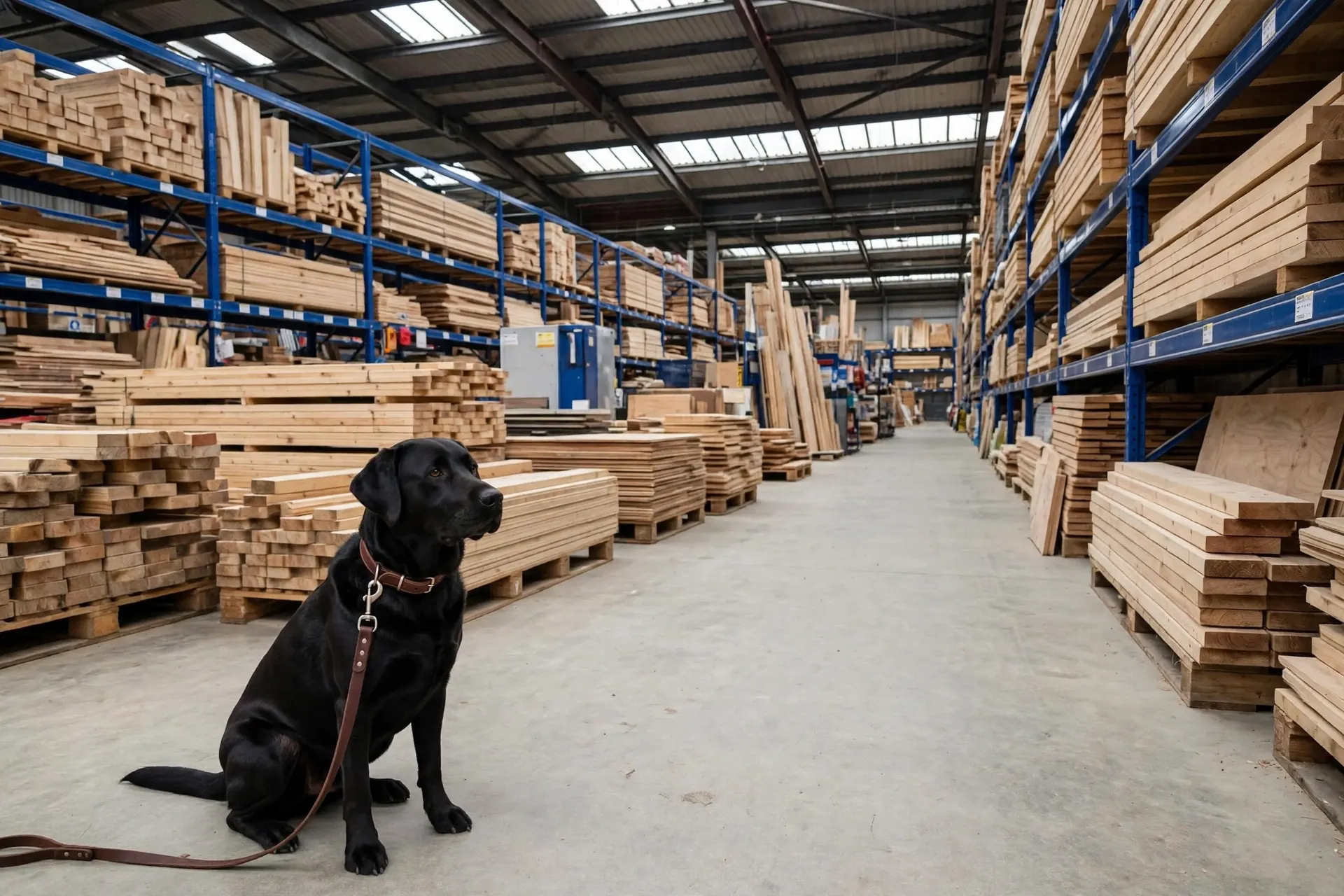
The timber and building materials area is the second zone. Lengths of timber, plasterboard sheets and bagged cement are heavy, and they are often stored upright or leaning, which means they can slip. A dog that bumps a leaning stack, or pulls towards a pallet while its owner reaches for a board, can be in the wrong place at the wrong moment. Forklift routes are the third and most serious risk: these are marked on the floor, usually with yellow lines or hatched areas, and they are working lanes, not walkways. A forklift driver has limited visibility at ground level and cannot stop instantly with a load, so never let your dog cross a marked forklift route, and never let the lead trail across one. If a forklift is moving in your aisle, step into a side aisle and wait until it has passed.
Smaller hazards are worth a mention because they are easy to miss. Sharp edges on cut timber and metal racking sit at nose height for a medium dog. Screws, nails and small fixings dropped on the floor are tempting to sniff and swallow. Bagged sand, cement and plaster dust coat paws and get licked off later, so wipe paws after a visit if your dog has walked through a dusty aisle. Garden chemicals, slug pellets and weed killers, which often sit near the outdoor area, are toxic to dogs and should be treated like medicine: never within reach, never sniffed, and reported if a bag is torn. The rule for all of these zones is the same: the dog walks beside you, on a short lead, in the middle of the aisle, and you do the reaching.
It is also worth thinking about the car park before you even reach the door. DIY store car parks are busy with reversing vans, flatbed trolleys and customers carrying long loads. Keep the dog on a lead from the car to the door, use a pedestrian route where one is marked, and do not let the dog walk behind a reversing vehicle. Inside, the same awareness applies at the checkout: queues are tight, trolleys are heavy, and a dog that lies down across the queue becomes a trip hazard. Train the dog to sit or stand at your side, tucked against the till rather than stretched across the floor, and the checkout becomes the easiest part of the trip.
Leads, trolleys and where the dog stands
The lead is the single piece of kit that decides whether a DIY store visit works. Use a short, fixed-length lead of one to two metres, held close, with the dog walking at your side. Retractable leads are a poor choice in this setting: a dog on a long line can round a shelf end into the path of a trolley or a forklift before you have time to reel it in, and the thin cord is almost invisible to other shoppers. A harness gives you better control than a collar if your dog pulls, and it spreads the load if you need to guide the dog quickly out of the way. Whatever you use, it should be something you can shorten instantly with one hand, because your other hand will often be holding a basket, a board or a paint tin.
Trolleys deserve a clear rule of their own. Most DIY stores expect dogs to walk on the floor on a lead, not to ride in the trolley. A dog in a trolley is unstable around heavy goods, and a dog that jumps out of a trolley in a busy aisle is a danger to itself and to everyone nearby. Small dogs are sometimes carried in a closed carrier or a purpose-made pet bag, but ask a member of staff before you assume that is welcome, and never put a dog in a flatbed trolley or a builders' trolley, which have no sides and no safe place for an animal. If you need a trolley for a large load, the honest answer is that the dog walks beside it, or the trip is a two-person job: one person pushes, one person handles the dog.
Where the dog stands matters as much as how it is held. The best position is on your inside, away from the shelves, with the lead short enough that the dog cannot reach the racking. When you stop to look at a product, bring the dog to your side and ask for a sit or a stand, rather than letting it wander to the end of the lead while you read labels. At a shelf end, pause before turning the corner: shelf ends are the blind junctions of a DIY store, and a dog that darts around one can meet a trolley coming the other way. If another dog is in the store, keep a generous distance and do not let the dogs greet in a narrow aisle; a polite nod to the other owner and a wide pass is the right etiquette here.
Think about timing as part of the lead plan. A store at 10am on a Tuesday is a different place from the same store at 11am on a Saturday, when the aisles are full of weekend renovators and the queues stretch back past the paint. Early weekday mornings and weekday evenings are the calmest windows, and they are the best times for a dog's first visit. If you arrive and the store is heaving, the sensible choice is to shorten the trip to the essentials, or to come back another day. There is no prize for completing a long shopping list in the worst conditions, and a dog that copes well on a quiet visit may not cope at all in a crowd.
Finally, pack for the dog as you would pack for the job. Water and a collapsible bowl matter, because DIY stores are warm, dry buildings and a long browse is thirsty work. A few small treats help you reward calm waiting at the till and the paint counter. Poo bags are essential — accidents happen, and a responsible owner cleans up immediately and tells staff so the floor can be checked. A towel in the car covers muddy paws on the way home, and a familiar mat or blanket gives an older dog somewhere comfortable to settle if you need to wait at a cutting service or a trade counter.
Smells, dust and chemicals
A DIY store is one of the strongest-smelling shops a dog will ever enter, and a dog's sense of smell is many times more sensitive than ours. What registers to you as a faint whiff of paint is an intense wall of scent to a dog, and some of it is actively unpleasant or harmful. Understanding which smells matter, and which are just background, helps you read your dog's behaviour in the store and know when to leave.
Paint and varnish fumes are the main concern. Freshly mixed paint, open tins and the area around the paint-mixing machine carry the strongest fumes, and dogs with breathing difficulties, very young puppies and older dogs are the most sensitive. The practical answer is to minimise time in the paint aisle: know your colour before you arrive, or use a sample card at home, and treat the store visit as collection rather than deliberation. If your dog starts sneezing repeatedly, pawing at its nose, or pulling hard to leave an aisle, listen to it — those are signs the air is bothering them, and the right response is to move to fresh air, not to press on.
Dust is the second issue, and it is easy to underestimate. Sawdust from the timber cutting service, plaster dust, cement dust and the fine powder that coats bagged building materials all settle on paws and coats, and dogs lick them off later. A single visit is unlikely to cause harm, but repeated exposure, or a dog that walks through a fresh spill, is worth avoiding. Keep the dog away from the cutting area while timber is being sawn, and away from open bags of cement, sand or plaster. After the visit, wipe paws with a damp cloth before the dog gets into the car, and check between the toes for grit. Dogs that groom a lot, or that have skin conditions, are more affected by dust, so factor that in when you decide how long to stay.
Chemicals are the sharpest risk in the building, and they are not confined to one aisle. Wood treatments, adhesives, solvents, cleaning products, garden chemicals and pest control products are all potentially toxic to dogs if licked or swallowed, and some are harmful on skin contact alone. The rule is simple and non-negotiable: the dog never sniffs, licks or touches an open container, a spill, or a treated surface. If a bottle is leaking or a bag is torn, report it to staff and steer well clear. Keep the dog away from the floor in the adhesives and treatments aisle, where drips are common, and do not let it drink from any water on the floor in the store, which may contain cleaning chemicals.
If your dog does come into contact with something, act quickly and calmly. Do not try to make the dog sick, and do not wipe a chemical off with a solvent of your own. Rinse skin contact with clean water, keep the packaging or the product name if you can do so safely, and call your vet for advice, describing exactly what the dog touched or licked. Knowing the name of the product is genuinely useful to a vet, so a photo of the label, taken from a safe distance, is worth having. This is a rare event, but it is the one DIY store scenario where minutes matter, so keep your vet's number in your phone before you go.
Garden areas and builders' yards are different trips
Many DIY stores contain two different worlds under one roof, and dogs experience them very differently. The garden centre area, usually at the front or side of the store, is open-air, spacious and relatively calm, with plants, pots and outdoor furniture. The builders' yard, usually at the back, is a working area of pallets, loading bays and vehicle movements. Confusing the two is how dogs end up somewhere they should not be, so it pays to understand the distinction before you arrive.
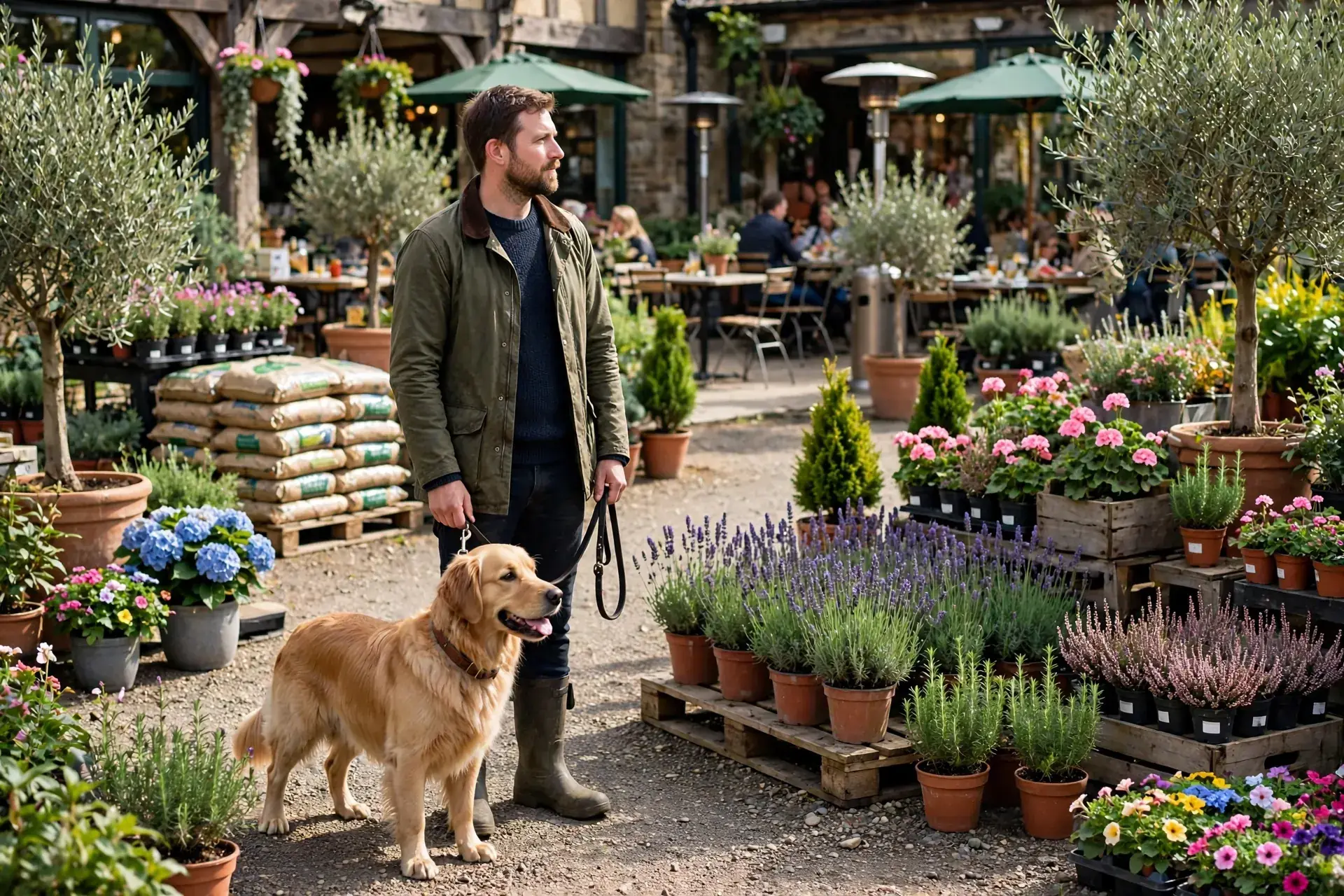
The garden area is usually the easiest part of the visit for a dog, and often the most welcoming. Outdoor air dilutes smells, the aisles are wide, and there is room to step aside. That does not make it risk-free: some plants are toxic to dogs if eaten, including bulbs, certain shrubs and treated compost, and slug pellets and weed killers are often shelved nearby. Keep the dog on a lead even outdoors, do not let it chew plants or dig in compost bags, and keep it out of the restaurant or café seating unless the store clearly allows dogs there. Our guide to dogs at garden centres covers plant-area rules, toxic plants and lead etiquette in more detail, and much of it applies directly to the garden section of a DIY store.
The builders' yard is a different matter. It is a working yard where forklifts, delivery lorries and reversing vans move constantly, loads are lifted overhead, and the ground is uneven, with pallets, strapping and loose aggregate underfoot. Many stores do not allow dogs in the yard at all, and those that do usually require the dog to stay in the trade counter or collection point while staff fetch the goods. Respect that boundary without argument: the yard is the one part of the store where a dog is genuinely in danger even on a short lead. If you need to collect heavy materials, use the store's collection service, ask staff to load the car, or bring a second person to stay with the dog at the front of the store.
The café and restaurant area is a third zone with its own rules, and it is the one that catches people out most often. A store can welcome dogs in the aisles and still keep them out of the seating area, for food hygiene reasons. In practice this means planning your refreshment stop separately: eat before you arrive, or use an outdoor seating area where dogs are welcome, rather than assuming the café will take you both. The same applies to the kitchen and bathroom showroom areas, which are often carpeted display spaces where a dog is welcome to pass through but not to linger. A short pass-through is fine; a long browse with the dog lying on a display bed is not.
Putting the zones together, the ideal DIY store visit with a dog has a shape: park, toilet stop, enter through the main doors, shop the main aisles on a short lead, step out to the garden area if you need plants, avoid the yard entirely, pay, and leave. The visit is a focused errand, not a day out, and the dog's job is simply to walk calmly beside you from the door to the till and back. Planned that way, the store's different zones stop being a puzzle and become a simple route you can repeat with confidence.
Plan the renovation-season list
Renovation season, roughly spring through early autumn, is when DIY stores are at their busiest and when dog owners are most tempted to bring the dog along for a long list of jobs. A little planning turns a three-hour wander into a forty-minute focused trip, which is better for the dog and better for the project. The planning starts at home, not in the car park.
Write the list in the order of the store, not in the order you thought of the items. Group paint and decorating together, timber and fixings together, and garden items last, so you walk the store once instead of crossing it three times. Check measurements at home before you leave: the length of the wall, the size of the shelf, the number of screws you actually need. Guessing in the aisle means standing still for ten minutes while the dog gets bored, and a bored dog in a DIY store is a dog that starts pulling towards interesting smells. Take a photo of the thing you are replacing — a broken hinge, a cracked tile, a paint colour card — so you can show staff instead of describing it.
Split the list into two columns: buy in store, and order online. Heavy, awkward or chemical items — bags of cement, long timber, large paint tins, solvents — belong in the second column, ordered for click and collect or home delivery, where the dog never has to be involved. The in-store column should be the small, safe, browseable items: brushes, rollers, screws, hooks, light fittings and the things you need to see before you buy. This split is the single biggest improvement most dog owners can make to a DIY trip, because it removes the heavy lifting from the dog's visit entirely.
Think about the season as well as the list. Spring brings the first big decorating push, and stores fill with people buying paint and garden supplies at the same time. Bank holiday weekends are the worst of all: queues, crowds and car parks full of trailers. If your list can wait until a weekday morning, it should. Autumn brings a second wave, as people prepare homes for winter, and the same logic applies. Winter is quieter in store, but the weather makes the car park and the yard less forgiving, and wet dogs and wet timber are a poor combination, so keep winter trips short and bring a towel.
Finally, use the list to decide whether the dog comes at all. A short list of small items on a quiet weekday is a good dog trip. A long list of heavy materials on a bank holiday Saturday is not, and no amount of lead training changes that. The honest question is not whether the store allows dogs, but whether this particular visit, on this day, with this list, is fair on the dog. If the answer is no, the dog stays home with something to chew, and you collect the materials on your own. That is not a failed trip; it is the right call, and the store will still be there tomorrow.
A calm first visit, step by step
If your dog has never been in a DIY store, treat the first visit as a training exercise, not a shopping trip. Choose a quiet weekday, go without a list, and set a time limit of fifteen to twenty minutes. The goal is for the dog to walk in, look around, and leave feeling that nothing alarming happened. A successful first visit is boring, and boring is exactly what you want.
Start in the car park. Let the dog out, give it a toilet opportunity on a patch of grass away from the traffic, and take a short walk around the outside of the building so the sounds and smells arrive gradually. Enter through the main doors and pause just inside, letting the dog take in the space: the high ceiling, the wide aisles, the movement of trolleys. Keep the lead short and your body language relaxed, and reward calm behaviour with a quiet word and a treat. Walk one aisle slowly, then a second, choosing wide, quiet aisles — storage, lighting or homewares — and avoiding paint, timber and the checkout queue.
Watch the dog, not the shelves. A relaxed dog walks with a loose lead, a soft body and an interest in sniffing. A stressed dog pants heavily, yawns repeatedly, licks its lips, tucks its tail, or pulls hard towards the exit. Those are signals to shorten the visit, not to push through. If the dog freezes or refuses to move, do not drag it; stand still, let it look, and offer a treat for a single step forward. If it cannot settle, leave calmly and try again another day, perhaps with a shorter visit. A dog that learns the store is a place where it can leave when it needs to will trust the next visit far more than one that was forced through a long one.
End the visit well before the dog is tired. Pay for one small item if you like, so the dog experiences the checkout calmly, then walk out, offer water, and let the dog decompress with a sniffy walk outside. Keep the whole outing under half an hour including the car park. Over the next few visits you can extend the time, add a second aisle, or bring a real list, but the first visit sets the pattern. Dogs remember how a place felt, and a calm first visit is the cheapest investment you will make in years of easy DIY trips.
Some dogs will never enjoy a DIY store, and that is fine. Noise-sensitive dogs, dogs that are frightened of trolleys or forklifts, and dogs that become over-excited around strangers may always find the store stressful, however carefully you introduce it. Recognising that is not failure; it is good ownership. For those dogs, the alternatives in the next section are the right answer, and the store becomes a human-only errand, which is a perfectly good arrangement.
When to leave the dog out of it
There are visits where the kindest and most practical choice is to leave the dog out of the store altogether, and knowing when that is makes you a better owner, not a less committed one. The clearest cases are the heavy jobs: collecting timber, plasterboard, bagged cement or anything that needs a flatbed trolley and a forklift. Those trips involve the yard, the loading bay and long waits, and the dog adds risk without adding anything useful. Leave the dog at home, or with a second person, and collect in peace.
Click and collect is the best alternative for most dog owners, and most DIY chains offer it. Order online, choose a collection slot, and drive to the store with the dog left at home, or with the dog waiting in the car only if another person stays with it and the weather is safe. Many stores now offer a drive-through or kerbside collection point, where staff bring the order to your car, which means you never have to leave the vehicle at all. Check the official guidance before you travel, because collection points and opening times vary by branch, and some large items still need to be collected from the yard.
Home delivery is the other obvious alternative, and it suits the biggest jobs best. Timber, kitchens, bathrooms and bulk materials are all things that are easier, and often cheaper, delivered than collected, and the delivery removes the dog question entirely. Delivery slots for large items usually need someone at home, so plan the day around it, and check whether the delivery team will carry goods to a specific room. For smaller items, standard parcel delivery is fast enough that a DIY emergency rarely justifies a stressful store visit with a dog in tow.
The supermarket comparison is worth making, because many dog owners already know it. Our guide to dogs in supermarkets explains why pet dogs are usually refused there, and how assistance dog law differs. DIY stores are more welcoming than supermarkets in general, but the principle is the same: the shop exists to sell things, not to entertain dogs, and the dog's welfare is the owner's responsibility, not the store's. If the choice is between a dog that is stressed in a store and a dog that is content at home while you shop, the content dog has won, and the materials will be exactly the same when you get back.
There is one fallback that should never be used: leaving the dog alone in the car while you shop. A car can overheat in minutes even on a mild or cloudy day, and a dog left in a hot car can suffer heatstroke quickly. It is also the fallback that other shoppers will notice and report. If your plan depends on the dog waiting in the car, change the plan: take a second person, use click and collect, order delivery, or come back without the dog. No shopping list is worth the risk.
Practical questions
Before you go
Are dogs allowed in B&Q?
In most cases, yes, but it is not a blanket guarantee. Many B&Q stores welcome well-behaved dogs on a lead, yet the decision rests with the individual branch, and a store can change its approach. Check the official guidance before you travel, and call your local branch if the visit matters to your day.
Can dogs go into Wickes, Screwfix or Toolstation?
These trade-focused stores are generally more mixed. Some branches welcome dogs, others keep them out of busy trade counters and warehouse aisles, and the answer can depend on the time of day. Check the official guidance before you travel, and treat a trade counter visit as a short, purposeful trip rather than a long browse.
Can my dog ride in the trolley?
Usually no. Most DIY stores expect dogs to walk on a lead at floor level, and a dog loose in a trolley is a safety problem around heavy goods and moving forklifts. Small dogs are sometimes carried in a closed carrier, but ask a member of staff first and never put a dog in a flatbed or builders' trolley.
Is paint dangerous for dogs?
Wet paint, paint thinners, wood treatments and solvents can all be harmful if licked or inhaled, and some contain chemicals that are toxic to dogs. Keep your dog well away from the paint-mixing area, open tins and spills, and away from strong fumes. If your dog licks paint or a treated surface, contact your vet promptly and check the official guidance before you travel.
Can I take my dog into the garden centre area of a DIY store?
Often yes, and the outdoor plant area is usually the easiest part of a DIY store for a dog, with open air and fewer hazards. The rules can still differ from the indoor store, and some garden areas keep dogs out of the restaurant or the covered plant house. Our guide to dogs at garden centres covers plant-area rules, toxic plants and lead etiquette in more detail.
What should I do if my dog is refused at the door?
Stay calm and do not argue with the door staff, who are following the branch policy. Ask politely whether there is a click and collect point you can use, or whether a colleague can bring your order out to you. Most DIY chains offer click and collect or home delivery, so you can still get the materials without leaving your dog in the car, which should never be the fallback.