This guide is independent and contains no paid placement. If affiliate links are added later, they will be clearly marked and will not change our editorial checks.
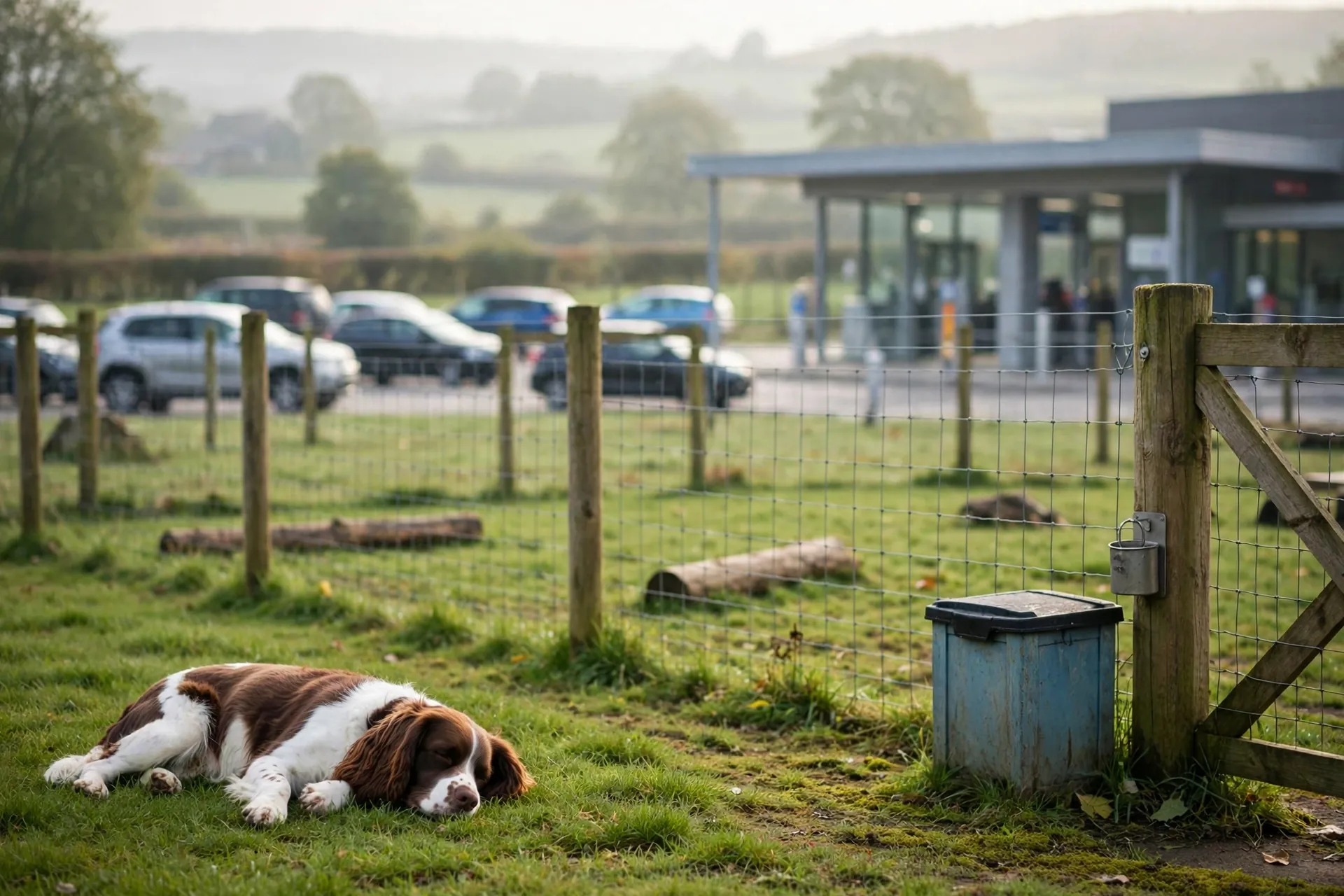
Plan charging stops around the dog, not just the battery. A rapid top-up gives time for a toilet break and water; a longer charge gives time for a proper walk and a rest. Pick stops with grass, shade, safe walking space and a place where the dog can settle, keep the lead short around cables and bays, and never use a charging session as a reason to leave a dog alone in the car.
The new rhythm: charging as a planned dog break
Driving a petrol or diesel car with a dog sets its own rhythm: a quick fuel stop, a short stretch of the legs, and back on the road. An electric car changes that rhythm, and for a dog owner the change is mostly good news, provided it is planned rather than endured. Charging takes longer than filling a tank, so the stop stops being a two-minute transaction and becomes a genuine break. The trick is to budget that time for the dog on purpose, instead of discovering, halfway through a forty-minute charge, that the dog has had nothing but a car-park kerb and a puddle.
Start by separating two clocks that run at the same time. The first clock is the charger: how much charge you need, how fast the charger delivers it, and how long you can reasonably stay before you are holding a bay someone else needs. The second clock is the dog: when the dog last had a toilet break, when it last drank, when it last moved properly, and when it last settled. On a long journey the dog clock is usually the stricter one. Most dogs are comfortable for around two hours in a moving car if they have travelled well, had a break before departure, and are settled and restrained, but that is a rough guide rather than a rule. Puppies need more frequent toilet stops, older dogs may need more frequent and gentler breaks, and anxious dogs may need shorter legs with more recovery time between them. If the charger says twenty minutes and the dog needs forty, the dog wins: move the charging plan, not the dog.
Dwell time is the phrase worth learning, because it describes what charging actually gives you. Dwell time is simply how long the car will be parked and plugged in. A short rapid top-up might give fifteen to twenty-five minutes of dwell time. A longer rapid or ultra-rapid session might give thirty to fifty minutes. A slower destination charge at a hotel or attraction might give several hours, which is a different kind of stop altogether. Each length suits a different dog job. A short dwell suits a toilet break, fresh water, a brief sniffing walk, and a chance to stretch. A medium dwell suits all of that plus a proper walk, a training or decompression pause, and a human meal eaten at a sensible pace. A long dwell suits a walk, a rest, and a full change of scenery, which is why destination charging pairs so well with an overnight stay or a day out. The mistake is to treat every dwell as if it were the same: rushing a dog through a long charge wastes the best part of the stop, while trying to squeeze a full walk into a ten-minute top-up leaves everyone, dog included, feeling hurried.
Think in legs, not in miles. Before departure, mark the journey in dog legs: drive, break, drive, break, arrive. A useful starting pattern for a settled adult dog is a break every two hours or so, with a longer break roughly halfway through a long day. Then fit charging into those breaks, rather than fitting breaks around charging alone. Sometimes that means charging earlier than the battery strictly requires, because the dog needs a stop and a charger happens to be there. Sometimes it means skipping a charger with no grass and no safe walking space, even though it is well placed for the battery, and using the next one instead. Battery range gives you flexibility here: arriving at a charger with charge to spare is not wasteful if it buys a better dog stop. The cheapest or fastest charging plan on paper is rarely the best plan once a dog, a lead, a water bowl and a tired bladder are part of the calculation.
Routine helps more than novelty on a charging day. Dogs settle faster when the stop follows a familiar order: car parked and plugged in first, so the car is safe and you are not juggling a cable and a lead at the same time; then the dog out, on a lead, for a toilet break; then water; then a walk; then a rest or a cafe pause if the site allows it; then a final toilet break before the dog goes back in the car. Keeping that order steady means the dog learns what a charging stop means, and you stop improvising under time pressure. It also protects the dog from the most common charging-stop error, which is opening the car door in a busy car park with a lead in one hand and a charging cable in the other. Plug in first, sort the dog second, and keep both jobs separate.
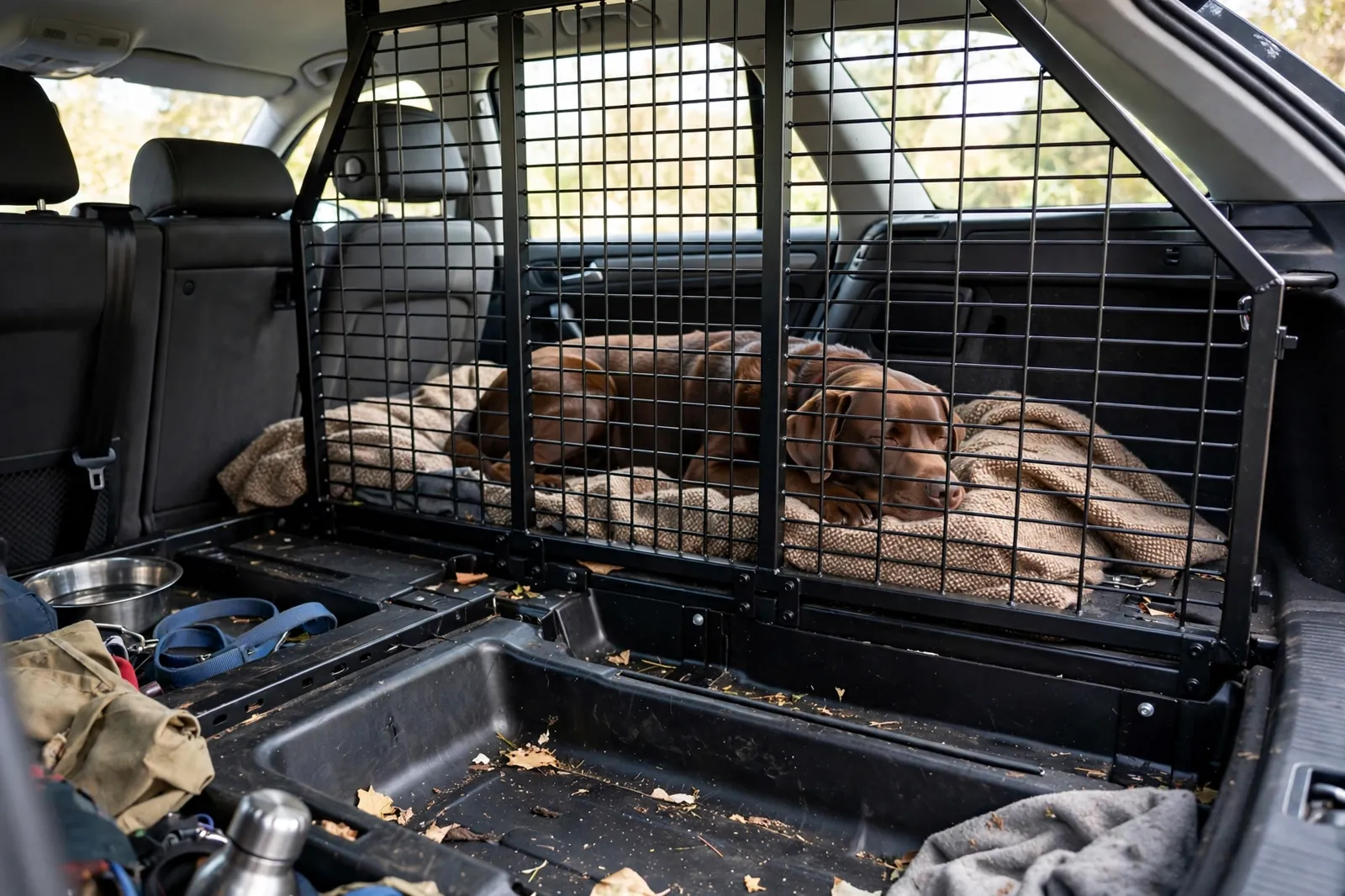
Finally, plan for the stop you do not expect. A charger can be out of service, occupied, or slower than advertised. A site can be busier than planned, or its dog area can be closed for maintenance. Build one spare stop into every long route, and keep a short list of fallback chargers within easy reach of the main route. That spare stop is what turns a failed charger from a crisis into an inconvenience, and it matters even more with a dog, because a dog cannot be asked to wait patiently for another hour while you hunt for a working charger. If you travel with a dog that is still learning to settle in the car, a well-fitted car boot guard and a familiar bed or blanket also help the car feel like a consistent resting place between stops, rather than a new place at every charge.
Stop types compared by what the dog gets
Not all charging stops are equal for a dog. The charger speed matters to the car, but the site around the charger matters far more to the dog. Four kinds of stop cover most UK journeys, and each one gives the dog something different. Learning to tell them apart before you set off is the fastest way to build a route that works for both passengers, human and canine.
Motorway service hubs are the most complete option, and for a long journey they are often the best dog stop. A large hub usually offers a building with food, toilets and shelter, a car park with marked pedestrian routes, and at least some grass. Some have a dedicated dog exercise area, and many sit beside a larger service area with more walking space than a small forecourt. The trade-off is busyness: heavy traffic, delivery vehicles, coaches, and a constant flow of people and dogs. A confident, well-socialised dog may enjoy the stimulation, while a nervous or reactive dog may find a busy hub overwhelming. For a detailed look at how service areas work for dogs in general, see our guide to dog-friendly motorway services in the UK, which covers indoor rules, exercise areas and tag-team visits. At a charging hub specifically, the dog benefit is time: a rapid or ultra-rapid hub often gives a thirty to fifty minute dwell, which is enough for a proper walk if you use the quieter edges of the site rather than the busiest forecourt. Check the official guidance before you travel if you are unsure about a particular operator's dog policy, because policies differ between operators and between buildings on the same site.
Retail-park rapid chargers are the mixed bag of the charging world. They are common, often fast, and usually close to a supermarket, a coffee shop, or a drive-through, which makes the human side of the stop easy. For the dog, though, they vary wildly. Some retail parks have generous grass verges, a quiet rear corner, and a pleasant loop around the edge of the site. Others are almost entirely tarmac, with traffic circulating constantly, delivery bays, and nowhere sensible for a dog to toilet except a narrow strip beside a busy road. The dwell time is often shorter, perhaps fifteen to thirty minutes, which suits a toilet break and water but rarely a satisfying walk. Retail parks also tend to have less shade and fewer places to sit with a dog, and dogs may not be welcome inside the shops. Use retail-park chargers for top-ups and toilet breaks, and save the proper walk for a better site later in the journey, rather than forcing a walk where there is no good ground to walk on.
Hotel and destination chargers change the maths completely. These are slower chargers, often 7 to 22 kilowatts, at hotels, attractions, restaurants, and holiday accommodation, where the car charges while you do something else. For a dog, that is often the best stop of the day, because the dwell time is measured in hours rather than minutes. The dog can have a walk, a rest, a meal-time settle, and a proper change of scene, while the car quietly gains charge in the background. The catch is access: a destination charger may be reserved for guests or visitors, may require a stay or a meal, and may sit in a car park with its own rules. Always check before arrival whether dogs are welcome in the building, the grounds, and the charging bays themselves, and whether the charger needs a particular app or card. When the answer is yes, a destination charge can replace both a charging stop and a rest stop, which simplifies the whole day. It also pairs well with an overnight stay: arrive, plug in, walk the dog, eat, sleep, and leave with a full battery and a rested dog.
On-street and small community chargers are the least dog-friendly category, and they are worth understanding precisely because they look convenient on a map. A single on-street charger beside a pavement may give a useful charge, but it rarely gives a dog anything: no grass, no safe walking loop, no shelter, and traffic passing close by. These chargers suit an overnight or long daytime charge while the dog is settled elsewhere, for example at accommodation, rather than a mid-journey break. If you do use one mid-journey, treat it as a charging-only stop: take the dog for its break somewhere better first, or plan a short walk away from the road before plugging in, and keep the dog on a short lead throughout. In rural areas, a village-hall or community charger may sit beside a green or a quiet lane, which is better, but do not assume it: check the surroundings on a map before you rely on it, and have a fallback.
A simple comparison helps when you are choosing between two chargers on the same leg. Ask five questions about each site: is there grass or a safe toilet area within a short walk of the bays; is there a walking loop that does not cross busy traffic; is there shade or shelter for waiting; can the dog settle with you while you eat or drink, or will you need to take turns; and is there a quiet edge where a nervous dog can decompress? The site that answers yes to more of those questions is usually the better dog stop, even if its charger is slightly slower. Speed matters, but a ten-minute faster charge is a poor trade for a dog that arrives at the next leg unsettled, unexercised, and needing another stop twenty miles later.
Minute-by-minute 20, 40 and 60 minute stop plans
A charging stop works better when everyone knows the order of events before the car doors open. The plans below assume one or two people travelling with one dog, a car that is parked and plugged in first, and a site with at least some grass. Adjust the timings to your dog and to the site, but keep the order: plug in, toilet, water, walk, settle, final toilet, back in the car. That order prevents the two most common errors, which are letting an excited dog drag you across a car park before the car is secure, and forgetting the final toilet break in the rush to leave.
For a twenty-minute stop, the goal is a clean reset, not a full outing. Minutes zero to three are for parking, plugging in, and checking that the charge has actually started. Do this before the dog comes out, so you are not holding a cable and a lead at once. Minutes three to eight are for the toilet break and water: lead on, walk directly to the nearest grass, let the dog toilet, offer water, and clean up. Minutes eight to eighteen are for a short sniffing walk. This is not exercise in the athletic sense; it is decompression. Let the dog sniff, choose its pace where it is safe to do so, and cover a short loop rather than marching in a straight line. A sniffing walk tires many dogs more effectively than a brisk march, because sniffing is mentally demanding. Minutes eighteen to twenty are for the final settle: a few calm minutes beside the car, a last toilet opportunity, and the dog back in the car, settled on its bed, before you unplug. If the charge finishes early, do not rush the dog: a two-minute wait for a proper settle is worth more than a two-minute earlier departure. If the charge needs longer than twenty minutes, treat the extra time as a bonus rest, not as a reason to extend the walk into a busy or unsuitable area.
For a forty-minute stop, add a proper walk and a human break. Minutes zero to five are parking, plugging in, and the first toilet break and water, as above. Minutes five to twenty-five are the walk itself: a loop of fifteen to twenty minutes at the dog's pace, using the quietest ground the site offers. At a motorway hub, that often means the edge of the site, a perimeter path, or a dedicated dog area, rather than the forecourt. At a retail park, it may mean a loop around the rear of the site or a nearby quiet street, if one is genuinely safe and suitable. Avoid busy roads, unlit paths, and areas with livestock unless the dog is under close control and the route is clearly a public path. Minutes twenty-five to thirty-five are for the human break and the dog's rest: water again, a chance to sit, and a cafe or takeaway stop if the site allows the dog to be with you, or a tag-team system if it does not. Tag-team means one person stays with the dog while the other orders, then you swap, so the dog is never left alone and nobody eats in a rush. Minutes thirty-five to forty are for the wind-down: a short final walk, a toilet break, and the dog settled back in the car before you unplug. A forty-minute stop is also the right length to check the dog's paws, coat, and general state after a long drive, and to top up water for the next leg.
For a sixty-minute stop, the goal changes from a reset to a real break in the day. This length suits a meal stop, a longer walk, or a stop where the humans need to rest as much as the dog does. Minutes zero to ten are parking, plugging in, toilet, water, and a short decompression sniff. Minutes ten to thirty-five are a proper walk of twenty to twenty-five minutes, at a pace that genuinely tires the dog without exhausting it. For a young, energetic dog, that might mean a longer loop with varied sniffing ground; for an older dog, it might mean a shorter, flatter loop with more pauses. Judge by the dog, not by the clock: a dog that is pulling, panting heavily, or lagging needs a different pace, and a dog that is happily sniffing is doing exactly the right thing. Minutes thirty-five to fifty are for rest and food: the dog settles on a mat or blanket if the site allows, the humans eat at a normal pace, and everyone drinks. If the site has a dog-friendly seating area, use it; if not, use the tag-team system and eat in turns beside the car or in a sheltered outdoor spot. Minutes fifty to sixty are for the final routine: water, a last toilet break, a calm few minutes, and the dog back in the car. A sixty-minute stop also gives time to check the charging progress without pressure, to adjust the next leg if the charge is slower than expected, and to let a tired dog actually sleep for a few minutes, which is often the most restorative part of a long day.
What to do while charging depends on the site, but a few activities suit almost every stop. A sniffing walk is the single most useful activity, and it needs no special equipment beyond a lead, a water bowl, and waste bags. A short training refresh, such as a few calm sits, waits, and recalls on a lead in a quiet corner, can help an excited dog refocus, provided it is kept light and positive. A chew or a lick mat, used only when the car is parked and you are present, can help a dog settle during a longer charge, but do not leave a dog alone with a chew in a parked car. For the humans, a charging stop is a good time to check the next leg, confirm the next charger, and note any changes in the dog: drinking, toileting, energy, and comfort. Keep a small charging-stop kit in the car so none of this requires unpacking the boot: lead, long line for suitable open ground, collapsible bowl, water bottle, waste bags, towel, and a spare blanket. A car seat cover for dogs also helps here, because it keeps the seat clean and dry after a wet or muddy walk, which makes the dog more welcome back in the car and the next leg more comfortable for everyone.
Finally, know when to cut a stop short or extend it. Cut a stop short if the dog is distressed, overheated, or frightened by the site, even if the car has not reached the planned charge: a calmer dog at the next stop is worth more than a fuller battery now. Extend a stop if the dog is still unsettled, has not toileted, or needs more rest, and the charger allows it without blocking others. Charging time is flexible in a way that a dog's needs are not, and the best charging plan is the one that leaves the dog ready for the next leg, not merely the car.
Charging etiquette and bay rules with a dog in tow
Charging bays have their own unwritten rules, and a dog adds a layer of complexity to all of them. The core principle is simple: a charging bay is for charging, not for parking, waiting, or exercising a dog. Everything else follows from that. Park only in a marked charging bay while you are actively charging, plug in promptly, and move the car once charging is finished or once you have reached the charge you need, rather than treating the bay as a convenient parking space for a long meal. Other drivers plan their journeys around bay availability, and a car sitting in a bay after charging has finished can strand the next driver, including one with a dog that also needs a break.
Queueing deserves care, because it is where tempers fray. If all bays are full, do not block a through route, a pedestrian crossing, or the entrance while you wait, and do not hover in a bay entrance in a way that blocks others. If a marked waiting area exists, use it. If not, park in an ordinary bay, take the dog for its break, and check back for a free charger. That order, dog break first and charging second, also prevents the awkward situation of a dog waiting in a queueing car with no break while the driver watches for a bay. If someone is waiting for your bay, finish promptly, unplug, and move before you do the final faff of repacking the car: you can sort bags and leads in an ordinary bay, but you cannot fairly hold a charger while you do it.
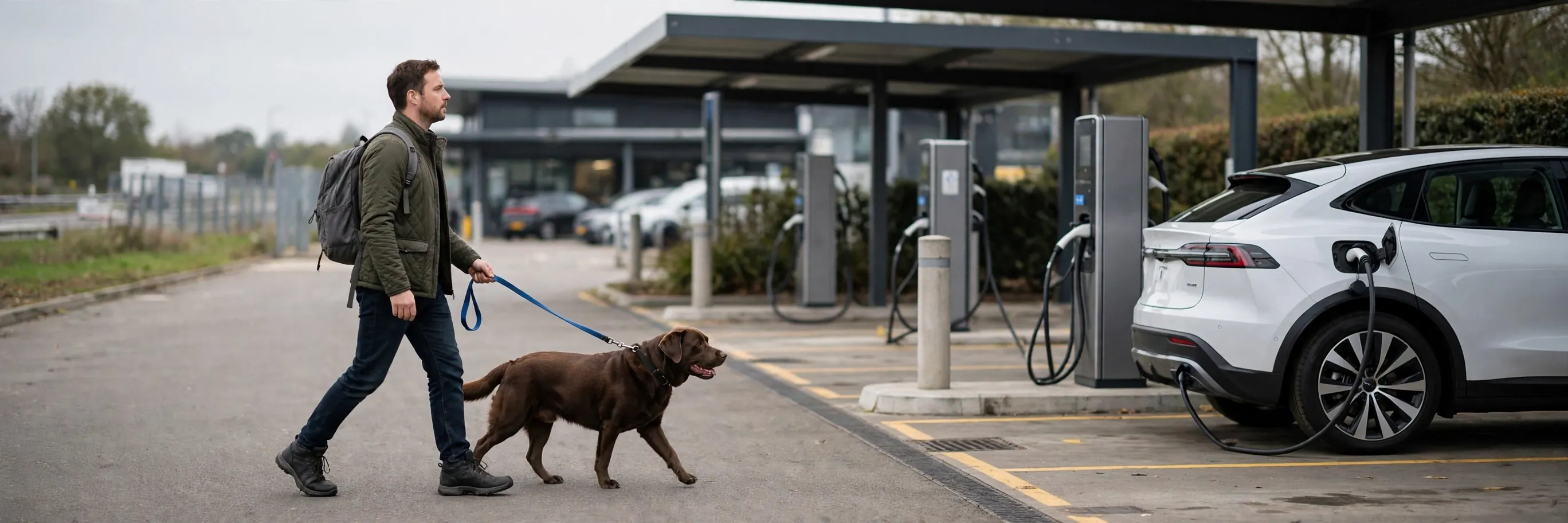
Cables are the most specific hazard of a charging stop, and they deserve the same attention as traffic. A charging cable runs from a unit to a car, often across or beside a pedestrian route, and it is easy to trip over, especially in low light or wet weather. Keep the dog well away from cables and charging units, keep the lead short near bays, and never let a lead or a long line cross a cable run. Do not let a dog sniff, chew, or paw at a charging unit or cable, and do not let a dog toilet against a charger or a cable housing. If a cable is damaged, frayed, or lying in a puddle, do not use that charger, and report it through the operator's usual channel if one is available. The same care applies to your own cable: coil it neatly when you unplug, rather than leaving it trailing where the next driver or dog walker could trip.
Bay rules also include the space around the car. Some bays are designed for a particular charging position, and parking neatly within the lines matters more than usual, because a badly parked car can block a neighbouring cable or force the next driver into an awkward manoeuvre. Open doors carefully in a busy charging area, because a dog bolting from an open door into a car park full of moving vehicles is a genuine risk. Load and unload the dog on the side away from traffic where possible, keep the dog on a lead from the moment the door opens until the moment it closes again, and never let a dog run loose in a charging area, even if the site looks quiet. A charging area is a working car park, not a field, and loose dogs and reversing cars are a dangerous combination.
Other people and other dogs are part of the etiquette too. Not every dog wants to greet, and a charging area is a poor place for an on-lead greeting, because both dogs are in a confined space with cars moving nearby. Keep a sensible distance from other dogs, pass with space where you can, and do not let your dog approach another dog, a child, or a picnicking family without an invitation. Clean up after your dog immediately, including on grass verges and dog areas, and carry waste bags even if the site provides bins. If your dog barks at other dogs, vehicles, or strangers, move to a quieter edge of the site rather than trying to train through it in the middle of a busy hub. Courtesy also extends to noise: a charging stop at night should be quiet, with doors closed gently and voices kept low, especially near hotels or residential areas.
Finally, respect the site's own rules, even when they are inconvenient. Some sites restrict dogs to certain areas, require leads at all times, or prohibit dogs inside buildings except assistance dogs. Those rules exist for safety and for other visitors, and they are usually signed at the entrance or on the operator's site. Check the official guidance before you travel if a rule is unclear, and plan for the strictest likely version: assume the dog may need to stay outside with one person, and bring what you need for that, including a blanket, water, and shelter from rain or sun. A charging stop that respects bay rules, cables, other drivers, and other dogs is not just polite; it is safer, calmer, and more likely to leave the next stop open and welcoming for dog owners too.
Weather, night and rural-edge cases
Charging stops are planned in fair weather and then used in whatever weather actually arrives, so the plan needs to survive rain, heat, cold, darkness, and a rural charger with nothing around it. Each condition changes what the dog needs, and each one has a simple adjustment that keeps the stop safe.
Rain changes the ground before it changes anything else. Grass becomes mud, paths become slippery, and a short toilet walk can leave a dog soaked and a car interior wet. Pack a towel and a drying coat as standard charging-stop kit, and use them before the dog goes back in the car, not after. Choose surfaced or short-grass ground where you can, avoid churned mud beside bins and gates, and check paws for grit and debris after a wet walk. In heavy rain, a shorter, more frequent pattern often works better than one long walk: a quick toilet break, a few minutes under shelter, and a second short outing if the charge allows. Do not shelter under a charging canopy with the dog if that puts the dog beside cables and moving cars; find a building canopy, a sheltered seating area, or the car itself with the door open and the dog on a lead beside you. After a wet stop, ventilation matters: a wet dog in a closed car with the heating on will steam the windows and feel clammy, so air the car briefly before the next leg.
Heat is the most serious weather risk at a charging stop, and it deserves direct language. Never leave a dog alone in a parked car in warm weather, even for a charging session, even with a window open, and even if the car has climate control that you expect to keep running. Cars heat up quickly, climate systems can stop, and a charging car is not a safe place to leave a dog unattended. At a hot stop, the priorities are shade, water, and a short outing. Park in shade where possible, offer water before and after the walk, keep the walk short and on grass rather than hot tarmac, and check paws on hot surfaces: if the ground is too hot for the back of your hand for a few seconds, it is too hot for paws. Brachycephalic breeds, older dogs, overweight dogs, and dogs with breathing or heart conditions are at higher risk in heat, and they need shorter, cooler stops with more rest. If the dog is panting heavily, drooling, or unsteady, move to shade, offer small amounts of cool water, wet the paws and belly with cool water, and seek veterinary advice promptly: check the official guidance before you travel for heat guidance, and know the nearest vet on a long summer route.
Cold, wind, and ice need a different adjustment. Short-coated, small, older, and very young dogs lose heat quickly, especially when standing still in wind. Keep cold-weather walks shorter, use a coat if the dog normally wears one, and dry the dog thoroughly before the next leg, because a wet coat in a cold car chills a dog fast. Ice and gritted paths can irritate paws, so check paws after a winter walk, rinse off grit where you can, and avoid heavily gritted areas if the dog is sensitive. In snow, a charging area can be harder to read: cables may be hidden, kerbs may be obscured, and pedestrian routes may be icy. Walk slowly, keep the lead short, and use marked routes rather than cutting across a car park. A blanket in the car helps a cold dog settle, and a warm drink for the humans is not a luxury on a long winter charging day.
Night charging brings its own set of risks, most of them about visibility. A dark charging area can have poor lighting, uneven ground, and vehicles moving with little warning. Keep the dog on a short lead at all times, wear or carry something reflective, and use a light on the dog's collar or harness if you have one. Walk on lit, surfaced routes where they exist, and avoid unlit grass edges, ditches, and hedgerows where a dog could find hazards you cannot see. At night, keep the stop simpler: toilet, water, a short calm walk, and back in the car. This is not the time for a long exploratory loop, however tempting an empty site may look. If you are staying overnight, a destination charge at accommodation is usually far better than a late-night rapid stop, because the dog can settle properly and the car can charge slowly while you sleep. If you must use a rapid charger at night, choose a well-lit, staffed, or busy site over an isolated one, keep doors locked when you are not with the car, and stay aware of your surroundings in the same way you would at any late-night car park.
Rural-edge chargers deserve a specific warning, because they are the stops where a map can mislead. A single rural charger may sit beside a pub, a village hall, a farm shop, or a layby, with no shop, no toilet, and no obvious dog area. That does not make it a bad stop, but it does make it a stop that needs homework. Check the surroundings on a map before you rely on it: is there a public footpath, a village green, or a quiet lane suitable for a short walk, or is the charger on a fast road with no pavement? Is the site lit, and is it open at the time you will arrive? Some rural chargers are on private land with limited access hours, and arriving after closing to find a locked gate and a dog that needs a toilet is a miserable experience. Carry extra water, waste bags, and a torch on rural routes, and always have a fallback charger further along the route. If a rural stop turns out to be unsuitable for the dog, do not force it: charge enough to reach the next good stop, and give the dog its proper break there. A slightly longer journey with a good dog stop beats a shorter journey with a dog that has had nowhere sensible to toilet.
Building a dog-aware charging route
A dog-aware charging route is built backwards from the dog's day, not forwards from the battery's range. Start with the destination and the rough driving time, then place breaks at intervals that suit the dog, then choose chargers that sit at or near those breaks. That order sounds obvious, but it is the opposite of how most route planners work, which is why so many dog owners end up at a charger with no grass and a dog that has waited too long.
Begin with a simple route sheet, on paper or on a phone, with one line per leg. Each line needs five facts: the departure point, the charging stop, the expected dwell time, what the dog gets there, and the fallback charger if that stop fails. For example, a leg might read: leave home, charge at a motorway hub, forty minutes, grass and a perimeter walk with a cafe stop, fallback at the next junction's retail-park charger. Writing it down forces the useful questions: does this stop actually have grass, is the walk long enough, is there shade, and what happens if the charger is busy? A route sheet also helps a second driver or a passenger, because everyone can see the plan without a debate at every junction. Keep the sheet short: three to five stops cover most UK long days, and more stops than that usually means the legs are too short or the plan is overcomplicated.
Next, match charger speed to the job of each stop. Use rapid or ultra-rapid chargers for mid-journey breaks where the dog needs a toilet and a walk, and use slower destination chargers where the car will be parked for a meal, a visit, or an overnight stay. Do not use a slow charger for a mid-journey toilet break unless you genuinely have hours to spare, and do not rely on a rapid charger for an overnight charge unless you plan to move the car when it finishes. Charging apps and route planners can help here, but treat their dog information with caution: a planner may know charger speeds, prices, and availability, but it rarely knows whether a site has grass, shade, or a dog-friendly cafe. Cross-check the dog side of each stop yourself, using site information, maps, and the operator's own pages, and check the official guidance before you travel if a site's dog policy is unclear.
Build the dog's daily routine into the route, not just its toilet breaks. If the dog normally eats at set times, try to keep those times, and choose a longer stop for the main meal of the day, so the dog is not fed in a rush in a car park and then asked to travel immediately. If the dog normally has a long walk in the morning, give it that walk before departure, so the first leg starts with a settled dog. If the dog is due medication, keep it accessible rather than buried in luggage, and note the time on the route sheet. Puppies, older dogs, and dogs with medical needs may need more frequent stops, and that is fine: a route with more, shorter stops is often easier for a dog than a route with fewer, longer ones, even if it adds a little driving time. The goal is a dog that arrives settled, not a route that looks efficient on a screen.
Pack for the charging day as a system, not as a pile of items. The charging-stop kit lives in one accessible place: lead, spare lead, water bottle and bowl, waste bags, towel, drying coat, blanket or mat, torch, and a small first-aid kit. The boot should be organised so the dog's bed or blanket stays in place between stops, rather than being unpacked and repacked each time. Food, medication, and any comfort items should be reachable without emptying the car. A dog that travels restrained, whether by harness, crate, or guard, travels more safely and settles more quickly at each stop, and the restraint should be checked at the start of the day, not discovered to be loose halfway through a journey. For longer trips, a check of the car itself before departure, including tyre pressures, charge cable, and charging apps or cards, prevents the kind of roadside delay that turns a planned dog break into an unplanned wait.
Finally, review the route at the end of the day, briefly, and note what worked. Which stop had the best grass, which site was too busy, which charger was slower than expected, and which fallback saved the day? Those notes, even a few lines, make the next journey easier, because dog-aware charging is a skill that improves with practice. The first electric road trip with a dog feels like a new kind of driving, and it is. By the third or fourth, the rhythm feels familiar: plug in, toilet, water, walk, settle, and drive on, with a dog that knows what a charging stop means and a driver who no longer has to choose between the battery and the dog. That is the real benefit of planning charging stops around the dog: the stops stop feeling like waiting, and start feeling like part of the trip.
Practical questions
Before you go
Can I leave my dog in the car while it charges?
No, not as a routine plan. A charging stop is a break for the dog as well as the car, and a parked car can heat up, cool down, or leave a dog stressed and unobserved. Take the dog out, give a toilet break and water, and stay with the dog or use a tag-team system if one person needs to go inside. If you must step away for a moment, keep it to the shortest possible time, keep the car in sight, and never rely on a charging session as a reason to leave a dog unattended.
Are dogs allowed inside charging hub buildings and cafes?
It depends on the site, and the answer often differs between the shop, the cafe, and the seating area. Some hubs welcome dogs throughout, some allow dogs only in a defined seating zone or outside, and some allow assistance dogs only indoors. Check the signs at the entrance and check the official guidance before you travel if the site policy is unclear, and plan on the basis that the dog may need to stay outside with one person while the other orders.
How long should a charging stop last for my dog?
Twenty minutes is enough for a toilet break, water, and a short sniffing walk for most settled dogs, while forty to sixty minutes suits a longer walk, a proper rest, and a meal break for the humans. Match the stop to the dog in front of you rather than to the charger alone: puppies, older dogs, and anxious dogs often need a calmer, shorter outing, while a young, energetic dog may need more movement before settling again in the car.
What should I do if every charger bay is full?
Do not block a bay, a through route, or a pedestrian path while you wait, and do not leave the dog in a queueing car without a plan. Park in a marked ordinary bay if one is available, take the dog for its break first, and then join the charging queue once a bay frees up. If the site is full and the dog is unsettled, move on to the next planned stop rather than letting frustration build in a crowded car park.
Can my dog walk around the charging area on a lead?
Yes, on a short lead and under close control, but a charging area is a working car park, not a dog exercise field. Keep the dog away from cables, charging units, and moving vehicles, use marked walkways where they exist, and move to grass or a quieter edge of the site for the proper toilet break and sniffing time. Clean up after your dog, keep the lead short near bays, and never let a long line trail across a bay or a cable run.