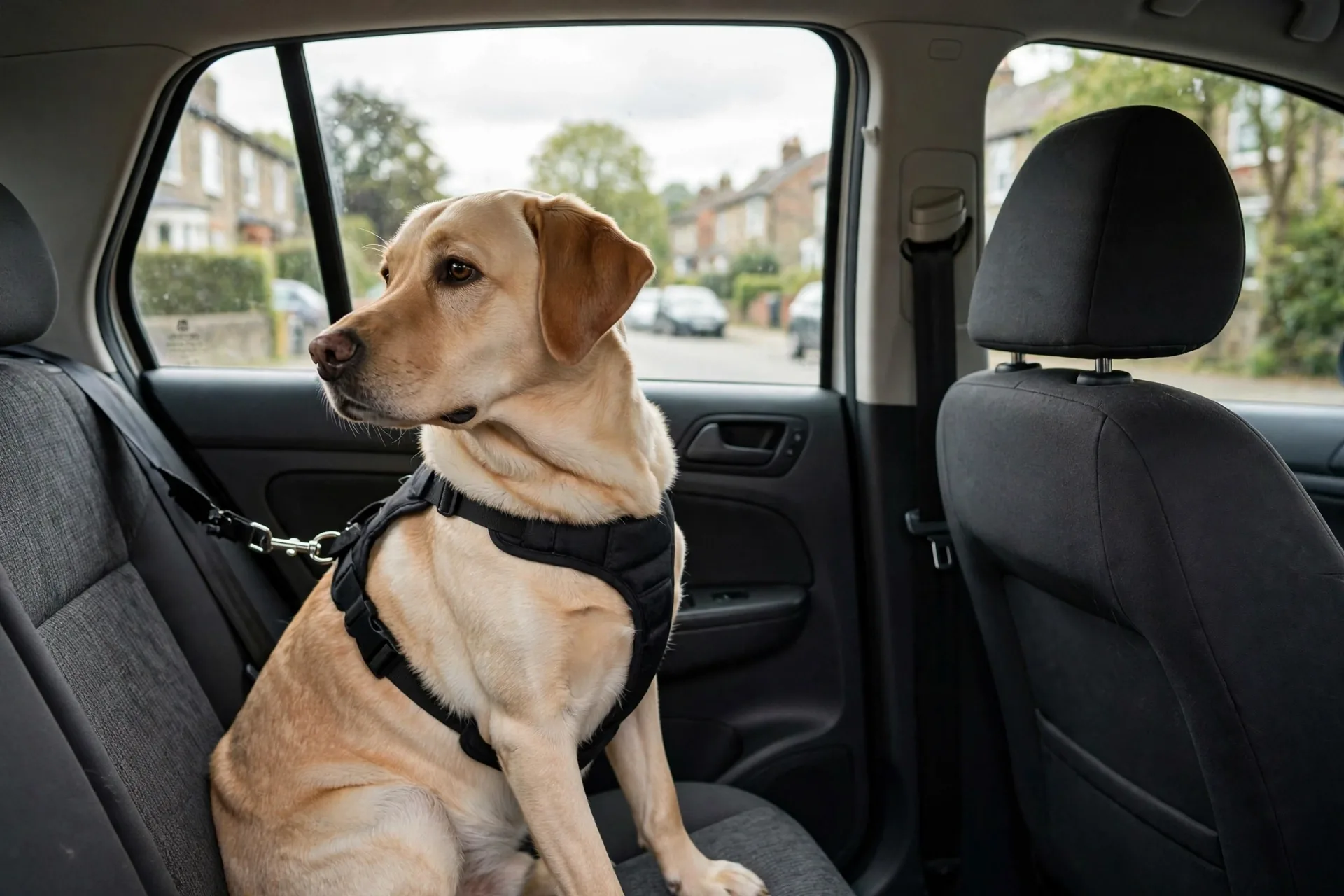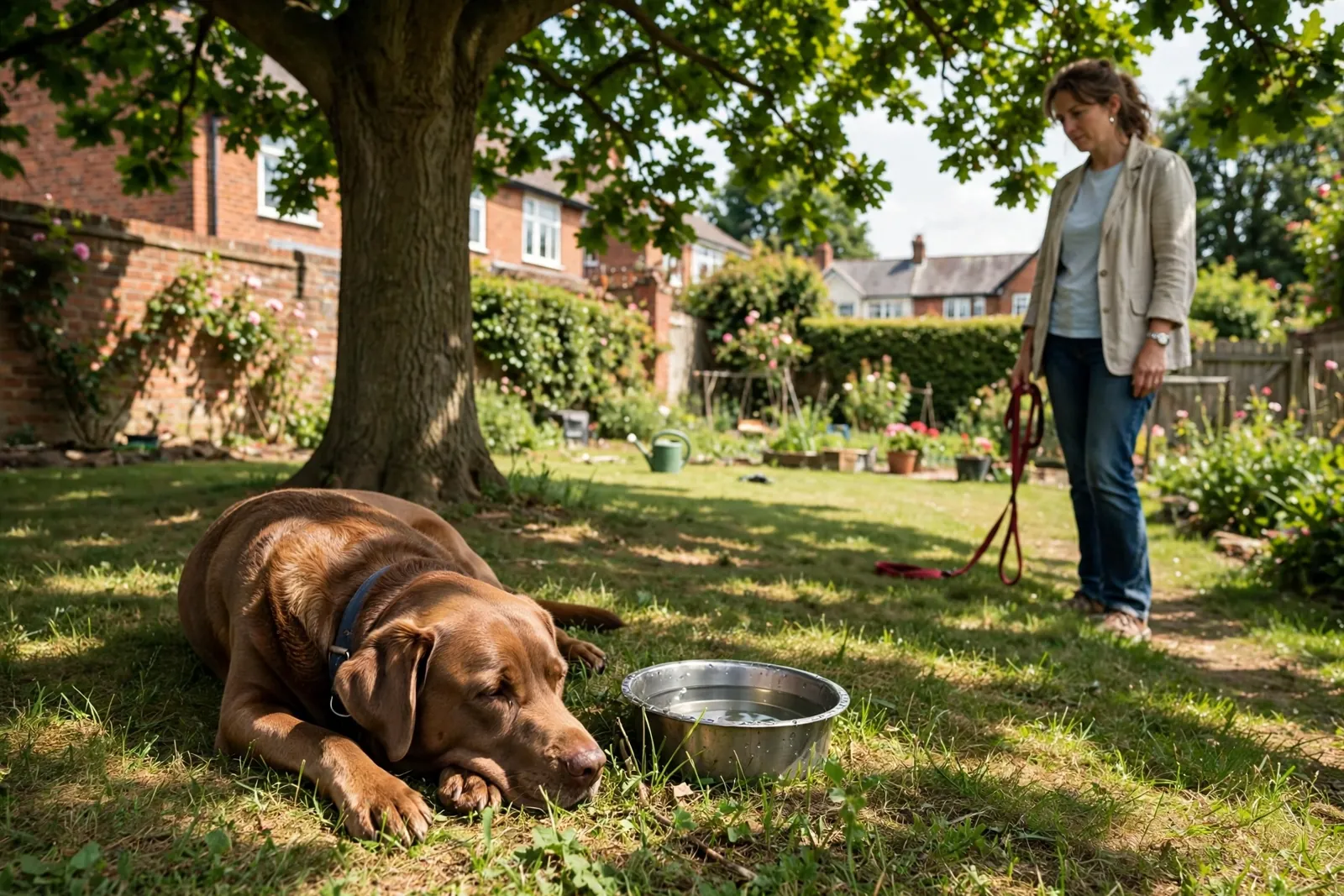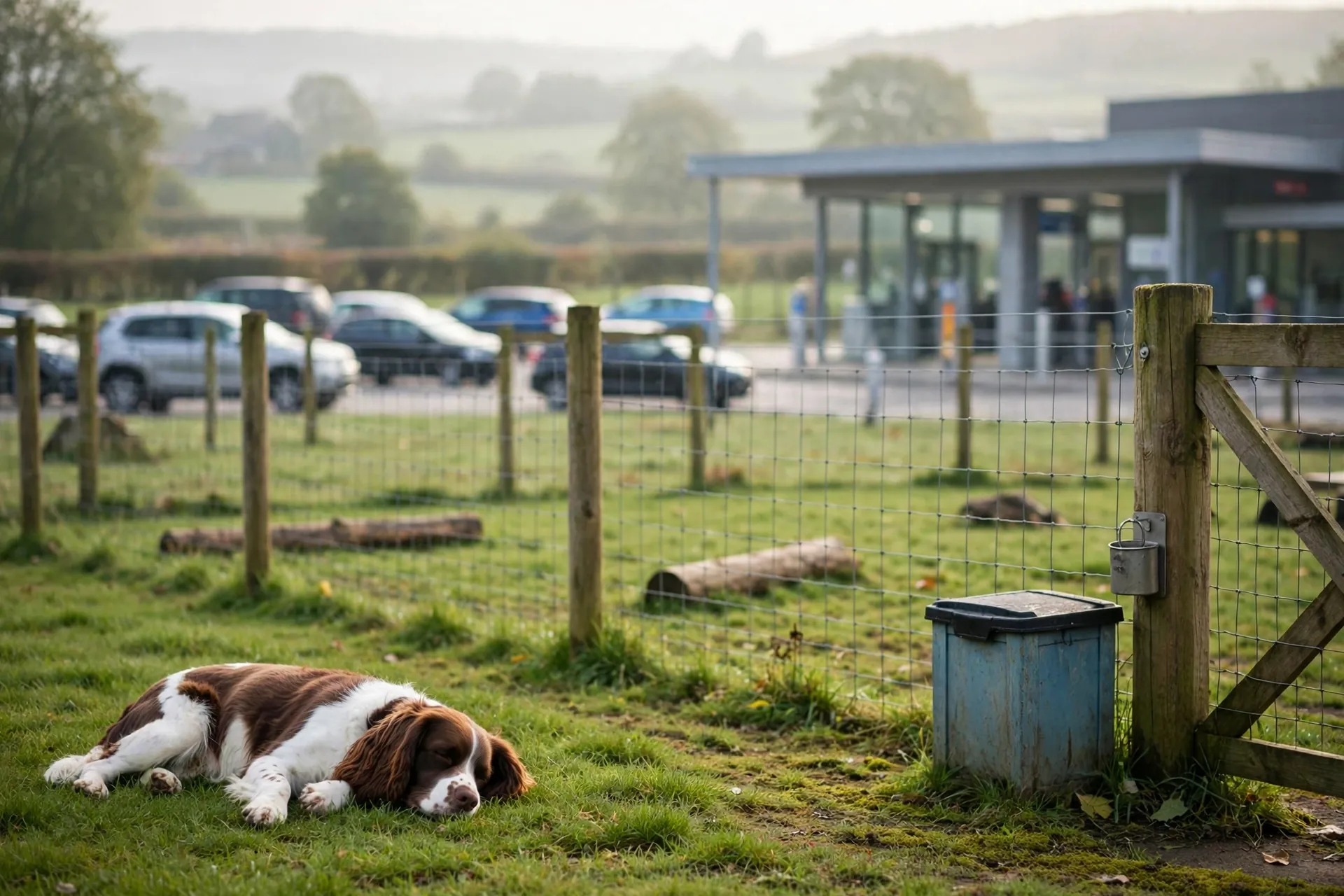
Assume your dog cannot go inside any service-area building, and plan around it. Pick stops with a proper dog-exercise area, run a tag-team so someone is always with the dog, stop roughly every two hours, and never leave the dog in a parked car — even briefly. Everything below builds on those four decisions.
Why the stop decides the drive
Driver-fatigue guidance in Britain has pointed to the same rough number for years: a proper break every two hours or so on a long motorway run. What gets said less often is that the dog's clock and the driver's clock drift apart in the back of the car. The driver fatigues mentally; the dog stiffens physically, needs the toilet on a schedule that has nothing to do with fuel range, and loses the ability to settle the longer they stay caged in a vibrating metal box.
This mismatch is why so many journeys with dogs go sideways around the second hour. The driver feels fine, the dog does not, and the decision gets postponed to the third hour, when both are worse off. Planning the stops before you leave removes the negotiation entirely. Mark two or three service areas on your route in advance, each with a job: this one is the leg-stretch, this one is the meal stop, this one is the final comfort break. A stop that has a purpose is a stop that actually happens.
The other argument for planned stops is predictability for the dog. A dog that learns the pattern — car, stop, grass, water, car — settles faster at each successive stop. A dog that gets one chaotic unplanned stop on a lay-by followed by three hours of nothing builds anxiety instead of confidence. Service areas are noisy, smelly, high-stimulation environments; the only way they become tolerable for a sensitive dog is repetition and routine.
The indoor rule: dogs and the service building
The general position across UK motorway service areas is simple: pet dogs do not go inside the main building. The building houses food courts, coffee shops and retail units, and hygiene rules keep animals out of food preparation and serving areas. Assistance dogs are the clear exception — they must be admitted — but a pet dog stays outside. This is the baseline assumption you should travel with.
There are wrinkles. A handful of sites permit dogs in specific outdoor seating zones or on terraces, and a few operator-run units have experimented with dog-tolerant seating at the margins of the building. None of this is standard, and arrangements can change with management. Treat any "dogs welcome here" claim you saw in a blog post last year as unreliable; check the operator's current information for the specific site before you depend on it. If you need a definite answer for a service area you are counting on, a phone call beats a forum thread.
The practical consequence of the indoor rule is that your stop happens in two places at once: the building for the humans, the car park and exercise area for the dog. That split is exactly what the next section's tag-team system is built for. One more point worth stating plainly: do not be tempted to carry a small dog inside a bag or coat to get around the rule. Apart from breaching the site's policy, it puts the dog in a stressful environment with nowhere to retreat and no toilet access.
The tag-team system that actually works
When two or more people travel, the stop runs like a relay. One person goes inside with the shopping list and the order; the other stays outside with the dog. Then you swap if the second person needs the facilities. The part people skip — and the part that makes it work — is agreeing the order before anyone unclips a seatbelt: toilets first or coffee first, dog walked first or food first. Ninety seconds of coordination at the start saves twenty minutes of drifting around the car park.
Give the dog-watcher a real job, not just babysitting. Their task is the dog's stop: a toilet walk, fresh water, a short sniff session and a check for anything picked up underfoot. The person going inside buys for both, including anything the dog needs — treats, a top-up water bottle, a packet of wipes. When the inside person returns, hand over with two sentences: where the dog has been, how the dog seems. It sounds fussy; it means the second person does not repeat the same walk or miss that the dog is flagging.
Solo drivers run the same system with one person, which means the stop stays outdoors. Park near the building's exit side so you can see your car, use the takeaway hatch or the external coffee window if there is one, and bring everything you need from the boot before you close the tailgate. For the toilet problem, many operators have accessible toilets near the entrance you can reach quickly — but the dog still needs someone with it. This is the one journey profile where travelling with another adult, even for the driving leg alone, is worth arranging.
Reading the dog-exercise area in two minutes
Most UK service areas provide some form of dog-walking provision — usually a grassed area, sometimes fenced, almost always with a waste bin. But "dog area" covers everything from a generous fenced paddock to a strip of verge between the car park and the fuel pumps. You can judge what you have got in about two minutes by looking for five things.
First, fencing and gates: a genuinely fenced area with a gate you can close changes the stop completely, because it lets the dog move without a lead clipped to your wrist the whole time. Second, size: a nervous or reactive dog needs room to arc away from other dogs, so a tiny pen that funnels every dog through the same gate is a stressor, not a feature. Third, the bin situation: is there one, is it a dog-waste bin or a general bin, and is it full? Fourth, the surface: worn-to-mud grass in February is honest but tells you to keep the dog moving rather than settle; gravel margins and broken glass near lorry parks tell you to keep the dog on lead and look down. Fifth, the exits: does the area open straight onto the main car park or the fuel forecourt, where a slipped lead becomes a genuine emergency?
Carry spare waste bags regardless of what the area promises. On-site bag dispensers run empty and stay empty for weeks. If the exercise area turns out to be unusable — locked gate, overflowing bins, or simply a flooded corner of the field — do not improvise on the main pedestrian plaza. Use a quieter margin of the site, keep the dog on a short lead, pick up everything, and move on. The next stop on your list is never far.
Comparing stops before you roll
Service areas are run by a handful of operators, each with its own site style, and they differ more in dog practicality than in fuel brands. What actually matters to you is not who sells the coffee but the site layout: how far the car park is from the green space, whether the dog area is fenced, whether there is covered outdoor seating for a rainy stop, and whether the site is a giant interchange hub or a smaller single-sided stop. Bigger is not automatically better — the busiest hubs have the longest walks from car to grass and the most chaotic parking.
Online, operator websites usually describe site facilities, and independent service-area directories track which sites have dog-walking provision and how substantial it is. Check the current listing for each of your planned stops rather than relying on memory: sites get refitted, fencing comes down, bins move. We cannot make firm promises here about any individual site's current dog facilities — the only source that counts is the operator's latest information, so treat the stop list as something to verify in the week before you travel, not something to memorise from a guide.
When choosing between two stops at a similar distance, favour the one with the simpler exit and re-entry. A service area that requires you to loop the whole site, cross a slip road and rejoin through a tight junction adds twenty minutes of driving for the same fifteen-minute stop — and with a dog, the stop that costs an extra twenty minutes is the stop that gets skipped next time. Simple in, simple out, grass close to parking: that is the winning combination.
A rest rhythm for long drives
The workable rhythm for most adult dogs is a proper stop roughly every two hours, with the dog out of the car for at least fifteen to twenty minutes. "Proper" means the full sequence: toilet, movement, water, and a few minutes of nothing — the dog standing or lying on grass with no demands. A stop where the dog stays clipped on a short lead at the car door while you scroll your phone is not a rest; it is a pause that adds to the debt.
Adjust the interval to the dog you have. Puppies under six months, dogs over about ten years, and flat-faced breeds that overheat faster do better on a 60–90 minute rhythm, even if each stop is shorter. A fit young spaniel that sleeps through the M1 can genuinely stretch toward two and a half hours — but stretch, not skip. Whatever the interval, hold it steady across the whole journey rather than compressing the first half and limping through the second. Drivers tire on the same curve, so the dog's rhythm protects the driver too.
Time the meal stop around the dog's feeding routine rather than your hunger. A dog fed at its usual time, given twenty minutes to settle, then driven on for another two hours sleeps better than a dog fed three hours late at the last stop before home. If your route crosses a ferry or a long tunnel section, remember that those hours add to the total confinement time with no stops possible — plan an extra-long exercise stop before embarking and another immediately after. Our guides to keeping a dog safe in the car and the legal restraint rules cover the in-car side of the same journey. If you are driving to a port, plan the crossing too — dogs on UK ferries compares operator rules, kennels, pet cabins and fees.
Heat, cold and the parked car
The parked-car rule admits no exceptions: never leave a dog in the car at a service area, not for five minutes, not with the windows cracked, not while you dash to the toilet. Cars heat to dangerous levels far faster than most people expect — on a mild 22°C day the interior can pass 40°C in minutes — and dogs cool themselves far less efficiently than we do. At a service area the dog is also a theft target, and reports of stolen dogs from service car parks surface every year.
Heat changes the stop even when the dog is outside with you. In summer, walk the dog-exercise area first and judge the shade before the dog spends twenty minutes in full sun; carry extra water because service-area taps are not always where you expect them; and move the car's parking spot into shade for the return if the site allows. Brachycephalic breeds, dark-coated dogs and older dogs need the shortest exposure and the longest access to water. There is a fuller treatment of this in our hot-weather travel guide, but the service-area version is simple: shade, water, brevity.
Cold is the quieter hazard. In winter the dog waiting with the tag-team partner can cool down fast, especially small, thin-coated or wet dogs standing on wet tarmac. Keep a drying coat in the stop kit, move the dog onto grass or the car boot mat rather than tarmac where possible, and keep the waiting part of the stop short in freezing weather. A dog shivering through your coffee run is not resting.
Nervous, reactive and older dogs at busy stops
Service areas are among the most stimulating places a dog will ever encounter: lorries air-braking, coaches idling, children sprinting with ice creams, dozens of unfamiliar dogs passing through the same small paddock. For a nervous or reactive dog, the stop is a management exercise, not a holiday. Three adjustments make it survivable.
First, park at the far edge of the car park, not by the building. The walk to the exercise area is longer, but the dog gets distance from the pedestrian river and from every car door slamming. Second, time your stops off-peak: mid-morning and mid-afternoon on weekdays are far calmer than Friday evenings, Saturday mornings and bank holidays, when the site is at its most frantic. Third, keep the dog on a short fixed lead through the busy zones and only extend the long line or release in the fenced area — and if the fenced area already has three dogs bouncing in it, wait in the car park margin until it clears rather than adding your dog to the mix.
Older dogs need a different kind of consideration: surface and distance. Wet tarmac and gravel are slippery for arthritic hips; choose grass routes even if they are longer, and keep the walking loop short but sniff-rich rather than trying to "tire them out." For arthritic dogs, the dog area's value is not exercise but toileting without urgency — give them time, not distance. If your dog is both old and anxious, consider whether one longer, calmer stop beats two rushed ones; with an experienced settled dog it usually does.
Overnighting at services with a dog
Sometimes the journey is too long for one day and the service area becomes the night stop. The hotels and lodges at motorway service areas vary in dog policy: some accept dogs for a small nightly fee, some restrict dogs to ground-floor rooms, some do not accept them at all — and the hotel brand's policy is what counts, not the service area's. Check the specific property's pet policy before you rely on it, confirm the charge and any restrictions in writing, and ask where the dog can toilet at night, because the site is at its darkest and busiest between 10pm and midnight.
If the hotel does not take dogs, the fallback is a dog-friendly stay a short drive off the motorway — many sit within ten minutes of a junction and are calmer than the service area itself. Sleeping in the car at the service area is not a safe plan: it is uncomfortable, poorly ventilated, and exposes the dog to a noisy car park all night. If you must nap in the car during the day, both humans stay with the dog, the car stays shaded, and it is a nap, not an overnight.
For campervan and caravan travellers, note that most service areas are not set up for overnight parking of leisure vehicles — rules differ and some sites prohibit it outright, while designated overnight parking, where offered, may carry a fee and a time limit. Check the operator's current position before planning to sleep at the services, and have a nearby campsite or aire-style option as the backup.
The stop kit that lives by the door
Keep a small stop kit in the front passenger footwell rather than buried in the boot, because the whole point is that it deploys in seconds. The list is short: a fixed lead and a long line, a water bottle and a collapsible bowl, spare waste bags, a drying coat or towel, wipes, a few high-value treats, and a torch or clip-on light for dark stops. In winter add a warm coat for thin-coated dogs; in summer add a cooling mat for the wait.
Two items people forget: a spare lead, because the one in use will jam, snap or get left at the bin eventually; and a familiar mat or blanket that goes on the grass wherever the dog settles. The mat is more than comfort — it becomes the cue that this stop is the resting kind, and dogs that learn "mat means settle" start switching off faster at each successive stop.
Water deserves its own discipline. Refill the bottle at every stop, not every other stop, and offer the dog water before the walk rather than after — a dog that has already drunk is less likely to drink from a puddle near the lorry park. If your dog is on medication that must be given with food or at set times, build the stop around the medication schedule, not the other way round; a missed dose on a travel day is a miserable error.
When the stop goes wrong
The most serious failure at a service area is a loose dog near traffic. If a lead slips, do not chase — a chased dog runs toward the open road. Drop to a crouch, call once in a warm voice, and let curiosity bring the dog back; if the dog has recall training, use the trained cue exactly once and then stay still. Prevention beats rescue: a properly fitted harness or a martingale-style collar, a fixed lead rather than an extendable through busy zones, and a carabiner clip on the harness as backup for known escape artists.
Smaller problems are more common. A dog that has picked up something on the exercise area needs it removed calmly and, if it might be harmful, a call to the vet rather than a wait-and-see on the motorway. A dog that refuses to toilet at a strange site usually needs a longer, boring walk rather than being hurried back to the car — hurried dogs hold it, and a held bladder becomes a car problem later. A dog that has worked itself into a frenzy from over-stimulation needs ten minutes of nothing: sit on the grass with them, no interaction, until the breathing slows.
And if the whole stop is a write-off — the exercise area is a flooded mud pit, the site is chaos, the dog is shaking — there is no shame in cutting it short. Do the toilet run on the quietest margin, give water, and drive ten minutes to the next site on your list. The plan exists so you can change it.
Practical questions
Before you set off
Can I take my dog inside a UK motorway service area?
Pet dogs are generally not allowed inside service-area buildings, which contain food outlets and shops with hygiene rules to follow. Assistance dogs are the exception and must be admitted. A few sites tolerate dogs in specific seating zones, but this varies by operator and can change, so check the latest official information before you travel rather than assuming.
Is it ever safe to leave my dog in the car while I go inside?
No. Even a few minutes in a parked car can put a dog at serious risk from heat, and a dog left alone is also a theft target. The workable alternative is the tag-team approach: one person stays with the dog while the other goes inside, then you swap. If you are travelling alone, bring food and drink to the car and keep the stop outdoors.
Do all UK service areas have somewhere to walk a dog?
Most do, in the form of a grassed dog-exercise or dog-walking area, usually with a waste bin — but quality and size vary enormously. Some are generous fenced paddocks; others are a small strip of verge near the lorry park. Check what is actually there before you arrive if your dog needs space, and bring extra waste bags in case the bin is full or missing.
How often should we stop when driving a long way with a dog?
A sensible rhythm is a proper stop roughly every two hours, with the dog out of the car for at least 15–20 minutes each time. Puppies, older dogs and brachycephalic breeds may need stops every 60–90 minutes. Build the stops into your route before you set off so a tired driver is not choosing between pushing on and an unplanned roadside stop.
What if my dog is nervous around busy service-area car parks?
Time the stop outside peak hours, park at the far edge of the car park rather than near the building, and keep the dog on a short lead away from the busiest pedestrian flows. Choose stops with larger green space when you can. If your dog is noise-sensitive, avoid stops at the busiest junctions on Friday evenings and bank-holiday weekends.
Can we stay overnight at a motorway service area with a dog?
The hotels and lodges at service areas vary in their dog policies — some accept dogs for a small fee, others do not, and the rules differ between the hotel brand and the service area operator. Check the specific hotel's pet policy before relying on it, and confirm the charge, room type and any restrictions in writing. Sleeping in the car at the service area is uncomfortable and not a safe plan.