This guide is independent and contains no paid placement. Store practice can change by branch and over time, so always check the official guidance before you travel.
Many John Lewis branches are reported to welcome well-behaved dogs on the shop floor, but there is no safe assumption that every branch, every floor or every food area follows the same rule. Check the official guidance before you travel, confirm with the specific branch, keep your dog on a short lead, and have a backup plan for cafes and food halls.
The short answer
If you are asking whether dogs are allowed in John Lewis, the honest answer has two parts. First, John Lewis has a reputation among dog owners as a relatively welcoming place to shop with a dog, and many branches do allow dogs in the main shopping areas. Second, that reputation is not a guarantee for the branch in front of you on the day you visit. Individual stores, departments and food areas can set different conditions, and those conditions can change for refurbishment, a special event, a safety concern or a change in local management. Treat a dog-friendly reputation as a good reason to check, not as a promise.
That distinction matters because a department store is not one simple space. A single John Lewis building can contain open shop floors, fitting rooms, beauty counters with strong fragrances and fragile displays, escalators and lifts, a food hall, a cafe, a restaurant and a customer collection point. Each of those areas raises a different question. A dog that is perfectly welcome beside a clothing rail may not be welcome where food is prepared or served, and a dog that copes well in a quiet weekday store may struggle in a crowded Saturday sale. The most useful question is therefore narrower than the one most people ask: not only whether dogs are allowed in John Lewis in general, but whether dogs are allowed in this branch, in these departments, at this time, under these conditions.
Assistance dogs sit in a separate category altogether, and this guide keeps that distinction clear throughout. A person who uses an assistance dog has legal protection that a pet dog does not, and a store should not refuse access simply because a dog is present. Pet dogs, by contrast, are admitted at the discretion of the business, subject to conditions the business sets. Confusing those two categories helps nobody: it can lead a pet owner to expect a right they do not have, and it can put unnecessary pressure on an assistance dog handler who does have that right. If you travel with an assistance dog, the section on assistance dogs below explains the position in plain terms and what to do if you are challenged.
For a pet dog, the practical approach is straightforward. Before a special trip, check the official guidance before you travel and contact the branch directly if the answer matters to your plans. On arrival, look for signs at the entrance, ask a member of staff if anything is unclear, and be ready to adapt. A short, calm visit with a settled dog and a backup plan is almost always a better experience than a long, hopeful visit that ends in a difficult conversation at the door of a cafe. The rest of this guide turns that approach into a checklist you can use for any branch, from a large city flagship to a smaller store in a shopping centre.
Why branches can differ
Department stores are not run as identical copies of one another. A flagship store in central London, a branch inside a shopping centre and a smaller store in a market town may have different layouts, different landlords, different lease conditions and different local safety assessments. A shopping centre, for example, may have its own rules about animals in shared walkways, lifts and car parks, and those rules can affect the route into the store even when the store itself is happy to welcome dogs. A branch that shares an entrance with other retailers may need to follow a shared policy for that entrance, while a standalone branch controls its own doors. That is why two honest reports from two different branches can sound contradictory, and why neither report should be treated as a national rule.
Departments can differ for a similar reason. A homeware floor with wide aisles and sturdy displays is a very different environment from a beauty hall with open testers, glass bottles and strong scents, or a bedding department where a dog could easily brush against pale fabrics. Staff may ask you to keep a dog closer, avoid a particular aisle or skip a department altogether, and that request is usually about protecting stock and other shoppers rather than a judgement on your dog. Fitting rooms raise another practical question: a dog waiting in a small cubicle may be stressed, may mark, or may slip out when the curtain moves. Some branches will be relaxed about a small, calm dog in a fitting room, while others will ask you to leave the dog with another person outside. Ask before you try, and do not be surprised if the answer varies.
Time and context matter too. A store that welcomes dogs on a quiet Tuesday morning may tighten its approach during a Christmas shopping weekend, a sale event or a product launch, when aisles are narrower, queues are longer and staff are focused on crowd safety. Refurbishment can close a lift, narrow a corridor or create noise and dust that make a visit unpleasant for a dog even if dogs are still technically allowed. Seasonal displays, school holiday crowds and even a visiting event with food sampling can change what is sensible on the day. The branch is not necessarily being inconsistent; it is responding to conditions that change. Checking on the day, or at least in the same week as your visit, is therefore more reliable than relying on a blog post or a social media comment from months ago.
It is also worth remembering that individual staff members apply policy in real situations. A security guard, a department assistant and a cafe manager may each be responsible for a different area, and they may interpret a general instruction differently when they meet a large, excited dog, a dog that is barking, or a dog that is clearly distressed. That human element is another reason to arrive with a calm, well-managed dog and a polite question rather than an assumption. A dog that is settled, clean, on a short lead and under control gives staff every reason to say yes, while a dog that is pulling, jumping up at displays or barking at other shoppers gives them a practical reason to intervene, whatever the written policy says.
Food halls, cafes and restaurants
Food areas are where most dog owners meet an exception, and it helps to expect that exception before you arrive. Even in a branch that welcomes dogs on the general shop floor, the food hall, cafe or restaurant may operate under stricter hygiene rules. Food safety law and the practicalities of serving food in a busy space give a business strong reasons to limit animals where food is prepared, displayed unpackaged or eaten. That does not mean every food area will refuse dogs, but it does mean the food area is the place most likely to have a different sign on the door. If lunch is part of your plan, check that part of the plan separately rather than assuming the shop-floor welcome extends to the table.
The pattern varies in ways that are easy to misunderstand. One branch may allow dogs in a cafe seating area but not in the restaurant, another may allow dogs on an outdoor terrace but not indoors, and a third may allow dogs throughout the food area provided they stay on the floor and away from food preparation zones. Some food halls allow dogs to pass through but not to linger, which matters if you planned to browse cheese counters and delicatessen displays with your dog for half an hour. Others draw the line at seating: you can buy packaged food to take away, but you cannot sit down to eat it with your dog beside you. The only reliable way to know is to ask at the food area itself, look for the sign at its entrance, and have an alternative in mind.
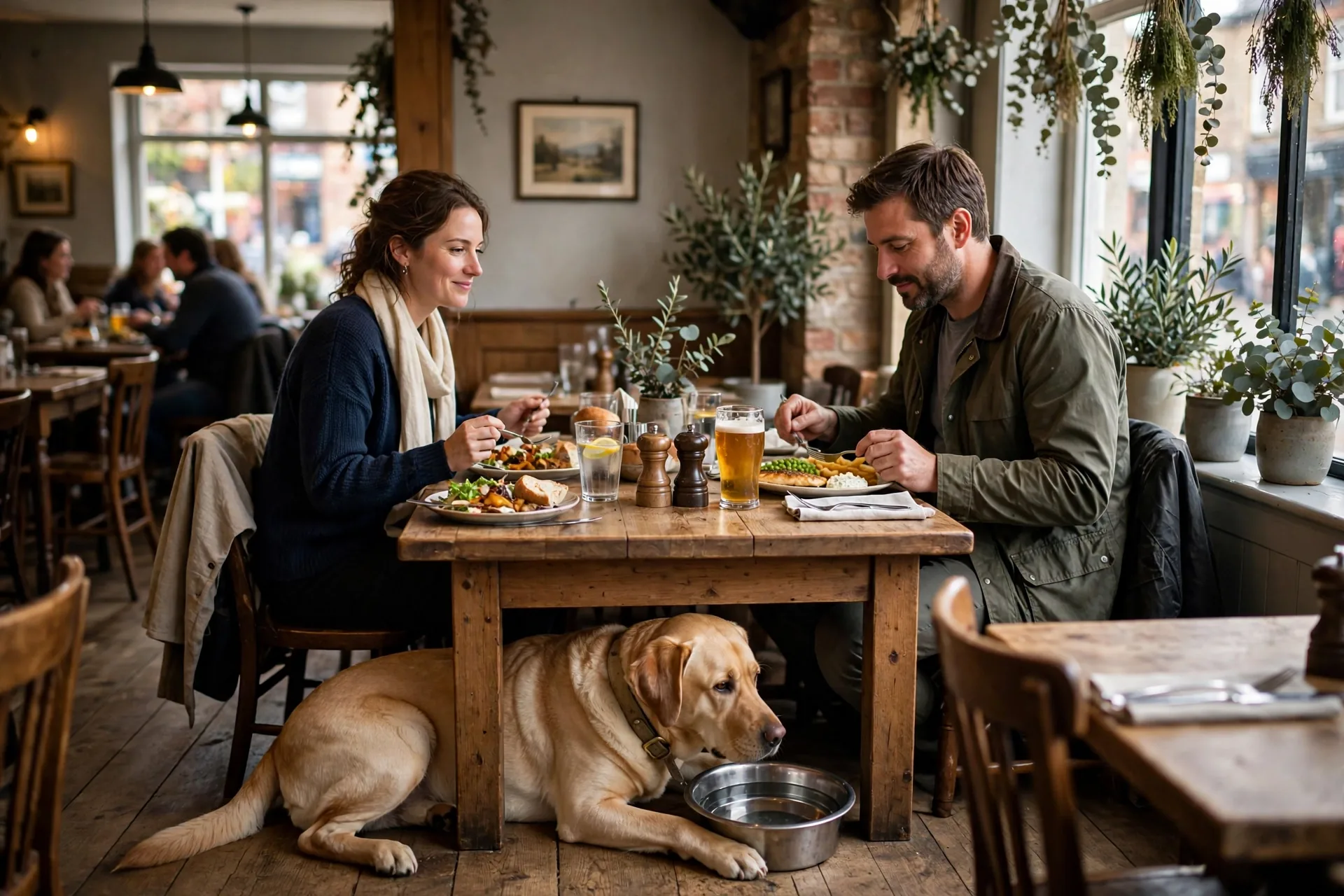
When you do eat with a dog nearby, the etiquette that works elsewhere applies with extra care. Our guide to dog friendly cafes in the UK explains how to check a cafe before you go and how to settle a dog under a table, and the same habits help inside a department store cafe: a short lead, a dog that lies down rather than wandering, water offered discreetly, and food kept off the floor where it could attract attention from other dogs or create a slip hazard. A similar approach is covered in our guide to dog friendly restaurants in the UK, which is useful even for a quick department store lunch, because table spacing, waiter routes and the presence of other diners all affect whether a dog can settle. If the cafe is busy, a dog that would be calm at a quiet table may still struggle when trays pass overhead and chairs scrape constantly, so consider a takeaway coffee and a walk instead.
One practical tip saves many awkward moments: decide the order of your visit before you enter. If you want to shop and then eat, ask about the food area first, while you still have time to adjust. If dogs are not welcome in the cafe, you can shop first, leave the store for lunch elsewhere, and return afterwards, rather than discovering the restriction with a full basket and a hungry family. If you are travelling with another adult, agree in advance who will wait with the dog and where, so the wait is comfortable rather than improvised on a busy pavement. A little sequencing turns a possible refusal into a minor rearrangement.
Assistance dogs and the law
Assistance dogs are not pets in the eyes of the law, and that difference is important. Under the Equality Act 2010, which applies in England, Scotland and Wales, it is generally unlawful for a service provider to refuse access to a disabled person because they are accompanied by an assistance dog, or to treat that person less favourably for that reason. This protection covers shops, cafes, restaurants and other places open to the public, and it is not limited to guide dogs for blind people. It includes, for example, hearing dogs, mobility assistance dogs and other dogs trained by recognised organisations to help a disabled person. Northern Ireland has its own disability discrimination law with a similar effect, and the practical expectation is the same: an assistance dog should be admitted where a customer is admitted.
That legal position does not mean every interaction is simple. Staff may not always recognise an assistance dog, especially if the dog is not wearing an obvious harness or jacket, or if the handler does not wish to discuss their disability at the door. A handler is not required to carry a particular certificate in law, although many assistance dog partnerships do carry identification from their training organisation, and showing it calmly can resolve a misunderstanding quickly. If you are an assistance dog handler and access is questioned, a short, clear explanation usually helps: state that the dog is an assistance dog, ask to speak to a manager if the first member of staff is unsure, and note the branch, date and names involved if you need to follow up afterwards. You should not have to justify your disability in detail to enter a shop.
Pet owners should be careful not to borrow this protection. Claiming a pet is an assistance dog, buying a vest online, or arguing that a dog provides emotional support in a general sense does not create the same legal position, and it makes life harder for genuine assistance dog partnerships when staff become sceptical. If your dog is a pet, the honest route is to ask about the branch policy, accept the answer, and use the backup plans later in this guide. That honesty also protects the wider dog-owning community: branches that have positive experiences with well-managed pet dogs are more likely to keep welcoming them.
Our guide to assistance dog rights in the UK explains the legal background, common exceptions and practical steps in more detail, and it is worth reading before a trip if you rely on an assistance dog. In particular, note that hygiene rules for food preparation areas are sometimes raised as a reason to refuse access, but the general expectation is that an assistance dog should still be admitted to areas open to customers, with reasonable adjustments made for genuine food safety concerns rather than a blanket refusal. If you encounter a refusal that you believe is unlawful, keep a factual record and consider the complaint route described in that guide rather than trying to settle a legal argument at the shop door.
Check before you travel
A five-minute check before you leave home can prevent a wasted journey, especially if you are travelling a long way or combining the store visit with other plans. Start with the official guidance before you travel: look for the current customer information published by John Lewis, and check whether it mentions dogs, pets or assistance animals for the branch you intend to visit. If the published information is general rather than branch-specific, treat it as background and confirm the detail with the branch itself. A short phone call or message to the store, asking whether pet dogs are welcome on the shop floor and in the cafe on the day you plan to visit, gives you a named answer you can rely on more than a second-hand report.
When you contact the branch, ask specific questions rather than a single yes-or-no question. Useful questions include whether pet dogs are welcome throughout the store or only in certain departments, whether the cafe or restaurant has a separate rule, whether there are size or lead requirements, whether dogs are welcome in lifts, and whether any event, refurbishment or temporary restriction applies on your chosen date. Note the answer, the date you asked and, if possible, the name of the person who answered. That note is helpful if you arrive and meet a different member of staff with a different understanding, because you can politely explain what you were told without turning the conversation into a dispute.
Also check the journey, not just the destination. If the branch is inside a shopping centre, check the centre rules for dogs in malls, car parks and shared lifts, because the centre policy may be stricter than the store policy. If you are travelling by public transport, check the operator rules for dogs on trains and buses, and plan a toilet break and a walk before entering the store so your dog arrives settled rather than restless. If you are driving, check parking arrangements and whether there is a nearby green space for a pre-shop walk and a post-shop toilet break. A dog that has already had a walk, a drink and a toilet opportunity is far more likely to settle quietly for a shopping trip than a dog that has been waiting in a car or on a train for an hour.
Finally, think about timing. Weekday mornings are usually calmer than Saturday afternoons, and the first hour after opening often gives a dog more space and fewer sudden encounters than a peak shopping period. Sale events, school holidays and the weeks before Christmas bring larger crowds, longer queues and more noise, all of which can unsettle a dog that is normally confident. If your dog is nervous, reactive or still learning to settle in busy places, choose a quieter time for a first visit, keep the visit short, and build up gradually. A successful twenty-minute visit teaches a dog far more than a stressful two-hour visit that ends badly.
In-store etiquette that works
Good etiquette inside a department store is mostly about making your dog invisible in the best sense: present, calm and easy for everyone else to ignore. Keep your dog on a short lead at all times, even if the store feels spacious, and keep the lead in your hand rather than tied to a display or a chair. A short lead prevents a dog from wandering into a neighbouring aisle, sniffing a display of food, jumping up at a child or tangling around a clothing rail. It also gives you immediate control if another dog appears around a corner, a trolley turns suddenly, or a member of staff opens a stockroom door. If your dog needs more freedom to settle, a department store is not the place to provide it; a park or a garden is.
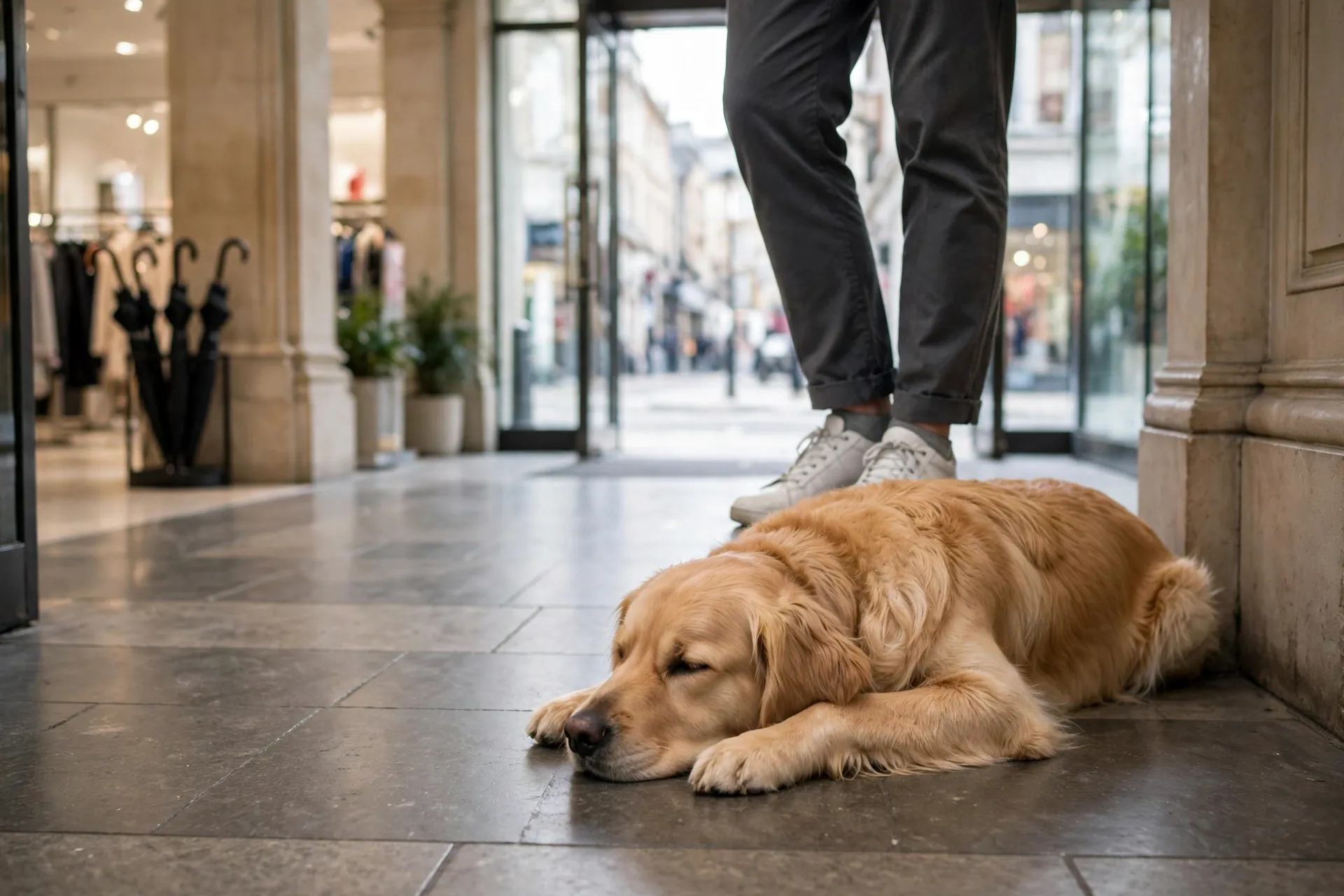
Position matters as much as lead length. Ask your dog to lie down beside you or behind you, rather than in the middle of an aisle where shoppers and staff must step around them. In a queue, keep your dog close to your legs and on the side away from passing traffic. In a lift, position your dog in a corner and keep the lead short so the doors do not become a hazard. At a till, settle your dog before you start paying, so you are not trying to manage bags, a card machine and a restless dog at the same time. These small habits are not about strict obedience; they are about reducing the number of surprises for your dog and for everyone else.
Cleanliness and consideration are part of the deal. Make sure your dog is clean and dry before entering, especially after a wet walk, because muddy paws on pale carpets and wet coats against clothing rails create a genuine problem for the store. Carry waste bags and a small towel even for a short visit, and clean up immediately if there is an accident, alerting staff so the area can be cleaned properly. Keep your dog away from food displays, open testers and personal care counters, and do not allow your dog to drink from a display, chew packaging or take food from a low shelf. If your dog barks, whines or shows signs of stress, treat that as information rather than embarrassment: shorten the visit, move to a quieter area, or step outside for a break.
Respect other shoppers, including those who are nervous around dogs, allergic, or travelling with children. Not everyone wants to meet your dog, however friendly your dog may be, and a department store is a shared public space rather than a dog park. Keep greetings brief and only with permission, prevent your dog from approaching assistance dogs at work, and do not allow your dog to sniff food, bags or pushchairs. If a child asks to stroke your dog, it is perfectly reasonable to say no if your dog is tired, nervous or simply not in the mood, and to suggest a wave instead. Polite boundaries protect your dog as much as they protect other people.
Lifts, escalators and busy floors
Moving between floors deserves its own plan, because escalators and lifts present different risks for dogs. Escalators are a particular hazard: a dog's paws, claws, nails and long coats can catch in the moving steps and side panels, and many safety guides advise against taking dogs on escalators at all. If a store has a lift, use the lift even if it means a short wait, and keep your dog close to you inside it. If the only route to a floor you want is an escalator and you are unsure whether it is safe for your dog, ask staff for an alternative route or skip that floor. Carrying a small dog on an escalator is sometimes suggested, but it is not a safe solution for a medium or large dog, and it still leaves the dog exposed to sudden movement and noise.
Lifts bring a different set of manners. Wait for a lift that has space, rather than squeezing a dog into a crowded car where other passengers may be uncomfortable or where the dog may feel trapped. If the lift is busy, let it go and wait for the next one; a minute of patience is better than a stressful ride. Inside the lift, keep the lead short, keep your dog still, and watch the doors: a lead trailing through closing doors is a serious hazard, so gather the lead fully inside before the doors close. If your dog is reactive to strangers in confined spaces, consider whether you need that floor at all, or whether you can ask staff to bring an item down, use a different entrance, or complete that part of the shopping online.
Busy floors need a route, not just a destination. Before you start browsing, notice the widest aisles, the quieter corners and the nearest exit or lift, so you can move your dog away from a crowd quickly if needed. Avoid dead-end displays where a dog could feel cornered, and avoid narrow aisles during peak times when trolleys and pushchairs pass in both directions. If you are shopping with a pushchair, a wheelchair or a large amount of luggage as well as a dog, the combination can become difficult to manage; consider splitting the party, using a basket rather than a trolley, or making a shorter list for the in-store visit and completing the rest online. A store visit should be enjoyable, not an obstacle course.
Noise and scent are part of the environment too. Perfume counters, cleaning products, food smells, music and announcements can overstimulate a sensitive dog, while polished floors can be slippery for older dogs or dogs with mobility problems. If your dog slips on a polished floor, move to a carpeted area, ask staff whether a mat or a different route is available, and consider whether a short visit is kinder than a long one. Dogs that wear boots for outdoor walks may find indoor floors easier with boots on, but check that boots fit securely and do not create a new slipping hazard. The goal is not to complete an exhaustive shopping list at any cost; it is to leave with a dog that is still relaxed and a shopping trip that you would repeat.
If a branch says no
Being told that your dog cannot enter, or cannot enter a particular area, is disappointing, especially after a long journey. The most useful response is calm and practical. Thank the member of staff, ask politely whether the restriction applies to the whole store or only to a department or food area, and ask whether there is a manager or a written notice that explains the position. That information helps you decide whether to adjust your plan, wait, or come back another day, and it avoids a confrontation that will not change the outcome on the spot. If you believe you have been given incorrect information about an assistance dog, the position is different and is covered in the assistance dog section above, but for a pet dog, the store is entitled to set its own conditions.
Do not leave a dog tied up outside as a fallback unless you have no other option and the location is genuinely safe, which a busy high street or shopping centre entrance rarely is. Theft, distress, weather, and interference from passers-by are all real risks, and some locations prohibit leaving dogs unattended. A better fallback is to split the party: one person shops while the other waits with the dog in a comfortable place, such as a nearby cafe with outdoor seating, a park bench in shade, or the car in appropriate weather with proper ventilation and a short stay. If you are shopping alone, consider whether the purchase can wait, whether click and collect is available, or whether a shorter visit without the dog on another day would be simpler. The purchase is rarely worth a stressed or unsafe dog.
Afterwards, note what happened while it is fresh: branch name, date, time, the area concerned and what you were told. That note is useful if you want to check again before a future visit, because you can ask the branch whether the restriction was temporary or permanent. It is also useful if you want to give feedback through the official customer service route, where a calm, factual account is far more persuasive than a social media complaint written in frustration. If the branch told you that dogs are welcome but a particular department was closed to dogs that day, your note will help you plan a better visit next time rather than avoiding the branch altogether.
Finally, remember that a refusal at one branch does not tell you the policy at another branch, and a refusal on one day does not necessarily tell you the policy on another day. Branches change, managers change, and temporary restrictions end. Check the official guidance before you travel again, confirm with the specific branch, and try a quieter time if the previous visit coincided with an event or a refurbishment. A single difficult visit should not end your dog-friendly shopping altogether, but it is a good reason to build a backup plan into every future visit rather than assuming the door will always be open.
Backup plans and nearby options
A good backup plan turns a refused entry into a pleasant day out rather than a ruined one. Start with the simplest alternative: click and collect. Many department store purchases can be ordered online and collected from a collection point, a car park desk or a nearby partner location, sometimes without entering the main shop floor at all. Check whether the branch offers a collection option that suits your dog, and whether you can collect at a time when you can also walk your dog nearby. If you only need one or two items, collection may be faster and calmer than a full store visit with a dog in tow.
Nearby dog-friendly places can rescue the day. A market, a park, a riverside walk or a dog-friendly cafe near the store gives the non-shopping member of the party somewhere pleasant to wait, and gives the dog a proper outing rather than a wait on a pavement. Our guide to dog friendly markets in the UK is a useful starting point for combining shopping with a dog-friendly outing, because markets often welcome dogs outdoors and offer a more relaxed atmosphere than a crowded department store. Even if the market is not in the same town, the habit of pairing a store visit with a nearby walk or cafe means the dog gets something from the trip even when the store itself says no.
Other retailers can also be part of the plan, but do not assume their policies match John Lewis. Some high street shops, bookshops, garden centres and outdoor retailers welcome dogs, while others do not, and the same branch-by-branch caution applies. If you are planning a shopping day with a dog, research two or three dog-friendly stops in advance rather than discovering each policy at the door. A garden centre with a cafe, a bookshop with wide aisles, or an outdoor clothing store may all be more dog-friendly in practice than a busy department store, and they may offer a calmer experience for a nervous dog. Keep the day short, include toilet breaks and water, and end with a walk so the dog associates shopping days with pleasant outings rather than long waits.
When in doubt, shorten the trip. A dog does not need to accompany every shopping errand, and a short, successful visit is better than a long day of waiting outside shops. If the weather is hot, cold, wet or crowded, leaving the dog at home in comfort, with a sitter or a family member, may be the kindest choice, even if the store would have welcomed the dog. Dog-friendly shopping is about choosing the right outings for your particular dog, not about taking a dog everywhere. The best shopping days are the ones where the dog is settled, the shopping is done efficiently, and everyone, including the dog, comes home relaxed.
What to pack for a store visit
Packing for a department store visit is lighter than packing for a holiday, but a few items make a real difference. A short, sturdy lead is essential, and a harness that fits well gives you better control than a long retractable lead in a crowded store. Bring a collapsible water bowl and a small bottle of water, because a dog that has walked to the store or travelled on public transport may be thirsty, and not every store will have a water bowl available. Bring waste bags, a small towel for wet paws, and a familiar mat or blanket if your dog settles better on their own mat rather than on a shop floor. A few small treats can reward calm settling, but keep them discreet and do not feed your dog from a food counter or near other shoppers' food.
Consider your dog's comfort and the store environment together. If your dog is elderly, arthritic or sensitive to slippery floors, a well-fitted harness and a slow pace matter more than any gadget. If your dog is a puppy or a young dog still learning to settle, keep the visit short, choose a quiet time, and bring a chew or a familiar toy for the waiting moments, while being careful not to let a toy become a tripping hazard in an aisle. If your dog wears a coat in cold or wet weather, make sure the coat is clean and dry before entering, and remove a wet coat at the entrance if possible so your dog does not drip on displays or carpets. A clean, comfortable dog is easier for staff to welcome and easier for you to manage.
Finally, pack for yourself as well as for your dog. A small bag that keeps your hands free, a phone with the branch number saved, and a note of your backup plan all reduce stress at the door. If you are shopping for something specific, bring measurements, photographs or a list so you can find it quickly rather than browsing every floor with a dog that is gradually losing patience. If you need to try on clothing, think about how the dog will wait: a second person, a quiet corner, or a shorter fitting session all help. The less time your dog spends waiting in a busy, stimulating environment, the better the visit will be for everyone, and the more likely you are to be welcomed back next time.
Before you set out, run through a final checklist. Has the branch confirmed that pet dogs are welcome on the day you plan to visit? Do you know the food area rule? Is your dog walked, toileted, watered and settled? Do you have a short lead, water, waste bags and a backup plan if the answer changes at the door? If you can answer yes to most of those questions, you are ready. If you cannot, a short delay to check the official guidance before you travel is almost always worth it. A prepared visit is a calm visit, and a calm visit is the best advertisement for dog-friendly shopping.
Practical questions
Before you go
Are dogs allowed in every John Lewis store?
Do not assume a single national rule. Practice can vary by branch and by department, and a store may change its approach for events, refurbishment or safety reasons. Check the official guidance before you travel and confirm with the specific branch you plan to visit, especially before a long journey.
Can I take my dog into a John Lewis cafe or restaurant?
Food and drink areas are the most likely exception. Even in a branch that welcomes dogs on the shop floor, cafes, restaurants and food halls may have stricter rules for hygiene reasons. Ask staff at the entrance to the food area, look for signs at the door, and plan a backup so you are not left choosing between lunch and your dog.
Are assistance dogs treated differently?
Yes. Assistance dogs have a different legal position from pet dogs under the Equality Act 2010 in England, Scotland and Wales, and service providers generally must not refuse access to a person because they use an assistance dog. If access is questioned, stay calm, explain that the dog is an assistance dog, and ask for a manager if needed.
What should I do if a branch says no to my dog?
Thank staff, do not argue at the door, and use your backup plan. That may mean one person shops while the other waits with the dog, using click and collect, returning at a quieter time, or choosing a nearby dog-friendly cafe or park instead. Note the branch name and date so you can check again before your next visit.
Do dogs need to be on a lead inside John Lewis?
Keep your dog on a short lead at all times inside a store, even if the branch is dog-friendly. A short lead keeps your dog clear of escalators, displays, other shoppers and staff carrying stock. If your dog is nervous, reactive or likely to pull toward people, choose a quieter time or a shorter visit.
Can I leave my dog tied up outside a John Lewis store?
Avoid leaving a dog tied up outside a busy store. Theft, stress, weather and a loose lead are real risks, and some locations do not allow dogs to be left unattended. If you cannot take your dog inside, it is safer to shorten the trip, split the shopping between two people, or use click and collect.