This guide is independent and contains no paid placement. Library policies change branch by branch, so treat this guide as a planning framework and check the official guidance before you travel.
There is no UK-wide rule on dogs in libraries. Each council library service, university and community library sets its own policy, so one branch may welcome a calm dog on a lead while the next branch in the same town does not. Assistance dogs are different: they are not pets in law and should be admitted to libraries open to the public. For pet dogs, always check the specific branch before you travel, plan a short visit, and be ready to leave the quiet areas the moment your dog becomes restless.
No national rule: who decides
The first thing to understand about dogs in libraries is that there is no single national answer to look up. Unlike assistance dog access, which is protected by equality law, admission of pet dogs to a library is a local management decision. In England, Scotland and Wales, public libraries are mostly run by local authorities, and each authority writes its own visitor rules, building byelaws or conditions of use. A library in one council area may have quietly welcomed dogs for years, while a library twenty minutes away, run by a different council, may display a clear no-dogs notice at the door. Neither branch is breaking a national library rule, because no such rule exists.
That patchwork is why general statements such as "libraries allow dogs" or "libraries ban dogs" are both misleading. The decision usually sits with the library service manager, sometimes with the council department that owns the building, and sometimes with a trust or community group that runs the branch. University libraries add another layer: the university owns the building, sets its own access policy, and often restricts entry to students and staff in the first place, so a dog policy written for the general public may not apply at all. Community libraries, which are increasingly run by volunteers under an agreement with the council, may follow the council policy, write their own, or simply follow whatever the volunteers on duty that day consider reasonable. The practical consequence is simple: the branch matters more than the category.
It also helps to understand why libraries are cautious. A library is not a shop or a cafe, where background noise is expected and a bark blends into the general hum. The core promise of a library is a quiet, clean and safe space for reading, studying and using shared equipment. Staff worry, reasonably, about allergies, about people who are frightened of dogs, about damage to books and furniture, about hygiene around food-free study areas, and about the disruption caused when one dog barks and every reader looks up. A policy that welcomes dogs therefore has to protect that quiet promise, which is why dog-friendly libraries almost always attach conditions: a short lead, a settled dog, restricted zones, and an immediate exit if the dog disturbs anyone. Those conditions are not hostility to dogs. They are the price of keeping the door open.
There is a second reason for the variation, and it is worth knowing before you argue with a member of staff. Many older library buildings carry byelaws or local rules written decades ago, when dogs in public buildings were simply not contemplated. Changing a byelaw takes time and committee approval, so a library may in practice tolerate a calm dog in the entrance area while the formal rule still says no animals. Conversely, a library that advertises itself as dog-friendly may still exclude dogs from particular rooms, such as a local studies archive where original documents are handled, or a children's library during story time. In both cases the written rule and the everyday practice can differ slightly, and the only reliable source is the branch itself. If you cannot find a published policy, that silence is information too: it usually means the library has not made a deliberate decision, and staff will apply their judgement on the day.
So the question to ask is never just "are dogs allowed in libraries?" It is "does this branch, on this day, in this room, allow this dog?" That sounds fussy, but it is the question that prevents a wasted journey and an awkward conversation at the desk. The rest of this guide works through each type of library in turn, then sets out the etiquette and planning steps that make a visit succeed wherever dogs are welcome.
Public libraries: the most varied picture
Public libraries, the familiar council-run branches on high streets and in town centres, show the widest variation of all. Some have embraced dogs as part of a broader effort to make libraries feel welcoming: a dog asleep under a reading table is good publicity for a community space, and staff sometimes point out that a regular dog visitor brings their owner in more often, which is exactly what a library under pressure wants. Other branches, particularly large central libraries with busy study floors, keep a strict no-pet-dogs rule because the volume of visitors makes exceptions hard to manage fairly. Both positions are rational, and both can exist within the same library service, with the central library saying no and a small neighbourhood branch saying yes.
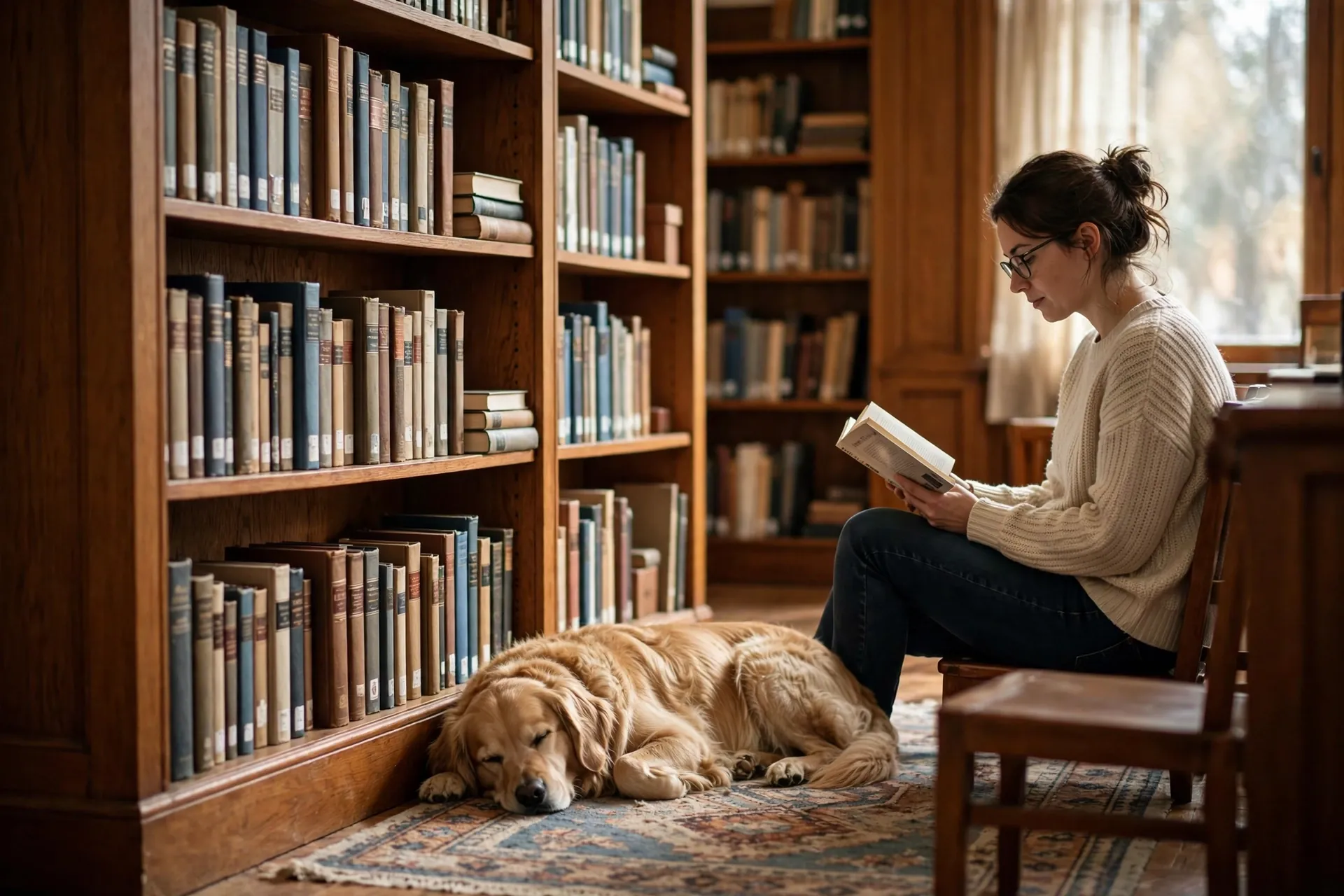
Where public libraries do admit dogs, the permission is usually partial rather than whole-building. Common patterns include dogs welcome in the entrance lobby and community room but not on the silent study floor; dogs welcome throughout the lending library but not in the children's library; or dogs welcome at any time except during school holiday activities and rhyme time sessions. Some services allow dogs only when they are carried, which in practice excludes medium and large dogs. Others require the dog to remain on a lead at all times and to lie under a table rather than wander between shelves. A few libraries run specific dog-friendly hours or events, such as a weekly reading session where children read aloud to a calm dog, and those events are the exception to an otherwise no-dogs rule rather than evidence that the branch is dog-friendly all week.
Size and layout matter more than policy wording. A small branch with a single open room, a carpeted floor and a staff desk in sight of the door can watch a dog easily and intervene quickly. A multi-floor central library with quiet zones, computer suites, meeting rooms and a cafe spread across levels cannot supervise a dog in the same way, so it tends to be stricter. If you are choosing between branches, the smaller and more open-plan branch is usually the better bet for a first visit, and a branch with a cafe or community area gives you a natural fallback: if the study floor is off limits, you can still sit with the dog in the social space and browse the new-books display.
Public libraries also have to balance competing access needs, and this is where a dog owner's courtesy matters most. A reader with a severe dog allergy, a child who is frightened of dogs, or a person using a wheelchair who needs a clear aisle all have as much right to the space as you do. Staff are entitled to ask you to move, to keep the dog close, or to leave a particular area if another user's needs conflict with yours. Accepting that gracefully, without debate, is what keeps a discretionary welcome alive. The branches that stay dog-friendly are almost always the ones where dog owners police themselves before staff have to.
One more practical point about public libraries: opening hours and staffing have changed a great deal in recent years, with some branches operating unstaffed or self-service hours. During unstaffed hours, a dog policy may be stricter or simply unenforced, but that is not permission. If a branch is unstaffed, the responsible choice is to follow the published rule and, if there is none, to leave the dog at home. A dog left to wander an empty library while you browse the shelves is a safety and security problem, not a quiet victory for dog owners.
University libraries: expect a stricter door
University libraries are the least promising place to take a pet dog, and it is better to expect a refusal than to plan around an exception. Most university libraries restrict entry to students, staff and registered visitors in the first place, and their dog policies are usually written for that academic audience. During term time, and especially during revision and examination periods, the library is a high-pressure study environment where a single bark can derail dozens of students. Universities therefore tend to prohibit pet dogs outright, with assistance dogs as the clear and lawful exception.
There are exceptions, and they are worth understanding because they show how universities think about the issue. Some universities run organised wellbeing events in which a registered therapy dog visits the library during exam season, under supervision, in a designated room, for a fixed period. Those events are sometimes reported in the press as "the university library allows dogs", which creates the misleading impression that any student can bring a pet dog on any day. They cannot. The therapy dog is invited, insured, assessed and supervised, and the event is separate from normal library access. Similarly, a university may allow a dog in a students' union building or a campus cafe while prohibiting dogs in the library itself, so a dog-friendly campus is not the same as a dog-friendly library.
If you are a student or a member of staff, the route to an answer is your university's library regulations, usually published on the library website under visitor information or regulations. Search for the animal or pet clause before you ask at the desk, because desk staff during exam periods are dealing with seat shortages and noise complaints and will give you the short answer. If you are a member of the public hoping to use a university library as a visitor, check whether public access exists at all before worrying about the dog: many university libraries offer reference-only access, day passes or alumni membership, and each of those categories may carry different conditions. A public visitor with a dog is, in practice, the lowest priority for an exception.
Postgraduate researchers and visiting academics sometimes ask whether a dog can wait quietly while they consult a special collection. The honest answer is that special collections reading rooms, with their rules about bags, pens, food and drink, are the least likely rooms in any library to admit a dog. The risk to unique material, the need for silence, and the presence of invigilators all point the same way. If your research requires a special collection, plan the visit without the dog, and use the time to photograph catalogue entries or request digital surrogates where available. Check the official guidance before you travel, because individual universities do revise their regulations, and a policy that was strict five years ago may now include a defined exception for a specific building.
For dog owners who live near a university, the practical alternative is usually the public library a short walk away. University towns almost always have both, and the public branch is far more likely to have a workable dog policy. Save the university library for dog-free research days, and treat any campus cafe that welcomes dogs as the social part of the trip instead.
Community libraries: small rooms, personal decisions
Community libraries occupy a middle ground that is often the most rewarding for dog owners, precisely because the decision is personal. These are libraries run wholly or partly by volunteers, sometimes in a village hall, a former council branch, a church room or a shop unit, often under a partnership agreement with the local authority. Because the team is small and the regular visitors are known by name, a community library can make a judgement about a particular dog that a large central library cannot. A calm, familiar dog that lies quietly while its owner chooses books may be welcomed without any formal policy ever being written.
That informality cuts both ways. A community library may welcome dogs on a Tuesday when the regular volunteers are on duty and decline them on a Saturday when a different team is running a children's craft session. A new volunteer may not know that the previous team allowed dogs, and a complaint from one regular reader may change the practice overnight. None of this is unfair; it is what a volunteer-run space looks like. The way to handle it is to ask politely on each visit, to accept the answer for that day, and never to present a previous welcome as a permanent right. Community libraries survive on goodwill, and goodwill is spent quickly by visitors who argue.
Community libraries also tend to have simpler layouts, which helps. A single room with bookshelves around the walls, a table in the middle and a kettle in the corner is easy to share with a dog, provided the dog can settle. Some community libraries keep a water bowl by the door and a jar of treats on the desk, which is a reliable sign that dogs are part of the furniture. Others keep a strict no-dogs rule because the room doubles as a playgroup, a lunch club or a health clinic at different times of day, and animal hair on shared seating is a genuine hygiene concern for those users. Again, the room's other uses decide the answer more than any abstract principle about dogs.
If you are travelling through a village or small town, a community library can be a lovely stop: a quiet place to sit, a local noticeboard, a shelf of local history, and often a volunteer happy to talk about the area. Treat it as a visit to someone's shared living room rather than a public right of entry. Arrive with the dog already toileted, keep the lead short, choose a seat near the door so you can step outside easily, and keep the visit short on a first trip. If it goes well, you have found a regular stop. If dogs are not welcome, thank the volunteers and move on; the village cafe or bookshop may be the dog-friendly alternative, and our guide to dog-friendly bookshops in the UK covers the browsing etiquette that transfers well to a small library room.
Assistance dogs and the law: a different category entirely
Assistance dogs are not an exception to a library's dog policy. They are in a different legal category, and confusing the two causes most of the disputes at library doors. Under the Equality Act 2010 in England, Scotland and Wales, and equivalent legislation in Northern Ireland, a service provider that is open to the public must not discriminate against a disabled person, and refusing entry to a person because they are accompanied by an assistance dog is very likely to be unlawful discrimination. This applies to libraries in the same way as it applies to shops, cafes and restaurants. It does not depend on whether the library welcomes pet dogs, and a library with a strict no-pets rule must still admit an assistance dog.
What counts as an assistance dog matters here. The usual examples are guide dogs for blind and partially sighted people, hearing dogs for deaf people, and assistance dogs trained to help with physical disabilities, epilepsy, diabetes alert, autism and psychiatric conditions. The dog will normally be trained by a recognised organisation, will wear a harness or jacket identifying it, and will be highly trained to settle quietly, ignore distractions and work without disturbing others. Staff may ask what tasks the dog performs, but they should not demand a certificate, an identity card or proof of registration as a condition of entry, because there is no single official register that covers every assistance dog. If you use an assistance dog and you are refused entry, the practical steps are to stay calm, to ask for the reason and the name of the person refusing, to ask for the decision in writing, and to follow it up with the library service manager and, if necessary, with an equality advice service. Our guide to assistance dog rights in the UK sets out the position in more detail, including what to do if a refusal happens.
There is a distinction that pet dog owners should respect: a dog that provides comfort or emotional support, but has not been trained to perform specific tasks related to a disability, is not an assistance dog in law, even if it is well behaved and even if it wears a vest bought online. Libraries are entitled to treat such a dog as a pet for admission purposes. Claiming assistance dog status for a pet dog undermines the access rights of people who genuinely depend on their dogs, and staff who have been misled in the past become more suspicious of everyone. If your dog is a pet, present it as a pet, ask politely, and accept the answer.
For libraries, the sensible approach is training: front-desk staff should know the difference between a pet and an assistance dog, should know not to distract a working dog by talking to it or offering food, and should know that an assistance dog may need a water bowl and a toilet break without the handler being treated as a problem. For dog owners generally, the lesson is simpler: never challenge a library's pet policy by invoking assistance dog law unless it genuinely applies to you, and never distract a working assistance dog you meet in a library. A working dog that misses an alert because a stranger fussed over it has been put at risk, and its handler has been put in difficulty, in the quietest room in the building.
Quiet-room etiquette: how to be invisible
A library visit with a dog succeeds or fails on etiquette, and the standard is higher than in a cafe or a pub. In a cafe, a dog that sighs, shifts position or gives a short bark is background noise. In a silent study room, the same sounds are the only sounds, and every reader hears them. The goal is therefore not a dog that is merely well behaved, but a dog that is effectively invisible: lying still, breathing quietly, making no contact with strangers, and leaving no trace behind.
Start before you enter. Walk the dog properly first, so that the visit is not the dog's first outing of the day and pent-up energy does not arrive with you. Offer a toilet break immediately before entering, and carry bags for the return journey. Choose a time when the library is quieter if you have a choice: mid-morning on a weekday is usually calmer than Saturday afternoon, and the hour before closing can be peaceful but rushed, which is a poor combination for settling a dog. Avoid the first visit being a long one. Twenty minutes of calm browsing that ends well is worth far more than an hour that ends with the dog whining at the door.
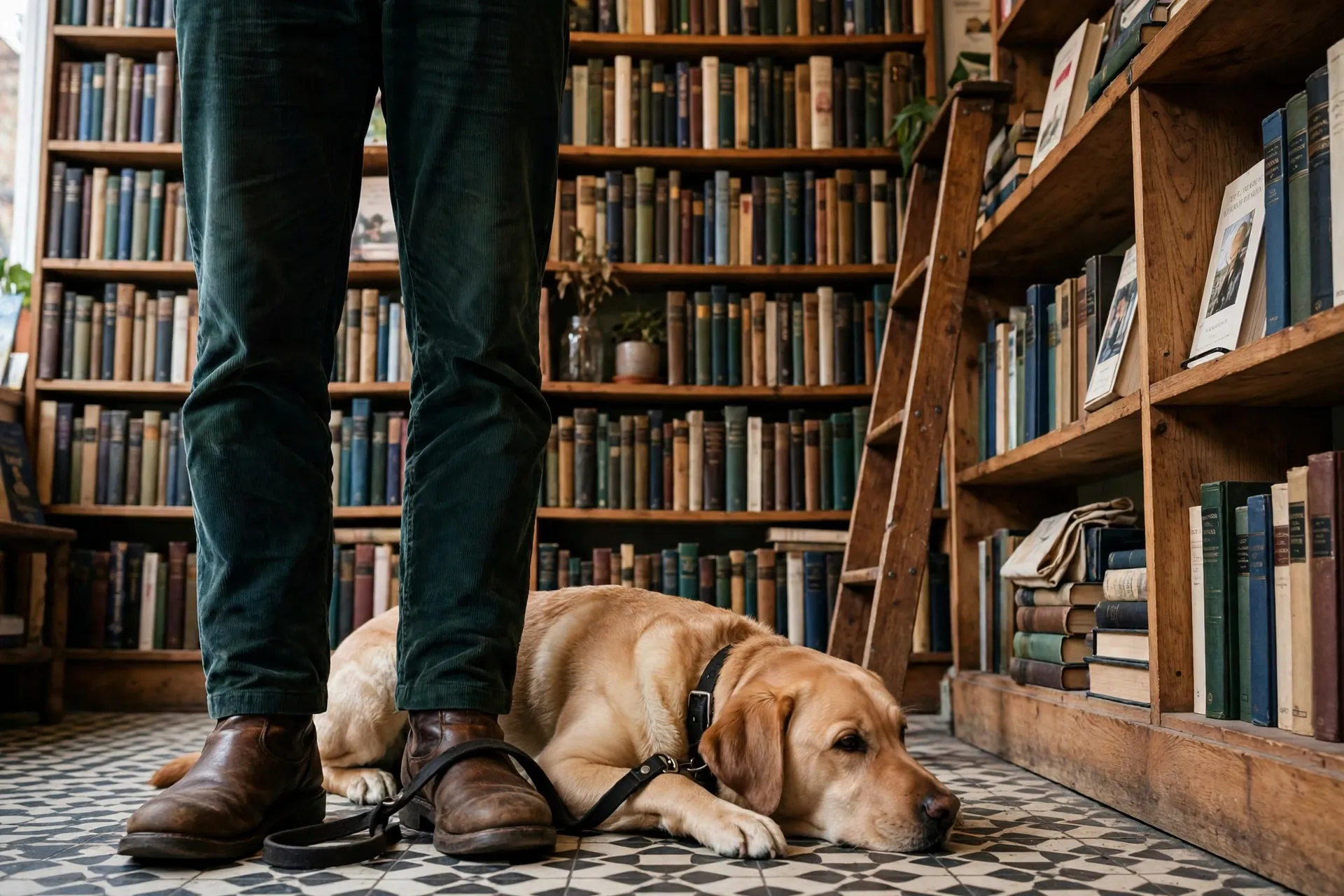
Inside, the details matter. Keep the lead short and under your foot or hand, so the dog cannot wander to the next table or nose a stranger's bag. Choose a seat at the edge of the room, near the door, where you can leave quickly and where the dog is not in the main traffic flow. Place a familiar mat or blanket under the dog: it gives the dog a defined place, protects the carpet, and signals to staff that you have thought about the visit. Do not feed the dog in the library, do not offer treats to other people's dogs, and do not let the dog greet strangers, however friendly the stranger seems. A library is not a socialisation opportunity. If a child approaches, smile, keep the dog still, and let the parent decide whether contact is welcome.
Noise is the line that cannot be crossed. A single bark, a whine, a bout of scratching or a lead jangling against a metal chair leg will draw attention in a quiet room. If any of it happens, leave the room at once, calmly and without fuss. Do not apologise at length to the whole room, do not scold the dog loudly, and do not hover in the doorway hoping the dog will settle. Step outside or into the lobby, let the dog calm down, and decide whether a shorter return is sensible or whether the visit is over for today. Staff notice this response. A dog owner who leaves promptly after a noise is someone staff will welcome back. A dog owner who waits for a second complaint is someone staff will remember for the wrong reason.
Cleanliness is the second line. Brush the dog before the visit if it moults heavily, wipe muddy paws at the door, and carry a lint roller if your dog sheds onto seating. Never allow the dog onto chairs, sofas or study desks, even if the furniture looks informal. If the dog has an accident, clean it thoroughly, tell staff honestly, and offer to pay for any cleaning. Accidents happen, and honesty about them is far better than a stain discovered later. The same applies to damage: a chewed book spine or a scratched chair leg should be reported, not hidden on the shelf.
Researching with a dog: making the visit useful
A library visit is only worth the effort if you can actually get something done, and a dog changes how you work. The most successful approach is to treat the visit as a short, focused task rather than an open-ended study session. Decide before you arrive what you need: three specific titles, a local newspaper archive enquiry, a printing job, or a browse of the new non-fiction shelves. Use the library's online catalogue from home to check availability, reserve items where possible, and note shelf locations, so that your time inside is spent collecting rather than searching. Many library services also offer click-and-collect, which lets you order online and pick up at the desk in minutes: an ideal option when the dog can only settle for a short period.
Computers, printers and study desks need a different plan. A dog cannot be left unattended while you queue for the printer or visit the microfilm reader, and a dog lying beside a computer workstation may block an aisle or distract neighbouring users. If your task requires a computer, book a session in advance where possible, choose a terminal near the edge of the room, and keep the session short. If you need to print, ask whether staff can hold your printing while you step outside with the dog, or print in two short stages rather than one long one. For extended study, the honest answer is usually that the library is the wrong venue with a dog: work from home or from a dog-friendly workspace for the long session, and use the library for the short, specific tasks it does best.
Local history and reference collections deserve special care. Many libraries hold local newspapers, maps, photographs and archives that cannot be borrowed, and the reading rooms for those collections often have the strictest rules: no bags at the table, no pens, no food or drink, and no animals except assistance dogs. Do not assume that a general dog-friendly policy extends to the archive room. Ask specifically, and if the answer is no, use the library's enquiry service instead: staff can often answer a local history question by email, copy a specific article, or arrange a dog-free appointment for you on another day. The same logic applies to rare books and special collections in university libraries, where the reading room rules are set by conservation needs rather than by general visitor policy.
Children's research and homework visits need their own plan. If you are bringing a child and a dog together, the dog adds a layer of supervision that can make homework help harder, not easier. Keep the visit short, give the child a defined task, and sit where you can see both the child and the dog without moving. School holiday periods are the worst time for a dog visit to a children's library: story sessions, craft tables and summer reading challenges fill the room, and staff will reasonably ask dogs to stay away. Term-time weekday afternoons, when the children's library is quiet, are far more workable.
Finally, think about what you carry. A library visit with a dog works best with light luggage: a small bag, a book or two, a phone for catalogue searches, and the dog's mat and water bottle. A large rucksack, a laptop, a coat, a shopping bag and a dog lead together create a pile that spreads across a table and annoys neighbouring readers. Travel light, keep your belongings under your table, and remember that the dog's comfort items count as luggage too. A tidy table is part of quiet-room etiquette, not a separate concern.
Checking before you go: the four questions
The single most useful habit in this guide is a two-minute check before every library visit, even to a branch you have visited before. Policies change, rooms close for events, and a branch that welcomed dogs last month may be hosting a children's reading challenge this week. The check costs almost nothing and saves the most common failure: arriving with a dog, being refused at the desk, and having no plan B.
Start with the library service website. Search for the service name plus terms such as "visitor rules", "dogs", "animals" or "code of conduct". Some services publish a single visitor policy covering all branches; others publish branch pages with local notes. If the website says nothing, check the branch's social media page, where staff sometimes answer dog questions informally, and check recent visitor reviews, which occasionally mention dogs. Treat all of these as hints rather than proof. The proof is a direct answer from the branch, by phone or email, and it is worth getting for a first visit to any branch.
When you contact the branch, ask four specific questions, and note the answers with the date and the name of the person who answered. First, are pet dogs admitted at all, or only assistance dogs? Second, which areas may a dog enter, and which are excluded? Third, must the dog remain on a lead, and is there any size or breed condition? Fourth, does the rule change during children's events, exam periods or busy times? Those four answers tell you almost everything you need, and they show staff that you are a serious visitor rather than someone hoping to slip a dog past the desk. If staff seem unsure, ask them to check with a manager rather than accepting a guess; a guess that turns out to be wrong helps nobody.
Also check the journey, not just the destination. Is there somewhere safe to park or tie up briefly if the answer turns out to be no? Is there a nearby green space for a toilet break before and after the visit? Is there a dog-friendly cafe nearby where you can wait if one person goes inside alone? A library visit that fails gracefully, with a nearby cafe and a park as fallback, is a pleasant outing. A library visit that fails with no fallback, in rain, with a restless dog, is a miserable one. Our guide to dog friendly cafes in the UK is a useful companion here, because a cafe stop before or after the library turns a short library visit into a proper day out.
One caution about online information: a library's dog policy may be described on a third-party listings site, a blog or a social media post that is years out of date. Policies do change, sometimes because of a single incident, sometimes because a new manager takes over, sometimes because the building changes use. A blog post from three years ago saying a library is dog-friendly is not a promise. Check the official guidance before you travel, and if the official guidance is silent, phone the branch. The two minutes you spend checking are the difference between a welcome and a refusal.
Settling your dog inside: the first five minutes
The first five minutes inside a library decide the whole visit. Dogs read new environments quickly, and a library smells, sounds and looks unlike anywhere else: polished floors, paper dust, the hum of computers, strangers sitting still for long periods, and the peculiar stillness of a room where nobody talks. A dog that arrives over-excited will take far longer to settle than a dog that arrives tired, toileted and familiar with the routine. Build a small arrival ritual and repeat it every time, so that the library becomes a known place rather than a new excitement.
Begin outside. Give the dog a proper walk and a toilet break, then spend a few minutes in a calm spot near the entrance, letting the dog sniff and watch people come and go. Enter during a quiet moment rather than pushing through a crowd at the door. Walk directly to your chosen seat, without touring the shelves or greeting other visitors, and settle the dog on its mat before you do anything else. Offer a small drink of water, place the lead where it cannot tangle a chair leg, and sit down yourself. Dogs settle when their owner settles, so opening a book and reading calmly for a few minutes is more effective than fussing over the dog or repeatedly telling it to lie down.
Choose your seat with the dog's temperament in mind. A confident, social dog does better in a corner where strangers cannot approach from behind. A nervous dog does better near the door, where it can see the exit and where you can leave quickly. A dog that watches other dogs does better away from the entrance, where other dogs pass less often. Avoid seats beside the children's area, beside the photocopier queue, or in the middle of a study table where the dog is surrounded on all sides. A window seat can help if the dog likes watching the street, but it can also increase barking at passers-by, so judge your own dog honestly.
Watch for the early signs that the visit is not working: panting, lip licking, yawning, pacing, whining, staring fixedly at other visitors, or repeatedly standing up. These are stress signals, not naughtiness, and they mean the dog needs a break. Step outside for five minutes, offer water, walk around the block, and reassess. Sometimes a short break resets the visit completely. Sometimes it confirms that today is not a library day, and the kindest choice is to go home or to the park instead. Forcing a stressed dog to remain in a silent room, in the hope that it will eventually give up and sleep, is unfair to the dog and to every other reader.
Young dogs, puppies and recently rehomed dogs deserve particular patience. A puppy that has never been in a quiet public building may find the stillness itself unsettling, and a rescue dog may need several short, successful visits before it can settle for half an hour. Build up gradually: a five-minute visit to collect a reserved book, then a ten-minute browse, then a longer sit. Reward calm behaviour quietly, with a calm word rather than an excited treat session, and end every visit while it is still going well. A library is a training goal, not a first outing, and the dogs that succeed in libraries are usually the ones whose owners built up to it slowly.
Children, events and busy times
Children's areas and library events change the dog calculation completely, and dog owners should plan around them rather than through them. A children's library during rhyme time, story time or a holiday craft session is a noisy, fast-moving, food-scattered environment where a dog is an additional complication for staff who are already supervising twenty children. Even a library that welcomes dogs during quiet hours will usually exclude them from these sessions, and that exclusion is reasonable. Children may run up to a dog without asking, may drop food that a dog will try to eat, or may be frightened by a dog they did not expect. Staff cannot supervise both a craft activity and a visiting dog at the same time.
Reading-to-dogs programmes are the notable exception, and they deserve a mention because they confuse many owners. In these programmes, a trained therapy dog visits the library so that children can practise reading aloud to a calm, non-judgemental listener. The dog is selected, assessed and insured for the role, the sessions are scheduled, and the handler is present throughout. They are not an invitation to bring your own dog to the next story session, and they do not mean the library is dog-friendly in general. If your child would benefit from such a programme, ask the library whether it runs one, and respect the distinction between a programme dog and a pet dog.
Busy times beyond children's events also matter. Exam periods in university towns, school holiday weeks, author talks, local history exhibitions and community meetings all fill a library with people who did not expect a dog and may not want one nearby. If you visit during an event, check whether the event itself changes the dog rule: an author talk in the community room may be dog-friendly while the study floor remains dog-free, or the whole building may be no-dogs for the duration of the event because of crowd management. When in doubt, visit on a plain weekday and save event days for dog-free trips.
School visits are another busy-time factor. A class of thirty children arriving for a library induction will transform a quiet branch in minutes, and a dog that was settled five minutes earlier may become excited or anxious. If a school group arrives during your visit, the courteous move is to leave the main room with the dog until the group has settled, or to cut the visit short. Staff will remember the courtesy, and your dog will not have to cope with a sudden crowd.
Seasonal patterns complete the picture. Summer reading challenges, winter holiday activities and half-term programmes all increase children's footfall, while January and February are often the quietest months in a public library. If you are planning a first dog visit to a new branch, a quiet weekday in a quiet month gives you the best chance of a calm introduction. A first visit during the summer reading challenge gives you the worst. Timing is not a detail in library etiquette. It is half the plan.
If dogs are not allowed: good alternatives
A refusal at the library door is not the end of the outing, provided you planned for it. The simplest alternative is the library's own remote services, which have improved enormously: online catalogues, e-book and audiobook lending, reservation and click-and-collect, online reference enquiries, and digital newspaper and magazine access. Many people discover that the book they wanted from the library can be reserved online and collected in a two-minute visit, which is far easier with a dog waiting outside for a moment than a long browsing session inside. If one person is travelling with another, taking turns to go inside while the other waits with the dog outside is a practical solution, provided the dog is never left tied up alone.
Never leave a dog tied outside a library while you go in. It is tempting when the visit will only take five minutes, but five minutes is long enough for a dog to be stolen, to become distressed, to chew through a lead, or to trip a passer-by. Some libraries will also move or report an unattended dog, and a dog that barks continuously outside the door disturbs readers inside just as effectively as a dog inside. If you are alone with the dog and dogs are not admitted, use click-and-collect, ask staff whether they can bring a reserved item to the door, or return another day without the dog. The inconvenience is real, but it is smaller than the risk of leaving a dog alone in a public place.
The wider outing can still work. A library that does not admit dogs is often near a bookshop that does, and browsing a bookshop with a dog, then borrowing from the library on a dog-free day, gives you both experiences without breaking any rule. A nearby park gives the dog its exercise, a cafe gives you both a rest, and a market or high street walk fills the rest of the day. The point of a dog-friendly outing is not to force every venue to admit the dog. It is to build a day in which the dog is welcome in most places and comfortable waiting during the exceptions, with no long, boring waits in a car or tied to a railing.
If you feel strongly that your local library should welcome dogs, the constructive route is a polite suggestion, not a confrontation at the desk. Write to the library service manager, explain that you are a regular borrower, describe how your dog behaves in quiet public spaces, and ask whether a trial period or a designated dog-friendly area could be considered. Libraries do change policies in response to polite, specific requests, especially when dog owners offer to follow clear conditions. What does not change a policy is an argument in the entrance hall, a complaint posted online before speaking to staff, or repeated attempts to bring a dog in after a refusal. Those approaches make staff defensive and make the next dog owner's visit harder.
Finally, keep perspective. Libraries are one part of a dog-friendly life, not a test of it. A town with a strict library, a welcoming bookshop, a dog-friendly cafe and a good park is a good town for a dog owner. The library's silence is part of what makes it valuable, and protecting that silence, even at the cost of leaving the dog at home for one visit, is a reasonable trade. Check the official guidance before you travel, plan a short visit, follow the room's etiquette, and you will find that many libraries are more welcoming than their reputation suggests, provided the dog is as quiet as the room requires.
Practical questions
Before you go
Are dogs allowed in UK libraries?
There is no national rule. Each library service, university or community library sets its own policy, so some welcome well-behaved dogs, some allow them only in certain areas, and some do not admit pet dogs at all. Check the official guidance before you travel, and confirm the rule for the specific branch you plan to visit.
Do assistance dogs have a right to enter a library?
Yes. Assistance dogs are not treated as pets under equality law, and a library that is open to the public should not refuse entry to a disabled person accompanied by an assistance dog. Staff may ask what tasks the dog performs, but they should not demand a special certificate as a condition of entry. If you are refused, ask for the reason in writing and check the official guidance before you travel.
Which parts of a library are most likely to allow dogs?
Entrance areas, community rooms, cafes and event spaces are more likely to allow dogs than silent study floors, local history archives and children's story sessions. Where a library does welcome dogs, the permission often comes with conditions: keep the dog on a short lead, stay out of quiet study zones, and leave promptly if the dog becomes noisy.
What should I do if my dog barks in a library?
Leave the quiet area calmly and immediately, without scolding the dog loudly or trying to wait it out. Settle the dog outside or in a lobby, offer water, and only return if the dog is fully calm and the visit is short. Repeated barking in a silent room is the fastest way for a dog-friendly policy to be withdrawn.
Can I leave my dog tied outside a library while I go in?
It is not recommended. A dog left alone outside a public building can be stolen, can become distressed, can block a pavement, and may be moved by staff if it causes an obstruction. If dogs are not admitted, use the library's online catalogue, click-and-collect service or a short visit by one person at a time instead.
How do I check a library's dog policy before visiting?
Search the library service website for its visitor rules, check the branch page for a pet or animal notice, and phone or email the branch if nothing is published. Ask four things: whether pet dogs are admitted, which areas they may enter, whether a lead is required, and whether the rule changes during children's events or exams.