This guide is independent and contains no paid placement. Store policies change; where this guide is uncertain it says so and advises you to check the store's latest policy.
No — pet dogs are not allowed inside UK supermarkets. Tesco, Sainsbury's, Asda, Morrisons, Aldi, Lidl, Waitrose, M&S Food and Co-op all admit assistance dogs only, for food hygiene reasons. Use click-and-collect, or leave your dog at home — never the food aisles.
Start with the table: nine chains, one pattern
Most dog owners do not need a lecture on food hygiene. They need a straight answer before they set off: can the dog come in, yes or no, at the shop they actually use? The table below answers that for the nine chains most people in Britain shop at weekly. Read it row by row for your usual store, then read the notes underneath, because the interesting detail is not in the headline answer — it is in the exceptions column, where garden centres, outdoor seating and collection points occasionally change what is practical, even though they never change the rule for the food hall itself.
| Chain | Pet dogs inside? | Assistance dogs | Worth knowing |
|---|---|---|---|
| Tesco | No | Welcome | Large stores sometimes have a separate cafe operator and an attached garden centre with its own entrance; neither opens the food aisles to pet dogs. Check the store's latest policy for the specific branch. |
| Sainsbury's | No | Welcome | Consistently assistance-dogs-only across superstores and Local formats. Habitat and Argos concessions inside a store follow the host store's rule at the door. |
| Asda | No | Welcome | Assistance-dogs-only. Click-and-collect lockers and collection bays are outside the sales floor, which makes Asda collection one of the easier workarounds with a dog in the car. |
| Morrisons | No | Welcome | Assistance-dogs-only, including Market Street fresh counters where open food makes staff particularly strict. Some stores have outdoor cafe seating in summer; confirm locally. |
| Aldi | No | Welcome | Assistance-dogs-only, with no in-store cafe or seating to create a grey area. Small car parks mean waiting outside puts a dog close to trolley traffic. |
| Lidl | No | Welcome | Assistance-dogs-only, same compact format as Aldi. No collection service at most branches, so home delivery or shopping without the dog is usually simplest. |
| Waitrose | No | Welcome | Assistance-dogs-only. A minority of branches are within garden centre sites or share entrances with non-food retail; the food hall rule still applies once you cross into food areas. |
| M&S Food | No | Welcome | Foodhalls are assistance-dogs-only. Larger M&S stores with clothing and home departments apply the same door policy throughout the store for simplicity; do not assume non-food floors are an exception — check the store's latest policy. |
| Co-op | No | Welcome | Assistance-dogs-only across the various regional Co-op societies. Small village stores are the ones owners most often ask about, because the dog is known locally, but familiarity does not change the policy. |
Three things stand out from the table. First, there is no permissive outlier to hunt for: no major chain has decided to welcome pet dogs into food areas, so forum posts claiming that one branch turned a blind eye describe an individual member of staff being lenient on one day, not a policy you can plan around. Relying on leniency is a poor plan because the next visit, a different shift, or a complaint from another customer ends it, and being asked to leave mid-shop with a full trolley is far more stressful than planning honestly from the start. Second, the rule is applied at the door of the whole store in most formats, not aisle by aisle, so a dog cannot wait just inside the entrance, in the foyer, or in the trolley bay either, even though those areas feel like neither inside nor outside. Third, every chain makes the same single exception, for assistance dogs, and that exception is not a loophole: it exists because the law requires it, which the next sections explain.
A note on smaller shops, because the question often follows. Independent convenience stores, farm shops and village stores set their own policies, and a meaningful minority do welcome dogs, particularly where the owner knows customers personally and food is packaged rather than open. That is a genuine difference, not an inconsistency: a small shop can make its own risk assessment, while a national chain applies one auditable standard everywhere. If a local shop welcomes your dog, enjoy it, keep the dog on a short lead away from counters and other customers, and do not treat that welcome as evidence that the supermarket down the road should do the same. Conversely, a small shop that refuses dogs is within its rights and is usually following its insurer's or environmental health adviser's guidance rather than being difficult.
Why food shops say no: hygiene, law and insurance
Understanding the reasoning matters because it tells you which requests are reasonable and which will never succeed. Supermarkets refuse pet dogs for three overlapping reasons, and only one of them is a direct legal prohibition. The first is food safety management. Food businesses in the UK must operate under food hygiene law, including the Food Safety and Hygiene (England) Regulations 2013 and equivalent rules in Scotland, Wales and Northern Ireland, and must run documented hazard controls. Animals in food areas are a recognised contamination risk: hair, paws that have walked pavements, and the simple possibility of a dog shaking, toileting or snapping at food create hazards that a store would have to control and evidence. Banning pet animals from food areas is the simplest control, and environmental health officers expect to see it. Open food raises the stakes further, which is why bakeries, delis, fish and butcher counters, salad bars and in-store cafes serving unwrapped food are the areas staff guard most carefully.
The second reason is consistency and fairness at scale. A chain with hundreds of stores cannot ask each manager to judge which dogs are clean, calm and well handled enough to come in. Any discretionary system collapses the first time a wet, muddy or reactive dog is admitted and something goes wrong, and it puts front-line staff in the position of arguing about individual dogs at the door. A single clear rule — assistance dogs only — is enforceable, trainable and defensible. The third reason is insurance and liability: if a dog in a store bites a child, trips an elderly customer with a trailing lead, or causes a customer with an allergy or a phobia serious distress, the retailer carries much of the argument about whether it should have been there at all. Insurers price that risk accordingly, which quietly reinforces the ban even in stores where the manager personally loves dogs. For owners, the matching question is what your own cover pays if your dog injures someone in a public place — see our guide to dog travel insurance in the UK.
What the law does not do is equally worth knowing. There is no UK law that says a pet dog commits an offence by entering a shop, and no law that requires a shop to admit one either, assistance dogs aside. Shops are private premises: the owner sets conditions of entry, and a customer who refuses to leave after being asked may be treated as a trespasser. That is why arguing about rights at the door goes nowhere, and why the productive question is never “are you allowed to ban my dog?” but “what is the most practical way to get this shopping done?” The rest of this guide concentrates on that second question.
Allergy and phobia concerns deserve a fair mention rather than dismissal. For most customers a dog in the next aisle is a pleasure or a matter of indifference, but for a customer with a serious dog allergy, a young child who is frightened of dogs, or an older shopper unsteady around leads across a floor, a crowded Saturday supermarket is already demanding without an animal weaving between trolleys. Retailers design for the whole customer base, including the most vulnerable people in it. Keeping that in mind makes the rule easier to accept and, frankly, makes dog owners better ambassadors in the many places where dogs genuinely are welcome.
Assistance dogs are different — and the difference matters
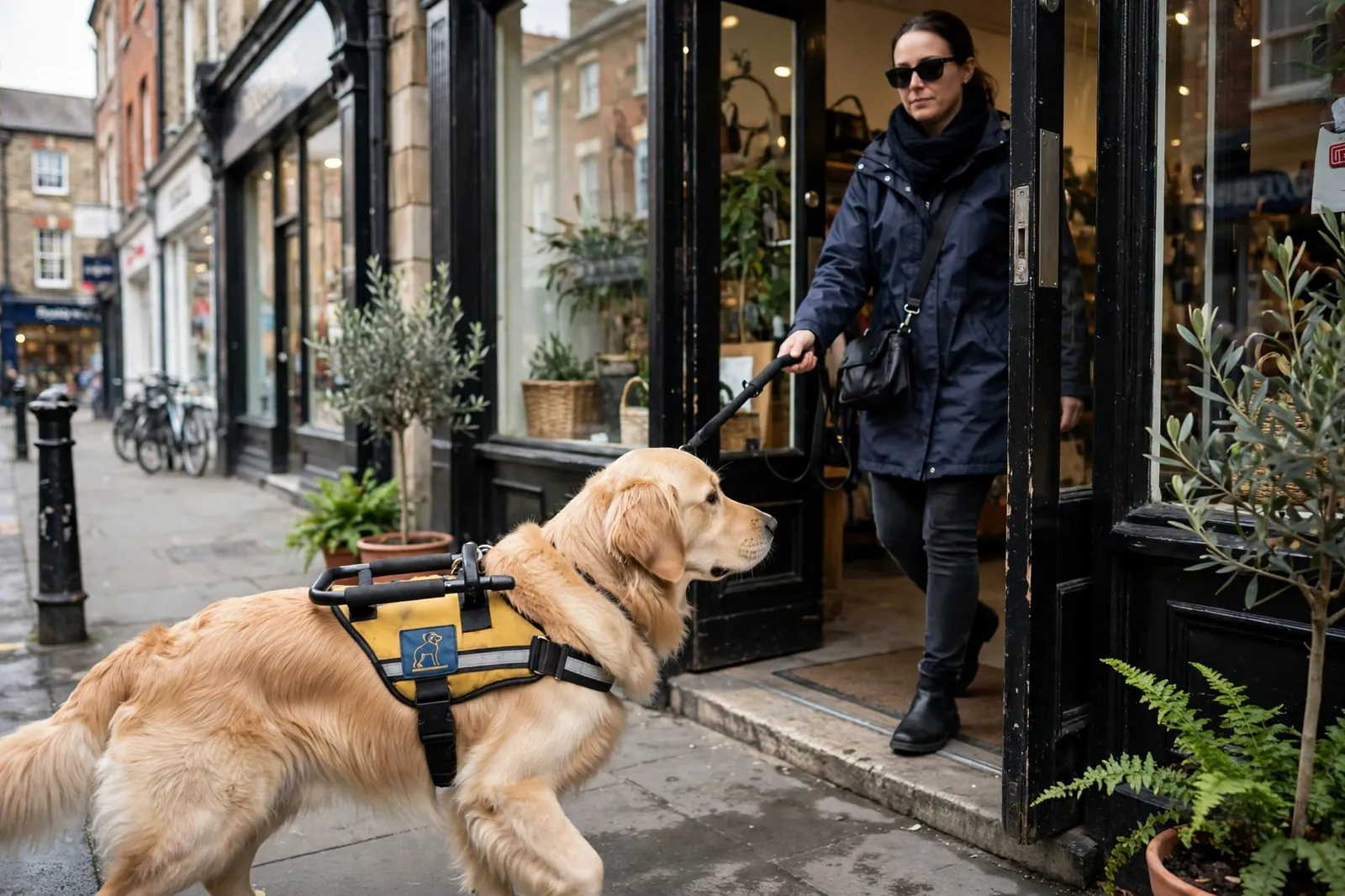
An assistance dog is trained to perform specific tasks that mitigate its handler's disability: guiding a blind person, alerting a deaf person to sounds, detecting medical episodes, providing mobility support, or carrying out trained tasks linked to another condition. Under the Equality Act 2010 in England, Scotland and Wales, and disability discrimination law in Northern Ireland, service providers must make reasonable adjustments and must not refuse a person access because they are accompanied by an assistance dog, charge them extra, or treat them less favourably. Supermarkets are service providers, so assistance dogs are welcome in every chain in the table, in every aisle, cafe and customer area, as a matter of law rather than goodwill. Our full guide to assistance dog rights in the UK covers what to do if access is refused, how access refusals should be reported, and how the rules differ for taxis, housing and other settings, and it is the right next read for handlers and for anyone who supports one.
Two confusions cause most door-step friction, and clearing them up helps everyone. The first is paperwork. There is no single official UK register or ID card that an assistance dog handler must hold, and dogs may be trained by a charity such as those accredited through Assistance Dogs UK, by another organisation, or by the handler themselves. Staff can ask what tasks the dog is trained to perform, and most handlers are happy to explain briefly, but demanding to see a certificate as a condition of entry is not how the law works, and well-trained store teams know this. The second confusion is emotional support animals. In the UK, an emotional support animal has no legal access status: comfort and companionship, however genuine and valuable, do not make a pet dog an assistance dog unless the dog is also trained to perform disability-related tasks. Buying a vest, harness or certificate online does not change the dog's status, and presenting a pet as an assistance dog undermines the credibility of genuine working dogs and can get a store's staff blamed for a problem they did not create. If your dog helps you enormously but is not task-trained, the honest and effective route is the workarounds in this guide, not a costume.
Behaviour expectations still apply. An assistance dog that is out of control, toileting in store or posing a genuine health risk can be asked to leave, just as any customer's behaviour is managed, and handlers overwhelmingly keep their dogs to a very high standard precisely because access matters so much to them. For pet owners, the respectful position is simple: never distract a working dog, never let your own situation borrow its status, and if you witness a refusal, offering calm support to the handler — a name, a witness account of the time — is worth far more than a heated argument on their behalf.
Garden centres, cafes and the grey areas people ask about
If the rule is so clear, why do so many owners report seeing dogs in or around supermarkets? Because modern stores are bundles of different spaces, and some of those spaces genuinely do operate under different rules. Sorting them accurately saves wasted journeys.
Attached garden centres. Several supermarket sites include a garden centre, sometimes a separate national garden brand operating under the same roof or in an adjoining building. Garden centres in Britain very commonly welcome dogs on leads, at least in outdoor plant areas and often throughout, because their product is not open food and their customers shop at a slower pace. Where the garden centre has its own entrance from the car park, its own policy applies from its own door, and taking a dog in through that entrance is entirely legitimate. The boundary is the internal doorway into the food store: a dog welcome among the shrubs does not carry any right through that doorway into the supermarket. Where the only entrance is shared, the stricter rule usually governs the whole route, so check signage at the door and, if it is unclear, check the store's latest policy before entering rather than chancing it.
In-store cafes. Supermarket cafes sit in an awkward middle ground. The cafe sells and serves food, so the hygiene argument applies, and most chains treat the cafe as part of the store for dog purposes: assistance dogs only. Occasionally a cafe is operated by a separate company, has outdoor seating, or has a designated dog area near an external door, and those arrangements can legitimately differ from the store rule. The reliable test is not what another branch does but what is signed at that cafe's entrance on the day. If there is no clear welcome sign, assume assistance dogs only, and if cafe time with your dog is the point of the trip, choose a venue that courts it instead: our guide to dog-friendly cafes across the UK lists the kinds of independent and chain cafes where dogs are part of the offer rather than a tolerated exception.
Pharmacies, opticians and concessions. A pharmacy counter, optician, travel money desk or phone shop inside a supermarket does not create a separate entrance right. You reach them through the store, so the store rule applies on the way in. Standalone high-street branches of the same pharmacy or optician set their own door policies and many are more relaxed, which is why collecting a prescription with a dog is often easier at a standalone branch than at the counter inside a superstore. The same logic applies to petrol station shops attached to supermarkets: the kiosk is a food shop in miniature and applies the same rule, even when the forecourt itself is obviously fine for a dog on a lead.
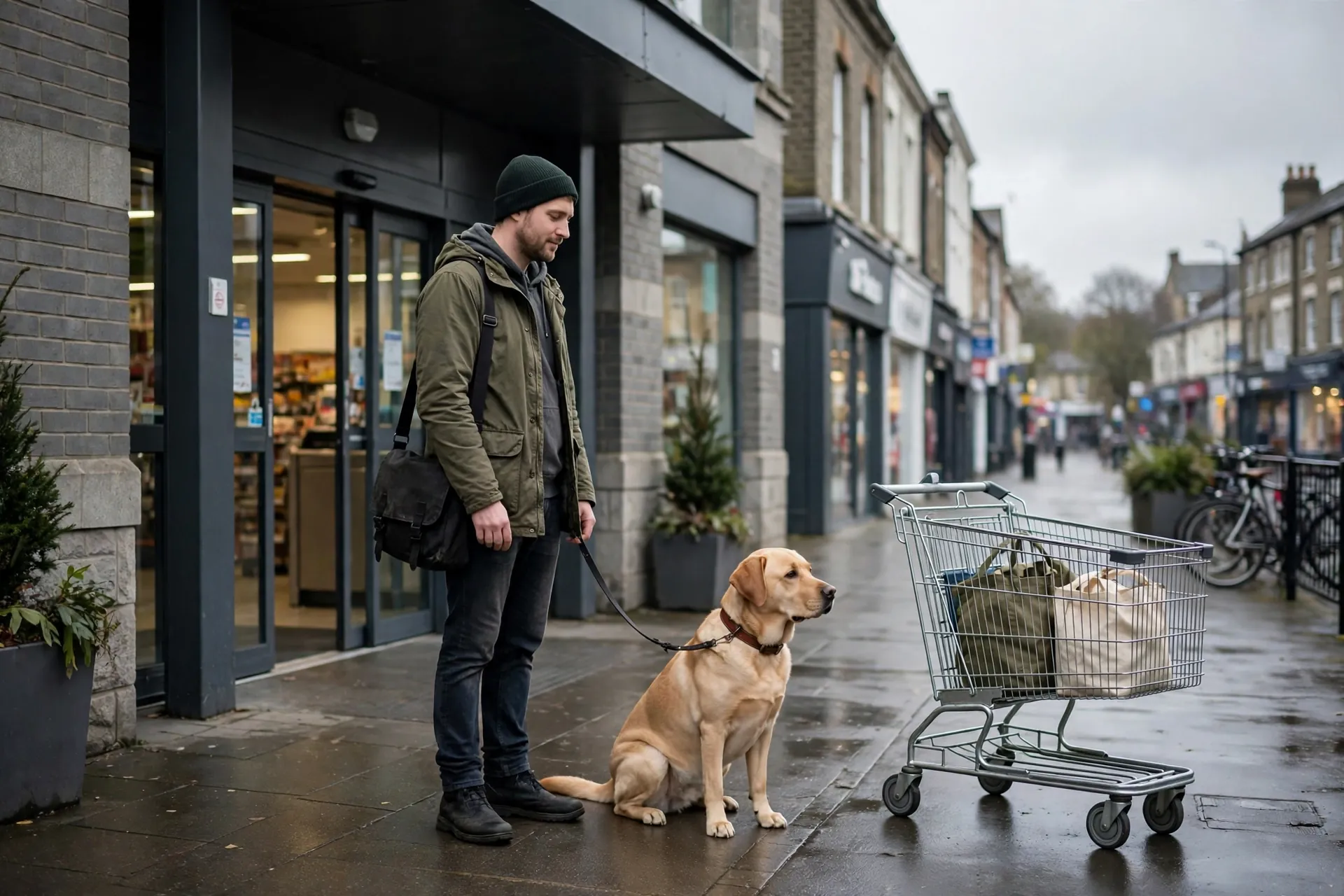
Car parks, trolley bays and outdoor seasonal displays. Outside the store, dogs are generally fine on a lead, and nobody objects to a dog walking across the car park, waiting by the seasonal plant or compost displays outside the entrance, or sitting with a second person by the trolley bays while the first person shops. That last arrangement — one shops, one stays with the dog outside — is the single most common way couples and families handle supermarket trips with a dog in tow, and it works well when the outside wait is short, shaded and away from the busiest trolley routes. It stops working when the wait stretches, the weather turns, or the dog is left alone, which is the subject of the next section.
Leaving a dog outside: theft, weather and stress
The railings outside a supermarket entrance, often with a water bowl nearby, look like an invitation to tie a dog up for ten minutes. Treat them instead as a last resort with known risks, and weigh those risks honestly before deciding that a quick shop justifies them. Dog theft is the risk owners underestimate most. An unattended dog outside a shop is visible, stationary, approachable and advertised to everyone passing, including the small number of people actively looking for dogs to steal for resale or breeding. Charities and police forces consistently identify dogs left outside shops as one of the highest-risk situations in everyday life, and a dog does not need to be a fashionable breed to be taken — though popular breeds and young, friendly dogs are at particular risk. A lead tied to a railing is not security; it unties in seconds, and a frightened dog can slip a collar even faster.
Weather is the second risk, in both directions. In summer, a dog tied in direct sun outside a south-facing storefront can overheat quickly, and the tarmac of a car park radiates heat at exactly dog height; there is no shade to move into because the lead fixes the dog's radius. In winter, a wet dog tied in wind outside an entrance chills fast, especially small, old, thin-coated or unwell dogs, and entrances are draughty places by design. Rain also changes behaviour: a miserable dog whines, barks and lunges at passing legs, which is miserable for the dog, awkward for customers, and the kind of complaint that prompts stores to remove railings and bowls altogether.
The third set of risks is interaction. Outside an entrance, your dog will meet trolleys at close quarters, children who run up before a parent can intervene, other tied dogs within lead range, mobility scooters, delivery riders and dropped food, from grapes and chocolate to cooked chicken bones, all of which are hazards if eaten. A dog that is impeccably behaved on a walk can be a different animal when tied, because tying removes the flight option and many dogs become more defensive when they cannot move away. Add the legal layer — some councils restrict tethering in public places, and a dog that injures someone while tied up is still its owner's responsibility — and the conclusion is steady rather than dramatic: avoid tying a dog outside a supermarket whenever there is any alternative, keep any unavoidable wait to a few minutes within your sight, and never treat the presence of a railing as the store endorsing the practice.
Leaving a dog in the car deserves its own sentence because it is the alternative people reach for. On a mild day, for a very short stop, with windows vented and the car in shade, many dogs settle happily in a familiar car. On a warm day it can become dangerous in minutes, even with windows cracked, and “warm” arrives earlier than owners think: a sunny spring morning is enough. If there is any doubt, the dog stays home. A missed bargain is trivial next to a dog in distress behind glass while strangers debate breaking a window.
Click-and-collect with a dog: the workaround that actually works
Click-and-collect changes the geometry of the problem. Instead of entering the store, you drive to an external collection point, locker bank or designated bay, stay with the car, and staff bring the shopping out or you load it from a locker. The dog never needs to enter a food area, and in most formats never needs to leave the car at all. For a dog owner travelling, staying in holiday accommodation, or simply combining the weekly shop with a dog walk, that makes collection the most practical supermarket option available, and it is worth learning your usual chain's version of it in detail.
The main variations are these. Locker collection, offered by several chains for smaller orders, uses a bank of lockers in the car park or on the store's outer wall: you receive a code, open the locker, and load the car. It is fast, contact-light and entirely outdoors, so a dog on a lead beside you is no problem at all, though keep the dog clear of other customers collecting at the same time. Bay collection, where you park in a numbered bay, check in on an app or by phone, and staff wheel the order out, is even easier with a dog: the dog stays in the car, you load the boot, and nobody queues indoors. Collection from a customer service desk inside the store is the one format that does not solve the dog problem, because it requires entering the store; if that is the only option at a branch, check the store's latest policy, collect without the dog, or choose delivery instead.
A few practical refinements make collection with a dog genuinely smooth. Book a collection slot that follows a walk rather than preceding one, so the dog is exercised and ready to settle in the car. Keep a car routine for collection days: water available, a familiar blanket, windows managed for the weather, and the dog secured in its usual travelling position rather than loose among the shopping bags on the way home, because a boot full of food bags and an unsupervised dog is a combination that ends with an opened packet and, occasionally, something eaten that should not have been. Check chilled and frozen items promptly at the car, since queries are far easier to resolve at the collection point than from home. And remember that collection staff are working to a timed system: having the order number ready, being in the right bay, and keeping the dog from greeting the trolley all make the handover quicker and pleasanter for everyone.
Home delivery removes the question entirely and is the right answer for the big weekly shop in most weeks of the year. Its dog relevance is at your own front door rather than the store: brief the delivery driver via the order notes if your dog is nervous of visitors, put the dog behind a door or gate before opening up, and keep the hallway clear so crates can come in without a lead tangling around them. Owners who combine strategies — delivery for the heavy weekly shop, collection for top-ups while out with the dog, and dog-free trips for anything that requires browsing — almost never find the supermarket ban an actual obstacle. It only bites when every trip is unplanned and the dog is simply always in the car.
Dog-friendly alternatives: shop where dogs are part of the plan
The most enjoyable response to the supermarket rule is not to fight it but to shift the shopping that can be shifted towards places that actively welcome dogs, and to enjoy those places properly. Britain has a deep bench of them. Independent pet shops are the obvious start: dogs are not merely allowed but expected, often weighed, fitted and fussed over, and staff advice on food, harnesses and chews is usually excellent. Garden centres, as noted above, are broadly dog-friendly and make a genuine outing of buying plants and pots. Farm shops vary — many welcome dogs in outdoor areas and some throughout, but those serving open food indoors may restrict dogs to a terrace, so check the store's latest policy on their website before a special trip.
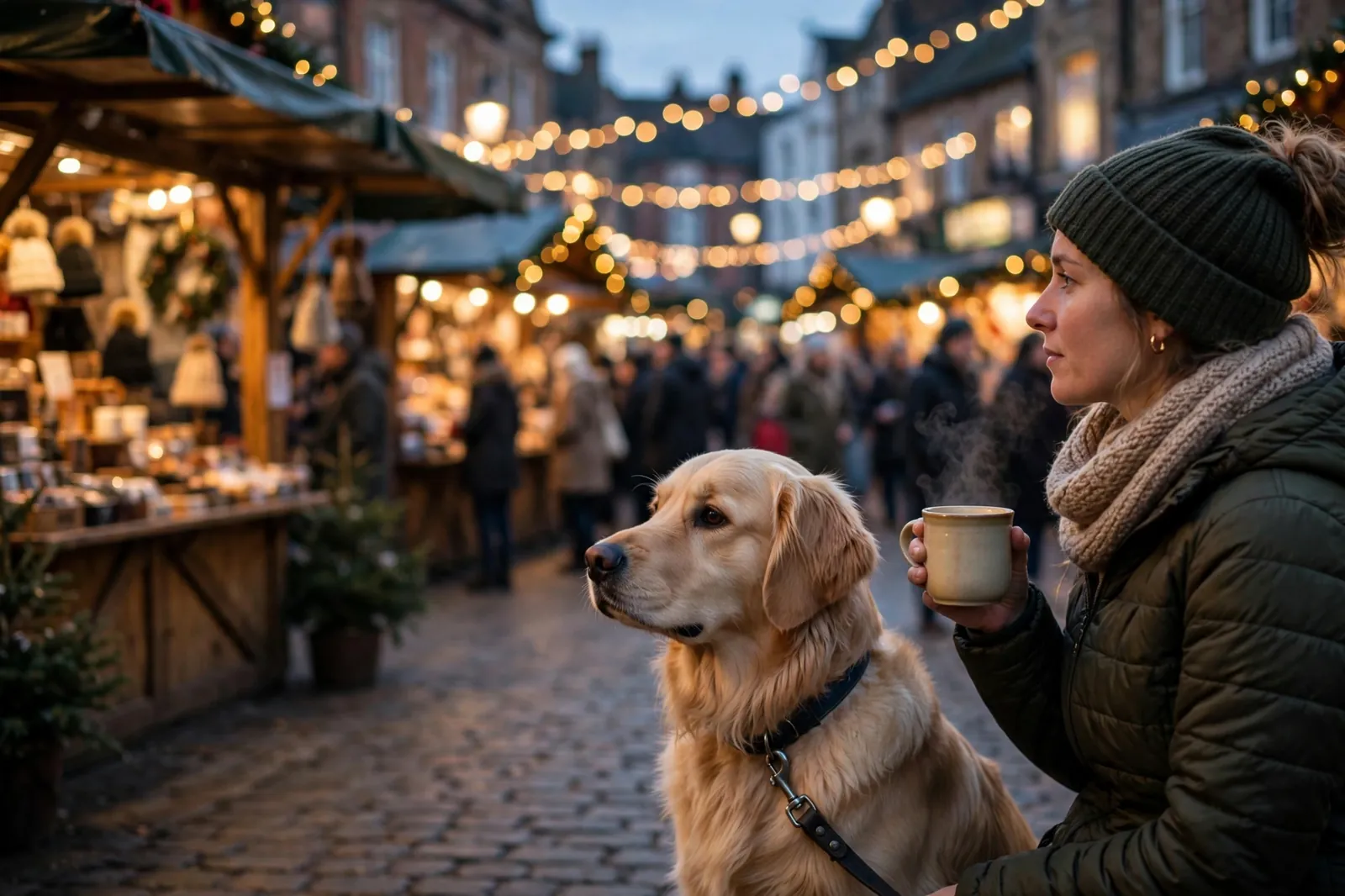
Markets deserve special emphasis because they suit dogs so well when chosen carefully. Outdoor farmers' markets, craft markets and car boot sales are usually open to dogs on leads, with space to step aside, water bowls at stalls, and a pace of shopping that allows sniffing breaks. Our guide to dog-friendly markets in the UK explains how to judge whether a particular market will suit your dog, including crowding, surfaces and the midday peak to avoid. The caveats are real: covered food halls within markets often restrict dogs, busy indoor Christmas markets can overwhelm all but the steadiest dog, and dropped food on market ground is a constant scavenging test. Go early, keep the lead short in food rows, and step out to a quieter street whenever your dog's body language says the novelty has stopped being fun.
Beyond food, a wide range of non-food retail welcomes dogs as a deliberate policy, because it brings owners in for longer, unhurried visits. Many outdoor and country stores, bookshops, homeware shops, garden and DIY stores with outdoor yards, and independent high-street shops display a dogs-welcome sign and mean it. Policies still vary branch by branch and can change, so treat any list, including this one, as a prompt to check the store's latest policy rather than a guarantee. The pattern to look for is a business whose product does not involve open food and whose floor space allows a dog to stand aside from other customers: those are the shops that can say yes and keep saying it. When you find them, repay the welcome visibly: short lead, dog under control, muddy paws wiped, accidents cleaned up instantly and reported. Dog-friendly retail survives on owners being easy to host, and every well-behaved dog in a shop is an argument for the next one.
Cafes and pubs complete the picture for a shopping trip that includes a break. A dog-friendly cafe near the shops turns a chore run into a half-day out, and a pub lunch after a market is a well-worn British pleasure. The etiquette that keeps those welcomes alive is consistent everywhere: dogs on the floor, not on seats or laps at tables; no feeding from the table in a way that teaches begging at strangers; water bowls used gratefully and moved out of walkways; and a quick exit if your dog cannot settle, rather than a loud hour that the whole room endures. None of this is onerous, and most owners do it instinctively. It is worth stating only because the contrast with supermarkets is often misunderstood: cafes can welcome dogs because they choose to, manage small numbers, and serve food in a controlled way, while supermarkets cannot, for the scale and hygiene reasons already covered. Both positions are reasonable, and a dog owner's life is better for having both kinds of venue in it.
A calmer shopping routine when the dog is with you
Pulling the threads together, a workable weekly routine for a dog-owning household usually looks like this. The main shop arrives by delivery on a chosen day, with the dog settled in another room for the ten minutes the door is open. Top-up shopping happens in one of two ways: a collection order picked up after a walk, with the dog comfortable in the car and the handover done at an outdoor bay or locker, or a short in-person shop done by one person while another walks the dog nearby, turning the wait into exercise rather than a tether outside a door. Local extras — bread, plants, pet supplies, a present — come from the independent shops, garden centres and markets that welcome dogs, deliberately chosen and genuinely enjoyed. On holiday or away from home, the same system flexes: collection slots booked at the nearest large store to the accommodation, one-person shops while the other explores with the dog, and no reliance on an unfamiliar store being lenient.
Three habits hold the routine together. First, plan the dog's part of the trip before leaving home, every time: where exactly will the dog be during each stop, for how long, in what weather, supervised by whom? If the answer for any stop is improvised, change the stop. Second, keep a short list on your phone of the places near you that have confirmed dog policies — the welcoming pet shop, the garden centre, the cafe with the dog area, the market's dog rules — and update it when policies change, checking the store's latest policy before relying on an old memory for an important trip. Third, be gracious about refusals and quick to leave when asked, even when you believe the member of staff is wrong about their own store's policy. Note the branch and, if it matters, raise it with the chain's customer service afterwards, where policy is actually set and records are kept. The owner who leaves calmly preserves goodwill for every dog that follows; the owner who argues at the till achieves nothing except a worse afternoon.
Finally, a word for owners of young, reactive or newly rehomed dogs, for whom all of this can feel harder than it sounds. Supermarket surroundings — car parks, trolleys, automatic doors, crowds — are advanced environments for a dog still learning about the world. There is no training requirement to expose a dog to them, and a dog that never waits outside a supermarket has missed nothing essential. Build shopping-adjacent confidence in the places designed for it: quiet garden centres on weekday mornings, a welcoming pet shop, an early market. If a dog struggles even there, a behaviourist's input and a life in which shopping simply happens without the dog is a perfectly good outcome. The goal of this guide is not to get dogs into more shops at any cost. It is to make the boundary clear, the reasons understood, and the alternatives so workable that the boundary stops mattering.
Practical questions
Before you go
Are pet dogs allowed in UK supermarkets?
In almost all cases, no. Every major UK supermarket chain limits entry to assistance dogs trained to support a disabled person. Pet dogs, puppies being socialised by the public, and emotional support animals are not covered by that exception. Individual stores cannot waive the rule, so always check the store's latest policy before you travel if your circumstances are unusual.
Can supermarkets refuse assistance dogs?
No, not lawfully in most circumstances. Under the Equality Act 2010, refusing entry to a person accompanied by an assistance dog, or charging extra, is generally unlawful discrimination. Staff may ask what task the dog performs but should not demand paperwork as a condition of entry. If refused, ask for the manager, note the time and report it.
Can I leave my dog tied up outside a supermarket?
It is legal in many places but rarely wise. Dog theft, escape, tangling, heat, cold rain and confrontation with other dogs are all common risks, and some councils and store car parks prohibit tethering. If you must leave a dog for a few minutes, stay within sight, use a secure fixing away from trolleys and traffic, and never leave a dog in a car on a warm day.
Are dogs allowed in supermarket cafes and garden centres?
Sometimes, and it varies by site. A garden centre attached to a supermarket often has its own entrance and may welcome dogs on leads in outdoor plant areas while still barring them from food aisles and cafes serving open food. In-store cafes that are separately operated sometimes allow dogs in a designated area. Always check the store's latest policy at the entrance or online before entering.
What are the best dog-friendly alternatives to taking my dog shopping?
Choose shops designed for dogs to be present: independent pet shops, many garden centres, dog-friendly markets and farm shops with outdoor areas, and cafes or pubs that explicitly welcome dogs. For the weekly shop itself, use click-and-collect or home delivery so the dog stays comfortable at home or in the car with you, rather than waiting outside a store.
Can one person shop while the other stays outside with the dog?
Yes. A short in-person shop done by one person while another walks the dog nearby turns the wait into exercise rather than a wait tied outside a door, and it avoids leaving a dog tied up outside, where theft, escape, tangling, heat and confrontation with other dogs are risks. For the weekly shop itself, click-and-collect from an outdoor bay or locker, or home delivery, lets the dog stay comfortable at home or in the car with you. Assistance dogs are different: they are welcome inside, so this workaround is for pet dogs. For a large-store errand where a dog can often come inside instead, see our guide to dogs in B&Q.