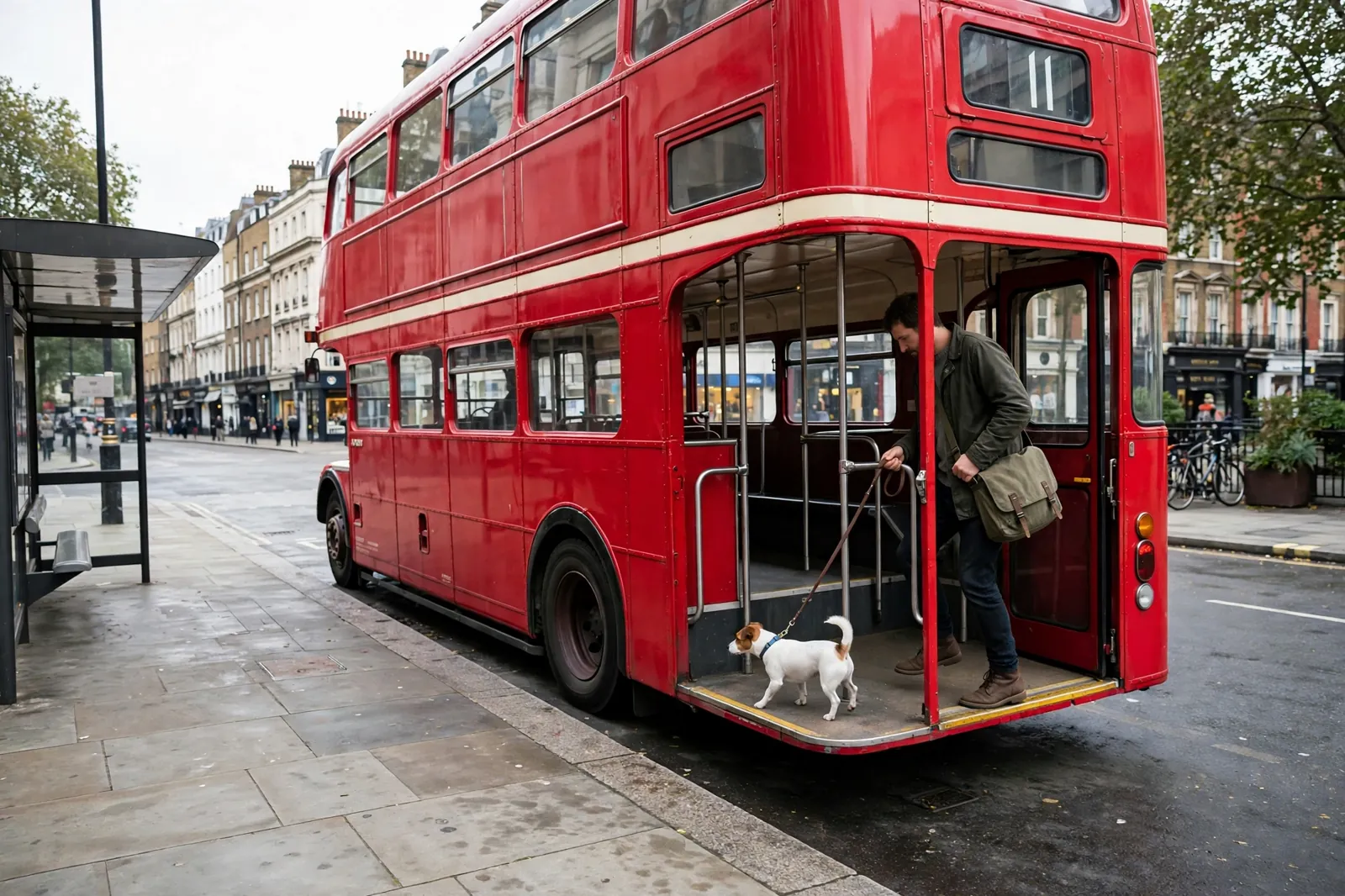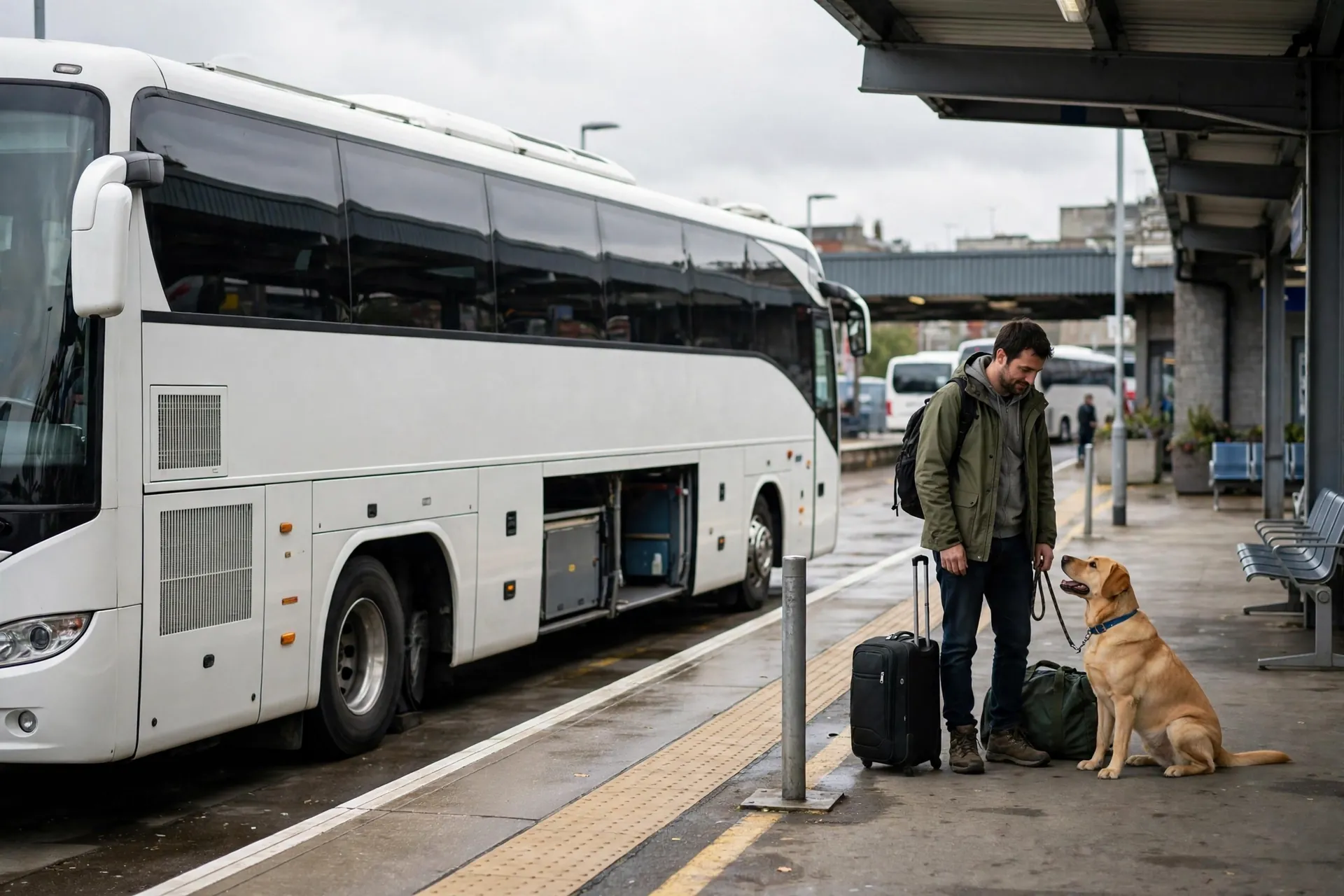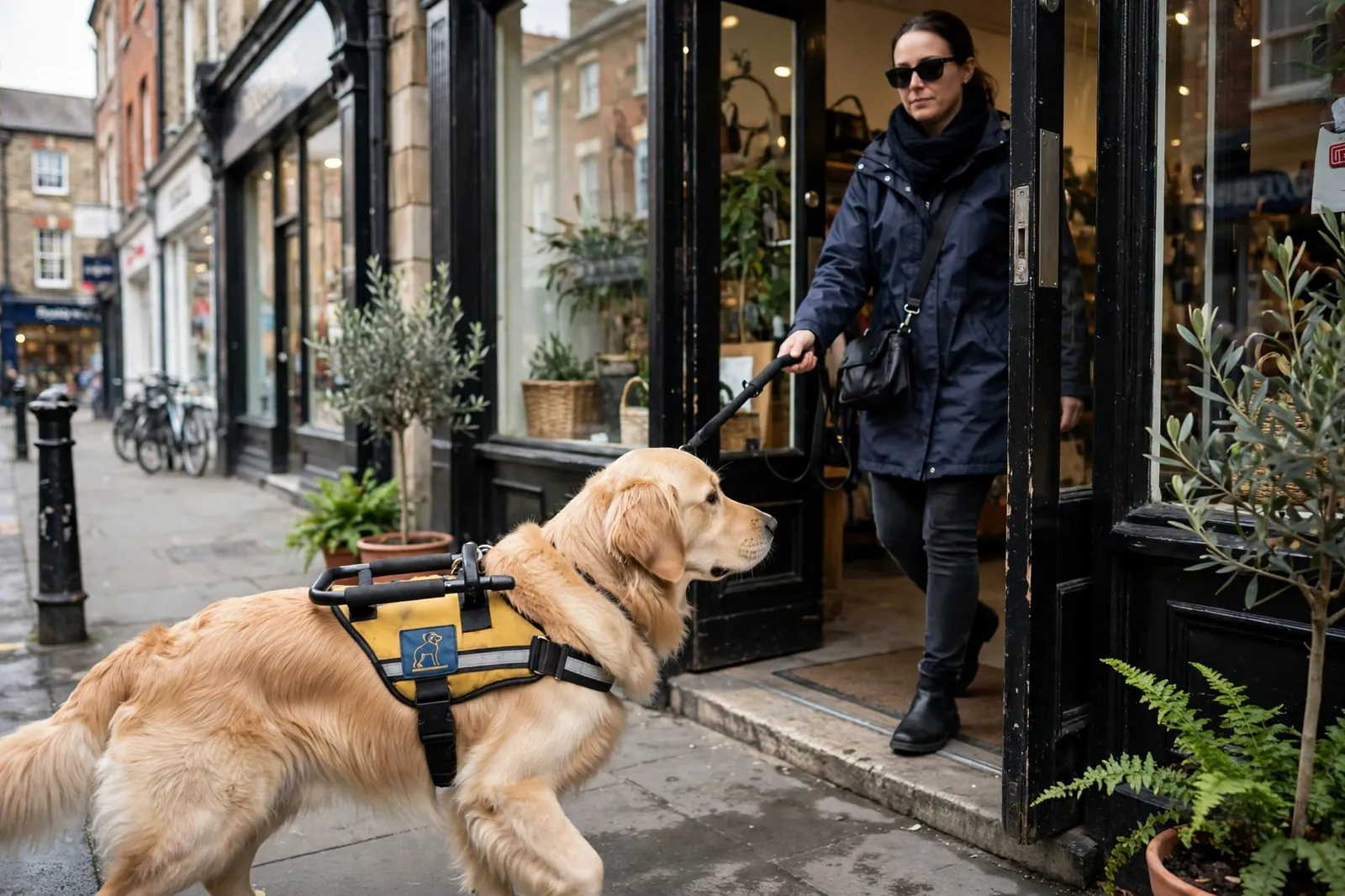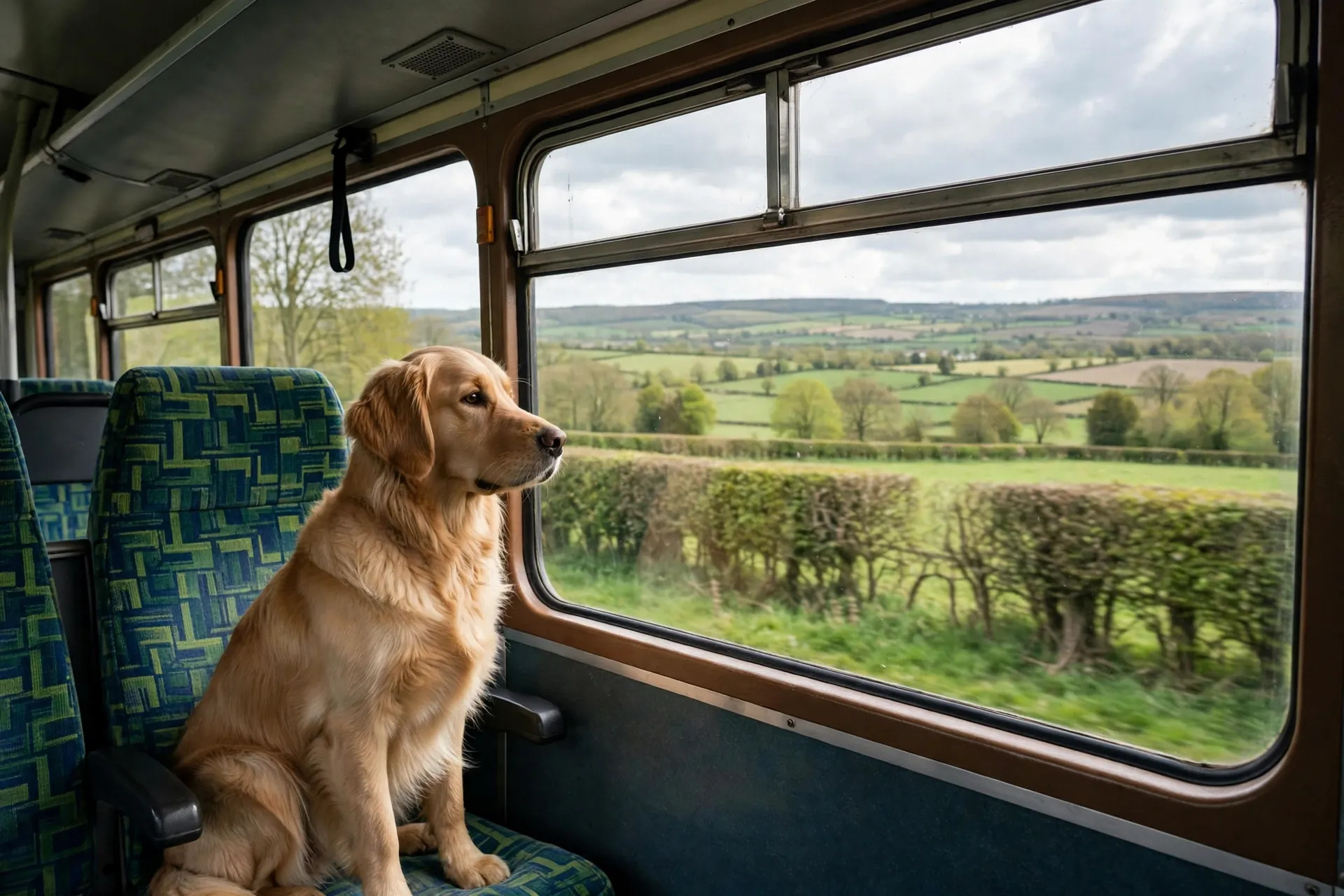
Most local bus operators in Britain allow dogs at the driver's discretion, usually free of charge. Long-distance coaches are a different story: the big networks generally do not carry pet dogs at all. Assistance dogs are the exception everywhere — they travel by legal right, free, on buses and coaches alike. Check the operator's latest published policy before any journey that crosses company boundaries.
One map, many answers: why buses have no single rule
Ask whether dogs can ride British trains and the answer fits in one sentence: almost every train company welcomes them, free, usually up to two per passenger. Ask the same question about buses and you need a map, a timetable and the name painted on the side of the vehicle. That difference is the whole point of this guide — and once you understand why it exists, the patchwork stops feeling random.
Outside London, Britain's bus market is deregulated. Hundreds of companies run local services, from national groups with thousands of vehicles to family firms with a dozen buses and one depot. Each operator writes its own conditions of carriage, and the dog clause is entirely theirs to set. There is no equivalent of the rail industry's broadly shared pet policy, and — crucially — no law that gives a pet dog the right to board a local bus. What exists instead is permission: most operators grant it, some attach conditions, and a few withhold it on particular services. In London itself, most visitors switch to the London Underground with a dog, where dogs travel free on a short lead.
This has two practical consequences for planning. First, the answer can change mid-journey. A dog that boards a Stagecoach bus in one town may need a different company's permission to continue on the next leg, and rural connecting services sometimes run under different rules from the town routes they feed. Second, the driver is the last word. Even the friendliest published policy leaves room for the person at the wheel to say no on a crowded bus, and that discretion is written into nearly every operator's terms. Treat the policy as the starting position and the driver as the decision-maker, and you will rarely be caught out.
The good news sits underneath all of this: the default across Britain is welcoming. The typical local bus service in England, Scotland, Wales and Northern Ireland accepts dogs on a short lead, kept off the seats, free of charge. The refusals that make headlines are the exceptions, not the pattern. The rest of this guide walks through the operators you will actually meet, the stricter world of coaches, what dogs cost, and the small habits that keep the welcome warm.
Local buses: the picture across most of Britain
Strip away the brand names and most local bus dog policies read remarkably alike. Dogs are carried at the driver's discretion. They travel on a short lead, held close, and they stay off the seats — the floor by your feet or the wheelchair bay when it is free is where they belong. One or two dogs per passenger is the usual understanding, though few operators print an exact number. Behaviour is the real ticket: a calm, controlled dog boards easily; a lunging, barking one gives the driver every reason to refuse.
Geography softens or sharpens the rule. Rural routes are often the most relaxed in practice — drivers know the regular dogs by name, and a collie hopping on for the three miles into market day is part of the scenery. Urban commuter routes are where discretion bites hardest: a packed double-decker at 8:30 in the morning leaves no floor space for a Labrador, and drivers will quite reasonably say not this one. If your journey can slide thirty minutes either side of the peak, it usually can.
A handful of service types sit outside the friendly default. Airport express buses sometimes exclude dogs because luggage and tight turnarounds dominate the boarding area. A few park-and-ride operations and sightseeing open-toppers set their own terms, occasionally requiring dogs to stay on the lower deck or ride only at quiet times. Demand-responsive and community transport minibuses vary widely — book ahead and ask, because these are often run by councils or charities with their own rulebooks. None of this is mysterious; it is printed on the operator's website under conditions of carriage or a dedicated pets page, and a two-minute check beats a refused boarding every time.
One more thing worth internalising early: permission is not a right. Unlike assistance dogs, which the law protects, a pet dog on a local bus is there by the operator's grace. That sounds one-sided, but in practice it is what keeps the system working — drivers use their judgement, regular riders learn the rhythm of their route, and the overwhelming majority of journeys happen without incident. Your job is simply to make saying yes easy.
The big operators, one by one
Britain's buses are dominated by a few large groups, and knowing their general stance covers most journeys you will ever make. The summaries below reflect the policies these operators publish; details shift over time, so treat this as a map rather than a contract and check the operator's own website on the day of travel.
Stagecoach is one of the country's biggest bus operators, running local services from the south coast to the Scottish Highlands. Its published position is dog-friendly: dogs are generally carried at the driver's discretion and travel free of charge. The usual conditions apply — short lead, off the seats, under control — and drivers can decline on crowded services. If your whole trip sits on Stagecoach routes, you are on some of the most reliably dog-welcoming buses in Britain.
First Bus operates across many English regions plus parts of Scotland and Wales through its local companies. The group-wide picture is similarly welcoming: dogs are normally accepted at the driver's discretion, and in most areas they ride free. Because First runs as regional businesses, the odd local variation exists — a particular city's airport link, for example, may differ from its town routes — so the local company's own page is the one to check rather than the group homepage.
Arriva covers large parts of England and Wales. Its standard line is that dogs are welcome at the driver's discretion, with the driver entitled to refuse if the bus is full or the dog's behaviour gives cause for concern. As with First, Arriva's operations are regional, so confirm on the local site before a journey that matters — a hospital appointment, say, or a connection you cannot afford to miss.
Go-Ahead's companies — including names like Brighton & Hove, Oxford Bus Company, Southern Vectis on the Isle of Wight and several London operators — each publish their own conditions, and they are generally among the more explicitly dog-friendly. Some Go-Ahead brands even spell out that well-behaved dogs are welcome, which takes the guesswork out of boarding. The Isle of Wight is worth a special mention: island bus travel with a dog is part of daily life there, and the local policy reflects it. Coach routes do not cover every island, so for crossings see dogs on UK ferries — most routes accept dogs, but where they spend the crossing varies.
In Scotland, Lothian Buses in Edinburgh is known for a straightforward, welcoming stance toward dogs on its city network, at the driver's discretion. Rural Scottish operators — the firms connecting Highland villages and island ferry ports — tend to be pragmatic and accommodating, though on long, single-deck rural runs the driver may ask a large dog to sit where it does not block the aisle.
In Northern Ireland, Translink's buses — Metro and Glider in Belfast, Ulsterbus beyond — allow dogs at the driver's discretion, normally free of charge. The pattern will be familiar by now: lead, floor, driver's call.
Wales follows the same national pattern through operators like Cardiff Bus and Newport Bus, which generally accept dogs at the driver's discretion on local services.
London runs its own show under Transport for London, with rules and rhythms distinct enough to deserve their own guide — including how the one-dog guidance works in practice and what to do on the Tube's busiest corridors. If your journey touches the capital, read our London buses guide alongside this one.
Finally, the independents: the family-run firms and council-supported rural services that fill the gaps between the big groups. Most are friendly — many publish a simple "dogs welcome" line — but they are also the most variable, because one company's policy is one manager's decision. A quick look at their website, or a phone call the day before, settles it.
Coaches play by stricter rules
Everything changes when the vehicle becomes a coach. Long-distance express services — the sealed, air-conditioned coaches running two, three, five hours between cities — operate under much tighter animal policies than local buses, and the biggest names in the business draw the line in the same place: assistance dogs only.
National Express, the largest scheduled coach network in the UK, does not carry pet dogs. Not on a lead, not in a carrier, not in the luggage hold. Only assistance dogs travelling with the person they assist may board, and they travel free. There is no fare you can pay and no exception you can request to change this; it is a network-wide condition of carriage. Because this surprises so many travellers, we have covered it in depth separately — see our National Express guide for the full rule and what to do instead.
Megabus takes a similar line on its intercity network: pet dogs are not carried, while assistance dogs are welcomed free of charge. FlixBus, which has grown quickly on UK routes, likewise restricts carriage to assistance dogs on its published terms. Scottish Citylink, the main express network north of the border, operates the same way: no pet dogs on board, assistance dogs carried free. Operators revise these pages periodically, so if your journey depends on it, confirm the current wording on the operator's own site before booking — but do not expect the direction of travel to have softened.
The strictness has practical roots rather than spite. A coach is a sealed tube for hours at a time: no opening windows, no unscheduled stops, and a luggage hold that is dark, unventilated and unsafe for any animal. A dog that needs a toilet break at hour three of a four-hour run has no good option, and neither do the forty passengers around it. Allergies and fear of dogs are also harder to escape on a non-stop express than on a local bus where people come and go. None of this is the operator being difficult — it is the physics of the vehicle.
What does this mean for planning? Treat coaches and local buses as separate systems. A journey that mixes a local bus to the coach station with a coach onward needs two different answers, and the coach leg is the one that usually fails for pet dogs. For longer distances, trains are the natural alternative — most UK train companies carry dogs free — or the car, which gives you full control of stops. Licensed pet transport services exist for dogs that need to travel without you. And if your heart is set on a particular city break, check the train first: the railway's dog-friendliness is one of the quiet advantages of rail travel in Britain.
Assistance dogs: the one guarantee
There is exactly one category of dog that boards by right rather than by permission: the assistance dog. Under the Equality Act 2010, bus and coach operators must carry assistance dogs accompanying disabled passengers, and they must do so free of charge. This is not a company policy that can be tightened or quietly dropped — it is the law, and it applies from a village minibus to a National Express coach.
What counts as an assistance dog in practice? The recognised picture is a dog trained by an accredited organisation — guide dogs for blind and partially sighted people, hearing dogs for deaf people, and dogs trained to assist with physical disabilities, medical conditions and mental health conditions, including many trained through Assistance Dogs UK member charities. Drivers are used to these dogs and will generally recognise a working dog in harness without interrogation. Carrying the dog's identification booklet smooths the rare awkward encounter, though you are not required to produce paperwork on demand like a ticket.
The legal protection bites hardest where pet policy is strictest. An operator that bans pet dogs outright — National Express among them — still carries assistance dogs, still free, still without counting them against any limit. The dog travels with you in the passenger area, not in a hold, and no cleaning surcharge or special fare can be attached. If an assistance dog is ever refused, note the time, route, vehicle and driver's description and complain to the operator in writing: that refusal is unlawful, and operators treat such complaints seriously.
Two edge cases are worth knowing. Trainee assistance dogs — young dogs still in training with their handlers — sit in a greyer area: some operators and some regions accept them, others ask you to check in advance, so a quick call ahead is wise. Emotional support animals, which have a recognised status in some other countries, have no special legal standing on UK public transport and are treated as pet dogs for boarding purposes. For the full legal picture, including taxis and other settings, see our assistance dog rights guide.
Do dogs pay? The fare picture
The fare question has a happier answer than most people expect. On the large majority of local bus services across Britain, dogs ride free. No ticket, no surcharge, no negotiation at the fare machine — the dog simply boards with you. This is the norm for the big groups and for most independents, and it is one of the quiet pleasures of bus travel with a dog: the marginal cost of bringing them is zero.
The minority position is a small flat fare. A scattering of operators — more often smaller rural firms than the big groups — charge a nominal amount for a dog, commonly in the region of 50p to £1, collected like any other fare. A few community or council-supported services price slightly higher. Where a fare exists it is per dog, per journey, and it does not buy the dog a seat: the floor rules still apply. Day tickets, weekly caps and season tickets cover the human, not the dog, so a dog fare — where one exists — is paid on top of whatever you pay for yourself.
On coaches the fare question barely arises, because pet dogs are not carried at any price. Assistance dogs, everywhere, travel free by law. The practical advice is simple: before a journey, glance at the operator's fares page for a dog line; where none is mentioned, assume free but keep a little change or a contactless card to hand just in case. Drivers appreciate passengers who have the dog fare ready rather than discovering it at the ticket machine, and on rural routes where the driver is also the timetable, the ticket office and the customer service desk, that small preparedness is noticed.
One budgeting note for multi-leg days out: because each operator sets its own terms, a day that strings together three companies could theoretically include three different dog-fare answers. In practice it almost never does — free is free almost everywhere — but if you are counting coins for a long rural ramble with several connections, the operators' websites will confirm it in minutes.
Riding well: the etiquette that keeps dogs welcome
Dogs are welcome on most British buses because, by and large, dog owners ride well. The etiquette below is not a rulebook anyone hands you at the stop — it is the accumulated common sense that keeps drivers saying yes. Follow it and you become part of the reason the policy stays friendly.
Start before you board. A short lead — not a flexi-lead extended to its full optimistic length — tells the driver at a glance that the dog is under control. Let alighting passengers off first, then step up with the dog close at your side, moving with the unhurried confidence of someone who has done this before. Hesitation at the door, a dog lunging ahead while you fumble for your pass, is the body language of a problem about to happen. Calm is contagious, including to drivers.
Inside, the floor is the dog's place. Dogs stay off the seats on every British bus — no exceptions, no blanket loophole, no "but he's clean." The best spot is the floor space by your feet on the lower deck, ideally near the doors so you can exit without threading a large animal past the whole bus. Keep the lead short enough that the dog cannot wander into the aisle, where it becomes a trip hazard the moment the bus brakes. On double-deckers, the lower deck is the right call; the stairs are not designed for four-legged passengers and there is nothing for a dog up there but trouble.
Wet dogs deserve special planning. A dog that has just swum a river or crossed three muddy fields is a legitimate concern for the driver and the upholstery. Towel the dog down before the stop where you can, sit them on a travel mat or an old blanket you carry for the purpose, and choose the least upholstered corner of the lower deck. Nobody expects a showroom-standard animal after a country walk — but the visible effort to contain the mud is what separates a welcome dog from a complained-about one.
Think about timing. A quiet mid-morning bus and a packed school-run bus are different propositions for the same dog. If you have any flexibility, travel outside the peaks: the 9:30 bus is roomier, calmer and kinder to a nervous dog than the 8:15. School services deserve particular care — excited children and a strange dog in a confined space is a combination to avoid rather than manage.
Other passengers are part of the calculation. Some people are allergic, some are frightened, and a few have had genuinely bad experiences. Keep the dog from approaching strangers, however friendly your dog is and however much you want to demonstrate it. A dog that lies quietly at your feet and ignores everyone is the best ambassador the policy could ask for. If someone is clearly uncomfortable, a small adjustment of position costs you nothing and buys the whole system goodwill.
Barking is the fastest way to lose the room. A single alert bark at a sudden noise is forgiven; sustained barking at every passenger who boards is not. If your dog is vocal on transport, train for it before relying on buses — short practice rides at quiet times, rewarded calm, build the habit. And on the day, if the dog will not settle, the gracious move is to step off and wait for the next bus rather than enduring twenty minutes of escalating noise that every passenger remembers.
A word on muzzles: they are not generally required for dogs on UK buses, and you will rarely see one. But if your dog is reactive around strangers or other dogs, a comfortable, well-fitted muzzle is a sensible courtesy — it reassures the driver and nearby passengers far more than any verbal promise that "he's friendly really." Similarly, never tie a dog to a stop and board without it, never leave a dog unattended on a bus while you hop off for something, and always carry bags for the obvious reason: a pavement outside a rural stop has no bin and no excuses.
If the answer is no
Even with perfect etiquette, refusals happen. The bus is genuinely full, another dog is already on board and the driver judges two too many, or the driver simply exercises the discretion their terms give them. What you do in the next thirty seconds matters more than the refusal itself.
Stay polite. Arguing at the door has never reversed a decision and it poisons the well for the next dog owner. A brief, good-humoured "no problem — when's the next one?" keeps every option open, including the possibility that the next bus, with a different driver and fewer passengers, says yes. If the refusal felt arbitrary rather than practical, note the route number, time and direction; operators' customer service teams do read feedback, and patterns of unreasonable refusal are exactly what feedback systems exist to catch.
Then work the alternatives. Check whether another operator serves the same corridor — on many urban routes two or three companies overlap, and their dog policies were written independently. A licensed taxi is the most reliable fallback for a single leg; many drivers welcome dogs, especially with advance notice — our dog-friendly taxis guide covers how to book well. Where a railway station is within reach, trains are the stronger backup: most UK train companies carry dogs free and without the driver's-discretion lottery. For a planned day out, re-routing the dog leg onto the train and the human legs onto the bus is often the neatest solution.
For journeys that matter — a vet appointment, a ferry connection, the last bus home from a rural walk — build the fallback into the plan rather than discovering it at the stop. Save a local taxi number before you set out, know the train times as well as the bus times, and allow one service's worth of slack. The dog does not know the plan has changed; only you carry the stress of it, and a pre-thought alternative keeps it that way.
One final distinction: if an assistance dog is refused, that is not discretion — it is unlawful. Note the details, complain to the operator in writing, and expect to be taken seriously. For pet dogs, though, the honest framing is this: the driver said no, the system gives them that right, and the grown-up response is a good alternative rather than a confrontation.
Practical questions
Before you go
Can I take my dog on any bus in the UK?
On most local bus services, yes — at the driver's discretion. There is no national rule obliging every operator to carry pet dogs, so the policy belongs to the company running the route and the driver on the day. In practice the majority of local buses across England, Scotland, Wales and Northern Ireland accept dogs on a short lead, usually free of charge. Always check the operator's published policy before a journey that crosses company boundaries.
Are dogs allowed on National Express coaches?
No. National Express does not carry pet dogs on its coaches — not on a lead, not in a carrier, and not in the hold. Only assistance dogs travelling with the person they assist may board, and they travel free of charge. This is one of the strictest policies among UK coach operators, and it applies across the whole network.
Does my dog need a ticket on the bus?
Usually not. The large majority of local bus operators in the UK carry dogs free of charge. A minority charge a small flat fare — typically around 50p to £1 — so it is worth checking the operator's policy and having a little change or a contactless card ready. Assistance dogs always travel free.
Can the driver refuse to let my dog on?
Yes. Even where the operator allows dogs, the driver has the final say on the day. Common reasons include a crowded bus, another dog already on board, or a dog that seems aggressive or out of control. Boarding calmly with the dog on a short lead and off the seats gives you the best chance, and if you are refused, stay polite — the next bus may be a different story.
Are assistance dogs allowed on all buses and coaches?
Yes. Under the Equality Act 2010, bus and coach operators must carry assistance dogs accompanying disabled passengers, free of charge. This applies on local buses and on long-distance coaches, including operators that ban pet dogs. Assistance dogs do not count towards any pet limit and cannot be charged a fare.
How many dogs can I bring on a bus?
Most operators that accept dogs allow one or two per passenger, at the driver's discretion. Two calm, well-controlled dogs are usually fine on a quiet service; on a busy one, the driver may ask you to wait for the next bus. If you travel with more than two dogs, contact the operator in advance — and for larger groups, a taxi or a car is usually the more reliable option.