This guide is independent and contains no paid placement. If affiliate links are added later, they will be clearly marked and will not change our editorial checks.
Plan on pet dogs staying outside. Most small, busy Pret A Manger stores in the UK are effectively assistance dogs only inside, because the queue, the open food and the lack of floor space leave nowhere sensible for a pet dog to be. Where a branch has real outdoor seating, that is usually your option — and where it does not, a nearby dog-welcoming cafe is a better coffee stop. Always check the individual shop.
The short answer at the door
Picture the moment this question usually happens. It is breakfast time, the pavement is already full, a queue is curling back from the till, and you have a dog who has just had a good morning walk and would happily sit anywhere for ten minutes. The shop in front of you looks casual, the door is wide open, and nobody has put a large sign in the window. It is tempting to read all of that as permission.
Do not. For Pret A Manger in the UK, the working assumption for a pet dog should be no inside, unless the specific shop has clearly told you otherwise. That is not the same as saying every branch, in every building, in every town, applies an identical rule in an identical way. It is saying that the format of the shop — small, fast, crowded at predictable peaks, and built around chilled cabinets and open food preparation — points firmly in one direction, and you should plan your morning around that direction rather than around a hopeful exception.
That planning distinction matters more than the exact wording of any single doorway conversation. If you build a route, a commute or a day out on the assumption that your dog can come in, a refusal ruins the whole stop: you are left on the pavement with a hot drink you cannot buy and a dog who needs water, shade and a plan B. If you build the same route on the assumption that your dog stays outside, everything else becomes a bonus. Outdoor tables, if they exist, are a bonus. A second person who can hold the lead while you nip in is a bonus. A quieter branch at a quieter hour where staff can advise you from the door is a bonus. None of them needs to work for the day to work.
So use this guide as a decision tool, not as a promise about a named branch. It explains why the answer is usually no, where the genuine exceptions tend to sit, how stations and airports add a second layer of rules, and what to do instead when you are in central London with a dog and a perfectly reasonable desire for coffee and a sandwich. Where anything is uncertain — and with individual high-street shops it often is — the honest instruction is the one repeated throughout this page: check the individual shop.
Why small busy stores say no
Start with the floor plan, because the floor plan explains almost everything. A typical small city Pret is not a cafe with a counter in the corner. It is a queue with fridges along one wall, a narrow route to the tills, a collection point where people stand watching for their order, and a handful of tables that turn over quickly at lunch. At 8am and again at 1pm, that space is used to its limit by people carrying bags, pushchairs, suitcases and trays. A dog lying across the route to the till is not a minor inconvenience in that layout; it is a trip hazard in a crowd that is mostly looking at phone screens and shelf labels, not at the floor.
Then add the food. Sandwiches, salads, baked goods and fruit are displayed and prepared in the same compact space customers move through. Food businesses have to manage hygiene carefully, and keeping pet animals away from open food areas is the simplest, most consistent way for a busy chain to do that across hundreds of different sites. A large rural cafe with a separate dog room, a tiled entrance and staff who can see every table is solving a different problem from a 40-seat commuter shop where one person is restocking a fridge while another is calling out orders.
Noise and arousal matter too. City-centre shops are loud in a particular way: espresso machines, fridge doors, shouted collections, delivery trolleys through the back, and a constant flow of strangers passing within inches. A dog who is calm in a pub garden can be unsettled by that density even if they are technically well behaved. Owners sometimes frame the question as whether their dog would cause trouble. Staff have to frame it differently: whether any dog, including a nervous one they have never met, can be accommodated safely in a space that is already full. A blanket rule is easier to apply fairly at speed than a case-by-case judgement at the door during a rush.
None of this makes Pret anti-dog in any wider sense, and it should not be read that way. It makes it a grab-and-go food shop whose core job is moving a lot of people through a small space quickly. Compare that with the places covered in our guide to dog-friendly cafes in the UK, where sitting down with a dog is part of the offer, water bowls appear without asking, and nobody expects you to leave in four minutes. Both models are legitimate. The mistake is expecting one to behave like the other because both sell coffee.
Assistance dogs are different — and that difference is the law
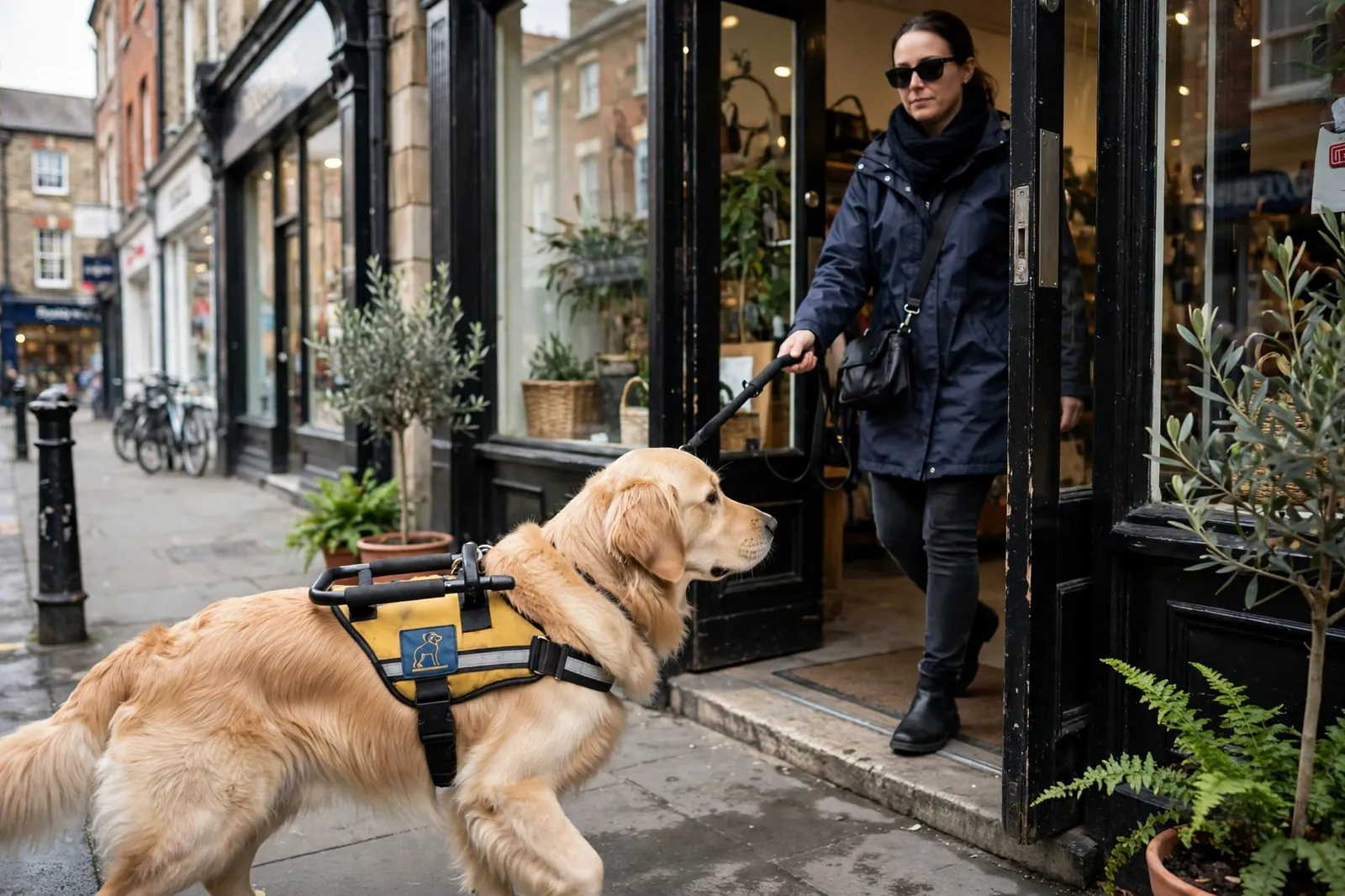
Everything above is about pet dogs. Assistance dogs are not pets, and they should never be treated as an exception granted by a kind manager. A trained assistance dog working with a disabled handler is welcome in shops, cafes and food premises, including places that refuse pet dogs, and refusing access can amount to discrimination under equality law. Our separate guide to assistance dog access rights in the UK sets out those rights, the identification handlers may carry, and what to do if access is challenged.
Three practical points are worth repeating here because busy food shops are a common place for misunderstandings. First, staff should not ask a handler to sit in a particular corner, wait outside, or pay anything extra because the dog is present. Second, the presence of open food does not override access rights; assistance dogs are trained to work in exactly these environments and to ignore food. Third, other customers objecting is not a lawful reason to refuse a handler either.
If you are a handler and a refusal happens in a fast-moving queue, the most useful approach is usually short and factual: state that the dog is an assistance dog, that it is trained to assist you with a disability, and ask the person to check with their manager before refusing. Keep any incident details — time, branch, what was said — if you intend to follow it up afterwards, when you are not also trying to catch a train. If you are a pet owner reading this, please do not borrow the language of assistance to get a pet dog through a door. Every false claim makes life measurably harder for the handlers who depend on those dogs, and staff who have been misled become more suspicious of the next genuine dog that arrives.
Outdoor seating, where it exists
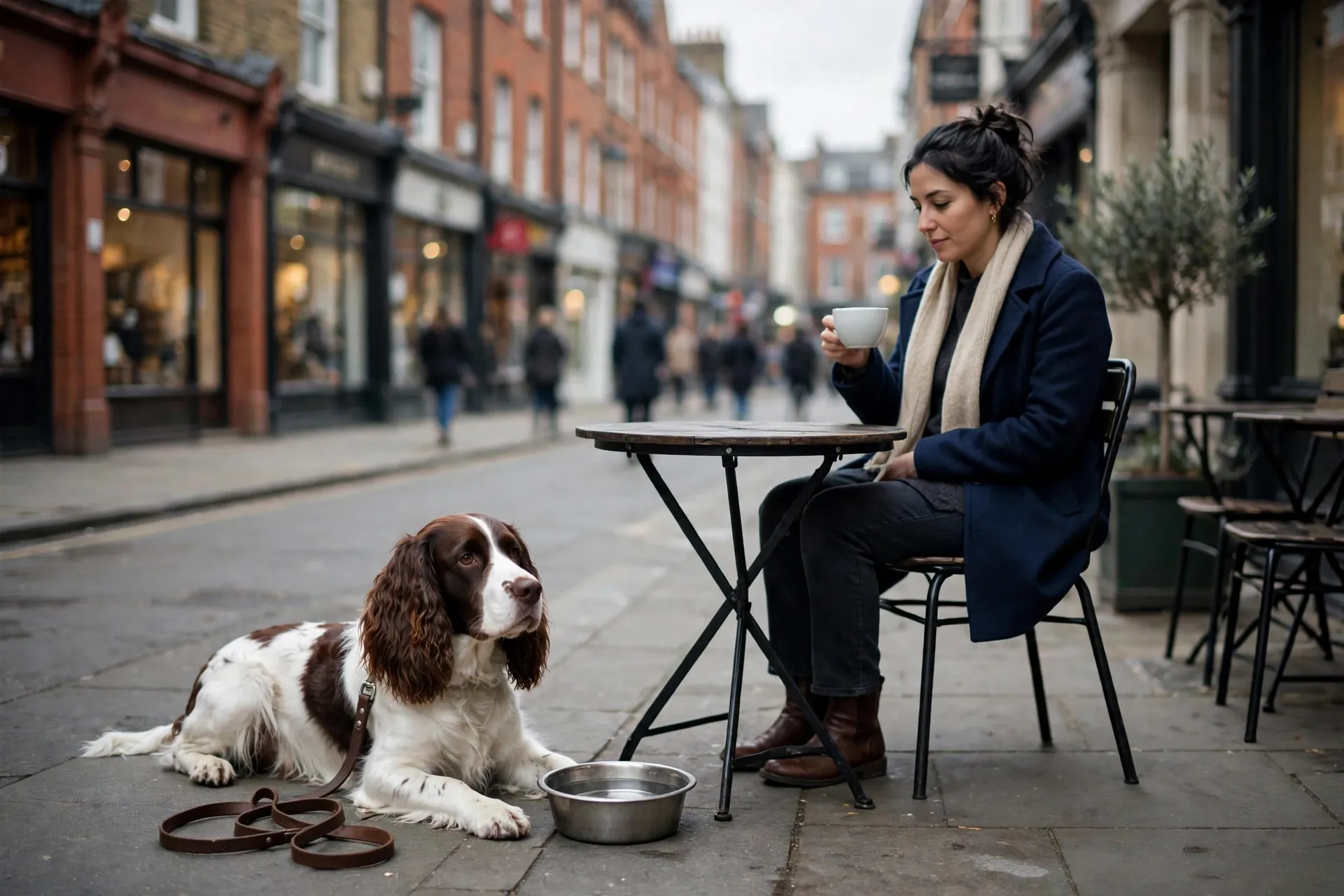
The realistic middle ground is outside. Some Pret shops have a few tables on a wide pavement, a small terrace, or seating in a shopping-centre forecourt or station plaza. Where that seating genuinely exists and is part of the shop's own area, a calm dog on a short lead can usually stay beside you while you eat and drink. That turns an impossible stop into an easy one: one of you orders, the dog settles under the table, and nobody has to negotiate the queue.
The catch is how uneven that provision is. Many central branches have no outside seating at all, because the pavement is narrow, the landlord does not allow it, or the shop is entirely inside a station, office building or airport. Others have seating that looks public but belongs to the building, a market hall or a neighbouring unit, each with its own animal rules. A photograph online can also mislead: tables photographed in summer may be removed in winter, and a bench on the street outside is not the same thing as seating provided for customers. This is why checking the individual shop, rather than searching for a chain-wide answer, gives you the information you can actually use.
If you do use outdoor seating, set the dog up for the conditions rather than hoping for the best. Choose the table furthest from the door swing and the queue spill-out, keep the lead short and under your chair leg rather than stretched across the walkway, and put the dog on the building side of the table so passing dogs are separated from yours by furniture, not by six inches of pavement. Bring your own water and a collapsible bowl; do not assume a busy shop can supply one during a rush, and never let a dog drink from a human glass you intend to return to the counter. In summer, check the surface temperature and shade before settling — a south-facing paved forecourt at midday can be unsuitable even when the air feels pleasant to you.
Finally, read the weather and the clock honestly. Outdoor seating solves the access question but not the comfort question. A dog who has to wait in driving rain while you eat a sandwich under a narrow awning is not having a good stop, and neither are you. On those days the better answer is usually to move the coffee to a place designed for sitting inside with a dog, and keep Pret for a takeaway run when you have a second pair of hands.
Stations and airports: a second set of rules on top
Branches inside railway stations and airports deserve their own section because people often assume travel hubs are more permissive. Usually the opposite is true. Before you reach the counter you are already inside a building with its own rules about animals in concourses, security areas and departure lounges. A shop cannot welcome your dog into a space your dog was not allowed to enter in the first place.
On the rail network, well-behaved dogs are generally allowed to travel on trains, which is why you will see dogs in stations at all — see our guide to dogs on the London Underground for the capital's specific rules on escalators and carrying smaller dogs. But travelling through a station with a dog is different from settling that dog inside a small food shop on the concourse. Station branches are often the most space-pressed of all, with luggage piled in the queue and passengers watching departure boards rather than the floor. Expect assistance dogs only inside, use any seating out on the concourse only if the station allows dogs to wait there, and be ready for staff to direct you to the door quickly and without much discussion. They are managing a rush that repeats every few minutes.
Airports are stricter again. Airside — after security — pet dogs are normally present only if they are travelling in an approved way under an airline's rules, and many terminals restrict animals in food areas regardless. Landside branches sit in arrivals and departures halls with their own security and cleaning regimes. If you are meeting someone with a dog, plan the coffee for outside the terminal or at a dog-welcoming venue away from the airport, rather than assuming the arrivals-hall branch will work. And if you are travelling with an assistance dog, notify your airline in advance as airlines require, and allow extra time: the paperwork and the route through the terminal matter more than any individual shop's policy.
The general rule for all transport hubs is to check two things, not one: the venue's animal rules and the individual shop. If either says no, the answer is no, and arguing the other one's position at the door will not change it.
The London commuter problem
London is where this question bites hardest, because London is where Pret is densest, office routines are most rigid, and dog ownership among flat-dwellers and hybrid workers has grown fastest. A common pattern looks like this: a morning walk in a local park, a train or Tube journey into the centre, a coffee on the way to the office, and a dog who is expected to fit into each stage. Stages one and two often work well. Stage three is where the plan quietly falls apart.
The reason is timing. The branches nearest stations and offices are at their absolute busiest exactly when commuters with dogs want to use them, between about 7.30am and 9.30am, and again at lunch. At those hours even a branch that might be flexible at 3pm on a quiet Tuesday has no space, no staff time and no reason to improvise. If your routine depends on a coffee stop, test it at the time you will actually use it, not on a Saturday afternoon when the same shop is half empty and everything feels easier.
There are workable London patterns. Offices in areas with wide pavements and newer developments are more likely to have branches or neighbouring cafes with outside tables. Parks and garden squares near office districts — and there are more of them than visitors expect — let you split the journey: coffee bought by one person, drunk on a bench with the dog on grass, which is a better experience for the dog than any indoor compromise. Hybrid working also helps: many owners find the smoothest routine is a dog-welcoming local cafe near home before travelling in without the dog, or after returning, rather than a city-centre stop in the middle of the rush.
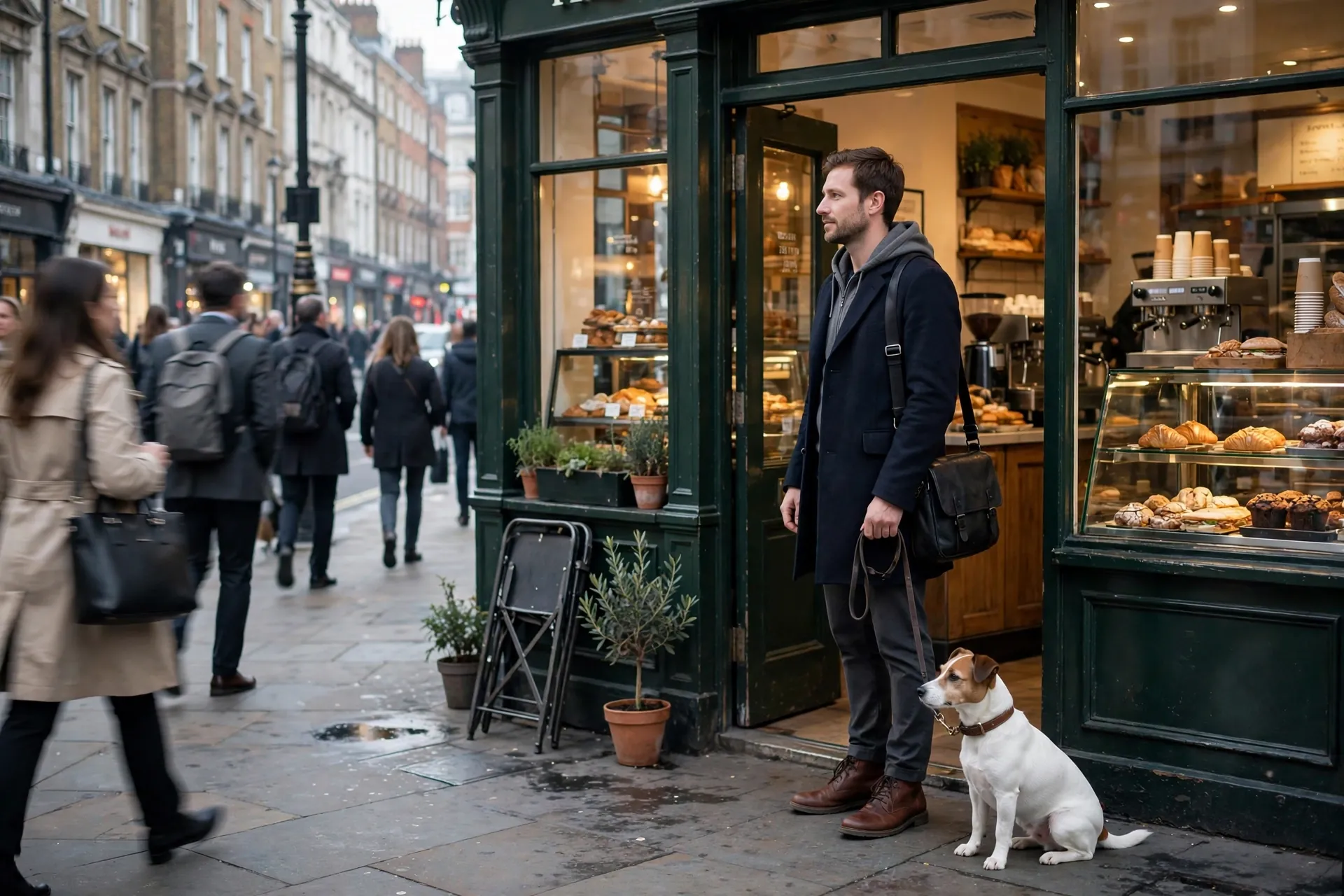
What does not work reliably is tying a dog to railings outside a busy branch while you queue. Central London pavements are theft-prone, crowded and full of distractions; a dog can be stolen, slip a collar, be fed something unsuitable by a well-meaning stranger, or simply panic at a siren and pull into the road. Staff inside cannot watch your dog, and should not be expected to. If a stop requires leaving the dog alone and out of sight, it is the wrong stop.
If you are on your own with your dog
Solo owners face the sharpest version of the problem, so it deserves direct advice rather than a shrug. You cannot be in the queue and outside with the dog at the same time, and the honest options are the following.
Go as a pair when you can. The two-person relay — one orders, one stays outside with the dog, drinks carried out — is the simplest fix and the one most city dog owners actually use. It works at any branch, in any weather you are willing to stand in, and it never depends on a policy exception.
Ask at the door, at a quiet moment, and accept the answer. If a branch is visibly empty and you can see the till from the doorway, it is reasonable to catch a staff member's eye, explain you are alone with a dog, and ask whether they can help — for example by telling you the best way to order. Some may be able to suggest an approach; others will say the dog cannot come in and that is the end of it. Asking is fine. Stepping inside with the dog while asking, so that the conversation happens with the dog already at the counter, is not.
Choose the takeaway window of your day, not the rush. A mid-morning or mid-afternoon visit changes the whole interaction. Queues are shorter, staff have time to talk, and if there is outdoor seating it is more likely to be free. Building your coffee around the quieter window is often easier than finding a different shop.
Do not tie up and dash. It bears repeating in this section because it is the option everyone is tempted by. A two-minute queue is rarely two minutes, a dog tied outside a food shop attracts attention from strangers and other dogs, and you cannot intervene from inside a queue. If there is no pair, no outdoor seating and no quiet moment, the coffee has to move — and the alternatives in the next section are usually within a few minutes' walk in any city centre.
Better alternatives nearby when you have a dog
The good news is that this is a problem with excellent substitutes. Britain's independent cafe scene has moved decisively towards welcoming dogs, precisely because chains built for speed often cannot. In most town and city centres you will find, within a short walk of a Pret, at least one of the following.
Independent coffee shops with room to sit. Look for space between tables, a water bowl by the door, and dogs already inside — the surest sign of a real welcome rather than a tolerated one. Our comparison of dogs in Costa Coffee shows how even large chains vary by format, and independents vary even more, which in this case works in your favour: the bigger, calmer and more seating-led the cafe, the more likely your dog is welcome.
Pubs and bakery-cafes earlier in the day. Many pubs that serve coffee and brunch welcome dogs in the bar area, and bakery-cafes with spacious seating often do too. Both tend to have more floor space per customer than a commuter sandwich shop, which is the underlying thing your dog actually needs.
Parks, squares and benches with a takeaway bought by someone else — or bought on a dog-free errand. If it is specifically a Pret sandwich you want, the food travels well. Buy it when you are without the dog, or have a companion buy it, and eat it somewhere your dog is genuinely welcome and can relax off the pavement flow.
Dog-welcoming chains and venues listed locally. Search for the specific neighbourhood rather than the chain name, and check recent reviews mentioning dogs, which reveal the current practice at that branch faster than any head-office statement. Then still check the individual shop on arrival: a welcome can change with a refurbishment, a new manager or a change in seating.
The mindset shift is to stop asking which big name will let your dog in, and start keeping a small personal list of three or four places near the routes you actually walk — home, office, station, park — where your dog is known to be welcome. That list, once built, removes this question from your mornings entirely.
Etiquette if you stay outside — or are briefly at a door
Where you do use outdoor seating, or speak to staff at a doorway, a few habits keep the welcome alive for the next owner. They cost nothing and they are noticed.
- Short lead, dog close, route clear. Keep your dog beside your chair, never on a extending lead across a pavement, and never blocking a doorway, a pram route or the queue.
- Off the furniture, off the tables. Dogs stay on the ground. Paws and noses on cafe tables are the fastest way to turn a tolerant venue into a no-dogs venue.
- Bring water, a mat and poo bags. A familiar mat gives a dog a defined place to settle, your own bowl avoids pressure on staff, and any mess is cleared immediately and completely.
- Read other customers honestly. Some people are nervous of dogs, allergic, or simply eating lunch in their only quiet ten minutes. Move a seat further away rather than debating their reaction.
- Keep it short in busy spots. Outdoor tables outside a commuter shop are for a coffee, not a two-hour laptop session with a restless dog. The shorter and calmer the visit, the easier the next one is.
- Accept a no gracefully and immediately. If staff say the seating is not for dogs, or the area has changed, leave without argument and note it for next time. Front-line staff rarely set the policy, and a scene at the door helps nobody's dog.
Owners sometimes worry that being refused reflects on their dog personally. It almost never does. It reflects floor space, food rules, a landlord's condition or a manager applying a chain policy during a rush — all things that would apply to the calmest dog in Britain. Taking it in stride is part of travelling well with a dog in cities.
Check before you go: a two-minute routine
Finish with the routine that prevents almost every bad version of this stop. Run through it before you set off, not when you are standing in a queue.
- Decide your assumption: pet dogs outside, assistance dogs inside. Build the plan on that basis.
- Check the individual shop: look up the specific branch, look for outdoor seating in recent photos, and if the stop matters, call ahead and ask directly. Policies and seating change; a two-minute check beats a wasted journey.
- Check the venue too: if the shop is inside a station, airport, shopping centre or office building, check that building's rules for dogs as well.
- Plan the dog's part of the stop: who holds the lead, where the dog waits, whether there is shade and water, and what happens if the seating is full.
- Have a named plan B: one nearby dog-welcoming cafe, pub or park bench you already know, so a refusal is a short walk rather than a spoiled morning.
- Time it outside the rush if you can: mid-morning and mid-afternoon transform both the welcome and the experience.
None of this is complicated, and after a few repetitions it stops feeling like research at all. It becomes local knowledge: which branch has the two tables under the awning, which independent cafe two streets away puts a bowl out without being asked, and which park bench catches the morning sun. That is the real answer to the question in the title. A chain-wide yes or no was never going to run your morning — your own map of the places you actually go, checked shop by shop, is what does that.
Practical questions
Before you go
Are dogs allowed inside Pret A Manger in the UK?
In most small city stores, pet dogs are not allowed inside and only assistance dogs should be taken in. Stores are compact, busy and centred on open food counters, so do not assume a pet dog can join the queue. Check the individual shop before you travel, because layouts and local arrangements vary.
Are assistance dogs allowed in Pret A Manger?
Yes. Assistance dogs are working dogs, not pets, and they are welcome in shops and food premises in the UK. Staff should not charge extra, ask for a separate area, or refuse entry because a food counter is nearby. If a problem arises, stay calm, explain the dog is an assistance dog, and ask the manager to check the policy.
Can my dog sit with me at outdoor seating outside Pret?
Where a shop has genuine outdoor seating on the pavement or a terrace, a well-behaved dog on a short lead can usually stay with you there. Not every branch has outside tables, and some seating belongs to a landlord or station rather than the shop itself. Check the individual shop, keep the lead clear of the queue and never tie a dog to a table in a busy doorway.
Are Pret shops in stations and airports different?
They can be stricter, not more relaxed. Station and airport branches sit inside buildings with their own animal rules, security checks and crowded concourses, and pet dogs may be barred from the wider building even before you reach the counter. Follow the station or airport rules first, and check the individual shop and the venue before you set off.
What should I do if I am alone with my dog and want a coffee from Pret?
Do not leave your dog tied up alone outside a busy city shop. The safer options are to choose a nearby cafe with outdoor seating or a dog welcome, go with another person who can wait outside with the dog while you order, or time the coffee stop for a quieter branch where staff can advise you at the door. Never take a pet dog inside just because the queue looks short.