This guide is independent and contains no paid placement. Store policies change and vary by branch, so always check the latest official guidance and your local store before travelling.
Yes, in most stores. Many B&Q stores welcome well-behaved dogs on short leads — more dog-friendly than most large retailers — but it is not a nationwide guarantee, and trade counters and paint-mixing desks may be off limits. Ring your branch, keep the lead short, and have a plan B. Official source: B&Q general information FAQs (checked October 2026).
The short answer — and why B&Q is different
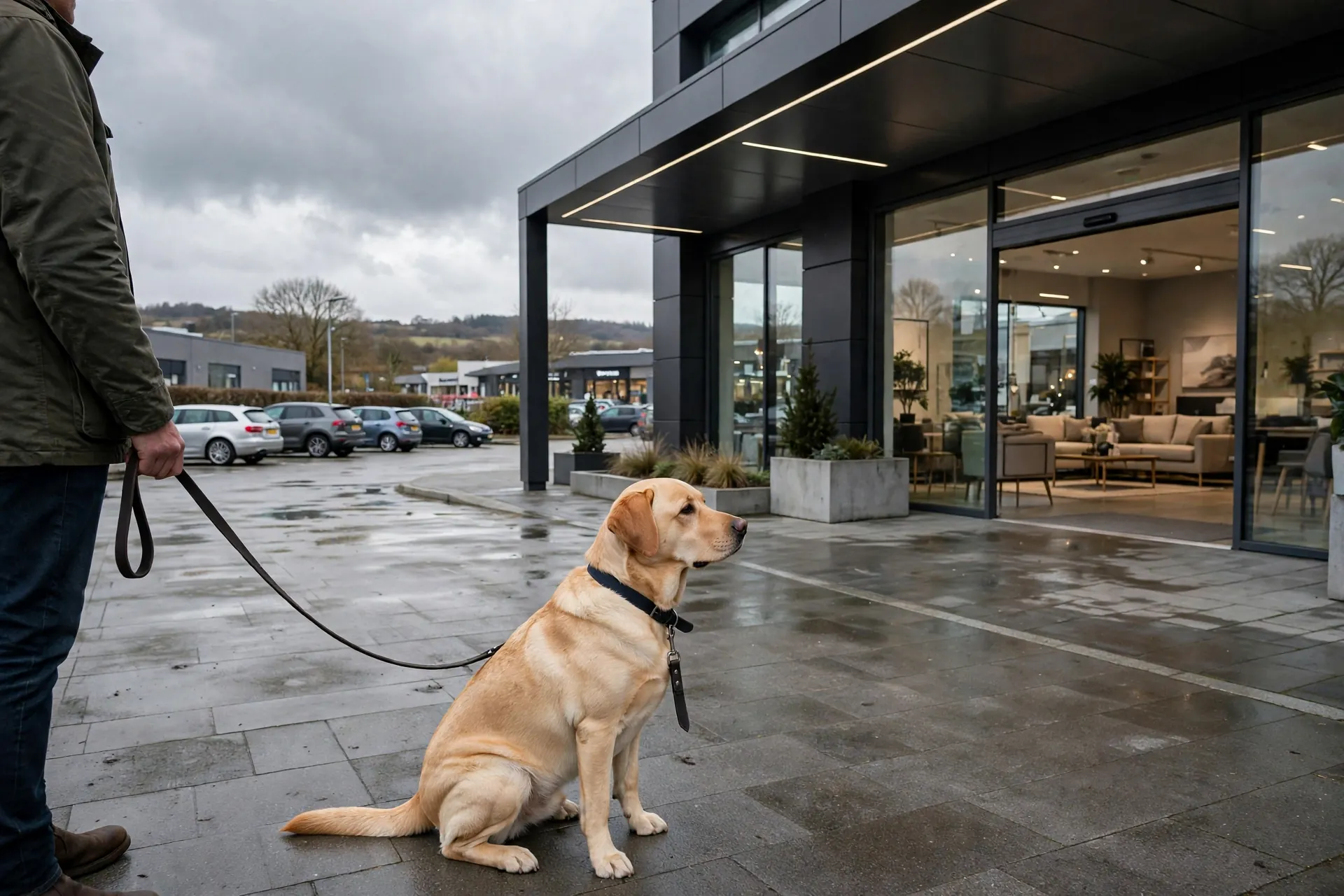
Start with the question most people type into a search engine outside the car park: can the dog come in, or does someone have to wait outside with them? At B&Q the answer is more hopeful than at most big shops. B&Q has built a reputation among dog owners for welcoming dogs in many of its stores, provided they stay on a lead and under control. That reputation is broadly deserved, and it is one reason a DIY trip so often becomes a combined errand and outing, especially at weekends when a project list and a dog walk compete for the same few hours.
The difference from a supermarket is easy to understand. A DIY warehouse sells timber, tools, paint and plants rather than open food, the aisles are wide, a large part of the stock is outdoors or in covered yards, and shoppers expect dust, noise and trolleys loaded with awkward lengths of wood. A calm dog on a short lead fits that environment far more naturally than it fits a chilled food aisle. Our guide to dogs in UK supermarkets explains why food retailers take a much stricter line, and the contrast helps explain why a hardware store can afford to be more relaxed without being careless.
Hopeful, however, is not the same as guaranteed. “Many stores welcome dogs” is not the same sentence as “every store must admit every dog”, and treating it as a right is the fastest way to start an argument at the entrance that nobody enjoys — least of all the dog. Policies can differ between a large warehouse store with a sprawling outdoor yard and a smaller, tighter high-street format. Individual managers can also restrict access temporarily: during a spillage clean-up, a major refit, an exceptionally busy trade morning or after an incident involving another dog. The sensible mindset is that you are being welcomed as a guest, not exercising an entitlement, and guests behave accordingly.
There is also a welfare question hidden inside the permission question. Even where dogs are allowed, a B&Q warehouse on a bank holiday Saturday is loud, echoing and full of reversing forklifts, rattling trolleys, children in flatbed carts and the sudden crash of dropped timber. A confident adult dog that walks nicely through a market town will usually cope for twenty minutes. A puppy in the middle of socialisation, a rescue that startles at metallic noises or an elderly dog that dislikes slippery floors may have a miserable time even though the door was open. Permission answers whether you may go in. It does not answer whether you should, and this guide keeps returning to that second question because it is the one your dog would ask.
Why your local store decides
B&Q operates hundreds of stores in different buildings, and that variety is the practical reason discretion matters. One branch might have a fully outdoor garden centre you can reach without crossing the main warehouse at all. Another might route every customer past the paint mixing desk and the trade counter, with narrow queuing barriers that leave no safe place for a dog to stand. A store inside a retail park with a shared entrance lobby may also be bound by landlord rules that the manager cannot override, however dog-friendly they personally feel.
Discretion also covers the individual dog in front of staff. A store that generally welcomes dogs can still reasonably ask an owner to leave if a dog is lunging at other customers, barking continuously, fouling repeatedly or being carried in a way that looks unsafe near machinery. That is not discrimination or inconsistency; it is the ordinary duty any retailer has to other shoppers and to its own team. If you have seen a photograph online of a dog sitting happily in another branch, treat it as evidence that dogs are often welcome, not as a contract that binds the branch in your town.
Season and time of day quietly change the picture too. Early on a weekday morning, trade customers move fast with heavy loads and staff move stock with pallet trucks; it is an efficient time to shop but not a forgiving environment for a dog learning the ropes. A quiet weekday evening or a Sunday morning browse in the garden centre is a completely different experience. If your first visit with a dog is an experiment, choose the calmest plausible slot rather than the busiest one, keep the list short, and leave while things are still going well. A short successful trip teaches a dog that shops are boring, which is exactly the lesson you want.
Finally, remember that policies evolve. Retailers review access after incidents, refurbishments and changes in store format, and advice written about any chain — including this guide — can age. That is why every section here ends in the same practical habit: check the current official information, then confirm with the specific store. It takes two minutes and it prevents the one outcome everyone wants to avoid, a dog shut in a hot car because the plan collapsed at the door. Leaving a dog in a car while you “just pop in” is never the fallback; if the dog cannot come in and nobody can stay with them outside, the DIY trip waits.
Where dogs can and cannot go inside
Think of a typical large B&Q as a set of zones rather than one uniform space, because dog comfort and staff tolerance vary sharply between them. The main shop floor — lighting, plumbing, storage, decorating sundries and seasonal displays — is where welcomed dogs most commonly walk. Aisles are wide enough to pass a trolley without squeezing, floors are hard and washable, and there are usually several routes to the tills so you can avoid a crowd rather than push through it. Even here, keep to the wider through-routes where you can, and step into a quiet side aisle to let a flatbed trolley or a family group pass rather than expecting them to steer around a dog.
The trade counter deserves separate treatment. TradePro areas and trade entrances are working environments built for speed: account customers queue with lists, staff carry sheet materials, and doors open constantly onto yards where delivery vehicles move. Some stores may allow a dog to wait with you at the edge of that area; others will reasonably say no, or ask you to use the main tills instead. Accept the steer without debate. If you are buying for a job and need trade service, the cleanest solution is often for one adult to deal with the counter while the other waits with the dog in a calmer part of the store — or for the dog to skip that trip entirely.
Paint mixing and colour desks are a second grey area. The machines vibrate and whirr, sample pots get opened constantly, and the floor around a busy desk is exactly where drips and spills happen — and spilt paint is not something you want on paws, both for the dog’s health and for the white paw prints that would trail across the shop. Queues at mixing desks also stand close together in a way that leaves a dog trapped between strangers’ legs. A practical compromise is to choose your colour from swatches with the dog beside you in the open aisle, then step up to the desk alone while a companion holds the lead a few metres back. If you are shopping solo, ask a member of staff what they would prefer; they will usually suggest a sensible spot where the dog can wait in sight while the paint is mixed.
Some zones should be treated as out of bounds unless staff explicitly invite you in. Kitchens and bathrooms showrooms often contain raised display platforms, loose tiles and mirrored units at dog height; a wagging tail can do expensive damage in a single sweep. Cutting services for timber and sheet materials involve saws, extraction noise and airborne dust, and no dog should be near them while cutting is under way — collect cut material afterwards instead. Staff-only areas, stockrooms and the yard behind the barriers are obviously excluded, and if your list includes collecting a bulky item from a service door, arrange the handover so the dog stays well clear of moving vehicles and forklift routes. Cafés or food concessions, where a store has one, follow food rules rather than shop-floor rules; assume a pet dog cannot enter a food serving area unless signage clearly says otherwise, just as in our guide to dogs in IKEA UK, where food areas are the firm boundary even when the wider visit has workable alternatives.
Safety hotspots: paint, chemicals, timber and tools
A DIY store concentrates more household hazards in one building than almost any other shop, and most of them sit at exactly dog height. The paint and decorating aisles carry solvents, brush cleaners, spray products and fillers whose labels warn adults to keep them away from children and animals; a dog does not need to chew anything to be at risk, because licking a paw that has walked through a spill is enough. Walk these aisles with your eyes on the floor as much as on the shelves. If you see a fresh spill or a damaged container, steer well around it, tell a member of staff, and wipe your dog’s paws when you get home even if you think you avoided it.
Cleaning, pest control and garden chemicals raise the stakes further. Slug pellets, rodent controls, weedkillers, fertilisers and concentrated cleaners are among the most dangerous everyday products for dogs, and they are merchandised on low shelves in packaging a curious nose can reach. Keep your dog on the opposite side of your body from those displays, do not let them sniff at shelf level, and never park the lead around a display while you read a label with both hands — shorten the lead, step back into the open aisle and read from there. If you are buying any of these products, put them straight into a bag or the far end of the trolley where a nose cannot reach, and at home store them exactly as the label directs, out of the dog’s world entirely.
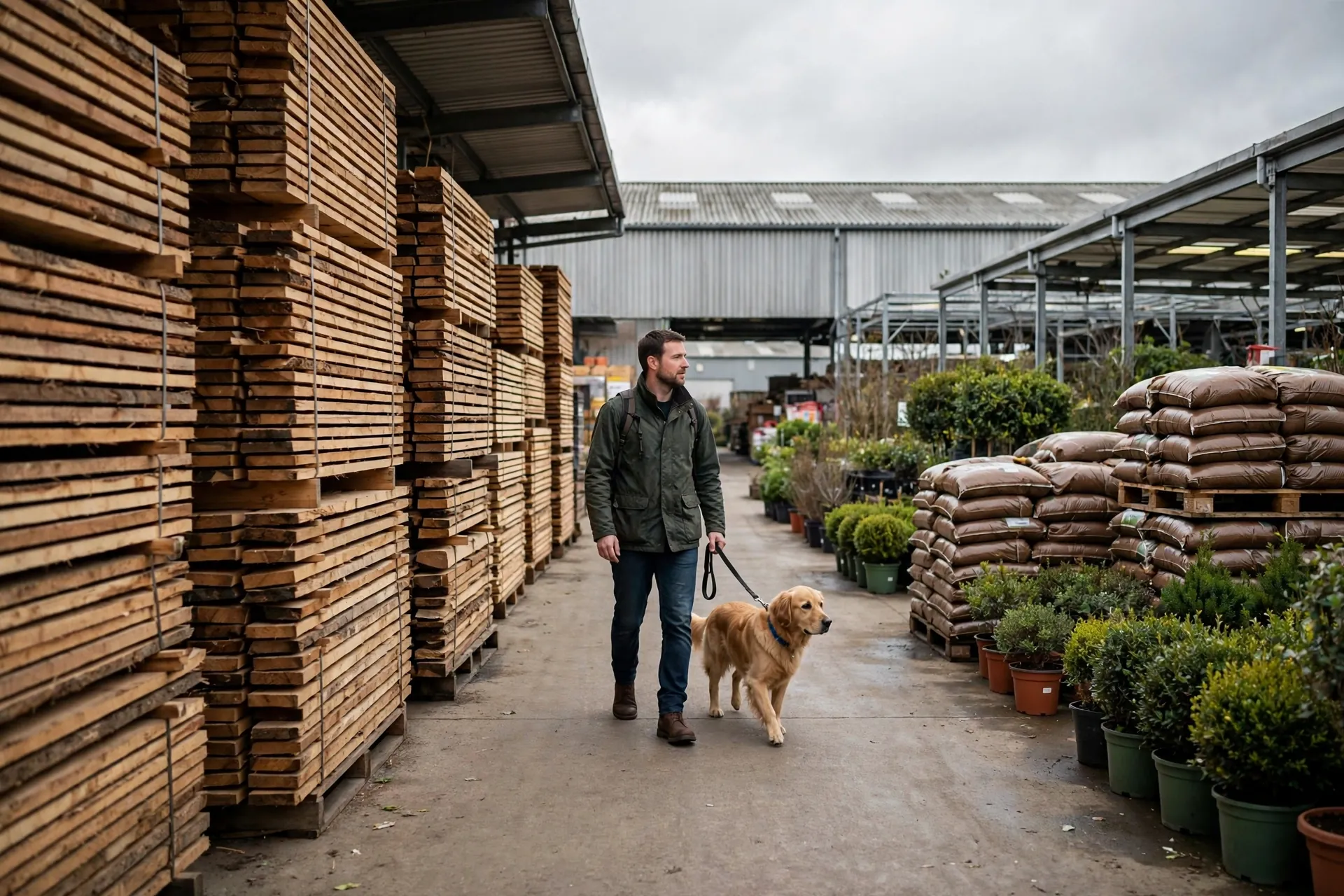
Timber, building materials and tools create physical rather than chemical risks. Lengths of timber carried horizontally turn corners at dog head height; sheet materials lean in racks and can slide; loose screws, nails and offcuts hide on the floor of cutting and hardware aisles where bare paws walk. Keep your dog beside you rather than ahead of you when you turn a corner, give anyone carrying a long load a wide berth, and scan the floor in the fixings aisle before you stop to browse the screw sizes. Power tool displays are usually secured, but demonstration areas and returned-goods trolleys can hold items with trailing cables and sharp edges at floor level. None of this is a reason to avoid the shop altogether; it is a reason to treat the visit as an exercise in active handling rather than a stroll where the dog wanders at the end of a long lead while you think about grout colours.
Noise and flooring complete the safety picture. Warehouse floors are polished concrete or sealed surfaces that many dogs find slippery, particularly older dogs and large breeds whose hips dislike scrabbling. If your dog’s feet splay or they hesitate at the entrance, that is information, not stubbornness: shorten the trip, stick to the outdoor areas, or call it a day. Sudden noises — a dropped plank, a reversing alarm, a tannoy announcement echoing off a high roof — can spook even steady dogs, and a startled dog lunging sideways into a display helps nobody. Keep the lead short enough that a startle moves the dog inches rather than a metre, and position yourself between your dog and the busiest traffic whenever you stop.
The garden centre and outdoor areas
For most owners, the outdoor garden centre is the highlight of a B&Q trip with a dog, and the part most likely to be genuinely enjoyable for both of you. There is space to move, fresh air instead of echo, plants to sniff at a respectful distance and none of the clatter of the main warehouse. Many people sensibly structure the whole visit around it: garden centre first for the plants and compost, a short pass through the indoor aisles only for items they can carry, and no attempt to do a full renovation shop with the dog in tow. If your branch lets you enter the garden centre directly from the car park, that route can reduce the indoor portion to almost nothing.
Outdoor does not mean hazard-free. Compost, manure-based soil improvers and cocoa-based mulches attract scavenging dogs, and a mouthful bolted from a torn bag can mean a vet visit, so keep noses out of split sacks and give torn or spilt product a wide berth. Fertilisers and lawn treatments are often displayed outdoors at ground level; the same discipline as the chemical aisles applies. Water is another trap: dogs love to drink from plant trays, saucers and puddles in the yard, but that water can carry fertiliser residue, algae or cleaning chemicals. Carry your own small bottle and a collapsible bowl, as you would on any outing, and offer that instead.
Weather shapes the outdoor areas in both directions. In summer, tarmac and concrete yards heat up fast, shade is patchy between plant benches, and a dog waiting while you compare paving slabs can overheat quietly. Test the ground with the back of your hand; if it is too hot to hold there comfortably, it is too hot for paws, and the visit should move to the shaded benches or wait for a cooler hour. In winter the same yards are exposed, wet and sometimes icy, and grit and de-icer residue irritate paws — rinse feet at home after a winter trip. Broken pots, stray staples from pallets and splinters from outdoor timber stacks are year-round floor hazards, so keep scanning the ground as you walk, especially around the compost and paving displays where heavy goods are dragged and dropped.
One more garden-centre courtesy matters: other customers are choosing plants they will take home, and nursery stock is easily damaged by a dog pushing through a bench of bedding plants or cocking a leg on a potted shrub. Keep your dog in the main walkways, not threading between display benches, and never let them urinate on plants, pots or bagged compost — walk them to a verge outside before you go in, and if an accident happens on a product, tell staff and offer to pay. Owners who behave like that are the reason garden centres stay welcoming; owners who treat the plant area as a dog run are the reason policies get reversed.
Lead, trolley and control rules in practice
Every account of dogs being welcomed in B&Q comes with the same condition: on a lead. In practice that means a short, fixed lead held in your hand — not a retractable lead extended to three metres across an aisle, which creates a trip wire for other shoppers and gives you no control when a trolley rounds the corner. If you only own a retractable lead, lock it short before you enter or, better, swap to a standard lead of around one to two metres for shop visits. A harness your dog is used to is fine; what matters is that you can bring the dog to your side in one step and keep them there while loads pass.
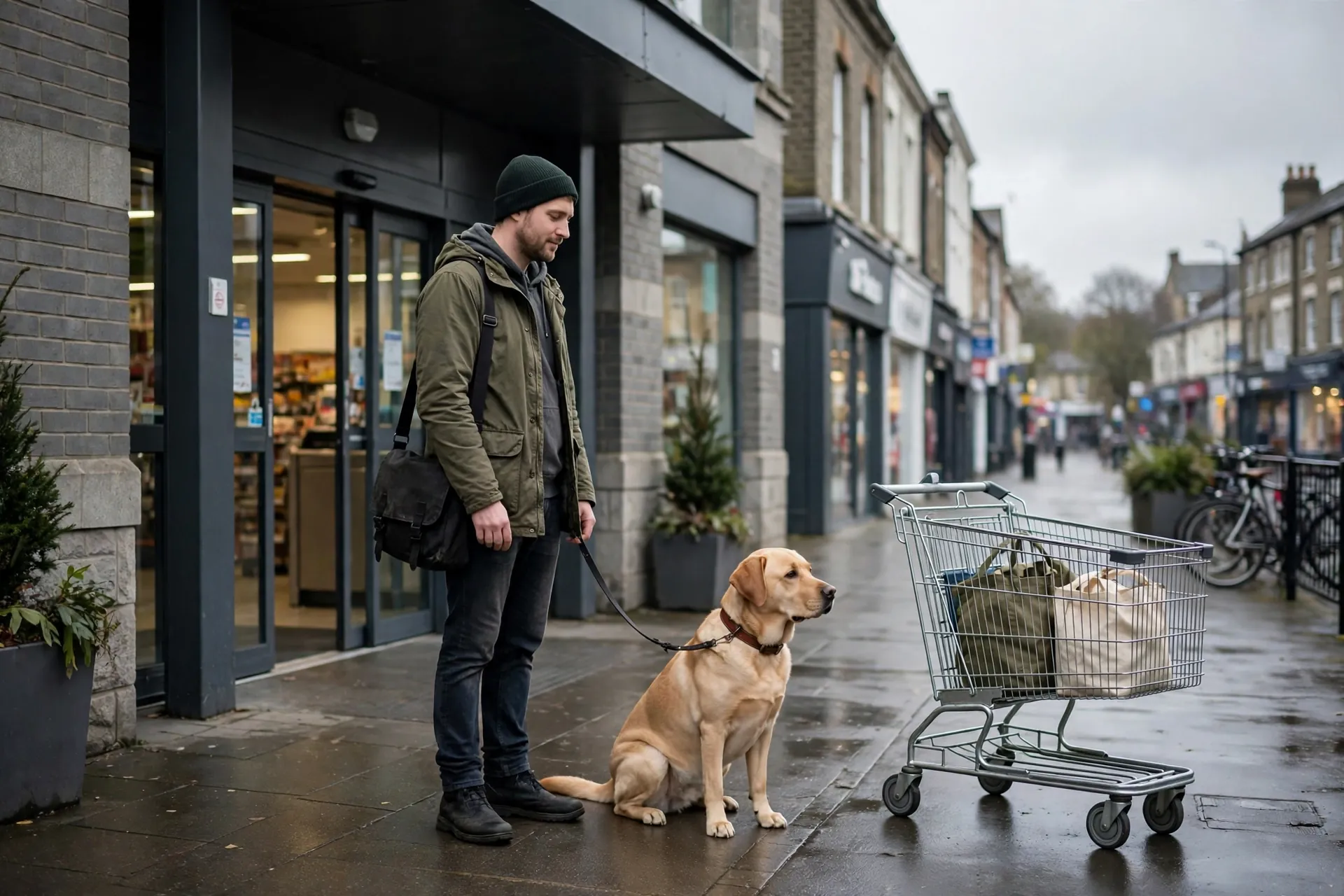
Trolleys raise a question owners ask constantly: can the dog ride in one? The safe default is no, unless a member of staff at that store tells you otherwise. Standard B&Q trolleys are built for goods, not animals; a dog standing on a metal grid floor can trap a toe, panic at the noise and movement, and leap out suddenly near the car park. Flatbed trolleys are worse, placing the dog at exactly the height of passing sheet materials. Small dogs are sometimes carried in arms or in a secure carrier, which some stores tolerate and others do not — ask rather than assume, keep the carrier closed, and never place a dog in a trolley that will also carry paint, chemicals or sharp tools. If carrying is not an option and walking is not working, the visit is over; there is no version of finishing the shop that justifies an unsafe ride.
Control is broader than the lead itself. Your dog should be able to walk past another dog without lunging, stand beside you at a shelf without wrapping the lead around a display, and wait at the till without greeting every person in the queue. You should have one hand effectively dedicated to the dog; if your list requires two hands for lifting bags of cement or manoeuvring a flatbed of plasterboard, that is a two-person shop or a dog-free shop, because a lead looped around a trolley handle while you heave is control in name only. Keep treats for rewarding calm behaviour, but feed them in a quiet corner rather than at the till, and avoid squeaky toys or games that raise excitement in an echoing building.
Toileting and accidents are part of control too. Give your dog a proper chance to toilet on grass or a verge before you go in — never on the store’s planted displays or bagged goods — and carry bags as you would anywhere. If your dog does foul indoors, clean it up yourself immediately, tell a member of staff where it happened so the floor can be disinfected, and apologise plainly. Staff judge dog access by how owners handle the worst moments, not the best ones, and a prompt, unbothered clean-up is remembered far more kindly than an owner who walks away from a puddle between the paint rollers.
Puppies, nervous dogs and assistance dogs
A B&Q visit can look like a gift for puppy socialisation: new sounds, surfaces, people and smells in one dry, spacious place. Used carefully and briefly, in a store that welcomes dogs, it can indeed help a puppy learn that shops are uneventful — but only under conditions that protect both the puppy and the experience. Go at a quiet time, stay in the widest and calmest areas, keep the visit to a few minutes, and leave before the puppy is tired, overexcited or desperate for the toilet, since accidents are near-certain with young puppies on exciting outings. Carry a puppy that is not fully vaccinated rather than putting paws on floors used by many dogs, and check current veterinary advice if you are unsure; a shop floor is a shared surface, and the risk judgement for an unvaccinated puppy is different from that for an adult dog.
Nervous and reactive dogs need a more honest assessment. A warehouse store offers no escape routes: aisles are long, corners are blind, and another dog can appear at the end of a display with little warning. If your dog reacts to unfamiliar dogs, to men in hi-vis, to sudden noises or to children at eye level, a DIY store contains all of those triggers arranged in sequence. Some reactive dogs cope well in the outdoor garden centre only, with its sightlines and space; others are better served by a quiet walk while a partner does the shop. There is no failure in deciding that, and our wider writing on travelling with anxious dogs makes the same point in every setting: the dog’s experience counts, not the owner’s convenience. If you do try, choose the quietest hour, rehearse an exit route in your head, and treat leaving early as success rather than defeat.
Assistance dogs sit in a completely different category, and it is important not to blur the two. An assistance dog is working, is trained to a high standard of behaviour, and has legal protection for access to services; a pet dog in B&Q is there by the store’s courtesy. Assistance dogs should be welcomed throughout the store, including areas where pet dogs may be asked not to go, and handlers should not be challenged with demands for certification beyond what the law and current guidance allow. If you are shopping with a pet dog and meet an assistance dog in an aisle, give it the widest possible berth, do not let your dog approach, greet or sniff it, and say nothing that distracts it from its handler. That courtesy costs you three seconds and matters enormously to the person relying on that dog.
Age and health deserve a final word. Older dogs with arthritis often struggle with the combination of hard, smooth floors and long aisles with nowhere to rest; a full lap of a warehouse is a longer walk than it looks, and there is nowhere appropriate to settle down for a break indoors. Dogs recovering from surgery, dogs in season and dogs that are unwell should simply skip the trip. If in doubt, ask what the visit offers the dog: if the honest answer is nothing beyond your own convenience on a day when staying home was an option, choose the option the dog would choose.
Etiquette that keeps stores welcoming
Dog access in shops survives on accumulated goodwill, and goodwill is built by unglamorous behaviour repeated by hundreds of owners. Arrive with a dog that has already had a walk and a toilet break, not a dog bursting with energy after hours at home. Enter calmly, keep the lead short from the car park onwards — car parks are the most dangerous part of the whole visit, with reversing cars, loose trolleys and delivery vehicles, so treat the walk to the door as part of the shop, not a warm-up for it. If there is a greeter or a member of staff near the entrance, a brief “dogs are okay today?” costs nothing and occasionally saves you from walking a policy change the length of the store before discovering it.
Inside, the rules are the same ones that make any shared space work. Keep your dog beside you and out of the centre of the aisle when you stop. Do not let them greet other dogs without the other owner’s clear agreement; many dogs in shops are there under protest or in training, and an enthusiastic greeting in a confined aisle can undo someone’s careful work in seconds. Do not let children stroke your dog in a crowd without managing the interaction yourself, and be ready to decline politely — a shop is not a petting zoo, and a dog that is tolerating an outing does not owe strangers a cuddle. If your dog barks, settle them once; if the barking continues, take them outside and reset or leave, rather than letting a chorus echo around the warehouse while other customers wince.
Respect the stock as you would in any shop that has trusted you with unusual access. Dogs should not chew display items, lick products, climb on pallet displays or be lifted onto counters and showroom furniture for photographs. Photographs deserve a specific mention: a quick picture of your dog beside the plant you are buying is harmless in a quiet corner, but staging photos in busy aisles, on display kitchens or with the dog in a trolley “for the likes” is exactly the kind of behaviour that gets quoted when a retailer reviews its policy. Take the hint from pub and café culture — the places covered in our guide to dog-friendly cafés in the UK stay welcoming for precisely the same reasons, because regulars clean up, keep dogs off furniture and leave before their dog becomes the room’s problem.
At the till, position your dog behind or beside you, away from the conveyor, the card reader cable and the next customer’s ankles. Pay, pack and leave without letting the lead drift across the exit route, and thank staff if the visit went smoothly — it registers. Then finish the outing the way you started it: straight across the car park with the dog close, no loose lead while you load the car, and never a dog left alone in the vehicle while you return the trolley to a distant bay. Take the trolley back with the dog walking with you, or load the dog safely and choose the nearest trolley park. Small decisions like that are the whole of etiquette, really: nobody notices them individually, and everybody notices when they stop happening.
How to check your local store before you go
Because discretion sits with each branch, checking is not a courtesy extra — it is the core skill of shopping with a dog at B&Q. Start with the official B&Q website: look for help pages on store services and accessibility, and for your specific store’s page, which lists its facilities, opening hours and contact number. Online information tells you the general position, but for dogs the decisive source is the store itself, because only the team on site can tell you today’s position in that building. If anything you read online conflicts with what the store tells you, follow the store.
A phone call takes two minutes and gives you everything this guide cannot. Ask four things, in this order. First, are well-behaved pet dogs on leads welcome in this store at the moment? Second, are there any areas you should avoid with a dog, such as the trade counter or paint mixing desk? Third, is there a best entrance or route — for example, straight into the garden centre — and anywhere dogs must not go, such as a café? Fourth, is there anything happening today, such as a refit, an event or stock movement, that makes it a bad day to bring a dog? Write down the answers, and if you are told yes, note the name of the person who said so; it smooths any confusion at the door far better than insisting that “the website said”.
Timing your checked visit well multiplies your chances of a good experience. Mid-morning on a weekday, after the trade rush and before lunch, is often the calmest window in a large store; weekday evenings can also be quiet but may coincide with shelf-filling and pallet movement. Weekends, bank holidays and the first warm Saturday of spring — when the entire town buys barbecue charcoal and bedding plants at once — are the worst times for a first visit, a nervous dog or a long list. Bad weather cuts both ways: rain empties the garden centre but pushes everyone indoors, while heat makes car parks and yards risky for paws. Choose the slot that suits your dog, not just your diary.
If your local store says no, take it gracefully and use the alternatives rather than arguing the national reputation. Click-and-collect lets one person run in while another walks the dog nearby. Delivery covers heavy and bulky items better than a car boot does. Another branch a few miles away may have a different layout and a different answer, and independent garden centres and hardware shops are often delighted to welcome a dog — ask them with the same phone-call method. The habit of checking travels well: it works for every retailer, café and attraction in Britain, and once it is automatic you will rarely be caught out at a doorway again.
If you are turned away
Even after checking, plans occasionally fail: a store changes its position, a new manager applies a stricter rule, or an incident that morning means dogs are paused for the day. How you handle that moment decides whether it stays a minor inconvenience. Stay polite, keep your dog calm and close, and ask one clarifying question — is this a permanent change for this store, or just today? The answer tells you whether to update your mental note for next time or simply try again next week. Do not demand to see a written policy at the door, do not cite other branches, and do not attempt to slip in through the garden centre or trade entrance instead; being caught doing that converts a misunderstanding into a reason for a permanent ban.
Above all, do not solve the problem with the car. A dog left alone in a car while you complete “just a quick shop” faces rising temperatures even on a mild, cloudy day, plus theft risk and the stress of watching you disappear into a strange building. If nobody can stay with the dog outside, the correct outcome is that the shopping waits: drive home, drop the dog somewhere safe, and return alone — or reorder the day so the dog gets their walk first and the DIY run happens afterwards. It is frustrating, and it is also the entire bargain of owning a dog and taking them places: their safety outranks your schedule every single time.
If you believe an assistance dog has been refused, the situation is different in kind, not just degree, because legal rights are engaged. Stay calm, ask for a manager, explain the dog’s status clearly, and make a note of the time, the store and what was said. Follow the retailer’s complaints process afterwards and, if needed, take advice from an assistance dog organisation or disability advice service on the current position — check official guidance before your visit rather than relying on memory, because the detail matters. Pet owners reading this should not borrow that script for a pet dog refusal; courtesy access refused is disappointing, but it is the store’s choice to make, and accepting it well is part of how the welcome survives for everyone else.
Finish on the longer view. Every uneventful, well-handled B&Q trip — the dog that walked quietly past the timber stacks, toileted before entering, ignored the assistance dog at the tills and left the paint aisle exactly as clean as it found it — is a small deposit in the account that keeps those doors open. Retailers do not review policies by counting good visits; they review them after bad ones. Shop like someone who wants the answer to stay yes, and for most branches, on most days, it will.
The same check-first habit applies to the post run: Our guide to dogs in the Post Office explains branch-by-branch rules before you queue with a parcel.
Practical questions
Before you go
Are dogs allowed in all B&Q stores in the UK?
No, not automatically. Many B&Q stores welcome well-behaved dogs on leads, but the final decision rests with each store, and policies can differ by location, layout and whether there is a separate trade entrance. Always check with your local store before travelling, especially if you are making a special trip, and be ready to shop elsewhere if that branch says no on the day.
Does my dog need to be on a lead in B&Q?
Yes. Dogs that are welcomed into B&Q are expected to stay on a short, fixed lead and under close control at all times. Retractable leads should be locked short or left at home, dogs should not ride loose in trolleys unless the store explicitly allows it, and you should keep your dog away from other shoppers, staff and stock. If your dog cannot settle on a lead in a busy aisle, a shop visit is not fair training.
Can dogs go into the B&Q trade counter and paint mixing area?
Often not, or only with staff permission. Trade counters, paint mixing desks and cutting services involve queues, machinery, strong smells and spilled chemicals, so staff may ask you to wait in a wider aisle with your dog while another adult completes that part of the shop. Never assume access: ask at the desk, keep clear of forklifts and cutting equipment, and check the official store guidance before you visit.
Are assistance dogs treated differently in B&Q?
Yes. Assistance dogs have legal access rights that pet dogs do not, and they should be welcomed throughout the store, including areas where pet dogs may be restricted. Staff should not ask for unnecessary proof or charge extra. If you are travelling with an assistance dog and meet a problem at the door, ask politely for a manager and refer to the store's accessibility information and current official guidance.
Can I take my dog into the B&Q garden centre section?
In many stores the outdoor garden centre is the easiest and most comfortable area for a dog, with more space, fresh air and fewer fragile displays. Access still depends on the individual store, and you should watch for fertilisers, slug pellets, broken pots and hot tarmac in summer. Keep your dog on a short lead, avoid letting them drink from plant trays or puddles, and check with staff if any part of the garden area is signed as no dogs.
What should I do if a B&Q store manager asks me to leave with my dog?
Leave politely and do not argue at the till: B&Q’s own FAQ says store managers may make a local decision to exclude any dog from a store, other than guide dogs and special assistance dogs, which are always permitted. The decision is the store’s to make, so the useful step is to ring another branch or come back without the dog. See the rule on B&Q’s official FAQ page: B&Q general information FAQs (checked October 2026).
What hazards should I steer my dog away from inside B&Q?
Keep your dog on a short, fixed lead and close to you, and steer clear of forklifts and cutting equipment, trade counters and paint mixing desks unless staff say otherwise, and spills or low displays of paint, solvents, weedkillers, fertilisers and slug pellets. In the garden centre, keep noses out of split sacks and do not let your dog drink from plant trays or puddles. A store manager can still ask you to leave with a pet dog, while guide dogs and special assistance dogs are always permitted. See our guide to assistance dog rights in the UK for the access rules that apply to assistance dogs.