This guide is independent and contains no paid placement. Chain policies change and individual pubs apply them differently, so always check the current rule for the exact pub before you travel.
Pet dogs are not allowed in Wetherspoons pubs — inside or outside. Under Wetherspoon’s published policy, animals are not allowed in its pubs, hotels, gardens, car parks or other external areas; the only exceptions are trained guide dogs and assistance dogs with accredited training from Assistance Dogs UK (ADUK) member organisations or the Assistance Dog Assessment Association (ADAA), and staff may ask for proof of that training. The same ban is stated in the hotel terms and conditions (clause 8, Pets). Some individual pubs are reported to be relaxed outdoors in practice, but that is a local exception, not the rule — always check with the specific pub before you travel, and have a dog-friendly alternative ready.
The short answer, without the wishful thinking
It starts raining halfway through a dog walk, the nearest roof belongs to a Wetherspoons, and someone in the group says, “They let dogs in, don’t they?” That sentence — half memory, half hope — is where most disappointing pub trips begin. The honest answer has two halves, and mixing them up is what causes the awkward conversation at the door.
First half: under company policy, pet dogs are not allowed inside a Wetherspoons pub. That applies to the bar, the dining areas and the carpeted family sections alike, whether the pub is empty at three o’clock on a Tuesday or packed on a Saturday night. A quiet pub is not an exception to the rule, and neither is a very small dog, a dog in a carrier, a dog asleep in a bag or a dog that “won’t be any trouble”. Staff who enforce the rule are not being difficult; they are applying the policy they are trained and managed on.
Second half: the company policy does not stop at the door. Wetherspoon’s published policy covers gardens, car parks and other external areas too, so the default for a pet dog outside is also no — not a separate, friendlier garden rule. What varies in practice is local enforcement: some individual pubs are reported to be relaxed outdoors, letting well-behaved dogs use a beer garden or terrace, while others apply the company ban everywhere on the premises. Because the estate ranges from converted cinemas and banks in city centres to large suburban pubs with lawns, what you find on the ground can differ from pub to pub. That is why every useful answer in this guide ends with the same instruction: individual pubs may apply the policy differently in practice, so check with the exact pub before you travel — and never treat a garden welcome as the rule.
Keep those two halves separate in your planning. If your plan needs a roof, heating and a table inside — a winter birthday meal, a long wait for a train in bad weather, a family lunch where grandma needs to be warm — a Wetherspoons is the wrong plan for a pet dog, and you should book somewhere from the start that welcomes dogs indoors. If your plan is a summer walk ending with a drink at an outdoor table, a Wetherspoons garden is only a possibility where that exact pub confirms a local exception in advance; the company rule itself says no. Treating the pub as a possible garden stop rather than a guaranteed indoor refuge makes the whole day more relaxed.
Why inside is different: food, scale and assistance dogs
Understanding why the chain draws the line indoors helps you predict how staff will respond. Wetherspoons pubs serve a lot of food, in large open rooms, at high speed, with customers carrying trays and plates through the same spaces where a dog would be lying. Add children moving between tables, glass collection, and the sheer number of covers in a big converted building, and a blanket indoor rule is simply easier to run consistently than hundreds of local judgements. You do not have to like the rule to plan around it accurately.
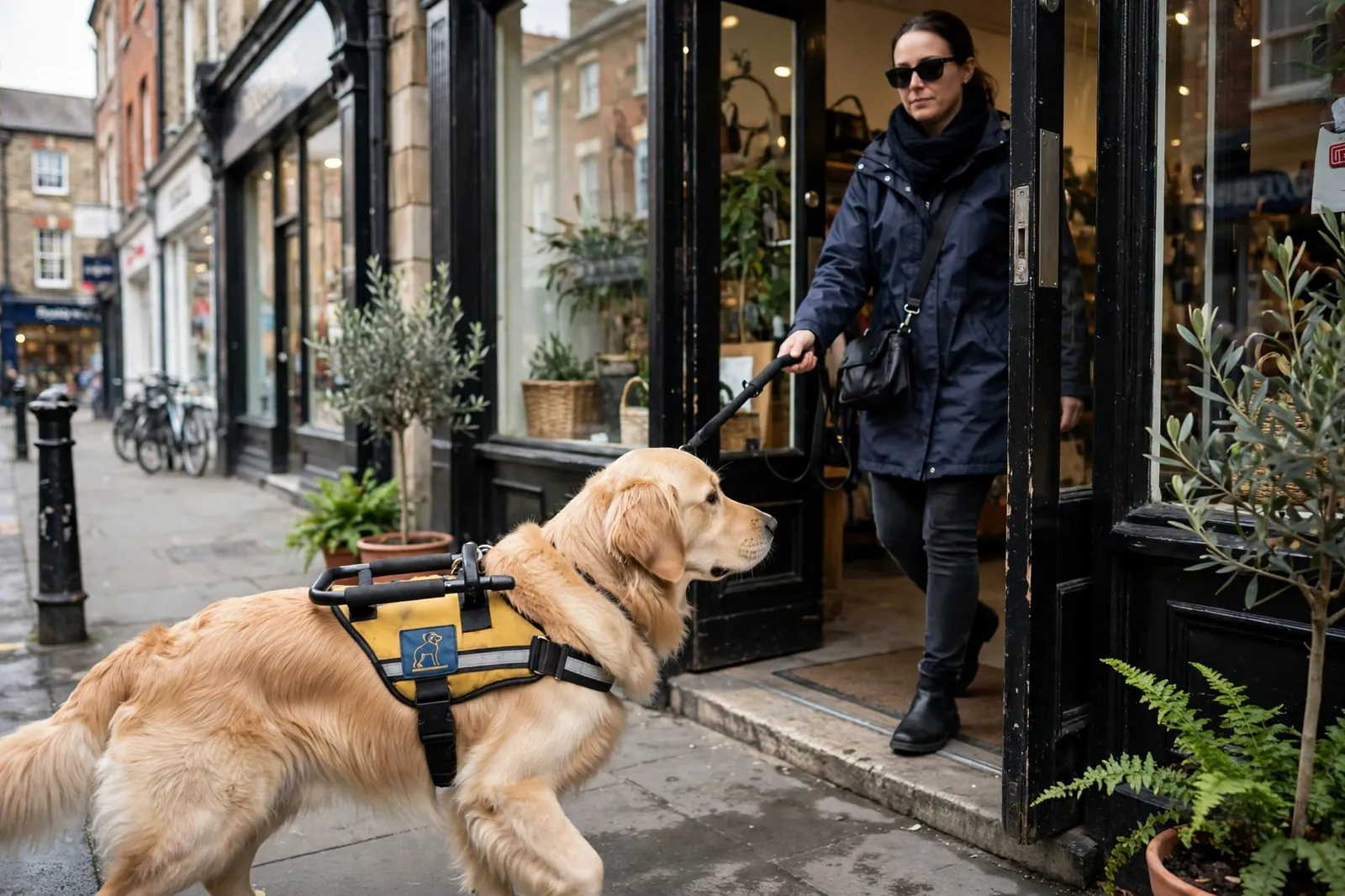
The important exception is not really an exception at all. Assistance dogs are welcome inside because they are not pets in this context: they are trained working dogs that enable a disabled person to use the pub on equal terms. Refusing an assistance dog, charging for one, or pushing the handler into a corner away from other customers would normally be unlawful under equality law in Great Britain, and different arrangements apply in Northern Ireland. Our guide to assistance dog rights in the UK explains what staff can and cannot ask, and what to do if access is challenged. If you travel with an assistance dog, you do not need to phone ahead to ask permission to enter, although some handlers still call ahead about access, space for the dog beside the table, or a quieter seating area — that is a practical choice, not a legal requirement.
Emotional support animals and therapy dogs, however well trained they feel to their owners, do not automatically carry the same legal access rights as assistance dogs in the UK. A harness bought online, a certificate from a registry, or a letter that is not part of a recognised assistance training route will not turn a pet into an assistance dog at the door. Presenting a pet as an assistance dog also makes life harder for genuine teams, whose dogs may then face more suspicion and more questions. If your dog is a pet, plan as a pet owner: garden where allowed, or a different pub where pets are welcome inside.
One more indoor trap deserves naming. Some pubs in the chain sit inside larger buildings — stations, shopping areas or hotels — where the route to the garden crosses the interior. Even if the garden welcomes dogs, you may not be able to walk a pet through the bar to reach it. Ask about the entrance route when you check. A garden that can only be reached through the dining room is, for a pet dog, not an accessible garden at all, and discovering that with a thirsty dog and a round already ordered is nobody’s idea of a good afternoon.
The garden is not a guarantee: four kinds of outdoor space
“It has a garden” can mean four quite different things — but first, the policy baseline: a garden does not escape the company ban. Wetherspoon’s published policy covers gardens and other external areas, so any garden welcome for a pet dog is a local exception granted by that pub, not a company-wide garden rule. Sorting the types of outdoor space out before you go still saves most surprises, because where an exception exists it usually follows the type of space.
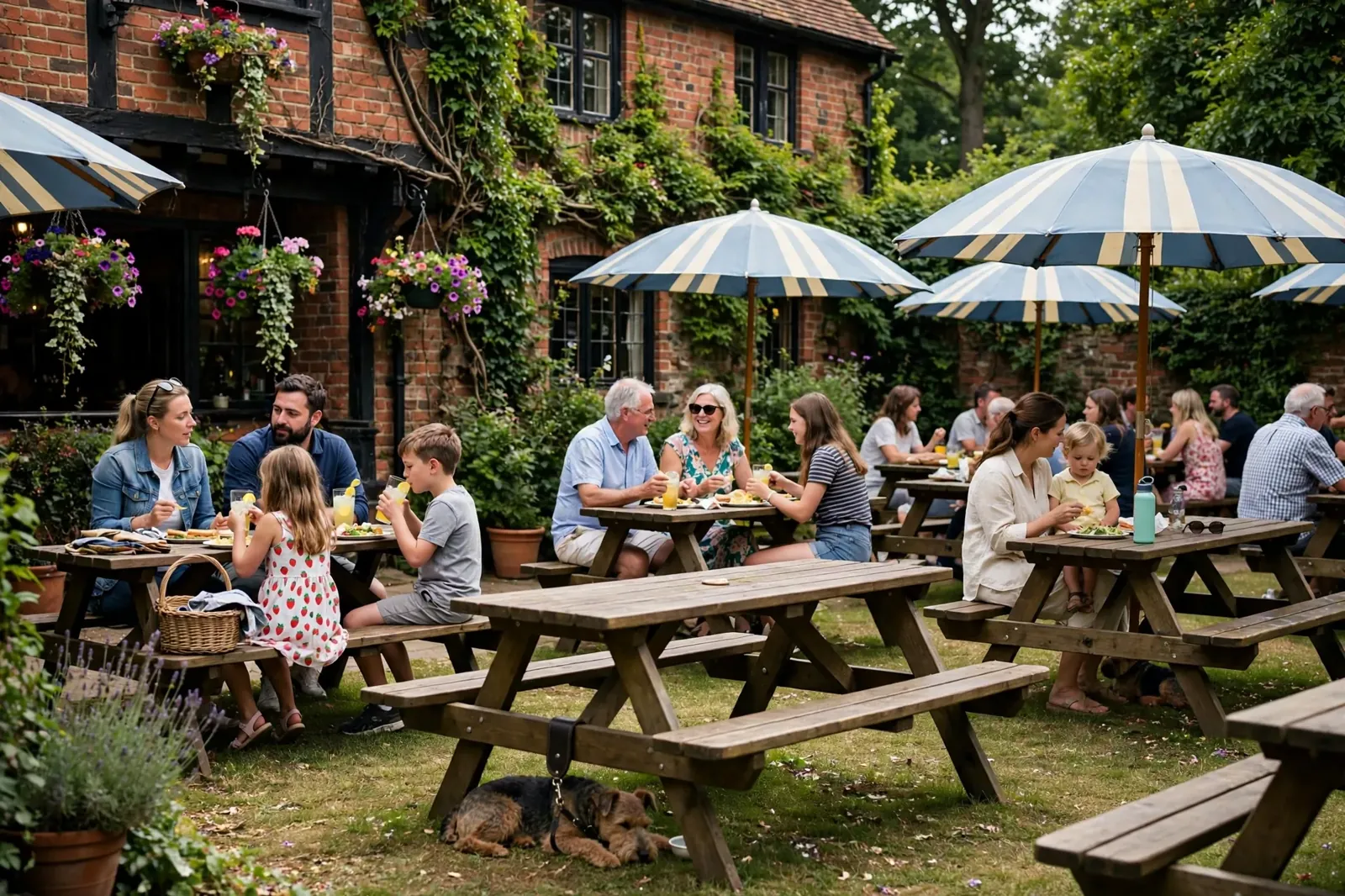
The first is a true beer garden: grass or paving behind or beside the pub, usually fenced, with fixed benches and often a separate gate or side entrance. Where a pub does make a local exception, these are the outdoor areas most likely to be the ones where it applies, because a dog under a bench there interferes least with food service and other customers. The second is a terrace or patio attached to the dining area, where tables are served exactly like indoor tables and staff carry hot food constantly between them. Dogs may be allowed at the outer tables only, or not at all. The third is pavement seating outside the front of a city-centre pub, sometimes little more than two tables beside a busy street. Even where dogs are technically allowed there, traffic noise, dropped glass and a lead trailing across a public pavement make it a poor choice for many dogs. The fourth is a smoking area. It may be the only outdoor space a particular pub has, it may be covered and busy, and it is rarely a pleasant or appropriate place to settle a dog for a meal, whatever the formal rule says.
Weather changes the category too. A garden that welcomes dogs in June can be closed entirely in January, locked for a private event, or given over to a marquee, heaters and extra seating at Christmas. Temporary fencing for building work can remove the side gate that made dog access practical. None of this appears reliably on a listing page, which is why a phone call close to the day beats a screenshot taken months earlier.
Finally, remember that garden permission is a licence for that visit, not a right. A manager can withdraw it on a crowded day, restrict it to part of the garden, or ask one owner to leave because a dog is distressed, lunging at passers-by or fouling the seating area. That discretion can feel unfair when you have checked in advance, but it is built into how outdoor dog access works almost everywhere. Our wider guide to dog-friendly pub garden etiquette covers the behaviour that keeps gardens open to dogs in general — the same habits that protect your welcome at a chain garden.
Check a specific pub: a five-minute routine that actually works
Checking properly takes about five minutes and has three layers, because each layer catches failures the others miss. Do all three for a pub you have never visited with a dog, and just the phone call for a pub whose listing you already know well.
Layer one: the individual pub page. Search for the pub by its proper name, not just the town — many towns have two or three pubs in the chain, sometimes within a few streets, and they can have completely different outdoor space. On the pub’s own page on the company website or app, look at its facilities, opening hours, garden or outdoor seating description and any specific note about dogs. Read for precision. “Beer garden” tells you the space exists, not that dogs are allowed in it. “Dogs welcome” without saying where usually needs the second layer anyway. Note the pub’s phone number from that page so you know you are calling the right building.
Layer two: the phone call, with the right questions. “Do you allow dogs?” invites a one-word answer about the inside, which you already know. Ask instead: “Are pet dogs allowed in your beer garden? Is there any part of the garden they cannot use? Are there times when dogs are not allowed outside, such as match days or Saturday nights? Do we come in through the garden gate or through the pub? And is there water available for dogs?” Those five questions produce a usable plan. Call at a quieter moment — mid-morning or mid-afternoon on a weekday — rather than during the Friday rush, and write down the answer with the date. If the person answering sounds unsure and says to “ask when you get here,” treat that as a warning, not a yes: plan a backup pub within walking distance.
Layer three: the arrival check. Look for signage at the garden entrance before you settle, choose your table, or order through the app. Signs about dogs, leads and designated areas override what you may have been told about a different pub or a previous visit under a different manager. If there is no sign and no obvious answer, catch a member of staff before ordering and ask one short question: “We checked the garden was fine for dogs — is this table okay?” That ten-second courtesy prevents the far worse conversation that happens after food has arrived. Once you have a clear yes, settle the dog first, then order.
What not to rely on: a review from two years ago saying a dog was spotted in the garden, a photo on a listing site showing a dog that might belong to a customer or might be an assistance dog, or the experience of a friend at a pub with the same name in another town. Chain branding makes pubs look interchangeable; how the company ban is applied on the ground is one of the places where they differ. Individual pubs may apply the policy differently in practice, so check before you travel — and check the pub you are actually going to.
Choose your spot: where to sit once the answer is yes
The best garden table for a dog is rarely the best table for the view. Aim for a corner or edge bench with a wall, fence or hedge behind you, so people and other dogs pass on one side only. Your dog can then lie facing outwards, watch the world from a predictable direction, and settle without being startled from behind. A table in the middle of the garden, on the route between the door, the bar hatch and the toilets, guarantees a stream of legs, trays and dropped chips within lead range of your dog’s nose.
Keep clear of three specific places. The first is the doorway swing and the first metre inside any gate, where arriving dogs meet departing dogs nose to nose in a space neither can leave. The second is the children’s play area, if the garden has one: running children, dropped ice cream and sudden shrieking are too much for many otherwise calm dogs, and parents reasonably expect the play space to be dog-free even in a dog-tolerant garden. The third is directly beside another dog that is already settled. Two calm dogs at neighbouring tables can still spend an hour in a low-level staring contest that neither owner notices until one of them erupts. One empty table of buffer is worth more than the sunniest seat in the garden.
Think about the surface and the shade as carefully as the position. Dark tarmac and decking can become uncomfortably hot for paws and bellies on a summer afternoon, while a shaded patch under a bench stays cool all day. Check where the sun will be in an hour, not just where it is now, if you are staying for food. In wet weather, avoid the drip line under parasols and the puddle that forms by every garden gate; a dog that has to lie in standing water will not settle, and a wet, restless dog shortens everyone’s visit. If the garden has both grass and paving, paving is usually the kinder choice after rain — grass turns to mud, mud transfers to benches and cars, and nobody relaxes.
Settle the geometry before drinks arrive. Shorten the lead and fix the dog’s place under the table or tight against your bench, with enough slack to lie down and turn, but not enough to reach the next table, the walkway or the dropped food under a neighbour’s chair. Never tie the lead to a table that a large dog could drag, and never loop it around a chair leg someone is about to move. A settle mat, if your dog is trained to one, turns an unfamiliar bench into a known place; it also keeps a damp dog off the bench timbers and signals clearly to staff that this dog has a place and is in it.
Garden etiquette that keeps the welcome open
Most garden rules are unwritten until somebody breaks them. The owners whose dogs stay welcome for years tend to do the same handful of things automatically, and none of them are complicated.
Give the dog a proper toilet break before you enter the garden — on a verge or street outside, not on the garden grass — and carry bags even if you are certain you will not need one. If your dog does foul the garden, clean it immediately, tell staff if the surface needs water, and do not pretend it belongs to somebody else’s dog. Few things turn a garden team against dogs faster than a mess discovered under a vacated table. Equally, do not let a male dog spend the visit scent-marking bench legs, planters and parasol bases; interrupt, move on, and choose a spot away from the furniture other customers will touch.
Keep the dog off the furniture. Benches and picnic tables are where the next family will eat, and “he is cleaner than most people” is not an argument that survives contact with a food business. Dogs belong on the ground, ideally under the table where they are out of the way of passing trays. If your small dog is genuinely distressed on the ground, the answer is your lap with the dog held securely and away from the table surface — or, more honestly, a different pub where the setup suits your dog better.
Manage greetings actively rather than hopefully. Not every dog in a garden wants to meet yours, and not every customer wants to meet either of them. Keep meetings on loose leads, in open space, with both owners consenting, and end them after a few seconds before excitement builds. If your dog barks at arrivals, position yourself between the dog and the gate, reward quiet attention early, and be ready to take a short walk around the block to reset rather than letting a barking match run through other people’s lunch. Persistent barking is the single most common reason individual owners are asked to leave gardens that otherwise welcome dogs — staff will generally warn once, and they are entitled to.
Feed your dog only from your own kit. A small handful of their normal treats or a chew that lasts ten quiet minutes is fine; a plate of pub chips, onion rings or anything containing onion, garlic or rich gravy is not a treat, it is a vet visit looking for somewhere to happen. Never let your dog beg at neighbouring tables, and step in cheerfully if strangers try to feed them — a polite “sorry, he is on a special diet” ends almost every such offer without offence, whether or not it is strictly true.
Water, food and ordering without leaving the dog
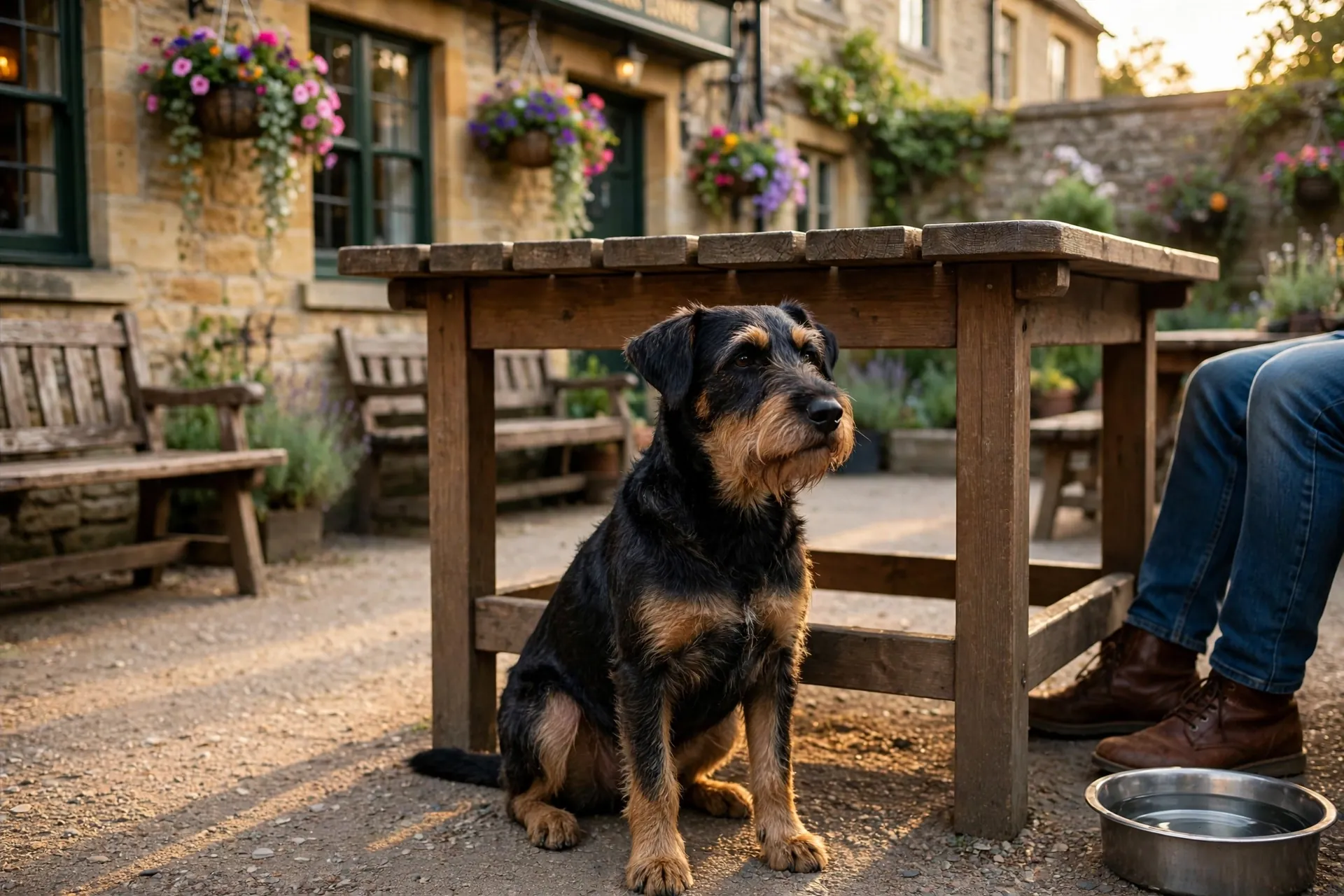
Water is the first practical test of any garden. Many dog-tolerant gardens provide a bowl by the entrance, a tap, or bowls on request at the bar — but you cannot count on any of those, and a communal bowl that has sat in the sun all afternoon is not something every owner wants a puppy, an elderly dog or a dog with a weakened immune system drinking from. Carry your own collapsible bowl and a bottle of water as standard. It weighs almost nothing, it means the dog drinks immediately on arrival rather than after your first round, and it keeps you independent of whether the pub’s bowl is present, clean or already claimed by a dog twice yours’ size. Ask staff before refilling from an inside tap if the route indoors is unclear; many gardens have an outside tap precisely so dog owners do not need to queue at the bar with a bowl.
Ordering food with a dog outside raises the classic solo-owner problem: the dog cannot come inside, and should not be left tied up alone outside either. A tied, unattended dog is at risk of theft, of being fed or teased by strangers, of tangling its lead, and of a frightened reaction if another dog approaches and it cannot move away. If you are visiting as a pair or group, the answer is simple — one person stays with the dog, the other orders. If you are on your own, table ordering through the chain’s app, where the individual pub offers it to garden tables, solves the problem neatly; check the table number on your bench and confirm garden delivery is running before you rely on it. Where app ordering is not available to the garden, ask staff whether you can order at the door hatch or whether they will take an order at the table; some garden pubs are set up for exactly this. If none of that works, the honest options are a takeaway to eat on a bench outside the premises, or a different pub — not a dog tied to a railing while you queue indoors.
When food arrives, move your own plate out of lead range before the tray leaves the server’s hands, and decide in advance where dropped food lands in your setup. Chips will fall. A dog positioned under the table will find them faster than you can. A quick check under the bench before you leave — picking up dropped food, especially cooked bones, grapes or anything with onion — protects the next dog that sits there, including one with allergies whose owner cannot see what is on the ground until it is eaten. Leaving your table’s ground as clean as you found it is a small habit that garden staff notice and remember.
Busy days, match days and the evenings to avoid
A garden that is a pleasure at four o’clock can be the wrong place entirely by eight, and the difference is usually predictable. Live football on big screens draws standing crowds into gardens, with sudden roaring at goals that can terrify a noise-sensitive dog and send even a steady one scrambling under the bench. Quiz nights, karaoke, live music and bank holiday events have the same effect in slower motion: more people, more alcohol, more dropped glass, less space, and staff with no spare attention for a dog problem. Some pubs respond by restricting dogs in the garden during specific events or peak hours, which is one more reason the phone call matters if your visit coincides with a big match or a local event.
Read the day as carefully as the pub. A garden beside a stadium, a racecourse town on a race day, a seaside pub on the first hot Saturday of the year, or a city-centre terrace during a festival will all be operating at a level of crowding where a dog’s experience is mostly legs, noise and smells it cannot reach. Dogs do not enjoy atmosphere; they enjoy space, predictability and their owner’s attention, all three of which run out as a garden fills. If you arrive to find a queue at the gate, standing room only, or a screen being tested at full volume, take the hint early and use your backup plan rather than squeezing into the last corner table and hoping.
Heat deserves its own warning here because gardens concentrate it. On a genuinely hot day, a crowded garden with limited shade is a welfare problem, not a lifestyle choice: dogs overheat faster than people, dark surfaces store heat, water bowls empty quickly, and an excited dog in a noisy place may not show distress until it is urgent. Choose a morning or evening visit, a shaded edge table, frequent water, and a hard limit on how long you stay. If your dog is panting heavily, restless and unable to settle despite shade and water, the visit is over — go home, cool the dog gradually, and contact a vet if you are worried. No round of drinks is worth a collapsed dog, and staff would far rather you left early than dealt with an emergency in their garden.
Children’s peak times cut both ways. Early evening family hours can be lovely for a dog that adores children, and overwhelming for one that does not. Be honest about which dog you own. A dog that is merely tolerant will cope for one drink at an edge table; a dog that is anxious around small children should not be placed through a two-hour family meal at the next bench, however welcome dogs nominally are. Planning the pub stop around your dog’s actual temperament, rather than the dog you hope they will be after practice, is the thread that runs through every good pub trip — see our broader guide to eating out with dogs in the UK for how to judge a venue’s fit before you book a full meal.
If you are turned away: handle it well and learn the useful bit
Even with careful checking, it can still happen: a new manager, a private event, a garden closed at short notice, or a rule applied more strictly than the person on the phone described. The moment is annoying, especially with a thirsty dog and a plan built around the stop, but how you handle it decides whether you get useful information or just a bad afternoon.
Keep it short and polite. Put the dog on a short lead, step out of the doorway or gate so other customers can pass, and ask one calm question if the situation allows: is it that dogs are not allowed in this garden at all, that they are restricted today, or that the spot you chose is the problem? Each answer tells you something different. A blanket rule means do not return with a dog. A today-only restriction means your checking routine worked and the day beat you. A spot problem — too close to the food hatch, blocking a fire route, in a section reserved for dining — may have an immediate solution if another table is offered. What arguing will never do is change a licensing, safety or management decision at the door, and a scene at the entrance is the story staff will remember about dog owners generally.
Then use the backup you hopefully identified while checking. This is why the five-minute routine above includes noting another option nearby: the best time to find an independent dog-friendly pub is at your kitchen table, not on a pavement with a disappointed group. If there is genuinely no backup, a takeaway coffee and a bench in a park, churchyard or along a towpath is a perfectly good ending to a walk — the dog, notably, does not care whether the drink came with a branded glass. Note the pub, the date and what you were told in your phone; if you visit the area regularly, that note is the start of your own reliable local list, which will always beat generic listings.
Better alternatives when you want a proper pub, not a loophole
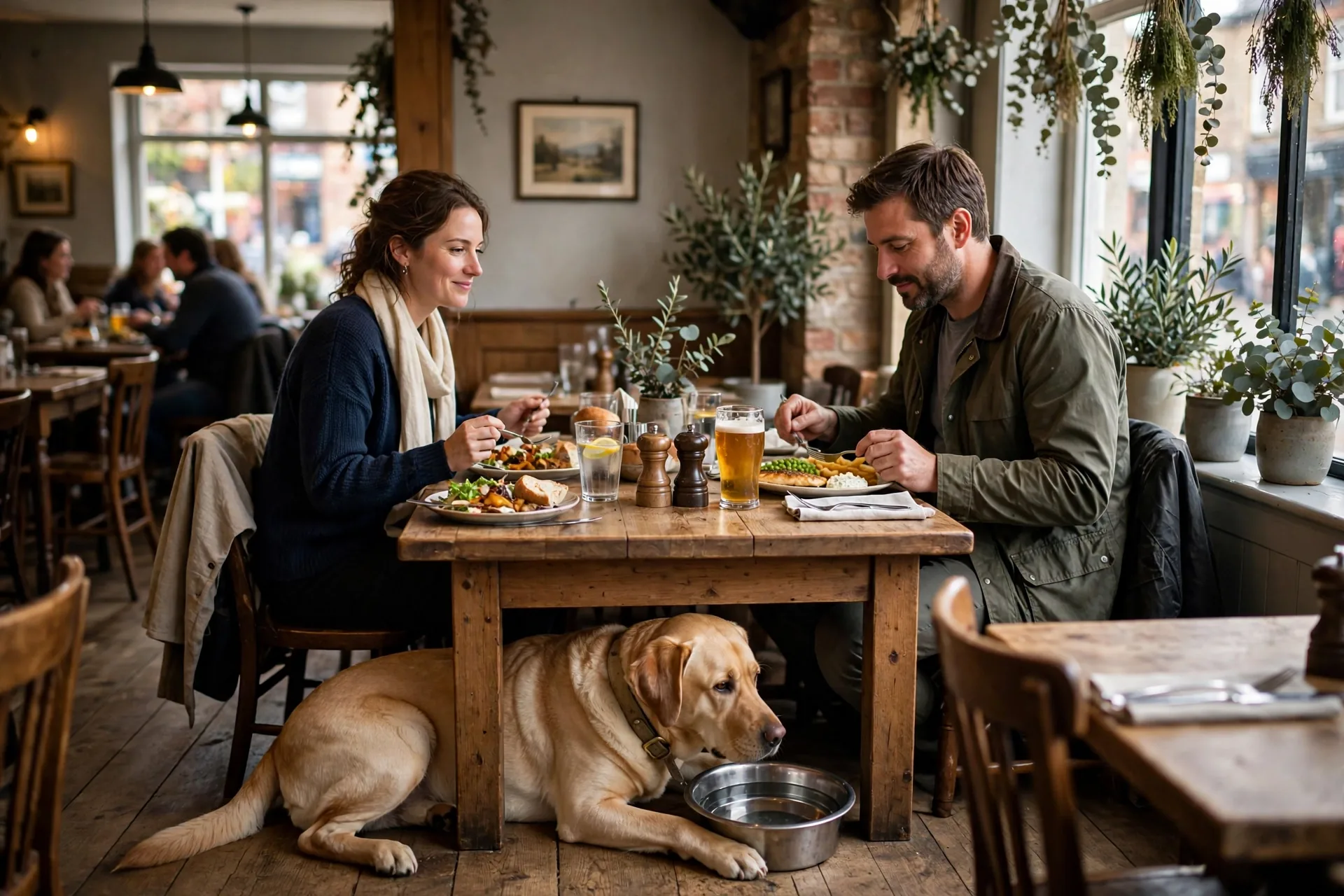
For many dog owners the real conclusion of this guide is liberating: stop trying to make a chain that does not want pet dogs indoors fit an occasion that needs them indoors. Britain is unusually well supplied with independent pubs, brewery taprooms, cafés and country inns that welcome dogs in the bar as a matter of pride — towels by the door, jars of treats on the counter, water bowls that appear before your own drink, and sometimes a dog menu. In those places your dog is part of the offer, not an exception being tolerated at the far end of a garden, and the whole visit is easier for it.
Finding them is a skill in itself. Local dog-walking groups, independent pub websites, and listings that specify “dogs welcome in the bar” rather than a vague paw-print icon are the most reliable sources. Phone with the same precision you would use for a chain pub: inside or garden only, any areas off limits, any times restricted, water and treats provided, and whether booking a dog-friendly table is possible on busy nights. Our guide to dog-friendly cafés across the UK covers the daytime version of the same judgement, for the many walks that end at elevenses rather than at the pub at all.
None of this makes a Wetherspoons garden a bad choice when it is the right choice. On a long town walk, in a place you do not know, a big chain garden with app ordering, predictable prices and a table you have verified — at a pub that has confirmed a local exception for your visit — can be exactly the low-effort stop you need. The skill is in the sorting: inside occasion, choose a pub that welcomes dogs inside; garden occasion, check the specific garden and get its answer before you set off; uncertain either way, phone before the walk, not from the doorway. Do that, and you will never again have the rainy-day conversation at the door that this guide opened with.
Practical questions
Before you go
Are pet dogs allowed inside a Wetherspoons pub?
No. Pet dogs are not allowed inside Wetherspoons pubs under company policy, and the same policy covers gardens, car parks and other external areas. The inside areas are reserved for trained guide dogs and assistance dogs with accredited training. Do not assume an exception because a pub looks quiet or because you have seen a dog inside elsewhere in the chain. If a specific pub is reported to be relaxed outdoors, that is a local exception, not the rule — check with the exact pub before you travel.
Can my dog sit in a Wetherspoons beer garden?
No, not under company policy: Wetherspoon’s published policy states that animals are not allowed in its pubs, hotels, gardens, car parks or on other external areas. Some individual pubs are reported to be relaxed outdoors in practice, but that is a local exception, not the rule, and it can be withdrawn on busy days. Always check with the specific pub before you set off, and have a dog-friendly alternative ready.
How can I check if a specific Wetherspoons allows dogs outside?
Find the individual pub page on the Wetherspoons website or app and look for its facilities and dog information, then phone the pub and ask specifically about the beer garden, any time restrictions and where dogs must sit. Ask again on arrival if signs are unclear, because the duty manager on the day has the final say.
Are assistance dogs allowed in Wetherspoons?
Yes. Trained guide dogs and assistance dogs with accredited training from Assistance Dogs UK (ADUK) member organisations or the Assistance Dog Assessment Association (ADAA) are welcome inside Wetherspoons pubs. They are working dogs, not pets, and refusing them would normally breach equality law in Great Britain. Note that Wetherspoon states it considers asking for proof of accredited training to be a reasonable adjustment, so staff may ask to see it. Emotional support dogs are not covered by this exception.
What should I do if staff ask us to leave the garden?
Stay polite, put your dog on a short lead and leave by the route staff suggest. Ask briefly whether the issue is a blanket rule, a busy-period restriction or something about the spot you chose, so you know for next time. Do not argue at the table or try a different entrance. Note the pub name and time and check its listing again before a future visit.
Are dogs allowed in a Wetherspoons beer garden?
No, not under company policy. Wetherspoon’s published policy states that animals are not allowed in its pubs, hotels, gardens, car parks or on other external areas; the exceptions are trained guide dogs and assistance dogs with accredited training from Assistance Dogs UK (ADUK) member organisations or the Assistance Dog Assessment Association (ADAA). The same ban is stated in the hotel terms and conditions (clause 8, Pets). Some individual pubs are reported to be relaxed outdoors, but that is a local exception, not the rule, so always check with the specific pub before you go, and have a dog-friendly alternative ready. Policies can change, so check before you travel.