This guide is independent and contains no paid placement. If affiliate links are added later, they will be clearly marked and will not change our editorial checks.
Dogs travel free on CrossCountry — up to two per passenger, on a lead or in a carrier, never on the seats, and with no booking needed for the dog. The challenge is not the rules but the railway itself: four- and five-car Voyagers with tight floor space, a hub change at Birmingham New Street on many routes, and journeys that can run for five hours or more. Pick an end-of-coach seat, travel off-peak where you can, and give your dog a proper toilet break before you board.
The CrossCountry dog rules, in full
CrossCountry is one of the more straightforward train operators for dog owners, and the headline is genuinely good news: dogs travel free. There is no dog fare, no pet ticket to buy at the machine, and no need to phone ahead or add the dog to your booking. You buy your own ticket, turn up with your dog on a lead, and board. That simplicity is the reason CrossCountry works so well for spontaneous trips — a walk in the Peak District or a weekend in Edinburgh does not need a week of paperwork first. But free does not mean unconditional, and the conditions are worth knowing word for word before you reach the platform, because they are the same conditions the conductor will apply if anything goes wrong.
The published rules allow dogs, cats and other small animals to travel free of charge, up to a maximum of two pets per passenger, provided they are well behaved and do not endanger or inconvenience other passengers and staff. That last phrase does a lot of work. It covers barking at strangers, lunging at other dogs, blocking the aisle, and any behaviour that makes the people around you uncomfortable. There is no published list of banned breeds for CrossCountry services, and no size limit written into the pet rules — but the operator reserves the right to ask you to leave or to prevent a dog from boarding because of its behaviour or size, or if the train is very busy. In practice that means a calm Labrador is never a problem and a reactive dog on a packed Friday-afternoon Voyager can be refused, and the decision sits with the staff on the day. If your dog is the sort that struggles in crowds, that discretion is the single most important thing to plan around, and you should check the official guidance before you travel if you are unsure whether your dog will be accepted on a particular service.
Leads are non-negotiable. Dogs must be kept on a lead at all times unless they are contained in a basket or carrier, and that applies on the platform and in the station just as much as on the train. A dog that is normally reliable off the lead at home still needs one here: stations are full of moving luggage, food smells, other dogs and the edge of a platform. For dogs without leads, and for cats, birds and other small animals, the carrier must be an enclosed basket, cage or pet carrier measuring no more than 85 x 60 x 60 cm. It must be rigid rather than soft-sided, it must not open, and the animal inside must be able to stand and lie down in comfort. That size limit matters more than it looks: a carrier that big will not fit in the footwell of a Voyager seat, so a large dog in a carrier is a different logistical problem from a small dog in a carrier, and you should measure before the day rather than discovering the problem in the vestibule.
Two further rules catch people out. Animals are not allowed on seats or tables in any circumstances, and animal carriers must not occupy seats either — if a carrier takes a seat, an extra charge can be made. That is the rule that ends the idea of booking the window seat for the dog, or of lifting a small dog onto the empty seat beside you on a quiet train. The dog's place is the floor. And assistance dogs are treated separately from pet dogs throughout: they are welcome on all CrossCountry trains free of charge, can travel in any part of the train except on seats, and are not counted against the two-pet limit. If you travel with an assistance dog, none of the juggling in this guide about floor space and peak-time refusal applies in the same way, although the lead rule and the seat rule still do.
One more point deserves a plain statement. CrossCountry does not require a muzzle, a dog passport, a vaccination record or any other paperwork for a domestic dog travelling within Great Britain. What it does require is a dog that can cope with a busy, noisy, enclosed space for the length of the journey you have chosen. That is a temperament test, not a paperwork test, and it is the reason the rest of this guide spends so much time on seat choice, route choice and journey length: the rules will let almost any well-behaved dog on board, but a five-hour ride in a crowded carriage is a big ask for a dog that has only ever done twenty minutes to the beach.
Which trains you will actually ride: Voyagers and Turbostars
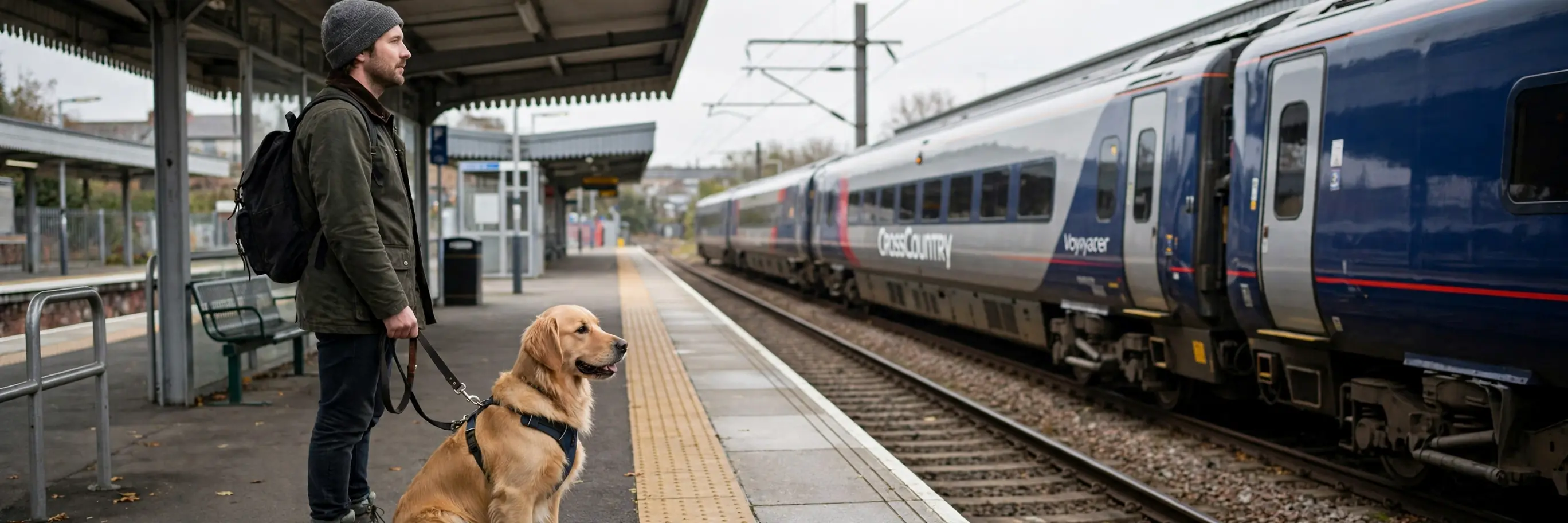
Almost every long-distance CrossCountry service runs with a Voyager — a Class 220 with four coaches or a Class 221 Super Voyager with five. These are the diesel trains that have worked the cross-country network since the early 2000s, running at up to 125 mph on routes that other operators barely touch. A four-car Voyager carries around 200 seats and a five-car set around 260, which sounds generous until you remember that a single train can be carrying a full load of passengers from Plymouth to Edinburgh with luggage for a week away. For a dog owner, the important numbers are not the top speed but the interior ones: the coaches are narrower than the trains on the London main lines, the vestibules are compact, and the luggage racks at the ends of the coaches fill up early on long routes. There is no buffet car and no dedicated dog area, so the space your dog gets is the floor in front of your seat and whatever you can negotiate around the luggage.
The shorter CrossCountry routes use a different train altogether: the Class 170 Turbostar, a two- or three-car diesel unit that works services such as Cardiff to Nottingham and Birmingham to Stansted Airport. Turbostars feel roomier for a dog in one specific way — the layout is more open, the doors are wide, and the area near the doors gives a large dog somewhere to lie without blocking the aisle. They are also slower and stop more often, which is actually a kindness on a first trip: frequent stops mean frequent chances to step onto a platform for air, even if you stay on the train, and the journey rarely runs long enough for a dog to become truly restless. If you are building a nervous dog up to train travel, a Turbostar route is a far better starting point than a five-hour Voyager to Scotland.
Inside a Voyager, the layout rewards anyone who has studied it before boarding. First class sits at one end of the unit, with standard class filling the rest; a designated Quiet Coach runs on many services in standard class, and the rest of the coaches are ordinary, conversation-allowed space. Each coach has a toilet at one end, and one coach carries the accessible toilet, but none of them is a place to leave a dog while you go — the dog comes with you or stays with your travelling companion, because an unattended dog in a vestibule is exactly the sort of thing that ends with a complaint. Power sockets are available at many seats, and free Wi-Fi is provided, which is useful for checking connection times at Birmingham New Street mid-journey rather than discovering a platform change from a garbled announcement.
Boarding a Voyager with a dog takes a little choreography. The doors are plug doors with a step up from the platform, and the gap between train and platform edge varies by station — mind your dog's paws at the threshold, especially a small dog that might try to jump the gap or hesitate on the step. Once inside, the vestibule is small and the corridor is single-file, so a long lead is a hazard: shorten it to a metre or less before the doors open, keep the dog tight to your leg, and move straight to your seat rather than stopping to rearrange bags in the doorway. If you are travelling with a large dog and a large suitcase, board early and head for the luggage rack at the end of the nearest coach — that is the one place where a big dog and a big case can coexist without an argument in the aisle.
One practical difference between the two fleets matters for summer travel. Voyagers are air-conditioned throughout, which keeps the interior bearable on a hot day, but the air conditioning has to work hard on a crowded train and the sun through the windows can still make a window seat warm. Turbostars have opening windows in some areas and a different ventilation feel. Either way, never leave a dog in a car in a station car park while you go inside to buy a ticket or check a departure board — a car heats up far faster than a train carriage, and the ten minutes you think it will take is often twenty.
Where to sit with a dog on a Voyager
CrossCountry does not sell a dog seat, reserve a dog space or mark any coach as dog-friendly, so seat choice is entirely your problem — and it is the choice that decides whether the journey is comfortable or miserable. The best seats on a Voyager for a dog owner are the airline-style seats at the very end of a coach, next to the luggage rack. They give you a wall on one side, a clear patch of floor in front of you, and a short walk to the doors when you need to step off at a station. A dog lying in that spot is out of the main flow of people heading for the toilet, and you are not asking a stranger to step over a Labrador every time they want to stretch their legs. Book that seat if you can, and if the reservation system will not give it to you, aim for any airline seat rather than a table seat.
Table seats are the trap. Four people around a table looks sociable on a booking screen, but a dog under a table has three strangers' feet to negotiate, a smaller patch of floor, and no easy escape route when the person opposite needs the toilet. A calm small dog that sleeps on your feet can manage it; a large dog, or a dog that stands up every time someone moves, will spend the journey apologising. The exception is a table you have entirely to yourselves — two adults travelling together with one dog can take a table of four and give the dog the floor on one side — but on a busy train that spare seat will be taken, and the dog will be back to negotiating feet. If you are travelling alone, airline seats win every time.
Priority seats near the doors look tempting because they are close to the exit, but they are designed for passengers with reduced mobility, and a dog lying across the doorway space will block the very people those seats exist for. Use them only if they are genuinely free and you can keep the dog tucked well in. The seats beside the luggage rack are better than the seats beside the toilet, too: toilet traffic is constant on a long service, and a dog that reacts to people passing will be triggered every few minutes. The quietest corner of a Voyager is the end of a coach furthest from the toilet and the doors, and that is where a nervous dog settles fastest.
First class deserves an honest paragraph. The published pet rules do not carve first class out, and a dog can travel there under the same lead and floor rules as anywhere else. But first class on a Voyager is a small, quiet, expensive space with fewer seats and less tolerance for noise, and a barking dog there will be noticed immediately. Unless you have a genuinely silent, settled dog and a long journey where the extra space is worth it, standard class is the better choice — you will be more relaxed, and a relaxed owner is most of what a dog needs on a train. The same logic applies to the Quiet Coach: it is a designated quiet area on many services, and a dog that whines, pants loudly or shifts around constantly does not belong in it. Choose an ordinary coach and keep the lead short, and nobody will mind.
Finally, think about the floor itself. A Voyager floor is hard, smooth and vibrates, and a dog that has never lain on one will slide around for the first few minutes. Bring a blanket or mat from home — it gives the dog a defined patch to lie on, stops paws slipping, and carries the smell of home, which settles most dogs faster than anything else. A non-slip mat is worth its weight for an older dog or a dog with stiff joints. Put it down before the train moves, settle the dog on it with a treat, and keep the lead looped around your wrist or under your foot so the dog cannot wander into the aisle while you are distracted by the view.
Birmingham New Street: the change that matters
For many dog owners, Birmingham New Street is not a destination at all — it is the ten or fifteen minutes in the middle of the journey where everything can go right or wrong. CrossCountry's network is built around Birmingham: routes from Plymouth, Bristol, Cardiff, Manchester, Nottingham, Leeds, Newcastle and Edinburgh all pass through it, and a large share of journeys with a dog will involve either changing trains here or sitting through the stop while other passengers swarm on and off. Understanding the station before you arrive is worth more than any amount of clever packing.
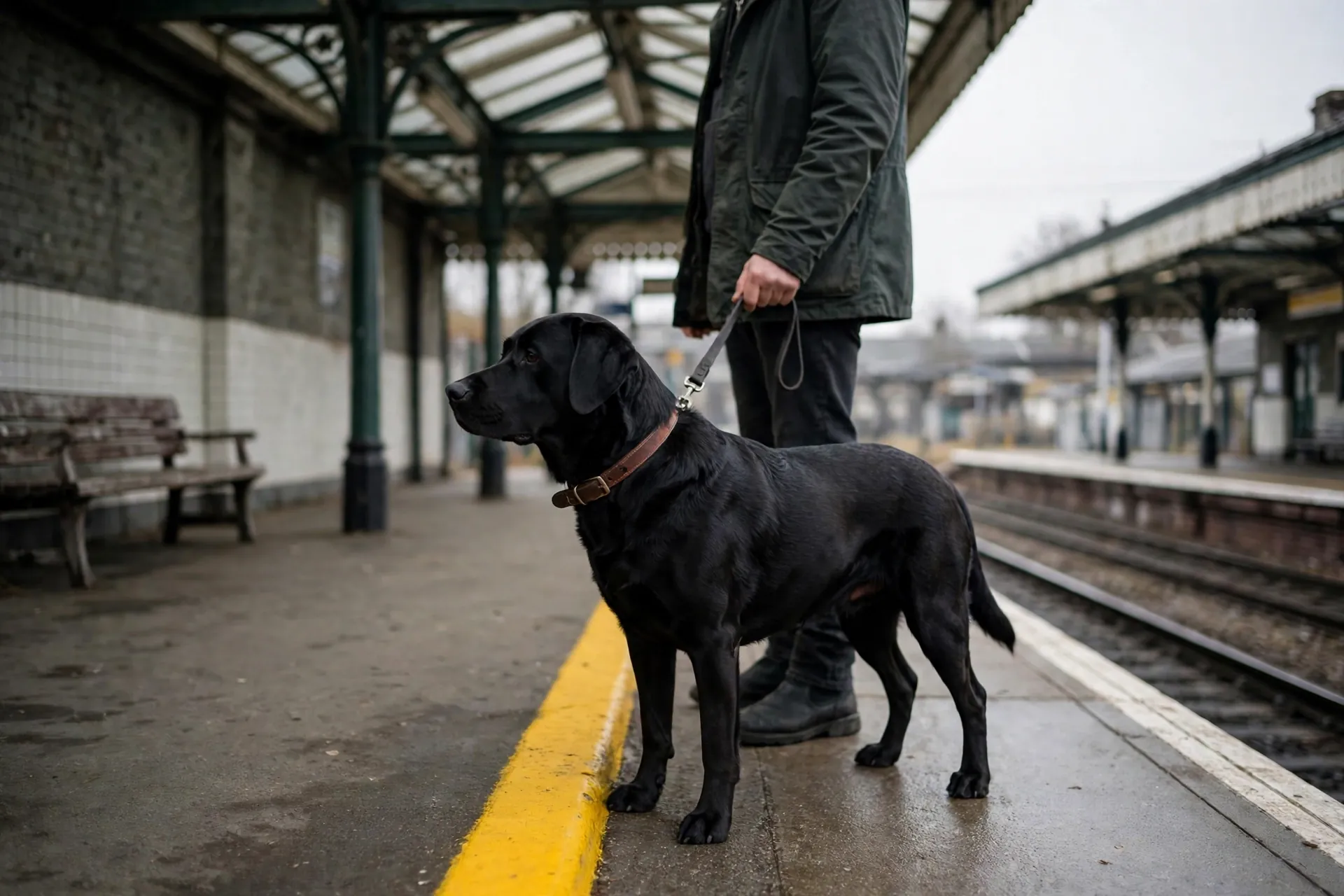
New Street is a vast, modern station built largely underground, with a huge concourse above the platforms and a warren of escalators, lifts and walkways in between. For a dog, the first shock is sensory: tiled floors that amplify every footstep, echoing announcements, the smell of food from the concourse, and a constant flow of people in every direction. Keep the lead short and the dog close to your leg on the concourse, and use the lifts rather than the escalators — a dog should not ride an escalator, where paws can catch in the steps, and the lifts are signposted from the concourse to every platform group. If your dog is nervous in crowds, the far end of a platform is usually calmer than the middle, where the concourse stairs disgorge passengers. Our guide to dogs on UK train platforms and in stations covers yellow-line safety, escalator and lift advice and waiting-room rules in more detail, and it is worth reading before a first change at New Street.
Connection times at New Street are usually workable but rarely generous. A typical change between CrossCountry services is ten to twenty minutes, which is enough if you know where you are going and not enough if you are reading the departure boards for the first time with a dog pulling towards a food stall. Check the platform for your onward train before you arrive — the CrossCountry app and the station boards will usually show it while you are still on the incoming train — and move directly. If your incoming train is late and the connection is tight, do not run: a missed connection on an Off-Peak or Anytime ticket simply means the next service, usually within the hour on core routes, while a sprint across a crowded station with a dog on a lead is how leads get tangled and dogs get frightened.
One more New Street habit is worth building. When your train arrives, wait for the initial rush to clear before you step off with the dog, especially if you are changing platforms. The first minute after arrival is a crush of people and luggage; the second minute is calm. A dog that steps onto a crowded platform in a panic will remember it, and the next station will be worse. Give it a minute, let the crowd thin, then walk at the dog's pace to the lift. The same patience applies in reverse: arrive at the station in good time, give the dog a toilet break on the streets outside before you go through the barriers, and treat the concourse as a place to pass through rather than a place to linger.
Five CrossCountry routes that work with a dog
CrossCountry's network is unusual: it barely touches London and instead runs the long diagonal lines of Britain, from the south-west to Scotland and from the south coast to the north-east. That shape is exactly why it suits dog owners — it connects the walking country directly, without a change across London — but it also means journey times are long and the choice of route matters. These five routes are the ones worth knowing, with honest notes on what each one asks of a dog.
Plymouth to Edinburgh is the spine of the network and the longest regular CrossCountry journey most dog owners will attempt, at around seven to eight hours end to end. It runs up through Exeter, Taunton, Bristol, Birmingham New Street, Derby, Sheffield, Leeds, York, Durham and Newcastle before crossing into Scotland. Nobody should attempt the whole thing with a dog in one sitting unless the dog is a proven long-distance traveller; the sensible version is to break it at Birmingham or Leeds, stretch legs on a platform, and treat it as two journeys with a pause. The reward is that it links the south-west coast to the Scottish capital on a single train, and the stretch from Newcastle to Edinburgh is one of the finest coastal rides in Britain — worth a window seat if the dog will let you look out of it.
Bristol Temple Meads to Manchester Piccadilly is the mid-length classic, around three hours via Birmingham New Street, and a good first long journey for a dog that has already managed an hour or two. Bristol is an easy station to start from, with long platforms and lifts, and Manchester Piccadilly is a straightforward arrival with a big concourse and a taxi rank outside. The Birmingham change is the only complication, and it is the one this guide covers in detail above. If you want to avoid the change entirely, check the timetable for direct services, which run on some departures — a direct train is worth waiting an hour for when a dog is involved.
Birmingham New Street to Manchester Piccadilly is the perfect first CrossCountry trip with a dog: around an hour and a half, direct, frequent, and short enough that water and toilet breaks can wait until arrival. Use it as a test run before you commit to anything longer. If the dog settles, lies down and sleeps, you have a train dog; if the dog paces, whines and will not lie down for ninety minutes, you have learned something important for the price of a cheap Advance ticket, and you can work on shorter journeys before trying Bristol or Edinburgh.
Plymouth to Birmingham New Street, around three hours via Exeter St Davids, Taunton and Bristol, is the south-west gateway and a good example of a route where the scenery does the settling for you. The line follows the coast and then the river valleys, and a dog that likes watching the world go by will be occupied for the first hour at least. Exeter and Bristol are both good break points if you want to split the journey, and both stations have step-free access and space to walk a dog on the platform side. The trains on this route are busy on Friday afternoons and Sunday evenings with weekend traffic, so a midweek departure is noticeably calmer.
Cardiff Central to Nottingham is the Turbostar route, around three hours via Gloucester, Cheltenham Spa, Birmingham and Derby, and it is the most underrated dog journey on the network. The trains are smaller and more open, the stops are frequent, and the line passes through the kind of country — the Severn valley, the Cotswold edge, the Derwent valley — that makes the journey feel like part of the holiday rather than a chore to be endured. It is also a useful reminder that CrossCountry is not only Voyagers: if your dog struggles with the enclosed feel of a long-distance train, a Turbostar service with its wider doors and more frequent stops may suit them far better. Check the official guidance before you travel if you are counting on a particular train being a Turbostar, because stock can change.
Two more routes deserve a mention even though they are not for beginners. Manchester to Bournemouth runs south through Birmingham, Oxford, Reading and Southampton to the coast, and is a long day out rather than a casual trip. Aberdeen to Penzance is the longest direct journey in Britain, at around thirteen hours, and it is not a journey to attempt with a dog in a single day — split it at Edinburgh or Birmingham, stay overnight, and treat the train as two days of travel. The route exists, and it is a remarkable ride, but a dog's comfort has to come before the romance of the timetable.
Tickets and fares: what the dog costs
The dog costs nothing. That is the whole of the dog's fare, and it is worth saying plainly because it is the question every dog owner asks first. There is no pet supplement, no dog ticket and no charge for a carrier, and the two-dog limit does not come with a price tag. Your ticket is the only fare, and the choice of ticket is really a choice about flexibility — which matters more with a dog than it does on your own, because a dog can turn a tight plan into a missed train.
Advance tickets are the cheapest option and the least flexible: they are valid only on the specific train you booked, and if your dog needs an extra toilet break before boarding and you miss it, the ticket is lost. They make sense for a confident dog on a short, familiar route where the plan is solid — Birmingham to Manchester on a Tuesday morning, for example. Off-Peak tickets cost more but let you take any off-peak service on the day, which is the right trade for a first long journey: if the dog is unsettled at the station, you can wait for the next train without buying a new ticket. Anytime tickets are the most expensive and the most forgiving, valid on any service, and worth it on a day when connections are tight or the weather might change your plans. For a dog owner, the extra money for flexibility is usually better spent than the saving on an Advance fare that locks you to a train your dog may not be ready for.
Seat reservations are free with most tickets and worth making, because they are the only way to guarantee the end-of-coach seat this guide recommends. Reserve an airline seat near the luggage rack, not a table seat, and if you are travelling with another adult, reserve two seats together so the dog has floor space on both sides. Reservations do not reserve floor space and they do not stop someone sitting next to you, but they do stop you arriving to find every suitable seat taken. Railcards — Two Together, Family and Friends, Senior, Disabled Persons and the rest — reduce your fare in the usual way, and the dog still travels free on top. There is no Railcard for dogs, and none is needed.
Buy your ticket online or in the CrossCountry app before you travel where you can. Station ticket offices and machines are fine, but a queue at a busy station with a dog on a lead is a needless stress, and an e-ticket on your phone means you can walk straight to the platform. If you do need to buy at the station, give the dog a toilet break first and keep the transaction short. And if you are considering split tickets — buying separate tickets for legs of the same journey to save money — be careful: split tickets can add a change of train where a through ticket would not, and every extra change is an extra platform, an extra lift and an extra chance for a nervous dog to lose confidence. Check the official guidance before you travel if a split-ticket saving depends on a connection you are not sure about.
Surviving a four-hour-plus journey
CrossCountry's longest routes are where dog owners most often come unstuck, because the journeys are genuinely long: Bristol to Edinburgh is five to six hours, Plymouth to Edinburgh seven to eight, and the full Aberdeen to Penzance run is the best part of a day. A dog can do these journeys, but only if the journey is managed in the same way you would manage a long car trip — with water, rest, food timing and realistic expectations about toilet breaks. The train itself gives you almost nothing for the dog: there is no dog toilet on board, no exercise area and no outdoor access until you reach a station. Everything the dog needs, you carry.
Water comes first. Bring a bottle of water and a collapsible bowl, and offer water at every station stop and roughly once an hour on a long run. Dogs dehydrate quietly on warm trains, and a dog that will not drink from a strange bowl on a moving train will often drink from a bowl it knows, on your lap, when the train is standing at a station. Do not rely on buying water on board: catering on CrossCountry is limited to a trolley on some longer services and is not guaranteed, and the trolley may not reach your coach for an hour. Pack more water than you think you need, and a few treats that double as a distraction when the train stops and starts.
Toilet breaks are the hard problem, and honesty is better than reassurance. A dog cannot get off at an intermediate station unless you are prepared to miss the train, and most intermediate stops last two minutes — not enough to leave the train, find grass and get back. The only realistic toilet opportunities are the longer dwell times at major stations, and even then you should only step off if the train is timetabled to wait and you can see the platform clearly. The practical answer is to manage the dog before boarding: a long walk and a proper toilet break at home, a light meal rather than a full one, and no large drink in the hour before departure. For a journey over four hours, consider breaking it deliberately — an hour in Birmingham, Leeds or Bristol, a proper walk outside the station, and a fresh start — rather than asking the dog to hold on for the whole run. Puppies, elderly dogs and dogs with medical conditions simply should not be asked to do five hours without a break, and if your dog cannot manage it, the journey needs splitting or the destination needs changing.
Settling the dog is the third piece. A blanket or mat from home, a familiar-smelling item, and a long-lasting chew will do more than any gadget. Exercise the dog properly before departure — a tired dog sleeps, and a fresh dog paces. Feed lightly before travel rather than a full meal, because a full stomach and a moving train is a combination that ends badly for some dogs. If your dog is prone to travel sickness, talk to your vet before the trip rather than experimenting on a five-hour service. And if the journey runs into the evening, think about what happens at the other end: an overnight stay needs a dog-friendly bed for the night, and our guide to dogs on sleeper trains in the UK explains the overnight alternative for routes where a sleeper service exists — it is a different kind of journey, with its own cabin rules and fees, and it suits some dogs far better than a very long day train.
Station by station: the big stops
CrossCountry serves some of Britain's largest and most confusing stations, and a little knowledge of each one saves a lot of platform panic. These are the stops dog owners ask about most, with the practical details that matter when you have a lead in one hand and a suitcase in the other.
Bristol Temple Meads is a long, grand station with a curved trainshed and platforms that feel like a walk in themselves. The main entrance leads to a wide concourse, lifts serve the platforms, and the station is generally calmer than New Street. The walk from the concourse to the far platforms is long, so allow time, and keep the dog close on the narrow footbridge routes. Outside, there is green space a short walk away for a pre-boarding toilet break.
Manchester Piccadilly is the big northern terminus, with a huge concourse, a long main trainshed and a taxi rank and tram stop outside. It is busy at all hours but spacious, which helps: there is room to stand aside with a dog while you check the boards. Lifts serve all platforms, and the station has waiting areas on the concourse. The platforms are long and exposed to the wind at the far end, so a small dog will feel the cold in winter.
Edinburgh Waverley is the most confusing station on the network for a first-time visitor, built in a valley with entrances at different levels and a layout that even regulars get wrong. Allow extra time, follow the signs to your platform rather than your instincts, and use the lifts — the ramps are long and steep, and a dog that pulls will make them harder. The station sits in the middle of the city, so a toilet break outside is easy once you are through the barriers, but the station itself is a place to move through with purpose rather than to linger in.
Plymouth is compact and straightforward by comparison: a single concourse, clear platforms, and a short walk to the city. It is one of the easiest CrossCountry stations to start a journey from with a dog, and a good place to break a long south-west journey. Leeds and Sheffield are both large, modern stations with good lifts and wide concourses; Leeds in particular is a useful break point on the Plymouth to Edinburgh run, with space to walk a dog around the concourse and a straightforward platform layout. Derby is smaller and calmer, a good place to change trains without the crush of New Street, and Cheltenham Spa is a pleasant, manageable station on the Cardiff to Nottingham line with easy step-free access.
Smaller stations on the network — the halts and local stops that Turbostars serve — are a different proposition. Many are unstaffed, with no waiting room, no toilets and no staff to ask, and the help point is the only assistance available. That is fine for a confident dog on a short hop, but it is not the place to be stranded with a dog in bad weather. Check the official guidance before you travel if your journey starts or ends at a small station, and know in advance whether there is step-free access, because a footbridge with steps and a large dog and a suitcase is a problem you want to discover at home, not on the platform.
Busy trains and peak times
The single most common reason a dog is refused boarding on CrossCountry is not the dog's behaviour but the train's loading. The published rules give staff the right to prevent a dog from boarding if the train is very busy, and on a packed Voyager there may genuinely be no floor space for a dog to lie without blocking the aisle. That is not a rule to argue with on the platform; it is a risk to plan around by choosing your train well.
The busiest CrossCountry services are the Friday afternoon trains out of the big cities, the Sunday evening trains back, and anything that coincides with a major event: the Edinburgh Festival in August, Cheltenham Festival week in March, football and rugby weekends in Manchester, Newcastle and Cardiff, and the school holidays, when families with luggage fill every rack. The Plymouth to Edinburgh spine is also the route that carries the most leisure traffic, and a summer Friday on that line can be standing room only from Birmingham northwards. If your dates are flexible, travel on a Tuesday, Wednesday or Thursday, in the middle of the day — late morning and mid-afternoon services are usually the quietest, with space to choose a seat and room for the dog to settle.
If you arrive at the platform and the train is already full, the honest choice is usually to wait for the next one. An Advance ticket will not let you do that, which is one more reason to buy an Off-Peak or Anytime ticket when you are travelling with a dog. If you do board a busy train, stand in the vestibule with the dog for the first stop or two rather than forcing your way down a crowded aisle — passengers get off at the first major station on most routes, and a seat usually frees up within twenty minutes. Keep the lead short, keep the dog against the wall of the vestibule, and do not let the dog's lead trail across the doorway. And if the conductor says the train is too full for the dog, accept it gracefully and ask when the next service with space is likely to be; arguing on a crowded platform helps nobody, least of all the dog.
Delays, cancellations and being stranded
CrossCountry runs some of the longest routes in Britain, which means it also collects more than its share of delays: a late train at Plymouth becomes a late train at Birmingham, and a problem at Newcastle ripples all the way to Edinburgh. When you are travelling with a dog, a delay is not just an inconvenience — it is extra time in a crowded space, a missed connection, and a dog that needed a toilet break an hour ago. The system for dealing with it is straightforward, and knowing it in advance keeps a bad day from becoming a worse one.
If your train is delayed, CrossCountry's Delay Repay scheme allows you to claim compensation when your arrival is delayed by 15 minutes or more, and the claim is made online after the journey with your ticket details. Keep your ticket and any booking confirmation, note the time you actually arrived, and claim promptly — the money will not be much on a cheap Advance fare, but the habit of keeping records matters when a cancellation cascades into a missed connection and a hotel night. If your train is cancelled, you can normally take the next available CrossCountry service on the same route with the same ticket, and station staff can tell you whether other operators are accepting CrossCountry tickets that day. Do not simply board another operator's train and hope: ticket acceptance is arranged service by service, and the staff at the station are the people who know.
Being stranded with a dog needs a plan of its own. If the last train is cancelled, ask staff about the next service before you leave the station, and use the waiting room rather than the platform while you decide. A dog that has been travelling for hours will need a toilet break, and the streets outside the station are usually the only option — keep it short, keep the lead tight, and do not leave the dog unattended while you go back inside to ask questions. If you need a hotel for the night, check that it accepts dogs before you book, and expect to pay for the room yourself and claim it back later if the operator's obligations cover it; check the official guidance before you travel on what CrossCountry will and will not cover, because the answer depends on the cause of the disruption.
Rail replacement buses are the gap in the system that catches dog owners out. When engineering work closes a line, buses replace trains, and dogs are not generally carried on rail replacement buses in the way they are on trains — the buses are operated by coach companies under different rules, and a pet dog will usually be refused. National Express coaches do not take pet dogs at all, as our guide to dogs on National Express coaches explains, and replacement buses are no more accommodating. Check for engineering works before you book, check the official guidance before you travel if works are planned on your route, and if a bus is the only option, be ready to change your travel day rather than argue with a bus driver on a wet platform.
What to pack for a CrossCountry trip
Packing for a CrossCountry journey is a short list, and every item on it earns its place by solving a problem that actually happens on these trains. Start with the lead: a short, strong lead of a metre or so, and a harness rather than a collar for a dog that pulls, because a collar tightens every time the train brakes. Add a collapsible water bowl and a bottle of water, a handful of poo bags, and a towel — not for the dog's comfort but for yours, because a wet dog on a Voyager seat is a problem and a wet dog on a towel on the floor is not.
The blanket or mat from home is the most important item after the lead. It marks the dog's place, stops paws sliding on the floor, and carries the smell of home. A long-lasting chew or a stuffed Kong will occupy a dog through the first half-hour while the train fills up, and a few small treats will let you reward settling rather than attention-seeking. If your dog is small, bring the carrier as well as the lead, and measure it against the 85 x 60 x 60 cm limit before you leave. A muzzle is not required by CrossCountry, but for a reactive dog in a crowded carriage it is a sensible precaution and a visible signal to other passengers that you are taking their comfort seriously.
For the human half of the trip, pack a phone charger or power bank, your ticket on your phone and as a screenshot in case the signal fails, and the details of your onward journey written down — platform numbers at Birmingham New Street are much easier to read from a note than from a phone screen in a crowd. Bring food for yourself, because the trolley may not come, and bring a book or headphones, because a long CrossCountry journey is a good time to do nothing at all. Finally, pack the vet's number and your dog's medication if they take any, in your bag rather than your suitcase: a delay that stretches a three-hour journey to five is exactly when a missed dose matters.
What not to pack is almost as useful. Do not bring a retractable lead — it is a trip hazard in a narrow aisle and gives a dog exactly the wrong amount of freedom on a platform. Do not bring a large, squeaky toy that will annoy a whole carriage. Do not bring a full meal for the dog to eat on the train, and do not bring anything that needs to be kept cold. The train is a small, shared, moving room: pack as if you were visiting someone else's house, not as if you were moving into your own.
Practical questions
Before you go
Do dogs need a ticket on CrossCountry trains?
No. Dogs travel free on CrossCountry trains, and there is no dog ticket to buy and no booking to make for the dog. You only pay for your own ticket. The free allowance covers up to two dogs, cats or other small animals per passenger, provided the dog is on a lead or in a carrier, stays off the seats and does not endanger or inconvenience other passengers or staff.
Can my dog sit on the seat next to me on a CrossCountry train?
No. Dogs are not allowed on seats or tables on CrossCountry trains under any circumstances, and a carrier that occupies a seat can attract an extra charge. Your dog should settle on the floor at your feet, in the footwell or in a carrier on the floor. If you need more floor space, choose an end-of-coach seat near the luggage rack rather than a table seat.
How many dogs can I take on a CrossCountry train?
Two dogs per passenger is the limit published by CrossCountry, and the same limit covers cats and other small animals. A household of two adults can therefore bring up to four dogs between them, but each dog still needs its own lead or carrier and its own patch of floor. Staff can refuse boarding if the train is very busy or if a dog's size or behaviour is likely to cause a problem, so check the official guidance before you travel on a peak service.
Can my dog travel without a lead if it is in a carrier on CrossCountry?
Yes. Dogs must be kept on a lead at all times unless they are contained in a basket or carrier. A carrier used instead of a lead must be rigid and enclosed so the animal cannot escape, must measure no more than 85 x 60 x 60 cm, and must be large enough for the animal to stand and lie down in comfort. Cats, birds and other small animals must always travel in such a carrier, even if they are used to a lead.
What happens if my CrossCountry train is cancelled and I am travelling with a dog?
You can normally take the next available CrossCountry service on the same route with the same ticket, and staff at the station can confirm whether other operators are accepting CrossCountry tickets. Keep your ticket and any booking confirmation, note the time of the cancellation, and claim Delay Repay if your arrival is delayed by 15 minutes or more. Do not assume a rail replacement bus will take your dog: check the official guidance before you travel, and ask station staff before boarding a bus.
Can I take my dog into the Quiet Coach on a CrossCountry Voyager?
CrossCountry runs a designated Quiet Coach on many Voyager services, and it is the wrong place for a dog that barks, whines or paces. The published pet rules do not ban dogs from any particular coach, but a noisy dog in a quiet coach will draw complaints and staff may ask you to move. Choose an ordinary standard-class coach, ideally an end-of-coach seat away from the doors, and keep the lead short so your dog cannot wander into the aisle.