This guide is independent and contains no paid placement. Operator policies change, so check the current National Express conditions and the conditions of any alternative operator before you book.
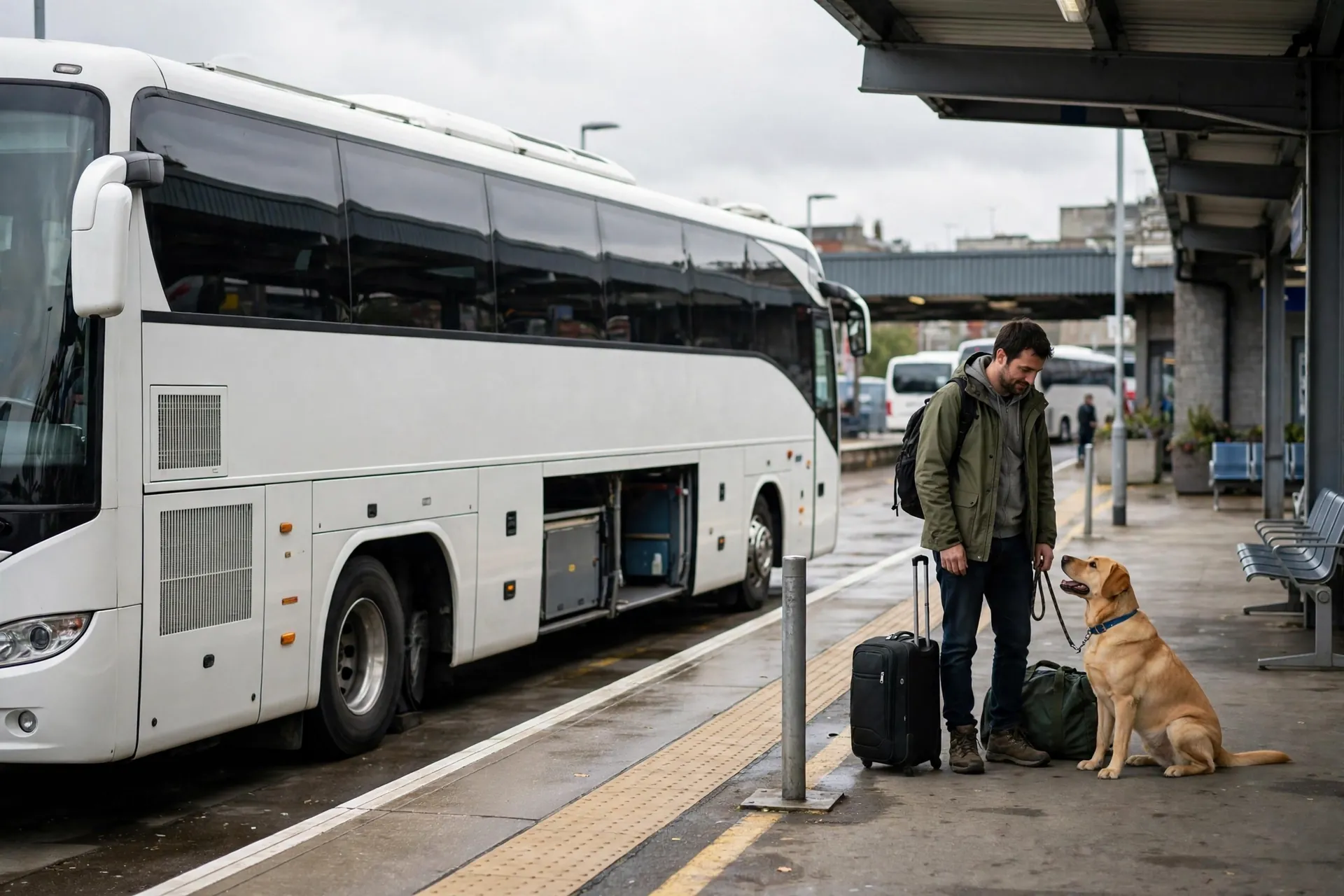
Pet dogs are not allowed on National Express coaches — not on a lead, not in a carrier and not in the hold. Only assistance dogs travelling with the person they assist may board, and they travel free. Everyone else needs another mode: trains accept pet dogs on most UK services, driving gives you full control of stops, and licensed pet transport can move a dog without you. Official source: National Express: disabled travellers (checked October 2026).
The alternatives compared first
Most coach guides bury the useful part at the end. This one starts with it, because once you know a pet dog cannot ride, National Express stops being a booking question and becomes a substitution problem. You are not looking for a loophole in the luggage rules. You are choosing which of three workable replacements fits your route, your budget and your dog — and each one fails in a different way, so the comparison matters more than any single price.
Put the three options side by side. The train is the closest equivalent to the coach: someone else drives, you sit with your dog, and on most British rail services a pet dog travels without a separate pet fare, on a lead and under control. Its weakness is disruption — a cancelled service, a crowded replacement bus or a tight change of trains is harder with a dog than without one, and rail replacement buses do not always mirror the train rules. Driving is the opposite profile: the timetable is yours, toilet and water stops happen when your dog needs them, and a nervous dog travels in a familiar space. Its weakness is concentration and cost over very long distances, plus parking and congestion charges at the far end. A pet transport service, sometimes called a pet courier or pet taxi for longer moves, removes you from the vehicle altogether: a licensed transporter carries the dog door to door, often sharing the route with other animals. Its weakness is trust and price — you hand over the dog, you pay considerably more than a coach fare, and you must do proper licensing checks rather than picking the cheapest social media advert.
Cost illustrates the gap clearly. A long coach fare bought early can look temptingly cheap next to a walk-up rail fare, which tempts owners to hope the dog rule has an exception. It does not, so compare like with like among the options that will actually carry you: an advance rail fare bought weeks ahead, split tickets where they are legitimate, the true cost of fuel plus parking for driving, and a written all-in quote for a transporter. Journey time needs the same honesty. A coach from London to the North or to Scotland is already a long sit; the train is usually faster on main lines, driving is fastest door to door for rural destinations with no station nearby, and a shared courier route can be the slowest of all because the vehicle stops for other animals. Comfort cuts the other way again: a dog that cannot settle among strangers may cope far better in your own car than in a quiet carriage, while a dog that sleeps through anything may find a train table seat perfectly easy. Arriving in London by coach, you can continue by London Underground with your dog — dogs travel free, on a lead.
Keep that three-way picture in mind as you read on. The sections below deal first with the one group who can use National Express — assistance dog handlers — in the detail they need, and then work through each alternative properly, so that by the decision section you can pick with reasons rather than with hope.
The short answer on pets: no, in any form
National Express carries assistance dogs. It does not carry pet dogs. That distinction is the whole policy, and it applies regardless of the dog's size, breed, temperament or training as a pet. A toy breed in a closed carrier is still a pet dog for this purpose. A dog that has flown in a cabin, ridden happily on local buses or completed a pet training course is still a pet dog. An emotional support animal, as the term is used in some other countries, is not treated the same way as an assistance dog under British equality law and does not gain the same access, so do not book on the assumption that a letter, a vest bought online or a registration certificate will convert a pet into an assistance dog.
The ban also covers the parts of the coach people ask about as a workaround. Dogs do not travel in the luggage hold under the coach, in a bag at your feet, on your lap under a blanket, or in the care of another passenger who offers to claim the dog as theirs. Asking at the station does not create a fourth option, and arriving early, travelling off-peak or offering to pay an extra fare does not change the conditions of carriage. If anything, planning around a refusal is the expensive outcome: coach fares are often bought on non-flexible terms, same-day rail fares at a busy station cost far more than advance ones, and a dog that has already travelled to a city-centre coach station then has to be taken home or re-routed while tired and unsettled.
There is one narrow point worth stating precisely, because it causes real confusion online. Guide dogs, hearing dogs and other assistance dogs are not pets travelling by permission; they are working dogs accompanying a disabled person, protected under the Equality Act 2010 in England, Scotland and Wales, with separate equality law applying in Northern Ireland. Refusing an assistance dog without a lawful justification, or charging extra for one, is not a policy choice an operator can make in the way it chooses a pet policy. That is why the operator can lawfully and consistently say yes to assistance dogs and no to every pet dog on the same service. Our guide to assistance dog access rights in the UK explains that wider legal picture, including what to do if you are refused anywhere.
Travelling with an assistance dog: what to expect on board
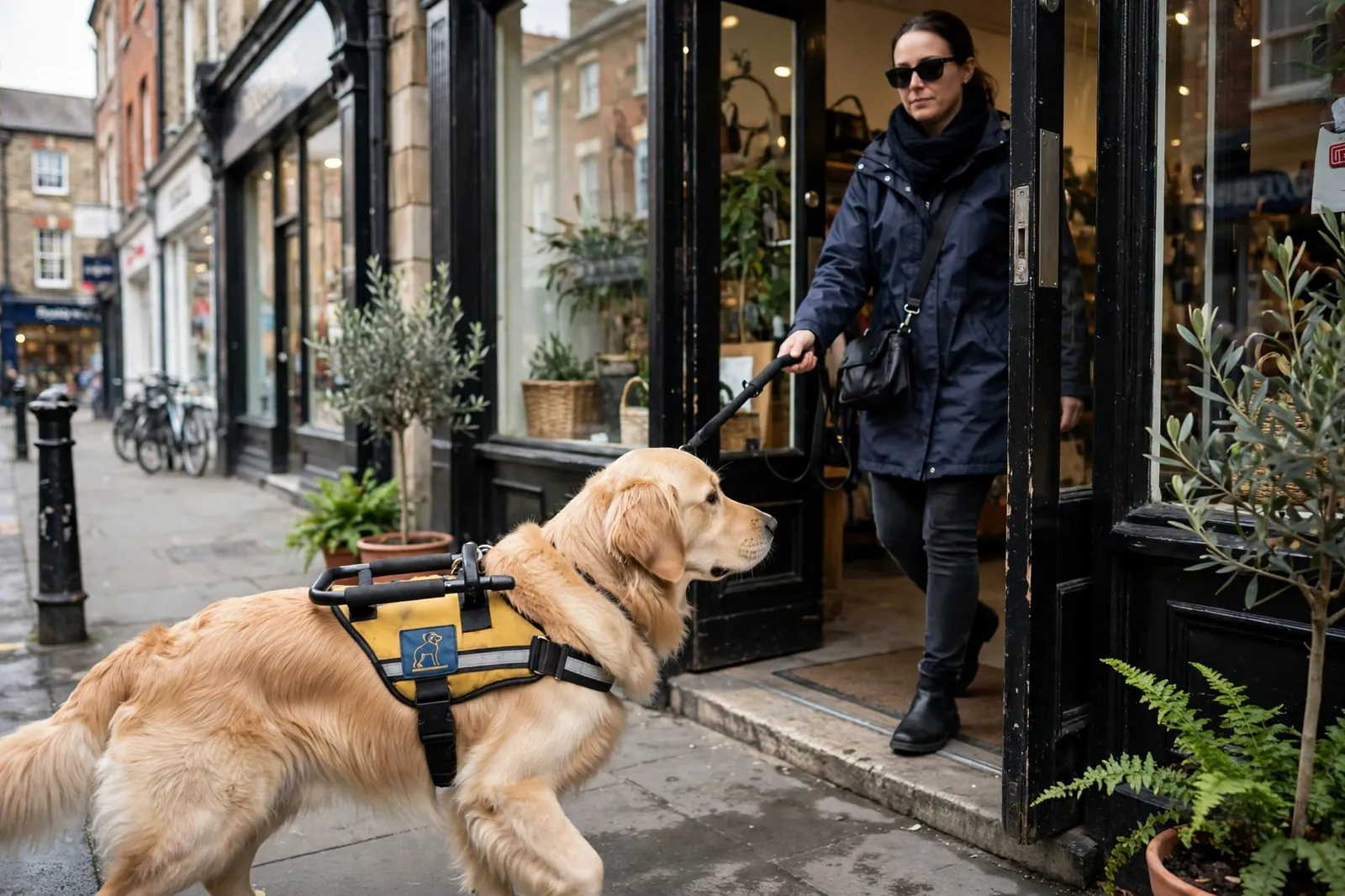
If you are an assistance dog handler, National Express should be a usable option rather than a battle, and knowing the normal pattern helps you spot when something has gone wrong. Your dog travels with you in the passenger cabin, free of charge, and stays with you throughout — it is never separated into the hold. In practice the dog settles on the floor, usually in the footwell or under the seat space in front of you, out of the aisle so that other passengers and crew can move safely. On a long journey that means choosing space deliberately: a seat with a clear floor area, close enough to the door for a calm exit at service stops, and away from a heat vent that will make a thick-coated dog restless after an hour.
Long coach journeys differ from short bus hops in ways handlers should plan for. There is no opportunity to get off at will, toilet breaks depend on scheduled stops and driver announcements, and a dog that needs to relieve itself mid-route cannot simply be taken to a vestibule as on some trains. Feed lightly before departure, offer water in a spill-proof bowl at stops rather than continuously in a moving vehicle, and use every scheduled stop for a short leg stretch even if your dog seems settled — a dog that has held a down-stay for three hours will board again far more calmly after five minutes of sniffing than one carried straight from seat to seat. Bring familiar settling equipment: the mat or blanket the dog associates with long rests, a silent chew for the first part of the journey if that is part of your routine, and waste bags stored where you can reach them without unpacking overhead luggage.
Other passengers are part of the environment too. Most will ignore a working dog, some will want to talk about it, and a few may be nervous or allergic. You are not responsible for managing everyone else's feelings, and your dog does not need to perform friendliness on demand, but a calm, rehearsed routine — dog tucked in, lead short, attention on you — prevents most friction. If a fellow passenger objects to the dog's presence, that is a matter for the driver or station staff to resolve under the operator's duties, not a negotiation you should be drawn into at the kerb. Equally, if your dog is unwell, has had a recent stomach upset or is in a stage of training where a five-hour sit is unrealistic, postponing is kinder and safer than testing it on a full coach; assistance dog access is a right, but welfare planning is still yours.
Booking with an assistance dog, step by step
The reliable sequence is simple, and doing it in order prevents nearly every problem handlers report with long-distance coach travel. First, book your own ticket for the service you actually want, on the operator's website or app or through its normal sales channels, keeping the booking reference. You do not buy a ticket for the dog. Second, contact National Express in advance to register that you will be travelling with an assistance dog and to arrange any other assistance you need — boarding help, accessible seating, extra time at the stop or help with luggage. Use the assisted travel or accessibility contact route published on its official site at the time you book, because phone numbers and forms change, and keep a note of the date, the name of the person you spoke to if given, and any reference number.
Third, decide what evidence you will carry. Dogs trained by organisations that are members of Assistance Dogs UK usually have an identification booklet, and carrying it makes checks quick. Owner-trained assistance dogs are equally lawful, but handlers often carry other evidence of training and of the tasks the dog performs, precisely because there is no single compulsory register. What staff should not do is demand medical proof of your condition, insist on one particular brand of jacket or harness as a condition of travel, or treat the absence of an ADUK booklet alone as proof that a dog is not an assistance dog. If a booking agent says something that contradicts that, ask them to check the operator's own accessibility policy and, if necessary, escalate before the day of travel rather than arguing it at departure.
Fourth, plan the stop itself. Coach stations vary enormously: some have step-free routes, seating and nearby grass a short walk away; others are essentially a kerb, a shelter and a tight boarding window. Check where your service actually departs from — the named coach station and the named local stop are not interchangeable — and arrive with enough margin to toilet your dog, find the correct bay and board without rushing. Fifth, on the day, make yourself known to staff or the driver as the passenger who booked assistance, settle the dog before the aisle fills, and keep your booking confirmation and identification together. If travel is refused or made conditional on payment for the dog, stay calm, note names, times and the exact service number, travel by another means if you must, and pursue the complaint and any refund afterwards in writing; a contemporaneous note is worth more than a heated exchange.
Alternative one: the train — the closest replacement
For a pet owner, the train does most of what you wanted the coach to do. Pet dogs are generally welcome across the British rail network, normally with no pet ticket to buy, provided the dog is kept under control, does not occupy a seat and does not endanger or inconvenience other passengers. Operators commonly allow up to two dogs per passenger without charge, with rules on leads in stations and on board, and animals other than a dog travelling in a suitable carrier under separate conditions. Always check your specific operator before a long journey, because details on numbers, peak crowding and engineering-work arrangements belong to them — and check before you travel if part of your route is covered by a rail replacement bus, since the replacement vehicle may be run under different terms.
Book the railway like a dog owner, not like a solo commuter. Advance fares reward early booking just as coach fares do, and choosing a quieter service — mid-morning or early afternoon rather than the first peak train — buys your dog floor space that no reservation can guarantee. A table bay often works better than an airline-style pair, because the dog can lie under the table out of the aisle. Reserve seats where reservations exist, travel from the station you can reach calmly rather than the one that saves ten minutes on paper, and build a change of trains you could still make at a walking pace with a dog that wants to sniff every pillar. On sleeper routes the rules are different again and need separate checking; our guide to dogs on UK sleeper trains covers that niche if an overnight rail journey is part of your plan.
On board, the routine is straightforward but worth rehearsing. Keep the dog on a lead, settled on the floor on a familiar mat, and off the seats even if a carriage looks empty — staff enforce that rule unevenly until the moment they do not. Offer water at changes rather than leaving an open bowl in a moving carriage. At intermediate stops, only get off for a leg stretch if the dwell time, the platform layout and your confidence about reboarding all allow it; on most stops the answer is to stay put. For very long rail journeys — London to Edinburgh, the South West or the Highlands — split the day mentally into legs, plan food for the dog around the timetable, and accept that a slightly slower stopping service with an easy change can be a better dog journey than the fastest express with a four-minute connection.
Alternative two: driving — full control, full responsibility
Driving wins whenever control matters more than effort. You decide when to stop, which services have a usable dog area, how warm the car is and whether a wobbly start means turning round and trying again in an hour. For large dogs, elderly dogs, dogs recovering from illness, reactive dogs and households travelling with more equipment than they can carry, that control is often worth more than any fare saving. Hiring a car extends the same option to households that do not own one, although hire firms apply their own pet conditions — cleaning expectations, protective covers and sometimes an outright pet policy — so declare the dog at booking rather than discovering the clause when you return the keys.
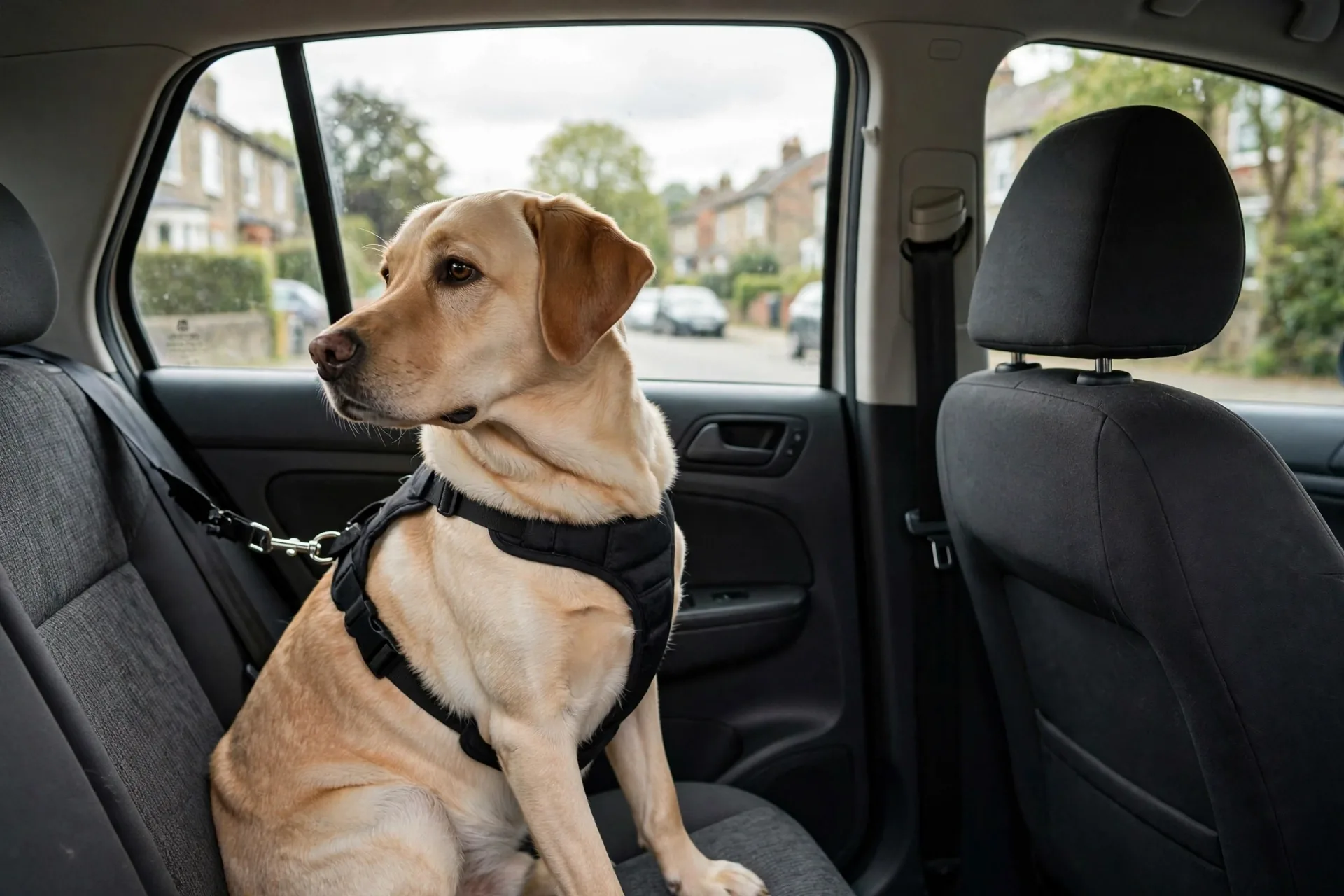
The legal and safety basics are not optional extras. In the UK a dog in a car must be suitably restrained so it cannot distract the driver or injure anyone in a sudden stop, a duty captured in Highway Code Rule 57 and explained in our guide to dog car law and Rule 57 restraint rules. Use a crash-tested harness attached to a seat belt, a secured crate or a properly fitted guard, and never a lead tied to a headrest as an improvisation. Plan stops roughly every two hours on a long drive, and more often for puppies, older dogs and hot weather; a proper stop means out of the car, on a lead, water offered and a chance to toilet, not five minutes in a car park doorway. Never leave a dog alone in a parked car in warm weather, even with a window cracked — on a long journey that constraint shapes where you eat and how you share driving and dog-watching duties if two adults travel.
Cost a long drive honestly before assuming the train is dearer. Fuel or charging, motorway tolls where they apply, city parking for the whole stay, congestion or clean air charges and the value of an extra night if the drive is too long to do safely in one day all belong in the total. Against that, set the savings: no station transfers at either end, no per-person fares multiplying for a family, and a boot that swallows the dog bed, food and wet-weather gear without luggage allowances. For a rural destination — a cottage, a farm stay, a relative's house far from a station — driving is frequently not just the most comfortable option but the only one that completes the last ten miles without a second, harder problem involving taxis or lifts.
Alternative three: pet transport services — when the dog travels without you
A pet transport service solves a different problem from the one the coach posed. Use one when the dog needs to relocate and you cannot accompany it — a house move where you are travelling separately with removals, a puppy or rehomed dog being collected from a breeder or rescue at a distance, or a journey where your own travel is by air or by a route the dog genuinely cannot share. Reputable transporters carry dogs in purpose-fitted vehicles with secure crates or compartments, planned rest, water and toilet stops, ventilation and cleaning between animals, and they quote for shared routes, where several animals travel in one planned direction, or for a solo dedicated journey at a higher price.
The checks here are the most important in this whole guide, because the market mixes professional operators with informal adverts. In England, businesses transporting pets commercially may need a licence for animal activities or, for longer and larger-scale transport, authorisation under animal transport rules administered through the Animal and Plant Health Agency; Scotland and Wales operate their own licensing arrangements. Before paying anything, ask for the licence or authoriser details and verify them with the issuing authority, ask for insurance documents, ask exactly who will be in the vehicle with your dog, how many other animals will travel, how often stops happen, how you will receive updates, and what the contingency plan is if the vehicle breaks down. A professional answers those questions in writing without irritation. Walk away from anyone who asks for full payment to a personal account with no contract, cannot say where your dog will sleep on an overnight route, or prices a very long solo journey at a figure that could not plausibly cover fuel, time and legal operation.
Prepare the dog for a courier journey as carefully as for any other. Send familiar bedding, clearly labelled food in measured portions, written feeding and medication instructions, veterinary contact details and microchip information, and a collar with an identity tag showing a current phone number. Confirm collection and delivery windows with a person present at both ends, agree how handover identity will be checked, and keep your phone available for the whole route. Expect a proper service to cost far more than any passenger fare you were comparing earlier — you are buying a vehicle, a driver and a day of regulated care, not a seat — and treat a surprisingly cheap quote as a prompt for more questions, not as a bargain.
Other coaches, local buses and the patchwork in between
Owners often ask whether a rival long-distance operator will take the dog instead. Treat every operator as its own policy and check the current conditions before booking: other national coach brands have generally applied a similar assistance-dogs-only approach to pet dogs on long-distance services, and policies can change or vary by route and by the company actually operating the vehicle. Never assume that because one brand's local bus accepts dogs, its intercity coach does too — the vehicle, the journey length and the conditions of carriage are different products wearing similar colours.
Local buses sit at the more permissive end of the patchwork, which is exactly why they confuse the picture. Many local operators allow a pet dog at the driver's discretion or under published conditions, usually one dog, on a lead, on the floor and sometimes for a fare. That can solve the first or last few miles of a re-routed journey — home to the railway station, for example — but it is not a long-distance strategy, and chaining local buses across a county is slow, unreliable and unfair on the dog. Our guide to dogs on London buses shows how specific even a single city's rules can be. Taxis and private hire vehicles are another short-leg option, with assistance dogs protected in law and pet dogs accepted by some drivers and firms if you declare the dog when booking. For a sea crossing at the end of a long land journey, separate rules apply again — see dogs on UK ferries for operator-by-operator detail rather than assuming land rules carry over.
The through-line is simple: the longer and more commercial the journey, the less discretion anyone at the kerb actually has. Build your plan only from modes whose published conditions accept your dog in writing, and use discretion-based modes only for short legs where being refused would be an inconvenience rather than the collapse of the whole trip.
Choosing by dog, distance and budget
Decisions get easier when you name the deciding factor instead of weighing everything at once. If the deciding factor is your dog's temperament, choose the car for a dog that is anxious, reactive, very young, very old or medically fragile, and choose the train for a dog that settles readily in public and has already proved it can rest among strangers. If the deciding factor is distance, remember that effort scales differently: driving fatigue grows steadily hour by hour, rail discomfort mostly arrives in spikes at changes and disruptions, and courier stress for an owner is front-loaded into handover and waiting for updates. A journey of two hours and a journey of eight are different decisions even on the same route.
If the deciding factor is budget, do the arithmetic in full for your actual party. One adult with one dog will often find an advance rail fare cheapest once parking is priced in. Two or three adults sharing one car regularly reverse that result. A courier is almost never the budget option and should be chosen for necessity or welfare, not for price. If the deciding factor is luggage or destination, let it decide cleanly: a station at both ends and a hotel between them suits rail; a self-catering stay, a boot full of dog equipment and a destination miles from a station suit the car; a dog travelling to a new home without you suits a licensed transporter and nothing else.
Finally, consider whether the dog needs to make this journey at all. For a short human trip — a wedding, a work visit, a city weekend in a hotel that is not right for a dog — a trusted home boarder, a licensed day-care and boarding arrangement or a friend the dog already knows can be the kindest and cheapest answer, and it is not a failure of the holiday to travel separately. That option disappears, of course, for moves, for long stays and for the trips that exist because of the dog. But naming it stops owners forcing a beloved dog through eight hours of transport to spend a weekend in a strange hallway, when the dog would have chosen the familiar sofa at home every time.
If you must replan: a calm checklist
If you have reached this guide holding a National Express ticket you cannot use, work through the replan in this order and do not skip the first step. First, check the ticket conditions: whether the fare can be changed, refunded or credited depends on the fare type you bought, and doing this before you buy anything else tells you the true cost of switching. Second, price the rail alternative for the same day and for a day either side, because flexibility of even twenty-four hours can change an advance fare dramatically. Third, if driving is possible, check parking at the destination before committing — the cheapest rail fare and the easiest drive both fail if the far end has nowhere legal and affordable to leave a car.
Fourth, tell whoever is expecting you about the new arrival time while you still have options, not from a platform in a panic. Fifth, prepare the dog for the mode you have actually chosen: a practice short train ride for a dog that has never travelled by rail, a refresher on car settling and stops for a dog that has only done local drives, or the licensing checks and paperwork pack described above for a transporter. Sixth, keep the original coach booking reference, any refusal or advice you were given and all new confirmations together, so that refunds, complaints or insurance questions can be answered from one folder. Policies do change, so before any future long journey, re-check the operator's conditions on the day you book rather than relying on this or any guide — and if you are an assistance dog handler booking ahead, re-confirm the assistance arrangement close to departure as well.
Practical questions
Before you go
Can I take my pet dog on National Express if it stays in a carrier?
No. The ban covers pet dogs in carriers, on laps and in the luggage hold. National Express coaches do not carry pet dogs in any part of the vehicle, however small or quiet the dog is. Only assistance dogs travelling with the person they assist are carried, so a carrier does not change the answer and you should choose a train, a car journey or a licensed pet transport service instead.
Do assistance dogs travel free on National Express and do I need to book in advance?
Yes, assistance dogs travel free and should not be charged as luggage or as an extra passenger. Book your own ticket as normal, then contact National Express in advance through its assisted travel arrangements so the booking can be noted and any space or boarding help can be planned. Advance notice is strongly recommended for longer routes and for accessible seating, even though your legal right to travel does not depend on giving notice.
What evidence might I be asked for with an assistance dog?
Be ready to show the evidence you normally carry, such as an Assistance Dogs UK identification booklet for dogs trained by member organisations, or other credible evidence of training for owner-trained dogs. Staff should not demand a specific jacket, demand medical details or refuse travel simply because a dog was owner-trained. Carry your usual identification, keep the dog under close control and under the seat or in the footwell, and contact the operator before travel if you want the arrangement recorded.
Can a driver make an exception for a small, quiet dog?
No, do not rely on an exception. The rule is an operator policy applied across the network, not a discretion left to individual drivers, station staff or fellow passengers. Arriving with a pet dog risks being refused boarding, losing the fare under the ticket conditions and being stranded at the coach station with luggage and no onward plan. Book an alternative that accepts pet dogs before you travel.
What is the best alternative to National Express for a long trip with a pet dog?
For most owners the train is the closest like-for-like replacement, because pet dogs are generally welcome on UK trains without a pet ticket, subject to lead, number and behaviour rules. Driving gives the most control over stops and is often best for nervous or large dogs if you can share or afford the fuel and parking. A licensed pet transport service suits a dog travelling without you or a move where you cannot drive, but costs more and needs careful licensing and insurance checks.
What happens if a National Express driver is allergic to dogs?
National Express says that where a driver declares an allergy to dogs, it will endeavour to board customers and their assistance dogs on the next available service. Drivers can also refuse travel if a dog displays aggressive behaviour, in line with health and safety rules. This matters only for assistance dogs, since pet dogs cannot travel at all. See National Express’s accessibility information: National Express: disabled travellers (checked October 2026).