This guide is independent and contains no paid placement. Station layouts and local signs vary, so follow staff instructions and on-site signage on the day, and check operator information before you travel.
Keep your dog on a short, non-extending lead from the moment you enter the station, stay behind the yellow line until your train has stopped, carry small dogs on escalators or use the lift, and give fast trains and crowded edges a wide berth. Dogs travel free on National Rail within the usual limits — you need the ticket, not them.
Before the platform: concourse, tickets and barriers
Most platform problems actually begin on the concourse. A dog that arrives at the edge already wound up — dragged through a noisy booking hall, tangled at a barrier, startled by a departure board crowd — has very little calm left for the moment a train rushes in. Treat the station entrance as the start of the safety routine, not as a warm-up you can rush. Slow down at the doors, shorten the lead before you go inside, check which platform you need from a board you can read without standing in a flow of people, and give your dog thirty seconds to take in the echo, the announcements and the smell of hot brakes before you move on. Once you are in London, the same lead and control rules continue on dogs on the London Underground, where dogs travel free.
Tickets are simpler than many first-time travellers expect. Under National Rail conditions, dogs travel free and do not need a ticket of their own, subject to the standard limit — usually up to two dogs per passenger, provided they do not occupy a seat or endanger or inconvenience other passengers. You, however, do need a valid ticket to be on the platform at most stations, whether you buy it from a machine, an app or a booking office. If you are only meeting someone, ask staff about a platform ticket where those still exist, or wait on the public side of the barrier. Do not assume you can slip through with a dog and sort it out later; barrier staff see that attempt every day.
At the barriers themselves, always choose the wide gate. It is designed for wheelchairs, pushchairs and luggage, and it is the only sensible route for a dog on a lead: the standard paddles close too quickly and can catch a dog that hesitates, balks at the noise or tries to turn back. Hold the lead short, walk through together as one unit, and keep moving until you are fully clear before you stop to put your ticket away. If your dog is genuinely frightened of barriers, speak to staff — at staffed stations they can open a gate manually and let you through at your dog's pace. That small request is routine for them and far better than a wrestling match in front of a queue.
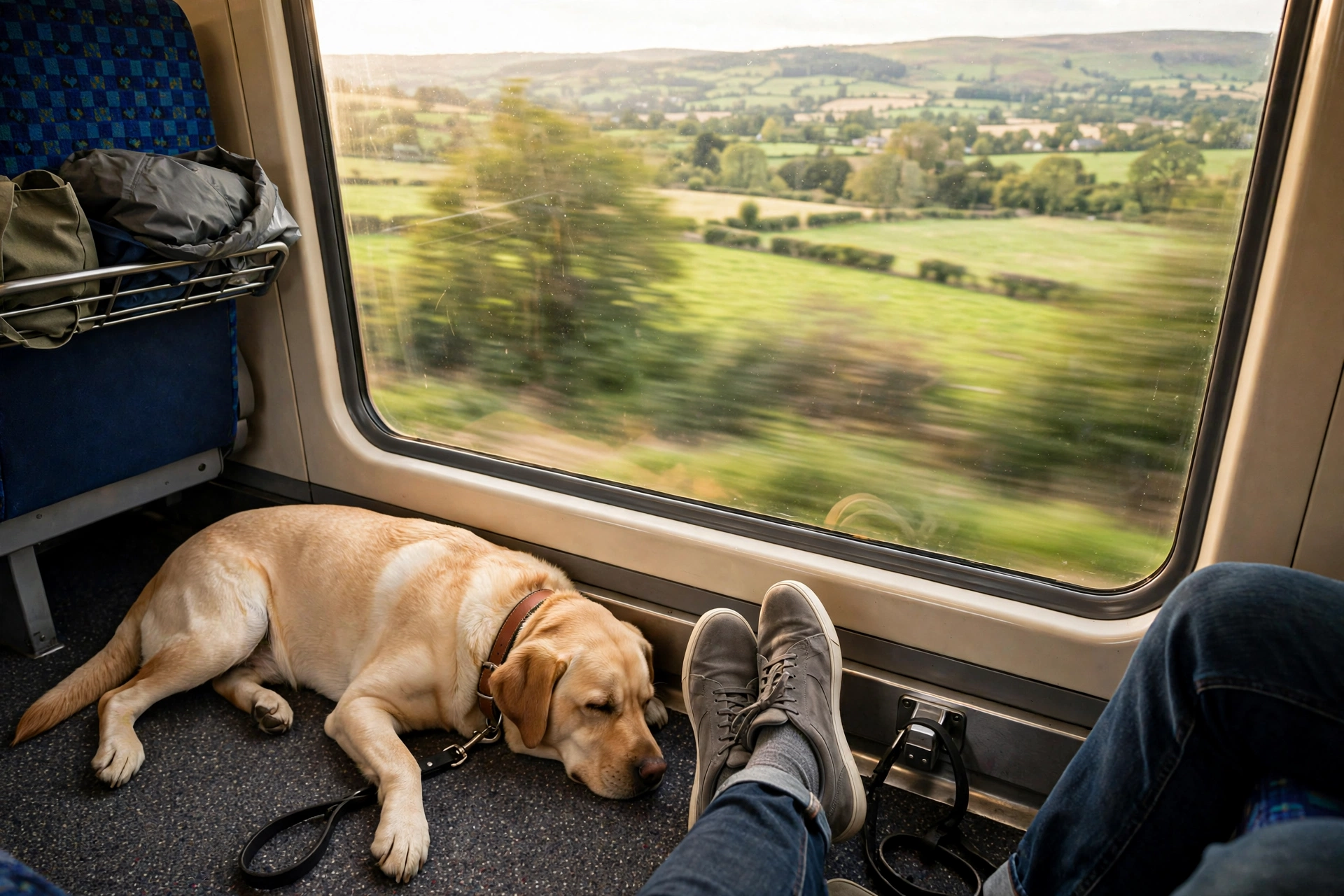
Finally, plan the toilet question before the barrier, not after it. Dogs should relieve themselves well away from the station, on grass or a quiet street outside, because there is no appropriate place on a platform and fouling there creates a hazard for everyone. Offer water outside too if you can. A dog that boards comfortable, empty and watered is a dog that can wait quietly — which is the whole game on a platform. For the on-train part of the journey, see our full guide to taking a dog on UK trains, which covers seating, operator differences and settling a dog in the carriage.
Lead rules: short, fixed and in your hand the whole time
The rule that governs almost everything in a station is control, and in practice that means a short lead, held properly, for the entire time you are on railway property. National Rail conditions require dogs to be on a lead or secured in a suitable carrier or container, and station byelaws allow staff to require control of any animal that could cause danger or nuisance. A dog trotting loose across a concourse, even a famously obedient one, is not under control in the sense staff need: platforms have gaps, edges, moving machinery and sudden noises that no recall can outrun.
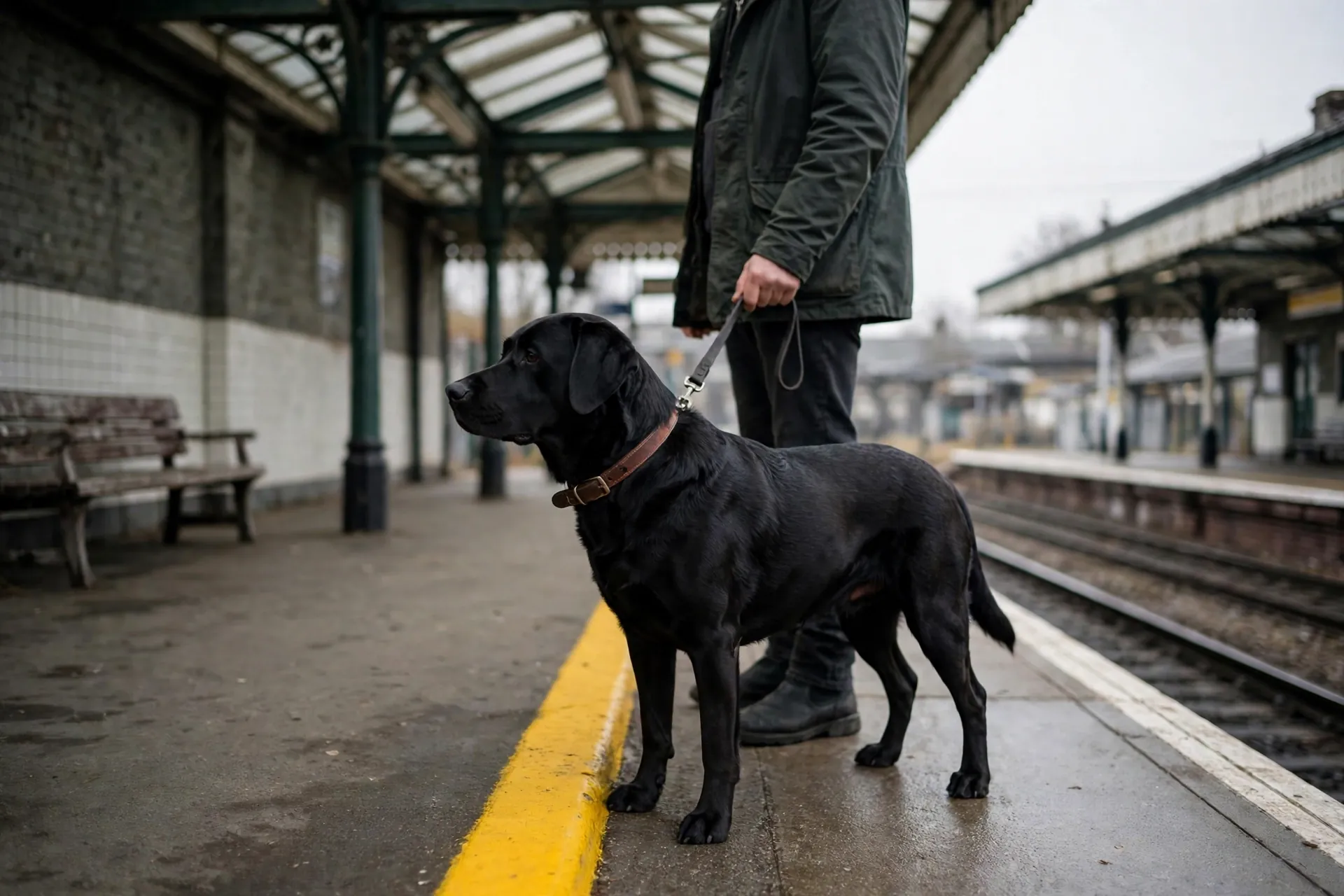
Lead length is where well-meaning owners most often get it wrong. An extending lead set at three or four metres gives a dog exactly enough rope to step over the yellow line, wrap around a stranger's ankles, lunge at a pigeon towards the tracks or surge through a barrier behind someone else. On a platform, lock an extending lead at its shortest setting — or better, swap it for a plain fixed lead of about a metre to a metre and a half before you enter the station. Clip it to a well-fitting collar or harness that the dog cannot back out of when startled; frightened dogs reverse surprisingly fast, and a loose collar on a platform is an emergency waiting for a trigger.
How you hold the lead matters too. Keep it in the hand on the wall side, so your body sits between your dog and the track, and keep your dog on that same side whenever the layout allows. Avoid loops dangling near the ground where they can catch on bench legs, luggage wheels or escalator machinery, and never tie a lead to a railing, a trolley or a bench while you go to a departure board or a coffee kiosk — a tied dog that panics at a passing train can injure itself and anyone nearby in seconds, and unattended dogs may be treated as a security concern by staff. If you need both hands, ask a travelling companion to hold the lead, or put your bag down and sort your ticket with the lead looped securely over your wrist, dog sitting at your heel.
Carriers deserve a brief word. Small dogs travelling in a proper pet carrier count as secured and can be a calm option in very busy stations, provided the carrier is ventilated, the dog is used to it, and you can carry it without setting it down on the platform edge side. Never place a carrier on the ground close to the edge while trains are passing — position it against a wall or bench, in your personal space, while you wait.
The yellow line: what it means for a dog, not just for you
Every regular rail traveller has heard the announcement to stand behind the yellow line, and with a dog it stops being a general courtesy and becomes a precise positioning job. The line marks the zone where aerodynamic pressure from a passing train is strongest, where stepping backwards in a crowd could put a foot — or a paw — too close to the edge, and where a startled lurch becomes dangerous. Your dog does not understand the line, so you have to embody it: dog behind the line, you beside the dog, both facing the wait with enough room that neither of you needs to shuffle backwards when the platform fills.
Choose your waiting spot with the same care you would use for a toddler near a road. The best positions are against a wall, fence or shelter, roughly opposite where your carriage is expected to stop, with a clear view along the platform so you can see your train arrive. The worst positions are at narrow pinch points — beside stairwell entrances, at the end of ramps, next to help points where people cluster, or on the sliver of platform between a bench and the edge. On narrow platforms at smaller stations, the safe area may be only a metre or two deep; if so, stand at the widest part, even if it means a slightly longer walk to your carriage door when the train stops.
Non-stopping trains need special respect. Express and freight services can pass at speed with very little warning beyond an announcement you might miss in wind or crowd noise, and the slipstream can tug leads, coats and small dogs and startle animals that have never felt air move like that. When a fast train is announced or you hear one approaching, move as far back as the platform allows, shorten the lead to almost nothing, get your dog sitting or standing calmly at your wall-side heel, and hold on to a hat, scarf and any loose papers at the same time. Do not film, wave or step forward for a better look. If your dog reacts badly to the first passing train, reposition for the rest of the wait — further from the edge, behind a shelter if there is one, where the effect is blunted.
Tactile paving — the bumpy surface near the edge — is a warning surface for visually impaired travellers, and it is a useful extra cue for you: if your dog's paws are on the bumps, you are both too close. Keep dog and feet on the smooth side until the train has fully stopped, the doors are released and people in front of you have begun to board. Boarding is a walk, not a race; the doors stay open long enough for a calm approach, and at staffed stations staff can give you extra time if you ask before the train arrives.
Escalators, stairs and lifts: the rule that catches people out
If there is one station rule that surprises dog owners, it is the escalator rule. Signage at stations with escalators commonly states that dogs must be carried — and it is not fussiness. Escalator steps are moving metal with gaps at the comb plates where the steps flatten at the top and bottom; paws can slip, claws and soft pads can be caught, and a loose lead or a dangling strap can be drawn into the mechanism. A dog that panics halfway, on a moving staircase it cannot step off, is in serious danger. So the honest test is this: can you carry your dog securely, with one hand still free for the handrail, for the full length of the escalator? If yes, pick the dog up before the entrance plate, keep leads and clothing tucked in, stand in the middle of the step, and put the dog down only once you are fully clear at the other end.
If the answer is no — and for any medium or large dog it is no — do not use the escalator at all. Use the lift, which almost every escalator-equipped station also provides, or use the fixed stairs if your dog is fit and confident on steps. In a lift, keep the lead short, position the dog away from the doors, and be ready for the doors to open onto a crowd: step out decisively rather than letting the dog surge into strangers' legs. Lifts at busy stations can involve a wait, so build that time into your arrival; a missed connection is recoverable, an escalator injury is not. If a lift is out of order, ask staff — they may be able to escort you via a staff route, authorise an alternative exit, or advise the nearest step-free station for your return.
Stairs sound like the easy fallback and usually are, but they have their own dog logic. Station stairs are often steep, metal-edged and busy in both directions. Keep your dog on the wall side, on a short lead, and go at the dog's pace rather than yours; a dog that rushes downwards can pull you off balance, and a dog that freezes halfway needs patience, not dragging, while commuters flow around you. Wet paws on polished stone or metal treads slip easily, so slow down in rain and after cleaning. Very young puppies, elderly dogs and dogs recovering from injury should not be expected to manage long flights — that is another lift journey, however inconvenient.
The same caution applies to travelators and moving walkways where they exist, and to automatic doors and ticket gates with sensors: anything that moves, closes or flattens under your dog deserves a pause and a decision, not momentum. When in doubt, stop in a safe place out of the flow and ask a member of staff. Helping a passenger with a dog find a safe route through the station is ordinary work for them.
Busy platforms: rush hour, events and the art of the quiet corner
A platform at eight in the morning before a commuter service, or at half past five after a football match, is a different environment from the same platform at midday — and your dog experiences the difference more intensely than you do. Noise bounces off hard surfaces, hundreds of people move with purpose and very little spare attention, and the space behind the yellow line can shrink to a shuffle. If your journey allows any flexibility at all, the single kindest choice is timing: travel off-peak, arrive after the previous service has cleared the platform, and avoid the exact minutes when an event crowd is pouring out of a nearby stadium or arena. The fare is often cheaper, too.
When busy is unavoidable, work the platform like a defensive driver works a motorway. Arrive early enough to claim a quiet position before the crowd builds — the far end of the platform, away from the main entrance and the coffee kiosk, is usually the calmest territory, because most passengers bunch near the arrival point and the departure board. Face your dog towards a wall or fence rather than into the moving crowd, which reduces visual stimulation, and keep a steady, boring routine: stand, sit, watch you, receive a treat. This is not the moment for games, greetings with strangers' dogs or allowing children to crowd in for a stroke, however friendly your dog normally is; a polite “sorry, we're training, please give us space” protects everyone.
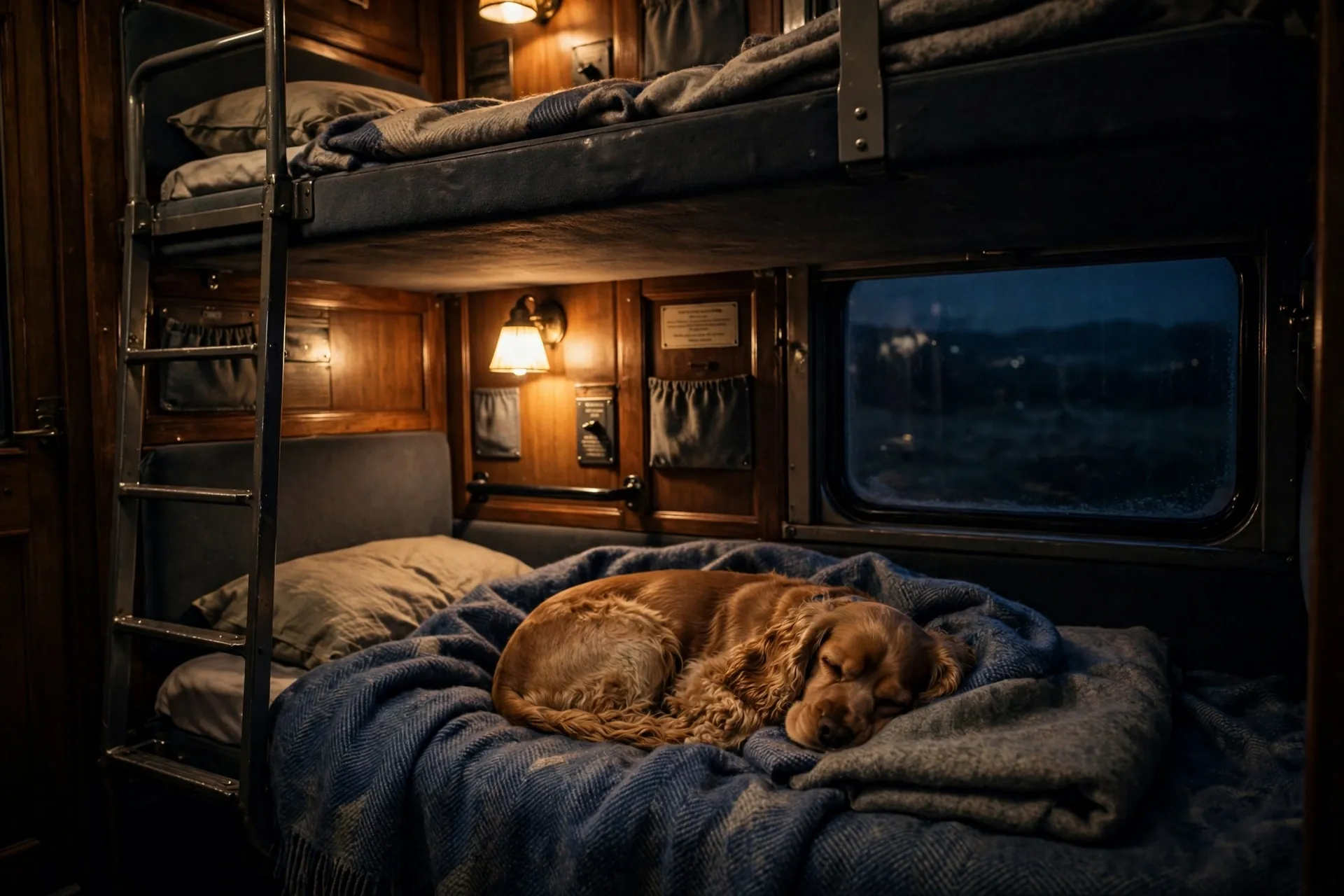
Watch for the platform-specific hazards that crowds create. Rolling suitcases clip paws and heels; wheeled bags on straps trail exactly at dog height. Food dropped from outlets attracts a scavenging lunge across someone's path. Umbrellas drip, pop open and jab. Spilled hot drinks are a genuine scald risk for a dog standing at ankle height in a crush — another reason to wait away from refreshment queues. And when the train arrives, resist the surge: let the first wave board, keep your dog back from the doors while passengers pour off, and board through the nearest quiet door once the flow eases. If the train is so full that your dog would have to stand pressed in a vestibule among strangers' feet, seriously consider waiting for the next service; our guide to dogs on sleeper trains shows how much calmer planned, spacious rail travel can be, and the same principle applies to an ordinary daytime service.
Reactive and nervous dogs need an extra layer of honesty here. A platform is an inescapable environment — you cannot cross to the other side of the street to create distance. If your dog is likely to bark, lunge or panic, choose quieter stations and times, use a clearly marked harness or lead sleeve asking for space, position yourselves at the very end of the platform with an exit route behind you, and have a threshold: if the dog is over it before the train comes, leave and rethink the journey. There is no embarrassment in that decision, and station staff would far rather you made it on the concourse than on a crowded edge.
Waiting rooms, shelters, seating and water
Waiting rooms are one of the genuine pleasures of travelling with a dog in Britain — a warm, dry room with a bench and a door that shuts out the wind can transform a twenty-minute wait at a rural station in February. At most staffed stations, dogs on leads are welcome in waiting rooms and platform shelters on the same terms as the platform itself: keep the dog on the floor, off the seats, out of the doorway and under close control, and clean up any mud or water you bring in as best you can. Local signs always win — a small number of rooms may be restricted — and staff can reasonably ask you to step out if a room becomes overcrowded or your dog is distressing other passengers. Assistance dogs are in a different legal position and must be accommodated; there is more on that below.
Seating etiquette is simple but frequently breached. Dogs do not belong on platform benches or waiting-room seats, even on a blanket, even “just for a minute”: seats are limited, other passengers may have allergies or simply not wish to sit where a dog has been, and staff are entitled to insist. A settle mat on the floor beside your feet solves the comfort question properly — it gives the dog a defined, familiar place, keeps paws off cold or wet concrete, and signals to other passengers that your dog is parked, not wandering. If your dog cannot yet settle on a mat in a stimulating place, practise at home and in quiet stations first; the platform of a terminus at rush hour is an exam, not a classroom.
Water needs a little planning because provision varies enormously. Some larger stations have water bowls or dog water points near entrances or in pet relief areas, and many station cafés will happily fill a bowl if you ask — but you cannot rely on finding either, especially at smaller stations. Carry a collapsible bowl and a bottle of water for the dog as standard rail kit, offer a drink on the concourse or in a sheltered corner rather than in the middle of a crowd, and mop up spills: a wet patch on a platform is a slip hazard. In hot weather this becomes a safety issue rather than a comfort one. Stations trap heat, platforms offer little shade, and a dog waiting on hot tarmac or in a sun-baked shelter can overheat quickly; wait in the shadiest, airiest spot available, offer water little and often, and never leave a dog tied up in the sun while you go inside — or anywhere else in a station, at any temperature.
One more waiting-room courtesy: keep doors in mind. Dogs lying across doorways, however deeply asleep, trip people carrying luggage and block wheelchair users. Tuck your dog fully beside or under your bench, lead short, and re-check every time the room fills or empties.
Assistance dogs on platforms: a different set of rights
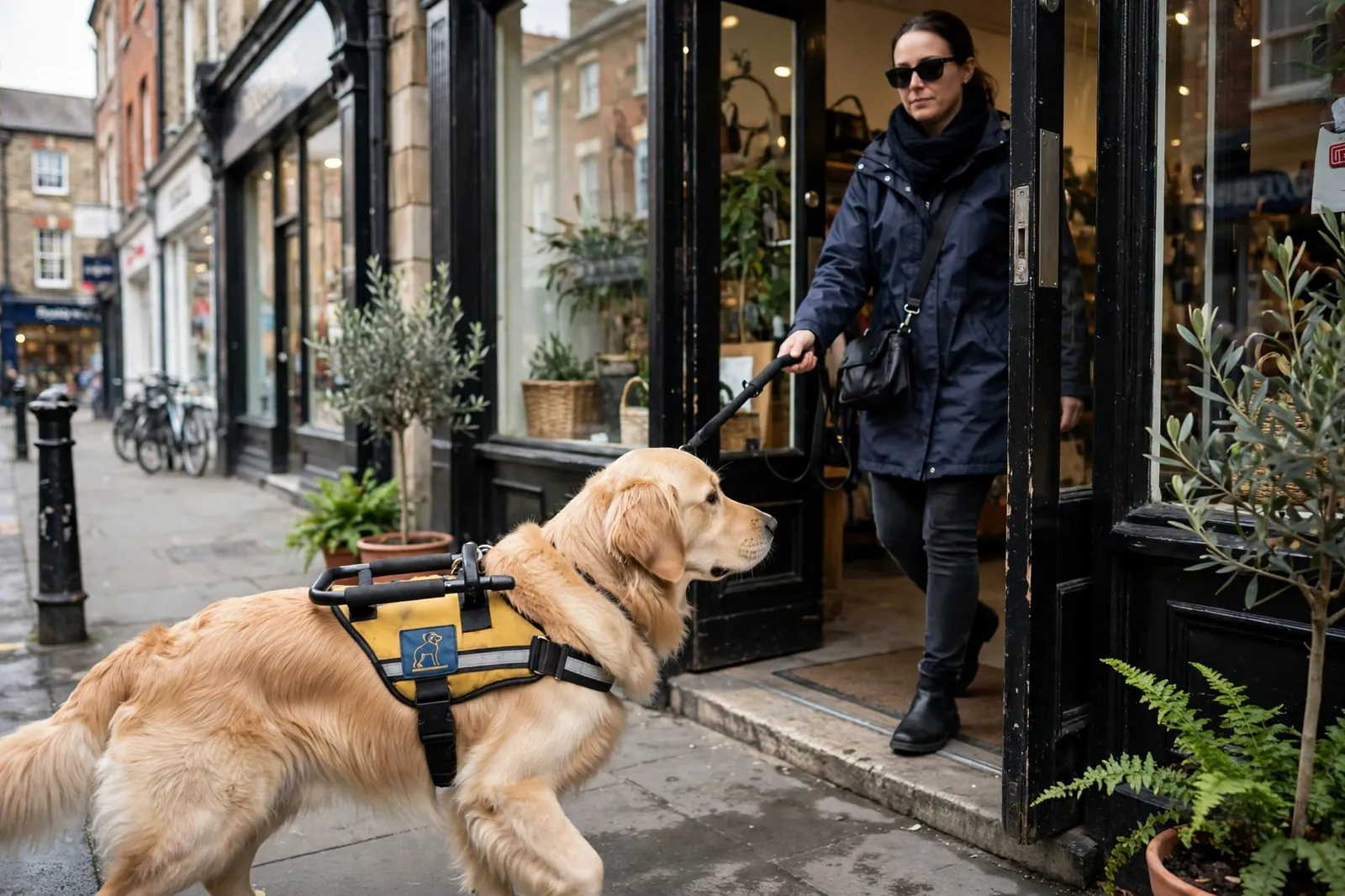
Everything in this guide so far is written for pet dogs, whose access to stations is a matter of operator conditions and good behaviour. Assistance dogs — guide dogs, hearing dogs and other trained assistance dogs — stand in a different position. Under equality law, their handlers must not be refused access or treated less favourably because of the dog, and that protection covers stations, platforms, waiting rooms and trains just as it covers shops and taxis. An assistance dog does not count towards pet limits, should not be charged for, and must be allowed into areas where pet dogs might be asked to wait outside. Handlers should never be asked to leave a dog elsewhere, produce paperwork as a condition of travel, or justify the dog's presence to fellow passengers.
In practical platform terms, assistance dogs are trained for exactly these environments — positioning at the edge, ignoring crowds, settling in waiting rooms — and the most useful thing other travellers can do is nothing at all: do not distract, stroke, feed or call to a working dog, keep your own dog calm and at a distance so it does not interfere, and give the partnership space at barriers, lifts and doors. If you are travelling with a pet dog that is excitable around other dogs, cross to a quieter part of the platform rather than expecting the assistance dog's handler to move.
If you are an assistance dog handler and something goes wrong — a refusal, a demand for payment, a lift out of service with no alternative offered — station staff and the operator's accessibility team are the first port of call, and passenger assistance can be booked in advance for help with barriers, boarding and connections, though you are entitled to travel without booking too. Our dedicated guide to assistance dog access rights in the UK explains what the law requires, what identification actually means, and how to challenge a refusal calmly and effectively.
Unstaffed stations: lovely, quiet — and entirely down to you
A large share of Britain's stations have no staff at all, or staff for only a few hours a day, and many of the prettiest rural halts are little more than a platform, a shelter and a help point. With a dog, these stations are often the calmest places to wait — and the places where preparation matters most, because there is nobody to ask, nowhere to buy a ticket from a human, and sometimes no lighting, no toilet and no second platform exit if you get things wrong.
Do the homework before you leave home. Check which platform your train uses and how you reach it: at many unstaffed stations, changing platforms means a footbridge with open-tread steps, a level crossing, or a long ramp — all manageable with a fit dog on a short lead, all potentially impossible for an elderly dog, a puppy or a dog in a carrier if you arrive flustered with two minutes to spare. Check step-free access information for both your departure and arrival stations, look at live departure data before setting out, and screenshot what you need in case the signal drops in a cutting in the middle of nowhere. If your station has a ticket machine, allow time to use it with a dog at your heel; if it has none, know the operator's rules for buying on the train or by app, and keep your phone charged. For sea crossings rather than rail, dogs on UK ferries explains kennels, pet cabins and vehicle rules by operator.
On the platform itself, the disciplines from earlier sections apply with extra force, because there is no member of staff to warn the crowd or stop a situation developing. Keep well behind the edge — some rural platforms are low, narrow and served by fast through-trains — and be particularly careful at stations where you must cross the line itself via a barrow crossing or a foot crossing: stop, look and listen with your dog held close before you step on, and never cross when a train is approaching, however distant it looks. Use the help point if you need information, if departure boards fail, or if you feel unsafe; it connects to a control centre and is a normal, expected facility, not an emergency-only button. In darkness, a torch and something reflective for both you and the dog are sensible, ordinary kit.
Finally, have the honest backup plan. If your train is cancelled at an unstaffed station, the next one might be two hours away, the shelter might be draughty, and the nearest taxi that accepts dogs might be a phone call and a wait. Carry water, a warm layer for you and a coat or mat for the dog in the colder months, and know — before you travel — what you will actually do. Rural rail travel with a dog is one of the great pleasures of exploring Britain; it rewards exactly this kind of unglamorous preparation.
Leaving the station: the last five minutes count too
Arrival platforms carry a particular risk that departure platforms do not: relief. The journey is over, everyone relaxes, leads get lengthened, attention drifts to phones and onward plans — and that is precisely when dogs slip through closing barrier paddles, dart for a dropped sandwich across a concourse or step off a kerb into a taxi rank. Keep the departure routine running in reverse until you are completely outside the station: short lead through the doors, wide gate at the barrier with the dog at your heel, no stopping in the doorway flow to check directions, and a proper pause in a quiet corner once you are out to let the dog take in the new place.
Taxi ranks, bus interchanges and car parks each need a moment's thought. Keep dogs well clear of manoeuvring vehicles, cross at marked points where they exist, and remember that a dog that has just travelled may need the toilet urgently and may be stiff, thirsty or overstimulated. A short, calm five minutes — water, a sniff on grass if there is any, a chance to loosen up — sets up whatever comes next far better than marching straight into a connecting bus or a friend's car. If you are being met, ask your driver to wait in the car park rather than at the drop-off kerb, so you are not managing greetings, luggage and a wound-up dog in moving traffic.
And if the journey went badly — a frightening passing train, a barrier scare, a crowded platform your dog hated — note what happened while it is fresh. Dogs learn stations by association, and the next visit starts from the memory of the last one. A short, deliberately easy station visit on a quiet day, with treats and no train to catch, can rebuild confidence surprisingly fast and is worth doing before you need the route for real. Check the operator's latest guidance before you travel, as station works and local rules change.
Practical questions
Before you go
Do dogs need a ticket on UK trains and platforms?
No. On National Rail services dogs travel free and do not need their own ticket, within the usual limit of two dogs per passenger. You still need a valid ticket for yourself to pass ticket barriers and be on the platform, and staff may ask you to use a wide gate with your dog. Some special, heritage or private services set different rules, so check before you travel if you are not using a National Rail service.
Can I use an escalator with my dog at a station?
Only if you can carry your dog safely for the whole journey on the escalator. Station signs commonly require dogs to be carried on escalators because paws, claws and loose leads can get trapped in the moving steps. If your dog is too large or wriggly to carry, use the lift or the stairs instead. Never let a dog stand, sit or walk on an escalator, and keep leads and loose straps well clear of the mechanism.
How close to the platform edge can my dog stand?
Keep your dog behind the yellow line, or behind any white line or tactile paving where there is no yellow line, until your train has stopped and it is time to board. Hold a short lead, position yourself between your dog and the edge, and move further back for fast non-stopping trains, whose slipstream and noise can startle even a steady dog. Follow any staff instruction to move back straight away.
Are dogs allowed in station waiting rooms?
At most staffed National Rail stations, a dog on a short lead is welcome in waiting rooms and shelters on the same basis as on the platform, provided the dog stays off seats, does not block doors or aisles, and is kept under control. Local signs override general expectations, and staff can ask you to wait outside if the room is crowded or the dog is unsettled. Assistance dogs must be accommodated.
What should I do at an unstaffed station with my dog?
Plan ahead: check the platform layout, step-free access and departure information before you set off, arrive in good time, and keep your dog on a short lead well behind the edge. Use the help point on the platform if you need information or feel unsafe, keep your phone charged for live updates, and have a backup plan if your train is cancelled, because facilities, lighting and shelter may be very limited.